



50g cream jar, transparent double-layer cleansing balm dispenser
FEATURES
Foundation of Hard Capabilities: Equipment Infrastructure That Builds Trust
1. Mold Manufacturing Equipment — Precision That Eliminates Secondary Finishing
Our mold workshop operates a full suite of high-precision machining equipment designed specifically for cosmetic packaging tooling. This infrastructure directly determines the quality of your finished product before the first shot is ever fired.
Five-Axis High-Speed Machining Centers: We operate advanced five-axis high-speed CNC machining centers capable of holding ±0.002mm positioning accuracy on complex curved surfaces. For your 50g cream jar, this means the parting lines on the double-wall structure are machined to near-optical smoothness — no visible witness lines, no secondary sanding or polishing. Customer Value: You eliminate 100% of manual finishing costs typically associated with poor parting line quality, saving approximately $0.03–0.05 per unit in post-processing labor.
-
Mold Description
Product Materials:
pet petg ps as pp
Mold Material:
S136ESR
Number of Cavities:
1*12
Glue Feeding Method:
Hot runner
Cooling Method:
Water cooling
Molding Cycle
42.5s
- The mold manufacturing process and product material selection
Slow Wire EDM (Wire Electrical Discharge Machining): Our slow wire EDM systems produce features as fine as 0.03mm in diameter. For the double-layer balm dispenser, this capability is critical for creating the micro-precision venting channels and seal grooves on the inner dispensing mechanism. Customer Value: We guarantee your seal grooves will maintain dimensional consistency within ±0.005mm across all 64 cavities, preventing leakage failures that typically cost brands $10,000+ per production batch in returns and customer complaints.
-
Injection Molding Machine Fleet — Precision That Delivers First-Time Quality
Our injection molding floor features 30-ton to 4,000-ton all-electric servo-drive machines, providing the flexibility to run everything from single-cavity prototype runs to 128-cavity mass production.
All-Electric Servo Drive Technology: Every machine in our fleet employs full-servo electric motors rather than hydraulic systems. This configuration delivers shot-to-shot weight repeatability of ±0.1%. Customer Value: When you receive 50,000 cream jar bodies across three production shifts, the outer diameter of every single jar matches within 0.02mm — the same as the first shot from the first shift. Your assembly lines never jam, and your filling machines run continuously without downtime for diameter adjustments.
Clamping Force Coverage: Our 30-ton to 4,000-ton range covers everything from the 50g cream jar body (recommended 180–250 ton) to the double-layer dispenser lid (recommended 120–160 ton) on the same press platform. Customer Value: You do not need to requalify tooling across multiple contract manufacturers. One tool, one machine platform, consistent quality across every production run for the life of your product.
3. Quality Inspection Equipment — Data That Prevents Field Failures
Every mold we deliver is accompanied by a full dimensional inspection report generated on our in-house coordinate measuring machine (CMM) and optical vision measurement system.
CMM and Vision Measurement Systems: We measure every critical dimension — thread pitch, inner diameter, outer diameter, wall thickness distribution, and seal lip geometry — before the mold ever leaves our facility. Key dimensions are documented with CPK (Process Capability Index) values, targeting CPK ≥ 1.33 for all safety-critical features. Customer Value: You receive a mold that is statistically proven to produce parts within specification. No surprises during your first production run, no emergency engineering visits, and no unplanned downtime.
II. Core Competencies in Mold Manufacturing: Specifications That Deliver Competitive Advantage
1. Mold Materials — The Foundation of Tool Life and Part Quality
The material selection for your mold directly impacts tool longevity, cycle time, and surface finish quality. We select mold steels based on production volume and cosmetic requirements, not generic stock availability.
Steel Grade Selection: For the 50g cream jar mold, we specify:
Mold Base: P20 steel — pre-hardened to 28–32 HRC, providing excellent stability and machinability for the non-wear structural components.
Cavities and Cores: S136 (Stavax) stainless steel, hardened to 48–52 HRC with electroslag remelting (ESR) refinement. This material offers exceptional corrosion resistance, high polishability (surface finish Ra < 0.02μm achievable), and superior wear resistance.
Alternative Grades for Special Applications: For high-output requirements, we offer 2344 / 8407 (H13-class hot work steel); for mirror-finish clear parts, NAK80 delivers pre-hardened mirror polish ability; for wear-intensive applications with glass-filled materials, SKD-11 provides exceptional abrasive resistance.
Performance Guarantees:
Mold life: 500,000 shots for glass-fiber reinforced materials; 1,000,000+ shots for standard thermoplastics like PETG and PP.
Corrosion guarantee: S136 cavity surfaces maintain original polish and corrosion resistance for the full mold life when processed with our recommended drying and processing protocols.
Customer Value: You do not need to budget for mold replacement after two years. Our molds deliver 3–5 years of continuous production before any significant wear requires service.
2. Achievable Tolerances — Precision That Eliminates Rework
Different features require different tolerance strategies. We categorize every dimension on your product drawing and apply appropriate tolerances based on functional need.
Feature Type Achievable Tolerance Customer Benefit
General structural features (outer diameter, height, wall thickness) ±0.05mm Consistent assembly fit — lids thread smoothly, jar sits flat on shelves
Thread engagement surfaces ±0.02mm Reliable closure, no cross-threading during manual or automated capping
Seal landing zones (inner rim, valve seat) ±0.005mm Zero leakage — no secondary sealing test required, no returns
Decorative parting lines and surface transitions Visually imperceptible at normal viewing distance Brand presentation quality — your product looks premium on every shelf
Transparency Assurance: For the double-layer transparent dispenser, we certify surface roughness Ra ≤ 0.05μm on all light-path surfaces. Customer Value: Your product displays the formula clearly and attractively at point of sale — no haze, no clouding, no diffusion that obscures the texture and color of your cream.
3. Mold Types and Gate Design — Speed and Material Savings by Design
Hot Runner Systems: We default to hot runner gating for all high-volume cosmetic packaging. The hot runner manifold maintains the polymer at processing temperature, eliminating the cold runner sprue that would otherwise be wasted as scrap after every shot. Customer Value: Material savings of 15–25% compared to cold runner systems. For a 50g cream jar with typical runner weight of 12g per shot, this represents a saving of approximately 18,000 grams of resin per 10,000 jars produced — direct cost reduction with zero performance compromise.
Sprue Gate Positioning: For the 50g cream jar, we position the sprue gate at the center of the bottom surface — the least visible location on the final product. Customer Value: No post-molding gate trimming is required. Your jars come out of the machine with no raised gate marks, no tail trimming, and no polishing of gate vestiges.
Multi-Cavity Configuration: We produce molds configured for 8, 16, 32, or 64 cavities depending on your annual volume requirements. Customer Value: Output scaling without additional capital investment. A 64-cavity mold running on a 250-ton press produces 6,400 jars per hour at a 15-second cycle time.
4. Mold Flow Analysis (MFA) — Prediction That Prevents Defects
Every mold we design undergoes comprehensive Moldflow or Moldex3D simulation before the first piece of steel is cut. This software simulates the entire injection process — filling pattern, pressure distribution, temperature gradients, and cooling behavior — allowing us to optimize the tool design virtually.
What We Simulate:
Filling flow front: We verify balanced filling across all cavities simultaneously. For your double-layer dispenser, our MFA ensures the transparent inner wall fills uniformly without hesitation marks.
Weld line location: By adjusting gate position, injection speed, and melt temperature, we relocate weld lines to non-visible or non-structural areas.
Air trap identification: The simulation identifies exactly where trapped air will accumulate. We then position venting channels at those precise locations before the mold is cut.
Pressure drop prediction: We verify the required injection pressure stays within the machine capability for the selected material.
Cooling uniformity: The simulation predicts part ejection temperature distribution. We accept designs only when cavity temperature delta remains below 5°C across the entire part.
Customer Value: Your T0 (first test shot) samples are production-ready parts, not experimental prototypes. The time and cost typically wasted on five to ten tool modifications are eliminated entirely. You move from project kickoff to approved sample in weeks, not months.
III. Injection Molding Process Control: Production Stability That Eliminates Quality Anxiety
1. Process Standardization — Every Shot, The Same
Manufacturing Execution System (MES) Integration: Every injection molding machine on our floor is connected to our MES platform. Critical process parameters — melt temperature, injection pressure profile, holding pressure, screw rotation speed, back pressure, cooling time, and mold temperature — are locked within the system and can only be modified by authorized process engineers. Customer Value: Batch-to-batch consistency is guaranteed by software, not dependent on operator memory or shift supervisor vigilance.
First-Article and Last-Article Verification: Every production batch begins with a first-article inspection report comparing 10 consecutively molded parts against the approved master sample. When the batch completes, we repeat the same measurement protocol on the last 10 parts. Customer Value: You know, with documentary evidence, that every jar in the batch meets specification. The risk of non-conforming product reaching your filling line is effectively zero.
2. Dimensional Stability — Warpage and Shrinkage Control
Conformal Cooling Channel Design: Standard cooling channels are drilled in straight lines, creating hot spots and cold zones across the cavity surface. For your double-layer dispenser, we deploy conformal cooling channels that follow the exact contour of the product geometry, machined directly into the core and cavity inserts using high-speed machining. Customer Value: Cooling time reduction of 20–35% compared to conventional straight-channel designs — your cycle time drops from 18 seconds to 12 seconds, increasing annual output by 50% on the same machine fleet without any capital equipment addition.
Zone Temperature Control with Mold Temperature Controllers (MTCs): We equip every mold with multi-zone temperature controllers that maintain the core and cavity surfaces at independently specified temperatures, typically holding differential within 2°C across the molding surface. Customer Value: Shrinkage is uniform in all directions. Your 50g jar maintains roundness within 0.03mm TIR (total indicated runout). Lids thread smoothly without binding; the dispenser pump seats perfectly without wobble.
3. Surface Quality Classification — From Standard to Premium Finish
Grade Application Specification Process Requirements
Grade A (Optical) Double-layer transparent dispenser outer surface Ra ≤ 0.02μm, no visible flow lines or bubbles S136 core/cavity, diamond-polished, material dried to ≤ 0.02% moisture
Grade B (Premium) Cream jar exterior walls SPI-A1 diamond finish, Ra ≤ 0.05μm SPI-A1 grade tool finish
Grade C (Standard) Internal surfaces (non-visible) SPI-B3 stone finish, draft angles maintain Matte finish for demolding reliability
Customer Value: You pay only for the surface quality you actually need. Internal surfaces that no consumer will ever see do not require optical-grade polishing. We match finish specifications precisely to functional requirements.
4. Special Material Processing Capabilities
Our 28 years of manufacturing experience spans the full range of engineering thermoplastics used in cosmetic packaging and beyond:
Material Family Grades Processed Application Customer Value
PETG / PCTG SKYGREEN® PN200, CR-5083 Transparent double-layer dispenser wall ≥91% light transmittance, glass-like clarity, FDA-compliant food contact
PMMA (Acrylic) Standard extrusion grade Thick-walled cream jar outer shells Mirror-like polishability, premium luxury appearance
PP / PP+GF Homopolymer, Copolymer Cream jar inner chambers, lids Chemical resistance, dishwasher-safe, cost-effective bulk structure
ABS General purpose Cap components, decorative rings Excellent painting/plating adhesion
PC / PC+GF General purpose engineering grade High-impact components 0.5mm thin-wall capability, impact resistance
Transparent Material Drying Protocol: PETG and PMMA are hygroscopic with equilibrium moisture content of 0.2–0.4% at standard ambient conditions. Our desiccant dryers reduce material moisture to ≤ 0.02% before processing — verified by in-line moisture meters. Customer Value: Your transparent parts leave the machine with zero bubble defects, zero splay marks, and zero degradation haze — every piece, every batch.
IV. Full-Service Manufacturing Lifecycle: Reducing Your Management Overhead
1. Early Engagement — Design for Manufacturability (DFM) Report
Before you approve the final product design, we deliver a comprehensive DFM (Design for Manufacturability) analysis report that addresses every manufacturability concern and proposes optimizations that reduce tooling costs and improve production reliability.
What the DFM Report Contains:
Draft angle recommendations: We verify every vertical wall has adequate draft (typically 1–3° per side for cosmetic surfaces) for reliable ejection without surface drag.
Wall thickness optimization: We identify thick-to-thin transitions and propose ribbed structures or core-outs to maintain strength while reducing material content.
Gate location and marking: We propose gate placement locations and verify the resulting gate vestige will be invisible or hidden.
Ejector pin marking locations: We document where each ejector pin contacts the part and ensure marks fall on non-cosmetic surfaces or within brand-approved tolerances.
Material shrinkage compensation: We calculate expected linear shrinkage for your selected material and adjust cavity dimensions accordingly.
Mold flow analysis summary: We present filling simulation results and proposed venting/temperature management strategies.
Customer Value: You receive a manufacturable design before the tooling purchase order is issued. The costs and delays associated with discovering manufacturability problems after the mold is already in production are completely avoided.
2. Sample Validation Protocol — T1 Through T3 Approval
We operate a disciplined sample validation process that gives you full visibility into the refinement of the mold:
T1 (First Shots): We send you 25–50 sample parts from the finished mold. You evaluate fit, form, function, and appearance.
T2 (First Adjustments): Based on your T1 feedback, we perform targeted modifications — adjusting gate sizes, polishing cavity surfaces, modifying ejector pin lengths — and produce a second sample batch.
T3 (Final Verification): After T2 approval, we lock the mold and produce a validation batch of 100–500 parts for your final sign-off, complete with a full dimensional inspection report.
Customer Value: You never pay for a mold that does not meet your specification. The T1–T3 process ensures you sign off only when you are satisfied. No surprises, no negotiations over non-conforming parts.
3. Pre-Production Pilot Run — Statistical Confirmation Before Full Production
Before moving to mass production, we run a pilot batch of 1,000 to 5,000 parts through the production process exactly as it will run for your main order. During this pilot run:
We measure critical dimensions on 30 consecutive parts at the start, middle, and end of the run.
We calculate CPK for each critical feature.
We document the optimal process parameter set.
We identify any edge case conditions (material lot variation, ambient temperature changes) that might affect quality.
Customer Value: When your main order goes into production, the process is already validated, the parameters are locked, and the operators are trained. Your production run starts efficiently and finishes on time.
4. Post-Delivery Support — Spare Parts and Maintenance Program
Every mold we deliver is accompanied by a complete spare parts kit:
Spare ejector pins (100% of active count)
Spare core pins for all critical geometry
Spare cavity inserts for high-wear features
Detailed maintenance schedule with recommended lubrication intervals and inspection checkpoints
We also offer a program of preventive maintenance every 200,000 cycles, with mold service performed either at our facility or on-site at your manufacturing location. Customer Value: Your mold does not become a maintenance burden. The necessary spares are already in your possession, and trained service technicians are a phone call away.
V. Cost Reduction Strategy: Eliminating Customer Pain Points
1. The Mold Repair Problem — Solved
Customer Complaint: “Our current supplier’s molds break frequently, requiring emergency repairs that shut down production for weeks.”
Ansix Solution: We perform a 2,000-shot wear test on every mold before shipment. We measure critical dimensions before and after the test and document wear progression. We also provide a three-year structural warranty on the mold body and core/cavity components (excluding normal wear items such as ejector pins). Customer Value: Your mold arrives pre-validated for extended production. You do not need to discover its limitations during your peak shipping season.
2. The Flash Problem — Solved
Customer Complaint: “Our injection molded jars have flash (excess plastic) around the parting lines, requiring manual trimming that adds cost and can damage the part.”
Ansix Solution: We machine parting line surfaces to 0.005mm flatness and provide taper-lock clamping systems that automatically compensate for thermal expansion in the press. Customer Value: Flash is limited to less than 0.03mm — the equivalent of two human hairs. No manual trimming is required, and parts feed directly into automatic assembly without jamming.
3. The Dimensional Variation Problem — Solved
Customer Complaint: “Every batch is different — sometimes the lids fit, sometimes they do not. We have to sort production manually.”
Ansix Solution: We equip our injection molding presses with in-mold cavity pressure sensors and ultrasonic wall thickness measurement systems. The process control system monitors every shot and automatically adjusts injection pressure and holding time to compensate for material viscosity variation and ambient temperature changes. Customer Value: Shot-to-shot dimensional variation is reduced to within ±0.02mm. Your assembly line runs continuously without manual sorting, and your customers never receive a jar that leaks or a lid that fails to thread.
4. The Extended Mold Repair Cycle Problem — Solved
Customer Complaint: “When a mold needs repair, the supplier sends it overseas and it takes 6–8 weeks to return.”
Ansix Solution: We maintain an in-house electrode manufacturing center and electrical discharge machining (EDM) department. Routine repairs — weld build-up, cavity re-polishing, ejector pin replacement, core pin repair — are performed on-site and typically completed within 24 hours. Customer Value: You do not lose months of production time waiting for mold service. Your mold returns to production in days, not weeks.
VI. Project Execution Roadmap: From Design Approval to Mass Production
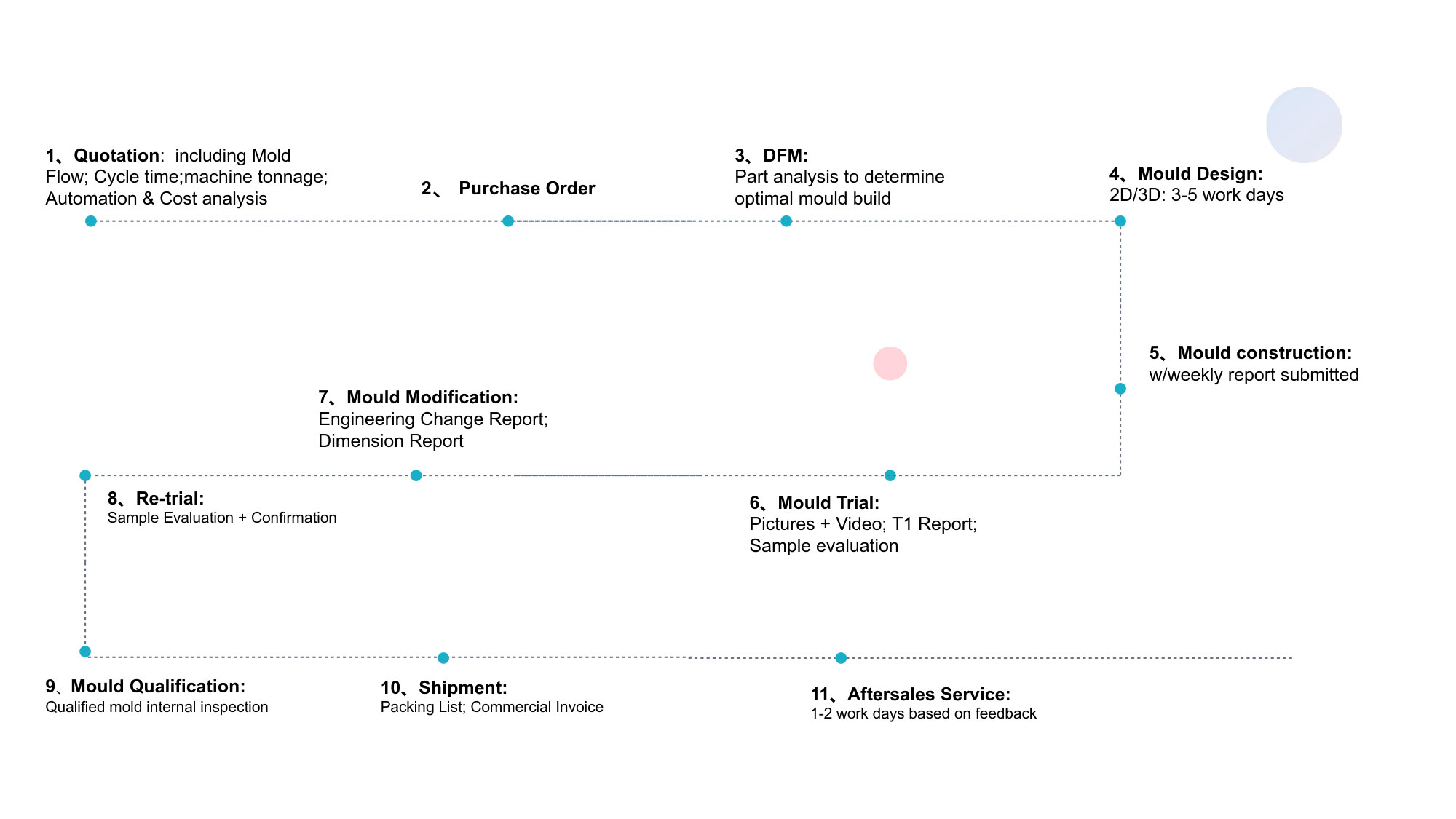
Phase Duration Activities Deliverables
Phase 1: DFM & Design Approval 1–2 weeks Receive 3D model → Perform Moldflow analysis → Evaluate draft angles, wall thickness → Optimize gate placement → Approve final tool design DFM Report with MFA simulation results, shrinkage-compensated cavity design files
Phase 2: Mold Manufacturing 4–6 weeks Machine electrodes → EDM cavities → CNC machining → Bench fitting → Heat treat → Surface finishing Completed injection mold, full dimensional inspection report (CMM + optical)
Phase 3: Sampling & Validation 1–2 weeks T1 sample run → Dimensional check → T2 modifications (if needed) → T3 final validation 50–100 sample parts, process parameter sheet, material consumption estimate
Phase 4: Pilot Production 1 week Run 1,000–5,000 parts → Measure CPK → Optimize cycle → Lock process parameters Pilot batch, CPK ≥ 1.33 report, documentation for mass production
Phase 5: Mass Production Ongoing Schedule production → Raw material ordering → Mold setup → Quality inspection → Packaging → Shipment Regular shipments on agreed schedule
VII. Quality Management System: Certifications and Compliance
Ansix Tech operates under internationally recognized quality management certifications:
ISO 9001:2015 — Comprehensive quality management for design, manufacturing, and service
ISO 13485:2016 — Medical device manufacturing, applicable where cosmetic packaging requires clinical-grade cleanliness
ISO 14001:2015 — Environmental management, covering material sourcing, waste reduction, and energy efficiency
IATF 16949:2016 — Automotive quality standard, applied where cosmetic packaging requires ultra-precision tolerances and zero-defect processes
Customer Value: You are not taking a risk on an unverified supplier. Our certifications have been audited and approved by international registrars. Your regulatory compliance team can approve us with confidence.
VIII. Answered: Frequently Asked Customer Concerns
Q: What is Ansix Tech’s cost advantage?
Direct Answer: We reduce costs at three levels:
Material cost: Hot runner systems reduce material waste by 15–25%; thin-wall design optimization further reduces material content by 8–12% per part.
Process cost: Conformal cooling reduces cycle time by 20–35%, increasing machine output without capital investment.
Labor cost: Flash elimination and assembly-ready quality eliminate manual trimming and sorting.
Measured result: Typical cosmetic jar projects realize 18–25% reduction in landed per-unit cost compared to standard industry benchmarks.
Q: What happens if the mold fails during production?
Direct Answer: Our three-year structural warranty covers the mold body, cavities, cores, and slide systems. Wear items (ejector pins, core pins for high-wear features) are excluded — but we provide spares with the mold at no additional cost. For any warranty claim, we either repair the mold at our facility or replace it entirely, with shipping and service included.
Q: How do you ensure batch-to-batch consistency across months of production?
Direct Answer: Every production run is recorded against the master process parameter set, stored in our MES system. When you order a repeat batch, we load the same process file into the machine — same temperature profile, same injection speed, same cooling time. The first 50 parts of each new run are measured against archived masters. Variation exceeding 0.02mm triggers an automatic quality hold and engineering review.
Q: Can you handle branded labeling or decoration?
Direct Answer: Yes — we offer in-mold labeling (IML) for integrated brand decoration, pad printing, silk screening, hot stamping, and pad transfer printing for post-mold decoration. For IML, our automated side-entry robots place pre-printed labels into the mold before injection, producing finished jars with decoration that will not wear off through repeated cleaning or handling.
IX. Conclusion: Your Return on Investment with Ansix Tech
Selecting Ansix Tech for your 50g cream jar and transparent double-layer cleansing balm dispenser project delivers measurable outcomes across your entire supply chain:
Reduced Total Cost of Ownership
15–25% material savings via hot runner systems
20–35% cycle time reduction via conformal cooling
Elimination of manual finishing via precision parting line machining
Accelerated Time to Market
DFM-driven tool design eliminates redesign cycles
T1–T3 validation completes in 2 weeks, not months
Pilot production validation before full commitment
Eliminated Production Risk
Statistical process control at every stage
CPK ≥ 1.33 guaranteed before mass production begins
Mold-level spares included at no additional cost
Protected Brand Presentation
Optical-grade surface finish for transparent components
Flash-free parting lines for premium appearance
Reject levels below 0.5% over full production runs
About Ansix Tech
With over 28 years of continuous operation, Ansix Tech stands as a dedicated manufacturer of precision injection molding tools and mass-production injection molded components for the global cosmetic packaging industry. Our team of engineers, mold makers, and process technicians has delivered thousands of production programs for customers ranging from emerging beauty brands to global market leaders. We meet every project with the same discipline: understand the customer‘s product, quantify the customer’s requirements, and deliver a manufacturing solution that works — consistently, predictably, and profitably.
For technical consultation, sample requests, or to schedule a DFM review of your product design, please contact Ansix Tech Engineering Department.
Ansix Tech Co Ltd
If you have any plans related to 50g cream jar, transparent double-layer cleansing balm dispenser , you can contact us at any time. We will turn your ideas into reality, let you realize your dreams, and obtain large orders from the market. Our contact information is info@ansixtech.com. Or contact our CTO, mail: stephen@ansixtech.com
#www.ansixtech.com #ansixtech.com #50g cream jar, transparent double-layer cleansing balm dispenser #50g cream jar, transparent double-layer cleansing balm dispenser moulds #50g cream jar, transparent double-layer cleansing balm dispenser injection molding companies #50g cream jar, transparent double-layer cleansing balm dispenser Canopy Mold injection mold companies #Ansix #Ansix moulds #Ansix china #Ansix tech china #Ansix tech company #Ansix facotry #50g cream jar, transparent double-layer cleansing balm dispenser injection molding #50g cream jar, transparent double-layer cleansing balm dispenser injection tools #50g cream jar, transparent double-layer cleansing balm dispenser injection moulds #50g cream jar, transparent double-layer cleansing balm dispenser plastic mould #50g cream jar, transparent double-layer cleansing balm dispenser plastic tools #Ansix Tech #Ansix molds #Ansix injection molding #Ansix mold factory #injection molding 50g cream jar, transparent double-layer cleansing balm dispenser #Ansix mold factory #50g cream jar, transparent double-layer cleansing balm dispenser china #50g cream jar, transparent double-layer cleansing balm dispenser molds #injection factory #50g cream jar, transparent double-layer cleansing balm dispenser injection molding #50g cream jar, transparent double-layer cleansing balm dispenser injection molding factory #injection molding company #50g cream jar, transparent double-layer cleansing balm dispenser injection mold companies #50g cream jar, transparent double-layer cleansing balm dispenser#50g cream jar, transparent double-layer cleansing balm dispenser mold limited #Ansix mold china #Ansix companies #Ansix company China #50g cream jar, transparent double-layer cleansing balm dispenser facotry #Ansix Tech #Ansix Tech mould #50g cream jar, transparent double-layer cleansing balm dispenser injection moulding #injection moulding company #Ansix 50g cream jar, transparent double-layer cleansing balm dispenser parts injection mold companies #medical injection molding companieschina #50g cream jar, transparent double-layer cleansing balm dispenser china factory #Ansix moulding companies #Ansix molding company #50g cream jar, transparent double-layer cleansing balm dispenser injection moulding facotry #Ansix Tech mold #50g cream jar, transparent double-layer cleansing balm dispenser mould #50g cream jar, transparent double-layer cleansing balm dispenser plastic injection molding #ansix plastic mold #Mold manufacturing #50g cream jar, transparent double-layer cleansing balm dispenser parts manufacturing #50g cream jar, transparent double-layer cleansing balm dispenser plastic parts factory #50g cream jar, transparent double-layer cleansing balm dispenser injection parts mold #50g cream jar, transparent double-layer cleansing balm dispenser PRECISION MANUFACTURING #50g cream jar, transparent double-layer cleansing balm dispenser #China mold #50g cream jar, transparent double-layer cleansing balm dispenser injection moulding china #50g cream jar, transparent double-layer cleansing balm dispenser mould china #china precision mold #mold in china #50g cream jar, transparent double-layer cleansing balm dispenser mold china #Precision molds #High-precision molds #50g cream jar, transparent double-layer cleansing balm dispenser #Injection molds #50g cream jar, transparent double-layer cleansing balm dispenser Factory #50g cream jar, transparent double-layer cleansing balm dispenser Company #Super Large Injection Mold Factory #Large Tonnage Injection Molding Factory #50g cream jar, transparent double-layer cleansing balm dispenser Company #50g cream jar, transparent double-layer cleansing balm dispenser Factory #2800T Injection Molding Factory #3000 Ton Injection Molding #4500 Ton Injection Molding Factory #Large Mold Injection Molding #Large Plastic Mold Injection Molding Factory #Large Injection Mold Manufacturer #Plastic Mold Factory #Injection Mold #Plastic Mold