



Ansix Tech Industry 4.0 Intelligent Manufacturing for Medical Injection Molded Products
FEATURES
Industry 4.0 Intelligent Production Workshop
Temperature controlled production area with 24/7 operation of automatic pickup, calibration, processing, cleaning and CMM steel reportOver 300 machines automatic production scheduling, real-time data collecting and trackingTalent international technical engineer and scientific management system
- Ansix's Intelligent Manufacturing Solution for the Plastic Products Industry
Functions
Production ExecutionThe MES/MOM system, integrated with production planning, efficientlyprepares production tasks, allows real-time viewing of work orders/SOPduring production, and controls post-production quality processes,enabling full-process traceability.Quality ManagementThe MES/MOM system supports incoming inspection, first articleinspection, patrol inspection, sampling, and warehouse inspection forcomprehensive quality process control, preventing missed or incorrectinspections. It facilitates closed-loop quality management to form a qualityknowledge base for continuous improvement.
Equipment ManagementThe system enables daily inspection, maintenance, fault repair, and spareparts management, establishing a tool for full lifecycle equipmentmanagement to reduce wear and enhance utilization rates.
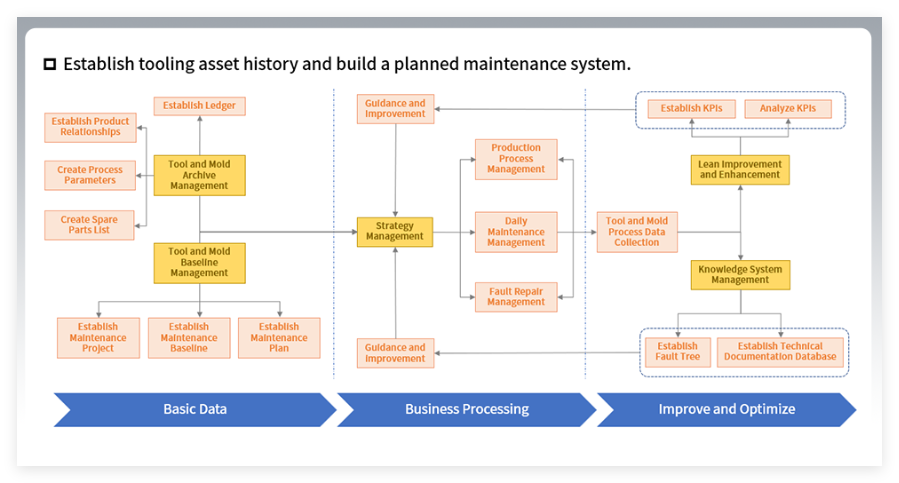
Mold ManagementThe system manages mold warehousing, mold changeover, and routinemaintenance and repair, as well as spare parts management, whichenhances mold management efficiency.Personnel ManagementSystematically manage personnel skills matrix, define flexible job objectivesand skill levels, control training plans and assessment processes, achievingdynamic and visual management of personnel skills.Warehouse ManagementBarcode-enabled precise slot management enables comprehensivemanagement from material receipt to finished goods shipment, achievingdigitalization of warehouse operations.
Integrated Management of Molds/Stamping/Injection/AssemblyThe MES/MOM system allows enterprises engaged in mass production(such as injection molding, stamping, die-casting, etc.) to perform project,engineering, mold, injection, and quality lifecycle management on a singleplatform, bridging the mold and mass production workshop to facilitateefficient coordinated manufacturing at the factory level.KANBAN-drivenMaterial and process Kanban pull systems perpetually optimize the shopfloor' s Work-In-Progress (WIP) and inventory.-




- Blueprin
Ansix Manufacturing Operations Management System delivers an integrated solution of the entire business process from sales order to shipment, including the integration of multiple systems such as ERP/PLM/OA/Enterprise WeChat/DingTalk, advanced planning and scheduling (APS), production execution (MES), quality management (QMS), warehouse management (WMS), equipment networking (IoT), automated guided vehicles (AGV), automated storage and retrieval systems, and supply chain collaboration (SCM).
-


AdvantagesFlexible DeploymentCompatible with Push and Pull ProductionSupportsmodularor full deployment,withoptionsforon-Combines order-driven push production planning withpremise or cloud deployment.inventory-driven pull production, using Kanban to streamlineproduction and material delivery, achieving leanmanufacturing.Advanced Automatic Scheduling (APS)Integrated Molding, Stamping, Injection, and AsserBased on 20 years of APS algorithm research, ensures orderA unified MOM platform facilitates integrated management of molcdelivery commitments and optimizes production schedulesstamping,injection, and assembly operations.undcaaoamacaneamaaplans and production work arrangementsInternet of Things (IoT)Support for Multi-system IntegrationReal-time device connectivity collects data on equipmentFeatures a proprietary APl open platform, with a wealth ofstatus,parametrs,outputandalarmswhichcanbeleveragedexperienceandcasesin integrating withsystemslikeERp,PLMinproductionordes(eg.pocessparametermoldliOA, DingTalk, and WeChat.production reporting, quality inspections).
-


- CNC Automation UnitFeatures:Automatic part identification and program parsing with integratedheight measurement.Automated loading and unloading, automatic machine processing.Pre- and post-processing tool diameter and length checks for processing
CMM Automation UnitFeatures:● Covers processing and detection scenarios for standard small parts.Automatic point extraction and program generation based on partmodels.● Lightweight 3D inspection reports for clear viewing of results.●Flexible Automation Rail LineFeatures:Suitable for various middle- to small-sized part processing scenarios.●Automated centering program generation Integrated chip conveyorreduces manual chip removal frequency.Integrated cleaning machine for automatic part cleaning post-processing,Large Part Automation Flexible LineFeatures:Supports parts approximately 10oomm or heavier than 1T.Uses heavy-duty stackers for machine part loading and unloading.Integrates with MES system for plan execution.Multifunction integration: quick tool changes, centralized chip disposal,Flexible Automation - IntegratedWarehouse and LogisticsFeatures:Integrates AGV, automated storage systems, WMS warehousemanagement, WCS warehouse monitoring, and AGV logistics schedulingsoftware.Builds afully automated, intelligent, digital factory covering the entireBlueprinThe ANSIX Flexible Automation Processing System (FMS) supports flexible combinations for single or multiple processes: accommodating any part type, size, quality, or shape, including electrode/steel part CNC processing, EDM processing, and CMM inspection.
-


- BlueprinThe ANSIX Flexible Automation Processing System (FMS) supports flexible combinations for single or multiple processes: accommodating any part type, size, quality, or shape, including electrode/steel part CNC processing, EDM processing, and CMM inspection.
-


- ANSIX Advanced Planning and Scheduling SystemIndustry Modelbottleneck optimization, intelligent algorithms, enterprise strategies,threshold boundaries, multi-objective optimization, and datainterconnection. It digitizes enterprise process constraints and rules forscheduling and provides import of mature industry business models toquickly onboard planners using industry-standard data models.Demand OrdersProvides functionalities for order batching, merging, enabling, freezing,and simulation. This is used to perform periodic capacity forecasting forlarge-scale, annual, and semi-annual product demands. It helps to achievethe breakdown of products, sub-products, and related products,establishing the most economical production order and material provisionProduction OrdersProvides production planning for three types of orders: formal sign-of, in-progress production, and simulation assessment. It also includes six sub-modules such as order/in-progress management, equipment management,manpower management, tooling/die management, resource/calendarmanagement, and process structure management. This achieves staticWork Order ManagementOffers four sub-modules: production planning (Gantt chart), resourceplanning (graphics), resource load (graphics), and operation task details. Itvisualizes and graphically represents scheduling production plans, withdata analysis functions in each sub-module to help planners locate,analyze, and adjust plans easily, including splitting, merging, LFT, EST,Material Planning: Includes three sub-modulesmaterial supply planning, material consumption details (graphics), andmaterial purchase planning. It aligns data transparency for finishedproducts, self-manufactured (parts), raw materials, and formulations withworkshop production capacity. Each sub-module provides analysisfunctions to help planners understand the impact and demand of materials

- Business Process DiagramANSIX Intelligent APS - The process from requirement exploration to practical application.
-


- Ansix Manufacturing Data Collection & Status Managementenables real-time data collection and analysis for predictive maintenance, fault prediction, and quality control. It integrates with production management and automated processing systems, providing a platform for improved efficiency and equipment interconnectivity.Factory Monitoring24/7 monitoring of workshop equipment production collects parameterssuch as operational status, shutdown, idle times, debugging, alarms,position of each axis, spindle speed, feed rate, machine efficiency, andoutput value.Equipment Operations AnalysisSeamless integration between people, equipment, and systems throughnetworking, leveraging big data statistics and analysis to share data andcreate a smart factory.Visual DashboardsDynamic visual charts that can be accessed via computer, large screendisplays, and mobile devices, providing a clear reflection of the current orhistorical production status of equipment.Remote MonitoringEnable remote monitoring of workshop equipment via mobile devices,allowing real-time understanding of each machine' s operational statusand enabling timely response and handling of alarms, faults, and otheranomalies.
-


- BlueprintProvides a comprehensive solution integrating APS, production execution, quality, warehousing, equipment, moulds, and Andon while addressing post-processing management for plastic products (such as painting, electroplating, assembly, and packaging) to offer a one-stop solution for enterprises.

Ansix Tech Industry 4.0 Intelligent Manufacturing for Medical Injection Molded Products
Industry 4.0 Intelligent Manufacturing for Medical Injection Molded Products: Ansix Tech Pioneers Digital-First Precision at Scale
New integrated ecosystem from digital twin validation to cleanroom mass production redefines cost structure and quality assurance for medical device OEMs
In the high-stakes arena of medical device manufacturing, component quality is non‑negotiable—yet margins are under relentless pressure. The global medical injection molding market, valued at over $27 billion in 2025, continues its steady growth trajectory, propelled by rising demand for disposable devices, minimally invasive surgical tools, and advanced diagnostic equipment. Across the industry, medical device OEMs face a persistent trilemma: achieving micron‑level precision, compressing total landed cost, and delivering predictable capacity at scale.
Ansix Tech, a precision engineering firm with over 28 years of injection molding expertise, has announced a comprehensive program to address precisely this challenge through a fully integrated Industry 4.0 intelligent manufacturing ecosystem for medical injection molded products. The initiative—anchored by the company’s ANSIX Mold Workshop project—represents a systematic re‑engineering of the entire manufacturing lifecycle, from digital design validation to cleanroom mass production, assembly, and rapid delivery.
-
A Foundation of Scale and Certification
Before examining the Industry 4.0 framework in detail, it is worth understanding the operational platform upon which it is built. Ansix Tech operates four production bases in China and Vietnam, with a total of 260 injection molding machines ranging from 30 tons to 2,800 tons, and a combined building area of approximately 200,000 square meters. The company employs more than 1,200 people, including over 200 designers, and has built more than 30,000 molds since its establishment.
Critically for medical applications, Ansix Tech maintains a complete quality control system with certifications including ISO 13485 (medical devices), IATF 16949 (automotive—demonstrating rigorous process control capability), ISO 9001, and ISO 14001. Production for medical components is conducted within an ISO 8 cleanroom environment, with adherence to FDA 510(k) and GMP requirements.
The company’s technical precision is demonstrated by key performance metrics: 0.002mm accuracy capability, 70% automated machining ratio, and an average of only two mold trials before production approval. This combination of scale, certification depth, and technical precision provides the foundation upon which Industry 4.0 methodologies are deployed.
Program Overview: From Project Initiation to Integrated Execution
The Industry 4.0 intelligent manufacturing program for medical injection molded products was formally initiated following a comprehensive market and capability assessment. The program’s objective is not incremental improvement but structural transformation of how medical components are designed, validated, produced, and delivered.
Unlike fragmented service providers that separate design, tooling, production, and logistics, Ansix Tech offers a unified platform that integrates every stage—from product design and prototyping to mold manufacturing, high-volume production, secondary processing, and assembly. This integration eliminates communication gaps, accelerates project timelines, and ensures consistency from concept through to delivery.
The program adopts a phase‑gate development framework with distinct stages for design verification, design validation, and design transfer, ensuring thorough evaluation before commitment to production. At each gate, data from digital simulations and prototype runs informs go/no‑go decisions, systematically de‑risking the manufacturing pathway.
Value Proposition: What Ansix Tech Delivers to Medical Device Customers
For medical device OEMs, the program delivers value across four interconnected dimensions:
1. Risk Mitigation Through Digital Pre‑validation
Every medical component project at Ansix Tech begins in silicon, not steel. Using advanced Computer‑Aided Engineering (CAE) tools and Autodesk Moldflow simulation software, engineers create a digital twin of both the mold and the plastic flow within it. This Mold Flow Analysis predicts filling patterns, pressure requirements, cooling times, and potential defects such as weld lines, air traps, and sink marks before any physical tooling is cut.
This “test before you invest” methodology provides final verification of fit, form, and function, substantially de‑risking the project before committing to high‑cost production tooling. For a delicate anesthetic needle hub or a thin‑walled catheter tube, achieving a balanced fill digitally is critical to prevent stresses that could compromise structural integrity in the finished device.
2. Uncompromised Quality with Full Traceability
The medical device industry demands zero‑defect quality, not as an aspiration but as a regulatory requirement. Ansix Tech’s Industry 4.0 framework builds quality into every stage rather than inspecting it at the end. The company’s quality framework mandates rigorous engineering tests, including pressure distribution analysis to prevent deformation and comprehensive material validation to ensure specifications are met.
Full batch‑level traceability is maintained from raw material incoming inspection through blending, drying, barrel loading, molding, and final packaging. Medical‑grade polymers are sourced from certified suppliers with certificates of analysis (COA) verified at receipt, enabling complete field recall capability if required.
3. Predictable Capacity and Reliable Delivery
Medical device OEMs cannot afford supply chain surprises. Ansix Tech’s 260 injection molding machines, distributed across multiple production bases, provide redundant manufacturing capacity that insulates customers from single‑site disruptions. The program’s integrated logistics platform coordinates everything from in‑process inspection to final packaging and rapid delivery, with consolidated sea freight and air freight options available based on customer urgency requirements.
4. Structural Cost Reduction
Perhaps the most distinctive element of Ansix Tech’s value proposition is its systematic approach to cost reduction. Rather than competing on low initial pricing, the company focuses on reducing total manufacturing cost through material optimization, process efficiency, and design refinements.
As the company’s published data demonstrates, Design for Manufacturability (DFM) analysis alone can reduce part cost by 18–35%. When combined with strategic material selection, multi‑cavity tool optimization, automated degating, and robotic part handling systems, the cumulative cost reduction becomes substantial.
The Problems Industry 4.0 Intelligent Manufacturing Solves
The program directly addresses five persistent challenges in medical injection molding:
Problem 1: Extended Development Cycles and Multiple Mold Trials
Traditional injection molding projects often require numerous mold trials and iterations, each consuming weeks of time and substantial resources. Ansix Tech’s digital twin and Moldflow analysis approach enables the identification and resolution of potential molding issues—such as improper gate locations, unbalanced runner systems, or inadequate venting—before steel is cut. The company’s average of only two mold trials before production approval represents a dramatic reduction from industry norms.
Problem 2: Inconsistent Part Quality Across Production Runs
Medical devices demand repeatability, yet variations in material batches, environmental conditions, and machine settings can introduce quality fluctuations. Ansix Tech addresses this through machine learning algorithms combined with real‑time process monitoring, enabling the system to detect deviations before non‑conforming parts are produced.
The program’s closed‑loop control systems, integrated with cavity pressure and temperature sensors, continuously adjust process parameters to maintain part quality within specification limits, independent of material batch variations or environmental changes.
Problem 3: High Total Cost of Ownership from Unoptimized Processes
Many medical injection molding projects suffer from unnecessarily high per‑part costs due to suboptimal mold designs, excessive cycle times, or inefficient material utilization. Ansix Tech’s DFM process scrutinizes part geometry for potential molding issues like wall thickness variations and stress concentrations, designing parts that are inherently easier, faster, and cheaper to mold without compromising function.
Problem 4: Difficulty Validating Processes for Regulatory Compliance
Meeting regulatory requirements such as IQ (Installation Qualification), OQ (Operational Qualification), and PQ (Performance Qualification) is time‑consuming and resource‑intensive. Ansix Tech’s process validation framework provides scientific evidence of process consistency and reliability, with supporting statistical analysis including CpK and GR&R.
Problem 5: Limited Capacity for High‑Volume Production
As medical device demand grows, many suppliers struggle to scale production without compromising quality. Ansix Tech’s 260 machines, automated 70% machining ratio, and multi‑facility footprint provide the capacity to handle high‑volume production runs while maintaining quality standards.
Material Selection: Strategic Foundation for Medical Device Performance
The performance of any medical injection molded component is fundamentally a function of its material. Ansix Tech maintains an extensive material database, selecting from thousands of polymer grades based on simulation results and application requirements.
Common Medical‑Grade Material Selections
Material Key Properties Typical Medical Applications
Polypropylene (PP) – Sabic® PP 511P Excellent chemical resistance, flexibility, low cost; sterilizable by autoclave (121°C) and EtO Syringe barrels, specimen containers, protective caps, sheaths
Polycarbonate (PC) – Covestro Makrolon® 2458 High impact strength, clarity, thermal resistance (-40 to 135°C); gamma and EtO sterilization compatible Dialyzer housings, surgical instrument handles, safety goggles, diagnostic housings
ABS (Acrylonitrile Butadiene Styrene) Good rigidity, impact strength, surface finish; highly moldable with durable cosmetics Needle hubs, structural parts, enclosures, wearables
PC/ABS Blends Combines PC strength with ABS moldability; clean durable cosmetics Housings, enclosures, lab equipment, wearable medical devices
PEEK (Polyetheretherketone) – Victrex® 450G High‑temperature stability (-100 to 250°C), exceptional chemical resistance, strength; autoclave and gamma sterilization Orthopedic implants, endoscope components, sterilization trays
Polysulfone (PSU) – Solvay Udel® P-1700 Thermal stability (-100 to 180°C), dimensional stability, autoclave compatible Dialysis membranes, surgical instrument housings, diagnostic tubing
COC/COP (Cyclic Olefin Copolymer) – Topas® 8007 High clarity, low protein adsorption, gamma and EtO sterilization Microfluidic chips, PCR tubes, optical detection devices, pre‑filled syringes
Medical‑grade TPE – Kraiburg TPE® FC/S 45M Flexibility, biocompatibility, EtO and UV sterilization IV tube connectors, respirator mask seals, flexible medical tubing
Material Optimization for Cost Reduction
Beyond material selection, Ansix Tech’s expertise extends to material optimization for cost reduction. This may involve recommending a high‑flow grade that allows for lower injection pressure and faster cycles, or identifying alternative medical‑grade polymers that meet all performance requirements at a lower cost point.
For hygroscopic materials such as nylon and PETG, rigorous moisture content checks are performed before processing, preventing material degradation that would otherwise result in part rejection and waste.
DFM and Mold Flow Analysis: Digital Validation Before Steel Is Cut
The Design for Manufacturability (DFM) analysis is the cornerstone of Ansix Tech’s digital validation approach. Before any steel is cut for the mold, the component is perfected in the digital realm, with part geometry scrutinized for potential molding issues.
DFM Risk Assessment
The DFM process includes:
Wall thickness analysis: Uniform wall thickness reduces shrinkage and warpage; transitions should not exceed a 1.5:1 ratio
Weld line strength evaluation: Medical products require weld line strength of ≥ 35 MPa at areas with sudden wall thickness changes
Filling pressure analysis: For micro‑features such as 0.3mm holes, filling pressure must be controlled between 80–120 MPa
Insert compatibility verification: The coefficient of thermal expansion (CTE) difference between stainless steel inserts and PC plastic must be < 2 × 10⁻⁵/℃
Gate location optimization: For multi‑cavity molds, mold flow analysis optimizes gate locations and venting systems to ensure consistent product quality across all cavities
Material Compatibility Verification
For medical‑grade materials, the DFM stage includes rigorous verification testing:
Thermal aging test: 120°C for 4 hours to verify dimensional stability
Biocompatibility testing: ISO 10993‑1 standard
Bonding strength verification: For insert‑molded components, pull‑out force ≥ 50 N
Mold Design and Manufacturing: Engineering for High‑Volume Production
The transition from digital validation to physical mold manufacturing requires meticulous attention to design details that directly impact production efficiency and part quality.
Mold Design Priorities for Medical Applications
Design Element Specification Production Impact
Gate System Pin gate + hot runner combination; gate diameter 0.8mm; runner diameter ratio 1:3 Reduces pressure drop, enables balanced cavity filling
Cooling System Conformal cooling channels; 2.5mm distance to cavity wall; flow rate ≥ 8 L/min Uniform cooling minimizes cycle time and prevents thermal stress deformation
Parting Surface Curved parting surface design Hides parting line on non‑functional surfaces; prevents flash
Draft Angles 1–2° on all vertical surfaces Ensures smooth ejection without mold damage
Guide Pins and Bushes 0.01–0.02mm clearance Maximizes mold lifespan and part consistency
Venting On parting lines and cavities Prevents air traps and burn marks
Mold Manufacturing Challenges and Solutions
Medical injection molds require precision at the micron level, presenting several manufacturing challenges:
Challenge 1: High‑precision cavity machining
Solution: Five‑axis linked machining using DMG MORI DMU 50 or equivalent
Parameters: Rough machining leaves 0.15mm margin (Ra3.2); finish machining uses diamond‑coated ball‑end milling cutters with 0.05mm/rev feed rate at 18,000 rpm spindle speed; sidewall perpendicularity maintained at 0.003mm/50mm
Challenge 2: Micro‑hole EDM for complex features
Solution: Japanese SODICK AQ550L EDM machine
Parameters: 0.3mm diameter micro‑holes with 10:1 depth‑to‑diameter ratio; surface roughness Ra0.8; peak current 3A; pulse width 2μs; machining speed 15 mm³/min; multi‑electrode replacement process ensures dimensional consistency of ±0.002mm
Challenge 3: Mold steel durability for high‑volume runs
Solution: Vacuum quenching + cryogenic treatment
Parameters: Quenching temperature 850°C for 2 hours; cryogenic treatment at −196°C for 24 hours to eliminate retained austenite
Mold steel selection: P20, 718, and NAK80 grades provide hardness and wear resistance for 1M+ shot production runs
Mold Manufacturing Workflow
The complete mold manufacturing process follows a structured workflow:
3D mold design using SolidWorks/Creo Parametric
Mold flow simulation validation (Moldflow/Moldex3D)
CNC rough machining (leaving 0.15mm finishing allowance)
Heat treatment (vacuum quenching + cryogenic treatment)
Five‑axis finish machining (diamond‑coated tools, 18,000 rpm)
EDM micro‑machining for complex cavities and micro‑holes
CMM inspection (Mitutoyo CMM and optical comparators)
Mold assembly with guide pins, ejector systems, and cooling circuits
Mold trial (average 2 trials to production approval)
Cooling System and Runner Design for High‑Volume Production
The cooling system is arguably the most critical factor in achieving short cycle times and consistent part quality at high volumes. Ansix Tech employs:
Conformal cooling channels that follow the contour of the part, maintaining a uniform distance of 2.5mm from the cavity wall
Symmetric cooling circuit arrangement to eliminate hot spots and dead zones that cause thermal stress deformation
Flow rate monitoring to ensure ≥8 L/min through each cooling channel
Dynamic cooling simulation to validate cooling performance before mold manufacturing
The runner system is equally important for balanced cavity filling:
Hot runner systems eliminate runner waste, reduce cycle time, and improve part quality by maintaining consistent melt temperature
Runner diameter ratio of 1:3 optimizes pressure drop versus shear heating
Balanced runner layouts ensure all cavities fill simultaneously, eliminating quality variations across cavities
Ejection System Design
The ejection system must reliably remove finished parts from the mold without damaging delicate medical components. Ansix Tech’s ejection systems are designed with:
Ejector pin placement on non‑cosmetic surfaces or features
Sufficient ejection force without marking or deforming parts
Smooth, interference‑free motion validated through virtual mold trials
Stripper plate mechanisms for thin‑walled or delicate components
Injection Molding Process Optimization: Efficiency and Cost Control
Once the mold is manufactured and validated, the injection molding process itself becomes the focus of Industry 4.0 optimization. Ansix Tech employs machine learning algorithms combined with real‑time process monitoring to continuously optimize production parameters.
Process Parameter Optimization
The program optimizes four primary parameter groups:
1. Temperature profile
Barrel temperatures (rear, middle, front, nozzle) optimized for each material
Mold temperature controlled via cooling system (typically 40–120°C depending on material)
Melt temperature monitored continuously to detect deviations
2. Injection parameters
Injection speed profiled to fill cavities completely without flash
Injection pressure optimized for complete filling without excessive stress
Switch‑over position from filling to packing precisely controlled
3. Packing and holding
Packing pressure and time set to compensate for material shrinkage
Holding pressure decay profiled to minimize residual stress
Gate seal timing verified to prevent back‑flow
4. Cooling parameters
Cooling time minimized based on part geometry and material
Cooling efficiency validated through thermal imaging and part temperature measurement
Efficiency Improvements Through Industry 4.0
The integration of digital monitoring and control systems enables substantial efficiency gains:
Real‑time cavity pressure monitoring with closed‑loop control eliminates post‑mold inspection and reduces scrap
Digital twins stabilize Cp/Cpk before Production Part Approval Process (PPAP), reducing validation iterations
Automated degating and robotic part handling reduce labor costs and eliminate handling‑induced defects
Predictive maintenance on molding machines prevents unplanned downtime
Cost Control Through Process Optimization
Cost reduction is achieved through multiple levers:
Material cost reduction:
Strategic material procurement network across Asia reduces resin costs
Hot runner systems eliminate runner waste (typically 15–30% material savings)
Regrind and reprocessing protocols for non‑patient‑contact components
Energy cost reduction:
Servo‑driven electric presses with predictive heater control reduce energy consumption
Optimized cooling system design reduces chiller energy requirements
Labor cost reduction:
Automated degating and robotic handling reduce direct labor
70% automated machining ratio reduces manual intervention
In‑line vision inspection eliminates manual quality checking
Scrap reduction:
Real‑time process monitoring catches deviations before non‑conforming parts are produced
Digital twin validation reduces process development scrap
Closed‑loop control maintains process within specification limits
Quality Assurance and Process Validation
For medical device components, quality is not merely inspected—it is built into the process and proven through validation.
ISO 13485 Quality Management System
Ansix Tech operates under an ISO 13485:2016 certified Quality Management System (QMS), the globally recognized standard for medical device component manufacturing. The QMS governs the end‑to‑end production lifecycle, from raw material control through post‑molding processing, cleanroom packaging, and final product release.
Key QMS elements include:
Standard Operating Procedures (SOPs) and Work Instructions (WIs) for machine setup, tool changeovers, and in‑process inspections
Controlled documentation with revision control of mold validation protocols
Device Master Records (DMR) and Device History Records (DHR) for full traceability
Quality objectives including CpK and PpK targets for critical dimensions
Process Validation: IQ, OQ, PQ
All critical molding processes must be validated to demonstrate process repeatability and capability under production conditions:
Validation Phase Purpose Key Activities
Installation Qualification (IQ) Verify proper installation of equipment Machine calibration verification; tooling inspection; utility verification; software validation
Operational Qualification (OQ) Establish process parameter windows Determine melt temperature range; optimize hold pressure profile; verify cycle time; conduct design of experiments (DOE)
Performance Qualification (PQ) Confirm consistent production Run multiple production lots; measure CpK for critical dimensions; verify quality across all cavities; document capability
Validation is backed by statistical analysis including GR&R (gage repeatability and reproducibility), DOE, and control charting. This rigorous framework provides scientific evidence of process consistency and reliability, directly supporting regulatory submissions to the FDA and other global authorities.
Cleanroom Production and Environmental Control
Medical injection molding for Class II and Class III devices is conducted in certified ISO 8 cleanroom environments. Environmental controls include:
HEPA filtration and positive pressure differentials
Validated environmental monitoring for particulates and microbial load
Personnel gowning protocols, training, and access control
Routine cleanroom requalification per ISO 13485 and ISO 14698
In‑Process and Final Inspection
Quality verification occurs at multiple points throughout production:
In‑process inspection: Sample parts measured at defined intervals; cavity‑specific measurements ensure all cavities are producing conforming parts
Statistical Process Control (SPC): Control charts for critical dimensions detect trends before out‑of‑specification parts are produced
CMM inspection: Mitutoyo CMM and optical comparators verify dimensional accuracy
First Article Inspection (FAI): Comprehensive dimensional verification of first production run
Final inspection: 100% inspection for critical dimensions where required; sampling for non‑critical dimensions
Traceability
Full batch‑level traceability is maintained throughout the manufacturing process:
Raw material lot numbers recorded at receipt with COA verification
Material consumption tracked by batch through blending, drying, and barrel loading
Production records link finished parts to material lots, machine settings, and inspection results
Device History Records (DHR) maintained for each production batch
Field recall capability enabled through complete traceability chain
Packaging and Rapid Delivery
The final stage of the manufacturing lifecycle is packaging and delivery. Ansix Tech’s integrated logistics platform ensures that finished medical components are properly protected, identified, and transported to meet customer timelines.
Packaging Protocols
Medical component packaging must maintain cleanliness, prevent damage during transit, and support sterilization at the customer’s facility. Ansix Tech offers:
Cleanroom packaging within ISO 8 environment
Anti‑static packaging for electronic and sensitive components
Vacuum sealing for moisture‑sensitive materials
Individual cavity‑specific packaging where required
Lot identification labels with full traceability information
Rapid Delivery Systems
The program coordinates multiple logistics channels to meet varying customer requirements:
Consolidated sea freight provides 40% cost savings versus air shipping for regular production orders
Air freight options for urgent deliveries or initial production runs
Regional warehousing in China and Vietnam for rapid regional distribution
Just‑in‑time (JIT) delivery coordination with customer production schedules
Industry Experience and Reliability
With over 28 years of injection molding expertise and a diversified customer base across automotive, medical, consumer electronics, and smart home products, Ansix Tech brings substantial cross‑industry knowledge to medical applications. This breadth of experience is directly transferable: techniques for high‑precision automotive components inform medical device manufacturing; consumer electronics surface finish standards translate to medical device cosmetic requirements; and smart home product reliability protocols align with medical device validation standards.
The company has built an extensive portfolio of medical applications, including:
Anesthetic needles and syringe components
Catheter tubing and fluidic connectors
Diagnostic instrument housings
Implantable device parts
Ophthalmic devices
Endoscopic drive racks and system components
For endoscopic drive rack production, Ansix Tech’s integrated approach has delivered unprecedented reliability and significant cost savings for medical device manufacturers, tackling the core challenges of part defects, production inefficiencies, and escalating costs.
Cost Reduction Framework: Systematic and Transparent
Perhaps the most distinctive element of Ansix Tech’s Industry 4.0 program is its systematic approach to cost reduction. Rather than competing on low initial pricing (which often masks hidden costs), the company focuses on reducing total manufacturing cost through three primary levers:
1. Material Cost Optimization
Strategic material procurement across Asia reduces raw material costs while maintaining certified medical‑grade sources
Material substitution analysis identifies lower‑cost medical‑grade polymers that meet all performance requirements
High‑flow grade selection enables lower injection pressure and faster cycles
Hot runner implementation eliminates runner waste (15–30% material savings)
2. Process Efficiency Optimization
Cycle time reduction through conformal cooling and optimized process parameters
Automated degating and robotic handling reduces direct labor costs
Multi‑cavity tooling increases output per machine hour
Energy efficiency through servo‑driven electric presses and predictive heater control
3. Efficiency Enhancements Through Industry 4.0
Digital twin validation reduces mold trials from industry average 5–7 to just 2 trials
Real‑time process monitoring catches deviations before scrap is produced, reducing waste rates by 10–17% in early production phases
Machine learning optimization continuously improves process parameters, reducing cycle times and energy consumption
Predictive maintenance prevents unplanned downtime
The cumulative effect of these optimizations is substantial. As industry data demonstrates, DFM analysis alone can reduce part cost by 18–35%. When combined with the other optimization levers described above, total cost reductions can significantly improve medical device OEM margins while maintaining—or even improving—quality standards.
Looking Forward: The Future of Intelligent Medical Manufacturing
As the medical device industry continues its evolution toward smaller, more sophisticated, and more cost‑effective devices, the importance of Industry 4.0 intelligent manufacturing will only increase. Trends shaping the industry include:
Micro molding for minimally invasive and wearable devices, requiring micron‑scale precision and tight tolerances (often below ±10μm)
Automation and in‑line quality with cavity pressure sensors, closed‑loop control, and digital twins
Sustainability through energy optimization, scrap reduction, and mono‑material design strategies
Regulatory evolution including FDA QMSR alignment with ISO 13485 and continued EU MDR scrutiny
Advanced materials including COC/COP for optical applications and high‑flow polymers for thin‑wall molding
Ansix Tech’s Industry 4.0 intelligent manufacturing program positions the company at the forefront of these trends. By combining over 28 years of molding expertise with digital validation tools, automated production systems, and a systematic cost reduction framework, Ansix Tech delivers a compelling value proposition for medical device OEMs: higher quality, lower cost, and greater reliability—not as trade‑offs, but as simultaneous outcomes of intelligent manufacturing.
Conclusion
The Ansix Tech Industry 4.0 intelligent manufacturing program for medical injection molded products represents a fundamental rethinking of how medical components are designed, validated, produced, and delivered. From digital twin validation and DFM analysis to precision mold manufacturing, optimized injection molding processes, rigorous IQ/OQ/PQ validation, and rapid delivery, the program provides medical device OEMs with a single, integrated partner capable of meeting the industry’s most demanding requirements.
With ISO 13485 certification, ISO 8 cleanroom production, 260 injection molding machines, 70% automated machining ratio, and over 30,000 molds successfully delivered, Ansix Tech has demonstrated the capability to scale Industry 4.0 methodologies from project initiation through to high‑volume production.
For medical device OEMs seeking to reduce total manufacturing cost while improving quality and delivery reliability, the program offers a proven pathway. By starting every project with digital validation, optimizing every process for efficiency, and validating every outcome against regulatory requirements, Ansix Tech is setting a new benchmark for intelligent, cost‑effective medical injection molding in the Industry 4.0 era.
This industry news report is based on information provided by Ansix Tech. For more information about the company’s Industry 4.0 intelligent manufacturing capabilities for medical injection molded products, please visit www.ansixtech.com.
Ansix Tech Co Ltd
If you have any plans related to Industry 4.0 Intelligent Manufacturing for Medical Injection Molded Products , you can contact us at any time. We will turn your ideas into reality, let you realize your dreams, and obtain large orders from the market. Our contact information is info@ansixtech.com. Or contact our CTO, mail: stephen@ansixtech.com

Advantages of Smart Manufacturing: Improved production efficiency, guaranteed product delivery times, ensured product quality, and reduced labor costs, thereby helping customers reduce costs and increase efficiency.