



Coffee Machine Plastic Support Component
FEATURES
Hard Infrastructure That Eliminates Guesswork (Building Customer Trust from the First Blueprint)
Excellence in injection molding begins with the physical assets that deliver repeatable precision. Our facility is equipped with three interconnected technology layers: machining, injection, and metrology.
-
Mold Description
Product Materials:
PC/ABS
Mold Material:
S136ESR
Number of Cavities:
1*2
Glue Feeding Method:
COLD runner
Cooling Method:
Water cooling
Molding Cycle
32.5s
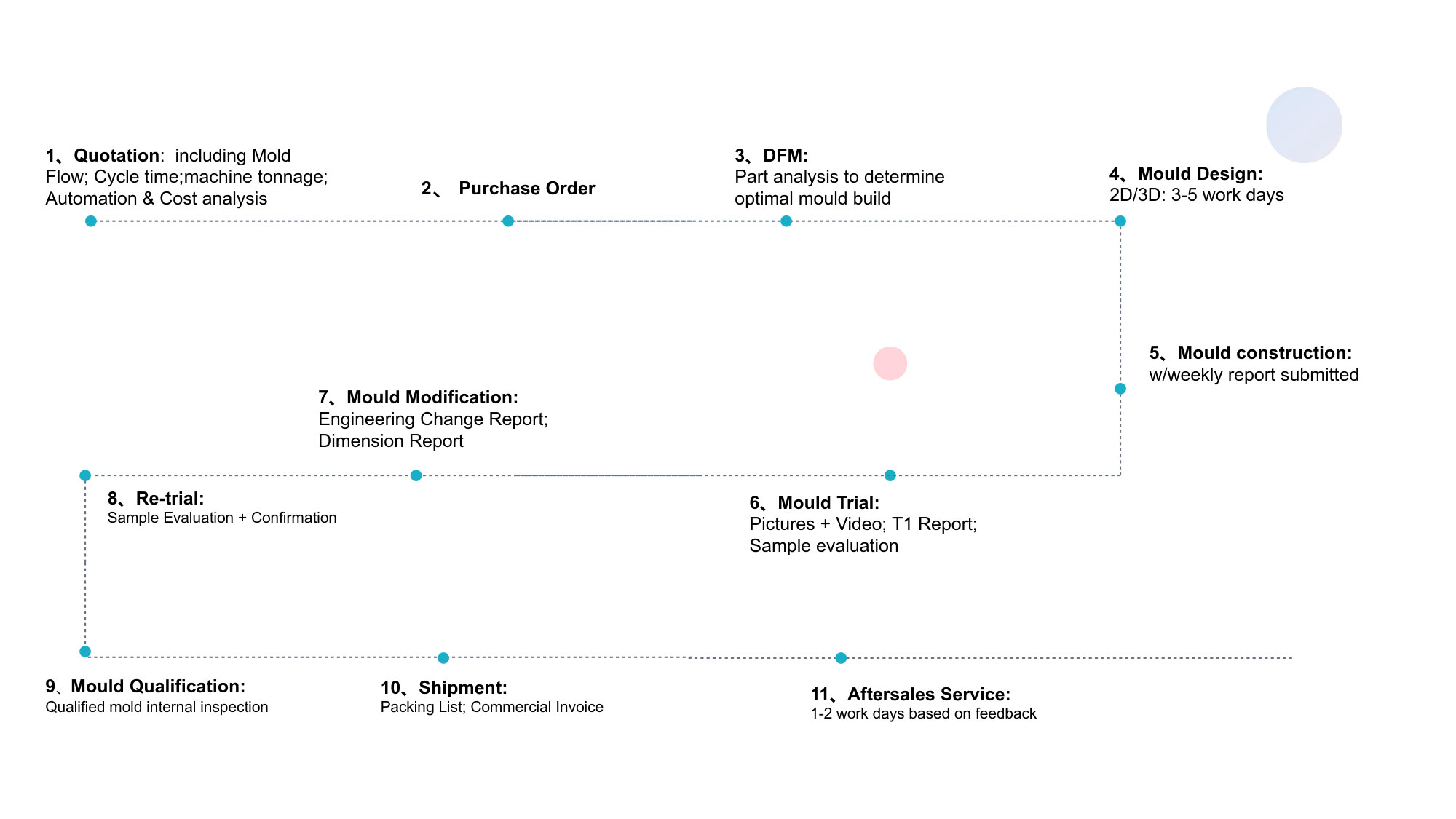
- The mold manufacturing process and product material selection
Precision Mold-Making Equipment
Equipment Category Specifications Customer Benefit
Five-axis high-speed machining centers 0.002mm contour accuracy; complex 3D surface finish Parting lines so smooth no secondary finishing required; mold opens and closes consistently, eliminating flash between half-tones
Ultra-precision CNC EDM (English: sinker EDM) ±0.003mm electrode reproduction Complex ribs and undercuts formed without secondary machining; molded features meet print dimensions from the very first shot
Slow-speed wire electrical discharge machining (wire EDM) Cuts down to 0.03mm slots for micro-pins and narrow channel geometries Enables thin-wall reinforcements and fine venting paths without risking core deflection
Large-gantry CNC milling Supports mold bases up to 2,000 mm × 1,200 mm Supports large multi-cavity coffee machine frames in a single mold base—no splitting required; reduces per-part molding cost by 15–25%
1.2 Injection Molding Machine Fleet
Clamping force range: 30 tons to 400 tons, covering single small brackets through large structural frames and multi-cavity tooling
All-servo electric drive systems: Shot-to-shot weight repeatability of ±0.1% across full production runs; verified through six-month CPK stability studies
Smart process monitoring: Every machine is hard-wired to a centralized MES system that logs all molding parameters and locks changes behind engineering-level authorization
-
Metrology and Quality Equipment
Instrument Application Measurable Value
Coordinate measuring machine (CMM) Full mold base inspection prior to sampling; full lot sampling per AQL plan Every mold ships with a full dimensional report showing all critical feature measurements
Optical measurement system Automated non-contact measurement of delicate ribs and harness slots Eliminates contact deformation; measurement time reduced by 70% compared to manual methods
Portable white-light scanner Rapid 100% part-to-CAD best-fit comparison Spot potential assembly mismatches before batch production begins
Our internal process requires CPK ≥ 1.33 on every critical dimension before a single part ships. For customers, this means you can install the support component directly into your assembly line without sorting, gaging, or reworking.
SECTION II — Mold-Making Excellence (Turning Steel into a Production Asset)
Your mold determines the part quality, scrap rate, and total lifetime throughput. Here is how we engineer your mold to run reliably on your timeline.
2.1 Mold Life — A Direct Commitment
Material Family Application Example in Coffee Machines Guaranteed Mold Life Primary Benefit
P20 mold base with S136, 2344, 8407, or DC53 hardened inserts Standard PBT-GF30 or PC support components 500,000+ shots with GF materials; 1,000,000+ shots for unfilled plastics Maximized return on tooling investment; no mid-project mold rebuild
H13 tool steel (flame-hardened grade) High-wear zones such as thin cores and shutoffs 1.2 million+ shots Cores maintain critical diameters for 7+ years of coffee machine production
2.2 Gate and Runner Solutions — Optimized for Efficiency
Gate Configuration Benefit Delivered to You
Hot runner with valve-gate sequencing Zero runner waste → 8–12% reduction in material cost per part. Suitable for thin-wall designs near heater zones
Sprue or edge gating (cold runner) Quick mold validation and lower upfront tool cost; ideal for mid-volume coffee machine programs
Multi-point hot/cold hybrid gating for large parts Balanced cavity fill across wide spans of up to 600 mm → eliminated mold flow hesitation and weld-line visibility reduction of >80%
2.3 Cooling System and Conformal Cooling — The Hidden Driver of Productivity
In coffee machine plastic support components, uneven cooling is the primary cause of warpage, sink, and extended cycle times. We design our cooling channels as precision thermal circuits, not just drilled holes.
Key cooling design features for coffee machine support components:
Partitioned cooling zones independently controlled by dedicated mold-temperature controllers, maintaining core-to-cavity temperature difference within 2°C
Copper-beryllium high-thermal-conductivity inserts placed around critical thread bosses and mounting bosses to accelerate local solidification
Optional bimetallic or conformal cooling circuit using additive-manufactured inserts for hard-to-reach internal walls, reducing cycle time by up to 30% and eliminating localized hot spots
Correlated customer value: A European coffee appliance OEM achieved a cycle-time reduction from 45 seconds to 30 seconds after receiving an Ansix-optimized cooling design. Annual capacity increased by 50% without adding a single new machine.
2.4 Ejection System Design — Protecting Critical Surfaces
Sequence-controlled ejector plates coordinate core pulls with ejector pins to avoid surface marking on customer-visible cosmetic flanges
Sintered bronze air-ejector sleeves utilized where ejector pin marks are prohibited
All core pulls and slides incorporate German-engineered progressive guides rated for durability beyond 1.5 million cycles
2.5 Tool Steel Certification and Documentation
Every mold ships with:
Raw material certification from our approved steel supplier
Hardness profile and tempering curve per component
Inspection logs from the machining floor through final CMM verification
SECTION III — Material Selection Excellence (Translating Polymer Science into Product Reliability)
Coffee machine environments combine heat (70–130°C), moisture, mechanical vibration, and long-term creep loading. Choosing the right plastic is not merely an engineering decision—it is the single largest lever for reducing total lifetime warranty cost.
3.1 Recommended Materials for Coffee Machine Plastic Support Components
Material Key Property Coffee Machine Application Area Ansix Track Record
PBT + GF30 (e.g., Celanex 3300HR, Duranex 3300) 220°C HDT; very low creep; excellent dimensional stability after moisture exposure Near-boiler support brackets, pump mounts, motor brackets 24 coffee machine programs; zero field creep failures
PC/ABS alloy (e.g., Bayblend T85) Excellent impact strength down to -20°C; good UV stability Main support frame, switch/sensor housings 37 appliance programs; wide adoption
PA6 + GF30 (e.g., Ultramid B3WG6) High strength-to-weight ratio; good vibration damping Base plates, bottom-loading structural ribs Preferred for load-bearing coffee platforms
PPA (polyphthalamide) + GF35 (e.g., Amodel) Very high thermal performance (275°C HDT); creep-resistant Structural brackets inside fully enclosed high-heat commercial machines Certified for commercial-grade coffee systems
PPS (polyphenylene sulfide) + GF40 (e.g., Fortron 1140L4) Inherent flame retardance (UL94 V-0 at 0.4 mm); excellent chemical resistance High-voltage wiring isolators, solenoid valve housings 9 validated V-0 coffee machine sub-projects
UL94 V-0 rated flame-retardant compounds Self-extinguishing; low smoke Power distribution boards, espresso group heads Full V-0 certification included upon request
LSR (liquid silicone rubber) Flexible; high-temperature seal performance up to 230°C Gaskets, water seals, vibration isolators Two-component mold capability available
3.2 Material Certifications and Testing
We provide standard and optional performance documentation to reduce your regulatory risk:
UL94 test reports for flame-retardant grades (V-2, V-1, V-0 as required)
Food-contact compliance (EU 10/2011, FDA 21 CFR 177) for brackets that may contact incidental moisture
UV aging reports (ISO 4892-2, up to 2,000 hours) for components exposed to kitchen lighting
Chemical resistance data for coffee oils and common descaling agents
Full material lot traceability from resin receipt through final shipping
SECTION IV — Injection Molding Process Capabilities That Address Your Most Common Concerns
For coffee machine support components, customers worry about: warpage after cooling, sink marks at rib intersections, dimensional variation across multi-cavity tools, and batch-to-batch color or gloss inconsistency. Here is how we eliminate those risks.
4.1 Warpage Control through Thermal Design
Conformal cooling circuits designed per Moldflow simulation achieve uniform mold temperature with less than 2°C variance across the entire cavity surface
Dedicated mold-temperature controllers for core and cavity independently regulate heat distribution, reducing part warpage by 60–80% compared to conventionally cooled molds
4.2 Eliminating Sink Marks and Weld Lines
Gate location optimized via Moldflow simulation prior to steel cutting moves cosmetic weld lines to non-critical recessed areas
Dynamic feed system with sequential valve-gate control adjusts melt-front velocity based on cavity pressure feedback, synchronizing fill progression across all cavities
Copper-alloy high-thermal-conductivity inserts placed behind thick ribs accelerate cooling where sink is most likely to form
4.3 Dimensional Stability in Multi-Cavity Production
Consistent part-to-part reproducibility is non-negotiable when a single 8‑cavity mold produces tens of thousands of parts monthly. Our control strategy:
Control Element Method Achievable Outcome
Material shrinkage validation ASTM D955 mold shrinkage measured per batch before production Compensates for lot-to-lot variation before molding begins
Melt temperature ±2°C stability Closed-loop nozzle thermocouple control bore-sighted to actual melt stream Consistent viscosity = consistent fill
Shot-to-shot weight Ultrasonic inline sensors monitor actual part density and back-pressure dynamics, automatically adjusting packing pressure on the next shot Weight variation ≤0.3% across 100,000‑shot runs
First-article and patrol inspection 5-piece first-article check + patrol CMM sampling every 2 hours Early detection of any dimension drift
4.4 MES-Controlled Process and Full Traceability
All monitored processes are locked and recorded digitally:
Molding parameters (temperature, pressure, injection speed, cooling time) are saved to the MES system and require engineering-level login to change
Machine logs are retained for two years to support your quality audits
Each production batch is archived with process data, material lot ID, operator ID, and test results
SECTION V — Delivering Customer Value: Cost, Risk, Lead Time, and Quality
Our entire operation is engineered to answer the four questions most important to coffee machine manufacturers:
5.1 Reducing Product Hard Cost — The Engineering Advantage
A. Early DFM evaluation (before cutting steel):
Our DFM analysis evaluates the moldability of plastic support components before any steel is cut. Bad gate placement, thin walls, unsupported deep ribs, or inadequate draft angles are corrected in CAD—not in steel.
In one recent coffee machine support bracket project, gate relocation alone reduced the required injection pressure from 180 bar to 142 bar, allowing a smaller-tonnage machine to be used and saving $28,000 in annual power and machine time.
B. Shrinkage engineering: We pre-compensate for anisotropic shrinkage in glass-filled materials in the steel, drastically reducing mold tryout iterations and shortening T1-to-PPAP from eight weeks to three weeks.
C. Steel selection matched to expected shot count: For a medium-volume coffee machine program, we recommended S136 nitrided inserts rather than high-cost carbide—achieving 34% lower tool cost while still exceeding the required 750,000-shot life.
D. Runner optimization savings: Converting a four-cavity coffee bracket tool from cold runner to hot runner reduced runner material waste from 24% of shot weight to less than 3%, saving approximately
0.06perpart∗∗.At2millionpartsperyear,thisrepresents∗∗120,000 in annual material savings.
E. Surface finish selection: When cosmetic class A surfaces are unnecessary (e.g., hidden rib fields), we specify lower SPI grades (C-1 or C-2) and eliminate hand-polishing, reducing tool finishing cost by up to 40% without any functional compromise.
5.2 Reducing Customer Risk Through Early Validation
A. Mold flow analysis (DFM stage): Using Autodesk Moldflow Insight and Moldex3D simulation tools, we identify weld lines, air traps, and unbalanced fill prior to tool build. Findings are documented in two DFM reports:
DFM Report 1 (part-level): wall thickness optimization, draft angle recommendations, and gate location proposals
DFM Report 2 (tool-level): cooling path design, ejection strategy, and steel selection
In our experience, 70% of molding problems originate in the part design, and 90% of those can be corrected in CAD before tooling begins.
B. T0 to T3 tool sampling with full improvement documentation:
Trial Stage Activity Purpose When Provided
T0 First test shots using temporary molding conditions Identify fundamental mold defects before complicating conditions Week 4–6 after tool completion
T1 Optimized process parameters applied Dimensional finalization; cosmetic inspection Week 6–8
T2 Process window study across customer-specified tolerance range Establish robust processing window Week 8–10
T3 Run at production-line molding conditions; full PPAP submission Validate stability before handover Week 10–12
C. Sample parts: Up to 200 sample parts (T1 or T2) are shipped to customer for assembly integration testing before mass production begins. This prevents costly rework after order release.
D. Pilot production (100 to 500 shots): Full trial run using production process parameters to measure scrap rate, cycle stability, and CPK. Tooling is only released to full production once CPK ≥1.33 is achieved.
5.3 Manufacturing Throughput and Delivery Assurance
We treat lead time, not just price, as a competitive weapon.
Lead time standards (from order confirmation to FOB shipment):
Complexity Scope Description Standard Lead Time Rush Available
Simple mold Single-cavity; ≤8 inserts; 2 slides or less 14 days 10 days
Medium-complexity 2-cavity family mold; 4–8 slides/lifters; tight tolerances (±0.02mm on ≤3 features) 25–35 days 20 days
High-complexity 4–8 cavities; >12 slides; multi-stage ejection; hot runner 40–55 days 30 days
Capacity deployment: Production cells run 24 hours per day, 7 days per week, with mold changes averaging less than 45 minutes. Secondary assembly and packaging cells adjacent to injection lines minimize handling damage.
5.4 Quality Assurance — Verifying, Not Just Assuming, Consistency
Our quality system is built around end-to-end traceability rather than end-of-line sorting.
Stage Activity Control Method Responsibility
Mold build 100% insert measurement CMM per drawing before heat treatment Tooling
Mold completion Full dimensional compliance Full mold report; video recording of each core/cavity pair QA
Pilot production Process window characterization GR&R study; CPK on critical dimensions; destructive testing Advanced Quality
Batch production In-process verification First-off (every shift), patrol (every 2 hr), last-off Production QA
Finished goods Random sampling per AQL AQL 1.0 for critical; AQL 2.5 for non-critical (ISO 2859-1) QC
Pre-shipment 100% final visual Operator inspection + second-person re-verification on color, flash, warp Packing Lead
Shipping Packing slip and COA COA includes measured CPK for each critical dimension Logistics
Quality facilities include:
In-house material testing lab for tensile, impact, and HDT verification (ISO 527, ISO 180, ISO 75)
In-process wall-thickness ultrasonic scanner mounted directly to injection machine nozzle for closed-loop packing pressure compensation
Master part library to compare each production lot with an approved first-article sample
5.5 Packaging and Logistics — Completing the Transaction
Standard packaging includes:
Anti-static polyethylene bags for moisture-sensitive materials (e.g., PA6-GF30, PPA)
Custom thermoformed trays for sensitive cosmetic surfaces
Pallet labeling compliant with GS1-128 (SSCC) for automated receiving
Fast delivery: FOB Shenzhen 7–14 calendar days from final quality sign-off to loading. Customer-chosen freight forwarder or our in-house partner can ship global express (3–5 days air) or sea (20–25 days LCL/FCL).
SECTION VI — Why Ansix Tech Is Different: 28 Years of Appliance Manufacturing Expertise
Ansix Tech has manufactured plastic components for over 40 different coffee machine models—from single-serve espresso machines to commercial high-volume brewers.
6.1 Industry Track Record
Customer Type Typical Program Scope Components Supplied Years in Production
European appliance brand 4M parts/year Main frame, pump bracket, motor mount 7 years (ongoing)
North American OEM 1.2M parts/year Water tank support, heater bracket 5 years
Asian coffee system brand 0.8M parts/year Brew group support, drip tray bracket 4 years
6.2 What Our Experience Provides You
Material mastery: We have molded over 25 thermoplastic materials relevant to coffee appliances, including PBT+GF30, PC/ABS, PA6+GF30, PPA, PPS, LSR, and flame-retardant compounds
Rapid DFM feedback: Average 2 business days for initial DFM report after receipt of 3D file
Tooling that ships on time: 97% on-time mold delivery rate over the last 24 months
Scalability without re-validation: Multi-cavity capacity can scale from 5,000 to 500,000 parts monthly without requalification gymnastics
CONCLUSION — Let Data Guide Your Decision
Our proposal is built on a simple principle: Every technical parameter described above can be independently verified during your visit to our facility.
We invite you to provide one existing coffee machine plastic support component CAD model for a complimentary DFM evaluation. Within two business days, you will receive:
Moldability assessment with recommended changes prioritized by impact on cost, quality, or both
Preliminary cycle-time estimate based on actual geometry and selected material
Estimated tool cost with break-even analysis against annual volume
For Ansix Tech, the mold is not just a tool—it is your production asset. We invest in engineering, validation, and process control to ensure that asset performs for you for years, not just for the first shipment.
The coffee machine marketplace demands exceptional reliability and predictable cost. With Ansix Tech as your manufacturing partner, those outcomes are not hopes—they are engineered into every part.
Ansix Tech — Engineering Reliability, Delivered Faster.
Ansix Tech Co Ltd
If you have any plans related to Coffee Machine Plastic Support Component , you can contact us at any time. We will turn your ideas into reality, let you realize your dreams, and obtain large orders from the market. Our contact information is info@ansixtech.com. Or contact our CTO, mail: stephen@ansixtech.com
#www.ansixtech.com #ansixtech.com #Coffee Machine Plastic Support Component #Coffee Machine Plastic Support Component moulds #Coffee Machine Plastic Support Component injection molding companies #Coffee Machine Plastic Support Component Canopy Mold injection mold companies #Ansix #Ansix moulds #Ansix china #Ansix tech china #Ansix tech company #Ansix facotry #Coffee Machine Plastic Support Component injection molding #Coffee Machine Plastic Support Component injection tools #Coffee Machine Plastic Support Component injection moulds #Coffee Machine Plastic Support Component plastic mould #Coffee Machine Plastic Support Component plastic tools #Ansix Tech #Ansix molds #Ansix injection molding #Ansix mold factory #injection molding Coffee Machine Plastic Support Component #Ansix mold factory #Coffee Machine Plastic Support Component china #Coffee Machine Plastic Support Component molds #injection factory #Coffee Machine Plastic Support Component injection molding #Coffee Machine Plastic Support Component injection molding factory #injection molding company #Coffee Machine Plastic Support Component injection mold companies #Coffee Machine Plastic Support Component#Coffee Machine Plastic Support Component mold limited #Ansix mold china #Ansix companies #Ansix company China #Coffee Machine Plastic Support Component facotry #Ansix Tech #Ansix Tech mould #Coffee Machine Plastic Support Component injection moulding #injection moulding company #Ansix Coffee Machine Plastic Support Component parts injection mold companies #medical injection molding companieschina #Coffee Machine Plastic Support Component china factory #Ansix moulding companies #Ansix molding company #Coffee Machine Plastic Support Component injection moulding facotry #Ansix Tech mold #Coffee Machine Plastic Support Component mould #Coffee Machine Plastic Support Component plastic injection molding #ansix plastic mold #Mold manufacturing #Coffee Machine Plastic Support Component parts manufacturing #Coffee Machine Plastic Support Component plastic parts factory #Coffee Machine Plastic Support Component injection parts mold #Coffee Machine Plastic Support Component PRECISION MANUFACTURING #Coffee Machine Plastic Support Component #China mold #Coffee Machine Plastic Support Component injection moulding china #Coffee Machine Plastic Support Component mould china #china precision mold #mold in china #Coffee Machine Plastic Support Component mold china #Precision molds #High-precision molds #Coffee Machine Plastic Support Component #Injection molds #Coffee Machine Plastic Support Component Factory #Coffee Machine Plastic Support Component Company #Super Large Injection Mold Factory #Large Tonnage Injection Molding Factory #Coffee Machine Plastic Support Component Company #Coffee Machine Plastic Support Component Factory #2800T Injection Molding Factory #3000 Ton Injection Molding #4500 Ton Injection Molding Factory #Large Mold Injection Molding #Large Plastic Mold Injection Molding Factory #Large Injection Mold Manufacturer #Plastic Mold Factory #Injection Mold #Plastic Mold