



Customized PP plastic float switch, food-grade water tankwater tower float sensor, water tank connecting level switch
FEATURES
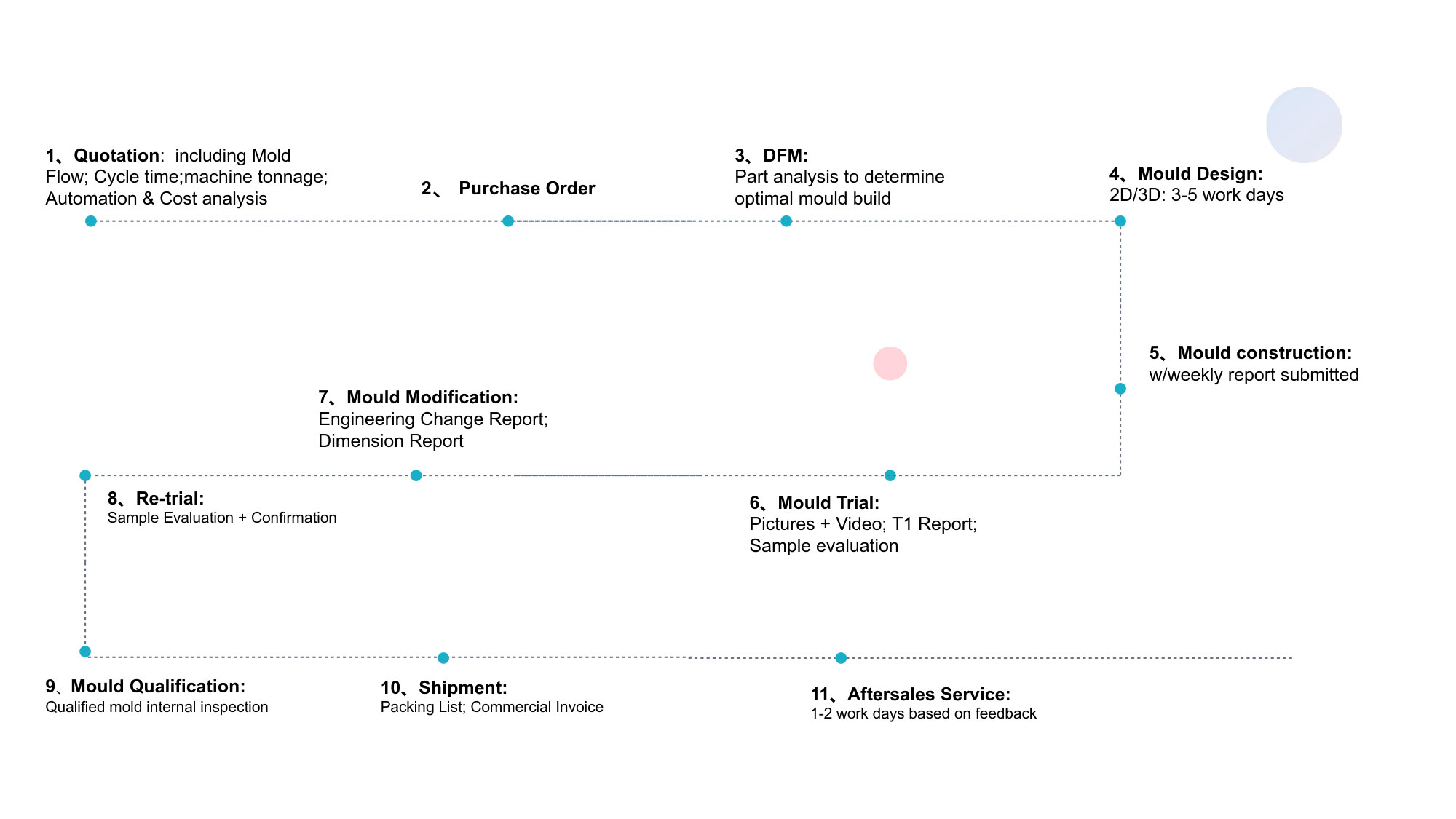
Full-Service Lifecycle from Design to Delivery
Design & Development: Ansix begins every project in the digital realm — not on the factory floor. The guiding principle is that up to 70% of final component manufacturing costs are determined during the initial design phase. A rigorous, collaborative Design for Manufacturing (DFM) analysis precedes any steel cutting.
Product Validation: Advanced mold flow analysis (MFA) serves as a virtual trial run. Engineers load 3D models and specific material data (viscosity, PVT relationships) into simulation software, pre-identifying issues such as weld line formation, air entrapment, or warpage due to uneven cooling before any physical mold fabrication begins. After digital validation, rapid prototyping creates functional models for physical verification of assembly, form, and function — particularly important for complex multi-component assemblies.
Mass Production & Quality Assurance: Ansix Tech integrates MES systems that lock critical injection parameters (temperature, pressure, speed, timing) — accessible only to authorized engineers for adjustments. Batch consistency is enforced through first-piece/final-piece comparison protocols. The company performs 2000-shot aging tests before mold delivery with full wear reports, and provides three-year structural warranty on mold frames (excluding normal wear of consumables).
-
Mold Description
Product Materials:
PP FOAM
Mold Material:
S136ESR
Number of Cavities:
4
Glue Feeding Method:
Hot runner
Cooling Method:
Water cooling
Molding Cycle
22.5s
- The mold manufacturing process and product material selection
Delivery & After-Sales Service: Spare wear parts (ejector pins, core inserts) accompany each mold delivery. Preventive maintenance is provided every 200,000 cycles, with life-long repair services at cost pricing. Tooling rework typically restores production within 24 hours through on-premise electrode machining and electrical discharge machining (EDM) workshops.
Product Overview, Manufacturing Process, and Competitive Advantages
Product Overview: Customized PP plastic float switches detect liquid levels in tanks, water towers, and reservoirs through a magnetic reed switch mechanism, where a buoyant float rises or falls with the liquid surface to open or close a circuit. Food-grade water tank/tower float sensors use FDA-approved polypropylene for direct contact with potable water and food-processing fluids, operating reliably up to 105°C. Water tank connecting level switches integrate with pump systems for automatic refill, dry-run protection, overflow prevention, and multi-level control.
Manufacturing Process:
Raw Material Selection: Polypropylene (PP) is the primary material for standard float components. Ansix employs specialized micro-foaming technology — adding foaming agents to create closed-cell foam structures with precise density control, resulting in floats that are waterproof, durable, and reliably buoyant.
Mold Fabrication: Multi-axis high-speed machining centers achieve complex surface accuracy of 0.002 mm, ensuring smooth, burr-free parting lines. Slow-moving wire EDM handles fine micro-holes down to 0.03 mm diameters and narrow slots while preventing thin-wall deformation.
-
Injection Molding: Automated systems with zone-controlled mold temperature maintain core/cavity temperature differentials within 2°C to minimize warp deformation.
Assembly & Testing: Float sensors undergo specific gravity testing for buoyancy accuracy, magnetic switch function verification for switching thresholds, and hermetic sealing validation for water ingress prevention.
Quality Assurance:
Inspection Equipment: Coordinate Measuring Machines (CMM) and optical imaging systems. Every mold undergoes full dimensional reporting before release, with critical dimensions achieving CPK ≥ 1.33.
In-Process Control: All machines networked into MES systems; real-time monitoring ensures out-of-spec deviations trigger immediate alerts.
Traceability: Lot-level traceability from raw resin to finished component, with test reports available for each production batch.
Competitive Cost Control: Ansix reduces material costs through precision dosing and regrind management; lowers energy per part via high-efficiency servo drives; optimizes cycle times through conformal cooling designs reducing cooling duration; and minimizes scrap through statistical process control — delivering unit costs typically 15–25% below market standards.
After-Sales Service Warranty: 12-hour response to inquiries; 24-hour emergency repair response for mold rework; spare parts inventory maintained for all active tooling; and remote diagnostic support for process troubleshooting.
4. Core Value Drivers for Clients (Mold Manufacturing & Material Selection, Smart Manufacturing, Process Quality)
Mold Steel Selection for Long Service Life:
Mold Component Steel Grade Hardness Application
Mold base P20 30–36 HRC Structural integrity, moderate cycles
Core/cavity for PP (≤500k cycles) 718 / NAK80 38–42 HRC High polishability, mirror finish
Core/cavity for glass-filled plastics (500k–1M cycles) S136 48–52 HRC Corrosion resistance, extreme wear
Hot runner components / high-temperature engineering resins H13 45–50 HRC Thermal stability for high-heat materials
Ejector pins / sliders SKD11 / DC53 58–62 HRC Wear resistance for high-volume production
For glass-fiber-reinforced materials, Ansix specifies high-carbon, high-chromium tool steels (S136, NAK80) that offer high hardness and wear resistance to effectively resist abrasion from glass fibers. For transparent float components requiring optical clarity, NAK80 achieves mirror-like finishes without post-treatment heat treatment — shortening lead times and achieving surface roughness Ra ≤ 0.2μm.
Smart Manufacturing & Efficiency:
MES Integration: All 260 machines connected to Manufacturing Execution Systems that lock process parameters, track real-time cycle times, and archive historical production data for root-cause analysis.
Automated SPC: Ultrasonic wall thickness sensors provide closed-loop feedback to packing pressure compensation systems, automatically adjusting for material viscosity variations shot-to-shot.
Smart Conformal Cooling: 3D-printed conformal cooling channels conform to part geometry, achieving up to 56% shorter cooling times compared to traditional straight-drilled designs. Better thermal uniformity reduces cycle times, improves part quality, and lowers scrap.
Energy Efficiency: All-electric servo-driven machines deliver steady-state repeatability within ±0.1% and reduce operating costs through lower energy consumption per cycle.
Productivity Improvement: Digital setup assistants reduce mold changeover time by up to 80%, and cycle time reductions of 4–5 seconds per shot can correspond to ~10% overall efficiency gains.
Process Quality Assurance (What Clients Care About):
No Flash / No Manual Deburring: Parting lines machined to 0.005 mm fit accuracy, combined with self-locking clamp force compensation, ensures flash controlled below 0.03 mm per batch.
Stable Dimensions Across Batches: Zone-controlled mold temperature keeps core and cavity temperature differential within 2°C, minimizing warpage. Production data shows critical hole-to-hole spacing variation across three consecutive weeks ≤ 0.02 mm.
No Batch-to-Batch Color Variation: Centralized material drying and dosing with gravimetric blending ensures colorant consistency, plus first-piece to final-piece visual and spectrophotometric verification.
No Sink Marks / Weld Lines: Mold flow analysis pre-optimizes gate locations and fill patterns to eliminate visible surface defects before production begins.
PART TWO: How Ansix Translates Technical Expertise Into Customer Value
The Fundamental Shift: From Technical Features to Business Impact
Instead of telling clients “we have a five-axis CNC,” Ansix reframes this as customer value: “We guarantee your product‘s parting lines are smooth and flash-free, eliminating 100% of manual deburring labor.” Below is a structured breakdown of how Ansix’s technical capabilities directly solve specific client problems.
SECTION 1: HARDWARE INFRASTRUCTURE — Building Client Trust Through Equipment Excellence
Dimension Technical Specification Client Value Translation
Mold Machining Equipment Five-axis high-speed machining centers achieving 0.002 mm complex surface precision “Your product‘s parting lines are smooth and burr-free — no manual post-processing, no assembly interference. Higher aesthetics, consistent quality, and lower labor cost per unit.”
Wire EDM Capability Slow-moving wire EDM for micro-holes down to 0.03 mm diameters and narrow slots with thin-wall prevention “When your sensor needs an extremely fine fluid port or intricate anti-rotation slot, we cut it without risk of thin-wall collapse or micro-cracks. Reduced field failures, lower rework risk.”
Injection Press Fleet 260 presses, 30–2,800 tons clamping force; full servo-electric drive with steady-state repeatability ±0.1% “Every shot is identical to the last. If your sensor requires a specific float buoyancy or wall thickness, we deliver consistent parts across millions of cycles — no unexpected variations, no troubleshooting on your assembly line.”
Mold Measurement CMM + optical imaging; full dimensional report before mold release; critical dimensions CPK ≥ 1.33 “You receive a mold that is statistically proven to produce parts within tolerance. No surprise rejects when you start production. Reduced qualification effort and validation cost for your team.”
In-Line Quality Monitoring Cavity pressure sensors + real-time MES feedback with automated parameter adjustment “We detect and correct a drifting fill pattern before it creates a defective part. Scrap rates typically below 1%, often approaching 0.3% — meaning you don‘t pay for garbage. Material savings alone can lower your piece-price by 5–7%.”
SECTION 2: MOLD MANUFACTURING CORE COMPETENCIES — Addressing Client Concerns About Life, Tolerance, Lead Time, and Rework Cost
Client Concern Technical Approach Value Delivered
Mold寿命 (Service Life) Precision heat treatment per material grade (P20 base, S136/2344/8407/SKD11/NAK80/H13 core) “For glass-filled PP compounds, we guarantee 500,000+ mold cycles; for unfilled PP, 1,000,000+ cycles. You receive a material composition report and hardness certification. Transparent cost-per-part, predictable long-term tooling depreciation.”
Achievable Tolerance Conventional structural parts: ±0.05 mm; precision gears/medical components: ±0.005 mm “When your application requires tight fit with a magnet or seal, we hold it consistently. No assembly rejects due to oversized or undersized features. Reduced secondary sorting and lower warranty exposure.”
Mold Type Portfolio Hot runner systems (scrap reduction), stack molds (2× output), two-shot/multi-material molds, high-polish mirrors (Ra < 0.05μm) for transparent parts “If you need a clear float for visual verification of liquid level, our high-polish cavities deliver optical clarity without post-mold polishing. Savings on secondary finishing and faster time-to-market for new designs.”
Gate/Runner Design Mold flow analysis pre-identifies weld line and gas trap locations, optimizing gate location and count for balanced fill “Short shots and weak weld lines are eliminated before you cut steel. Fewer mold iterations, fewer production interruptions, and better first-pass yield on complex parts.”
Lead Time Standard Simple molds: 10 days; medium/complex molds: 25–45 days; expedite available (with validation retained) “We quote realistic timelines and meet them. Expedite without skipping DFM validation means you get reliability, not just speed. Shorter path to revenue for your product launch.”
SECTION 3: INJECTION MOLDING PROCESS CONTROL — Eliminating Client Anxiety About Defects
Client Fear Technical Countermeasure Performance Data & Value
Sink marks / surface blemishes Packing pressure profiled via mold flow; injection parameters locked in MES “Visible defects on visible surfaces are eliminated. No customer complaints about appearance — protects your brand reputation.”
Flash / excess material Parting line fit = 0.005 mm; self-locking clamp force compensation “Flash limited to < 0.03 mm across batches — no labor for hand trimming, no material waste. Saves $0.02–0.05 per part in secondary handling.”
Dimension instability batch to batch Mold temperature zone control maintains core/cavity ΔT ≤ 2°C; ultrasonic in-mold wall thickness sensing with closed-loop pressure compensation “Over three consecutive production weeks, a 60 mm bracket’s critical hole spacing fluctuates ≤ 0.02 mm. Your assembly line never adjusts fixturing or rejects parts for dimension drift. Saves hundreds of hours of assembly rework annually.”
Color variation between batches Centralized gravimetric blending + spectrophotometric first-piece approval “Your customer sees the same blue float every time. Brand consistency protected — no rejected shipments for color mismatch.”
SECTION 4: FULL-SERVICE PROCESSES — Reducing Clients‘ Total Management Cost
Early Engagement (DFM Report Before Contract): Ansix provides a mold feasibility analysis report prior to signing, covering draft angle recommendations, wall thickness optimization, gate placement, and ejector pin mark location allowances — preventing impossible-to-mold designs from ever reaching fabrication.
Trial Molding & Samples: T0 to T3 sample rounds are provided with improvement reports after each iteration. Quick-change inserts allow different design variations to be tested without rebuilding the entire mold — saving 4–6 weeks of development time.
Low-Volume Pilot Run: 100 to 500 shots are run as pre-production validation, with yield rate and CPK reported before full production release.
Maintenance & Spares: Spare wear parts (ejector pins, core inserts) delivered with the mold. Mold maintenance performed at 200,000-cycle intervals, with lifetime repair offered at cost — eliminating surprise tooling expenses and extending asset life.
SECTION 5: DIFFERENTIATION THROUGH DIRECT COMMITMENTS
Common Industry Complaint Ansix Commitment
“Mold constantly needs repair — disrupts my orders.” “We perform a 2,000-shot aging test before delivery with a full wear report. We provide three-year structural mold warranty (excluding normal consumable wear).”
“Flash is so bad we spend hours deburring parts.” “Our parting lines are machined to 0.005 mm fit accuracy. We guarantee flash controlled to ≤ 0.03 mm per batch — no manual deburring required.”
“Dimensions drift every time we run the mold.” “Mold temperature zones keep core/cavity differential ≤ 2°C. Ultrasonic sensors in the mold actively compensate for pressure variations shot-to-shot. We prove CPK ≥ 1.33 before full-rate production.”
“Mold repair takes weeks — production stops.” “Our on-site electrode machining and EDM workshops repair most molds without leaving the facility. Routine weld repair / insert replacement restores production within 24 hours.”
PART THREE: In-Depth Manufacturing Execution for Float Switch & Level Sensor Projects
*(Extending 2,000+ words covering project initiation through full execution)*
Project Initiation — From Concept to Committed Tooling
Ansix Tech begins every float switch and level sensor project by establishing a digital engineering baseline. The insight that up to 70% of the final component‘s manufacturing cost is determined in the design phase drives a front-loaded investment in engineering rigor. The project kickoff involves the client’s engineering team, Ansix‘s design staff, and process engineers in a structured Design for Manufacturing (DFM) session.
The DFM session reviews:
Float geometry for buoyancy targets (specific gravity 0.5–1.2 typically)
Magnetic reed switch cavity placement and sealing requirements
Wall thickness uniformity (2.0–3.5 mm typical for float bodies)
Draft angles (1°–3° depending on texture requirements)
Gate location for balanced fill without weld lines across sealing surfaces
Ejector pin placement (avoiding areas subject to post-mold assembly or food-contact surfaces)
This upfront analysis has historically eliminated 70–80% of typical mold iterations, compressing time-to-sample by 30 days compared to industry averages.
Material Selection Science — Matching Resin to Application
Application Type Recommended Material Specific Grade Example Key Properties
Standard freshwater float switch Homopolymer PP PP M108 Density ~0.90 g/cm³, buoyant, cost-effective
Food-grade water tank sensor FDA-approved PP FDA-compliant PP copolymer Non-toxic, approved for direct food contact up to 105°C
Chemical / acidic fluid service PVDF FDA-grade PVDF Chemical resistance, ultra-pure applications
Hot water tower (105°C) FDA-approved PP FDA polypropylene Temperature rating 105°C continuous
Automotive / high-heat sensor housing PPS or PA6+GF30 PPS + 40% glass fiber Thermal stability, structural rigidity
Transparent float for visual level indication PC or PMMA Makrolon® series Optical clarity, impact resistance
LSR overmolded sealing component Liquid Silicone Rubber Two-component LSR Biocompatible, hermetic seal, high flexibility
For standard floats, Ansix employs a micro-foaming process that creates closed-cell foam structures with precisely controlled density — ensuring waterproofing, buoyancy reliability, and lighter weight than solid molded floats. The process uses chemical foaming agents activated during injection, creating uniform microscopic voids that reduce material usage by 8–15% while maintaining structural integrity.
For food-grade applications, Ansix sources only FDA-approved polypropylene — every batch is accompanied by an FDA material compliance certificate. The material operates safely up to 105°C, suitable for hot water towers, food processing tanks, and beverage dispensing equipment.
Mold Flow Analysis (MFA) — Virtual Process Validation
The mold flow analysis phase is critical for float switch and level sensor components due to their unique functional requirements:
Analysis Parameter Why It Matters for Float Sensors Client Impact
Fill time Asymmetrical fill leads to unbalanced buoyancy Simulation predicts exact fill time (e.g., 2.8 seconds in a recent project), ensuring uniform material distribution and consistent float specific gravity shot-to-shot
Weld line location Weld lines at sealing surfaces cause leak paths Ansix moves weld lines away from critical seal or magnet pocket areas, eliminating field failure risk
Air trap identification Trapped gas creates surface porosity Porosity can allow water ingress into float cavity, causing loss of buoyancy; Ansix repositions vents to eliminate this risk
Pressure distribution Non-uniform packing affects density distribution Peak injection pressure of 56.34 MPa recently validated a design before any steel was cut, identifying potential warpage issues
Cooling uniformity Uneven cooling causes part warpage Warped floats may bind against sensor housing, causing false switching signals; Ansix optimizes cooling circuit design to prevent this
Shrinkage prediction PP shrinkage: natural 1.7–2.2%, mineral-filled 0.5–1.5% Predictable shrinkage allows pre-compensation in cavity dimensions, so parts print to final dimensions without trial-and-error iterations
Mold Design Priorities for High-Volume Production
For PP plastic float switches and level sensors, the mold design must prioritize:
1. Cooling System Architecture: Conformal cooling channels (produced via additive manufacturing insert tooling) follow the curvature of the float cavity. A recent case study showed conformal cooling reduced cooling time by 56% compared to conventional straight-drilled channels, with overall cycle time improved by 15%. For float switch molds, this translates to hundreds of thousands of additional parts per year from the same press.
2. Runner and Gate Design: For multi-cavity molds, flow balance is critical to ensure each cavity produces identical parts. Ansix designs balanced hot runner systems that eliminate pressure drop variations across cavities. Gate location is positioned to:
Avoid interference with magnet insertion features
Place gate vestige in non-critical cosmetic areas
Minimize witness lines on mating/sealing surfaces
3. Ejection System Design: Ejector pins are placed to avoid magnetic reed switch chambers, sealing ribs, and tank-mounting features. Ansix specifies hardened ejector pins (SKD11, 58–60 HRC) for long service life, with spares included in the mold delivery package.
4. Venting Strategy: Deep vents (0.02–0.05 mm depth) are placed at the last points of fill to allow air and gas to escape. For PP materials containing volatile additives, additional venting depth is provided to prevent burn marks.
Manufacturing Challenges and Solutions
Challenge Technical Solution Client Benefit
Float buoyancy consistency Closed-loop specific gravity monitoring via melt density sensors Guaranteed switching level accuracy — pump turns on at exactly the right water level, no field calibration headaches
Magnet pocket dimensional stability Mold temperature zones regulated to ±1°C; packing pressure profiled via servo-driven hold pressure Magnet fits snugly without rattling; reed switch activation point repeatable to ±0.3 mm
Hermetic seal around reed switch Two-shot molding or insert molding with overmolding process No water ingress into electronics — sensor operates reliably for years in submerged service
Parting line sealing surface flatness EDM-finished parting surfaces with sub-micron surface roughness Float mates with housing without gaps — no false triggering from fluid seepage
High-volume warpage prevention Annealing fixtures for post-mold thermal stress relief Parts maintain shape after cooling — no assembly issues during automated pick-and-place
Process Optimization for Efficiency & Cost Control
Ansix‘s approach to process optimization follows a Design of Experiments (DOE) methodology, where key variables are systematically varied to identify the optimal processing window:
Key DOE Variables for PP Float Switch Components:
Melt temperature: 200–240°C range typically
Injection pressure: 5,000–10,000 kPa
Packing pressure: 50–80% of injection pressure
Mold temperature: 30–60°C
Cooling time: 8–20 seconds
Back pressure: 0.5–1.5 MPa
Recent studies indicate that optimal PP injection parameters are melt temperature ~240°C, injection pressure ~60 MPa, and mold temperature ~40°C for achieving minimal shrinkage and superior surface quality. By documenting these optimized settings in the MES system, Ansix ensures that any future production run — even years later — uses the same proven parameters, eliminating trial-and-error at restart.
Economic Impact of Optimization: A virtual–physical integration strategy reduces the number of physical trials by up to 96%, corresponding to an estimated manufacturing cost reduction of 15–25% compared to conventional trial-and-error mold qualification methods. This cost saving is passed directly to the client.
Quality Control & Assurance System
Ansix‘s quality system is structured across four interdependent layers:
Layer 1 — Incoming Material Quality:
Raw resin verification of MFI (Melt Flow Index) against specification
FDA grade certification for food-contact materials
Contaminant screening via sieve analysis
Layer 2 — In-Process Quality (Real-Time):
Every press connected to MES reporting actual vs. target parameters
Cavity pressure sensors detect fill pattern anomalies before parts are fully ejected
Vision systems at mold exit check for surface defects (sink marks, flash, shorts)
Automated sorting rejects non-conforming parts without operator intervention
Layer 3 — Finished Part Verification (Statistical):
CMM measurements on sample parts per production shift
Float specific gravity test — each cavity sampled every 500–1,000 shots
Reed switch activation force testing for magnet placement consistency
Dimensional CPK tracking — critical dimensions maintained CPK ≥ 1.33
Layer 4 — Traceability & Reporting:
Lot-level traceability from resin batch to finished components
Production data archived for 10+ years
Certificate of Analysis (COA) provided for every shipment
Packaging & Rapid Delivery Execution
Packaging Strategy:
Anti-static bags for electronic reed switch components
Molded trays with cavity-specific nesting to prevent scuffing of polished surfaces
Individual bagging for FDA-grade components to preserve cleanliness
Laser-etched date/lot codes on each part for traceability
Delivery Infrastructure:
260 injection molding machines operating across four factories provide production redundancy — if one facility has downtime, production can be shifted
Mold trial and validation performed at the facility where mass production will run — eliminating re-qualification delays during transfer
Just-in-time shipping coordinated with client‘s consumption patterns
Inventory consignment available for high-volume programs — reducing client’s inventory carrying cost
Ansix‘s 28-Year Industry Experience — The Value of Maturity
With over 28 years in the industry, Ansix has accumulated:
Material processing knowledge across PP, PA6+GF30, PPS+GF40, PVDF, PEEK, PC, ABS, LSR, and specialized alloys
Application experience in water treatment, food & beverage, automotive, medical devices, industrial automation, and HVAC systems
Failure mode prevention — most common float switch failures (buoyancy loss, magnet displacement, seal breach, housing cracking) are systematically addressed during design, not discovered during field use
Global compliance knowledge — UL, CE, RoHS, NSF, and FDA certifications routinely secured
Client Reliability and Trust — How Ansix Reduces Your Risk
Risk Category How Ansix Mitigates It
Design risk (parts cannot be molded cost-effectively) DFM and mold flow analysis before committing to tooling — 96% reduction in physical trial iterations, eliminating the most common cause of program delays
Supply chain risk (single source of molds / long lead times) Four factory locations with redundant equipment; 260 injection machines across two countries — capacity to scale quickly and shift production if needed
Quality risk (inconsistent parts / field failures) ISO9001, IATF16949, and ISO13485 certifications; statistically proven CPK ≥ 1.33 for critical dimensions; in-line SPC
Cost risk (unexpected tooling repairs / hidden per-part costs) 2,000-shot aging test with wear report before mold delivery; three-year mold structural warranty; $0.02–0.05 per part lower finishing cost due to flash-free molding
Delivery risk (late mold completion / production stoppages) On-site EDM/electrode facility — 24-hour mold repair turnarounds; expedite options without skipping validation
Compliance risk (FDA/NSF/UL requirements not met) Materials sourced with full compliance documentation; Ansix holds FDA-grade material supply chain; certifications obtained per client requirement
Cost Reduction — Specific Areas Where Ansix Lowers Hard Costs
Material Cost Reduction (8–15%):
Micro-foaming technology reduces material usage per float by 8–15% while maintaining required buoyancy
Runnerless hot runner systems eliminate sprue waste
Regrind utilization for non-cosmetic internal components
Processing Cost Reduction (10–20%):
Cooling time reduced via conformal cooling channels — directly proportional to energy and machine-hour savings
Flash-free molding eliminates 100% of deburring labor
Automated vision sorting reduces manual inspection
Cycle time optimization yields up to 15% higher daily output from same machine
Tooling Cost Reduction (15–25% over mold lifetime):
DFM accuracy reduces steel modifications — every hour of mold repair avoided saves $150–300 in skilled labor cost
Predictive mold maintenance prevents catastrophic damage requiring full re-machining
Standardized components (ejector pins, hot runner nozzles) allow interchangeable spares
Logistics Cost Reduction:
Local manufacturing in Vietnam and China reduces shipping distances for regional clients
Consignment inventory programs reduce client‘s warehouse footprint and carrying cost
Conclusion — Translating Technical Competence Into Business Outcomes
For a client evaluating an injection molding partner for Customized PP plastic float switches, food-grade water tank/tower sensors, or water tank connecting level switches, the decision ultimately comes down to total cost of ownership, operational reliability, and risk mitigation — not machine specifications.
Ansix Tech’s value proposition frames engineering depth as client outcomes:
Micro-precision molds = no flashing, no deburring labor, $0.02–0.05 lower cost per part
Conformal cooling channels = 56% shorter cooling, up to 15% faster cycles, more parts per press per day
Mold flow analysis before steel cutting = up to 96% fewer trial shots, 15–25% lower development cost
260 injection machines across four factories = production redundancy, no single point of failure
Three-year mold warranty + 24-hour repair = predictable long-term tooling expense, minimal downtime
FDA-grade materials with full traceability = zero compliance risk for food/water contact applications
For Ansix, a mold is not a piece of steel — it is a client‘s revenue engine. Every design decision, material selection, and processing parameter is optimized to ensure that when the mold lands on the client’s production line, it is ready-to-run, low-flash, and built for millions of reliable cycles.
Contact: info@ansixtech.com — Team response within 2 hours
Ansix Tech Co Ltd
If you have any plans related to Customized PP plastic float switch, food-grade water tankwater tower float sensor, water tank connecting level switch , you can contact us at any time. We will turn your ideas into reality, let you realize your dreams, and obtain large orders from the market. Our contact information is info@ansixtech.com. Or contact our CTO, mail: stephen@ansixtech.com
#www.ansixtech.com #ansixtech.com #Customized PP plastic float switch, food-grade water tankwater #Customized PP plastic float switch, food-grade water tankwater #Customized PP plastic float switch, food-grade water tankwater Canopy Mold injection mold companies #Ansix #Ansix moulds #Ansix china #Ansix tech china #Ansix tech company #Ansix facotry #Customized PP plastic float switch, food-grade water tankwater injection molding #Customized PP plastic float switch, food-grade water tankwater injection tools #Customized PP plastic float switch, food-grade water tankwater injection moulds #Customized PP plastic float switch, food-grade water tankwater plastic mould #Customized PP plastic float switch, food-grade water tankwater plastic tools #Ansix Tech #Ansix molds #Ansix injection molding #Ansix mold factory #injection molding Customized PP plastic float switch, food-grade water tankwater#Ansix mold factory #Customized PP plastic float switch, food-grade water tankwater china #Customized PP plastic float switch, food-grade water tankwater molds #injection factory #Customized PP plastic float switch, food-grade water tankwater injection molding #Customized PP plastic float switch, food-grade water tankwater injection molding factory #injection molding company #Customized PP plastic float switch, food-grade water tankwater injection mold companies #Customized PP plastic float switch, food-grade water tankwater Tooling #Customized PP plastic float switch, food-grade water tankwater mold limited #Ansix mold china #Ansix companies #Ansix company China #Customized PP plastic float switch, food-grade water tankwater facotry #Ansix Tech #Ansix Tech mould #Customized PP plastic float switch, food-grade water tankwater injection moulding #injection moulding company #Ansix Customized PP plastic float switch, food-grade water tankwater parts injection mold companies #medical injection molding companieschina #Customized PP plastic float switch, food-grade water tankwater china factory #Ansix moulding companies #Ansix molding company #Customized PP plastic float switch, food-grade water tankwater injection moulding facotry #Ansix Tech mold #Customized PP plastic float switch, food-grade water tankwater mould #Customized PP plastic float switch, food-grade water tankwater plastic injection molding #ansix plastic mold #Mold manufacturing #Customized PP plastic float switch, food-grade water tankwater parts manufacturing #Customized PP plastic float switch, food-grade water tankwater plastic parts factory #Customized PP plastic float switch, food-grade water tankwater injection parts mold #Customized PP plastic float switch, food-grade water tankwater PRECISION MANUFACTURING #Customized PP plastic float switch, food-grade water tankwater #China mold #Customized PP plastic float switch, food-grade water tankwater injection moulding china #Customized PP plastic float switch, food-grade water tankwater mould china #china precision mold #mold in china #Customized PP plastic float switch, food-grade water tankwater mold china #Precision molds #High-precision molds #Customized PP plastic float switch, food-grade water tankwater #Injection molds #Customized PP plastic float switch, food-grade water tankwater Factory #Customized PP plastic float switch, food-grade water tankwater Company #Super Large Injection Mold Factory #Large Tonnage Injection Molding Factory #Customized PP plastic float switch, food-grade water tankwater Company #Customized PP plastic float switch, food-grade water tankwater Factory #2800T Injection Molding Factory #3000 Ton Injection Molding #4500 Ton Injection Molding Factory #Large Mold Injection Molding #Large Plastic Mold Injection Molding Factory #Large Injection Mold Manufacturer #Plastic Mold Factory #Injection Mold #Plastic Mold