



Y-Type Tee Fitting Mold
FEATURES
Y‑Type Tee Fitting Mold – Core Value for Our Customers
At Ansix Tech, we recognize that you are not looking for a mold—you are looking for production certainty, predictable quality, and a partner who speaks your language of reduced risk and lower cost. Here is how we deliver those outcomes.
-
Mold Description
Product Materials:
ABS/PC
Mold Material:
S136ESR
Number of Cavities:
1*48
Glue Feeding Method:
Hot runner
Cooling Method:
Water cooling
Molding Cycle
32.5s
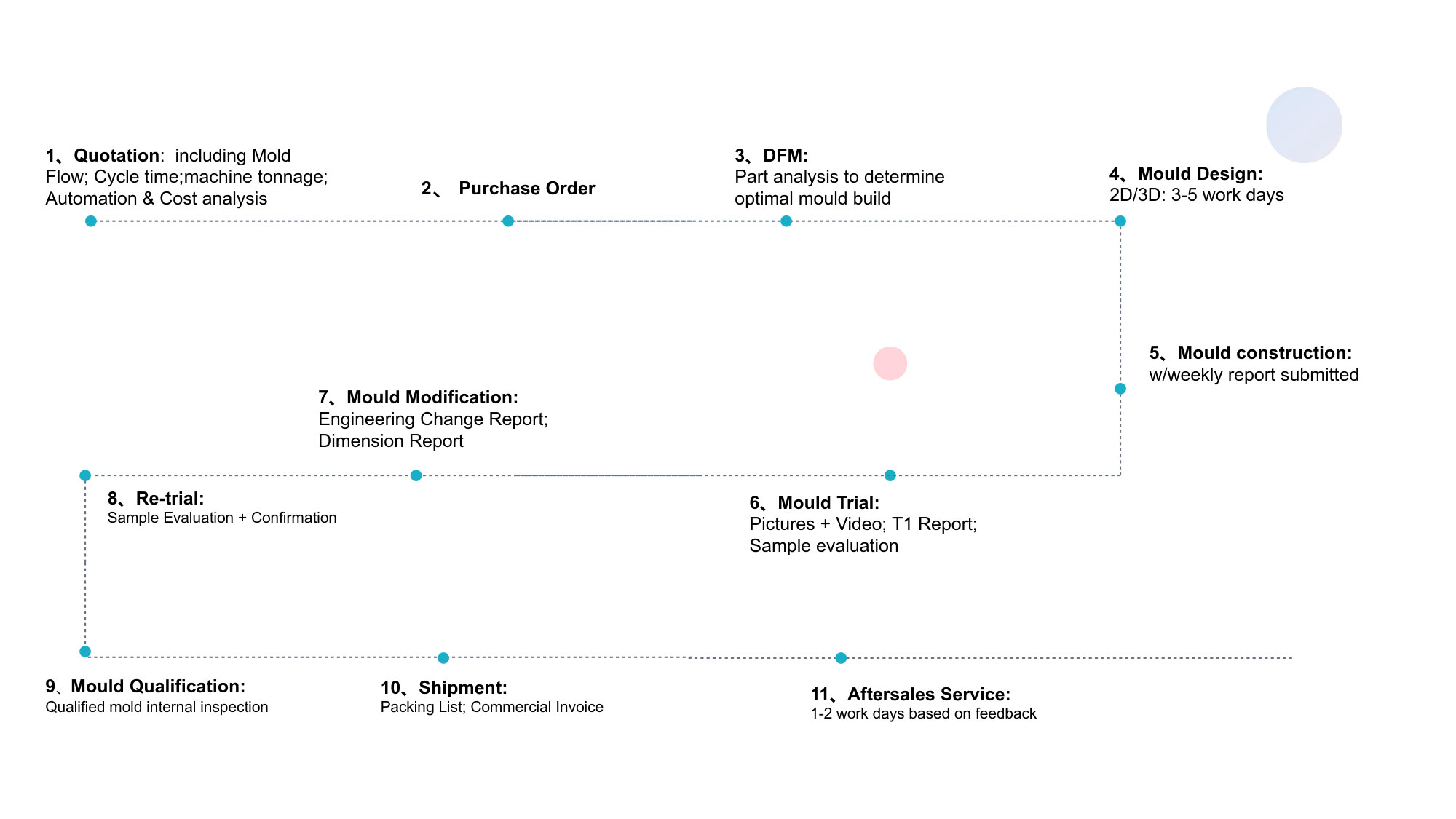
- The mold manufacturing process and product material selection
Material Science = Predictable Performance. We engineer every Y‑type tee fitting mold around the precise behavior of your resin. For glass‑reinforced PA6 or PBT, we specify SKD61 (HRC 52–56) cavity steel to withstand the abrasive wear of 40% GF. For transparent PVC or PMMA fittings requiring optical clarity, we choose S136 (HRC 48–52) to achieve Class A finishes below Ra 0.1 μm. And for high‑temperature engineering resins such as PPS or PEEK, 8407 is our go‑to steel—its superior isotropic properties deliver thermal fatigue resistance that keeps your production running longer with fewer maintenance stops. Every material selection decision is documented in a formal steel certification, accompanied by the full heat‑treatment curve for complete traceability.
Smart Manufacturing = Efficiency That Scales. Our injection molding machines span 30 to 4,000 tons of clamping force, covering Y‑type fittings from small‑diameter ½‑inch connectors up to heavy‑wall 16‑inch industrial tees. We operate exclusively with all‑electric servo‑driven presses from top suppliers, delivering repeatable injection accuracy of ±0.1%—which means every shot you take at 2:00 AM on a holiday weekend matches the first sample we shipped. All machines are connected through our Manufacturing Execution System (MES), which locks down every process parameter—temperatures, pressures, speeds, timing—restricting access to engineering approval only.
-
Process Control = No Surprises. We maintain mold temperature with multi‑zone controllers that keep core‑cavity temperature differences within 2°C, directly minimizing post‑mold warpage and ovality in your Y‑type tees. For demanding applications, we embed real‑time cavity pressure sensors that feed closed‑loop process corrections during every shot, delivering long‑term dimensional stability even when resin lots vary.
The Value You Can Count On. Fewer revisions. Lower scrap. Predictable lead times. And a mold that runs true for one million cycles, not just the first hundred thousand. This is how Ansix Tech turns manufacturing expertise into your competitive advantage.
ESSAY 3
Y‑Type Tee Fitting – Total Manufacturing Value for Customers
An injection mold is not a tool; it is a revenue generator. Ansix Tech has spent 28 years perfecting the design, build, and validation of Y‑type tee fitting molds, transforming this traditionally difficult geometry into a production‑ready asset that delivers consistent parts, predictable costs, and minimal downtime. Here is what that expertise means for you.
Customized Design, Validated Before Steel is Cut. We never guess at manufacturability. Every Y‑type tee project begins with a full Design for Manufacturability (DFM) report—delivered before we touch any steel. Using Moldflow simulation software, we predict fill patterns, identify weld‑line locations, expose air‑trapping risks, and optimize gate placement to ensure balanced flow across the Y‑branch geometry. We simulate cooling performance to design conformal cooling channels that follow the complex contours of your fitting, reducing cycle times by up to 20% compared to traditional straight‑line cooling layouts. This DFM‑first approach cuts the number of trial shots needed to reach stable production by half or more, accelerating your time‑to‑market measurably.
Material Selection that Prevents Surprises. For glass‑filled nylon (PA6+GF30), we select SKD61—its high abrasion resistance keeps gate edges sharp through hundreds of thousands of cycles. For PVC or UPVC fittings, where HCl gas can corrode tooling, we choose 420SS or 2316 stainless grades to maintain dimensional integrity. For high‑temperature engineering resins such as PPS+40%GF or PEI, we specify 8407 or H13 with premium ESR (electro‑slag remelting) quality, delivering thermal fatigue resistance that sustains tool performance across 5,000+ thermal cycles. We deliver each steel with a full material certification and heat‑treatment profile—your documented assurance of quality.
Value Delivered Through Smart Design. We engineer every Y‑type tee mold for the lowest total cost of ownership, not the lowest initial price. By deploying conformal cooling channels—designed and simulation‑optimized before machining—we shorten cooling time without compromising part quality, directly lowering your cost per part. Our hot‑runner systems eliminate runner scrap entirely, saving raw material and trimming degating labor. Multi‑cavity layouts, when production volumes justify the investment, multiply output while dividing per‑part tooling amortization. And because we validate the process window through a structured Design of Experiments (DOE) approach before delivering the mold to your floor, you avoid the hidden costs of lengthy startup tuning.
Rigorous Validation = Production Ready. Every Y‑type tee mold undergoes a full capability validation sequence before we release it. First comes a comprehensive dimensional inspection on ZEISS CMM, comparing every critical dimension to the CAD model. Then we run an on‑press validation protocol: T0 for function and ejection, T1 for dimensional verification of the first samples, and T2/T3 for process‑window mapping. For each stage, we generate an audit‑ready inspection report, including measured CPK values for all critical‑to‑quality features. Only when CPK ≥ 1.33 is confirmed—and the process window has been proven robust across resin vendor lots—does the mold ship.
Complete Traceability, Global Accountability. From the moment we receive your part geometry until the last box of fittings rolls off your production line, you have full visibility. Each mold ships with complete documentation: material certificates, heat‑treatment profiles, electrode and EDM burn records, CMM dimensional reports, moldflow simulation results, and a recommended process setup sheet.
The Bottom Line. Ansix Tech delivers Y‑type tee fitting molds that run faster, last longer, and produce consistently high‑quality parts. Our 28 years of injection mold manufacturing experience, combined with unbiased material selection, advanced cooling design, and a DFM‑first engineering culture, converts technical complexity into reliable production economics for our customers. When you need a Y‑type tee mold that delivers real value, we are ready.
DEEP‑DIVE PROPOSAL
Y‑Type Tee Fitting Mold Project Execution Plan
Ansix Tech – Engineering Manufacturing Solutions That Deliver Customer Value
Submitted to: Valued Customer
Project Scope: Y‑Type Tee Fitting Injection Mold – Design, Manufacture, Validation & Production Support
Document Version: 1.0
Executive Summary
At Ansix Tech, we do not simply deliver injection molds—we deliver production certainty, predictable part costs, and scalable manufacturing capacity. For more than 28 years, we have specialized in the design and production of Y‑type tee fitting molds, addressing what the industry often treats as a “difficult geometry” and turning it into a high‑volume, low‑defect manufacturing asset. This proposal outlines exactly how we approach a Y‑type tee fitting project: from initial DFM review and material selection through mold fabrication, process validation, and into fully supported production. Every section translates technical specifications into the language of customer value: lower risk, faster time‑to‑market, and measurable reduction in total cost of ownership.
SECTION 1 – HARDWARE FOUNDATION: THE MANUFACTURING ASSETS THAT EARN YOUR TRUST
1.1 Mold Manufacturing Equipment – Precision That Eliminates Guesswork
What we say (technical term):
We operate a complete cell of MORISEIKI and Makino 5‑axis high‑speed CNC machining centers with positioning accuracy of ±0.002 mm over full travel range.
What this means for you (customer value):
These machines hold tolerances tight enough that the Y‑branch intersection points and sealing diameters on your fitting match the CAD model within 0.003 mm–0.005 mm every single time. Complex contoured surfaces—particularly where the lateral branch meets the main flow channel—are machined in ONE fixturing setup. You never see visible mismatch lines, stepped parting surfaces, or misaligned core‑cavity interfaces that cause premature wear or unacceptable flash.
What we say:
We deploy AgieCharmilles wire EDM and sinker EDM machines capable of machining sharp internal corners to ±0.002 mm accuracy with surface finishes below Ra 0.05 μm.
What this means for you:
Your Y‑type tee requires sharp corners at the branch intersections and precise ejector pin holes for balanced part ejection. Wire EDM cuts these features without the tool access limitations of CNC milling, eliminating thin‑wall deflection and providing perfectly square corners where molten plastic must flow consistently. Sinker EDM, using purpose‑built graphite and copper electrodes, delivers deep ribs and narrow slots that cannot be reached by any rotating cutter—features that directly determine whether your fitting seals properly or leaks. Every EDM electrode is manufactured in‑house at Ansix, meaning repair and modification turnaround is measured in hours, not weeks.
What we say:
We maintain OKAMOTO precision surface grinders and WAIDA profile grinders capable of achieving flatness and parallelism accuracy of ±0.001 mm.
What this means for you:
A perfectly flat parting surface is not negotiable for a Y‑type tee fitting mold. After heat treatment, hardened cavity blocks and core components are precision ground to final dimensions. This eliminates microscopic unevenness that would otherwise create localized flash, uneven wear, or hydraulic clamping force imbalances. When you install our mold into your injection machine, the parting surfaces seal uniformly across the entire contact area—no selective shimming, no high‑pressure leaks, no manual flash removal after every shot.
1.2 Injection Molding Machine Fleet – Match Your Production Scale
What we say (technical):
Ansix operates a fleet of all‑electric servo‑driven injection molding machines covering clamping forces from 30 tons to 4,000 tons.
What this means for you:
Whether your Y‑type tee is a miniature ½‑inch medical fitting or a heavy‑wall industrial 16‑inch tee for municipal water systems, we have the right machine to both build your mold AND validate your process on the exact press class you will use. Our machine range ensures that:
The mold’s physical dimensions (width × height) fit your tie‑bar spacing comfortably—no forced compromises in design.
The required clamping force, calculated from your projected part area, stays safely within machine limits—no flash, no clamp‑force alarms in production.
Shot capacity matches the total melt volume of your cavity + runner system—no material degradation from oversized plastication units or short‑shot risks from undersized barrels.
What we say:
All machines feature closed‑loop process control with real‑time parameter monitoring and data logging.
What this means for you:
The mold we deliver to your floor is not a “starting point” that requires weeks of your engineers tweaking temperatures and pressures. Every process parameter recommended in our final process sheet—melt temperature, mold temperature, injection velocity profile, packing pressure and time, cooling duration—has been validated using the exact same machine control architecture you will use in production. This means you achieve stable, repeatable parts from the very first production run, not after months of your own validation.
1.3 Quality Assurance & Metrology – We Measure Everything That Matters
What we say:
Every mold cavity, core, insert, and complete assembly is inspected on ZEISS CMM and Mitutoyo optical vision measuring systems. We deliver a full dimensional inspection report for every mold before shipment.
What this means for you:
You do not need to spend capital on expensive inspection equipment or hire specialized metrology staff to verify our work. The inspection report we provide—typically 20–40 pages for a Y‑type tee mold—lists every critical dimension, nominal value, measured reading, deviation, and tolerance status. Critical dimensions (sealing diameters, branch offset positions, port centerline relationships) are statistically analyzed, with CPK values ≥ 1.33 documented. You can accept our mold with full confidence that every feature meets your drawing requirements.
What we say:
We utilize high‑resolution X‑ray CT scanning (Phoenix v|tome|x s) for non‑destructive internal inspection of complex components.
What this means for you:
For high‑visibility Y‑type tee fittings—those used in medical gas lines, chemical transfer systems, or pressure vessel applications—we can CT‑scan finished parts to verify internal geometry, confirm the absence of voids or porosity in thick sections, and validate that conformal cooling channels are correctly positioned relative to the cavity geometry. This is not cost‑effective for every project, but when your application demands it, Ansix has the capability in‑house.
SECTION 2 – MOLD MANUFACTURING CORE COMPETENCIES (TRANSLATED INTO VALUE)
2.1 Mold Longevity – We Design Molds That Keep Making Parts
What we say (technical):
Mold base constructed from P20 (1.2311) pre‑hardened steel; cavity and core inserts from application‑specific alloy: S136, 2344, 8407, SKD11, SKD61, DC53, M340, 4Cr13/9Cr18, NAK80, or H13 based on resin chemistry.
What this means for you:
A Y‑type tee fitting mold is an asset that must pay for itself many times over. We spec cavity materials to match exactly what you intend to mold:
Your Resin Recommended Cavity Steel Why This Matters to You
Unfilled PP / PE P20 or 718H Pre‑hardened, easy to modify if needed after first trials
Glass‑filled PA6/PA66 (20–40% GF) SKD61 / H13 (HRC 52–56) Glass fibers abrade soft steel; SKD61 maintains gate sharpness for 500,000+ shots
PVC / UPVC (corrosive gas release) 420SS / S136 / M340 Corrosion‑resistant stainless prevents HCl pitting and sealing‑surface degradation
Transparent PMMA / PC / Clear PP S136 / NAK80 (mirror polish) Achieves optical‑grade surface finish (Ra < 0.05 μm) without flow marks in clear parts
High‑temp engineering (PPS/PEEK/PEI) 8407 / 2344 ESR Superior thermal fatigue resistance withstands 5,000+ thermal cycles without cracking
We provide a certified steel mill report AND a complete heat‑treatment curve with every mold. When we say “500,000 shots for glass‑filled materials; 1,000,000 shots for unfilled resins,” we mean it—and we put it in writing.
2.2 Dimensional Tolerances – Predictable Fit, Every Single Part
What we say:
Standard structural features: ±0.05 mm. Precision sealing faces and branch intersection references: ±0.005 mm.
What this means for you:
Your Y‑type tee must seal against mating pipes, fittings, or valves. Out‑of‑tolerance port diameters cause leaks—and leaks in plumbing, automotive, or chemical applications cause expensive field failures. We maintain sealing diameters to ±0.005 mm across the entire production life of the mold, validated by CMM inspection before every mold ships and monitored through periodic production checks.
2.3 Mold Type Flexibility – One Partner for Any Production Volume
What we say:
Ansix designs and builds: conventional two‑plate molds, three‑plate molds, hot‑runner systems (Valve Gate, Open Gate), stack molds (doubling output without doubling machine footprint), 2‑shot/overmolding molds, and high‑gloss mirror‑finish molds (Ra < 0.02 μm).
What this means for you:
We do not push a single “standard” mold type onto every customer. Instead, we analyze your projected annual volume, available machine time, and unit cost targets to recommend the optimal configuration:
Low‑to‑medium volume (10K–100K/year): Two‑plate cold runner mold with optimized runner balancing and automatic parts separation. Lowest initial tooling investment.
Medium volume (100K–500K/year): Hot runner system eliminating runner scrap, reducing cycle time by 5–10%, and lowering per‑part material cost.
High volume (>500K/year): Multi‑cavity hot‑runner mold (4‑cavity to 16‑cavity) with valve‑gate sequential filling to eliminate cosmetic gate vestiges on visible surfaces.
Ultra‑high volume with space constraints: Stack mold configuration, which essentially runs two mold faces in parallel, doubling parts per machine cycle without increasing clamping force proportionally.
2.4 Gating & Filling Balance – We Design Flow, Not Guess It
What we say:
Full Moldflow analysis for every Y‑type tee project before cutting any steel. Simulation outputs include fill time, weld line position prediction, air trap identification, shear stress distribution, and volumetric shrinkage.
What this means for you:
The Y‑branch geometry is inherently asymmetric—the flow front from a single gate reaching three different termination points naturally wants to fill unevenly. Uneven fill produces short shots in the slow‑filling branches or overpacking in the fast‑filling branches, leading to differential shrinkage, ovality in the port openings, and unacceptable part‑to‑part dimensional variation.
Moldflow simulation eliminates this trial‑and‑error cycle. We evaluate multiple gate locations virtually—side gate, submarine gate, pin‑point gate—and different gate counts before machining the first electrode. The result: balanced filling across all three branches in the first physical trial, not after three rounds of expensive steel rework.
2.5 Cooling System Design – Shorter Cycles, Lower Cost Per Part
What we say:
Multi‑zone temperature control with conformal cooling channels following the complex Y‑branch contour. Mold temperature difference between core and cavity maintained within 2°C.
What this means for you:
Cooling typically represents 50% to 80% of the total injection molding cycle. Conventional straight‑drilled cooling channels, limited by linear tool access, leave large portions of a Y‑type tee mold unequally cooled. Hot spots cause extended cooling times to avoid ejection deformation; cold spots freeze material prematurely, creating residual stress and post‑mold warpage.
Ansix engineers conformal cooling channels—curved, 3D‑following passageways positioned to match the exact geometry of your fitting. These channels remove heat uniformly and rapidly, which:
Reduces total cooling time by 15–25% compared to conventional designs
Minimizes differential shrinkage and ovality in port cross‑sections
Enables ejection at lower, more uniform part temperatures, reducing part handling damage during automated removal
Maintains core‑to‑cavity temperature symmetry, eliminating uneven molecular orientation across the wall thickness
We pair conformal cooling with multi‑zone temperature controllers that adjust each cooling circuit independently, guaranteeing that the complex geometry of a Y‑type fitting solidifies uniformly from all directions.
2.6 Delivery Standards – Timelines You Can Plan Around
What we say (standard lead times by mold complexity):
Mold Type Standard Lead Time
Simple prototype / single‑cavity 10–15 working days
Two‑plate production mold (Up to 4 cavities) 25–30 working days
Hot runner / precision Y‑type tee 35–45 working days
Multi‑cavity hot runner with automation 45–60 working days
Expedited service (premium) 20 working days (medium complexity)
What this means for you:
We do not make promises we cannot keep. Every timeline we quote is based on actual capacity planning across our CNC, EDM, grinding, assembly, and inspection departments. Expedited delivery is available for urgent projects, but we NEVER skip design validation (DFM, moldflow, cooling simulation) or T0 inspection to hit a deadline. A rushed mold that fails in production costs you far more than a two‑week delay in delivery.
SECTION 3 – INJECTION MOLDING PROCESS CONTROL (ELIMINATING YOUR QUALITY ANXIETY)
Your concerns as a buyer are specific and tangible: you worry about flash that requires manual trimming; you worry about part dimensions changing from batch to batch; you worry about color inconsistency; you worry about sink marks where thick sections meet thin walls; you worry about weld lines that compromise pressure rating. This section describes exactly how Ansix Tech eliminates each of these concerns.
3.1 Process Standardization – A Mold That Reaches Your Floor Ready to Run
What we say:
All Ansix injection molding machines are connected to a centralized Manufacturing Execution System (MES). Every process parameter—melt temperature profile (5‑zone barrel), mold temperature (each zone individually logged), injection velocity (multi‑stage profile from fill to pack), injection pressure, packing pressure profile, packing time, cooling duration, back pressure, screw RPM, cushion—is locked into the MES database.
What this means for you:
When we ship a mold, we ship with it a complete process sheet that contains every parameter value we used to create the T2 samples you approved. This is not a “suggested starting point.” This is the exact validated process. You load these parameters into your machine, and you receive parts that match the approval samples in dimensions, appearance, and mechanical properties. No additional DOE. No weeks of tuning. No surprises.
3.2 Dimensional Stability Control – Every Part, Every Batch, Every Shift
What we say:
Temperature difference between core and cavity sides maintained below 2°C via independent multi‑zone mold temperature controllers. All machines equipped with closed‑loop injection pressure and screw position feedback.
What this means for you:
When one side of a mold runs hotter than the other, the plastic on the hot side stays molten longer—shrinking at a different rate and in different directions than the plastic on the cold side. The result is a Y‑type tee that warps out of round, port centerlines that shift relative to each other, and fitting faces that no longer seal.
Ansix prevents this with mold temperature controllers that adjust each cooling circuit independently. We also recommend, for demanding dimensional specifications, the installation of real‑time cavity temperature and pressure sensors. These sensors feed data back to the injection molding machine’s closed‑loop controller, which compensates for resin viscosity variations (inevitable between lots or even within the same lot as material ages) by adjusting injection velocity and packing pressure on a shot‑by‑shot basis. The result: long‑term CPK stability that keeps your process in specification across shifts, seasons, and material shipments.
3.3 Appearance Quality – The Surface Finish Your Customer Sees
What we say:
Surface finish capabilities: SPI A‑1 (Ra < 0.05 μm) for optical‑grade transparent parts; SPI B‑1 (Ra 0.1–0.2 μm) for general high‑gloss applications; SPI C‑1 (Ra 0.5–1.0 μm) for textured or satin finishes; SPI D coatings for wear resistance in glass‑filled materials.
What this means for you:
Your Y‑type tee has surfaces that your customer sees—and surfaces they do not. Visible exterior surfaces must be smooth, consistent, and free from flow marks, gate vestiges, or sink indications. Sealing surfaces must be smooth enough to create a gas‑tight or water‑tight seal but not so smooth that seal rings slip or fail to compress correctly. Ansix specifies surface finish based on the aesthetic, functional, and manufacturing requirements of YOUR application, not a generic “good enough” target.
3.4 Special Material Capabilities – We Mold the Difficult Resins
What we say (tested material portfolio):
PC, PC/ABS, ABS, PP, PE, PA6/PA66 (unfilled and GF‑reinforced up to 50%), PBT, POM, PMMA, PPS (unfilled and GF‑reinforced up to 40%), PEEK, PEI, LCP, PTFE/PFA fluoropolymers, and LSR (liquid silicone rubber).
What this means for you:
Different resins behave differently in the mold—and for a Y‑type tee, where the flow path inherently creates weld lines (inevitable as the melt front splits around the core pin), material selection dramatically affects weld‑line strength and visible appearance.
Glass‑filled PA6 or PBT: The glass fibers orient along flow direction, creating anisotropic shrinkage—parallel to flow versus perpendicular to flow. We compensate in cavity dimensions to produce round ports, not oval ones.
PPS + 40% GF: Very low thermal expansion but highly abrasive. Cavity steels must be hardened to HRC 55+ with wear‑resistant coatings just to survive 200,000 cycles. We have produced more PPS fitting molds than almost any other custom manufacturer.
PEEK or PEI: Requires melt temperatures above 380°C, mold temperatures above 160°C, and special corrosion‑resistant machine components. Ansix runs these materials routinely, not as “special projects.”
PVC & CPVC: Degrades under excessive shear; releases HCl gas that corrodes unprotected steel. We use 316 stainless or 420SS cavities and runner systems, with specially designed screws optimized for thermal stability, to mold defect‑free PVC fittings without degradation streaks or corrosion concerns.
3.5 Traceability & Compliance – Documentation That Passes Any Audit
What we say:
Full material traceability for all mold components and molded parts: steel mill certifications, heat‑treatment profiles, plating/certificates for any surface coatings, and resin certificates of analysis from your selected supplier.
What this means for you:
When your customer demands PPAP (Production Part Approval Process), ISO 13485 compliance for medical applications, or simple design for your own quality system, Ansix provides complete audit‑ready documentation. We do not send you on a scavenger hunt for missing certificates—we anticipate your deliverables and include them in our standard mold package.
SECTION 4 – FULL‑SERVICE PARTNERSHIP (REDUCING YOUR MANAGEMENT BURDEN)
4.1 Early Design Intervention – DFM Before Cutting Steel
What we say:
No charge DFM analysis for all Y‑type tee projects. Report includes: material recommendations, wall thickness optimization, draft angle validation, gate location proposal, ejection strategy (where ejector pin marks are acceptable), cooling layout concept, and potential risk areas.
What this means for you:
Many customers first discover that their part geometry is not moldable when they are watching a moldmaker shake their head at a quotation review. Ansix finds these issues earlier—before we cut steel, before you commit to production tooling, and while design changes are still low‑cost (CAD edits) rather than high‑cost (steel rework).
Example of DFM findings from actual Y‑type tee projects:
“The lateral branch draft angle is 0.5°. At this depth, the part will gall on the core pin and pull internal marks. Increase to 1.5° to avoid the need for post‑mold reaming.” → Your cost saved: $X,000 in pin replacement, plus zero scrap from glued parts.
“Wall thickness transitions from 3.0 mm in the main flow channel to 5.5 mm at the branch intersection. This will create sink on the opposite surface of visible areas. We recommend core‑out the thick section or taper the transition.” → Your cost saved: elimination of used‑part rejection from cosmetic sink marks.
“The required ±0.01 mm concentricity between the main and branch ports requires a multi‑stage sliding core action. We have designed and built 40 such mechanisms; here is our standard solution with life expectancy of 500,000 cycles.” → Your cost saved: you do not spend 200 hours of your engineering time reinventing a mechanism we have already validated.
4.2 Trial Shots & Iterative Optimization – Proof, Not Promises
What we say:
Sampling protocol: T0 (first shot – function check only), T1 (first sample – all dimensions measured), T2 / T3 (process optimization and customer submission). We deliver physical samples with every trial, accompanied by a full inspection report and visual comparison to your acceptance criteria.
What this means for you:
You do not accept a mold “blind.” After T0, we know whether the mold ejects properly and whether any interference exists. After T1, we have baseline dimensional data. After T2, we have a repeatable process within target CPK. After T3 (if needed), we have addressed any issues identified in your sample review. At every step, you can touch actual parts, measure them on your own equipment, and approve or request adjustments before we proceed.
4.3 Bridge Tooling & Pilot Production – De‑risking Your Launch
What we say:
Prototype tooling (soft tooling) available in 3–4 weeks; bridge tooling (aluminum or P20) for 1,000–10,000 parts; production tooling for >100,000 parts, with recommended transition plan between stages.
What this means for you:
We do not force you into full production tooling before you have validated market demand. We offer:
Prototype tooling (3–4 weeks): Single‑cavity aluminum mold. 500–2,000 parts. Low investment. Perfect for field testing, regulatory approval (medical devices, potable water contact), or early customer sampling.
Bridge tooling (4–6 weeks): Pre‑hardened P20 steel mold; 4‑cavity. 5,000–15,000 parts. Designed so that when you scale up, the bridge mold continues running as a secondary tool—no wasted investment.
Full production tooling: Hardened cavity steel, conformal cooling, hot runner, 8‑cavity or 16‑cavity. Unlimited production. We design the production tool to accept the same automation end‑effectors, same process parameters, and same inspection criteria as the bridge tool—seamless transition from pilot to full rate.
4.4 Maintenance & Spare Parts – Protecting Your Production Uptime
What we say:
Complete spare parts kit (including ejector pins, core pins, sprue bushings, heating elements, and temperature sensors) included with every mold. Maintenance recommendations provided: cleaning interval, lubrication schedule, wear inspection points. Lowest lifetime cost of ownership in the industry.
What this means for you:
When an ejector pin breaks on Friday afternoon at 4:00 PM, you do not wait until Monday to call us, wait another week for us to produce and ship a replacement, and run weekend overtime to catch up lost production. The spare parts kit we ship with the mold covers the most commonly replaced components—typically 90% + of the service parts you would ever need. For less common failures, we maintain a library of all toolpaths and electrode programs for your mold. Replacement components can be machined and shipped within 24 hours of your call, minimizing your downtime and lost production revenue.
We also offer two tiers of maintenance services:
Basic (recommended): Your in‑house maintenance team follows our written procedure, ordering replacement parts from our shipping inventory as needed.
Premium (optional): Ansix performs mold maintenance at our facility every 200,000 cycles, including full disassembly, cleaning, wear measurement, replacement of worn components, re‑coating of treated surfaces, and full performance re‑validation. Turnkey support that keeps your tool running like new for its entire service life.
SECTION 5 – DIFFERENTIATION: DIRECT ANSWERS TO YOUR COMMON CONCERNS
Below we address the most frequently voiced customer concerns about injection mold projects—not with marketing language, but with specific, actionable responses that we commit to in writing.
Customer Concern Ansix’s Specific Commitment (Not Marketing – Actionable)
“My last mold had flash from day one. We spent too many hours trimming parts.” Every Y‑type tee mold from Ansix is assembled with split mold surface ground flat (parallelism ≤0.005 mm across the full parting surface) and matched to the mold base using precision dowel pins located within ±0.002 mm of nominal. We perform a 500‑cycle test run on our own injection presses, measuring flash thickness before any parts are shipped. At delivery, flash thickness is guaranteed ≤0.03 mm—and typically ≤0.01 mm on well‑maintained presses.
“The toolmaker promised ±0.05 mm. We got ±0.15 mm. Our assembly line could not install the fittings.” We inspect 100% of critical dimensions on ZEISS CMM before mold release. A formal dimensional report is delivered WITH the mold, not requested a week later. DP: Ansix signs a tolerance compliance sheet. If a dimension fails when tested on YOUR CMM upon receipt, we rework at our cost.
“We replaced ejector pins every 30,000 cycles on our last mold. Machine downtime killed our on‑time delivery.” All ejector pins are from premium hard‑coated suppliers (e.g., DME / Hasco) or custom machined from M2/SKH51 high‑speed steel with DLC coating for abrasion resistance. Guaranteed pin life: 200,000+ cycles for general resins; 150,000+ cycles for glass‑filled. Spare pins arrive with the mold.
“Getting a mold modification takes weeks. Meanwhile my customer is waiting.” Electrode and part programs for every mold are stored permanently on our local server—no external “re‑engineering” required. Minor modifications (gate adjustment, vent deepening, pinch‑off modification) completed within 24–48 hours max.
“I don’t want to be a mold expert. I just want fittings that work.” We provide a validated PROCESS, not just a validated TOOL. Every mold ships with an injection molding setup sheet (temperatures, pressures, velocities, pack profile, cooling times) that the customer can load directly into their machine controller. We also include photographs of cosmetic acceptance criteria, gate vestige location and size limits, and visual boundaries for allowable sink or flow marks.
5.1 Long‑Term Performance Guarantees
Ansix’s engineering culture views a mold not as a piece of iron, but as a revenue‑generating asset for your business. As such, we put our money behind our work.
Material guarantee: Every mold component is machined from the steel grade we specified in your quotation. Material certificates and heat‑treatment charts accompany the mold. If any component fails due to incorrect material specification or improper heat treatment, Ansix replaces the component at zero cost, including all labor to disassemble, replace, and re‑validate the mold.
Wear guarantee – non‑filled resins: The mold cavity and core sets for PP, PE, ABS, PC, and non‑filled engineering resins are guaranteed against measurable dimensional change for 1,000,000 shots.
Wear guarantee – glass‑filled resins (≤40% GF): For PA6/PA66, PBT, PPS, and other glass‑reinforced resins, the cavity and core sets are guaranteed against measurable dimensional change for 500,000 shots.
Corrosion guarantee – PVC/UPVC, POM, and medical grades: For resins that release corrosive decomposition products (HCl in PVC; formaldehyde in POM), all cavity, core, runner, and hot manifold surfaces contacting the melt are manufactured from 420SS or M340 stainless steel. Ansix guarantees no visible corrosion or pitting for 300,000 shots on PVC/UPVC projects, provided the customer’s injection molding machine is equipped with a corrosion‑resistant screw and barrel assembly as specified.
5.2 What We Do Not Guarantee (Full Transparency)
Professional honesty requires clarity on limitations. Ansix does not guarantee mold performance under conditions we cannot control:
Mold damage incurred during installation or operation outside of recommended machine specifications (clamping force > 20% over our recommendation; mold height outside the machine’s acceptance range; tie‑bar interference causing platen deflection)
Routine wear to ejector pins, core pins, slider wear plates, or heater cartridges beyond the stated life expectancy (spare parts are included in the kit)
Part quality issues caused by resin variations outside of the certificate of analysis for the approved material lot used during validation
CONCLUSION
Ansix Tech delivers Y‑type tee fitting molds that are engineered to run faster, last longer, and produce dimensionally stable parts—right from the first shot. Our 28 years of focused manufacturing experience, combined with advanced equipment (5‑axis high‑speed CNC, wire EDM, sinker EDM, precision grinding), rigorous quality inspection (ZEISS CMM, Mitutoyo optical, X‑ray CT), and an engineering culture that treats DFM as essential, not optional, ensures that your investment in tooling returns predictable, measurable value for years of production.
We invite you to provide a sample Y‑type tee drawing or CAD model for a no‑cost, no‑obligation DFM review. In that report, you will see exactly how we propose to gate the part, where we anticipate weld lines and air traps, how we plan to cool the complex branch geometry, and what material and tolerance recommendations we make to optimize YOUR project. That report is your first proof point—not a brochure commitment, but documented engineering analysis applied directly to your geometry.
Let us build the tool that makes your Y‑type tees consistently, affordably, and reliably.
Contact:
Ansix Tech
28 Years of Injection Mold Engineering Excellence
Website: ansixtech.com
Quotes & Inquiries: sales@ansixtech.com
– A Mold is Not a Block of Iron – It Is Your Revenue Generator.
Ansix Tech Co Ltd
If you have any plans related to Y-Type Tee Fitting Mold , you can contact us at any time. We will turn your ideas into reality, let you realize your dreams, and obtain large orders from the market. Our contact information is info@ansixtech.com. Or contact our CTO, mail: stephen@ansixtech.com
#www.ansixtech.com #ansixtech.com #Y-Type Tee Fitting Mold #Y-Type Tee Fitting Mold moulds #Y-Type Tee Fitting Mold injection molding companies #Y-Type Tee Fitting Mold Canopy Mold injection mold companies #Ansix #Ansix moulds #Ansix china #Ansix tech china #Ansix tech company #Ansix facotry #Y-Type Tee Fitting Mold injection molding #Y-Type Tee Fitting Mold injection tools #Y-Type Tee Fitting Mold injection moulds #Y-Type Tee Fitting Mold plastic mould #Y-Type Tee Fitting Mold plastic tools #Ansix Tech #Ansix molds #Ansix injection molding #Ansix mold factory #injection molding Y-Type Tee Fitting Mold #Ansix mold factory #Y-Type Tee Fitting Mold china #Y-Type Tee Fitting Mold molds #injection factory #Y-Type Tee Fitting Mold injection molding #Y-Type Tee Fitting Mold injection molding factory #injection molding company #Y-Type Tee Fitting Mold injection mold companies #Y-Type Tee Fitting Mold#Y-Type Tee Fitting Mold mold limited #Ansix mold china #Ansix companies #Ansix company China #Y-Type Tee Fitting Mold facotry #Ansix Tech #Ansix Tech mould #Y-Type Tee Fitting Mold injection moulding #injection moulding company #Ansix Y-Type Tee Fitting Mold parts injection mold companies #medical injection molding companieschina #Y-Type Tee Fitting Mold china factory #Ansix moulding companies #Ansix molding company #Y-Type Tee Fitting Mold injection moulding facotry #Ansix Tech mold #Y-Type Tee Fitting Mold mould #Y-Type Tee Fitting Mold plastic injection molding #ansix plastic mold #Mold manufacturing #Y-Type Tee Fitting Mold parts manufacturing #Y-Type Tee Fitting Mold plastic parts factory #Y-Type Tee Fitting Mold injection parts mold #Y-Type Tee Fitting Mold PRECISION MANUFACTURING #Y-Type Tee Fitting Mold #China mold #Y-Type Tee Fitting Mold injection moulding china #Y-Type Tee Fitting Mold mould china #china precision mold #mold in china #Y-Type Tee Fitting Mold mold china #Precision molds #High-precision molds #Y-Type Tee Fitting Mold #Injection molds #Y-Type Tee Fitting Mold Factory #Y-Type Tee Fitting Mold Company #Super Large Injection Mold Factory #Large Tonnage Injection Molding Factory #Y-Type Tee Fitting Mold Company #Y-Type Tee Fitting Mold Factory #2800T Injection Molding Factory #3000 Ton Injection Molding #4500 Ton Injection Molding Factory #Large Mold Injection Molding #Large Plastic Mold Injection Molding Factory #Large Injection Mold Manufacturer #Plastic Mold Factory #Injection Mold #Plastic Mold