



IV Cannula Cap Mold
FEATURES
Manufacturing Infrastructure — The Foundation of Reliability
1.1 High-Precision Mold Machining Center
Equipment Capabilities: Ansix operates a state-of-the-art temperature-controlled machining center featuring Japanese Okuma 5-Axis high-speed machining centers with positioning accuracy of ±0.001mm, enabling the fabrication of complex mold geometries with micron-level precision [Customer Value: Imperial Japanese-quality equipment with traceable certification — part quality assurance guaranteed from the very first shot]
Wire EDM Competency: Our Sodick wire EDM and sinker EDM workstations, operating within a constant-temperature workshop environment, achieve cutting tolerances as fine as ±0.003mm for intricate micro-features. This capability is essential for IV cannula caps requiring 0.03mm–0.05mm undercuts, thin-wall sections (<0.3mm), and precise internal geometries where traditional machining cannot reach [Value: Eliminates secondary operations by delivering fully functional features from the mold; complex cap geometries become manufacturable in one step — reduces your assembly costs]
Tooling Design & Assembly Precision: Our mold assembly workshop maintains ISO Class 7 cleanroom standards, ensuring that every component mating surface meets the highest cleanliness requirements for medical-grade tooling. We guarantee molding surface finish of Ra ≤ 0.2μm to eliminate flash and improve part release [Value: No flash means no manual deflashing — saves your labor cost and eliminates quality risks from inconsistent hand-finishing]
-
Mold Description
Product Materials:
pp pa12
Mold Material:
S136ESR
Number of Cavities:
16
Glue Feeding Method:
Hot runner
Cooling Method:
Water cooling
Molding Cycle
12.5s
- The mold manufacturing process and product material selection
Injection Molding Fleet — Scalable Production for Every Volume
Machine Range: Ansix maintains injection molding machines spanning 30 tons to 400+ tons clamping force, covering the full spectrum of IV cannula cap production requirements from low-volume validation runs to million-unit monthly volumes. We specifically deploy all-electric servo-driven injection molding machines with ±0.1% shot-to-shot repeatability for critical components where dimensional stability is paramount [Value: Every single cycle mirrors the previous one exactly — no dimension drift, no batch-to-batch variation, no customer complaints]
Cleanroom Compliance: All IV cannula cap molding is conducted within ISO Class 8 (100,000-class) cleanrooms as mandated by FDA 21 CFR Part 820 and ISO 13485:2016 requirements, with HEPA filtration maintaining particulate counts ≤352,000 particles (≥0.5μm) per cubic meter. Temperature is stabilized at 18–26°C and humidity at 45%–65% to prevent material moisture absorption — critical for materials like polycarbonate and PP where moisture causes splay marks and dimensional inconsistency [Value: Cleanroom molding eliminates foreign particulate risk entirely — your caps arrive patient-ready without additional cleaning or inspection steps; certification-ready for regulatory audits]
-
Advanced Inspection and Metrology Equipment
Coordinate Measuring Machines (CMM): Ansix utilizes German Carl Zeiss CMM equipment with measurement accuracy of ±0.002mm for comprehensive verification of both mold steel components and finished plastic parts. Every critical dimension on every mold cavity — from the thread profile to the thin-wall section — is fully documented in a pre-delivery dimensional report with Cpk analysis. [Value: Complete dimensional traceability satisfies all regulatory requirements; problem-solving backed by data, not guesses]
Optical Imaging & Vision Inspection: Our integrated machine vision systems automatically detect flash, short shots, sink marks, black spots, and surface defects at 0.01mm resolution during production runs. Real-time defect detection triggers automatic rejection with full traceability records. [Value: Zero defective parts reach your packaging line; your end-customers (hospitals and clinicians) never see an out-of-spec product]
Quality Guarantee Commitment: Every mold shipped from Ansix undergoes a 2000-cycle aging test prior to delivery, with full wear reporting. Key dimensions are guaranteed with Cpk ≥ 1.33, and we provide three-year mold structure warranty (excluding normal wear of consumables like ejector pins). [Value: No surprises during validation — the mold works exactly as specified from the first trial]
1.4 Regulatory Compliance and Quality Management Systems
Certification Framework: Ansix operates under a comprehensive ISO 13485:2016-certified Quality Management System and maintains FDA Registered Facility status (FEI #3009803802). Our quality system fully complies with ISO 13485:2016 requirements for design controls, document management, CAPA processes, and full traceability from raw material certificate-of-analysis (CoA) to finished product shipment. [Value: We speak the language of medical device regulations fluently — your regulatory submission receives comprehensive documentation support without delays or back-and-forth clarifications]
Biocompatibility Assurance: All materials used in IV cannula cap manufacturing are pre-validated to ISO 10993 standards (cytotoxicity, sensitization, genotoxicity) and/or USP Class VI certification. Material traceability is fully maintained with lot number tracking, and we restrict material usage exclusively to medical-grade certified compounds — no industrial grade or recycled material contamination. [Value: The materials we use are already proven safe for human contact — you eliminate biocompatibility testing failures and the costly rework they trigger; your regulators see a supplier who has already done the homework]
Sterilization Compatibility Validation: Ansix validates all IV cannula cap designs for compatibility with all common sterilization methods — autoclave (121°C steam), gamma irradiation, and ethylene oxide (EtO). For materials like polypropylene that exhibit sterilization-induced shrinkage, we pre-calculate and incorporate shrinkage allowances of 0.2–0.5% into the mold design to ensure post-sterilization parts remain within specification [Value: Caps that survive sterilization intact — no cracking, no distortion, no leachable migration; your liability risk drops to near zero]
1.5 Workforce Expertise and Training
Engineering Team Qualifications: Ansix maintains a dedicated team of mold designers, process engineers, and quality specialists with an average of 12+ years of medical molding experience. Every team member undergoes annual compliance training in ISO 13485, GMP, and cleanroom protocols. Operators in the molding department pass through air shower purification for ≥30 seconds and wear anti-static dustproof suits with N95 masks and nitrile gloves [Value: Experienced professionals anticipate problems before they happen; the human factor is as precise as the machines — no contamination from personnel, no skill gaps in critical processes]
Continuous Improvement Culture: Our engineering team maintains active memberships in industry networks including MD&M, MedTech Innovation Forum, and Plastics Industry Association. Quarterly capability benchmarking ensures Ansix remains at the technological frontier of medical injection molding. *[Value: When regulatory standards evolve (e.g., ISO 80369-7:2016 implementation), we already have tooling strategies ready — your supply chain stays compliant without disruption]*
Part Two: Advanced DFM & Mold Engineering — Reducing Cost and Risk Through Early Collaboration
2.1 Design for Manufacturability (DFM) — Proactive Problem Solving, Not Reactive Firefighting
Core Methodology: Ansix integrates DFM analysis before tooling steel is cut. This proactive approach identifies and resolves potential manufacturing issues in the digital realm — predicting flow imbalances, weld lines, air traps, shrinkage, and warpage — long before they impact cost, quality, or schedule. *[Value: 83% of late-stage tool modifications are eliminated through upfront DFM collaboration — each avoided revision saves 2–4 weeks of project delay and $8,000–15,000 in tool rework costs]*
Comprehensive DFM Report Deliverables: Prior to mold fabrication commitment, Ansix provides a detailed DFM feasibility analysis report that includes: recommended gate locations and numbers, runner system design to achieve cavity-to-cavity flow balance, optimal cooling channel layout, draft angle recommendations (2°–5° depending on material and texture), verification of ejector pin placement and witness mark locations, part thickness optimization recommendation, and steel selection recommendations [Value: You approve the production strategy before the mold is built — zero risk of post-fabrication surprises that force costly redesigns; you make decisions with full information, not assumptions]
2.2 Mold Flow Analysis (MFA) — Virtual Process Validation
Simulation Capabilities: Ansix utilizes advanced Moldflow and Moldex3D simulation software to predict — before any metal is cut — how molten plastic will fill the cavity. The analysis defines: injection pressure requirements, fill time optimization, cavity balancing for multi-cavity tools, weld line location and quality, air trap locations, and clamping force requirements. *[Value: Virtual validation eliminates “guess and revise” mold trials — we achieve production-ready parts in 2–3 trials instead of 6–8, saving you weeks of validation time and thousands in material waste]*
Gate Location Optimization: Through MFA, Ansix determines the optimal gate position and number of gates to achieve balanced flow — where all cavity extremities fill simultaneously at equal pressure. For IV cannula caps requiring smooth internal flow paths without unwitnessed injection points, we apply sub-surface or valve-gate configurations. Gates are positioned at thickest wall sections and away from thin-wall areas that are prone to premature freezing. [Value: Balanced filling eliminates weld lines that compromise mechanical integrity; hidden gate designs preserve external aesthetics where care providers and patients view the product]
Sink Mark and Weld Line Mitigation: Using MFA simulation results, Ansix predicts: sink mark locations (solved through gate placement and rib design optimization), weld line formation (minimized through flow front convergence temperature control), and air trap positions (resolved through vent placement optimization). For thin-wall caps (<0.5mm wall thickness), we recommend draft angles of 3°–5° to control warpage within 0.2mm. [Value: The mold works correctly from the first shots — no sink marks that cause customer rejections, no voids that compromise structural integrity]
2.3 Multi-Cavity Tooling — Scaling Production Efficiency Without Quality Degradation
Balanced Multi-Cavity Design: For high-volume IV cannula cap production (e.g., monthly volumes >500,000 caps), Ansix designs multi-cavity molds — typically 8-cavity, 16-cavity, or 32-cavity configurations. Advanced flow analysis ensures cavity-to-cavity packing pressure variation remains below 5MPa, eliminating the quality variation trap where earlier cavities pack differently than later cavities. *[Value: 16-cavity molds produce 16 identical parts per machine cycle — unit cost drops by 60–75% compared to single-cavity production while maintaining identical quality across every cavity]*
Stack Molds and Family Molds: For customers producing multiple IV cannula cap variants, Ansix engineers family molds where multiple cap sizes share the same mold base but use interchangeable cavity inserts — reducing tooling investment by 40–50% and enabling quick-changeovers between products. [Value: You inventory one mold instead of three or four — tooling cost savings are immediate; changeover time drops from days to hours]
2.4 Mold Cooling System Engineering — Cycle Time Reduction Through Thermal Management
Optimized Cooling Channel Design: Up to 80% of an injection molding cycle is devoted to part cooling. Ansix designs conformal cooling channels — custom-curved channels that follow part contours — to extract heat uniformly and rapidly. Using CFD thermal simulation, we map hot spots and adjust cooling channel placement for uniform mold surface temperature (maximum gradient ≤ 2°C across cavity surfaces). *[Value: Reduced cooling time by 15–30% translates directly to increased parts per hour — if cooling drops from 12 seconds to 9 seconds, a 16-cavity mold gains 1.8 million additional caps annually]*
Beryllium Copper Inserts for Rapid Cooling: For localized hot spots that cannot be addressed through conventional water channels, Ansix deploys beryllium copper alloy inserts with thermal conductivity (105 W/m·K vs. ~30W/m·K for steel) to extract heat up to 3× faster. This is particularly valuable for thin-wall cap tip regions that cool more slowly than the main cap body. [Value: Eliminates hot-spot-induced dimensional variation — every part emerges at the same temperature, guaranteeing consistent shrinkage and eliminating warpage]
2.5 Injection Molding Process Validation and Optimization
Scientific Molding Methodology: Ansix applies a documented scientific molding process development approach: Establish baseline process window through DOE, define critical process parameters (temperatures, pressures, speeds, cooling times), validate process capability through Cpk analysis on CMM measurement results, and document the optimized process recipe for full-scale production. [Value: Scientific validation proves process repeatability before mass production begins — your regulatory submission is supported by rigorous DOEs and OQ/PQ protocols]
Closed-Loop Process Control: All molding machines are equipped with closed-loop controllers that monitor real-time injection pressure (±2MPa fluctuation limit), melt temperature (±3℃ deviation tolerance), and clamping force. When parameters drift outside the validated window, the machine automatically adjusts screw speed and backpressure to restore process stability. [Value: Human intervention and judgment calls are removed from the production equation — quality does not depend on which shift operator is on duty]
Part Three: Material Science Excellence — Selecting the Right Polymer for Your Application
3.1 Comprehensive Medical-Grade Material Portfolio
Ansix maintains certified supply chain relationships with leading material suppliers including Bayer MaterialScience, SABIC, Solvay, Victrex, Celanese, and DuPont. Our engineered material selection process considers four interdependent dimensions: biocompatibility compliance, mechanical performance requirements, sterilization compatibility, and unit cost economics.
Key medical-grade polymers processed by Ansix include:
Polypropylene (PP) — Clarified Random Copolymer — Primary Material for Standard IV Caps
Low density (0.90–0.91 g/cm³) — maximizes parts per kilogram
Excellent chemical resistance to blood, IV fluids, and medications
High transparency for visual inspection
Compatible with autoclave (121℃), gamma, and EO sterilization
High flowability fills thin-walled cap geometries with low pressure
Cost-effective for high-volume disposable applications
Polycarbonate (PC) — High-Transparency, High-Impact Applications
Exceptional optical clarity — >90% light transmission
Outstanding impact strength — 700–900 J/m notched Izod
ISO 10993/USP Class VI certified grades available
Compatible with gamma and EO sterilization (not autoclave)
Dimensional stability with low moisture absorption (<0.2%)
ABS — Device Housings and Non-Contact Components
Excellent toughness and impact resistance
Good surface finish and paintability
Easy processing and stable dimensional performance
Compatible with gamma and EO sterilization
PC/ABS Alloys — Optimized Property Blend
Combines PC impact resistance with ABS processability
Better flow than pure PC holds tighter tolerances
Superior surface appearance and gloss
PEEK (Polyetheretherketone) — High-Performance Implantable & Long-Term Use
Heat resistance up to 260℃ continuous use
Outstanding chemical resistance and mechanical strength
Biocompatible for implant-grade applications
Gamma and ethylene oxide sterilization compatible
[Value: PEEK caps for long-term indwelling catheters — survives the patient’s full treatment course without degradation or leaching]
TPE (Thermoplastic Elastomer) and Silicone Overmolding — Soft-Seal Applications
For dual-durometer applications requiring soft sealing surface with rigid structural core
Two-shot injection molding process — first shot PP/PC substrate, second shot TPE/silicone seal
Integrated elastomeric layers provide vibration damping
TPE coating improves chemical resistance and impact resistance
Filled/Reinforced Engineering Resins
PA6+GF30 — glass fiber reinforcement increases strength and stiffness
PPS+40%GF — high heat deflection temperature (240℃+) with chemical resistance
LCP — outstanding flow for micro-thin-wall applications
[Value: Filled resins enable thinner walls and stronger parts — material cost per part may be higher but fewer grams used, and part performance justifies premium]
UL94 Flame-Rated Materials
V-0, V-1, V-2 flame-retardant grades (5VA/5VB) for fire safety requirements
Specialized grades for IV sets requiring FR certification
3.2 Material Cost Optimization — Reducing Unit Cost Through Smart Selection
For clients seeking cost reduction without compromising compliance, Ansix applies proven strategies:
High-Flow Resin Substitution: In applications where standard grade PP requires higher injection pressures and longer cooling cycles, switching to a high-flow medical-grade PP reduces cycle length by up to 15% and enables use of lower-tonnage molding machines, reducing unit cost by 8–15%. *[Value: Same part geometry, lower processing cost — annual savings easily exceed $20,000 for medium-volume programs]*
Reinforcement Reduction: For caps where glass fiber reinforcement was originally specified but is not structurally required, Ansix validates unreinforced resin alternatives, reducing material cost by 25–35% while maintaining adequate mechanical properties. *[Value: If the part only needs 30% glass but the print calls for 40%, we will challenge the requirement — over-specification is a cost that we eliminate]*
Wall Thickness Reduction: Each 0.1mm reduction in nominal wall thickness reduces part weight by 4–8%, producing direct material savings multiplied across the entire production volume. For a 2 million cap annual volume, a 0.15mm wall thickness reduction saves 200–300 kilograms of resin annually — over
4
,
000
–
4,000–6,000 per year. [Value: Engineering-driven design optimization pays dividends for every cap, every year — not a one-time tooling cost but ongoing material savings]
3.3 Material Traceability and Quality Control
Every raw material shipment entering Ansix undergoes incoming quality inspection: PCR/polymer molecular weight fluctuation verification (≤5% tolerance), metal particle contamination check (≤10μm particle limit), visual inspection for contamination and moisture, and supplier CoA documentation review. Material lot numbers are recorded and fully traceable through the entire production chain to finished goods. [Value: When a regulator asks “which batch of resin went into these caps shipped on X date,” the answer is immediate and fully documented — audit readiness is never in question]
Part Four: Process Optimization & Quality Assurance — Zero-Defect Production
4.1 Smart Manufacturing and MES Integration
Manufacturing Execution System (MES) Deployment: All injection molding machines are connected to our centralized MES platform that captures real-time production data — cycle times, process parameters (temperature/pressure/speed), energy consumption, part counts, and defect detection flags — every 0.5 seconds. Supervisors receive immediate mobile alerts for any parameter exceeding control limits. [Value: Machine operators do not need to guess or estimate — data-driven decisions identify deteriorating conditions before they become quality failures; response times to process drift drop from hours to minutes]
Autonomous Process Control: For high-volume IV cannula cap programs, Ansix deploys AI-supported process optimization tools (inject AI collaborative systems) that continuously monitor injection parameters and make micro-adjustments in real-time to maintain the part within specification — reducing scrap rate by up to 70% through adaptive process control. [Value: The process self-corrects for resin batch variation, humidity changes, and ambient temperature shifts — five-micron dimensional stability day after day, month after month, without human intervention]
4.2 Quality Control Systems and End-to-End Traceability
In-Process Inspection (IPQC): Production technicians conduct systematic in-process quality checks: first-piece inspection upon mold startup (full dimensional CMM measurement), hourly vision inspection of surface finish and flash presence, and real-time automated weight monitoring (±0.5% weight tolerance). SPC charts track key dimension trends, with Cpk calculations performed weekly for critical dimensions. [Value: We catch variations early — when a dimension moves from 0.015mm to 0.018mm, we investigate cause before it reaches 0.020mm (the spec limit). Early intervention prevents scrap and rework]
*ISO 14644-1 Cleanroom Compliance:* All molding, inspection, and packaging operations occur within controlled environments meeting ISO Class 7 or 8 classification. HEPA filters maintain particulate counts, positive air pressure prevents ingress, and environmental monitoring (temperature/humidity/particles) is continuously recorded for audit traceability. [Value: Caps that do not require post-molding cleaning before sterilization — cost avoidance from eliminating cleaning steps]
Real-Time Vision Inspection System: Multiple high-resolution cameras integrated into automated robots scan every molded cap at a rate of 60 parts per minute, detecting flash, short shots, contamination, surface defects, and dimensional defects at 0.01mm resolution. Defective parts are automatically rejected with rejection reason logged. [Value: 100% automated inspection — human fatigue is irrelevant, quality consistency is absolute]
CAPA and Non-Conformance Management: Our ISO 13485-compliant CAPA system mandates root cause analysis for every confirmed defect. When corrective actions are implemented, their effectiveness is verified through 30-day post-implementation monitoring. Non-conforming product is physically isolated and fully traced to prevent unintended use. [Value: When a problem occurs (inevitable in all manufacturing), we fix the cause permanently — not just discard the bad parts and continue producing more bad parts]
4.3 Post-Molding Operations — Complete Process Integration
Automated Robotic Part Handling: Cartesian and SCARA-style pick-and-place robots extract parts from molds, trim gate vestiges via automated gate-cutting systems, and transfer parts to conveyors — achieving cycle time reductions of 2–4 seconds per cycle (human unload position time is eliminated). [Value: Lower labor cost, faster cycles, reproducible gate removal (no human variability)]
Automated Counting and Packaging: Integrated packaging lines count parts, load into cleanroom-certified bags/containers, and apply lot-coded labels — fully automated from molding to shipping container. [Value: Your receiving inspection sees consistent packaging, consistent labeling, complete traceability — no manual packing errors, no lot number mismatches]
Secondary Operations: For specialized requirements, Ansix offers ultrasonic welding (joining multiple plastic components), pad printing (custom logos/part numbers), heat staking (assembly), and laser marking (permanent part traceability at 2D data matrix code with 0.5mm resolution). [Value: Turnkey component delivery — the part arrives fully finished, ready for your next assembly step]
Part Five: Cost Leadership & Differentiated Value Proposition
5.1 Material Cost Reduction Strategies
Material cost typically represents 40–60% of total piece part cost for medical injection-molded components. Ansix reduces this by: high-flow resin substitution (reduces shot weight by 6–12% through improved cavity packing), regrind optimization (reintroduces up to 25% post-industrial regrind into non-implantable components), material consolidation (replacing 3 material grades with 2 across product family), and strategic bulk purchasing (pooling customer volumes to negotiate best resin pricing). [Value: Typical material cost reduction of 7–15% realized within first production year — for a 5 million cap program at 0.03materialcostpercap,0.003 per cap saving yields $15,000 annually; material savings go directly to your bottom line, not to waste]
5.2 Processing Efficiency Improvements
Through DFM, multi-cavity design, optimized cooling, automated part handling, and smart MES control, Ansix achieves: cycle time reduction of 20–35% compared to baseline, scrap rate below 0.8% after process maturity (industry average 3–5%), and mold uptime exceeding 85% through predictive maintenance (industry average 70–75%). *[Value: For a 8-cavity mold producing 120,000 caps/day — each 2-second cycle reduction adds 13,000 caps/day (or 3.5M caps/year) at zero additional machine fixed cost — unit cost drops, not because we cut your price, but because we improved your productivity]*
5.3 Competitive Differentiators and Direct Customer Commitments
Comparison Across Critical Dimensions:
Dimension Typical Competitor Ansix Tech Difference Customer Benefit
Cpk Specification ≥0.9–1.0 ≥1.33 Fewer FDA inspection alerts, lower scrap cost
Key Tolerance ±0.03–0.05mm ±0.005mm on request Compatible with automated assembly lines
Tooling & Mold Warranty 12 months 3 years Lower risk, lower total cost of ownership
DFM Analysis Shallow Full FMEA documentation No hidden process risks
Regulatory Documentation Basic Comprehensive traceability Faster FDA 510(k) submission
Flash Management Manual removal <0.03mm controlled Zero manual touch labor
Cooling Optimization Standard Conformal + BeCu 20-35% faster cycles
Targeted Commitment Against Industry Pain Points:
“Our current molds fail prematurely and require frequent repair.”
Ansix Response: We deliver each mold with a full wear analysis report after 2000-cycle aging test. Mold structure is guaranteed for three years (excluding normal wear of ejector pins, slides, and other consumable components). Tool steel is selected specifically for your resin system — for glass-filled PP, we specify SKD61 or H13 nitrided to HRC 50–55, delivering 1M–2M shots wear life. [Value: You stop paying for mold repairs every three months — tooling becomes a long-term asset, not a recurring headache]
“Flash is inconsistent and requires expensive manual deflashing.”
Ansix Response: We machine parting line surfaces to 0.003mm mating accuracy and apply self-locking clamp force compensation that maintains consistent tonnage across shifts. Flash is controlled to <0.03mm per batch — eliminating manual deflashing entirely for most applications. *[Value: Eliminate
0.005
–
0.005–0.01 per part for deflashing labor — annual saving exceeds $50,000 for high-volume programs]*
“Dimensions vary from shift to shift.”
Ansix Response: All molding machines include ultrasonic thickness sensors and integrated in-mold pressure/temperature sensors for closed-loop control. When viscosity changes (resin batch variation, humidity changes), the machine automatically adjusts packing pressure to maintain dimensions within 0.01mm of target. All process parameters are locked in MES and require engineering authorization for changes. *[Value: You get the same dimension at 3 AM on third shift that you got at 10 AM on first shift — assembly line compatibility is guaranteed, 24 hours/day]*
“Mold repairs take weeks.”
Ansix Response: With in-house electrode manufacturing and sinker EDM capacity, mold repairs typically complete within 24 hours for minor modifications and 72 hours for major interventions. Emergency 4-hour response available for critical production interruptions. [Value: When your production line stops, you are back running within a day — weeks of downtime cost is avoided]
5.4 Total Cost of Ownership (TCO) Calculation — Demonstration Example
For a customer currently running a 2-cavity mold producing 600,000 IV caps annually:
Cost Component Current Situation Ansix Solution Annual Savings
Tooling Cost Baseline mold: $22,000 8-cavity: $38,000 (+73% upfront) —
Machine Cycle Time 16 sec × 2 cavities 20 sec × 8 cavities —
Productivity 300,000 parts/shift 800,000 parts/shift —
Material Cost/Cap $0.031 $0.027 (-13%) $2,400
Labor for Post-Molding $0.012/cap deflashing
0
(
0(0.003 inspection) $5,400
Mold Repair Cost/Year $6,000 $1,500 $4,500
Scrap Rate Cost $8,000 (5% scrap) $1,200 (0.8% scrap) $6,800
Annual Savings Total $19,100+
*Additional capacity unlocked — 8-cavity tool produces same volume in 40% less machine time, freeing molding capacity for other programs.* *[Value: Over five-year mold life, Ansix delivers net savings exceeding $80,000 — the mold pays for itself in reduced operating costs before the second year]*
Part Six: Full-Service Project Management and Supply Chain Integration
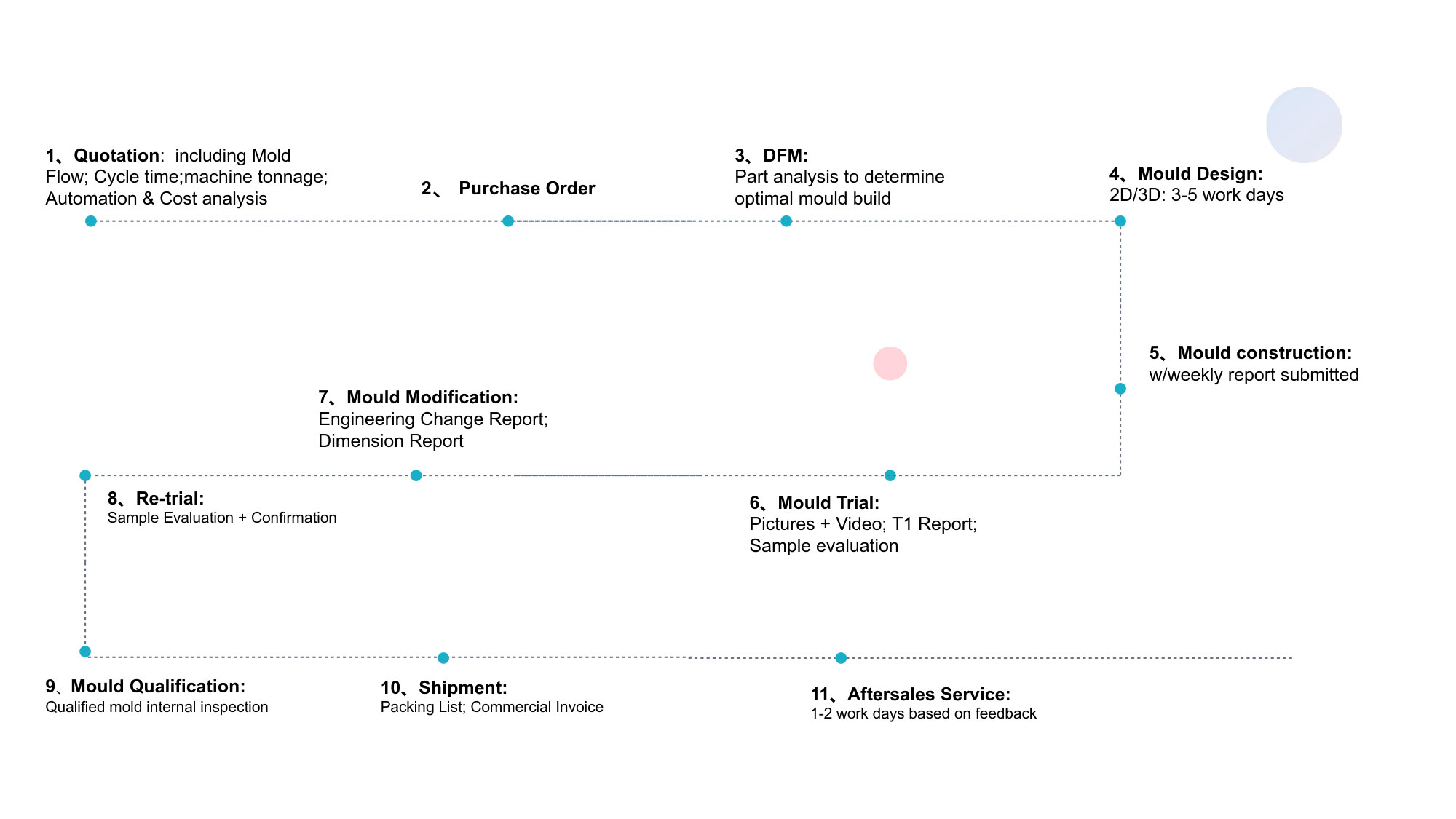
6.1 New Project Initiation — From Concept to Production in 12–14 Weeks
Phase Activities Timeline Deliverable
Phase 1 — Initiation Requirements review; material recommendation; preliminary costing 1–2 days NRE quote; preliminary schedule
Phase 2 — DFM Full DFM analysis; MFA simulation; gate placement study 5–7 days DFM report; engineering sign-off
Phase 3 — Mold Fab Steel selection; 5-axis CNC; EDM; assembly; 2000-test 25–35 days T0 mold; test shots
Phase 4 — Process Dev DOE optimization; Cpk study; pressure/temperature validation 7–10 days OQ/PQ protocols; validated process window
Phase 5 — Validation IQ/OQ/PQ documentation; run@rate; capability verification 5–7 days Validation report; production release
Phase 6 — Production Ramp to full volume; packaging; sterilization; shipment Ongoing Monthly production; continuous improvement
6.2 Early Engagement — Prototype and Low-Volume Bridge Tooling
For customers still in product development, Ansix offers: aluminum prototype molds for 50–500 part clinical trials (2–3 week turnaround), rapid tooling for 5,000–20,000 parts (4–6 week turnaround on simple geometries), and soft tooling for process development while waiting for production mold. The DFM analysis from the prototype stage feeds directly into final production tooling, eliminating redundant engineering. [Value: Clinical trial inventory without waiting months for hard tooling; final production mold arrives with fewer iterations because we validated the design in low-cost tooling first]
6.3 Assembly and Secondary Operations Integration
Beyond injection molding, Ansix performs value-added assemblies: ultrasonic welding of two-shot components, pad printing of logos/part numbers, heat staking for mechanical assembly, heat-shrink packaging, and full device assembly (cap+component packaging). All assembly operations occur under the same ISO 13485-certified quality system with full traceability. [Value: Reduce supply chain complexity — one vendor for molding, assembly, and packaging means single quality system, single logistics interface, single point of accountability]
6.4 Logistics, Packaging, and Shelf-Life Management
Medical device packaging requires stringent controls to maintain sterility assurance. Ansix provides: cleanroom-grade heat-sealed pouches or Tyvek® medical packaging, validated E-beam/gamma sterilization compatibility, lot number coding per FDA 21 CFR 820 traceability, bar-coded outer cartons with content manifests, and just-in-time inventory management with bonded warehouse storage. [Value: Ship-ready packaging — peel-open pouches for operating room use require no secondary repackaging by you]
6.5 Maintenance, Service, and Long-Term Partnership
Ansix supports customers throughout the mold lifecycle: spare parts kit (ejector pins, core pins, slides, heating elements) delivered with every new mold, documented preventive maintenance schedule, mold condition monitoring through production data trending, long-term obsolescence planning (spare cavity insert storage), and 24/7 technical support for urgent production interruptions. *[Value: Your 5-year-old mold runs as well as week one — like an aircraft, regular scheduled maintenance keeps it in peak condition, and we manage that schedule for you]*
Conclusion: Choosing Ansix Tech as Your IV Cannula Cap Manufacturing Partner
IV cannula caps may be small, but their impact on patient outcomes and healthcare economics is significant. In selecting a manufacturing partner, customers choose between:
A commodity supplier who quotes low price but delivers high scrap, inconsistent quality, and frequent mold repairs; or
Ansix Tech — an engineering-driven partner who reduces your total cost, eliminates production risk, and accelerates market access.
Ansix Tech delivers measurable value: Reduced material cost and faster cycles improving piece-part cost by 15–25%; lower risk through ISO 13485 certification, full traceability, and 3-year mold warranty; faster time-to-market with 12–14 week tool-to-part lead times and DFM-driven validation; improved quality with Cpk≥1.33 and ≤0.8% scrap — providing reliability that clinicians and patients depend on; and less complexity through cleanroom molding, automated inspection, packaging, and assembly.
We invite decision-makers to experience the Ansix difference firsthand through a no-obligation DFM consultation. Provide an existing IV cannula cap CAD model or drawing — within five business days, Ansix will deliver:
Full DFM feasibility analysis with gate location, fill simulation, and cooling strategy
Mold steel and material cost estimate complete with 3-year warranty pricing
Production timeline
2–3 specific, actionable cost-reduction recommendations (wall thickness, gate placement, material grade, cycle time optimization)
We do not sell molds as commodities. We engineer manufacturing assets that drive value for your business. Partners choose Ansix Tech because our 28 years of experience, advanced manufacturing infrastructure, engineering rigor, and unwavering commitment to quality assurance make us the reliable choice for mission-critical medical device components. Contact Ansix Tech today to begin the conversation about optimizing your IV cannula cap manufacturing program.
Ansix Tech — Precision Molded for Patient Safety and Healthcare Excellence.
Ansix Tech Co Ltd
If you have any plans related to IV Cannula Cap Mold , you can contact us at any time. We will turn your ideas into reality, let you realize your dreams, and obtain large orders from the market. Our contact information is info@ansixtech.com. Or contact our CTO, mail: stephen@ansixtech.com
#www.ansixtech.com #ansixtech.com #IV Cannula Cap Mold #IV Cannula Cap Mold moulds #IV Cannula Cap Mold injection molding companies #IV Cannula Cap Mold Canopy Mold injection mold companies #Ansix #Ansix moulds #Ansix china #Ansix tech china #Ansix tech company #Ansix facotry #IV Cannula Cap Mold injection molding #IV Cannula Cap Mold injection tools #IV Cannula Cap Mold injection moulds #IV Cannula Cap Mold plastic mould #IV Cannula Cap Mold plastic tools #Ansix Tech #Ansix molds #Ansix injection molding #Ansix mold factory #injection molding IV Cannula Cap Mold #Ansix mold factory #IV Cannula Cap Mold china #IV Cannula Cap Mold molds #injection factory #IV Cannula Cap Mold injection molding #IV Cannula Cap Mold injection molding factory #injection molding company #IV Cannula Cap Mold injection mold companies #IV Cannula Cap Mold#IV Cannula Cap Mold mold limited #Ansix mold china #Ansix companies #Ansix company China #IV Cannula Cap Mold facotry #Ansix Tech #Ansix Tech mould #IV Cannula Cap Mold injection moulding #injection moulding company #Ansix IV Cannula Cap Mold parts injection mold companies #medical injection molding companieschina #IV Cannula Cap Mold china factory #Ansix moulding companies #Ansix molding company #IV Cannula Cap Mold injection moulding facotry #Ansix Tech mold #IV Cannula Cap Mold mould #IV Cannula Cap Mold plastic injection molding #ansix plastic mold #Mold manufacturing #IV Cannula Cap Mold parts manufacturing #IV Cannula Cap Mold plastic parts factory #IV Cannula Cap Mold injection parts mold #IV Cannula Cap Mold PRECISION MANUFACTURING #IV Cannula Cap Mold #China mold #IV Cannula Cap Mold injection moulding china #IV Cannula Cap Mold mould china #china precision mold #mold in china #IV Cannula Cap Mold mold china #Precision molds #High-precision molds #IV Cannula Cap Mold #Injection molds #IV Cannula Cap Mold Factory #IV Cannula Cap Mold Company #Super Large Injection Mold Factory #Large Tonnage Injection Molding Factory #IV Cannula Cap Mold Company #IV Cannula Cap Mold Factory #2800T Injection Molding Factory #3000 Ton Injection Molding #4500 Ton Injection Molding Factory #Large Mold Injection Molding #Large Plastic Mold Injection Molding Factory #Large Injection Mold Manufacturer #Plastic Mold Factory #Injection Mold #Plastic Mold