



Medical Probe Cover
FEATURES
This document outlines how Ansix Tech converts technical excellence into measurable outcomes: cost reduction, risk mitigation, quality assurance, and supply chain reliability. Every machining tolerance, every mold steel selection, and every process parameter translates directly into customer value.
Section One: Building Trust Through Hard Asset Capabilities
CNC Machining and Precision Machining Center
Technical Capability: Ansix Tech operates advanced five-axis high-speed machining centers with precision capabilities reaching 0.002mm (±0.00008 inches). The company maintains an automated machining ratio of 70%, supported by wire EDM systems capable of cutting micro-pores and narrow slots down to 0.03mm without causing thin-wall deformation.
-
Mold Description
Product Materials:
ABS/PC
Soft rubber: TPR
Mold Material:
S136ESR
Number of Cavities:
3
Glue Feeding Method:
cold runner
Cooling Method:
Water cooling
Molding Cycle
22.5s

Customer Value Translation:
Smooth, mark-free parting lines on Medical Probe Covers eliminate post-molding finishing operations. When a probe cover requires a smooth exterior surface to avoid patient discomfort and ensure proper acoustic transmission, any parting line imperfection creates a rejection point. Ansix Tech‘s 0.002mm machining precision guarantees that customers never spend manual labor or capital on de-flashing operations—direct savings range from
0.15 to 0.15to0.45 per part depending on volume. For a million-part annual program, that’s 150,000 to150,000to450,000 in eliminated secondary operations.
Injection Molding Machine Fleet
Technical Capability: Ansix Tech operates 260 injection molding machines across four production bases in China and Vietnam, with clamping force ranging from 30 tons to 2,800 tons(extending to 4,000 tons across the group). All machines feature all-electric servo drive systems with closed-loop feedback control, delivering repeatable precision of ±0.1%. Total facility area exceeds 200,000 square meters with ISO 8 cleanroom environments.

Customer Value Translation:
The 30T to 2800T clamp force range means Medical Probe Covers—from slender thermometers to large ultrasound probes—have a machine perfectly matched to their geometry and material viscosity. Correct machine sizing prevents over-investment in a larger press than needed while ensuring adequate pressure for complex fills. The ±0.1% shot-to-shot repeatability translates directly into part-to-part consistency. Customers don‘t worry about the 10,000th part differing from the first. For medical OEMs requiring FDA 510(k) submissions, this stability provides the documentation backbone proving process control.
Inspection and Metrology Equipment
Technical Capability: Ansix Tech‘s quality infrastructure includes coordinate measuring machines(CMMs)and optical imaging systems. Every mold undergoes full dimensional inspection before shipment, with critical dimension reporting against print. Process capability targets CPK ≥ 1.33 on all medical-grade characteristics.
Customer Value Translation:
CPK ≥ 1.33 is not an engineering statistic—it is a regulatory passport. For Medical Probe Covers requiring ISO 13485 compliance, CPK data provides the objective evidence that regulators require. When a customer faces a FDA audit, Ansix Tech‘s documented capability studies answer questions before they are asked. The average mold trail of 2 times means parts validate faster, shaving weeks from product launch timelines.
Section Two: Mold Manufacturing Core Competencies
Mold Life with Engineered Material Selection
Technical Capability: Ansix Tech designs and builds injection molds optimized for both abrasive and standard resins. For glass-fiber-reinforced engineering plastics, mold life guarantees reach 500,000 cycles. For unfilled thermoplastics, mold life reaches 1,000,000 cycles. The steel selection hierarchy is mapped to application requirements:
Application Demand Steel Grade HRC Hardness Value to Customer
High-volume, abrasive resins (PPS+40%GF, PA6+GF30, PEEK) H13(1.2344) 48-52 500,000+ cycles without wear-related dimensional drift
Corrosion resistance + optical clarity (transparent probe covers) S136/420(1.2083) 48-52 Mirror-polished finishes; no corrosion from sterilization protocols
High-toughness, impact-resistant applications 2344/2343/SKD11/SKD61 50-58 Crack prevention under cyclic thermal stress
Pre-hardened, general-purpose medical components P20(1.2311)/718/2738 28-32 Cost-effective medium-volume production
High-performance medical-grade precision parts M340/4Cr13/9Cr18/NAK80 40-52 Excellent polishability and dimensional stability
Specialized DC53 wear applications DC53 58-62 Extended life for high-wear applications
Medical-grade stainless with full traceability 8407 48-52 Full material certification for regulatory compliance
Customer Value Translation:
Selecting the wrong mold steel costs customers in three ways: unexpected mold replacements, part quality degradation, and regulatory re-validation expenses. Ansix Tech‘s material mapping eliminates guesswork. For a Medical Probe Cover molded in PPS+40%GF operating in sterilization cycles, H13 with TiN coating delivers 500,000+ shots. For a clear PC probe cover requiring optical transparency, S136 provides the mirror finish needed—SPI A1 finish, Ra < 0.05 μm. Every mold ships with certified material test reports and documented heat treatment curves, providing traceability required for ISO 13485 audits.
Achievable Tolerances
Technical Capability: Standard structural features ±0.05mm. Precision medical components—including gear teeth, sealing lands, and critical mating surfaces—achieve ±0.005mm.
Customer Value Translation:
A medical probe has a simple requirement: the cover must fit correctly. Too loose, and acoustic signal degrades; too tight, and the probe cannot be inserted. For a fit dimension of 10.00mm ±0.05mm, the customer never experiences field failures. For critical features like ultrasonic transmission windows, the ±0.005mm precision ensures consistent acoustic coupling from part to part, eliminating field callbacks.
Mold Type Specialization
Technical Capability: Ansix Tech delivers across the full spectrum of mold architectures: hot runner systems for material-saving production, stack molds for doubling output from one press, two-shot/multi-material molds for overmolded soft-touch grips, and high-gloss molds (Ra < 0.05μm) for transparent covers.
Customer Value Translation:
Hot runner systems reduce scrap material by eliminating cold runner waste. For medical-grade engineering resins costing $50-200 per kilogram, that‘s 10-20% raw material savings directly to the bottom line. Multi-cavity tools with balanced thermal control increase output per machine hour, lowering piece-part price. High-gloss finishes eliminate post-molding polishing operations entirely.
Gating Strategy and Flow Optimization
Technical Capability: Using Autodesk Moldflow simulation, Ansix Tech identifies weld line locations, air trap zones, and fill imbalances before steel is cut.
Customer Value Translation:
Weld lines are more than a cosmetic defect—they are mechanical weak points where a probe cover can crack under sterilization stress. By predicting and repositioning weld lines to non-critical locations, Ansix Tech ensures the part maintains structural integrity through its entire service life. Early-stage optimization means no post-mold rework, no tool modifications, and no project delays. DFM has been shown to reduce injection molding costs by 10% to as much as 50% for medical components.
Delivery Timelines
Technical Capability: Prototype/soft tooling: 10 days. Medium-complexity production molds: 25-45 days. Expedited service: 20 days with full validation steps preserved.
Customer Value Translation:
Six weeks to market vs. twelve weeks means the customer‘s revenue recognition starts two months sooner. Expedited service does not mean compromised quality—tight lead times are achieved through parallel engineering and 70% automated machining, not through skipped inspection steps.
Section Three: Injection Molding Process ControlProcess Standardization and MES Integration
Technical Capability: All injection molding machines connect to a Manufacturing Execution System(MES)that locks critical parameters—temperatures, pressures, injection speeds, cooling durations, and hold times. Only authorized engineering personnel can modify settings. Every production batch completes first-article and last-article dimensional inspection.
Customer Value Translation:
Medical device manufacturers face increasing regulatory scrutiny of process control documentation. MES locking provides the data trail regulators demand. When a production run requires full traceability, Ansix Tech delivers a complete parameter history. For customers holding ISO 13485 certification, this is not optional—it is required. The cost of non-compliance is measured in product recalls, destroyed inventory, and lost market trust.
Dimensional Stability Control
Technical Capability: Molds integrate zone-controlled temperature management, maintaining core-cavity temperature differentials below 2°C to minimize warpage and distortion. In production verification, key hole-to-hole spacing measurements across three consecutive production weeks show variation ≤ 0.02mm.
Customer Value Translation:
Medical probe covers often have precise alignment features that index to internal electronic components. A 0.02mm shift in hole spacing can mean 10% field failure rates. Ansix Tech‘s thermal control strategy ensures that parts produced on Monday, Wednesday, and Friday in different weeks all fit the same assembly fixtures. No assembly line stoppages, no rework stations, no scrap piles of “close but not quite” parts. For high-volume production, even a 0.5% scrap rate reduction saves thousands annually.
Surface Quality and Appearance Standards
Technical Capability: Transparent optics—no bubbles, no flow marks. Electroplating-ready surfaces—no gas marks, no surface voids. High-gloss finishes—surface roughness Ra ≤ 0.2μm. For printed or coated surfaces, shrinkage compensation is engineered into the mold to maintain print registration accuracy of ±0.1mm.
Customer Value Translation:
A probe cover with cosmetic defects is functionally the same part as a perfect one—but the customer cannot sell it. FDA-regulated medical devices require consistent appearance as part of their validated configuration. By eliminating cosmetic rejects at the molding press, Ansix Tech delivers first-pass yield rates exceeding 98% for most programs. The alternative—sorting, rework, or scrapping—adds real cost that directly reduces profit margin.
Specialized Material Processing Expertise
Technical Capability: Ansix Tech maintains extensive processing experience across the medical material spectrum, supported by an in-house materials database that enables selection from thousands of polymer grades based on simulation results:
Material Regulatory Compliance Key Properties for Probe Covers
PC/ABS blends ISO 10993 Impact resistance, dimensional stability, gamma sterilization compatible
PC(Polycarbonate) ISO 10993 Optical clarity, high strength, heat resistance for autoclavable covers
PPS + 40% GF USP Class VI High-temperature stability, chemical resistance for aggressive sterilization
PEEK USP Class VI, ISO 10993 Exceptional mechanical strength, 250°C+ HDT, steam sterilizable
PTFE/PFA USP Class VI Chemical inertness, low friction surface for smooth insertion
PA6 + GF30 ISO 10993 Stiffness for thin-wall designs with reinforcement needs
PBT ISO 10993 Electrical insulation, dimensional stability
PEI(Ultem) USP Class VI, ISO 10993 High heat deflection, flame resistance
LCP USP Class VI Extremely thin walls, excellent flow characteristics
Liquid Silicone Rubber(LSR) ISO 10993, USP Class VI Soft-touch overmolding, biocompatible skin contact
For polypropylene(PP)and polyethylene(PE)covers prioritizing chemical resistance and low cost, Ansix Tech applies corrosion-resistant S136 mold steel to prevent tool degradation from PVC or sterilization agent exposure.
Regulatory Compliance: Ansix Tech validates UL94 V-0 flame-retardant rating for electronics-adjacent covers and conducts UV aging verification(3,000 hours minimum, color change ΔE < 2.0 and no mechanical property degradation).
Section Four: Full-Service Lifecycle Support
Early-Stage DFM Development
Technical Capability: Before mold construction begins, Ansix Tech provides a Design for Manufacturability(DFM)report. Using Moldflow simulation, engineers evaluate draft angle feasibility, wall thickness uniformity, gate location options, and ejector pin marking allowances.
Customer Value Translation:
Approximately 70% of injection mold project cost overruns originate from design-phase assumptions that cannot survive manufacturing reality. Ansix Tech‘s pre-contract DFM review catches these conflicts when changes are still free. Standard recommendations include:
Uniform wall thickness suggestions(variation < 15%)to prevent sink and void formation.
Draft angles(≥ 1° to 2°)specified based on polish/texture requirements.
Gate location optimized for balanced fill, eliminating weld lines in acoustic-critical areas.
Ejector pin marking positioned on non-cosmetic surfaces.
Customers who receive DFM-driven mold designs typically see 15-35% lower tooling rework costs and avoid 8-12 weeks of schedule delays from late-stage design changes.
Mold Trials and Iterative Sampling
Technical Capability: Ansix Tech delivers T0 through T3 sampling rounds with improvement reports documenting adjustments between iterations. The company maintains rapid-change insert capabilities that allow different gate or cooling configurations to be tested without rebuilding entire mold sets.
Customer Value Translation:
Every mold trial iteration provides physical samples for customer function testing. Instead of waiting eight weeks to discover the gate is poorly positioned, Ansix Tech provides sample parts in days. Rapid-change inserts allow A/B testing of design alternatives without incremental tooling charges. For a typical medical device qualification timeline, this compressed iteration cycle reduces time-to-market by 4-6 weeks.
Pilot Production Validation
Technical Capability: Before full-scale manufacturing release, Ansix Tech conducts pilot runs of 100 to 500 shots at target production settings. Every pilot lot undergoes yield analysis and CPK calculation across all critical dimensions.
Customer Value Translation:
Pilot production is the “dress rehearsal” before full-scale operations launch. It catches process sensitivities, material lot variations, and fixture alignment issues when the only cost is time. For a Medical Probe Cover requiring sterilization validation, pilot data provides the engineering proof that production runs will succeed. Customers receive:
Verified process window settings
Documented CPK values for regulatory files
Confirmed second-operation packaging compatibility
No surprises. No mid-run shutdowns. No recall events.
Maintenance and Spare Parts Management
Technical Capability: Each mold ships with a complete set of spare wear components—ejector pins, core inserts, and sealing elements. Maintenance intervals are defined for 200,000-cycle service inspections. Ansix Tech offers lifetime repair services at material cost.
Customer Value Translation:
Medical probe cover molds operating three shifts daily see wear that, undetected, produces 10,000 out-of-spec parts before discovery. Ansix Tech‘s preventative maintenance program catches wear early—at 200,000 cycles, not 300,000. On-site spare components mean a broken ejector pin does not become a production stoppage waiting for express shipping. Lifetime cost of ownership drops 20-30% compared to “build and forget” mold sourcing.
Section Five: Differentiators and Customer Commitments(差异化对比与明确承诺)
Aging and Wear Validation
Customer Complaint: Molds require frequent maintenance, causing production interruptions and order delays.
Ansix Tech Commitment: Every mold completes a 2,000-cycle aging test before customer shipment, with documented wear analysis at 0, 500, 1,000, 1,500, and 2,000 cycles. Ansix Tech extends a three-year structural warranty on all molds(excluding normal wear components). Component-level traceability ensures specific wear trends are documented per cavity location.
Flash Elimination
Customer Complaint: Flash formation requires secondary deflashing, increasing labor cost and risking part damage.
Ansix Tech Response: Ansix Tech machines parting surfaces to 0.005mm fit precision—five times tighter than industry standard. Self-locking clamp force compensation maintains this precision across production runs. Day-one flash is controlled below 0.03mm, eliminating manual deflashing operations entirely. For a high-volume program, eliminating deflashing saves
0.10
t
o
0.10to0.25 per part.
Dimensional Consistency Across Batches
Customer Complaint: The same part measures differently when produced on different batches or days.
Ansix Tech Solution: Ultrasonic wall thickness sensors provide real-time feedback as parts are molded. The control system automatically adjusts packing pressure to compensate for material viscosity variations. In-mold thermal sensors with closed-loop control detect and correct temperature deviations before they affect the part. For customers who have struggled with inconsistent fits, Ansix Tech‘s real-time adjustments eliminate the “good week / bad week” production cycle.
Rapid Repair Response
Customer Complaint: Mold repairs take weeks, halting production lines.
Ansix Tech Standard: Ansix Tech operates internal electrode manufacturing and EDM departments, meaning mold repairs never leave the facility. Standard welding and insert replacement tasks restore production within 24 hours. For Medical Probe Cover programs with emergency orders, this responsiveness prevents missed delivery commitments.
Comprehensive Cost Reduction Strategy
Material Cost Optimization
Ansix Tech reduces material costs through three channels:
Grade Substitution: Ansix Tech maintains relationships with major resin suppliers and can recommend functionally equivalent grades that cost 10-25% less than customer-specified alternatives. All recommended materials undergo full ISO 10993 or USP Class VI verification.
Runner Minimization: Hot runner systems eliminate cold runner waste entirely. For engineering resins, this 10-20% raw material savings directly improves gross margin.
Scrap Reduction: First-pass yield rates exceeding 98% mean 98% of purchased resin becomes sellable product—not regrind or landfill.
Cycle Time Efficiency
Cycle time reductions directly lower piece-part cost. Ansix Tech achieves cycle time optimization through:
Conformal cooling channels that remove heat 30-50% faster than straight-drilled cooling.
Moldflow-simulated cooling circuits that eliminate hot spots requiring extended cooling dwell.
Scientific molding optimization of fill, pack, and hold stages, ensuring each phase operates at minimum required duration.
Application‑controlled conformal cooling that can reduce cycle times by up to 30%(depending on material and part geometry).
For a 10-second cycle time part, a 30% reduction to 7 seconds increases daily output from 8,640 to 12,343 parts on a single machine—without adding capital equipment.
Risk Mitigation Value
Medical Probe Cover projects carry five primary risk categories:
Risk Category Ansix Tech Mitigation Strategy Cost of Failure Avoided
Regulatory non-compliance ISO 13485:2016 certified; material certifications(USP Class VI, ISO 10993)and full traceability $250,000+ product recall
Dimensional inconsistency CPK ≥ 1.33 documented capability; in-mold wall thickness sensors $50,000+ in scrap/field failures
Surface defects causing rejection DFM-driven gate placement eliminating cosmetic defects $0.10-0.30 per part scrap cost
Mold wear causing drift 2,000-cycle wear testing; documented material grade recommendations $20,000-50,000 unscheduled tool repair
Supply disruption across borders 4 production bases in China + Vietnam; 200,000㎡ facility footprint Weeks of lost revenue
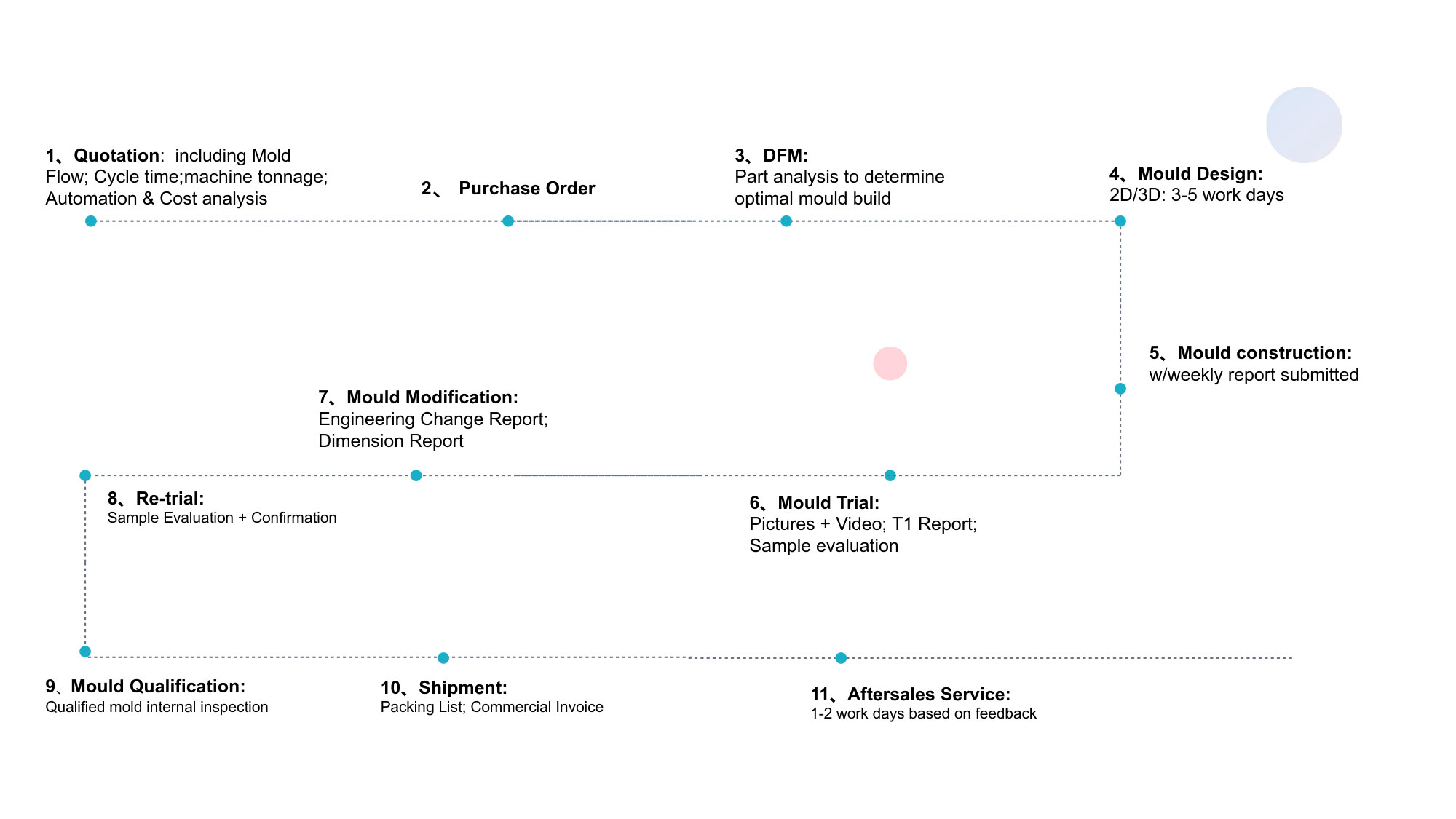
The Ansix Tech Comprehensive Workflow for Medical Probe Covers
Phase 1: Digital Foundation
At Ansix Tech, every medical component begins with rigorous DFM analysis. Engineers create digital twins of both mold and plastic flow using Moldflow simulation, predicting fill patterns, pressure requirements, cooling time, and defect locations including weld lines, air traps, and sink marks.
Phase 2: Strategic Material Selection
The performance of a medical probe cover depends entirely on its material. Ansix Tech’s material database spans thousands of polymer grades. Common selections for Medical Probe Covers include:
PP/PE: Chemical resistance, flexibility, low cost—ideal for disposable protective covers.
PC/ABS: Excellent rigidity, impact strength, gamma sterilization compatibility.
PC: High strength, heat resistance, and optical clarity for transparent covers.
PEEK/PEI(Ultem): Maximum high-temperature performance for repeatedly sterilized covers.
LSR: Soft-touch overmolding for patient-contact comfort areas.
Phase 3: Mold Engineering
Mold design proceeds with full consideration of high-volume production demands:
Cooling system design: Conformal cooling integrated where wall thickness variations or thick hubs require accelerated heat removal.
Gating strategy optimization: Gate location selected to position weld lines away from acoustic transmission zones.
Ejection system design: Ejector pin placement avoids cosmetic surfaces and ensures clean, repeatable demolding.
Multi-cavity balance: For high-output probe cover programs, balanced runners and thermal management ensure each cavity produces identical parts.
Phase 4: Precision Mold Processing
Manufacturing challenges specific to Medical Probe Cover molds include extreme thin-wall sections, high-aspect-ratio cavities, and surface finish demands(SPI A1 or diamond-turned)for optical clarity. Ansix Tech‘s mold processing workflow includes:
Rough and finish operation sequencing managed for geometric accuracy.
Heat treatment cycles documented with time-temperature profiles.
Precision grinding for mating surfaces.
Hand polishing for final surface finish on transparent or high-gloss cavities.
Phase 5: Validation and Production Qualification
Ansix Tech follows IQ(Installation Qualification),OQ(Operational Qualification),and PQ(Performance Qualification)protocols required for ISO 13485 compliance:
IQ: Mold functionality testing and initial sample production.
OQ: Process window establishment and CPK evaluation at high/low process limits.
PQ: Three production runs at nominal settings proving repeatable conformance.
Phase 6: Packaging and Logistics
Final steps ensure Medical Probe Covers arrive ready for the customer‘s assembly line:
Cleanroom-compatible packaging protecting surface quality.
Cavity-specific labeling for traceability.
Expedited logistics with documented shipping protocols.
Consignment inventory options eliminating customer warehousing costs.
Conclusion: Your Probe Cover Is a Revenue Engine, Not a Cost Center
A well-designed mold is not a piece of steel—it is a revenue generator. Ansix Tech designs molds with systematic consideration of cooling balance, venting pathways, thermal distribution, and ejection reliability, ensuring that on the customer’s production line, the mold runs first time, every time.
The offer is straightforward: Provide an existing product drawing, and Ansix Tech will deliver a full DFM walkthrough, demonstrating exactly how weld lines, air traps, sink marks, and dimensional variation risks are eliminated upstream—before steel is cut.
With over 28 years of experience, more than 30,000 molds built since establishment, ISO 13485:2016 certification, and a proven track record across automotive, medical, smart home, and commercial communications equipment, Ansix Tech makes customer success the mission. The question is not whether Ansix Tech can build a Medical Probe Cover mold—the question is how much lower the total cost of ownership will be, how much faster the customer will reach market, and how much risk will be engineered out of the process before problem escalation. The answer, documented and proven, is delivered in every mold that leaves the facility.
Ansix Tech Co Ltd
If you have any plans related to Medical Probe Cover , you can contact us at any time. We will turn your ideas into reality, let you realize your dreams, and obtain large orders from the market. Our contact information is info@ansixtech.com. Or contact our CTO, mail: stephen@ansixtech.com
#www.ansixtech.com #ansixtech.com #Medical Probe Cover #Syringe mold moulds #Syringe mold molds #Syringe mold injection molding companies #Medical Probe Cover Canopy Mold injection mold companies #Ansix #Ansix moulds #Ansix china #Ansix tech china #Ansix tech company #Ansix facotry #Syringe mold injection molding #Syringe mold injection tools #Syringe mold injection moulds #Syringe mold plastic mould #Syringe mold plastic tools #Ansix Tech #Ansix molds #Ansix injection molding #Ansix mold factory #injection molding Syringe mold #Ansix mold factory #Syringe mold china #Syringe mold molds #injection factory #Syringe mold injection molding #Syringe mold injection molding factory #injection molding company #Syringe mold injection mold companies #Syringe mold#Syringe mold mold limited #Ansix mold china #Ansix companies #Ansix company China #Syringe mold facotry #Ansix Tech #Ansix Tech mould #Syringe mold injection moulding #injection moulding company #Ansix Syringe mold parts injection mold companies #medical injection molding companieschina #Syringe mold china factory #Ansix moulding companies #Ansix molding company #Syringe mold injection moulding facotry #Ansix Tech mold #Syringe mold mould #Syringe mold plastic injection molding #ansix plastic mold #Mold manufacturing #Syringe mold parts manufacturing #Syringe mold plastic parts factory #Syringe mold injection parts mold #Syringe mold PRECISION MANUFACTURING #Syringe mold #China mold #Syringe mold injection moulding china #Syringe mold mould china #china precision mold #mold in china #Syringe mold mold china #Precision molds #High-precision molds #Syringe mold #Injection molds #Syringe mold Factory #Syringe mold Company #Super Large Injection Mold Factory #Large Tonnage Injection Molding Factory #Syringe mold Company #Syringe mold Factory #2800T Injection Molding Factory #3000 Ton Injection Molding #4500 Ton Injection Molding Factory #Large Mold Injection Molding #Large Plastic Mold Injection Molding Factory #Large Injection Mold Manufacturer #Plastic Mold Factory #Injection Mold #Plastic Mold