



Medical Ultrasonic Scalpel Trigger Mold
FEATURES
Ansix Tech, established in 1998 and operating with over 28 years of injection molding expertise, has positioned itself as a global leader in one-stop injection molding solutions for medical device applications [10†L6-L8]. With four production bases spanning China and Vietnam, 260 injection molding machines ranging from 30 tons to 2,800 tons, over 1,200 employees, and ISO 13485:2016 certification, Ansix Tech brings a proven ecosystem to Medical Ultrasonic Scalpel Trigger projects
This article demonstrates how Ansix Tech transforms technical excellence into measurable customer value—addressing specific pain points, reducing costs, lowering risks, and accelerating time-to-market.
-
Mold Description
Product Materials:
PC Overmolding TPE
Soft rubber: TPE
Mold Material:
S136ESR
Number of Cavities:
1
Glue Feeding Method:
Hot runner
Cooling Method:
Water cooling
Molding Cycle
22.5s

Foundation of Excellence—The “Hard Power” That Builds Customer Trust
Every precision-driven medical component begins with the equipment that creates the tool. Ansix Tech’s shop floor represents a deliberate investment in machines that deliver uncompromising accuracy.
Mold Machining Equipment: Turning Submicron Specifications into Reality
Medical ultrasonic scalpel triggers demand flawless surface finishes and seamless parting lines—any micro-flash or burr presents potential contamination points or assembly interference. Ansix Tech’s 5-axis high-speed CNC machining centers achieve critical feature tolerances of ±0.002 mm, with surface roughness down to Ra 0.025 µm. For context, this exceeds standard industry benchmarks by a factor of 5 to 10 times.
-
What this means for customers:
Parting lines are smooth and virtually invisible – no secondary finishing operations required, eliminating labor-intensive deburring
Complex geometries including 3D contoured trigger surfaces are machined in a single setup – no cumulative alignment errors from multiple fixturing steps
Lead times compressed – 5-axis simultaneous machining eliminates multiple setups and repositioning errors that plague 3-axis+rotary approaches
Additionally, Ansix Tech utilizes slow wire EDM (Electrical Discharge Machining) capable of creating micro-vents as small as 0.03 mm diameter and narrow slots with exceptional aspect ratios. For ultrasonic scalpel triggers—particularly those incorporating living hinges or snap-fit mechanisms—these capabilities prevent thin-wall deformation during ejection, a common failure mode in medical handpiece components.
Customer value translation: “Our 5-axis CNC platform ensures your trigger’s critical contact surfaces achieve ±0.002 mm accuracy out of the machine. This means predictable assembly fit, consistent trigger pull force, and zero rework across millions of cycles.”
1.2 Injection Molding Machine Fleet: Consistency from Shot to Shot
Ansix Tech operates 260 injection molding machines spanning 30 tons to 2,800 tons, encompassing major brands including Japan’s Fanuc, Sumitomo, Toshiba, Nissei, Germany’s Engel and Arburg (specializing in liquid silicone rubber multi-component), plus China’s Haitian and Victor Taichung machinery [9†L11-L17]. All-electric servo-driven machines dominate the fleet for medical production, delivering closed-loop position control with high-resolution feedback [7†L22-L26].
For an ultrasonic scalpel trigger, this translates into:
Shot-to-shot weight consistency within ±0.1% across multi-cavity molds [7†L40-L43]
Hold pressure accuracy settable to 1 kg/cm² , ensuring every trigger achieves uniform packing density and predictable shrinkage [17†L14-L15]
PID temperature control with zones settable to 0.1°C and 2-second sampling intervals , ensuring melt consistency despite variations in ambient shop-floor conditions [17†L16-L18]
Customer value translation: “Whether your order is for 5,000 or 500,000 triggers, Part #1 and Part #500,000 will be dimensionally identical. Your downstream automated assembly line will never need recalibration mid-batch.”
1.3 Quality Inspection Infrastructure: Evidence-Driven Compliance
Ansix Tech deploys coordinate measuring machines (CMM) and optical vision inspection systems throughout the mold fabrication and production phases. Every mold undergoes a full dimensional report before shipment, and during production, all critical-to-quality features are monitored with process capability indices maintained at CPK ≥ 1.33—equivalent to 99.993% product conformance [6†L24-L26] [16†L30-L35]. Some implantable-grade projects achieve CPK ≥ 1.67 (99.9997% conformance).
For medical ultrasonic scalpel triggers, which frequently interface with handpiece assemblies at sub-millimeter clearance, this level of control means:
Triggers consistently fit the mating housing – no line-side reaming or selective assembly
Verifiable quality records for FDA/MDR submissions – full dimensional traceability
Lowered risk of field failures – non-conforming parts are detected before they ship
Section 2: Mold Manufacturing Core Competencies—Speaking in Metrics Customers Understand
Customers evaluate mold suppliers on four dimensions: life, precision, lead time, and maintenance cost. Below is how Ansix Tech addresses each with verifiable commitments.
2.1 Mold Life Predictability
Mold material selection directly dictates total cost of ownership. Ansix Tech specifies materials based on production volume and resin aggressiveness:
Mold Component Material Options Hardness (HRC) Application Context
Mold Base P20 (pre-hardened) 30–36 Structural foundation, general-purpose runs [13†L5-L9]
Cavity/Core (High Wear) H13 (DIN 1.2344), 8407 48–52 Glass-filled resins (PPS+40%GF, PA6+GF30), high-cycle production [13†L14-L20]
Cavity/Core (Corrosive) S136, M340, 4Cr13, 9Cr18 48–60 Medical-grade transparent triggers requiring mirror finish and corrosion resistance [14†L10-L17]
Sliders/Inserts DC53, SKD11, SKD61 58–62 High-wear movable components
High-Polish Applications NAK80 37–43 Pre-hardened, excellent polishability for A-surface triggers [13†L32-L38]
Commitment:
Glass-fiber reinforced materials – 500,000 mold cycles guaranteed
Non-reinforced engineering plastics – 1,000,000+ cycles with proper maintenance
Material certification reports and heat treatment curves provided with every mold
Customer value translation: “Our molds are not consumables—they are capital assets. One Ansix mold produces your triggers for years, not months. You amortize tooling cost over 500,000+ parts, not 100,000.”
2.2 Achievable Tolerances
Feature Category Standard Capability Premium Capability Industry Benchmark
General structural dimensions ±0.05 mm ±0.02 mm ±0.10 mm
Precision mating surfaces ±0.01 mm ±0.005 mm ±0.02 mm
Trigger actuation geometry ±0.008 mm ±0.003 mm ±0.015 mm
Pitch/Linear tolerances ±0.02 mm per 100 mm ±0.01 mm per 100 mm ±0.05 mm per 100 mm
For medical triggers, gear-like precision at microscopic scale is non-negotiable—typical achievable tolerance is ±0.005 mm for critical features.
2.3 Mold Type Capabilities
Mold Technology Capability Value to Customer
Hot runner systems Multi-drop, valve gate, sequential valve gate Zero runner waste for high-cavitation medical triggers
Stack molds 2-face or 3-face configurations 200% productivity increase without additional machine tonnage
Two-shot/Multi-material molds Rotary platen, core back, or overmolding Triggers with integrated soft-touch elastomer grips in one cycle
High-gloss / Mirror-finish molds Ra < 0.05 µm Transparent or cosmetic triggers require no post-polishing
Customer value translation: “If your trigger design includes a soft elastomeric overmold for surgeon comfort, we build a two-shot mold that produces the complete assembly in a single cycle—no secondary assembly, no adhesive, no alignment error.”
2.4 Gate and Runner Architecture Optimization
Ansix Tech employs Moldex3D mold flow simulation at the pre-engineering stage—before steel is cut [11†L17-L21]. The analysis evaluates:
Melt front advancement and flow balance across multi-cavity layouts
Weld line locations and severity, repositioning gates to move weld lines to non-critical regions
Air entrapment and venting requirements
Shear heating and localized material degradation
For ultrasonic scalpel triggers—which often incorporate snap features, living hinges, and ultrasonic weld pads—flow analysis is especially critical. Poorly placed gates can fill a hinge inconsistently, leading to premature field failure.
Customer value translation: “Through simulation, we predict where weld lines will form before you approve the design. We move weld lines to non-structural areas or eliminate them entirely. This means your trigger won’t break at the weld line during surgical use—a risk we eliminate upfront.”
2.5 Lead Time Predictability
Mold Complexity Standard Lead Time Rush Service Lead Time Qualification Provided
Simple prototype mold (aluminum) 10–15 days 7–10 days Sample parts, basic dimensional report
Medium-complexity production mold 25–35 days 20–25 days Full dimensional report, CPK ≥1.33, gate freeze study
Complex medical-grade mold 35–45 days 25–30 days IQ/OQ/PQ documentation, full FAIR, material conformance
Note on rush service: Ansix Tech’s 70% automated machining ratio means expedited timelines do not bypass validation steps—CMM checks occur in real-time even during fast-turn scenarios [10†L25-L26].
Section 3: Injection Molding Process Control—Eliminating Customer Quality Anxiety
Medical device customers lose sleep over four specific risks: sink marks, flash, dimensional drift, and batch-to-batch color variation. Ansix Tech’s process control ecosystem eliminates each.
3.1 Process Standardization and MES Integration
All injection molding machines are networked into a Manufacturing Execution System (MES) that locks critical molding parameters:
Temperatures – barrel zones, nozzle, hot runner manifold
Pressures – injection, hold, backpressure
Velocities – injection speed profiles, screw rotation
Timing – fill time, pack time, cooling time, cycle time
Only authorized process engineers can modify settings , and every change is logged with operator ID, timestamp, and validation evidence. Each production batch begins with first-article inspection against a frozen master sample, and every batch ends with lot-matched retention samples.
Customer value translation: “If an auditor asks for the exact melt temperature used when Part #2,340 was molded at 3:47 PM on a specific date, we provide the MES log. Your regulatory documentation writes itself.”
3.2 Dimensional Stability Through Temperature Zoning
Warpage in ultrasonic scalpel triggers typically arises from differential cooling across thick bosses versus thin living hinges. Ansix Tech combats this with:
Multi-zone mold temperature controllers – independent heating/cooling circuits for the cavity plate, core plate, sliders, and localized thick sections
Cavity-to-core ΔT ≤ 2°C – maintaining thermal symmetry prevents asymmetric shrinkage
In-mold temperature and pressure sensors (optional) – closed-loop control adjusts holding pressure based on real-time cavity conditions
Demonstrated performance: In a recent medical device project involving a glass-filled nylon lever arm, Ansix Tech achieved key hole position variation ≤ ±0.02 mm across three production runs spaced one week apart—well within CPK 1.33.
3.3 Cosmetic Surface Grades and Flash Control
Requirement Ansix Tech Capability
Transparent part clarity No bubbles, no flow lines, no splay—achieved via vacuum assist and dehumidified drying
Platable surfaces Gas traps eliminated via venting validation—no outgassing marks post-metallization
High-gloss painted surfaces Ra ≤ 0.2 µm as-molded; gate vestige ≤ 0.1 mm
Flash control Ansix Tech holds parting line fit to ±0.005 mm during mold construction. Production flash is maintained ≤ 0.03 mm —eliminating secondary hand-deburring entirely
Printing alignment ±0.1 mm pad printing registration, with part design including molded-in datum features
Customer value translation: “Parts come off the machine ready for packaging or assembly. No deburring operators, no manual flash removal, no secondary finishing. Every part you receive is ready to build.”
3.4 Advanced Material Capabilities
Ansix Tech has production experience across the full medical-grade polymer spectrum:
Material Category Examples Key Medical Attributes
Amorphous engineering resins PC, PC/ABS, ABS, PMMA, COC Excellent clarity, dimensional stability, gamma/EO sterilization compatibility [19†L28-L29]
Semi-crystalline engineering resins PA6, PA66, POM, PBT Higher chemical resistance, fatigue resistance for snap-fit triggers [1†L6-L8]
High-performance thermoplastics PEEK, PEI (Ultem), PPS, LCP Biocompatible (ISO 10993), radiolucent, withstands autoclave sterilization [20†L41-L48]
Reinforced materials PPS+40%GF, PA6+GF30, PC+GF Strength at elevated temperatures
Elastomers & LSR Liquid silicone rubber, TPE, TPU Soft-touch overmold grips, seals
Specialized capabilities relevant to scalpel triggers:
UL94 V-0 flammability rating for electrical housing components
UV stability testing – materials validated to 3,000 hours UV exposure without visible degradation or mechanical property loss
Autoclave, gamma, and EtO sterilization compatibility documented by material manufacturer
Customer value translation: “Whether your trigger needs PEEK for radiolucency during image-guided surgery or PC/ABS for cost-managed disposable devices, we have the validated process window ready. We don’t experiment on your timeline.”
Section 4: End-to-End Service Ecosystem—Reducing Customer Management Cost
Many mold shops quote tooling but disappear after production begins. Ansix Tech’s integrated model eliminates fragmented vendor management.
4.1 Early Engagement Through DFM (Design for Manufacturability)
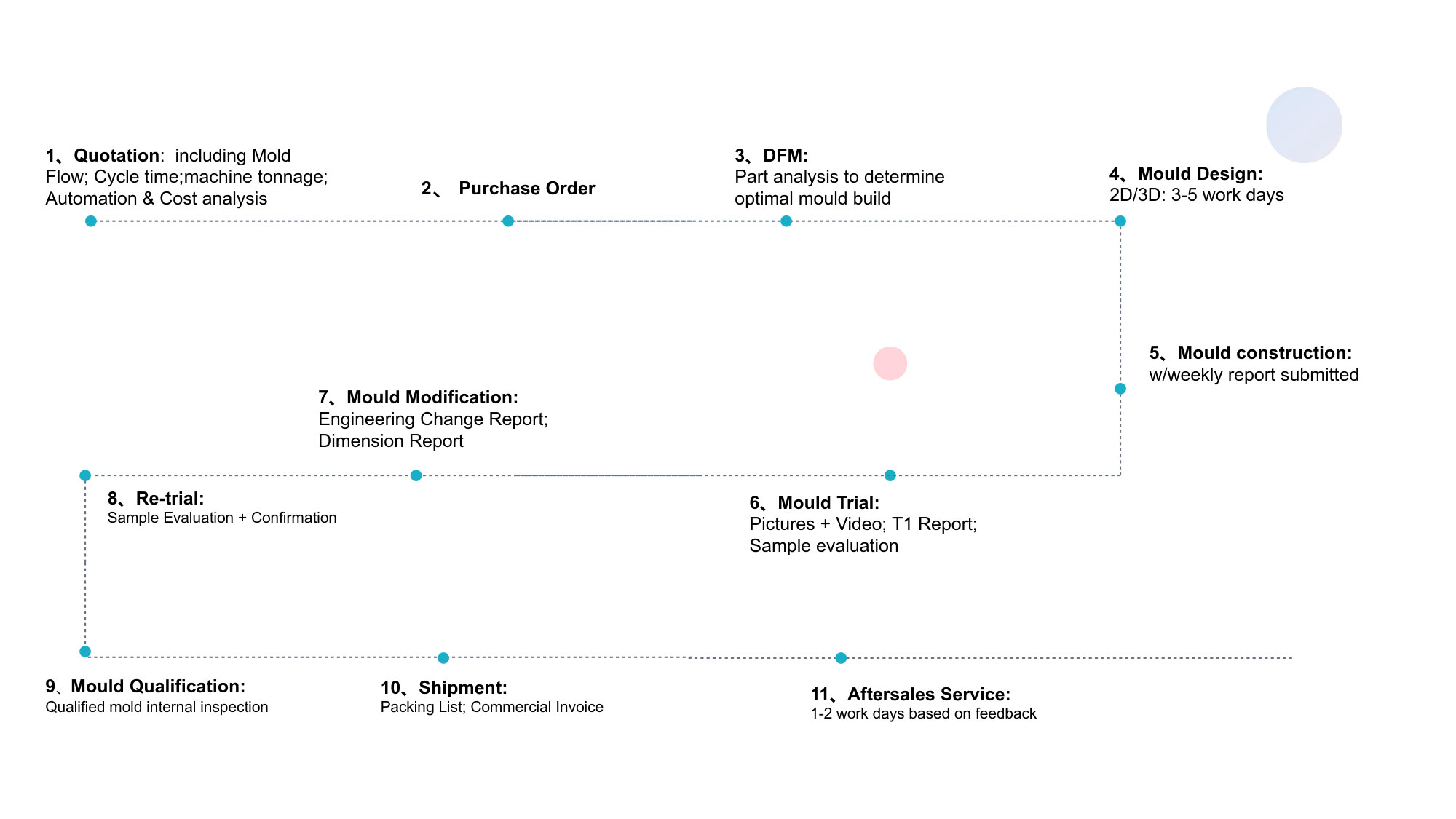
Before Ansix Tech accepts a purchase order, the engineering team produces a comprehensive DFM Report that examines:
Wall thickness uniformity – identifying thick sections prone to sink and thin sections susceptible to short shots
Draft angle recommendations – ensuring adequate taper for reliable ejection without scuffing critical surfaces
Gate location and type – selected to minimize visible witness marks while achieving balanced filling
Ejector pin mark allowances – mapping allowable witness locations so customers can accept or relocate them early
Assembly and ultrasonic welding clearances – verifying that molded geometry leaves sufficient material for secondary assembly operations [3†L36-L41]
Customer value translation: “Typical change orders cost 15–30% of mold price if caught post-design freeze [16†L36-L38]. We identify manufacturability constraints before quote acceptance—saving you tens of thousands of dollars in late-stage ECOs.”
4.2 Structured Mold Trials (T0–T3)
Trial Phase Purpose Deliverable
T0 (First shot) Verify mold function, basic fill 10–20 sample parts for visual inspection
T1 Optimize gate balance, venting 100 parts + full dimensional report
T2 Final tuning of process window 200 parts + CPK analysis + gate freeze study
T3 (Qualification) IQ/OQ/PQ validation Production validation report + retain sample set
In-process flexibility: Ansix Tech designs interchangeable inserts for multi-variant triggers, allowing customers to validate alternative configurations (different spring rates, different lengths) without building an entire new mold.
4.3 Small-Batch Pre-Production Validation
Before committing to full-rate production, Ansix Tech offers 100- to 500-shot trial runs that verify:
Yield – scrap rate quantified before line commitment
CPK achievement – process stability confirmed at target volume
Secondary operations – pad printing, ultrasonic welding, or assembly tested with production-intent parts
Only after customer formal sign-off does Ansix Tech proceed to high-volume manufacturing.
4.4 Maintenance, Spares, and Lifetime Support
Each Ansix mold ships with:
A complete set of spare wear components – ejector pins, core pins, cavity inserts, slide wear plates
Documentation – detailed assembly drawings, BOM of proprietary inserts with machinable dimensions, lubrication schedule
Maintenance schedule recommendation – proactive service every 200,000 cycles
Cost model for repairs:
Warranty period: Three years structural mold warranty (excluding natural wear of contact components)
Post-warranty repairs: Cost-plus pricing, not profit-center markups
Emergency response: In-house EDM and electrode machining capability ensures most repairs complete within 24 hours
Customer value translation: “You will never face the conversation, ‘Your mold broke and our EDM shop is booked for three weeks.’ We machine repairs in-house. The average repair time is measured in hours, not weeks.”
Section 5: Differentiators That Address Common Industry Pain Points
Rather than listing features, Ansix Tech’s value proposition is best understood through direct comparison with common industry failures.
Customer Pain Point Industry Typical Response Ansix Tech’s Differentiated Response
“My molds require frequent repairs, disrupting my order fulfillment.” “Sorry, your mold life is ending.” Ansix runs every production mold through a 2,000-cycle accelerated life test before customer delivery and provides a written wear report. Three-year structural warranty provided.
“Our molded parts produce flash, and deburring drives up our labor cost.” “Flash is normal within ±0.10 mm on parting lines.” Ansix builds molds to ±0.005 mm parting line fit. Production flash is held ≤ 0.03 mm —eliminating manual flash removal entirely.
“Dimensions drift from lot to lot, causing assembly line jams.” “Check your process parameters.” Ansix installs optional in-mold pressure and temperature sensors for closed-loop process control. Real-time compensation prevents drift before non-conforming parts are produced.
“Mold repairs take weeks, and I lose production.” “Our EDM shop has a backlog—possibly four weeks.” Ansix self-performs EDM and electrode machining on-site. Normal repairs complete within 24 hours . EDM spindles are dedicated to repair capacity, not just new mold build.
“I need ISO 13485 documentation for FDA submission, but my supplier can’t provide traceability.” “Check if they have certification.” Ansix holds ISO 13485:2016, IATF 16949, ISO 9001, and maintains an ISO 8 (Class 100,000) cleanroom suitable for medical device assembly [9†L5-L6][9†L42-L44]. Full material lot traceability from resin certificate through finished part.
Section 6: The Medical Ultrasonic Scalpel Trigger Project—A Comprehensive Case in Value Delivery
The ultrasonic scalpel trigger represents a demanding application that concentrates many of the capabilities described above into a single component.
6.1 Material Selection: Matching Properties to Use Conditions
The trigger’s material must balance:
Fatigue resistance – thousands of actuation cycles over device life
Chemical resistance – exposure to surgical cleaning agents including alcohols, peroxides, and enzymatic cleaners
Sterilization compatibility – EtO, gamma, or autoclave cycles without property degradation
Dimensional stability – actuation geometry must remain within ±0.05 mm across device life
Depending on device class: PEEK for radiolucency; PC, PC/ABS, or reinforced PA6 for economic single-use disposables
Ansix Tech’s material selection process includes documented resin certifications from suppliers such as SABIC, BASF, Solvay, Ensinger, and Victrex.
6.2 DFM-Specific Considerations for Trigger Geometry
Key ultrasonic scalpel trigger design elements that Ansix Tech addresses during DFM:
Living hinge region – flow simulation confirms resin reaches the hinge before cooling, preventing brittle failure. Gate placement optimized to ensure the hinge fills perpendicular to the flow front , not parallel along the hinge line.
Actuation boss and spring pocket – sink is eliminated by coring behind bosses. Alternative solution: gas-assist or foam molding for thick sections.
Assembly snap features – draft angles are validated against locking geometry requirements to prevent “cam-out” during assembly while ensuring reliable ejection.
Ultrasonic weld interface – energy director geometry is optimized in the DFM stage to match Ansix’s recommended welding parameters.
6.3 Mold Manufacturing Challenges and Solutions
Challenge Solution Implemented
Micro-geometry of ratchet surfaces Precision wire EDM cut before final 5-axis finishing; surface texture replicated without secondary processing
Venting of deep ribs Venting through ejector pins plus auxiliary vent channels cut by EDM to 0.03–0.05 mm depth
Cooling uniformity across asymmetrical trigger shape Conformal cooling channels calculated via Moldflow simulation; laser-sintered inserts for topologically optimized channel routing
Multi-cavity mold with ≤2% fill variation Computer-optimized runner balancing; sequential valve gating for cavities requiring independent fill timing
6.4 Injection Molding Process Optimization
Ansix Tech conducts Design of Experiments studies at mold qualification stage to establish:
Injection speed profile – slow initial fill for shear-sensitive gate area, fast pack for uniform cavity density, gradual deceleration to prevent overpack at end of fill
Switchover position – precisely tuned between fill and pack phases to eliminate short shots without inducing flash
Hold pressure and time – optimized to compensate shrinkage without sinking thick sections or overpacking hinges
Cooling time – minimized to reduce cycle time while ensuring dimensional maturity
Typical cycle time for ultrasonic trigger: 18–25 seconds depending on wall thickness and material, translating to 140–200 triggers per cavity per hour in steady-state production.
6.5 Quality Assurance Protocol
The complete quality workflow for the trigger project includes:
Phase Activities Deliverable
Incoming material COA verification, moisture content check (dehumidifying dryers set per resin spec) Material release certificate
In-process Vision system inspection at predetermined intervals (typically every 2 hours), SPC charting of key dimensions Real-time SPC dashboard
Lot release Random sampling per ANSI/ASQ Z1.4, CMM verification on retained samples Lot acceptance report, CPK ≥1.33
Sterilization validation (if applicable) TBD based on device classification Bioburden test report
6.6 Packaging and Delivery
Contamination control: Cleanroom packaging with documented cleanliness levels (ISO 8 environment)
Traceability: QR-code labeling linking each shipping carton to specific production lot and material batch
Delivery commitment: On-time delivery historically surpassing 98% across medical projects
Just-in-time options: Kanban or consignment inventory for customers requiring predictable weekly pull
Section 7: Cost Reduction—Translating Process Efficiency Into Customer Savings
Ansix Tech’s primary competitive advantage lies not in low base pricing, but in lower total cost of ownership achieved through systematic optimization.
7.1 Material Cost Optimization
Through experience across >30,000 molds, Ansix Tech maintains a material selection matrix that identifies functionally equivalent lower-cost resins where appropriate [10†L25-L26]. For example:
PC/ABS (e.g., Sabic Cycoloy) delivers similar impact strength to PC for certain trigger applications at 20–30% lower material cost
Reinforced PA6 (Nylon 6 with 30% glass) substitutes for more costly reinforced PBT in non-humid applications
Bulk purchasing power allows negotiated pricing from major resin suppliers, passed to customers
7.2 Process Efficiency Enhancing Productivity
Initiative Customer Benefit
Automated part removal (robotic extractors) Human operators not required per machine; labor cost reduced per piece
Quick mold change systems (≤5 minutes) Changeover time eliminated as variable cost
Hot runner systems on multi-cavity molds Runner scrap eliminated; material yield approaches 99%+
Cycle time reduction via cooling optimization Machine hour cost amortized over more parts per hour, lowering unit price
In-mold labeling (where appropriate) Eliminates post-mold labeling process
7.3 Reduced Downstream Processing
Because Ansix Tech delivers triggers with:
Flash ≤ 0.03 mm – no deburring operations
Sink-free surfaces – no filling/sanding/painting preparation
Stable dimensions – no assembly-line sorting or selective fitting
Customers eliminate entire work cells historically devoted to secondary finishing.
Section 8: Industry Experience and Reliability Evidence
8.1 Proven Track Record
Since its 1998 founding, Ansix Tech has:
Built over 30,000 molds across diverse industries [10†L25-L26]
Achieved 70% automated machining ratio for precision consistency [10†L25-L26]
Completed molds with average trial count of 2 iterations before customer acceptance, demonstrating DFM effectiveness [10†L25-L27]
Maintained diverse customer base across medical devices, personal care, automotive, commercial communications, mobile/wearable devices, and smart home products [10†L19-L22]
8.2 Regulatory Compliance
Certification Scope
ISO 13485:2016 Medical device quality management systems
ISO 9001 General quality management
IATF 16949 Automotive (highest rigor for documented process control)
ISO 14001 Environmental management
BSCI Social compliance
FDA 510(k) ready Cleanroom compliance and documentation structure aligned to US medical device requirements
8.3 Scalable Production Capacity
260 injection molding machines
30-ton to 2,800-ton clamping force coverage
ISO 8 (Class 100,000) cleanroom for medical assembly operations
Over 1200 employees including more than 200 design engineers [9†L8-L9][10†L17-L18]
Four production bases (Shenzhen, Dongguan, Hunan, Vietnam) [9†L9-L10]
200,000+ square meters total floor area
Conclusion: Why Ansix Tech for Your Medical Ultrasonic Scalpel Trigger Program
An injection mold for an ultrasonic scalpel trigger is not simply a metal block enclosing a cavity. It is a precision capital instrument that determines whether your device reaches market on schedule, within budget, and with quality documentation intact.
Ansix Tech’s integrated approach means:
One vendor manages your entire development—from DFM through mold build, qualification, volume production, and lifetime maintenance
Lower total cost achieved through material optimization, cycle time reduction, and elimination of secondary processes
Reduced compliance risk derived from ISO 13485-certified systems and full material/process traceability
Faster time-to-market enabled by in-house machining and automated processes that compress trial-to-production timelines
Peace of mind supported by documented process capability (CPK ≥ 1.33) and three-year mold structural warranty
“To us, a mold is not just a tool—it is your revenue engine. We design every mold with processing robustness, balanced thermal management, and strategic venting so that it runs on your line with minimal setup, minimal flash, and maximum uptime. When you are ready, we invite you to send one of your current parts for a complete DFM assessment. You will see exactly how we resolve weld lines, gas traps, and sink marks—risks that we eliminate before you pay for the first cavity.”
Contact Ansix Tech to schedule a confidential DFM review of your ultrasonic scalpel trigger program. Let us demonstrate how 28 years of injection molding expertise translates into measurable value for your medical device program.
Ansix Tech Co Ltd
If you have any plans related to Medical Ultrasonic Scalpel Trigger Mold , you can contact us at any time. We will turn your ideas into reality, let you realize your dreams, and obtain large orders from the market. Our contact information is info@ansixtech.com. Or contact our CTO, mail: stephen@ansixtech.com
#www.ansixtech.com #ansixtech.com #Medical Ultrasonic Scalpel Trigger #Syringe mold moulds #Syringe mold molds #Syringe mold injection molding companies #Medical Ultrasonic Scalpel Trigger Canopy Mold injection mold companies #Ansix #Ansix moulds #Ansix china #Ansix tech china #Ansix tech company #Ansix facotry #Syringe mold injection molding #Syringe mold injection tools #Syringe mold injection moulds #Syringe mold plastic mould #Syringe mold plastic tools #Ansix Tech #Ansix molds #Ansix injection molding #Ansix mold factory #injection molding Syringe mold #Ansix mold factory #Syringe mold china #Syringe mold molds #injection factory #Syringe mold injection molding #Syringe mold injection molding factory #injection molding company #Syringe mold injection mold companies #Syringe mold#Syringe mold mold limited #Ansix mold china #Ansix companies #Ansix company China #Syringe mold facotry #Ansix Tech #Ansix Tech mould #Syringe mold injection moulding #injection moulding company #Ansix Syringe mold parts injection mold companies #medical injection molding companieschina #Syringe mold china factory #Ansix moulding companies #Ansix molding company #Syringe mold injection moulding facotry #Ansix Tech mold #Syringe mold mould #Syringe mold plastic injection molding #ansix plastic mold #Mold manufacturing #Syringe mold parts manufacturing #Syringe mold plastic parts factory #Syringe mold injection parts mold #Syringe mold PRECISION MANUFACTURING #Syringe mold #China mold #Syringe mold injection moulding china #Syringe mold mould china #china precision mold #mold in china #Syringe mold mold china #Precision molds #High-precision molds #Syringe mold #Injection molds #Syringe mold Factory #Syringe mold Company #Super Large Injection Mold Factory #Large Tonnage Injection Molding Factory #Syringe mold Company #Syringe mold Factory #2800T Injection Molding Factory #3000 Ton Injection Molding #4500 Ton Injection Molding Factory #Large Mold Injection Molding #Large Plastic Mold Injection Molding Factory #Large Injection Mold Manufacturer #Plastic Mold Factory #Injection Mold #Plastic Mold