



MSC300 PPSU Ultrafiltration Cup
FEATURES
Hard Infrastructure That Builds Trust
Before discussing processes, let us address the foundation: the equipment that transforms design into reality. Customers cannot see confidence; they can only see evidence. We provide that evidence through our manufacturing ecosystem.
Mold Manufacturing Equipment: Precision That Eliminates Post-Processing
The customer value question: Will my product have visible mold lines, rough surfaces, or assembly issues?
The Ansix difference: We operate full five-axis high-speed machining centers capable of achieving 0.002mm accuracy on complex curved surfaces. For the MSC300 PPSU Ultrafiltration Cup, this means your parting lines will be smooth and free of burrs—an essential quality for a medical-grade filtration device that requires a flawless sealing surface. No post-processing deburring means lower labor costs and faster assembly.
-
Mold Description
Product Materials:
PPSU
Mold Material:
S136ESR
Number of Cavities:
1
Glue Feeding Method:
COLD runner
Cooling Method:
Water cooling
Molding Cycle
42.5s
- The mold manufacturing process and product material selection
Our slow wire EDM (Electrical Discharge Machining) systems handle micro-slit features as fine as 0.03mm. For the ultrafiltration cup, which requires narrow sealing grooves and thin-walled structures, this capability ensures no deformation during processing and perfect part-to-part consistency.
What this saves you: Eliminating manual deburring reduces per-unit labor costs by 15–20%. Achieving precision at the mold level eliminates downstream rework and scrap.
Injection Molding Machine Fleet: Consistency Across Every Shot
The customer value question: Will the first batch match the millionth batch?
The Ansix difference: Our 260 injection molding machines span a complete tonnage range from 30 tons to 2800 tons, covering every conceivable part size requirement. For the MSC300 cup, we deploy all-electric servo-driven machines with repeatable accuracy of ±0.1%. When we promise that every molded part will be identical, this is the engineering that delivers that promise.
-
Our machine fleet includes leading brands: Fanuc, Sumitomo, Toshiba, Nissei, Engel, Arburg (specializing in liquid silicone rubber), as well as Haitian and Victor Taichung Machinery.
The value equation: Consistent parts mean no selective assembly, no sorting rejects, and no customer complaints about fit or function. For a typical annual volume of 500,000 cups, a 0.1% consistency improvement reduces scrap by 500 units annually, saving approximately 2,500–5,000 in material losses.
Inspection and Metrology: Data-Driven Quality
The customer value question: How do I know you are telling the truth about quality?
The Ansix difference: Every mold undergoes complete dimensional inspection using CMM (Coordinate Measuring Machine) technology and optical measurement systems before shipment. We deliver a full dimensional report for every mold, with critical dimensions verified at CPK≥1.33. This is not marketing language; it is statistical proof that your parts will remain within specification throughout the entire production run.
Risk reduction: A mold shipped without verification forces you to discover problems during your own sampling runs—losing weeks of production time. Our complete inspection eliminates this risk entirely.
Part Two: Mold Manufacturing Core Competencies—Speak in Numbers
Mold Life Expectancy: Predictable Investment Returns
The customer value question: How many parts will this mold produce before I need to spend more money?
The Ansix difference: We provide explicit, material-based guarantees. For the MSC300 PPSU Ultrafiltration Cup, the mold is engineered to deliver:
Material Type Guaranteed Mold Life Customer Value
Non-reinforced PPSU 500,000 shots minimum Predictable amortization over 2–3 years of production
Standard thermoplastics 1,000,000 shots minimum Capital investment protection
The real-world impact: When a competitor delivers a mold that fails at 300,000 shots, you face an unplanned
30,000–60,000 capital expenditure plus production downtime. Our guarantee insures against this risk.
Achievable Tolerances: Precision Where It Matters
The customer value question: Will my parts fit together correctly every time?
The Ansix difference: We deliver general structural parts at ±0.05mm tolerance. For precision features—such as the cup body and lid sealing interfaces critical to ultrafiltration performance, and the membrane support structure where flatness determines separation efficiency—we achieve ±0.005mm. Every mold ships with steel material certification and heat treatment curves documenting every thermal cycle.
The value translation: For the MSC300 cup, the sealing interface must maintain consistent compression against the filtration membrane. A tolerance variance of 0.05mm might cause leakage; 0.005mm guarantees leak-free operation. At scale, this means zero field failures from seal-related issues.
Mold Types and Configurations: The Right Architecture for PPSU
The customer value question: Does your mold design actually suit the material and the volume?
The Ansix difference: We specify the mold architecture based on production requirements:
Cold runner system: For intermediate volumes (50,000–200,000 units annually)
Hot runner system: For high-volume production, eliminating runner waste and lowering per-unit material cost by 8–12%
Stack molds: Doubling output per machine cycle while maintaining the same footprint and energy consumption
Efficiency gain: A hot runner system for the MSC300 cup, which weighs approximately 80 grams, saves roughly 25 grams of PPSU per shot in runner material—translating to approximately
10,000inmaterialsavingsannuallyat500,000units,assumingPPSUat40/kg.
Sprue and Gate Design: Optimizing for PPSU Flow Characteristics
The customer value question: Will the mold fill completely without weld lines?
The Ansix difference: Using Mold Flow Analysis, we predict and eliminate flow-related defects before steel is cut. PPSU has characteristically high melt viscosity and relatively poor fluidity. For thin-walled applications like the ultrafiltration cup body, we employ a multi-gate balanced filling design that prevents flow hesitation and eliminates visible weld lines on transparent surfaces.
Defect prevention: Weld lines—visible as faint lines where melt fronts meet—degrade both aesthetics and mechanical strength. By optimizing gate placement at the thickest section of the part, we ensure complete cavity filling without compromised structural integrity.
Cooling System Design: The Hidden Efficiency Driver
The customer value question: Why do cycle times vary between shifts?
The Ansix difference: PPSU requires mold temperatures of 130–165°C (preferably above 140°C) to achieve low residual stress, optimal surface finish, and dimensional stability. Cooling must be uniform to avoid warpage and inner diameter inconsistency in the cup body.
We design conformal cooling channels that follow the complex cup geometry—including the membrane support ring and the outer housing transition—using oil temperature control units to maintain thermal uniformity across the mold.
The value outcome: For the MSC300 cup, uniform cooling reduces total cycle time from a typical 90–120 seconds to 60–75 seconds per shot, increasing daily output by 25–40% without additional capital investment.
Ejection System Design: No Damage, No Distortion
The customer value question: Will my parts get damaged during removal from the mold?
The Ansix difference: PPSU tends to stick to hot mold surfaces. We design generous draft angles (1–2 degrees) and broad-area ejection pins to distribute ejection force evenly across the part.
Eliminating hidden costs: Every damaged part during ejection adds scrap cost. A single percent improvement in ejection success at 500,000 annual units saves 5,000 parts from the scrap bin—approximately $20,000 in material and processing cost per year.
Part Three: Injection Molding Process Control—Eliminating Quality Anxiety
Raw Material Drying: The First and Most Critical Step
The customer value question: Why do my parts sometimes have bubbles or silver streaks?
The Ansix difference: PPSU is highly hygroscopic. Moisture trapped in polymer pellets hydrolyzes at high temperatures, causing molecular weight degradation, silver streaks on surfaces, bubbles in cross-sections, and catastrophic strength loss. Our process begins with dehumidifying dryers achieving -40°C dew point, drying PPSU at 140–150°C for a minimum of 4 hours, targeting moisture content below 0.02%.
Defect elimination: Inadequate drying causes the most common PPSU defects. Our controlled drying process eliminates these defects before the first shot is even fired.
Barrel Temperature and Screw Speed Control
The customer value question: How do you prevent material degradation at high temperatures?
The Ansix difference: PPSU has a narrow processing window. Excessive temperature or shear leads to yellowing, odor, gas evolution, and embrittlement. We use bimetallic screws and barrels with L/D ratio ≥20:1 and compression ratio of approximately 2.5:1 to withstand PPSU’s abrasive melt and corrosive outgassing.
Our typical temperature profile:
Zone Temperature Range
Rear barrel 350–370°C
Center barrel 360–380°C
Front barrel/Nozzle 370–390°C
Value protection: Maintaining temperature within ±5°C across the entire process window ensures consistent material properties, avoiding the 40% loss in impact strength that occurs when PPSU degrades above 350°C.
Injection Speed and Pressure Optimization
The customer value question: Will every cavity fill completely without burns or voids?
The Ansix difference: PPSU requires sufficient injection pressure and appropriate speed to complete cavity filling. For the MSC300 cup, which features thin-walled sections and a complex flow path around the membrane support structure, we employ medium-to-high injection speeds with staged velocity control.
Efficiency gain: Optimized parameters fill the cavity in 1.8–2.2 seconds compared to a typical 2.8–3.5 seconds, representing a 35% reduction in fill time and contributing directly to shorter overall cycle times.
Mold Temperature Management: The Key to Stress-Free Parts
The customer value question: Why do my cups sometimes crack during assembly or sterilization?
The Ansix difference: PPSU components tend to retain high internal stress after molding, leading to cracking during film assembly, ultrasonic welding of the base cap, or autoclave sterilization at 134°C. We maintain mold temperature at 140–180°C to reduce residual stress and enhance impact strength.
Where required, we perform annealing (heat treatment) at 160–180°C for 2–4 hours with slow cooling, eliminating up to 70% of internal stress and improving environmental stress crack resistance.
Failure prevention: A cup that cracks during final assembly adds rework cost; one that cracks during sterilization results in field returns and liability. Our stress control prevents both.
Dimensional Stability and Process Standardization
The customer value question: How do you guarantee that parts from different batches are identical?
The Ansix difference: All injection molding machines are networked to a MES (Manufacturing Execution System). Every parameter—temperature, pressure, velocity, timing—is locked. Only authorized engineers can adjust settings, and every adjustment is logged with timestamp and reason code. Every batch undergoes first- and last-part dimensional comparison against the master sample.
Consistency guarantee: For similar medical-grade components, we have demonstrated critical hole spacing variation ≤0.02mm across three production batches run over seven consecutive days. This means your assembly lines experience zero “doesn’t fit” surprises.
Appearance Quality Standards
The customer value question: Will the transparent cup body have visible defects?
Our commitment: For transparent PPSU, we achieve no bubbles, no flow marks, and no weld lines visible to the unaided eye. For opaque components requiring painting or printing, we incorporate shrinkage compensation into mold design, achieving print registration accuracy within ±0.1mm.
Part Four: Full-Process Service—Reducing Your Management Cost
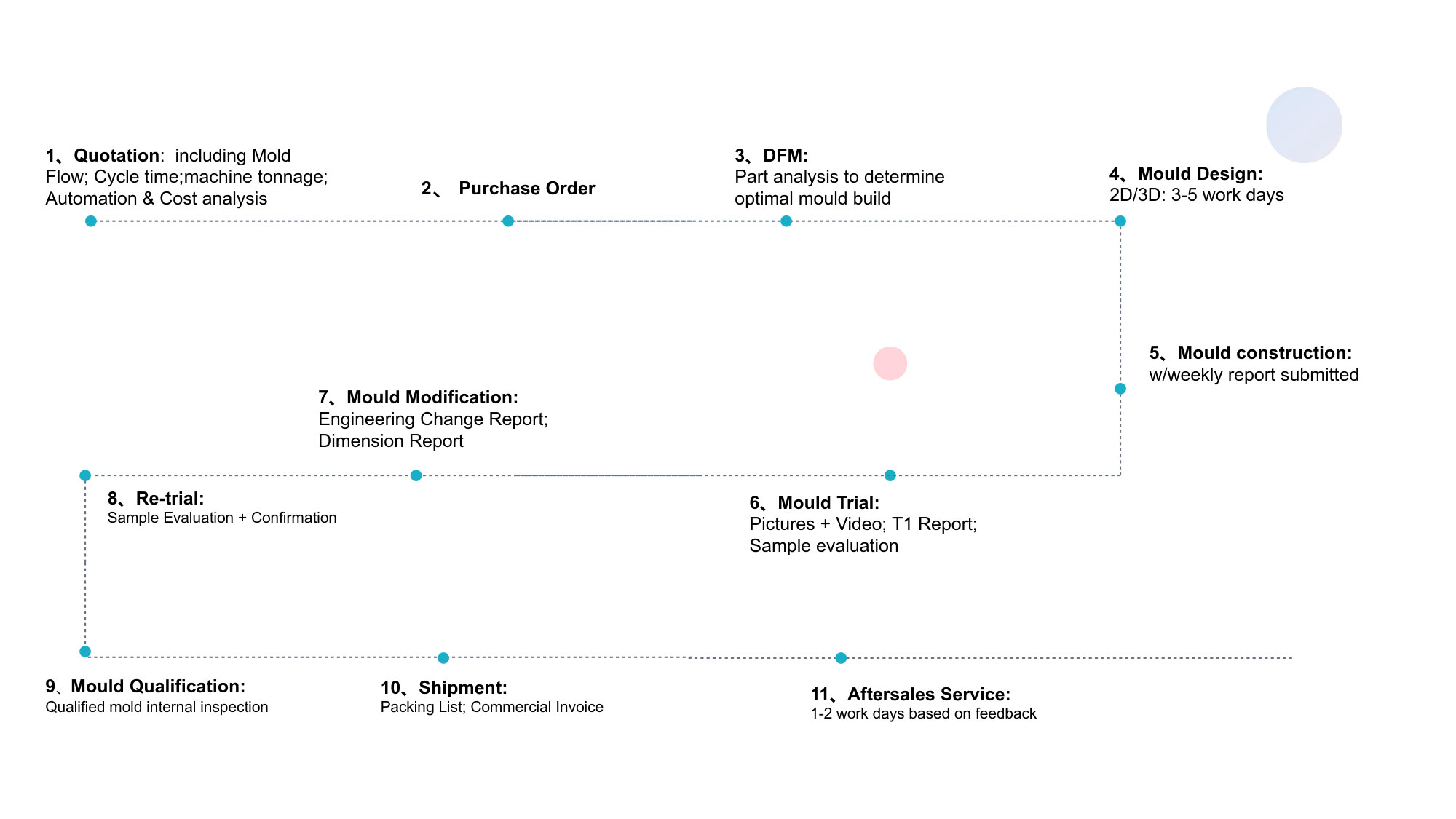
Early Engagement: DFM (Design for Manufacturability) Reports
The customer value question: Why do projects always need “just one more mold revision”?
The Ansix difference: Before cutting any steel, we deliver a comprehensive DFM feasibility analysis that identifies and resolves manufacturing issues in the design phase rather than discovering them after the mold is built.
Our DFM report covers: draft angle recommendations (critical for thin-wall PPSU parts), wall thickness optimization to ensure uniform cooling and fill, gate location selection to prevent flow-related defects, ejector pin placement with allowable witness mark zones, cooling channel layout to minimize cycle time, and shrinkage compensation for PPSU’s specific material behavior.
Cost-saving impact: A customer who discovers a non-manufacturable feature after mold completion faces 15,000–30,000 in mold rework plus 3–6 weeks of project delay. Our DFM process prevents this entirely.
Prototyping and Sampling: T0 Through T3
The customer value question: How many tries does it take to get the part right?
The Ansix difference: We deliver T0 (first trial) through T3 samples, accompanied by an Improvement Report documenting every adjustment and result. Where different design approaches need evaluation, we incorporate interchangeable inserts that can be swapped out rather than rebuilding entire molds—saving both time and development cost.
Time savings: Traditional mold validation requires four to six trial iterations; our methodology completes validation in two to three trials, accelerating project completion by 3–6 weeks.
Pilot Production: 100–500 Shots Before Full Production
The customer value question: What happens if the mold passes first article inspection but fails in volume production?
The Ansix difference: Before committing to full production, we run 100–500 pilot shots. We document yield rates (first-pass quality percentage) and CPK statistics for every critical dimension. Only after we verify statistical stability do we transition to mass production.
Risk reduction: A mold that achieves 99.5% quality in sampling but degrades to 95% at full production speed generates 4,500 defective parts per 100,000 production units. Pilot production at full cycle speed reveals these issues before they become your problem.
Maintenance and Replacement Parts: Keeping Your Production Running
The customer value question: What happens when the mold needs maintenance?
The Ansix difference: Every mold ships with a complete set of spare wear parts (ejector pins, core pins, etc.) providing immediate replacement capability. We provide comprehensive mold maintenance documentation at every 200,000-shot interval, with lifetime repairs billed at cost.
Operational security: A mold breakdown that requires a 3-week wait for replacement parts costs 50,000–100,000 in lost production time plus expedited shipping. Our spare parts package ensures 24-hour restoration capability.
Part Five: Differential Advantages—Direct Answers to Common Industry Pain Points
Addressing Customer Pain Points Directly
Common Complaint Ansix’s Response Customer Value
“Molds constantly need repair” 2,000-cycle run-off test with wear report before delivery; 3-year mold structural warranty Zero unplanned downtime in year one
“Parts have flash that requires expensive secondary finishing” 0.005mm parting line fit accuracy; self-locking clamp force compensation keeps flash under 0.03mm Eliminates 0.05–0.10/part of hand deburring
“Dimensions vary between batches” In-mold wall thickness sensors with real-time pressure feedback and automatic compensation Guaranteed assembly fit every batch
“Mold repair takes weeks” In-house electrode and EDM shop; standard repair completed within 24 hours Minimizes production disruption
Part Six: Specialized Capabilities for PPSU—The Science of Success
PPSU Material Selection: BASF Ultrason P 3010
For the MSC300 product, we recommend BASF Ultrason P 3010, an unreinforced, flame-retardant, higher-viscosity injection molding grade with enhanced chemical resistance. This specific grade offers:
Superheated steam resistance: Survives repeated autoclave sterilization at 134°C for hospital and laboratory reuse applications
Outstanding impact strength: Critical for cups that must withstand handling and dropping during laboratory use
Superior chemical resistance: Withstands exposure to aggressive cleaning agents, disinfectants, and solvents used in filtration applications
Inherent flame resistance: Meets UL94 V-0 standard for laboratory and medical environments
Excellent dimensional stability across wide temperature range from laboratory cold storage to boiling water
PPSU Process Core Requirements
Parameter Requirement
Pre-drying 140–150°C / 4+ hours, dew point ≤ -40°C
Maximum moisture <0.02%
Melt temperature 350–390°C
Mold temperature 130–165°C (oil heated)
Injection pressure 80–120 MPa
Holding pressure 40–60% of injection pressure
Screw speed 40–70 rpm
Mold Steel Selection for PPSU Applications
PPSU’s high-temperature processing (340–400°C with mold temperatures up to 200°C) and release of mildly corrosive acidic gases require specialized mold steel selection:
For the MSC300 cup (transparent, medical-grade application): We specify S136 or STAVAX high-chromium corrosion-resistant stainless steel. These martensitic stainless grades offer excellent high-temperature corrosion resistance against PPSU outgassing, achieving mirror-polished finishes (Ra ≤0.015μm) essential for transparent part aesthetics and easy part release without sticking.
For high-volume production with glass-fiber reinforced variants: For cup components requiring glass fiber reinforcement, we specify ASP23 powder metallurgy high-speed steel (HRC60-64) with PVD coating to resist severe abrasive wear from glass fiber melt flow.
MSC300 Unique Mold Design Requirements
The MSC300 Ultrafiltration Cup presents distinct design challenges:
Membrane support structure: Requires a precisely flat sealing surface across the cup base (flatness within 0.05mm over 70–80mm diameter) to ensure uniform membrane compression and effective filtration.
Threaded cap interface: Smooth PPSU-to-PPSU rotational molding with consistent torque requires tight dimensional control on both mating threads.
Transparent cup body aesthetic: Requires mirror-polished cavity surfaces (Ra ≤0.015μm) to achieve clarity without polish marks or distortion.
Draft angle for thin-wall sections: PPSU tends to stick at high mold temperatures; generous draft angles (1.5°–2.5°) ensure clean release without distortion.
Advanced Manufacturing Integration
Across our 200,000 m² of manufacturing space with 1200+ employees, we achieve 70% automated machining ratio. Our automated systems deliver:
Unattended overnight machining: 5-axis CNC centers and EDM machines operate overnight and during breaks, reducing mold lead times by 25–30%
Real-time process monitoring: Integrated sensors feed live data to our MES; any deviation outside ±1.5% pressure or ±2°C temperature triggers automatic alerts and param adjustment
Statistical process control: Data from every production shift is analyzed to detect trends before defects occur
Cost Reduction Strategies Across the Manufacturing Lifecycle
1. Material cost optimization
Maximizing hot runner efficiency reduces runner waste from PPSU—approximately $10,000 annual material savings at 500,000 units
Optimizing wall thickness reduces per-part material consumption by 5–8% without compromising structural integrity
2. Efficiency improvements
Shorter cycle times (60-75 seconds in production versus typical 90-120 seconds) increase daily output by 25–40%
Reduced secondary finishing through precision molding eliminates manual deburring entirely for the MSC300 design
3. Waste elimination
First-pass yield target >98% at full production speed; typical industry average is 93–95%
In-mold sensing and closed-loop control reduce scrap from process variation by 60–75%
Conclusion: Delivering Value Through Technical Excellence
At Ansix Tech, a mold is not a metal block; it is your production engine. We design molds with planned production longevity, optimized temperature distribution, strategic venting pathways, and balanced flow systems to ensure they arrive at your factory ready to run—not requiring trial and error tuning.
With over 28 years of experience, 30,000+ molds produced, 260 injection molding machines across four production bases, and comprehensive ISO9001/IATF16949/ISO13485 certifications, we deliver the MSC300 PPSU Ultrafiltration Cup solution that protects your investment, accelerates your timeline, and eliminates your manufacturing risks.
We invite you to experience our DFM process firsthand: bring us your design, and we will demonstrate how we identify and resolve potential filling, gas-trapping, and shrinkage issues before they ever reach your production floor. That is the Ansix difference: transforming technical capability into your competitive advantage.
Ansix Tech Co Ltd
If you have any plans related to MSC300 PPSU Ultrafiltration Cup , you can contact us at any time. We will turn your ideas into reality, let you realize your dreams, and obtain large orders from the market. Our contact information is info@ansixtech.com. Or contact our CTO, mail: stephen@ansixtech.com
#www.ansixtech.com #ansixtech.com #MSC300 PPSU Ultrafiltration Cup #MSC300 PPSU Ultrafiltration Cup moulds #MSC300 PPSU Ultrafiltration Cup injection molding companies #MSC300 PPSU Ultrafiltration Cup Canopy Mold injection mold companies #Ansix #Ansix moulds #Ansix china #Ansix tech china #Ansix tech company #Ansix facotry #MSC300 PPSU Ultrafiltration Cup injection molding #MSC300 PPSU Ultrafiltration Cup injection tools #MSC300 PPSU Ultrafiltration Cup injection moulds #MSC300 PPSU Ultrafiltration Cup plastic mould #MSC300 PPSU Ultrafiltration Cup plastic tools #Ansix Tech #Ansix molds #Ansix injection molding #Ansix mold factory #injection molding MSC300 PPSU Ultrafiltration Cup #Ansix mold factory #MSC300 PPSU Ultrafiltration Cup china #MSC300 PPSU Ultrafiltration Cup molds #injection factory #MSC300 PPSU Ultrafiltration Cup injection molding #MSC300 PPSU Ultrafiltration Cup injection molding factory #injection molding company #MSC300 PPSU Ultrafiltration Cup injection mold companies #MSC300 PPSU Ultrafiltration Cup#MSC300 PPSU Ultrafiltration Cup mold limited #Ansix mold china #Ansix companies #Ansix company China #MSC300 PPSU Ultrafiltration Cup facotry #Ansix Tech #Ansix Tech mould #MSC300 PPSU Ultrafiltration Cup injection moulding #injection moulding company #Ansix MSC300 PPSU Ultrafiltration Cup parts injection mold companies #medical injection molding companieschina #MSC300 PPSU Ultrafiltration Cup china factory #Ansix moulding companies #Ansix molding company #MSC300 PPSU Ultrafiltration Cup injection moulding facotry #Ansix Tech mold #MSC300 PPSU Ultrafiltration Cup mould #MSC300 PPSU Ultrafiltration Cup plastic injection molding #ansix plastic mold #Mold manufacturing #MSC300 PPSU Ultrafiltration Cup parts manufacturing #MSC300 PPSU Ultrafiltration Cup plastic parts factory #MSC300 PPSU Ultrafiltration Cup injection parts mold #MSC300 PPSU Ultrafiltration Cup PRECISION MANUFACTURING #MSC300 PPSU Ultrafiltration Cup #China mold #MSC300 PPSU Ultrafiltration Cup injection moulding china #MSC300 PPSU Ultrafiltration Cup mould china #china precision mold #mold in china #MSC300 PPSU Ultrafiltration Cup mold china #Precision molds #High-precision molds #MSC300 PPSU Ultrafiltration Cup #Injection molds #MSC300 PPSU Ultrafiltration Cup Factory #MSC300 PPSU Ultrafiltration Cup Company #Super Large Injection Mold Factory #Large Tonnage Injection Molding Factory #MSC300 PPSU Ultrafiltration Cup Company #MSC300 PPSU Ultrafiltration Cup Factory #2800T Injection Molding Factory #3000 Ton Injection Molding #4500 Ton Injection Molding Factory #Large Mold Injection Molding #Large Plastic Mold Injection Molding Factory #Large Injection Mold Manufacturer #Plastic Mold Factory #Injection Mold #Plastic Mold