


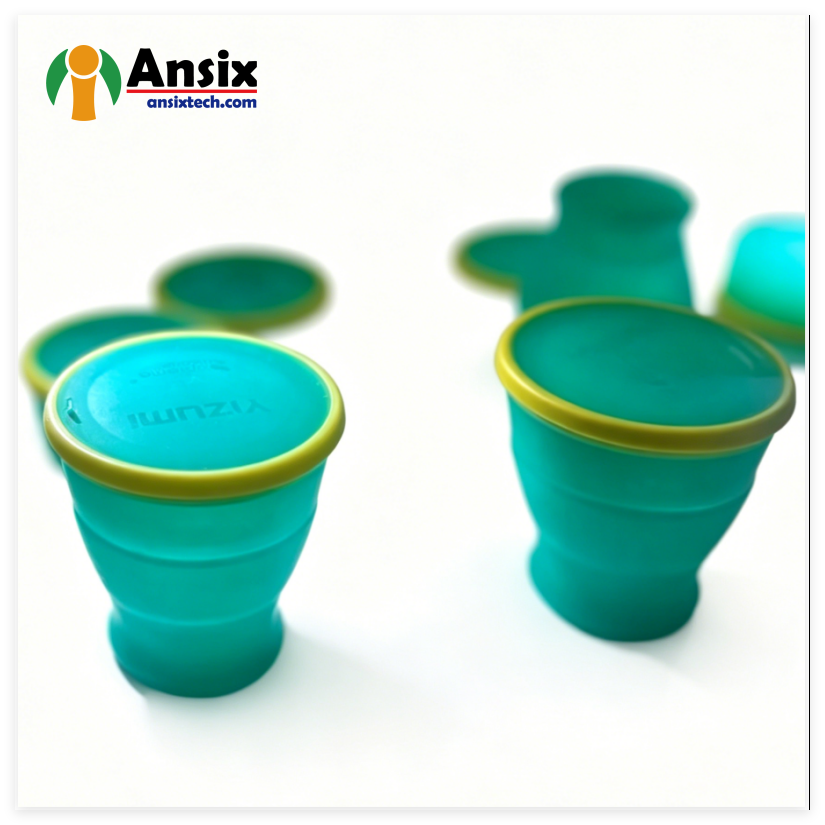


Transparent essence cream bottle, PET mask packaging jar
Transparent essence cream bottle, PET mask packaging jar
Hard Infrastructure — Building Trust Through Equipment Excellence
Manufacturing capability begins with the right equipment. Customers invest not just in a mold, but in the certainty that every part produced will meet specifications, every time. Ansix Tech’s hardware infrastructure is designed to deliver that certainty.
1.1 Mold Machining Equipment: Precision That Eliminates Rework
Our mold-making capabilities start with advanced CNC machining centers that directly impact part quality and reduce downstream finishing costs.
Five-Axis High-Speed Machining Centers
We operate five-axis high-speed machining centers capable of achieving ±0.002mm positioning accuracy on complex freeform surfaces. For transparent essence cream bottles, this precision translates to:
Customer Value: Seamless parting lines with zero visible mismatch. Traditional three-axis machining often leaves witness lines or step marks on curved surfaces. Our five-axis capability machines the entire contour in a single setup, eliminating alignment errors that cause visible parting lines on transparent products—defects that would otherwise render a premium cosmetic jar unsellable.
Cost Saving: Eliminates secondary finishing operations (sanding, buffing, manual touch-up) that typically add 15-25% to per-part costs.
Risk Reduction: Guarantees consistent appearance across every production batch, protecting your brand's premium image.
Slow Wire EDM (Wire Electrical Discharge Machining)
Our slow wire EDM systems can cut micro-features down to 0.03mm—fine slots, narrow grooves, and intricate details that are impossible to achieve with conventional milling.
Customer Value: Precision-cut thin-wall sections on PET mask packaging jars. The narrow ejection slots and venting channels required for thin-wall packaging components are machined with zero burr and no heat-affected zone, preventing thin-wall deformation during ejection.
Cost Saving: Eliminates hand-deburring operations; reduces tool wear on downstream assembly lines.
Risk Reduction: Consistent micro-feature geometry ensures reliable part ejection cycle after cycle, preventing stuck-parts production stoppages.
Surface Grinding and Polishing Equipment
For transparent products, mold surface quality is directly visible on every part. Our precision grinding and polishing capability achieves surface roughness down to Ra 0.05μm on mold cavities.
Customer Value: Crystal-clear transparency with no clouding, flow marks, or surface defects. For PET mask packaging jars, this means the product contents remain fully visible—a critical marketing feature for beauty brands.
Cost Saving: No need for post-molding polishing or coating operations.
Risk Reduction: Consistent optical clarity eliminates batch-to-batch appearance variation that would trigger quality rejections.
1.2 Injection Molding Machine Fleet: Consistent Repeatability at Scale
With 260 injection molding machines spanning 30 to 2,800 tons, Ansix Tech covers the full spectrum of cosmetic and personal care packaging sizes—from miniature caps to large industrial containers.
All-Servo Electric Drive Machines
Our fleet includes FANUC, Sumitomo, Toshiba, Nissei, ENGEL, and ARBURG (specializing in liquid silicone two-component injection) machines, predominantly featuring all-servo electric drive systems.
Customer Value: Shot-to-shot repeatability of ±0.1%—meaning every single jar in a million-unit production run is dimensionally identical to the first.
Why This Matters for You: Traditional hydraulic machines experience pressure fluctuations during extended runs due to oil temperature changes. Servo-electric machines maintain consistent injection parameters regardless of run duration, eliminating the gradual dimensional drift that ruins batches and triggers customer returns.
Cost Saving: Servo-electric machines consume 50-70% less energy than hydraulic equivalents, directly reducing your per-part manufacturing costs.
Comprehensive Tonnage Coverage
Product Type Recommended Tonnage Ansix Tech Capacity
Small caps, thin-wall jars 30-200T ✓
Medium cream bottles (30-100ml) 200-500T ✓
Large cream jars, mask jars (100-300ml) 500-1,000T ✓
High-cavitation multi-impression molds 1,000-2,800T ✓
Customer Value: Single-source manufacturing for your entire product portfolio. Whether you need micro-precision components or large-format packaging, one supplier handles everything.
Cost Saving: Eliminates supplier consolidation costs; reduces logistics and quality management overhead.
1.3 Inspection and Metrology Equipment: Data-Driven Quality Assurance
Quality cannot be managed without measurement. Ansix Tech employs industrial-grade inspection equipment to quantify what the naked eye cannot see.
Coordinate Measuring Machines (CMM)
Every mold shipped from our facility undergoes full dimensional inspection against customer blueprints.
Customer Value: Complete dimensional traceability for every critical feature. We can provide a full inspection report for any mold, documenting every measured dimension against specified tolerances.
What We Guarantee: Critical dimensions achieve Process Capability Index (Cpk) ≥ 1.33—meaning the production process is capable, stable, and fits within tolerance bands with significant margin to spare.
Risk Reduction: No surprise misfits between your bottles and caps, between jar bodies and lids, or between packaging components and your filling lines.
Optical Imaging and Vision Inspection
High-speed optical inspection stations verify part quality in real-time during production.
Customer Value: 100% dimensional inspection of critical features without slowing production. For threaded cream bottle necks, our vision systems verify thread profile accuracy on every cycle.
Cost Saving: Eliminates manual inspection labor; prevents defective parts from reaching your assembly line.
Material Testing and Certification
We provide full material certifications including:
Material grade verification against specified resin
Hardness testing for Mold Steels
Heat treatment curves and documentation
Corrosion resistance validation for transparent-grade materials
Section 2: Mold Manufacturing Core Competencies — Where Precision Meets Longevity
Molds are not merely tools; they are the foundation of your entire production economics. A high-quality mold produces millions of perfect parts with minimal downtime. A poor mold generates scrap, requires constant maintenance, and erodes profit margins. Ansix Tech builds molds that customers forget about—because they simply work, cycle after cycle.
2.1 Mold Life Expectancy: Quantifiable Durability
Mold life directly determines your total cost of ownership. Short-lived molds require frequent replacement, driving up capital expenditure and production interruptions.
Our Commitment
Material Type Guaranteed Mold Life Material Selection
Glass fiber-reinforceD Plastics (e.g., PC+GF30) 500,000 cycles minimum H13, DC53, SKD61
Standard plastics (PET, PP, PE, PC, PMMA) 1,000,000 cycles minimum S136, NAK80, 2344, 8407, M340
Transparent parts (PC, PMMA, PET) 1,000,000 cycles with SPI-A1 finish S136, NAK80
Material Selection Rationale — Translated to Customer Value
S136 (420-class stainless steel): Provides exceptional corrosion resistance and high-polish finish capability, achieving Ra < 0.05μm surface finish required for transparent parts. For essence cream bottles where clarity is paramount, we specify S136 for cavity surfaces.
NAK80 (P21-class pre-hardened steel): Offers excellent polishability without heat treatment distortion. Ideal for transparent mask packaging jars where dimensional stability is critical.
H13 / SKD61: High-toughness hot-work steel for cores that must withstand repeated injection pressure. For high-cavitation molds used in mass production of PET jars, H13 delivers the wear resistance required for 1M+ cycles.
DC53: Superior wear resistance for glass-filled materials. When your PET jar design incorporates glass fiber reinforcement for structural rigidity, DC53 mold steel protects against abrasive wear.
Cavity/Core Combinations: For transparent parts, both cavity and core are manufactured from high-polish grades (S136 or NAK80) to ensure optical clarity on both interior and exterior surfaces.
Customer Value Summary:
Cost Saving: A 1,000,000-cycle mold eliminates two or three mold replacements over a product's lifecycle, saving 50-70% on total tooling investment.
Risk Reduction: Guaranteed minimum mold life prevents mid-production mold failure—the single most disruptive event in injection molding operations.
Documentation: Every mold ships with full material certification and heat treatment records, providing complete traceability for quality management systems (ISO 9001, ISO 13485).
2.2 Achievable Tolerances: Precision That Fits Every Time
Precision tolerances are not academic specifications—they determine whether your caps screw on smoothly, whether jars seal properly, and whether packaging fits automated filling lines without jamming.
Our Capability
Component Type Achievable Tolerance Customer Benefit
Standard structural components ±0.05mm Consistent fit with mating parts
Precision mating surfaces (threads, sealing rims) ±0.02mm Leak-proof seals without gaskets
Micro-precision components (medical, gear applications) ±0.005mm Suitable for critical functional parts
Customer Value Translation:
±0.05mm for standard features (jar body outer diameter, overall height): Ensures compatibility with standard packaging lines. No manual sorting required.
±0.02mm for mating surfaces (bottle neck threads, snap-fit rims, sealing lands): Guarantees airtight seals for essence creams—preventing oxidation and preserving product efficacy. For dropper bottle applications, we maintain neck bore and thread tolerances within ±0.02mm for a snug fit.
±0.005mm for critical features (valve seats, precision dispensing mechanisms): Enables functional packaging with moving parts, eliminating post-molding assembly adjustments.
Supporting Documentation:
We provide full material certification (steel grade, hardness, microstructure)
Heat treatment curves documenting tempering cycles for optimum toughness
Grain structure analysis for high-polish applications
2.3 Mold Type Capabilities: Matching Technology to Application
Different products demand different mold configurations. Ansix Tech builds the full spectrum of injection mold types, each selected to optimize your specific production economics.
Hot Runner Systems
What It Does: Eliminates runner scrap by keeping material molten throughout the injection process, injecting directly into the cavity through heated nozzles.
Customer Value: Zero runner waste—100% of material becomes finished product.
Cost Saving: For high-volume PET mask packaging jars, hot runner systems reduce material consumption by 15-30% and eliminate regrind handling costs.
Application: Ideal for transparent products where regrind (re-ground scrap) would introduce contamination and optical defects.
Stack Molds (Multi-Level Molds)
What It Does: Doubles cavitation within the same press footprint by molding parts on two parallel parting lines.
Customer Value: Double the output from the same machine, same cycle time.
Cost Saving: 100% production capacity increase without additional machine investment. For a 32-cavity PET jar mold, converting to 32+32 stack configuration doubles output per press hour.
Two-Shot / Multi-Material Molds
What It Does: Injects two different materials or colors sequentially, forming a bonded component in one cycle.
Customer Value: Eliminates secondary assembly operations for two-material designs (e.g., clear jar body with colored sealing ring).
Cost Saving: Reduces assembly labor by 30-50%; eliminates inventory of separate components.
High-Gloss / Mirror-Finish Molds
What It Does: Achieves surface finish of Ra < 0.05μm, equivalent to SPI-A1 diamond polish.
Customer Value: Crystalline transparency with no optical distortion. For essence cream bottles, a mirror-finished cavity produces parts with “glass-like” clarity at a fraction of the weight and cost.
Application: All transparent products including PC and PMMA cosmetic packaging.
2.4 Gating Strategy Optimization: Science-Based Defect Prevention
The gate—where molten plastic enters the cavity—is the single most influential feature affecting cosmetic quality. Poor gate design creates visible defects (flow marks, weld lines, gate blush) that ruin transparent parts.
Our Process:
Moldflow Analysis: Every mold design undergoes computer-aided engineering simulation to predict material flow, identify potential defect locations, and optimize gate placement before steel is cut.
What Moldflow Analysis Predicts:
Fill pattern uniformity (balanced vs. unbalanced filling)
Weld line locations (where two flow fronts meet—visible as faint lines)
Air trap positions (where trapped air causes voids or burn marks)
Temperature distribution across the cavity
Pressure requirements for complete filling
Gate Types for Transparent Products:
Submarine gate (tunnel gate): Automatically shears from the part during ejection, leaving minimal witness mark—ideal for cream bottles where the gate must be invisible on the finished product.
Film gate: Distributes melt across a wide, thin cross-section, preventing flow marks on large-area parts—preferred for PET mask packaging jar covers.
Hot tip gate: Direct melt injection through a heated nozzle, eliminating cold runner scrap—essential for transparent parts where regrind cannot be used.
Customer Value:
Risk Reduction: Gates are optimized before mold construction, eliminating the risk of discovering aesthetic defects after mold completion (when changes would cost thousands and add weeks to lead times).
Cost Saving: Each simulation iteration costs less than 1% of a mold modification after steel is cut. Our upfront simulation approach saves $5,000-15,000 per mold in rework avoidance.
Quality Assurance: Proper gate placement eliminates weld lines that would otherwise appear as visible “scars” on transparent jars—defects that render cosmetic packaging unsellable.
2.5 Cooling System Design: Cycle Time Optimization
Cooling accounts for 70-80% of the injection molding cycle. Efficient cooling is the single most powerful lever for reducing production costs through faster cycle times.
Our Cooling Design Principles:
Conformal Cooling Channels: CNC-machined cooling channels that follow the contour of the part, rather than straight-drilled channels that stay far from curved surfaces. For a curved cream bottle, conformal cooling reduces cooling time by 30-40% compared to conventional straight channels.
Baffled and Bubbler Cooling: Targeted cooling for core pins and deep-draw features that would otherwise cool slowly and cause distortion.
Zone Temperature Control: Separate temperature zones for cavity (cosmetic surface) and core (structural side), managed by integrated mold temperature controllers (water or oil).
Customer Value:
Cycle Time Reduction: For a typical 50g PET jar, conventional cooling requires 25 seconds. Conformal cooling reduces this to 15 seconds—a 40% reduction.
Cost Saving: Faster cycles mean more parts per hour, lower energy consumption per part, and reduced capital requirement (one machine producing 40% more parts effectively adds 40% capacity at zero additional machine cost).
Quality Improvement: Uniform cooling prevents warpage and sink marks. For transparent parts, uniform cooling eliminates internal stresses that cause stress whitening or crazing.
Temperature Difference Specification: We maintain core/cavity temperature differential within 2°C across the entire mold, ensuring uniform shrinkage and eliminating distortion.
2.6 Runner and Feed System Design: Material Efficiency
The runner system is the pathway that carries molten plastic from the machine nozzle to the gate. Runner design directly impacts material waste and cycle efficiency.
Cold Runner Systems: For applications where hot runners are not cost-effective (low-volume production, temperature-sensitive materials)
Balanced runner lengths ensure all cavities fill simultaneously
Optimized runner cross-sections minimize pressure drop
Runner scrap can be reground for non-cosmetic applications
Hot Runner Systems: For high-volume transparent parts where regrind cannot be used
Insulated manifolds maintain material at processing temperature
Sequential valve gate systems for large multi-gate molds
Leak-free design eliminates burned or degraded material
Customer Value:
Material Savings: Hot runner systems eliminate 15-30% of material waste compared to cold runners.
Quality: No regrind contamination for transparent products—essential for optical clarity.
2.7 Ejection System Design: Damage-Free Part Removal
The ejection system pushes finished parts off the core side of the mold. Poorly designed ejection marks the part with visible witness lines or even damages delicate features.
Our Ejection Design Principles:
Ejector Pin Placement: Strategically located on non-cosmetic surfaces (the inside of jars, underside of lids, or hidden features) where witness marks will not affect aesthetics.
Sleeve Ejectors: Used around core pins to provide uniform ejection force on thin-walled parts.
Air Ejection: For delicate transparent parts where ejector pins would leave visible marks, we design air-assisted ejection using compressed air to float the part off the core.
Stripper Plate Ejection: For flat, thin-walled parts like jar lids, stripper plates provide uniform ejection force across the entire part surface without marking.
Customer Value:
Cosmetic Quality: No visible ejection witness marks on the exterior of transparent jars—preserving the “premium” appearance.
Process Reliability: Robust ejection prevents parts from sticking in the cavity, which would otherwise require production stoppage and manual part removal.
Automation Compatibility: Consistent, predictable part ejection enables robotic part handling for fully automated downstream operations (packing, labeling, assembly).
Section 3: Injection Molding Process Control — Eliminating Quality Anxiety
Customers’ greatest fears in injection molding are not abstract—they are specific, measurable problems that erode margins and damage brands:
Sink marks on visible surfaces
Flash (excess material at parting lines) requiring manual trimming
Dimensional variation between batches
Color inconsistency across production runs
Visible flow marks or streaks on transparent parts
Ansix Tech’s process control systems are designed to eliminate each of these fears systematically.
3.1 Process Standardization and MES Integration
MES (Manufacturing Execution System) Lock-In:
All injection molding machines are connected to a central MES that monitors and controls every process parameter in real-time.
Parameters Locked: Melt temperature, injection pressure, holding pressure, screw speed, cooling time, back pressure, and cycle timing.
Access Control: Only certified process engineers can modify parameters. Every change is logged, timestamped, and associated with a quality authorization ticket.
Batch Traceability: Every production batch is linked to the exact machine settings, material lot number, mold serial number, and operator. In the event of a quality issue, root cause identification takes minutes, not days.
First-Article and Last-Article Inspection:
Every production run includes:
First-article inspection: First 10 parts undergo dimensional, cosmetic, and functional verification before production continues.
In-process inspection: Parts sampled every hour for dimensional checks and cosmetic review.
Last-article inspection: Final 10 parts verified against same criteria as first-article, ensuring no process drift occurred during the run.
First/last comparison: Quantifies process stability over the entire production run.
Customer Value:
Risk Reduction: Every batch is statistically validated before shipping. No surprises.
Cost Saving: No customer returns due to unexplained quality variation.
Compliance: Complete traceability for ISO, FDA, and other regulatory requirements.
3.2 Dimensional Stability Control
Dimensional variation is the silent killer of packaging quality. A jar that is 0.1mm out of round may still look acceptable but will leak when filled. A bottle neck with inconsistent thread pitch will cross-thread caps, causing customer complaints.
Our Stability Control Systems:
Multi-Zone Mold Temperature Control:
Individual thermocouples and heaters in each cooling circuit
Independent control of cavity and core temperatures
Temperature differential between cavity and core maintained ≤ 2°C
Prevents differential shrinkage that causes ovality and warpage
Ultrasonic Wall Thickness Monitoring:
Sensors integrated into the mold cavity measure wall thickness in real-time
Feedback loop automatically adjusts packing pressure to compensate for thickness variation
Critical for thin-wall PET jars where consistent wall thickness is essential for structural integrity
In-Cavity Pressure and Temperature Sensors:
Miniature sensors embedded in critical locations within the cavity
Provide real-time process data for closed-loop control
When combined with MES, enable fully autonomous process correction without human intervention
Performance Guarantee:
For a typical PET jar or cream bottle, we guarantee:
Outer diameter variation across a 100,000-part batch: ≤ 0.02mm
Height variation across a 100,000-part batch: ≤ 0.03mm
Thread profile consistency: Full gauge “go/no-go” compliance at 99.5% confidence
Customer Value:
Risk Reduction: Parts that fit every time, on every machine, at every customer’s facility.
Cost Saving: No manual sorting, no scrap from dimensional rejects, no field failures due to poor fit.
3.3 Cosmetic Grade Standards for Transparent Products
For transparent essence cream bottles and PET mask packaging jars, cosmetic quality is not secondary—it is the primary requirement. Customers do not buy a jar that holds cream; they buy a jar that looks premium on a retail shelf.
Our Cosmetic Quality Standards:
Requirement Specification Verification Method
Bubble count Zero visible bubbles Backlit visual inspection
Flow marks None visible to naked eye Multi-angle visual inspection
Surface haze < 2% internal haze Haze meter measurement
Color uniformity ΔE < 1.0 across batch Spectrophotometer
Surface roughness Ra ≤ 0.2μm for non-cosmetic surfaces Profilometer
Achievable Surface Grades:
SPI-A1 (Diamond Polish): Mirror finish with no visible tool marks—achieved through progressive polishing with diamond compounds. Required for high-clarity essence bottles where the jar functions as a display case for the product.
SPI-A2 (Sequential Sanding with Diamond): High-gloss finish suitable for most premium cosmetic packaging.
SPI-B1 (400 Grit Stone): Matte finish for diffuser jars or applications where non-reflective surface is desired.
Textured Finishes: VDI 12 to VDI 45 range for soft-touch or brushed-effect packaging.
For Decorative Applications (Printing, Coating, Metallization):
When jars require post-molding decoration (screen printing, hot stamping, spray coating, vacuum metallization), we incorporate:
Deformation Compensation: Part design includes predicted shrinkage and warp compensation, ensuring printed graphics maintain registration after molding.
Printing Registration: We guarantee placement tolerance of ±0.1mm for multi-color printing applications.
Customer Value:
Brand Protection: Packaging that looks premium reinforces brand value. Poor cosmetic quality destroys it.
Cost Saving: Right-first-time cosmetic quality eliminates secondary sorting and rejection costs.
3.4 Special Material Processing Capabilities
Ansix Tech maintains comprehensive experience across the full spectrum of engineering thermoplastics. For each material, we understand the specific processing requirements that ensure quality and consistency.
Materials Processed in Our Facilities:
Material Family Applications for Beauty Packaging Key Processing Requirement
PET (Polyethylene terephthalate) Clear jars, bottles, mask containers Pre-dry 4-6 hours at 140-160°C; moisture < 0.02%
PC (Polycarbonate) Premium cream jars, dropper bottles Dry 4-6 hours at 120°C; high mold temperature for stress-free parts
PMMA (Acrylic) Crystal-clear containers, display jars Dry 3-4 hours at 80-90°C; moisture ≤ 0.02%
PETG Impact-modified transparent containers Lower processing temps than PET
PP (Polypropylene) Lids, closures, living hinge applications Moderate drying; wide processing window
ABS Opaque caps, decorative components Drying required; good surface finish
PC/ABS blend High-impact transparent/tinted packaging Balanced properties of both resins
PBT Structural components, electrical applications Pre-drying critical
PA6+GF30 Reinforced closures, high-strength components Drying to <0.2% moisture
PEEK Premium medical packaging High-temperature processing; specialized equipment
LSR (Liquid Silicone Rubber) Soft-touch components, seals, gaskets Two-component injection molding
PPS Chemical-resistant containers High-temperature stability
PFA / PTFE High-purity, chemical-resistant applications Specialized screw and barrel configurations
Processing Excellence for Transparent Materials:
Pre-drying Protocols: For hygroscopic materials like PET, PC, and PMMA, we use desiccant dehumidifying dryers (dew point ≤ -30°C) to achieve moisture content ≤ 0.02% before processing—essential for preventing bubbles, splay marks, and hydrolytic degradation.
Melt Temperature Management: Precision temperature control with multi-zone barrel heating and real-time melt thermocouples prevents thermal degradation that would cause yellowing or carbon specks.
Screw Design: General-purpose screws for standard materials; barrier screws for PET to ensure uniform melting; specialized screws for filled materials to minimize glass fiber degradation.
Special Requirements:
UL 94 V-0 Flame Rating: For electronic or regulated applications requiring flame resistance.
FDA Compliance: Materials certified for food contact applications.
ISO 10993 / USP Class VI: For medical or biocompatible packaging.
UV Resistance: Materials with UV stabilizers validated for 3,000+ hours of UV exposure without significant color shift or mechanical degradation.
Customer Value:
Material Expertise: You do not need to become a plastics engineer. We recommend the optimal material for your application based on 28 years of production experience.
Cost Optimization: We suggest material substitutions where lower-cost alternatives meet performance requirements—saving 15-40% on material spend without compromising quality.
Risk Reduction: We validate material performance before production, ensuring no surprises with shrinkage, warpage, or chemical compatibility.
Section 4: Full-Service Lifecycle Support — Reducing Customer Management Costs
Traditional mold suppliers deliver a mold, collect payment, and disappear. Ansix Tech provides continuous support throughout the product lifecycle, reducing the hidden costs of supplier management that erode profitability.
4.1 Early Engagement: Design for Manufacturability (DFM) Reports
The most expensive problems are those discovered after molds are built. Our DFM process identifies and resolves manufacturing challenges before the first chip of steel is cut.
What Our DFM Report Includes:
Before mold construction begins—often before you commit to tooling investment—we deliver a comprehensive DFM analysis that includes:
Part Design Review: Wall thickness uniformity, sharp corners (stress concentrators), draft angle adequacy, and undercut identification.
Material Recommendations: Based on functional requirements, cosmetic expectations, and cost targets.
Gate Location Optimization: Proposed gate locations with simulation data showing fill patterns, weld line locations, and air trap positions.
Ejection Strategy: Where ejector pins will contact the part, and how witness marks are managed for cosmetic surfaces.
Shrinkage Compensation: Anticipated shrinkage for selected material, and how mold dimensions are adjusted to achieve final part dimensions.
Tolerance Feasibility: Which dimensions can achieve which tolerances, and where looser tolerances could reduce costs.
Assembly Interface Validation: How the part interfaces with mating components (caps, pumps, droppers, filling lines).
Cooling Strategy: Proposed cooling channel layout and estimated cycle time.
Potential Risk Register: Documented list of identified risks (warpage, sink marks, dimensional instability) with proposed mitigation strategies.
The DFM Review Process:
Pre-DFM Consultation: We review your product requirements, quality targets, production volume projections, and budget.
CAD Model Analysis: Our engineers analyze your 3D model against injection molding design rules.
Moldflow Simulation: We run computer simulations of the filling, packing, cooling, and warpage stages.
DFM Report Generation: Comprehensive document with findings, recommendations, and risk assessments.
Collaborative Review: We walk through the report with your team, explaining recommendations and answering questions.
Design Iteration: We assist with implementing recommended changes in your CAD model (at no additional charge for reasonable changes).
Final Design Sign-off: Both parties approve the final design before mold construction begins.
Customer Value:
Cost Saving: Catching a design flaw at the DFM stage costs 0tofix.Catchingitaftermoldcompletioncosts5,000-20,000 in rework. Catching it after production launch costs even more in lost production time and customer returns.
Time-to-Market: DFM reduces the design-review-test-redesign cycle from weeks to hours. One study documented DFM reducing revision cycles by 40-60%.
Confidence: You know before you invest that your product can be manufactured to specifications.
4.2 Trial Molding and Sample Delivery (T0 to T3)
Mold construction is not complete until we have produced parts that meet your specifications. Our multi-stage sample process ensures quality is built in, not inspected in.
T0 (First Trial):
Objective: Verify mold function—does it open, close, eject parts, and cycle without interference?
Output: First parts from the new mold.
Purpose: Identify any major issues requiring mold modification before subsequent trials.
T1 (First Optimization Trial):
Objective: Achieve dimensional conformance to blueprint.
Process: After T0 modifications, we run the mold under production-like conditions and measure critical dimensions.
Output: Sample parts, dimensional measurement report, preliminary process parameters.
T2 (Second Optimization Trial):
Objective: Achieve cosmetic conformance and process stability.
Process: Optimize gate vestige, surface finish, color uniformity, and defect elimination.
Output: “Buy-ready” sample parts, finalized process parameters.
T3 (Production Qualification):
Objective: Validate process capability for mass production.
Process: Extended production run (minimum 100 cycles) to verify cycle time, yield, and stability.
Output: Production qualification report, CPk analysis for critical dimensions, approved master samples.
Between-Trial Documentation:
Every trial generates a formal Improvement Report documenting:
Achievements versus the previous trial
Remaining issues requiring attention
Proposed modifications
Timeline for modifications and next trial
Modification Flexibility:
When alternative designs need validation, we can:
Quick-change inserts: Pre-fabricated replaceable mold sections for experimenting with gate locations or ejector configurations.
No need for complete mold rebuild: Inserts cost 5-15% of full mold cost, enabling cost-effective design validation.
Customer Value:
Risk Reduction: You approve parts at each stage. No surprises when the mold reaches your production floor.
Cost Control: Design changes are validated incrementally, preventing expensive “big bang” modifications.
Speed: Parallel processing—samples from T0 can be submitted for regulatory approval or customer pre-qualification while T1 modifications proceed.
4.3 Low-Volume Pilot Production Run
Before committing to million-unit production, we offer pilot runs of 100 to 500 parts to validate that the manufacturing process delivers consistent quality at scale.
What a Pilot Run Includes:
Set-up and warm-up: Machine preparation using production-spec materials and conditions.
100-500 part run: Representative of full-scale production, not just a few hand-picked samples.
In-process inspection: Parts measured hourly, with SPC tracking of critical dimensions.
Yield calculation: Percentage of acceptable parts across the run.
Cpk analysis: Process capability index calculation for critical dimensions.
Cycle time verification: Confirmation that production cycle time meets target.
Defect Pareto analysis: Statistical breakdown of defect types and frequencies, if any.
Customer Decision Points:
Based on pilot run data, we jointly decide:
Proceed to mass production — if all quality, capability, and cycle time targets met.
Optimize parameters — if minor adjustments needed.
Modify mold — if structural changes required to achieve quality targets (at our cost if root cause was in our design).
Customer Value:
Risk Reduction: You validate the process before committing to million-unit production orders.
Cost Saving: Discovering process issues during a 500-part pilot run costs hundreds of dollars. Discovering them during 500,000-part production costs tens of thousands.
Confidence: Pilot production provides data, not promises.
4.4 Maintenance, Spare Parts, and After-Sales Support
A mold is not a one-time purchase; it is an asset that requires ongoing care. Ansix Tech provides comprehensive after-sales support to maximize mold life and minimize production interruptions.
Spare Parts Kit Included with Every Mold:
20 extra ejector pins (most common replacement part)
5 extra core pins (for high-wear applications)
2 full sets of heater bands and thermocouples
10 spare springs (for slide returns)
50 spare screws and fasteners
Preventive Maintenance Schedule:
Production Volume Recommended Maintenance
Every 200,000 cycles Cleaning, lubrication, wear inspection, ejector pin replacement as needed
Every 500,000 cycles Partial disassembly, visual inspection of all components, replacement of worn pins and bushings
Every 1,000,000 cycles Comprehensive rebuild: replace all wear surfaces, recondition polished surfaces, recalibrate alignment
Maintenance Documentation:
Provided at mold delivery: Complete maintenance guide with lubrication points, torque specifications, and inspection checklist.
Available on demand: Maintenance log templates for recording service history.
Lifetime Repair Service:
Cost-plus pricing: Repairs charged at our actual cost plus administrative overhead—no profit margin.
24-hour emergency repair: For molds in active production, we provide rush repair service with 24-hour turnaround for standard repairs.
On-site support: For critical production molds at our facility, we maintain on-site maintenance technicians.
Customer Value:
Risk Reduction: Spare parts on hand eliminate “mold down” emergencies that would otherwise stop production for days.
Cost Saving: Our cost-plus repair pricing saves you 30-50% versus for-profit repair shops.
Extended Mold Life: Proper maintenance extends mold life from 1 million cycles to 2 million cycles—doubling your tooling ROI.
Section 5: Differentiated Value — Direct Answers to Common Customer Complaints
The plastics industry suffers from chronic pain points that customers have learned to accept as “just the way it is.” Ansix Tech rejects that acceptance. We have systematically engineered solutions to each of the most common complaints.
Complaint #1: “My molds require constant repairs, interrupting production and delaying orders.”
Your Current Reality:
Molds that crack, wear prematurely, or seize during production
Unscheduled downtime for unplanned repairs
Expedited shipping costs for rush repairs
Missed delivery deadlines
Ansix Tech’s Solution:
Before shipping any mold, we perform a 2,000-cycle aging test under production-like conditions. The mold runs continuously for 2,000 cycles, after which we:
Measure wear on all moving parts
Photograph and document any visible degradation
Provide a formal wear report to the customer
Adjust final processing (if needed) to address any issues found
Our Guarantee:
3-Year Structural Warranty: We guarantee mold structural integrity (frame, core/cavity alignment, ejection system function) for 3 years of normal production. Excluded only are wear items (ejector pins, heaters, seals) as natural consumables.
No Surprise Downtime: Our pre-shipment aging test reveals wear patterns before the mold reaches your facility, so you know exactly what to expect.
Customer Value:
Risk Reduction: 2,000-cycle test identifies 90%+ of potential failure modes before they impact your production.
Cost Saving: Unplanned downtime costs an average of $500-2,000 per hour in lost production. Our pre-emptive testing virtually eliminates this cost.
Complaint #2: “Flash at parting lines generates excessive manual trimming labor.”
Your Current Reality:
Visible excess material around the perimeter of parts (flash)
Manual trimming required for every part before assembly
Labor cost: $0.02-0.05 per part for flash removal
For 1,000,000 parts: $20,000-50,000 of non-value-added labor
Ansix Tech’s Solution:
Precision Parting Line Machining: We machine parting surfaces to ±0.005mm accuracy, creating a “perfect fit” between cavity and core plates.
Self-Locking Clamp Force Compensation: Our injection molding machines use servo-electric clamping systems that maintain consistent clamp tonnage regardless of temperature changes or hydraulic oil viscosity.
Flash Limit Specification: We guarantee flash height ≤ 0.03mm on all parting surfaces—thin enough that no manual removal is required for most applications.
Customer Value:
Cost Saving: Eliminate $20,000-50,000 of manual trimming labor per million parts.
Quality: No rough edges that scratch hands or damage packaging.
Speed: Parts go directly from molding to filling/packing—no intermediate finishing station.
Complaint #3: “Dimensions change every production run—nothing fits consistently.”
Your Current Reality:
Parts from Batch #1 fit perfectly
Parts from Batch #2 are slightly too large/small
Scrap rates increase, or customers complain
Root cause identification takes weeks
Ansix Tech’s Solution:
Real-Time Closed-Loop Control:
Ultrasonic Wall Thickness Sensors: Installed in critical mold locations to measure wall thickness on every cycle.
Automatic Packing Pressure Compensation: When sensors detect thickness variation, the control system automatically adjusts packing pressure in real time to compensate—before the variation causes a defect.
In-Cavity Temperature and Pressure Sensors: Provide continuous process data for closed-loop control systems.
Performance Data:
In a documented case study, optimizing velocity and pressure profiles improved Cpk by approximately 50%, and with combined optimization achieved 120% improvement.
Our Guarantee:
For critical dimensions on transparent essence cream bottles and PET jars, we guarantee Cpk ≥ 1.33 across 100,000-part production runs—verified by independent measurement.
Customer Value:
Risk Reduction: No dimensional surprises between production runs.
Cost Saving: Eliminate scrap from dimensional rejects; eliminate customer returns due to poor fit.
Supplier Trust: Your customer service team stops fielding “why don’t your parts fit?” phone calls.
Complaint #4: “Mold repairs take weeks—my production line sits idle waiting.”
Your Current Reality:
Minor mold issue requires sending mold to external repair shop
Shipping, queuing, repair, and return shipping = 10-20 days downtime
Lost production revenue during downtime
Ansix Tech’s Solution:
In-House Repair Capability:
Electrode machining center for EDM repairs
EDM (Electrical Discharge Machining) equipment for cavity repairs
Surface grinding for parting line refurbishment
TIG/MIG welding for crack repair
Micro-milling for insert replacement
Response Time:
Repair Type Turnaround
Standard insert replacement 24 hours
Minor weld repair 24 hours
Cavity resurfacing 48 hours
Complete mold overhaul 7-10 days
Customer Value:
Cost Saving: 10 days of lost production costs more than most mold repairs. Our 24-hour turnaround saves thousands in downtime costs per incident.
Risk Reduction: No external logistics or third-party quality issues.
Speed: Your mold is repaired, not replaced.
Complaint #5: “My current supplier speaks ‘engineering.’ I need someone who speaks ‘business.’”
Your Current Reality:
Technical reports filled with jargon you don’t understand
Difficulty evaluating trade-offs (cost vs. quality vs. delivery)
Decisions based on incomplete information
Ansix Tech’s Solution:
We translate every technical decision into business metrics:
Technical Term Business Translation
“Cpk ≥ 1.33” “99.5% of parts will be good—you will scrap less than 5 parts per 1,000”
“Mold life 1,000,000 cycles” “This mold will produce parts for 4 years of 3-shift operation”
“Cycle time 12 seconds” “Our process produces 300 parts per hour from each cavity”
“Surface roughness Ra < 0.05μm” “Your product will look crystal-clear—retail customers will buy it”
We Design Molds to Run, Not Just to Exist:
Every mold design decision considers:
Runnability: Can this mold run 24/7 without operator intervention?
Venting Strategy: Proper venting prevents burn marks and incomplete fills
Gas Evacuation: Managing trapped gas in transparent parts prevents cosmetic defects
Thermal Balance: Uniform cooling prevents warpage and cycle time variation
Customer Value:
Clarity: You understand what you are paying for and why.
Confidence: You can justify tooling investment to your management team.
Partnership: We speak your language, not just our own.
Conclusion: Your Packaging Production Partner
For transparent essence cream bottles and PET mask packaging jars, manufacturing excellence is the invisible ingredient that makes the visible product succeed. Ansix Tech, with 28 years of injection molding experience, 260 machines across four facilities, and proven expertise in transparent materials, offers more than a mold supplier:
We offer a manufacturing partner who:
Translates every technical spec into business value
Solves problems before they become crises
Reduces costs through intelligent design and process control
Delivers quality you can count on, batch after batch
Responds when you need support
We invite you to schedule a DFM review for your next packaging project. Submit a CAD model, and we will return a comprehensive manufacturing feasibility analysis—showing exactly how we would solve weld lines, gas traps, and sink marks before building your mold. You will see, in concrete terms, why “mold” is not a block of steel but a machine for printing money.
Ansix Tech — Building the Molds That Build Your Brand.


Ansix Tech Co Ltd
If you have any plans related to Transparent essence cream bottle, PET mask packaging jar , you can contact us at any time. We will turn your ideas into reality, let you realize your dreams, and obtain large orders from the market. Our contact information is info@ansixtech.com. Or contact our CTO, mail: stephen@ansixtech.com
#www.ansixtech.com #ansixtech.com #Transparent essence cream bottle, PET mask packaging jar #Transparent essence cream bottle, PET mask packaging jar moulds #Transparent essence cream bottle, PET mask packaging jar injection molding companies #Transparent essence cream bottle, PET mask packaging jar Canopy Mold injection mold companies #Ansix #Ansix moulds #Ansix china #Ansix tech china #Ansix tech company #Ansix facotry #Transparent essence cream bottle, PET mask packaging jar injection molding #Transparent essence cream bottle, PET mask packaging jar injection tools #Transparent essence cream bottle, PET mask packaging jar injection moulds #Transparent essence cream bottle, PET mask packaging jar plastic mould #Transparent essence cream bottle, PET mask packaging jar plastic tools #Ansix Tech #Ansix molds #Ansix injection molding #Ansix mold factory #injection molding Transparent essence cream bottle, PET mask packaging jar #Ansix mold factory #Transparent essence cream bottle, PET mask packaging jar china #Transparent essence cream bottle, PET mask packaging jar molds #injection factory #Transparent essence cream bottle, PET mask packaging jar injection molding #Transparent essence cream bottle, PET mask packaging jar injection molding factory #injection molding company #Transparent essence cream bottle, PET mask packaging jar injection mold companies #Transparent essence cream bottle, PET mask packaging jar#Transparent essence cream bottle, PET mask packaging jar mold limited #Ansix mold china #Ansix companies #Ansix company China #Transparent essence cream bottle, PET mask packaging jar facotry #Ansix Tech #Ansix Tech mould #Transparent essence cream bottle, PET mask packaging jar injection moulding #injection moulding company #Ansix Transparent essence cream bottle, PET mask packaging jar parts injection mold companies #medical injection molding companieschina #Transparent essence cream bottle, PET mask packaging jar china factory #Ansix moulding companies #Ansix molding company #Transparent essence cream bottle, PET mask packaging jar injection moulding facotry #Ansix Tech mold #Transparent essence cream bottle, PET mask packaging jar mould #Transparent essence cream bottle, PET mask packaging jar plastic injection molding #ansix plastic mold #Mold manufacturing #Transparent essence cream bottle, PET mask packaging jar parts manufacturing #Transparent essence cream bottle, PET mask packaging jar plastic parts factory #Transparent essence cream bottle, PET mask packaging jar injection parts mold #Transparent essence cream bottle, PET mask packaging jar PRECISION MANUFACTURING #Transparent essence cream bottle, PET mask packaging jar #China mold #Transparent essence cream bottle, PET mask packaging jar injection moulding china #Transparent essence cream bottle, PET mask packaging jar mould china #china precision mold #mold in china #Transparent essence cream bottle, PET mask packaging jar mold china #Precision molds #High-precision molds #Transparent essence cream bottle, PET mask packaging jar #Injection molds #Transparent essence cream bottle, PET mask packaging jar Factory #Transparent essence cream bottle, PET mask packaging jar Company #Super Large Injection Mold Factory #Large Tonnage Injection Molding Factory #Transparent essence cream bottle, PET mask packaging jar Company #Transparent essence cream bottle, PET mask packaging jar Factory #2800T Injection Molding Factory #3000 Ton Injection Molding #4500 Ton Injection Molding Factory #Large Mold Injection Molding #Large Plastic Mold Injection Molding Factory #Large Injection Mold Manufacturer #Plastic Mold Factory #Injection Mold #Plastic Mold