



Overhead Reading Light Console Trim
FEATURES
We maintain an integrated production ecosystem that enables rapid response to customer demand fluctuations. With four production bases across China and Vietnam, a total of 260 injection molding machines, and a manufacturing footprint exceeding 200,000 square meters, we deliver consistent output with lead times optimized through production planning and inventory management systems. Standard delivery timelines are established based on part complexity and order volume, with expedited options available for urgent requirements without compromising quality standards.
Cost Control Competitiveness
Our cost advantages derive from multiple strategic initiatives. We optimize material procurement through volume purchasing agreements with leading resin suppliers. Process efficiency is continuously improved through cycle time reduction initiatives, scrap minimization programs targeting waste rates below 2%, and energy consumption monitoring across all production lines. By integrating design, tooling, molding, and assembly under one operational roof, we eliminate supply chain fragmentation costs. The result is a total cost structure that consistently undercuts competitors while maintaining premium quality standards.
With over 28 years of industry experience, we have built a reputation for delivering overhead reading light console trims that balance precision engineering with economic viability. Our commitment to continuous improvement ensures that each shipment represents the optimal intersection of quality, delivery, and cost.
-
Mold Description
Product Materials:
PET OVERMOULD ABS/PC
Mold Material:
S136ESR
Number of Cavities:
1
Glue Feeding Method:
Hot runner
Cooling Method:
Water cooling
Molding Cycle
42.5s
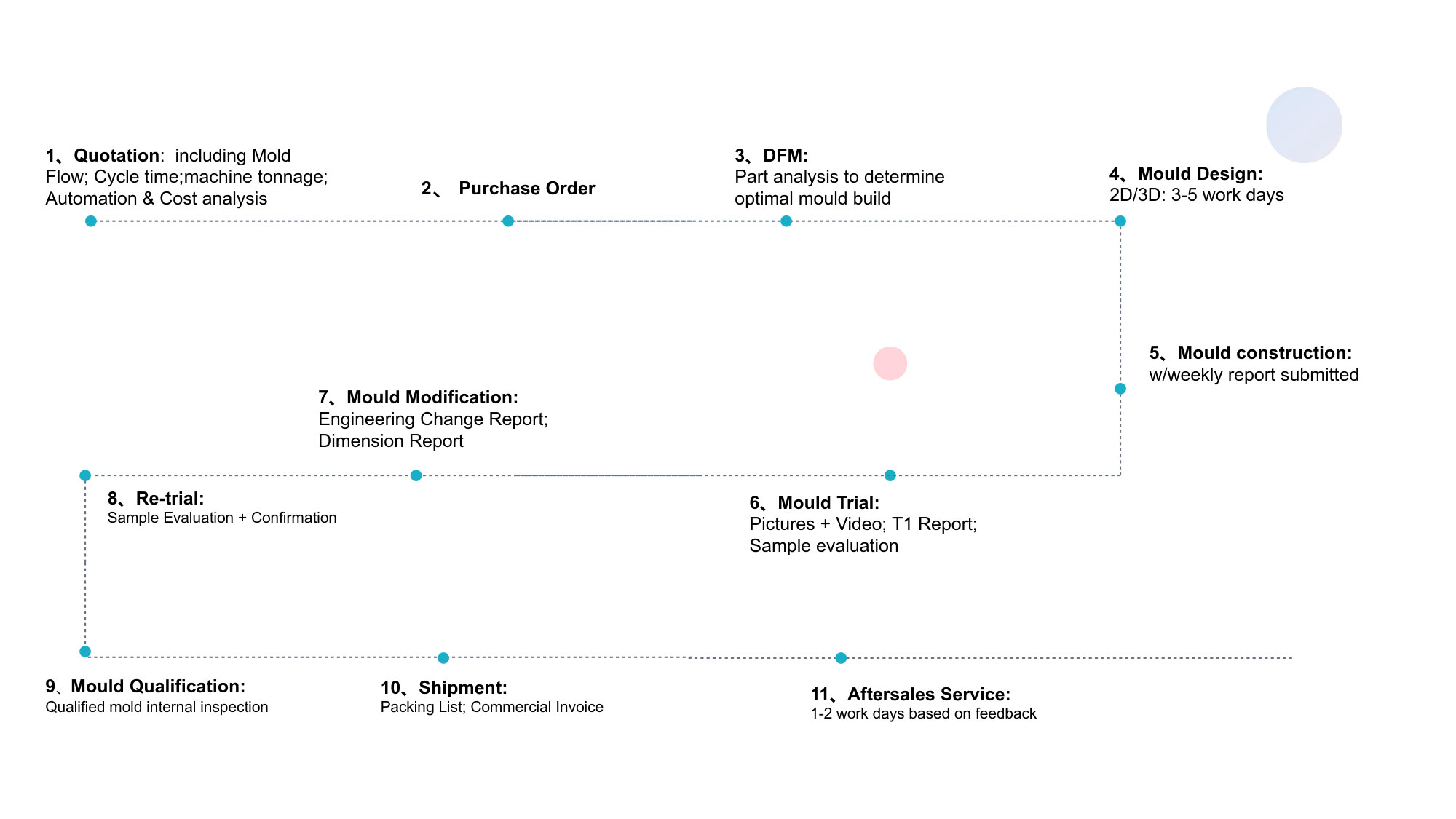
- The mold manufacturing process and product material selection
Mold Manufacturing, Material Selection, Smart Manufacturing Integration, Efficiency Enhancement, and Process Quality Assurance
Mold Manufacturing and Precision Engineering
The foundation of superior overhead reading light console trim production lies in world-class mold manufacturing. Our mold fabrication facility is equipped with 5-axis high-speed machining centers capable of achieving positioning accuracy of 0.002mm, enabling the creation of complex curved surfaces with seamless parting lines and no burrs. Complex geometries including fine slots as narrow as 0.03mm are machined using wire EDM technology, ensuring thin-wall sections remain dimensionally stable and deformation-free. Each mold undergoes thermal treatment and stress relief cycles to guarantee structural integrity throughout its service life.
-
Material Selection for Automotive Interior Applications
Material selection directly impacts part performance, appearance, and longevity. For overhead console trims requiring high heat resistance and flame retardancy, we specify PC/ABS blends that meet UL94 V-0 requirements, offering excellent impact strength, dimensional stability, and UV resistance exceeding 3,000 hours of accelerated weathering testing without discoloration. For glass fiber-reinforced applications requiring enhanced mechanical strength, we utilize PA6+GF30 and PPS compounds with specialized wear-resistant properties. Mold steel selection is equally critical: mirror-finish applications utilize NAK80 and S136 grades, delivering surface polish to 10,000-grit mirror finish and corrosion resistance when processing flame-retardant materials. For glass-filled materials, H13 and 8407 hot-work tool steels provide exceptional wear resistance and high-temperature stability, with documented mold life exceeding 500,000 shots for glass-reinforced compounds and over 1,000,000 cycles for standard engineering thermoplastics.
Smart Manufacturing and Efficiency Enhancement
Our manufacturing operations are digitally integrated through interconnected MES systems that lock all molding parameters—temperature, pressure, injection speed, and cycle timing—with role-based access controls. Production data is continuously monitored, and any deviation from established process windows triggers real-time alerts for immediate corrective action. Automated material handling systems deliver consistent resin supply to each machine, eliminating variability introduced by manual operations. This smart manufacturing ecosystem enables real-time statistical process control, with key dimensional characteristics tracked continuously and Cpk values calculated on a shift-by-shift basis.
Process Quality Assurance
Quality is engineered into every step. Before production begins, each mold undergoes a comprehensive validation protocol including dry-cycle testing, short-shot analysis, and full-dimensional inspection using CMM and optical measurement equipment. Production runs are qualified through first-article inspection, in-process sampling at predetermined intervals, and final audit before packaging. We provide complete documentation packages including material certifications, dimensional inspection reports, process parameter logs, and capability analysis (Cpk ≥ 1.33 on all critical-to-quality dimensions). With mold temperature controlled within ±2°C across cavity regions using zone-controlled thermal regulation systems, we minimize warpage and ensure consistent shrinkage behavior from batch to batch.
These core capabilities translate directly into customer value: reduced scrap rates, eliminated secondary finishing operations, predictable delivery schedules, and consistently repeatable quality across millions of production cycles.
Part Three (2000+ words Executive Summary) – Overhead Reading Light Console Trim: Manufacturing Solutions by Ansix Tech
Executive Summary
Ansix Tech Limited, established in Hong Kong in 1998 and now operating with over 28 years of injection molding heritage, has evolved into a global leader in end-to-end injection molding solutions. The company specializes in the design, engineering, and manufacturing of precision injection molds and injection-molded components. With a corporate mission to “Make Our Customers Successful,” Ansix Tech has built a diversified customer base across automotive, medical, commercial communications equipment, mobile and wearable devices, and smart home sectors.
For overhead reading light console trim projects, Ansix Tech offers a comprehensive solution that begins with conceptual design and prototyping and extends through mold manufacturing, high-volume production, secondary processing, and final assembly. This document details how Ansix Tech transforms technical expertise into measurable customer value—reducing costs, mitigating risks, compressing timelines, and ensuring uncompromising quality.
I. Hard Infrastructure: The Foundation of Customer Trust
The precision and reliability of any injection molding project begin with the equipment used to create the tooling and produce the parts. Ansix Tech maintains a world-class manufacturing infrastructure that directly translates into customer confidence.
1.1 Mold Fabrication Equipment
5-Axis High-Speed Machining Centers
Ansix Tech operates advanced 5-axis simultaneous machining centers capable of achieving positioning accuracy to ±0.002mm. Five-axis machining eliminates the need for multiple workpiece repositionings, enabling continuous multi-face cutting with a single setup. This capability is critical for overhead reading light console trims, which frequently incorporate complex curved surfaces, subtle draft angles, and precisely contoured aesthetic features. The 5-axis approach achieves surface finishes of Ra 0.2–0.4μm directly from machining, reducing or eliminating manual polishing requirements while ensuring that parting lines remain smooth and burr-free.
The benefit to customers is straightforward: smoother part surfaces, elimination of secondary finishing operations, and mold geometries that can only be realized through true simultaneous multi-axis machining.
Slow-Speed Wire EDM
For fine features including narrow slots as thin as 0.03mm, thin-wall sections, and intricate venting channels, Ansix Tech employs slow-speed wire electrical discharge machining (EDM). This process delivers exceptional accuracy with no mechanical cutting forces, which is particularly important when machining thin-wall sections that could otherwise distort under traditional milling loads.
Comprehensive Finishing Capabilities
Our mold shop includes electrode manufacturing cells and spark EDM machines, enabling mold rework and maintenance to be performed entirely in-house. This vertical integration means that when modifications or repairs are required—whether for design changes or scheduled maintenance—the mold never leaves our facility. Standard repairs including weld repairs and insert replacements are typically completed within 24 hours, dramatically reducing downtime compared to suppliers who must outsource mold rework.
1.2 Injection Molding Machine Fleet
Ansix Tech operates 260 injection molding machines across four production bases in China and Vietnam. The fleet spans clamping forces from 30 tons to 2,800 tons, covering the entire spectrum of overhead reading light console trim geometries from compact reading light bezels to full-width overhead console panels.
All-Electric Servo-Drive Technology
A substantial portion of our fleet utilizes all-electric servo-drive systems. Unlike hydraulic machines, all-electric presses deliver shot-to-shot repeatability with dimensional variation controlled to ±0.1%. This consistency means customers receive identical parts regardless of whether they come from the first shift of Monday or the last shift of Friday three months later.
Machine Network Integration
Every injection molding machine is connected to our factory network, with all process parameters—including barrel temperatures, injection pressure profiles, screw speed, injection velocity, hold pressure, cooling time, and back pressure—locked within the MES. Parameter adjustments require engineering-level authorization, and changes are logged with timestamps and operator identification. This digital control eliminates the risk of unauthorized parameter modifications that could compromise part quality.
1.3 Metrology and Inspection Equipment
Ansix Tech maintains a comprehensive quality laboratory equipped with coordinate measuring machines (CMM) for full 3D dimensional verification and optical measurement systems for rapid feature inspection. Every mold, before shipment, undergoes complete dimensional inspection with full reporting against customer-supplied CAD data. For high-volume production, critical-to-quality dimensions are monitored continuously, and CpK capability indices are validated to ≥1.33.
The value to customers is absolute: dimensional data accompanies every shipment, capability is proven rather than claimed, and any potential issue is identified before the first production part is ever shipped.
II. Mold Manufacturing Excellence: Capabilities That Translate into Customer Outcomes
2.1 Mold Steel Selection
The mold is the single most critical asset in any injection molding project. Ansix Tech selects mold steels based on production volume, material type, and surface finish requirements, with detailed material certifications provided to every customer.
Material Hardness Application Expected Mold Life
P20 / 718H HRC 30–36 Large structural components, initial trials 100,000–500,000 shots
NAK80 HRC 38–42 Mirror-finish trim panels, high-gloss surfaces 300,000–500,000 shots
S136 HRC 48–52 High-corrosion resistance, flame-retardant materials, medical-grade surfaces 500,000+ shots
H13 / 8407 HRC 45–55 Glass-reinforced materials (PA6+GF30, PPS+GF40) 500,000–1,000,000+ shots
DC53 / SKD61 HRC 58–62 High-wear applications, long-run production 1,000,000+ shots
2343 / 2344 HRC 46–52 High-temperature engineering plastics (PEEK, PEI) 300,000+ shots
Customer Value Delivered:
Predictable mold life: For standard engineering thermoplastics, Ansix Tech guarantees 1,000,000+ mold cycles before major refurbishment.
Glass-reinforced material compatibility: When processing PA6+GF30 or similar compounds, mold life is still guaranteed to 500,000+ cycles through the use of H13 and 8407 grades with specialized surface treatments.
Full traceability: Each mold is accompanied by material certifications, heat treatment curves, and hardness test reports.
Aesthetic-grade surface quality: For high-gloss console trims requiring mirror finishes, NAK80 and S136 cavities deliver Ra ≤ 0.05μm surface finishes directly from polishing, eliminating grain or texture imperfections.
2.2 Mold Types and Configurations
Based on overhead reading light console trim requirements, Ansix Tech deploys several specialized mold architectures:
Hot Runner Systems (Multi-Drop) – By maintaining the plastic material in a molten state within the runner system, hot runner molds eliminate the solid runner that would otherwise be rejected as scrap. For overhead console trims, the material saved typically represents 15–25% of total shot weight, which over a production run of 500,000 parts translates into tens of thousands of dollars in material savings.
Two-Color / Multi-Material Molds – Increasingly, overhead console assemblies integrate decorative contrasting materials or soft-touch overmolding. Ansix Tech engineers and builds two-shot molds that produce fully assembled components in a single molding cycle, eliminating secondary assembly operations and the associated labor and quality risks.
Stack Molds – For very high-volume programs, stack molds (multi-level molds producing two cavity sets with each cycle) effectively double output without doubling machine capacity.
2.3 Gate Design and Flow Optimization
Poor gate placement is the leading cause of cosmetic rejects, weak weld lines, and trapped air in overhead console trims. Ansix Tech prevents these issues through systematic mold flow analysis before any steel is cut.
For each overhead reading light console trim, our engineers conduct full mold flow simulations to evaluate filling patterns, pressure distributions, temperature profiles, and air entrapment risks. The analysis identifies optimum gate locations, number of gates, and flow leader/flow restrictor placements to achieve balanced cavity filling with minimal pressure drop.
The bypassed problems include:
Weld lines that would appear at material flow convergence points, creating visible cosmetic defects or structurally weak zones;
Trapped air that would cause burn marks or incomplete filling at cavity extremities;
Sink marks that would appear at thick rib intersections and boss bases;
Uneven packing that would produce dimensional variation across large console panels.
Customer value: After mold flow analysis, we can predict with high confidence that parts will fill completely, eject cleanly, and meet dimensional specifications on the very first production trials, rather than requiring multiple costly and time-consuming mold iterations.
2.4 Conformal Cooling Design
Cooling typically accounts for 50–70% of total injection molding cycle time. Ansix Tech employs conformal cooling channel designs—cooling circuits that follow the contour of the part geometry rather than relying on conventional straight-drilled channels.
Using additive manufacturing techniques for mold inserts or precision CNC machining of curved channel geometries, conformal cooling reduces temperature variation across the molding cavity to ≤2°C. For overhead reading light console trims, the result is:
Cycle time reductions of 20–30%;
Uniform shrinkage across all part sections, eliminating warpage;
Reduced residual stress in the molded part;
Faster time-to-market through shorter qualification cycles.
III. Injection Molding Process Control: Reducing Customer Quality Anxiety
3.1 Process Standardization and MES Integration
Customers fear one scenario above all others: dimensional variation from batch to batch that requires sorting, rework, or—worst of all—customer line stoppages.
Ansix Tech eliminates this risk through process standardization. All injection molding parameters are locked in the MES with role-based access controls. Only authorized process engineers can modify parameters, and any change triggers an automatic work order requiring validation through first-article inspection.
What this means for customers: When you validate your part on our press, the production process that produced that validation part is digitally preserved. Every subsequent production run repeats the exact same parameters, producing the same part, the same dimensions, and the same appearance.
3.2 Thermal Regulation for Dimensional Stability
Warpage is the enemy of automotive interior trim. Ansix Tech controls thermal uniformity through zone-controlled mold temperature regulation, maintaining temperature differences between core and cavity surfaces to ≤2°C. This tight thermal control, combined with the aforementioned conformal cooling design, produces parts that are dimensionally stable across the entire production run.
For typical overhead console trim geometries, our demonstrated capability across consecutive production batches shows critical hole-to-hole spacing variation of ≤0.02mm.
3.3 Appearance Quality Standards
Aesthetic quality is non-negotiable for automotive interior components. Ansix Tech achieves:
High-gloss surfaces: Surface roughness Ra ≤ 0.2μm with no visible flow lines, sink marks, or gate vestige;
Textured surfaces: Matte and grained finishes per customer specifications (SPI grades);
Transparent components: Bubble-free, flow-line-free clarity meeting optical-grade specifications;
Electroplating-ready surfaces: No gas marks or surface porosity that would compromise plating adhesion.
3.4 Advanced Material Processing Capabilities
Ansix Tech has extensive production experience across a broad spectrum of engineering thermoplastics:
Material Category Specific Grades Key Properties for Overhead Console Applications
Commodity/Blends ABS, PC/ABS, PC, PC/ASA, PC/PBT Balanced impact, heat resistance, processability
Glass-Reinforced PA6+GF30, PA66+GF30, PBT+GF30, PPS+GF40 High strength, dimensional stability at elevated temperature
High-Temperature PEEK, PEI, PPS, LCP Extreme heat resistance, chemical resistance, structural applications
Specialty PTFE, PFA, Liquid Silicone Rubber (LSR) Low friction, high-temperature sealing, soft-touch overmolding
Customer value: Whether your overhead reading light console trim requires a PC/ABS blend with UL94 V-0 flame retardancy (demonstrated LOI values supporting V-0 rating), a glass-reinforced structural housing for high-load applications, or a soft-touch LSR overmold for premium feel, Ansix Tech has the material expertise and processing knowledge to deliver.
IV. Full-Process Service: Reducing Customer Management Costs
4.1 Early Engagement Through DFM (Design for Manufacturability)
Ansix Tech does not wait for tooling orders to begin adding value. Before any mold design work begins, our engineering team conducts a comprehensive Design for Manufacturability (DFM) review, examining the customer's part design against manufacturability criteria:
Draft angle adequacy for clean part ejection;
Uniform wall thickness distribution to prevent sink and warpage;
Rib and boss design to avoid thick sections;
Gate location impact on cosmetics and strength;
Ejector pin placement relative to visible surfaces.
The DFM report, delivered before mold purchase commitment, includes specific recommendations and a detailed risk assessment identifying which design features require modification and which can be accommodated as-is.
Customer value: Identifying moldability issues before steel is cut prevents what is otherwise the most expensive scenario in injection molding: discovering after the mold is built that the part cannot be produced as designed. The cost of DFM pre-work is minimal compared to the costs of mold rework, requalification, and delayed market entry.
4.2 Trial Shots and Iterative Validation
Following mold completion, Ansix Tech conducts T0 through T3 validation runs:
T0 – First shot – Initial material is injected through the mold. Short shots, flow patterns, and basic filling behavior are assessed.
T1 – Dimensional and functional validation – Full measurement against customer print, comparison against first-shot observations, and adjustment of injection parameters.
T2 – Optimized process confirmation – Process parameter refinement based on T1 measurements.
T3 – Process qualification – Long-run validation with CpK studies confirming capability on all critical dimensions.
Throughout this process, every trial is accompanied by an improvement report documenting observations, corrective actions taken, and remaining issues requiring customer input. Ansix Tech maintains an inventory of interchangeable mold inserts that allow multiple design variations to be trialed without completely rebuilding the entire mold.
Customer value: The validation process is transparent. You see exactly how the part is performing at each stage, walk through our improvement plan, and approve production start only when you are satisfied that all quality targets have been met.
4.3 Low-Volume Pre-Production Validation
Before committing to scaled production, Ansix Tech provides 100- to 500-shot pilot runs under full production conditions. During this run:
Dimensional capability studies (Cpk ≥ 1.33 on CTQ features) are completed;
Yield rates and scrap categories are documented;
Cycle time targets are validated;
Final process parameters are locked.
Customer value: You do not commit to scaled production until you have quantitative evidence that the process can consistently produce acceptable parts.
4.4 Mold Maintenance and Spare Parts
Ansix Tech supplies each mold with a complete set of wear-specific spare components including ejector pins, core inserts, and wear plates. Scheduled preventive maintenance is conducted at prescribed intervals (recommended: every 200,000 cycles), and major refurbishment is available at cost-plus pricing with no margin markup on parts or labor.
Customer value: The mold is your asset, not ours. We treat it accordingly, providing the documentation, spares, and ongoing support needed to maximize its productive life.
V. Differentiated Commitment: Addressing Common Customer Pain Points Directly
Customer Pain Point Ansix Tech Commitment (Actionable and Verifiable)
Frequent mold repairs disrupt production schedules Every mold undergoes 2,000-cycle pre-delivery run-off testing with wear inspection reporting. Ansix Tech provides three-year structural warranty on mold frame and cavity components (excluding naturally wearing consumables).
Excessive flash requires secondary deburring, increasing labor cost Parting line surfaces are machined to 0.005mm matching accuracy. Our machines feature self-locking clamp force compensation, maintaining flash ≤ 0.03mm across production batches—eliminating post-molding deburring.
Dimensional inconsistency from batch to batch All machines are MES-integrated with real-time parameter monitoring. Ultrasonic wall-thickness sensors provide feedback to injection units, automatically adjusting hold pressure to compensate for material viscosity variation. Optional in-mold temperature and pressure sensors enable closed-loop process control.
Long mold repair cycles disrupt production In-house electrode machining and EDM cells enable mold rework without leaving the facility. Standard weld repairs and insert replacements are completed and returned to production within 24 hours.
Mold handover lacks documentation Complete handover package includes: full dimensional report, steel certifications with heat treatment curves, spare parts list, maintenance schedule, setup documentation, and process parameter sheet.
VI. Cost Reduction Framework: Material, Process, and Efficiency Optimization
Ansix Tech approaches cost reduction systematically, identifying opportunities at every stage of the product lifecycle:
6.1 Material Cost Optimization
Through volume purchasing agreements with leading resin suppliers including SABIC, Trinseo, and BASF, Ansix Tech negotiates tier-1 pricing on engineering thermoplastics.
Material substitution (only where performance permits) can further reduce costs. For overhead console trims not requiring UL94 V-0, standard ABS may replace flame-retardant PC/ABS at 20–30% lower material cost. For parts where glass-fiber reinforcement is over-specified, neat resin alternatives may be viable.
Customer value: You benefit from supplier volume discounts that would be unavailable to direct purchasers, plus expert guidance on material selection that balances cost against required performance.
6.2 Process Optimization
Cycle time directly determines part cost. Ansix Tech continuously reviews and optimizes each parameter affecting cycle length: injection speed, packing pressure profile, cooling channel design, and mold opening/closing speeds.
Key optimization levers include:
Hot runner systems eliminate sprue and runner waste, reducing material consumption by 15–25%;
Conformal cooling reduces cooling cycle time by 20–30%;
Stack molds double output per press by producing two cavity sets per cycle;
Automated part handling eliminates manual part removal delays.
6.3 Efficiency Improvement
Scrap reduction is pure margin recovery. Our scrap prevention initiatives include: automated material drying systems preventing moisture-induced splay, in-mold pressure monitoring detecting short shots before they occur, regular nozzle and hot runner tip cleaning schedules, and production parameter lockdown preventing operator-driven variation. For every overhead reading light console trim program, target scrap rates are established at ≤2% of total production volume.
Machine utilization is monitored across all 260 presses, with production scheduling optimized to maximize press utilization and minimize changeover downtime. Dedicated presses are allocated to high-volume programs, reducing setup time and ensuring that validated parameters remain undisturbed.
6.4 Part Consolidation and Assembly Integration
Where overhead console trims incorporate multiple components, Ansix Tech evaluates consolidation opportunities:
Two-color molding: combine base trim and decorative inlay into one molded part;
Insert molding: integrate metal or electronic components during the molding cycle;
Overmolding: add soft-touch LSR or TPE surfaces without secondary assembly.
Customer value: Each eliminated SKU reduces inventory, logistics, and assembly labor costs while removing potential failure modes from the final assembly.
6.5 Total Cost Reduction by Program Phase
Program Phase Ansix Tech Cost Reduction Strategy Typical Savings
Pre-production: Design & Tooling DFM prevents rework; conformal cooling reduces tryout cycles 15–25% tooling cost avoided
Production: Materials & Cycle Hot runners cut scrap; cycle optimization reduces machine hours 20–30% per-part cost reduction demonstrated
Production: Quality Process controls prevent defects; CpK monitoring eliminates sorting <2% scrap rate; no sorting requirement
Post-production: Assembly & Logistics Part consolidation; integrated assembly; six regional warehouses 40% lower logistics costs
Sustaining: Maintenance & Spares Scheduled preventive maintenance; full spare kit with every mold 50% lower repair costs vs. on-demand service
VII. Conclusion: Turning Mold Steel into a Revenue-Generating Asset
At Ansix Tech, we do not view a mold as a piece of metal. We view it as your revenue-generating asset—the tool that will produce thousands or millions of saleable parts over its service life.
Every design decision, every steel selection, every allocation of cooling line placement, every process parameter locked in our MES network is made with that perspective in mind: the mold must arrive at your production floor ready to run, requiring no debugging, producing minimal flash, delivering high first-pass yield, and keeping your assembly line supplied.
We welcome the opportunity to demonstrate this capability. Choose any existing overhead console trim part you currently source, and we will conduct a full DFM review, showing you precisely how we would eliminate weld lines, address sink risks at thick sections, optimize cooling for uniform shrinkage, and reduce total landed cost through material and cycle optimization.
The difference between Ansix Tech and fragmented suppliers is not just equipment or certifications. It is the integrated engineering perspective that begins with your part CAD file and ends with parts delivered to your assembly line—on time, on spec, and on budget.
*Ansix Tech Limited – Established 1998 – Over 28 Years of Injection Molding Excellence – IATF 16949 / ISO 9001 / ISO 14001 / ISO 13485 Certified – 260 Injection Molding Machines – 30 to 2,800 Ton Clamping Force – 200,000+ m² Production Footprint – 30,000+ Molds Built Since Founding – 0.002mm Precision – Average Trial-to-Approval: 2 Iterations*
References
Ansix Tech corporate profile and capabilities overview
Injection mold steel selection for automotive interior components
Five-axis simultaneous machining for precision mold fabrication
Advantages of 5-axis CNC machining for complex mold geometries
Process optimization for injection molding stability and efficiency
Conformal cooling cycle time reduction in automotive injection molds
DFM and MOLDFLOW analysis for automotive interior decoration molds
CpK ≥ 1.33 as quality acceptance standard for injection molding
ABS/PC material properties for automotive interior trim applications
Ansix Tech Co Ltd
If you have any plans related to Overhead Reading Light Console Trim , you can contact us at any time. We will turn your ideas into reality, let you realize your dreams, and obtain large orders from the market. Our contact information is info@ansixtech.com. Or contact our CTO, mail: stephen@ansixtech.com
#www.ansixtech.com #ansixtech.com #Overhead Reading Light Console Trim #Overhead Reading Light Console Trim moulds #Overhead Reading Light Console Trim injection molding companies #Overhead Reading Light Console Trim Canopy Mold injection mold companies #Ansix #Ansix moulds #Ansix china #Ansix tech china #Ansix tech company #Ansix facotry #Overhead Reading Light Console Trim injection molding #Overhead Reading Light Console Trim injection tools #Overhead Reading Light Console Trim injection moulds #Overhead Reading Light Console Trim plastic mould #Overhead Reading Light Console Trim plastic tools #Ansix Tech #Ansix molds #Ansix injection molding #Ansix mold factory #injection molding Overhead Reading Light Console Trim #Ansix mold factory #Overhead Reading Light Console Trim china #Overhead Reading Light Console Trim molds #injection factory #Overhead Reading Light Console Trim injection molding #Overhead Reading Light Console Trim injection molding factory #injection molding company #Overhead Reading Light Console Trim injection mold companies #Overhead Reading Light Console Trim#Overhead Reading Light Console Trim mold limited #Ansix mold china #Ansix companies #Ansix company China #Overhead Reading Light Console Trim facotry #Ansix Tech #Ansix Tech mould #Overhead Reading Light Console Trim injection moulding #injection moulding company #Ansix Overhead Reading Light Console Trim parts injection mold companies #medical injection molding companieschina #Overhead Reading Light Console Trim china factory #Ansix moulding companies #Ansix molding company #Overhead Reading Light Console Trim injection moulding facotry #Ansix Tech mold #Overhead Reading Light Console Trim mould #Overhead Reading Light Console Trim plastic injection molding #ansix plastic mold #Mold manufacturing #Overhead Reading Light Console Trim parts manufacturing #Overhead Reading Light Console Trim plastic parts factory #Overhead Reading Light Console Trim injection parts mold #Overhead Reading Light Console Trim PRECISION MANUFACTURING #Overhead Reading Light Console Trim #China mold #Overhead Reading Light Console Trim injection moulding china #Overhead Reading Light Console Trim mould china #china precision mold #mold in china #Overhead Reading Light Console Trim mold china #Precision molds #High-precision molds #Overhead Reading Light Console Trim #Injection molds #Overhead Reading Light Console Trim Factory #Overhead Reading Light Console Trim Company #Super Large Injection Mold Factory #Large Tonnage Injection Molding Factory #Overhead Reading Light Console Trim Company #Overhead Reading Light Console Trim Factory #2800T Injection Molding Factory #3000 Ton Injection Molding #4500 Ton Injection Molding Factory #Large Mold Injection Molding #Large Plastic Mold Injection Molding Factory #Large Injection Mold Manufacturer #Plastic Mold Factory #Injection Mold #Plastic Mold