



Plastic 4-point float valve, water tank float switch, household water tank automatic water replenishment switch, sewage control valve
FEATURES
Vertically Integrated Capabilities and Global Footprint
Ansix operates four production bases strategically located across China and Vietnam, with total factory floor space exceeding 200,000 square meters and a workforce of over 1,200 employees. This manufacturing network is equipped with 260 injection molding machines ranging from 30 tons to 2,800 tons of clamping force, enabling the company to produce components from miniature precision parts to large structural assemblies.
The company’s quality management systems hold ISO 9001, IATF 16949, ISO 13485, and ISO 14001 certifications, demonstrating unwavering commitment to quality management, environmental responsibility, and the stringent requirements of demanding applications. These certifications serve as foundational proof that every technical parameter Ansix masters directly translates into lower risk, faster delivery, and higher profit for customers.
-
Mold Description
Product Materials:
PP abs
Mold Material:
S136ESR
Number of Cavities:
1
Glue Feeding Method:
Hot runner
Cooling Method:
Water cooling
Molding Cycle
12.5s
- The mold manufacturing process and product material selection
Complete Service Lifecycle from Concept to After-Sales
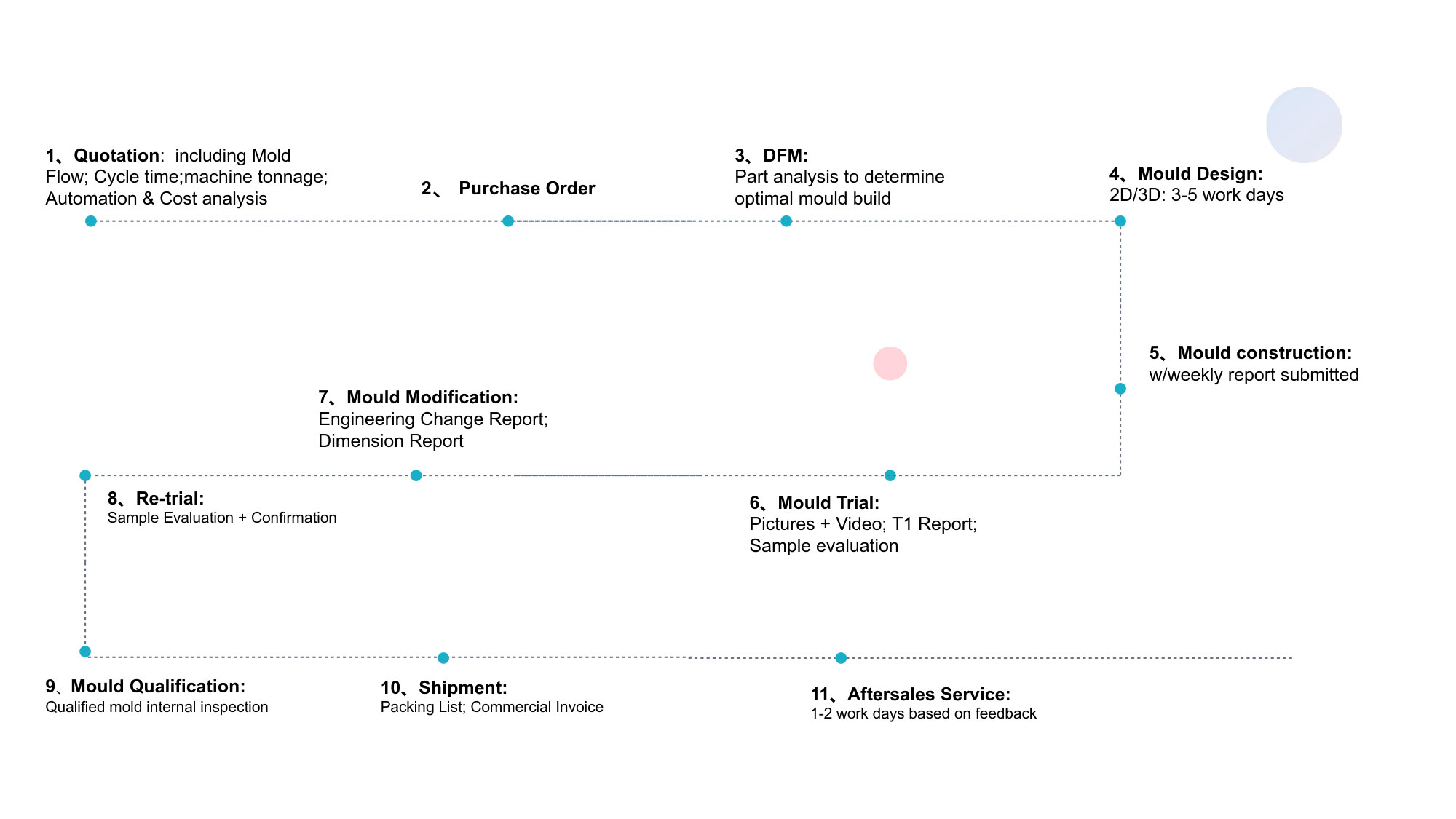
Ansix provides a comprehensive service architecture that eliminates the wasteful gaps between design concept and mass production. This includes:
Design & Development: Early DFM (Design for Manufacturing) analysis using Moldflow and Moldex3D simulations
Product Validation: T0 to T3 sample iterations with detailed improvement reports
Mass Production: High-volume manufacturing with scientific molding protocols
Quality Assurance: Full dimensional inspection with CMM and optical measurement systems
Delivery & Logistics: Coordinated global supply chain management
After-Sales Support: Spare parts inventory and mold maintenance services
Part II: Product Introduction, Manufacturing Process, Delivery Efficiency, Quality Assurance, Cost Control, and Service Guarantees
-
Product Introduction
Plastic 4-Point Float Valve: A precision-engineered valve assembly utilizing a four-point buoyancy mechanism for reliable liquid level control. The valve body is typically manufactured from corrosion-resistant thermoplastics such as PP, POM, or PA6, ensuring long-term durability in water and chemical environments. The four-point contact design distributes sealing forces evenly, preventing leakage and extending service life.
Water Tank Float Switch: An electromechanical level sensing device that activates or deactivates pumps or valves based on liquid level. The switch mechanism is encapsulated within a hermetically sealed plastic housing (typically PP or ABS with IP68 rating), protecting internal components from moisture and debris. These switches serve applications ranging from residential water towers to industrial sump systems.
Household Water Tank Automatic Water Replenishment Switch: An integrated automatic fill control system designed for residential water storage applications. The unit combines a float-actuated valve mechanism with a mechanical or magnetic switching interface, maintaining preset water levels without manual intervention. These systems are manufactured for compatibility with standard plumbing connections and can be adapted for various tank geometries.
Sewage Control Valve: A heavy-duty flow control device designed for aggressive media environments including sewage, industrial effluent, and chemical-laden liquids. The valve incorporates wear-resistant materials (often reinforced POM or PA6-GF30) and robust sealing geometries to withstand corrosive conditions, particulate abrasion, and extreme temperature fluctuations.
2.2 Manufacturing Process
The production of these fluid control components follows a tightly controlled, multi-stage process:
Raw Material Verification: Incoming resin lots are tested for melt flow index (MFI), moisture content (typically <0.02% for hygroscopic materials like PA6), and mechanical properties before release to production.
Material Drying and Preparation: Hygroscopic engineering plastics (PA6, PA66, PC, PBT, PET) undergo controlled drying in desiccant or vacuum dryers. Processing temperatures are precisely maintained—for PA6-GF30, melt temperatures are held at 240-280°C, with mold temperatures at 80-100°C, ensuring optimum flow and part integrity. Materials for float valves and switches are selected for specific properties: POM for wear resistance in sealing surfaces, ABS for cost-effective enclosures, PP for chemical resistance, and PA6-GF30 for high-strength threaded connections.
Injection Molding: 260 injection molding machines from FANUC, Sumitomo, Toshiba, Nissei, Engel, Arburg (LSR primary), Haitian, and Taichung, ranging 30-2800 tons, produce components with cycle times optimized for each product family. All machines are equipped with full-servo motor drives, achieving ±0.1% shot-to-shot repeatability.
Secondary Operations: Post-molding processes include deflashing (flash controlled to <0.03mm), ultrasonic welding for hermetic seals, magnet overmolding for magnetic float switches, leak testing at specified pressures, and assembly of multi-component systems.
Packaging and Traceability: Each component receives individual quality coding, enabling full traceability back to production shift, machine, and material lot.
2.3 Delivery Efficiency
Ansix has established industry-leading delivery capabilities through systematic production planning and global supply chain management:
Product Type Standard Lead Time Expedited Option
Simple Mold (single cavity, basic geometry) 10 working days Available upon request
Medium Complexity Molds (4-8 cavities, moderate cooling) 25-45 days 20 days minimum
High-Complexity Molds (multi-cavity, complex cooling) Customized per project Based on validation requirements
Simple molds can be completed within 10 working days, while medium-complexity molds are delivered in 25-45 days, with expedited options available for urgent requirements without compromising validation protocols.
The company’s four production bases across China and Vietnam provide manufacturing redundancy and proximity to global markets, reducing logistics lead times for customers across Asia, Europe, and North America. By internalizing sensitive processes such as EDM machining within dedicated workshops, Ansix eliminates outsourcing delays and communication barriers, accelerating overall mold manufacturing schedules.
2.4 Quality Assurance
Quality control at Ansix is systematic, data-driven, and certified to international standards:
Incoming Quality Control (IQC): All incoming raw materials—resins, colorants, additives, and purchased components—undergo inspection against certified material specifications. Material certifications, including UL94 flame ratings, RoHS compliance, and REACH declarations, are maintained for all stock keeping units.
In-Process Quality Control (IPQC): Production parameters (temperature, pressure, speed, cooling time) are locked into MES (Manufacturing Execution System) and accessible only to authorized engineers. Each batch undergoes first-piece and last-piece dimensional inspection, with key characteristic dimensions held to CPK ≥ 1.33.
Outgoing Quality Control (OQC): Before shipment, finished products are subjected to functional testing—float valves are leak-tested at operating pressures (typically 0.2-1.0 MPa), float switches are tested for switch point accuracy (±2mm repeatability), and sewage control valves undergo particulate bypass testing.
Quality Certifications: ISO 9001 (general quality management), IATF 16949 (automotive-grade quality management), ISO 13485 (medical device quality management), and ISO 14001 (environmental management), along with BSCI certification for social compliance.
2.5 Competitive Cost Control
Ansix reduces the single largest variable cost in injection molding—raw material—through multi-cavity tooling strategies. For high-volume float switch and valve components, 4-cavity, 8-cavity, 16-cavity, and up to 32-cavity layouts proportionally reduce per-part cost by distributing molding overhead across more cavities.
Cost optimization begins at design, where DFM analysis eliminates unnecessary complexity. Engineering teams collaborate with customers to establish cost-effective tolerance schemes, recognizing that in plastics manufacturing, “profit lies in the tolerance.” Rapid prototyping creates functional models for physical validation before committing to full tooling—validating assembly, form, and function without expensive mold rework.
Ansix’s internal EDM machining workshop enables precision machining of complex details at reduced costs, while multi-location manufacturing in China and Vietnam provides geographic cost advantages without sacrificing precision. In one documented thermostat housing project, Ansix achieved a first-pass yield of over 99.5% while reducing component costs by at least 15% compared to the customer’s previous supplier.
2.6 After-Sales Service
Ansix delivers comprehensive after-sales support including: spare parts inventory (ejector pins, core inserts) delivered with the mold, mold maintenance at every 200,000 cycles, lifetime repair service at cost, mold storage and management services, and remote technical troubleshooting within 24 hours.
Part III: Mold Manufacturing, Material Selection, Smart Manufacturing, and Process Quality Assurance
3.1 Mold Manufacturing and Material Selection
Mold Steel Selection: The choice of mold steel balances production volume, material abrasiveness (especially with glass-fiber reinforced resins), and cost. Typical steels include P20 for general-purpose molds (1 million+ shots), H13 for high-temperature applications, S136 for corrosion resistance, 8407 for glass-filled materials, NAK80 for high polish requirements for transparent parts, SKD11/DC53 for wear-resistant edges, and 2344/2343 for hot runner systems. Hardness targets are 48-52 HRC for mold bases and 52-58 HRC for core/cavity inserts for wear resistance in glass-filled applications.
Cooling System Design: Cooling time accounts for over 50% of production cycle time. Ansix employs conformal cooling channel designs where coolant paths follow part contours for uniform heat dissipation, significantly reducing cycle times and preventing warpage through consistent heat extraction.
Runner and Gate Systems: Properly designed runner and gate systems minimize visible witness marks, reduce material shear stress, and ensure balanced filling across multi-cavity layouts. Gate types include pin-point, edge, and submarine, selected based on part geometry, material, and aesthetic requirements.
3.2 Smart Manufacturing and Efficiency Enhancement
Ansix has embraced Industry 4.0 intelligent manufacturing principles to drive productivity and quality. The company’s smart manufacturing ecosystem integrates digital design, advanced cooling technology, and strategic material science to significantly reduce total cost of ownership. All injection molding machines are networked through MES, with processing parameters locked to prevent unauthorized adjustment. Quick-Mold-Change (QMC) systems and predictive maintenance protocols maximize machine uptime and reduce downtime during material or color changes.
3.3 Process Quality Assurance
Scientific Molding Protocols: Decouples filling, packing, and holding phases using measurable outputs like cavity pressure signatures, ensuring each shot is molded within validated process windows.
Dimensional Control and CPK: Prior to mold release, each tool undergoes comprehensive dimensional inspection using coordinate measuring machines (CMM) and optical measurement systems. For critical-to-quality dimensions, CPK ≥ 1.33 is standard with full dimensional reports submitted for customer approval.
Part IV: DFM Analysis, Mold Design, Manufacturing Process, Validation, and Production Optimization
4.1 Mold Flow Analysis (DFM)
Mold flow analysis using Moldflow or Moldex3D creates a complete digital twin of the mold to simulate molten plastic flow, predicting injection pressure, flow front progression, potential weld lines, air traps, and cooling behavior. The DFM report—delivered before tooling commitment—includes: gate placement optimization to ensure balanced filling, weld line and air trap identification, shrinkage prediction for dimensional compensation, warpage analysis for geometry verification, cooling analysis to eliminate hot spots, and moldability assessment confirming required CPK capability.
4.2 Mold Design Focus Areas
Material Selection: The mold steel selection matrix considers production volume, material filler content (glass fibers accelerate wear, requiring higher hardness steels), chemical resistance requirements, thermal cycling demands, and polishability requirements.
Cooling System Design: Conformal cooling channels following part geometry enable uniform temperature distribution across the mold, reducing cooling time by 20-40% compared to conventional straight-drilled cooling lines.
Runner System Design: Hot runner systems reduce scrap by eliminating cold runner waste, ideal for high-volume valve and float switch components. Balanced runner layouts ensure each cavity fills simultaneously, preventing over-packing of close cavities and under-filling of distant cavities.
Ejection System Design: Strategic ejector pin placement avoids functional surfaces while ensuring uniform ejection force distribution, preventing part distortion.
4.3 Mold Manufacturing Challenges and Solutions
Challenge Ansix Solution
Deep ribs and narrow slots Slow wire EDM with 0.03mm wire diameter capability
High polish requirements for sealing surfaces Dedicated polishing station with Ra measurement
Multi-cavity consistency Individual cavity pressure sensors and flow balancing
Glass fiber wear resistance S136/8407 steel with 54-58 HRC hardness and TiN coating
4.4 Material Selection for Specific Products
Float Components (PP Foamed Core): PP with 20-30% glass fiber reinforcement, density 0.9-1.2 g/cm³ (adjustable by foam ratio), heat deflection temperature >120°C. PP-GF30 and PP-GF40 provide excellent stiffness, creep resistance, and thermal stability under load. PP foamed micro-foaming technology creates lightweight buoyancy elements with integrated magnet overmolding for magnetic sensing applications.
Float Switch Housings (POM/ABS): POM (polyoxymethylene) provides strength, rigidity, fatigue resistance, creep resistance, and chemical resistance for critical bearing surfaces and gears. ABS provides impact resistance and cost-effectiveness for non-structural housings.
Sewage Control Valves (PA6-GF30): 30% glass fiber reinforced polyamide 6 (PA6-GF30) provides very good mechanical properties, optimal flow for fast mold filling, chemical resistance to hydrocarbons, mineral oils, alkalis, and weak acids. UL94 V-0 flame ratings available for fire safety in electrical enclosures.
Threaded Connections and Bushings (POM): Natural wear resistance with low friction coefficient, excellent for valve stems and rotating seal surfaces.
4.5 Injection Molding Process Optimization
Key Parameters Optimized for These Products:
Parameter Float Valve Float Switch Sewage Valve
Melt Temp 200-230°C 200-230°C 240-280°C
Mold Temp 40-60°C 40-60°C 80-100°C
Inj Pressure 60-100 MPa 60-100 MPa 80-140 MPa
Hold Pressure 50-70% of injection 50-70% of injection 60-80% of injection
Cooling Time 15-30s 15-30s 25-50s
Efficiency Improvements: Gas-assisted molding achieves 30-50% faster cycle times than conventional processes. High-cavity tooling (16-32 cavities) increases output per machine hour by 4-8x. Multi-component molds (rotary stack molds) combine operations, eliminating secondary assembly steps and handling costs.
4.6 Quality Control and Assurance
In-Process Monitoring: Real-time cavity pressure monitoring detects fill variations cycle-by-cycle. Ultrasonic wall thickness sensing ensures consistent wall distribution and compensates for material viscosity fluctuations.
Validation Protocols: T0 samples verify basic form, fit, and function. T1 samples incorporate first corrective actions. T2 samples confirm dimensional correction effectiveness. T3/T4 samples lock process parameters and validate CPK before mass production release.
Final Quality Control: Float valves 100% leak-tested at operating pressure. Float switches undergo switch point accuracy testing (±2mm repeatability). Sewage valves are particulate-bypass tested and cycle life tested (minimum 100,000 cycles for industrial grade).
4.7 Packaging and Rapid Delivery
Parts are packaged in moisture-barrier bags with desiccant, labeled with lot codes linking to production records. Inventory management through ERP systems enables just-in-time delivery coordinated with customer production schedules, with ocean freight, air freight, and express courier options available.
4.8 Customer Value Proposition
For every client, Ansix’s value translates directly into measurable business outcomes:
Cost Reduction: Per-part cost reduction of 15-30% versus previous suppliers
Risk Mitigation: DFM analysis identifies 95%+ of potential molding defects before steel is cut
Time to Market: 10-45 day mold lead times reducing product launch cycles by 4-8 weeks
Production Reliability: CPK ≥ 1.33 on critical dimensions and first-pass yield >99.5%
Lower Maintenance: Mold life guaranteed for 1 million+ shots, reducing tooling replacement frequency
Simplified Supply Chain: Single-source responsibility from prototype to production
Reduced Scrap: Optimized gate and runner design reducing material waste by 30-50%
Part V: Industry Experience and Reliability
With over 28 years of integrated injection molding excellence, Ansix has demonstrated capabilities across the entire mold manufacturing and injection molding project lifecycle. The company maintains a strategic manufacturing ecosystem that translates technical excellence into measurable client value through substantial cost reduction, enhanced efficiency, and reliability. Vertical integration across design, tooling, molding, and assembly ensures seamless project execution without coordination gaps. Ansix serves demanding sectors including water treatment, automotive, medical devices, and household appliances, with precision molding of high-performance engineering plastics including PEEK, PPS, PA6-GF30, PA66-GF35, PC, PC/ABS, POM, PBT, ABS, PP, and LSR.
By systematically reducing costs through material selection optimization, process efficiency improvements, multi-cavity tooling strategies, and vertical integration, Ansix delivers a total cost of ownership that consistently undercuts competitors without sacrificing quality or reliability. The company’s commitment to advanced digital design, innovative cooling technology, and strategic material science is establishing new industry benchmarks while providing unparalleled reliability and partner profitability for mold making and injection molding projects worldwide.
For more information about Ansix Tech’s mold making and injection molding capabilities for Plastic 4-point float valves, water tank float switches, household water tank automatic water replenishment switches, and sewage control valves, please contact info@ansixtech.com. The team responds within 12 hours.
Ansix Tech Co Ltd
If you have any plans related to Plastic 4-point float valve, water tank float switch, household water tank automatic water replenishment switch, sewage control valve , you can contact us at any time. We will turn your ideas into reality, let you realize your dreams, and obtain large orders from the market. Our contact information is info@ansixtech.com. Or contact our CTO, mail: stephen@ansixtech.com
#www.ansixtech.com #ansixtech.com #Plastic 4-point float valve, water tank float switch #Plastic 4-point float valve, water tank float switch #Plastic 4-point float valve, water tank float switch Canopy Mold injection mold companies #Ansix #Ansix moulds #Ansix china #Ansix tech china #Ansix tech company #Ansix facotry #Plastic 4-point float valve, water tank float switch injection molding #Plastic 4-point float valve, water tank float switch injection tools #Plastic 4-point float valve, water tank float switch injection moulds #Plastic 4-point float valve, water tank float switch plastic mould #Plastic 4-point float valve, water tank float switch plastic tools #Ansix Tech #Ansix molds #Ansix injection molding #Ansix mold factory #injection molding Plastic 4-point float valve, water tank float switch#Ansix mold factory #Plastic 4-point float valve, water tank float switch china #Plastic 4-point float valve, water tank float switch molds #injection factory #Plastic 4-point float valve, water tank float switch injection molding #Plastic 4-point float valve, water tank float switch injection molding factory #injection molding company #Plastic 4-point float valve, water tank float switch injection mold companies #Plastic 4-point float valve, water tank float switch Tooling #Plastic 4-point float valve, water tank float switch mold limited #Ansix mold china #Ansix companies #Ansix company China #Plastic 4-point float valve, water tank float switch facotry #Ansix Tech #Ansix Tech mould #Plastic 4-point float valve, water tank float switch injection moulding #injection moulding company #Ansix Plastic 4-point float valve, water tank float switch parts injection mold companies #medical injection molding companieschina #Plastic 4-point float valve, water tank float switch china factory #Ansix moulding companies #Ansix molding company #Plastic 4-point float valve, water tank float switch injection moulding facotry #Ansix Tech mold #Plastic 4-point float valve, water tank float switch mould #Plastic 4-point float valve, water tank float switch plastic injection molding #ansix plastic mold #Mold manufacturing #Plastic 4-point float valve, water tank float switch parts manufacturing #Plastic 4-point float valve, water tank float switch plastic parts factory #Plastic 4-point float valve, water tank float switch injection parts mold #Plastic 4-point float valve, water tank float switch PRECISION MANUFACTURING #Plastic 4-point float valve, water tank float switch #China mold #Plastic 4-point float valve, water tank float switch injection moulding china #Plastic 4-point float valve, water tank float switch mould china #china precision mold #mold in china #Plastic 4-point float valve, water tank float switch mold china #Precision molds #High-precision molds #Plastic 4-point float valve, water tank float switch #Injection molds #Plastic 4-point float valve, water tank float switch Factory #Plastic 4-point float valve, water tank float switch Company #Super Large Injection Mold Factory #Large Tonnage Injection Molding Factory #Plastic 4-point float valve, water tank float switch Company #Plastic 4-point float valve, water tank float switch Factory #2800T Injection Molding Factory #3000 Ton Injection Molding #4500 Ton Injection Molding Factory #Large Mold Injection Molding #Large Plastic Mold Injection Molding Factory #Large Injection Mold Manufacturer #Plastic Mold Factory #Injection Mold #Plastic Mold