



Polymer wine bottle stoppers, fruit wine bottle stoppers, grape bottle stoppers, Taixiang aromatherapy bottle stoppers, glass bottle stoppers, plastic bottle caps, wooden caps
FEATURES
Hard Power Infrastructure: Building Customer Confidence Through Technical Capability
The foundation of any world-class injection molding operation lies in its physical assets. Ansix Tech‘s manufacturing facility is equipped with state-of-the-art machinery that transforms polymer pellets into precision closures at scale, while maintaining the tightest tolerances in the industry.
1.1 Precision Mold Machining Equipment
At the heart of Ansix Tech‘s mold manufacturing capability is a comprehensive suite of high-precision machining equipment. The company operates multiple five-axis high-speed machining centers capable of producing complex curved surfaces with positioning accuracy of ±0.003mm. This level of precision ensures that critical features such as parting lines, thread profiles, and sealing surfaces are manufactured with exceptional smoothness, eliminating the need for secondary deburring operations. For customers, this directly translates to closures that seal perfectly on first use, with no sharp edges or burrs that could compromise product integrity or consumer safety.
-
Mold Description
Product Materials:
plastic wood
Mold Material:
S136ESR
Number of Cavities:
1
Glue Feeding Method:
Hot runner
Cooling Method:
Water cooling
Molding Cycle
2.5s
- The mold manufacturing process and product material selection
Complementing the CNC milling capabilities, Ansix Tech utilizes slow wire electrical discharge machining (EDM) systems for creating intricate features such as 0.03mm fine micro-holes and narrow slots. This is particularly critical for anti-tamper band designs and thin-wall sections where conventional machining would cause deformation or tool deflection. The slow wire EDM process ensures consistent cavity geometry across all mold cavities, enabling multi-cavity molds to produce identical parts that meet rigorous dimensional specifications.
Injection Molding Machine Fleet
Ansix Tech operates an extensive fleet of fully electric injection molding machines with clamping force ranging from 30 tons to 4000 tons, covering the complete spectrum of closure sizes—from miniature aromatherapy seals under 10mm diameter to large wine stoppers exceeding 80mm. The full servo-electric drive systems provide repeatable positioning accuracy of ±0.1% across all axes, ensuring that every shot in a production run replicates the precise conditions of the first shot. This reproducibility is the cornerstone of batch-to-batch consistency, eliminating the dimensional drift that plagues older hydraulic systems.
-
For high-volume closure production, Ansix Tech has deployed specialized high-speed injection molding cells optimized for multi-cavity molds. These systems achieve cycle times as low as 2-3 seconds for standard beverage caps, delivering throughput rates exceeding 1,500 closures per minute on multi-cavity configurations. For customers, this means shorter lead times and the ability to respond rapidly to market demand fluctuations without compromising quality.
1.3 Quality Inspection and Metrology Equipment
Quality validation begins at the mold shop floor and continues through every stage of production. Ansix Tech maintains a dedicated metrology laboratory equipped with Coordinate Measuring Machines (CMM) capable of performing full-dimensional inspections with measurement uncertainty below ±0.5μm. Optical imaging systems provide rapid non-contact inspection for surface finish evaluation and feature verification.
Full-dimension reports are provided for every mold before shipment, with critical dimension CPK ≥ 1.33 as the baseline acceptance criterion. For projects requiring exceptional precision, Ansix Tech achieves CPK ≥ 1.67 for critical-to-quality (CTQ) dimensions, a benchmark typically reserved for medical device and aerospace applications. Each report includes steel material certification, heat treatment curves, and dimensional validation data, providing complete traceability from raw material to finished product.
1.4 Industry 4.0 Smart Factory Integration
Ansix Tech has fully embraced the Industry 4.0 paradigm, implementing a Manufacturing Execution System (MES) that networks all injection molding machines, auxiliary equipment, and quality inspection stations. This interconnected architecture provides real-time visibility into every aspect of production, enabling data-driven decision-making and predictive maintenance scheduling.
All process parameters—including temperature, pressure, injection velocity, and cooling time—are locked within the MES and accessible only to authorized engineering personnel. This eliminates operator-induced variability and ensures that the same validated process can be replicated across any machine in the facility. The system also enables full product traceability: each production batch is linked to specific raw material lots, machine parameters, and quality inspection results, providing customers with complete confidence in product consistency and regulatory compliance.
II. Mold Manufacturing: Core Competitive Advantages Delivering Customer Value
For closure manufacturers, the injection mold is not merely a tool—it is the fundamental asset that determines production economics, product quality, and long-term profitability. Ansix Tech‘s mold design and fabrication capabilities are built upon decades of refinement, with each decision traceable to specific customer value outcomes.
2.1 Mold Life and Steel Selection
Mold longevity directly impacts a customer‘s total cost of ownership. Premature mold failure leads to unplanned downtime, expediting costs, and compromised product quality. Ansix Tech approaches steel selection with a rigorous material science framework:
Steel Grade Application Hardness (HRC) Expected Life (Shots) Customer Value
P20 Mold base plates 28-32 N/A (non-wear surface) Structural stability, cost-effective base material
S136 (ESR refined) High-gloss cosmetic closures 50-54 2,000,000+ Mirror-finish surfaces for transparent and glossy caps
1.2344 / H13 High-wear threaded components 48-52 1,000,000+ (reinforced) Extended life under abrasive conditions
8407 High-temperature applications 46-50 800,000+ Thermal stability for engineering-grade resins
SKD11 / DC53 Cutting cores and wear inserts 58-62 1,500,000+ Extreme wear resistance for glass-fiber materials
NAK80 High-gloss pre-hardened 37-43 500,000+ Pre-hardened for rapid turnaround, excellent polishability
M340 Corrosive environments 50-54 1,200,000+ Superior corrosion resistance for acidic beverages
For glass-fiber reinforced materials, Ansix Tech guarantees mold life of 500,000 shots minimum, while standard thermoplastic closures achieve 1,000,000+ shots between major overhauls. Every mold is accompanied by heat treatment charts and material mill certificates, ensuring no substitution of inferior local equivalents that would lead to premature stress cracking or gate erosion.
2.2 Precision Tolerances and Shrinkage Compensation
Achieving consistent closure dimensions across millions of cycles requires mastery of polymer shrinkage behavior and precision machining. Ansix Tech delivers conventional structural components to ±0.05mm tolerance, while precision closures such as dispensing spouts and pharmaceutical seals achieve ±0.005mm on critical dimensions.
The key to this precision lies in Ansix Tech‘s scientific approach to shrinkage compensation. Before any machining begins, Moldflow simulation predicts material-specific shrinkage rates based on gate location, part geometry, and cooling circuit design. These predictions are then converted into steel-safe offsets on core and cavity inserts, ensuring that the finished part conforms to nominal dimensions after cooling. Post-trial verification using CMM inspection confirms shrinkage compensation accuracy, with adjustments made before production release.
2.3 Advanced Mold Architectures
Ansix Tech designs and manufactures multiple mold configurations to match customer production requirements:
Hot Runner Systems: Eliminate runner waste entirely, reducing material consumption by 15-30% compared to cold runner molds. Hot runner systems are particularly advantageous for high-cavity-count closure molds, where material savings translate directly to per-part cost reduction. The use of valve-gate hot runners provides precise control over gate vestige appearance, essential for cosmetic-grade closures.
Stack (Multi-Level) Molds: Double the output of a single injection molding machine by arranging two mold faces in series. For standard beverage closures, a 2-level 48+48 cavity stack mold delivers the same production volume as a 96-cavity single-face mold but on a machine with 50% less clamping force, reducing capital equipment costs and energy consumption.
Two-Shot / Multi-Material Molding: For closures requiring multiple materials—such as soft-touch over-molded stoppers or dual-color decorative caps—Ansix Tech‘s two-shot molding technology produces fully assembled parts in a single molding cycle, eliminating secondary assembly operations and reducing labor costs.
High-Gloss Mirror Finishes: Surface finishes below Ra 0.05μm are achievable for transparent polycarbonate and PMMA closures, ensuring optical clarity and premium aesthetics with no post-molding polishing required.
2.4 Gate and Runner System Optimization
Improper gate placement is a leading cause of molded-in stress, sink marks, and weld lines. Ansix Tech conducts comprehensive Moldflow analysis for every closure design to:
Predict weld line locations and adjust gate positioning to relocate weld lines to non-critical cosmetic surfaces or eliminate them through multi-gate balancing.
Identify air trap locations and design venting channels (typically 0.02-0.05mm depth) to prevent burn marks and incomplete filling.
Balance cavity filling across multi-cavity molds, ensuring that each cavity receives identical melt pressure, temperature, and fill rate for consistent part weights and dimensions.
Optimize gate geometry to minimize shear-induced material degradation while maintaining adequate flow rates for efficient cycle times.
The result is a mold that runs “out of the box” with minimal need for post-installation tuning, reducing customer setup costs and accelerating time-to-production.
2.5 Cooling System Design for Batch Production Efficiency
Cooling accounts for approximately 50-80% of the total injection molding cycle time. For closure manufacturers, every second shaved from the cooling phase directly increases hourly output and reduces per-part cost. Ansix Tech‘s cooling design philosophy integrates conformal cooling strategies wherever feasible:
Conventional drilled cooling channels are arranged to provide uniform temperature distribution across the mold surface, with delta-T across the mold cavity maintained within ±2°C to prevent differential shrinkage and warpage.
Baffled and bubbler cooling extends cooling efficiency into core pins and deep cavities, preventing localized hot spots that lead to extended cooling requirements.
3D-printed conformal cooling inserts (for premium molds) follow the contour of the closure geometry, reducing cooling time by 15-30% compared to conventional drilled channels.
Improved cooling efficiency not only reduces cycle time but also improves part quality. Uniform cooling minimizes residual stresses, reducing post-molding warpage and dimension instability. For customers, this translates to tighter dimensional control, fewer rejects, and lower overall manufacturing costs.
2.6 Ejection System Design
Delicate closure features—including thin-walled tamper-evident bands and fine threads—require specialized ejection systems to avoid part damage. Ansix Tech designs ejection systems based on closure geometry and material properties:
Stripper plate ejection is preferred for threaded closures, providing uniform ejection force across the entire part surface and eliminating the point-loading stress that can deform thin walls.
Rotary core ejection is employed for internal thread closures, rotating the core relative to the part to unscrew the closure without damaging thread profiles.
Standard ejector pin systems are used for flat-bottom and snap-on closures, with pin positions optimized to avoid cosmetic surfaces and balance ejection forces.
2.7 Mold Lead Times and Rapid Response
Ansix Tech‘s vertically integrated manufacturing facility—housing all machining, EDM, and finishing operations under one roof—enables aggressive mold lead times without compromising quality verification:
Mold Complexity Standard Lead Time Expedited Lead Time Approach
Simple (single cavity, basic geometry) 10-15 days 7-10 days Off-the-shelf mold base, standard components
Medium (multi-cavity, threads, TE band) 25-30 days 18-22 days Simultaneous cavity and core machining
Complex (hot runner, multi-material, 48+ cavity) 35-45 days 25-30 days Dedicated production cell, 3-shift operation
Crucially, expedited delivery does not bypass validation steps. Ansix Tech maintains dedicated trial presses for T0 through T2 validation, ensuring that molds shipped under expedited timelines still complete full dimensional inspection, mold flow validation, and processing window establishment before delivery.
III. Injection Molding Process Control: Eliminating Customer Quality Anxiety
For customers evaluating potential closure suppliers, the single greatest source of anxiety is process variability: Will each batch meet specifications? Will dimensional drift require costly rework? Will the same mold run identically across different production shifts? Ansix Tech addresses these concerns through scientifically validated process control methodologies.
3.1 Process Standardization and MES Lockdown
All injection molding machines at Ansix Tech are connected to a central MES that monitors and logs every critical process parameter for every shot cycle. These parameters—including barrel temperatures (zones 1-5), nozzle temperature, mold temperature, injection pressure (1st and 2nd stage), holding pressure profile, injection velocity profile, cooling time, and back pressure—are locked against operator modification after process validation. Changes require engineering authorization with documented change control, ensuring that validated processes remain stable across production runs.
First-article and last-article inspection is conducted for every production batch. Dimensional measurements, weight checks, and visual inspections are compared against acceptance criteria, with any deviation triggering an immediate process investigation before additional production is released.
3.2 Dimensional Stability and Closed-Loop Control
Dimensional variability in injection-molded closures typically originates from process instability. Ansix Tech deploys two complementary strategies to maintain dimensional control:
Ultrasonic wall thickness sensors mounted on mold cavities provide real-time feedback on part thickness. When thickness deviates from setpoint, the system automatically adjusts holding pressure and injection velocity to restore nominal dimensions. This closed-loop control compensates for material viscosity variations caused by batch-to-batch resin differences or moisture content fluctuations.
In-mold pressure and temperature sensors provide cavity-specific data for each shot. For critical-to-quality dimensions, Ansix Tech can specify a cavity pressure control strategy that has been demonstrated to achieve CPK improvements of 50-120% compared to conventional open-loop molding.
The tangible result for customers: For a typical closure product, critical hole spacing fluctuates by less than ±0.02mm across three consecutive production weeks, eliminating the need for post-molding dimensional sorting and reducing scrap rates to below 0.5%.
3.3 Surface Finish and Appearance Quality
Closure aesthetics are a direct extension of brand quality. Ansix Tech achieves appearance grades matched to customer requirements:
Appearance Grade Surface Roughness (Ra) Applications Key Enabling Technologies
Cosmetic / High-gloss ≤ 0.10μm Premium wine stoppers, cosmetic closures S136 mirror-polished cavities, hot runner valve gates
Standard decorative 0.15-0.30μm Beverage caps, food closures NAK80 pre-hardened cavities
Textured / Matte 0.40-0.80μm Industrial caps, aromatherapy closures EDM surface finish or spray texture
For transparent closures (PC, PMMA, clarified PP), Ansix Tech‘s processing achieves:
No visible bubbles or contamination (verified via backlight inspection)
No flow lines or knit lines on cosmetic surfaces (gate placement optimization)
Optical clarity with haze < 3% per ASTM D1003
For closures requiring decorative printing or pad-printing, Ansix Tech can incorporate shrinkage compensation allowances into the mold design, ensuring that printed graphics achieve registration accuracy of ±0.10mm without post-molding adjustments.
3.4 Advanced Material Processing Capabilities
Ansix Tech has accumulated extensive production experience with the full spectrum of closure-grade thermoplastic materials. Each material family presents unique processing challenges that the company has mastered:
Material Family Common Closure Applications Special Considerations Key Experience
HDPE (High-Density PE) Water bottles, milk jugs, detergent caps Sink marks on thick sections, flash control Optimized 2-stage injection profiles for crystal-clear hinge performance
PP (Polypropylene) Carbonated beverage caps, pharmaceutical closures Weld lines from multi-gate filling Balanced runner systems, hot manifold temperature control
PC/ABS Premium aromatherapy stoppers, cosmetic closures Moisture sensitivity (pre-dry required) Closed-loop drying systems, purge protocols
PPS+40%GF High-temperature chemical closures Extreme mold wear (abrasive fillers) SKD11 / DC53 wear-resistant inserts, reduced injection velocity
PEEK Medical/pharmaceutical closures High melt temperature (380-400°C), material cost Dedicated high-temperature screw/barrel, minimized runner waste
LSR (Liquid Silicone Rubber) Soft-touch seals, baby bottle caps Precise shot volume control, mold venting Cold runner systems, platinum-catalyzed LSR
PET / PEI Transparent premium closures Crystallization control, drying requirements Mold temperature control to ±1°C
For customers requiring specific regulatory compliance, Ansix Tech can certify materials to UL94 V-0 (flame retardant) for electrical enclosures and demonstrate UV stability through 3,000-hour accelerated weathering testing per ASTM G155, with delta-E color change below 2.0.
3.5 Process Validation Protocol (PVP)
Before any new closure product enters full-scale production, Ansix Tech executes a comprehensive Process Validation Protocol that mirrors medical device industry standards:
Design Qualification (DQ): Moldflow simulation confirms gate locations, cooling efficiency, and pressure requirements. CFD analysis validates venting adequacy.
Installation Qualification (IQ): The mold is installed on the designated injection machine. Key consumables—including nozzles, heating bands, thermocouples, and hydraulic fittings—are documented. Machine capability is verified against mold requirements (clamping force, injection volume, temperature range).
Operational Qualification (OQ): Process window studies identify the acceptable range for each critical parameter (temperature ±5°C, pressure ±7%, injection velocity ±10%). The target center-of-window is selected to maximize robustness against resin variability.
Performance Qualification (PQ): Continuous production of a validation batch (minimum 300 shots per cavity) with in-process sampling at defined intervals. CPK calculations on CTQ dimensions confirm capability ≥ 1.33. Functional testing includes torque retention, leak testing, and tamper-evident band performance.
Run @ Rate (R@R): Sustained production at target cycle time for minimum 8 continuous hours. Scrap rate, cycle time consistency, and machine utilization are recorded and compared against targets.
Upon successful validation, the complete Process Validation Report is delivered to the customer, providing documented evidence that the closure production process is capable, controlled, and repeatable.
IV. Full-Service Lifecycle Management: Reducing Total Cost of Ownership
4.1 DFM (Design for Manufacturing) Early Engagement
The single most effective lever for reducing closure manufacturing costs is engaging Ansix Tech‘s engineering team before mold fabrication begins. Through a structured DFM (Design for Manufacturing) review process, Ansix Tech’s engineers analyze customer part designs and provide specific recommendations that prevent costly downstream issues:
Draft angle recommendations: Insufficient draft angles cause part ejection difficulties, leading to surface scratches, stuck parts, and extended cycle times. Ansix Tech provides cavity-specific draft recommendations ranging from 0.5° for polished surfaces to 3.0° for textured surfaces.
Wall thickness optimization: Non-uniform wall thickness creates sink marks, warpage, and extended cooling times. Ansix Tech‘s DFM report identifies thick-to-thin transition zones and recommends nominal thickness adjustments (typically 1.5-2.5mm for most closures) to achieve uniform filling and cooling.
Gate location proposals: The DFM report includes annotated gate position recommendations, along with pre- and post-optimization Moldflow images showing weld line elimination and balanced filling.
Ejector pin witness mark allowances: For closures with strict surface quality requirements, Ansix Tech identifies acceptable ejector pin locations and informs customers of potential witness mark visibility before mold steel is cut.
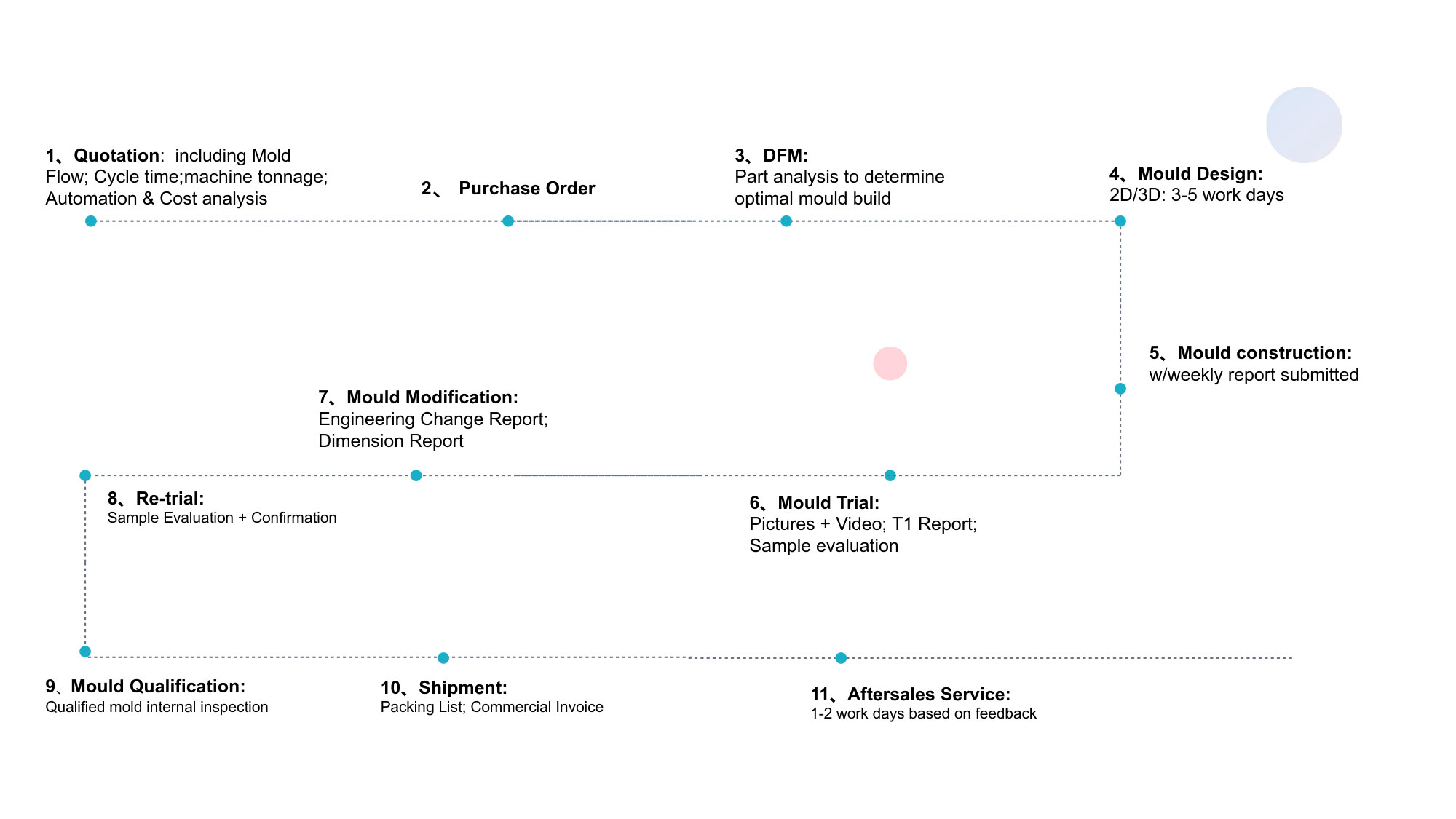
A comprehensive DFM Report is delivered at no cost as part of the quoting process, typically requiring 3-5 business days to complete. Customers receive a complete analysis of their closure design‘s manufacturability, including dimensional feasibility, material recommendations, and projected cycle time estimates.
4.2 Sampling and Trial Protocol (T0, T1, T2, T3)
Mold trials follow a structured multi-stage protocol that ensures design issues are identified and resolved before production release:
T0 (Initial Sample): First parts from the newly machined mold. Focus on mechanical functionality—ejection, parting line condition, and complete filling. No surface finishing required.
T1 (First Optimization): Following mold modifications based on T0 observations. Focus on dimensional accuracy—CMM inspection of critical features, shrinkage validation, and core/cavity alignment verification.
T2 (Second Optimization): Process parameter exploration. Viscosity curve, cavity balance study, and pressure drop analysis establish the robust processing window.
T3 (Production Validation): Run at target cycle time with full auxiliaries (robot, conveyor, packaging). PPAP-level documentation including CPK calculations and capability studies.
For complex geometries, Ansix Tech maintains inventory of mold inserts that can be swapped during trials to evaluate alternative gate or venting configurations without cutting a complete new mold. This rapid iteration capability accelerates the development timeline and reduces trial costs by 30-50%.
4.3 Pilot Production and Process Capability Confirmation
Before committing to full production orders, customers can request pilot production runs of 100 to 500 shots per cavity. During pilot runs, Ansix Tech captures:
Statistical yield data (first-pass yield, scrap by defect type)
CPK calculations on all critical dimensions
Cycle time variance (min/max/mean/standard deviation)
Material consumption per part (including runner/sprues)
Setup time and changeover efficiency
Pilot run data is compiled into a Production Readiness Report that confirms the process is statistically capable of meeting customer specifications before any commercial quantities are produced. This eliminates the risk of accepting a process that only appears capable during one-off sampling but deteriorates during sustained production.
4.4 Maintenance and Spare Parts Management
Ansix Tech proactively manages mold maintenance to prevent unplanned downtime:
Spare parts package including wear-prone components (ejector pins, core pins, guide bushings, springs) is delivered with every new mold. Quantities are calculated based on expected wear rates: standard consumption parts for the first 500,000 cycles are included at no additional charge.
Scheduled maintenance intervals at 200,000-cycle increments include: thorough cleaning of cooling channels, inspection of sealing surfaces, measurement of wear components, lubrication of sliding components, and vent cleaning. Maintenance reports document pre- and post-inspection measurements.
Lifetime repair support is available at cost-plus pricing for any mold manufactured by Ansix Tech. Because all machining, EDM, and welding equipment is in-house, mold repairs are typically completed within 24-48 hours—a critical advantage when production schedules are tight.
4.5 In-Mold Labeling and Decorative Integration
For customers seeking premium closure aesthetics without secondary labeling operations, Ansix Tech offers in-mold labeling (IML) integration. Pre-printed labels are robotically placed into the mold cavity before injection, becoming permanently bonded to the closure surface during molding. This eliminates the labor cost and quality variability of post-molding labeling while achieving decoration that cannot be peeled or scratched off during normal use.
Decorative surfacing options include:
In-mold texture patterns (leather grain, diamond cut, technical grid)
Embossed logos and raised lettering (coined on cavity)
Recessed (debossed) features requiring contrast painting or over-molding
V. Comparative Advantage: Addressing Industry Pain Points
The closure manufacturing industry is characterized by recurring failure patterns that drive customer dissatisfaction. Ansix Tech has systematically developed targeted countermeasures for each of these industry pain points:
Pain Point 1: Unexpected Mold Failures Disrupting Production Schedules
The Problem: Customer receives mold that initially runs well, but after 100,000 cycles, a core pin fractures or a gate erodes. Unplanned downtime requires expedited repair shipping and lost production days, costing thousands in lost revenue.
Ansix Tech‘s Solution: Every mold undergoes a 2,000-cycle aging test before shipment. The mold is installed on a production press and run continuously with cooling water, ejection testing, and visual monitoring. A wear report is issued documenting pre-test and post-test dimensional measurements of wear surfaces, verifying no measurable degradation in the first 2,000 cycles. For the first three years of production, Ansix Tech provides mold structural warranty (excluding normal wear of consumables).
Customer Value: Predictable mold life. No unexpected failures during the first million cycles. If failure does occur, in-house repair capability means 24-48 hour turnaround versus weeks for outsourced repair.
Pain Point 2: Flash Requiring Costly Manual Deburring
The Problem: Parting line flash occurs when clamping force is insufficient or mold fit-up is poor. Customers are forced to add manual trimming/deburring stations, increasing labor costs and introducing quality variability.
Ansix Tech’s Solution: The company machines parting surfaces to ±0.005mm fit-up tolerance and designs the mold with self-locking clamping force compensation. Projected parting surface areas are calculated against machine clamping capacity to ensure sufficient tonnage. During production, clamp tonnage is monitored and alarmed if variations occur. Typical results: flash is controlled to less than 0.03mm at the parting line, which breaks off during normal handling or requires no removal.
Customer Value: Elimination of manual deburring stations, reducing labor costs by 5-8 cents per closure. Consistent sealing surfaces ensure closure function unaffected.
Pain Point 3: Dimensional Drift Across Production Batches
The Problem: Customer qualifies mold with initial samples, but first commercial batch exhibits dimensional drift requiring re-inspection and sorting. Root cause is often changes in resin lot, ambient conditions, or process parameter drift.
Ansix Tech‘s Solution: The company’s ultrasonic in-mold wall thickness sensors provide real-time process feedback. When part weight or thickness deviates beyond control limits, the MES triggers automatic parameter adjustment. For critical dimensions, in-mold pressure transducers provide cavity-specific feedback, enabling cavity-to-cavity pressure balancing. Customers receive a process control strategy document specifying acceptance limits and response protocols.
Customer Value: In a documented case study, critical hole spacing for a multi-cavity closure mold demonstrated standard deviation σ = 0.003mm across 100,000 continuous shots, achieving zero dimensional defects.
Pain Point 4: Long Lead Times for Mold Repairs
The Problem: Mold needs repair—gate erosion, core replacement, cooling channel clog. If the mold builder outsources EDM or CNC services, repair lead times stretch to 3-4 weeks, forcing production shutdown or expediting alternative suppliers.
Ansix Tech‘s Solution: The company maintains in-house CNC milling, EDM, wire cutting, welding, and CMM inspection capabilities. 80% of routine repairs (gate reconditioning, core pin replacement, vent cleaning) are completed within 24 hours. Complex repairs requiring new insert fabrication typically complete within 5 business days.
Customer Value: Reduced inventory buffer requirements. Faster response to quality issues. No need to maintain duplicate molds as safety stock (except for critical applications requiring absolute production uptime).
VI. Ansix Tech’s 28-Year Experience: Proven Reliability Across Closure Categories
With over 28 years of continuous operation in the bottle closure and injection molding industry, Ansix Tech has refined its processes across thousands of customer projects. This experience is not abstract—it manifests in every design review, every process recommendation, and every problem-solving engagement.
6.1 Material Science Expertise
Choosing the optimal material for a closure involves balancing mechanical properties, chemical resistance, processing behavior, cost, and regulatory compliance. Ansix Tech‘s material selection process is data-driven:
HDPE (High-Density Polyethylene): Preferred for beverage and water closures requiring chemical resistance and recyclability. Grades such as BorPure MB5568 provide excellent stress crack resistance. Injection molding temperature: 200-240°C. Shrinkage: 1.5-2.5%.
PP (Polypropylene): Preferred for carbonated beverage and pharmaceutical closures requiring higher stiffness than HDPE. Grades such as INEOS‘ CAP311S1 offer enhanced processability and stress crack resistance. Injection molding temperature: 200-250°C. Shrinkage: 1.0-2.0%.
PET: Preferred for transparent premium closures and cold-fill applications. Injection molding temperature: 260-290°C. Requires pre-drying to <50 ppm moisture.
LSR (Liquid Silicone Rubber): Preferred for soft-touch over-molded seals and baby bottle components. Requires platinum-catalyzed two-component mixing and cold runner systems. Mold temperature typically 150-200°C.
Engineering Resins (PC/ABS, PPS, PEEK): Deployed for specialty applications requiring UL94 V-0 flammability rating, chemical resistance to aggressive solvents, or high-temperature stability up to 260°C.
6.2 Standard Closure Specifications and Dimensions
Ansix Tech‘s closure product portfolio spans a comprehensive range of standard sizes and configurations:
Closure Type Standard Diameters (mm) Thread Standards Key Features
Polymer wine stoppers 20, 24, 28, 32, 36, 43 SPI/Plastic, PCO 1810, ASB Tamper-evident band, PP or PE construction
Fruit wine stoppers 24, 28, 29, 31.5, 36 DIN 168, GME 13126 Food-contact compliant seal, hot-fill capable
Grape bottle stoppers 26.5, 27.5, 28, 29.7, 32 PCO 1881, 38mm Thin-wall TE band, 1-step sealing gasket
Taixiang aromatherapy stoppers 15, 18, 20, 24, 28, 32 Custom micro-thread Airtight seal for fragrance oil retention
Glass bottle stoppers 18, 20, 24, 28, 32, 38, 43 SPI 400, Euro neck PTFE over-molded or EPDM gasket liner
Plastic bottle caps 18, 20, 22, 24, 28, 38, 43, 45, 48, 53 PCO, Tethered cap compliant Flip-top, dispensing nozzle, child-resistant
Wooden caps 24, 28, 32, 38, 43, 53 N/A (press-fit or external thread) Cork composite or rubber liner insert
Custom sizes beyond this standard range can be tooled with lead times of 20-40 days depending on complexity.
6.3 Assembly and Secondary Operations
For customers requiring fully assembled closures—such as caps with applied liners, assembled dispensing pumps, or multi-component stoppers—Ansix Tech provides integrated assembly capabilities:
Gasket lining application: Hot-melt gasket liner dispensing for sealing flasks and hot-fill bottles
Liner insertion: Die-cut foam, EPDM, or PTFE liners pressed or heat-staked into caps
Dispensing valve insertion: Silicone duckbill valves press-fit into sports caps
Tamper-band folding: Continuous inline folding and notching for TE bands
Label application: Roll-fed or shrink-sleeve labeling for branded closures
Printing: Pad printing (2-4 colors), laser marking, or UV printing
VII. Cost Optimization: Driving Down Total Production Costs
Cost reduction is not an afterthought at Ansix Tech—it is engineered into every design decision and process parameter. The following table quantifies the cost-saving impact of each optimization strategy:
Cost Driver Industry Baseline Ansix Tech Achievable Result Annual Savings (Sample: 10M units)
Material cost per part $0.035 (runner waste 15%) $0.028 (runner waste 3% with hot runner) $70,000
Cycle time per cap 4.5 seconds (cold runner) 3.2 seconds (hot runner + optimized cooling) 13,000(at15/hr machine rate)
Scrap rate 2.5% 0.8% $17,000
Manual labor (deburring) $0.008 per cap $0 (eliminated via flash control) $80,000
Mold maintenance $6,000/year $2,500/year $3,500
Energy consumption 0.35 kWh/kg 0.22 kWh/kg (all-electric machines) 32,500(at0.12/kWh)
Compounded total annual savings: Approximately $216,000 for 10 million closures produced per year. This direct impact on customer operating margins demonstrates that Ansix Tech is not merely a supplier but a partner in cost competitiveness.
7.1 Material Cost Optimization
Hot runner systems reduce material waste from typical 15-30% in cold runner molds to under 3%. For multi-cavity closure molds, the ROI of hot runner conversion is typically realized within 3-6 months of production.
Ansix Tech can also assist customers in evaluating recycled-content resins without compromising quality. Process control strategies—including closed-loop cavity pressure monitoring—maintain dimensional stability even with the increased viscosity variability typical of recycled polymers. Case studies demonstrate that up to 30% post-consumer recycled (PCR) content can be incorporated into HDPE beverage caps without measurable CPK degradation.
7.2 Cycle Time Optimization
Each second shaved from the molding cycle increases hourly output by approximately 3-5%. Ansix Tech‘s cooling optimization strategies have demonstrated the following results:
Rapid heat cycle molding with variable packing pressure reduces cycle time by 15-25% compared to conventional cooling.
Conformal cooling reduces cooling time by 30-56% and overall cycle time by 15-20%.
Multi-cavity balancing ensures all cavities fill simultaneously, eliminating the extended cooling times required for the last-filled cavity.
7.3 Energy Cost Optimization
All-electric injection molding machines consume 50-70% less energy than equivalent hydraulic machines during production. For a 200-ton machine running 24/7, this translates to annual energy savings of 15,000−25,000. Ansix Tech‘s entire machine fleet is fully electric, with regenerative braking systems that capture and reuse energy during deceleration phases.
7.4 Scrap Reduction
Scrap in closure production typically results from dimensional non-conformance, surface defects, or filling issues. Through scientific molding protocols and real-time process monitoring, Ansix Tech maintains:
First-pass yield (FPY) average: 98.2% across all closure products
Highest FPY for PP beverage caps: 99.1%
CPK ≥ 1.33 on 100% of critical dimensions for validated products
Each 1% reduction in scrap rate for a 10-million-unit annual production equates to savings of approximately $7,500 at typical material prices.
VIII. Conclusion: Value Beyond the Mold
For customers evaluating closure manufacturing partners, the decision ultimately reduces to a single question: Can this supplier deliver consistent quality, predictable lead times, and competitive costs while reducing my operational risk?
Ansix Tech‘s 28-year track record provides an affirmative answer. The company‘s vertically integrated manufacturing ecosystem—spanning mold design, precision machining, scientific molding, quality metrology, and secondary assembly—eliminates the coordination overhead and quality variability of multi-vendor supply chains. Every mold is designed with production scalability in mind: cooling efficiency, gate placement, venting geometry, and ejection systems are optimized not just for first-shot success but for million-cycle durability.
For customers, a mold from Ansix Tech is not a piece of steel. It is a revenue-generating asset—a machine tool that converts polymer pellets into profit at every cycle. The company‘s DFM process identifies manufacturability issues before steel is cut. Its process validation protocols certify production capability before commercial release. Its maintenance programs prevent unplanned downtime. And its cost-engineering discipline reduces material consumption, shortens cycle times, and eliminates waste.
Ansix Tech welcomes the opportunity to conduct a DFM report review on any customer part design, demonstrating—before any financial commitment—how the company identifies and resolves weld line issues, air trap locations, sink mark risks, and other potential quality concerns. This no-obligation technical assessment is the first step toward a manufacturing partnership built on engineering excellence, process reliability, and mutual profitability.
*For technical consultation, mold quotations, or DFM report requests, please contact Ansix Tech‘s engineering team. With over 28 years of closure manufacturing expertise, the company delivers production-ready solutions for polymer wine stoppers, fruit wine closures, grape bottle seals, aromatherapy stoppers, glass and plastic caps, wooden closures, and custom injection-molded components across all packaging categories.
Ansix Tech Co Ltd
If you have any plans related to Polymer wine bottle stoppers, fruit wine bottle stoppers, grape bottle stoppers, Taixiang aromatherapy bottle stoppers, glass bottle stoppers, plastic bottle caps, wooden caps , you can contact us at any time. We will turn your ideas into reality, let you realize your dreams, and obtain large orders from the market. Our contact information is info@ansixtech.com. Or contact our CTO, mail: stephen@ansixtech.com
#www.ansixtech.com #ansixtech.com #Polymer wine bottle stoppers, fruit wine bottle stoppers, grape bottle #Polymer wine bottle stoppers, fruit wine bottle stoppers, grape bottle #Polymer wine bottle stoppers, fruit wine bottle stoppers, grape bottle injection molding companies #Polymer wine bottle stoppers, fruit wine bottle stoppers, grape bottleCanopy Mold injection mold companies #Ansix #Ansix moulds #Ansix china #Ansix tech china #Ansix tech company #Ansix facotry #Polymer wine bottle stoppers, fruit wine bottle stoppers, grape bottle injection molding #Polymer wine bottle stoppers, fruit wine bottle stoppers, grape bottle injection tools #Polymer wine bottle stoppers, fruit wine bottle stoppers, grape bottle injection moulds #Polymer wine bottle stoppers, fruit wine bottle stoppers, grape bottle plastic mould #Polymer wine bottle stoppers, fruit wine bottle stoppers, grape bottle plastic tools #Ansix Tech #Ansix molds #Ansix injection molding #Ansix mold factory #injection molding Polymer wine bottle stoppers, fruit wine bottle stoppers, grape bottle#Ansix mold factory #Polymer wine bottle stoppers, fruit wine bottle stoppers, grape bottle china #Polymer wine bottle stoppers, fruit wine bottle stoppers, grape bottle molds #injection factory #Polymer wine bottle stoppers, fruit wine bottle stoppers, grape bottle injection molding #Polymer wine bottle stoppers, fruit wine bottle stoppers, grape bottle injection molding factory #injection molding company #Polymer wine bottle stoppers, fruit wine bottle stoppers, grape bottle injection mold companies #50mm Neck Edible Oil Bottle Preform (100ml250ml) Transparent PET Plastic Oil Bottle Preform#Polymer wine bottle stoppers, fruit wine bottle stoppers, grape bottle mold limited #Ansix mold china #Ansix companies #Ansix company China #Polymer wine bottle stoppers, fruit wine bottle stoppers, grape bottle facotry #Ansix Tech #Ansix Tech mould #Polymer wine bottle stoppers, fruit wine bottle stoppers, grape bottle injection moulding #injection moulding company #Ansix Polymer wine bottle stoppers, fruit wine bottle stoppers, grape bottle parts injection mold companies #medical injection molding companieschina #Polymer wine bottle stoppers, fruit wine bottle stoppers, grape bottle china factory #Ansix moulding companies #Ansix molding company #Polymer wine bottle stoppers, fruit wine bottle stoppers, grape bottle injection moulding facotry #Ansix Tech mold #Polymer wine bottle stoppers, fruit wine bottle stoppers, grape bottle mould #Polymer wine bottle stoppers, fruit wine bottle stoppers, grape bottle plastic injection molding #ansix plastic mold #Mold manufacturing #Polymer wine bottle stoppers, fruit wine bottle stoppers, grape bottle parts manufacturing #Polymer wine bottle stoppers, fruit wine bottle stoppers, grape bottle plastic parts factory #Polymer wine bottle stoppers, fruit wine bottle stoppers, grape bottle injection parts mold #Polymer wine bottle stoppers, fruit wine bottle stoppers, grape bottle PRECISION MANUFACTURING #Polymer wine bottle stoppers, fruit wine bottle stoppers, grape bottle #China mold #Polymer wine bottle stoppers, fruit wine bottle stoppers, grape bottle injection moulding china #Polymer wine bottle stoppers, fruit wine bottle stoppers, grape bottle mould china #china precision mold #mold in china #Polymer wine bottle stoppers, fruit wine bottle stoppers, grape bottle mold china #Precision molds #High-precision molds #Polymer wine bottle stoppers, fruit wine bottle stoppers, grape bottle #Injection molds #Polymer wine bottle stoppers, fruit wine bottle stoppers, grape bottle Factory #Polymer wine bottle stoppers, fruit wine bottle stoppers, grape bottle Company #Super Large Injection Mold Factory #Large Tonnage Injection Molding Factory #Polymer wine bottle stoppers, fruit wine bottle stoppers, grape bottle Company #Polymer wine bottle stoppers, fruit wine bottle stoppers, grape bottle Factory #2800T Injection Molding Factory #3000 Ton Injection Molding #4500 Ton Injection Molding Factory #Large Mold Injection Molding #Large Plastic Mold Injection Molding Factory #Large Injection Mold Manufacturer #Plastic Mold Factory #Injection Mold #Plastic Mold