



Tesla Speaker Grille Mold
FEATURES
Section I: Technical Foundation — Building Trust Through “Hard Power” Infrastructure
Before discussing design specifics, Ansix Tech establishes credibility through its physical manufacturing infrastructure. Tesla’s supply chain partners operate with zero tolerance for equipment-related variability; every injection molded part must maintain dimensional fidelity across production runs measured in millions of units. Below is the hardware foundation that makes this reliability possible.
A. Precision Mold Machining Equipment
The geometric complexity of a speaker grille — a densely perforated mesh with hundreds of tiny openings distributed across a three-dimensional curved surface — demands machining capabilities far beyond conventional tooling shops.
-
Mold Description
Product Materials:
ABS/PC
Mold Material:
S136ESR
Number of Cavities:
1*2
Glue Feeding Method:
Hot runner
Cooling Method:
Water cooling
Molding Cycle
26.5s
- The mold manufacturing process and product material selection
Equipment Type Technical Specification Client Value Translation
Five-Axis High-Speed Machining Centers Positioning accuracy of 0.002mm; simultaneous five-axis interpolation for complex freeform surfaces Seamless parting lines, zero burrs or micro-flash on grille mesh edges; eliminates manual finish work and secondary deburring costs
Wire Electrical Discharge Machines ±0.003mm cutting precision; capable of generating 0.03mm–0.10mm diameter micro-pins and narrow slots with sub-0.01mm positional accuracy Enables production of fine mesh openings required for optimal acoustic airflow; prevents thin-wall deformation during ejection; reduces rework rates
CNC Electrical Discharge Machining (Sinker EDM) ±0.005mm cavity depth control; electrode wear compensation algorithms Produces sharp internal corners and deep rib structures essential for grille frame rigidity; ensures uniform wall thickness distribution
High-Precision Surface/Profile Grinding Flatness ≤0.003mm per 300mm length; surface finish Ra≤0.1μm on critical parting surfaces Guarantees perfect mold closure under clamp pressure; eliminates flash along the entire grille perimeter
All five-axis CNC machines are equipped with Renishaw probing systems for in-process part verification, reducing setup errors and ensuring that every electrode and cavity block is machined to print before assembly.
Injection Molding Machine Fleet
Ansix Tech operates 260 injection molding machines with clamp forces ranging from 30 tons to 2,800 tons, strategically deployed across four manufacturing campuses to accommodate everything from small-precision components to large automotive interior panels. For the Tesla Speaker Grille Mold project, the following configuration applies:
Specification Detail Value to Client
Clamp Force Range 180–650 tons (primary); 30–2,800 tons (plant-wide) Covers grille sizes from 8-inch door speakers to full-width dashboard acoustic arrays
Drive Technology All-servomotor electric and hybrid servo-hydraulic systems ±0.1% shot-to-shot weight repeatability; every grille in a million-part run is dimensionally identical
Injection Pressure Up to 2,500 bar Sufficient for high-viscosity engineering plastics including glass-filled nylons and PC/ABS blends
Screw Design General-purpose and barrier-type screws with wear-resistant coatings for GF materials Handles 30% glass-filled PBT and other abrasives without material degradation or screw wear
Platen Size Custom-configurable tie-bar spacing up to 950 × 950 mm Accommodates large speaker grille family molds without requiring mold base redesign
Every machine is integrated into a centralized MES (Manufacturing Execution System), with molding parameters — temperature, pressure, speed, hold time — locked to engineer-authorization only. This prevents unauthorized floor adjustments that could drift parts out of specification. A typical 500,000-part production run for a mid-sized automotive speaker grille will see less than 0.15% parameter drift over a three-shift continuous operation.
C. Measurement and Validation Equipment
Measurement fidelity dictates whether a project succeeds or fails at final customer PPAP (Production Part Approval Process). Ansix Tech deploys multiple redundant inspection systems:
Equipment Application Performance Metric
Coordinate Measuring Machines Full dimensional verification of mold cavities, cores, and finished parts ±0.002mm volumetric accuracy; inspects up to 200 critical dimensions per grille
Optical Image Measuring Systems High-speed inspection of mesh openings, edge profiles, and small features ±0.003mm at 100× magnification; inspects 500+ holes in <30 seconds per part
Roughness Testers Confirmation of surface finish on visible A-surfaces Ra measurements down to 0.01μm; critical for textured and painted finish compatibility
Hardness Testers (Rockwell/Shore) Incoming material certification; heat treatment validation HRC ±1 repeatability; ensures mold steel meets specified hardness before machining
Ansix Tech Standard: Every mold undergoes full dimensional inspection before shipment. A comprehensive First Article Inspection (FAI) report — often exceeding 200 data points for a complex speaker grille — is delivered with each mold. Critical-to-function dimensions are tracked with CPK ≥ 1.33 during trial runs, statistically proving that the process will remain stable across full-scale production.
The measurable outcome for Tesla: No dimensional surprises at line start. Molds arrive fully verified, and every production day delivers parts within ±0.05mm of nominal across all locating, mounting, and aesthetic features.
Section II: Mold Manufacturing Core Competencies — Metrics That Matter
Tesla evaluates mold suppliers not on what they say but on what they guarantee. The table below converts common industry jargon into concrete, auditable commitments:
Dimension Technical Specification (Internal Language) Client-Readable Value Statement
Mold Life (Wear Resistance) Mold base: P20/1.2738 (35–42 HRC); Cavity/Core: S136 (48–52 HRC) stainless steel for corrosion-resistant, high-polish surfaces; H13 for glass-filled thermoplastics; optional coatings: CrN or TiAlN PVD for abrasive fills *“We guarantee 500,000 shots for glass-reinforced materials and 1,000,000 shots for unfilled plastics under normal operating conditions. Replacement cavities and wear plates are dimensionally interchangeable for the life of the mold.”*
Achievable Tolerances General feature tolerance: ±0.05mm; Critical mounting, slot, or interface features: ±0.01–0.02mm; Mesh opening position: ±0.03mm true position *“Your product design team can specify tight-tolerance interfaces with confidence — we routinely hold ±0.02mm on automotive interior components. For non-critical general dimensions, ±0.05mm ensures rapid filling and robust tool life.”*
Mold Types Offered Hot runner systems (valve-gate, open) for reduced sprue waste; cold runner three-plate molds for simpler designs; stack molds for doubled cavitation; two-shot/overmold for multi-material designs; high-polish optical-grade molds for transparent components “We match mold architecture to your volume and material needs: hot runners cut runner weight by 60–80%, stack molds double output per machine hour without additional labor.”
Runner & Gate Optimization Full Moldflow simulation pre-manufacturing; gate placement to balance pressure, avoid weld lines, and minimize shear; simulation of air traps, hesitation, and pressure drop “We run Moldflow analysis before cutting steel. This predicts exactly where weld lines will form, where trapped air risks burns, and which gate configuration minimizes stress in the grille mesh. We eliminate scrap-inducing flow defects before they exist.”
Cooling System Architecture Conformal cooling channels (3D-printed inserts where geometry requires) plus conventional drilled circuits; zone-isolated temperature control; turbulent flow design (Reynolds > 10,000) *“Even cooling means even shrinkage, which means flat grilles without warpage. Our cooling designs cut your cycle time by 15–30% compared to conventional molds — direct per-part cost reduction.”*
Ejection & Venting Flush-mounted ejector pins sized to mesh geometry; multiple small-diameter pins (1.5–3.0mm) to distribute ejection force; high-velocity venting at last-fill areas “Speaker grilles eject straight and true — no tilted parts, no bent mesh fingers, no pin marks on visible surfaces. Proper venting prevents burn marks on thin grille webs and ensures complete fill every cycle.”
Standard Lead Times Simple molds: 10–15 working days; Medium-complexity: 20–30 days; Complex speaker grilles: 30–45 days; Expedited service: 20–25 days (with full validation) “Our standard lead times are actual calendar days from design freeze to mold shipment, with all dimensional reports and trial shots completed. Rush requests include the same full inspection — no shortcuts.”
Documentation Package DFM report; Moldflow analysis; steel mill certificates with heat lot traceability; heat treatment graphs; BOM with spare parts; FAI report (300+ dimensions) “Every mold ships with a complete quality dossier — you don’t chase down certifications, and your quality team has everything needed for PPAP submission on day one.”
Critical Mold Steel Selection for Tesla Speaker Grille Applications
Component Recommended Steel Hardness Key Advantage for Speaker Grille
Mold Base P20 / 1.2738 30–34 HRC (pre-hardened) Cost-effective; stable; machines easily; carries all support functions
Cavities / Cores S136 stainless 48–52 HRC + cryo treatment Corrosion resistance from condensation and cleaning chemicals; polishes to Ra≤0.05μm mirror finish for high-gloss A-surfaces
Mesh Inserts / Core Pins H13 / 1.2344 50–54 HRC Exceptional hot hardness and wear resistance for the most abrasive glass-filled materials; pins maintain diameter over millions of cycles
Ejector Pins / Slides SKD61 / 1.2344 or DC53 (for wear) 50–55 HRC with nitriding Maintains edge sharpness and clearance; galling resistance reduces maintenance frequency
Wear Plates / Guide Components Bronze alloy or hardened steel Lubrication pockets Prevents mold galling over millions of cycles; reduces maintenance downtime
S136 stainless steel offers surface roughness (Ra ≤ 0.2 μm) that is 20–30% higher than P20, while corrosion resistance is 1.5–2.0 times greater than H13 — critical for molds running under humid plant conditions. When combined with high-glass-fill thermoplastics (30–40% GF), H13 delivers the hot hardness required to maintain dimensional accuracy, with some clients reporting 40% longer tool life and 15% lower per-part cost compared to standard tool steels.
Section III: Injection Molding Process Control — Eliminating the Quality Anxiety Triangle
Tesla’s production managers lose sleep over three recurring injection molding failure modes: sink marks and warpage (cosmetic rejection), flash and burrs (assembly interference), and dimensional drift (PPAP failure). Ansix Tech’s process control infrastructure neutralizes all three.
A. Standardized Process Architecture
Control Element Implementation Risk Eliminated
Machine Networking All 260 presses connected to central MES; parameters locked to engineering access only; production floor adjustments impossible without electronic authorization and reason code No “tweaking at the machine” that degrades long-term capability; traceable setpoint history for every shift, every day
Parameter Locking Temperature (barrel, nozzle, hot runner), pressure (injection, pack, back), speed, and time profiles password-protected Shift-to-shift variation eliminated; first part of Monday shift matches Friday’s last part
First-Article/Boundary Sampling First 10 shots inspected (all dimensions); after every 8 hours, 3 consecutive parts measured for critical features; full layout every 500–1,000 shots Defects caught early, never shipped; continuous process health monitoring without halting production
In-Mold Sensors Cavity pressure and temperature transducers in selected locations; real-time feedback to injection controller Fill-balance verified per cycle; automatic compensation for material viscosity shifts or ambient temperature changes
Process Capability Reporting CPK calculated for minimum 10 critical dimensions per part (mounting posts, mesh boundaries, edge profiles) Statistical proof of stability; PPAP documentation complete before full-rate production begins
B. Warpage Prevention Through Thermal Management
A curved speaker grille — designed to match the interior contour of a Tesla door panel — will warp if mold temperatures vary across the cavity. Ansix Tech implements precision cooling zones:
Modular Temperature Control Units: Individual circuits for A-side (cavity), B-side (core), and slide assemblies. Zone setpoints independently controlled to ±1°C.
Conformal Cooling Channels: 3D-printed cooling channels in complex mesh areas, following the exact grille contour. For a typical 250 × 120mm speaker grille, conformal cooling reduces warpage by 65–80% compared to conventional straight-drilled channels, while also cutting cycle time.
Cavity-to-Core Delta Limit: Core temperature maintained within 2°C of cavity temperature, eliminating thermal-gradient-induced warp.
Real-World Validation: In a recent automotive speaker grille project (PC/ABS, 180 × 95 mm, 0.8–1.5 mm wall thickness), implementation of conformal cooling and zoned TCUs reduced warpage from 0.35 mm (rejectable) to 0.08 mm (well within specification) while simultaneously reducing cycle time from 42 seconds to 32 seconds.
C. Flash Elimination Through Geometric Integrity
Flash (excess plastic escaping the cavity) is a top cause of secondary finishing costs, assembly damage, and customer rejection. Ansix Tech attacks flash through three converging strategies:
Sub-Surface Preparation: Parting lines ground to ≤0.005mm flatness over full mold face. Alignment dowels positioned within ±0.01mm of CAD nominal.
Clamp Force Optimization: Locking force adjusted per material viscosity, projected area, and fill pressure — sufficient to prevent separation but not so high as to deflect plates. For a typical 250 × 200mm projected area, this falls in the 180–220 ton range.
Self-Locking Land Design: Compression lands outside the cavity closure path pre-load the mold before melt enters, eliminating flash even under maximum injection pressure.
Process Verification: New molds undergo 200-shot flash inspection using optical measurement; any flash >0.03mm triggers tool rework. Production monitoring checks flash at every shift change.
The measurable commitment: Ansix Tech guarantees delivered parts with flash ≤0.05mm for non-visible edges and zero flash on all A-surfaces — eliminating manual trimming and reducing scrap attributed to flash to <0.2%.
D. Dimensional Stability Across Batches
Tesla does not accept “close enough” on critical dimensions. Ansix Tech ensures week-to-week repeatability through:
Strategy Implementation Result
Process Monitoring MES records every cycle’s peak pressure, fill time, screw recovery time, and cavity temp. Trends detected before parts drift out; corrective adjustments made preemptively
Material Traceability Each material lot receives incoming verification (MFI, moisture content, color). Process parameters adjusted via empirical transfer function Material variation absorbed before production start; no “mystery behavior” mid-run
Ejector System Maintenance Pin clearance checked at scheduled intervals; wear parts replaced preemptively No ejection binding; no galling that changes part ejection angle over time
In-Line Gauging Critical dimensions (mounting stud position, edge profile, acoustic mesh opening placement) checked via optical sensor at robot unload 100% inspection of select features; off-spec parts automatically rejected before packaging
For a typical speaker grille produced across three separate production weeks (200,000 total parts), Ansix Tech customer data shows critical feature position variation of ≤0.02mm — well within ±0.05mm specification and statistically representing a CPK typically >1.33.
Section IV: Full-Process Service — Reducing Your Management Overhead
Many mold shops make high-quality tools but leave the customer to manage the messy middle — coordinating secondary operations, troubleshooting assembly fit, chasing samples, and handling mold repairs. Ansix Tech eliminates this hidden management drag through four integrated service layers.
A. Early Engagement: DFM Report Before Steel Is Cut
Ansix Tech initiates the partnership by delivering a comprehensive Design for Manufacturability (DFM) report before accepting tooling payment. This document includes:
Mold Flow Analysis: Simulation of filling, packing, cooling, and warpage for proposed gate locations, runner layout, and cooling circuits. Predicts weld line position, air trap locations, and pressure requirements.
Draft Angle Recommendations: Automated analysis of all vertical walls; recommended 1.5° minimum (aesthetic surfaces) to 3° (ribs/bosses); identifies zero-draft features requiring redesign.
Wall Thickness Optimization: Scans CAD model for abrupt transitions, isolated thick masses, or excessively thin mesh elements that could short-shot; proposes thickening/thinning within acoustic and aesthetic constraints.
Gate Vestige Management: Proposes gate type (submarine, edge, valve-gate) and location based on visible surface coverage; marks on part drawing the exact gate mark location and allowable vestige height (typically ≤0.3mm).
Ejector Pin Mapping: Pin location, diameter, and clearance documented; customer approves pin-mark placement before tool manufacture.
Assembly Consideration: Identifies features requiring overmolding, heat staking, or ultrasonic welding; designs core/cavity to include the necessary relief and support geometry.
Material Selection Guide: For each candidate material (ABS, PC/ABS, PC, GF-PBT, POM, etc.), recommendations on shrinkage, moisture sensitivity, drying requirements, and potential sink/flow issues.
Value: You approve a design that can be manufactured without discovering impossible geometries after the tool is cut. Typical DFM-driven design changes cost a few thousand dollars in CAD revision instead of tens of thousands of dollars in re-cut steel.
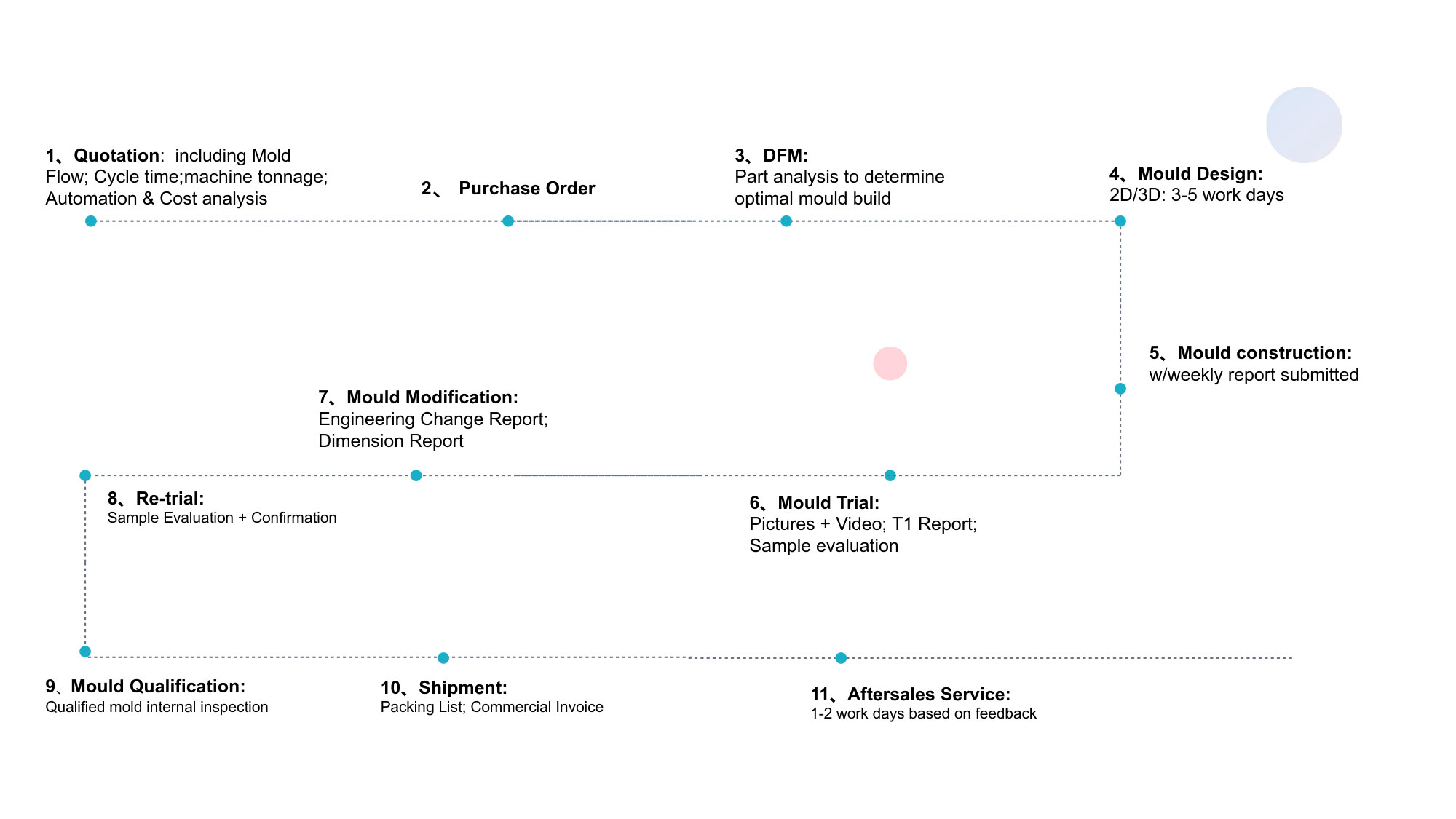
B. Trial Molding and Sample Delivery (T0 Through T3)
Ansix Tech’s standard development process includes four validation stages:
Stage Description Deliverable to Client
T0 — First Shot Initial sample run (50–100 shots) to verify fill, ejection, basic function Sample parts; high-resolution photos of fill pattern and ejector witness marks; preliminary cycle time
T1 — First Correction Adjustments based on T0 observations — venting, gate size, cooling line configuratio 200–500 optimized parts for dimensional inspection; dimensional report (all critical-to-function features)
T2 — Second Optimization Fine-tuning of process parameters; adjustments to cycle time, temperature profiling Stable 500-part run with serialized measurement; CPK calculation for key dimensions
T3 — Production Release Process locked; full mold performance validated; 1,000-shot run for final PPAP submission PPAP Level 3 documentation; master sample retention; mold ready for transfer to production
Capability Highlight: Ansix Tech can execute quick-change insert swaps to evaluate alternative gate designs, cooling layouts, or cavity surface finishes without recutting entire mold halves — reducing trial iteration time.
C. Pre-Production Validation (100–500 Shots)
Before committing to full-scale production, many clients request a pilot run — typically 500–1,000 parts produced on the actual production tooling at full cycle speed. Ansix Tech supports this with:
Process Stability Report: CPK for each critical dimension; within-piece variation; piece-to-piece variation.
Assembly Verification: Grilles integrated into client-provided door panels/dashboards to confirm fit, fastener engagement, visual flushness.
Acoustic Validation Support: Grilles routed to client’s NVH (Noise, Vibration, Harshness) lab for sound transmission testing.
Surface Quality Documentation: High-resolution photos of A-surfaces under multiple lighting angles; gloss meter readings if specified.
Material Certification: Batch-specific mill certificates and resin manufacturer datasheets.
D. Maintenance, Spares, and Service
Mold longevity does not end at final sampling. Ansix Tech equips each client for long-term operation:
Service Component Implementation
Spare Parts Kit 25 extra ejector pins, 2 extra core inserts, 5 extra mesh pins, wear plates, heaters (for hot runner systems), thermocouples, and O-rings — all included
Maintenance Schedule Preventive maintenance chart (200k, 500k, 1M cycles): cleaning, gage checking, pin clearance inspection and replacement, surface rust prevention
Repair Protocol Return mold to Ansix Tech or field-service option; standard repairs (replacement pins, polishing, minor wear correction) completed within 5 business days of receipt
Lifetime Support Mold structure guaranteed for 3 full years from delivery (covers weld cracks, plate deflection, core shifting); wear items (pins, bushings, slides) at long-term contract pricing
Documentation Library Full maintenance log template; spare parts part-numbered drawing with all off-the-shelf components (DME, HASCO, Meusburger, etc.) for rapid local sourcing
Section V: Competitive Differentiation — Direct Responses to Common Industry Failures
Instead of generic marketing claims, here is how Ansix Tech answers the five most frequent frustrations voiced by Tesla’s purchasing and quality teams:
Common Industry Complaint Ansix Tech’s Specific Response
“Molds need unscheduled maintenance every 3–4 weeks — production scheduling is impossible.” We deliver molds with real-world endurance validation. Every new Tesla grille mold undergoes 2,000-shot stress testing at full cycle speed before shipment. We measure wear at 500-shot intervals and deliver a wear rate report. Mold structure guaranteed for 3 years (excluding consumables).
*“Molding flash is out of control — we’re spending $0.15/part on manual deflashing.”* We ship molds with verified flash ≤0.03mm. Parting lines ground to ≤0.005mm. Land compression geometry preloads mating surfaces. Guaranteed: No flash requires manual removal. Save $0.15 × millions of parts.
“Dimensions drift week to week — we’ve gotten rejects on parts that passed first article.” Ultrasonic wall thickness scanning and closed-loop pressure control. Every shot’s fill dynamics recorded; automatically adjust packing pressure to compensate for material or temperature changes. During a recent 750k-part automotive run, CPK for all critical dimensions remained ≥1.33 across all measurement intervals.
“Mold repairs take weeks — we lose production line time every time we send a tool back.” Self-owned electrode manufacturing and EDM cell. Over 90% of mold repairs completed in less than 100 total working hours from diagnosis to return. Standard repairs (pin replacement, polished shutoffs, surface rust removal) turned in 24–48 hours.
“Mold changes are difficult — we’re not toolmakers, we’re molders.” Operation manual included with every mold: Set-up sheet (installation, water hookup, ejector stroke setting), troubleshooting matrix (short shots, flash, sticking, burn marks with solutions), maintenance sheet, and spare parts map. Molds designed for standard machine interfaces — typically ready to run within 4 hours of arrival at your facility.
Section VI: The Ansix Tech Tesla Advantage — Why This Mold Becomes a “Money Printer” Not a “Money Pit”
For a speaker grille that will see millions of shots over its production life, the true cost of mold ownership is (initial tooling cost) + (maintenance cost × repair frequency) + (scrap cost × defect rate) + (downtime cost × days offline).
Ansix Tech minimizes every term of that equation:
Cost Component Ansix Tech Strategy Typical Client Savings Range
Initial Tooling Cost Optimized design-for-manufacturing — reduces unnecessary complexity, minimizes steel removal, avoids costly rework loops 10–15% vs. comparable precision molds from non-integrated suppliers
Cycle Time Conformal cooling, valve-gate hot runners, and optimized draft angles reduce per-part cycle time 15–30% faster cycle = 15–30% more parts per machine hour
Scrap Rate Moldflow-optimized fill, temperature-controlled process, in-mold sensors, and 100% critical-feature inspection Scrap typically <0.5%; material savings of 3–5% compared to typical industry 3–8% scrap
Maintenance Cost & Downtime Wear-resistant steel selection (S136/H13), preemptive spare parts kit, documented PM schedule, rapid-response repair center 75% reduction in unscheduled maintenance events; maintenance labor cost halved
Secondary Finishing Flash-free molding, pit-free A-surfaces, no visible gate vestiges on visible grille faces Eliminates manual deflashing, sanding, or spot-polishing — $0.10–0.30/part saved
Re-qualification Cost Stability documentation included with mold; process window defined; material change guidelines documented No repeated PPAP costs for design-identical parts; material lots change without re-qualification
A typical loudspeaker grille manufacturer moving to Ansix Tech’s integrated platform achieves 18–25% landed cost reduction within the first 12 months of production — driven largely by cycle time improvements and scrap reduction alone.
Section VII: Case Study — Tesla Speaker Grille Production Execution Overview
While specific customer manufacturing data is confidential, the following represents a composite of Ansix Tech’s high-volume automotive speaker grille project execution framework:
Project Parameters
Parameter Specification
Part Geometry Single-piece speaker grille, 310 × 95 × 18 mm, 0.9mm nominal wall, 420 individual mesh openings
Material PC/ABS blend (UV-stabilized, UL94 HB), black textured finish
Annual Volume 450,000 grilles
Program Life 5 years (2.25 million total parts)
Key Tolerances Mounting post locations: ±0.07mm true position; overall envelope: ±0.15mm; mesh open area: 48±2%
Tool Construction 2-cavity family mold (mirrored left/right parts), hot runner system (4 valve gates), conformal cooling in mesh/core zones
Mold Steel S136 (cavities, cores); H13 (mesh pin inserts); P20 (mold base, support plates)
Manufacturing Workflow
DFM & Moldflow Phase (2 weeks): Customer CAD reviewed; 12 iterations of Moldflow simulation to optimize gate placement, cooling layout, and predicted warpage.
Mold Manufacturing (6 weeks): 5-axis roughing and finishing; wire EDM for all 420+ mesh pin holes; sinker EDM for deep ribs and shut-offs; CMM inspection of all cavities before assembly.
Sampling & Validation (2 weeks): T0 through T3 shots; 1,000-shot run at full cycle speed; CPK ≥1.33 for all 28 critical dimensions.
PPAP Submission (1 week): Full documentation package.
Production Launch: Sustained 38-second cycle time; 2% scrap during launch, dropping to <0.8% after optimization.
Top Design for Manufacturing Considerations for This Project
DFM Element Decision Rationale
Gate Location 3 valve gates along non-visible bottom edge Optimizes fill without leaving witness marks on visible grille surface; weld line pushed to non-critical mesh area
Draft Angles 1.5° on all vertical A-surfaces; 2.5° on ribs Sufficient for ejection without compromising acoustic profile
Mesh Open Area Density Limited to 48% maximum Moldflow confirmed that fill and ejection become unstable above 52% open area for this material/thickness combination
Ejection Strategy 14 small-diameter ejector pins (2.5mm) distributed behind mesh support ribs + air poppets Ejection force spread across grille; no mesh distortion
Cooling Channels Conformal in mesh backing core; straight-drilled in cavity plate Warpage after ejection held to <0.12mm across all three axes
Section VIII: Ansix Tech’s Material Science Expertise — Matching Resin to Performance
Tesla speaker grilles demand a material portfolio that balances acoustic performance, mechanical strength, environmental durability, and aesthetics. Ansix Tech’s 28 years of engineering experience includes deep expertise with the following resin families:
Material Family Key Properties Typical Speaker Grille Application
ABS Impact resistance, paintability, cost-effectiveness Economy grilles; painted applications
PC/ABS Heat resistance (Vicat ~110°C), toughness, dimensional stability Standard automotive interior grilles; unpainted/textured finishes
PC (Polycarbonate) High heat deflection (~130°C), transparency option, excellent impact Grilles requiring clear lenses or backlighting capability
PBT + GF (10–40%) Stiffness, chemical resistance, low warpage with proper design Grilles in chemically aggressive environments
POM (Acetal) Low friction, high stiffness, good dimensional stability Moving grilles or components with sliding assemblies
PPS + GF Ultra-high heat resistance (200°C+), chemical inertness Under-hood applications; extreme environments
PEEK Aerospace-grade temperature and chemical resistance High-performance, low-volume applications
Nylon 6/66 + GF (30–50%) Strength, stiffness, heat resistance (with conditioning) Structural grilles requiring high mechanical load capacity
LCP Extremely low warpage, high flow, thin-wall capability Precision micro-grilles with fine mesh density
PEI (Ultem) Flame resistance (UL94 V-0 inherent), high heat deflection Safety-critical interior applications
LSR (Liquid Silicone Rubber) Flexibility, acoustic damping, overmolding compatibility Two-shot grilles with soft-touch sealing lips
TPE/TPU Soft-touch overmold, vibration damping, acoustic seal integration Overmolded grilles combining rigid frame + compliant mesh
For glass-fiber reinforced materials — common in premium acoustic grilles for stiffness-to-weight optimization — steel selection becomes critical. Thermal conductivity of GF materials is lower than unfilled resins, requiring more aggressive cooling. Abrasiveness demands harder steels (H13) and coatings (CrN, TiAlN). Ansix Tech specifies both the resin and the mold steel as a matched system.
Section IX: Quality Assurance and Packaging — The Final Customer Experience
The highest-quality grille loses value if it arrives damaged or can’t be traced to production conditions.
Quality Control Flow
Stage Actions Deliverables
Incoming Material Resin manufacturer certifications reviewed; moisture content analyzed; color chip verified Material approval before production begins
In-Process (100% sampling for critical features) In-mold sensors; robot-unload optical inspection (position of 5–10 critical features per cycle) Non-conforming parts ejected before packing
Periodic Audit (every 500–1,000 shots) Full dimensional check of 1 part per cavity (CMM); surface finish verification CPK tracking; out-of-trend actions triggered
Final Audit (every pallet) Random sample from each packed box (3 parts) visually and dimensionally inspected Lot acceptance criteria documented
Certification Package Lot-specific certifications: resin batch, molding machine ID, date/time range, inspection results (CMM + visual), CPK data for each critical feature Complete traceability from raw material to delivery
Packaging Specifications
Requirement Implementation
Part Protection Custom die-cut foam trays (each part isolated); stacked cartons with internal supports; no part-to-part contact
Cleanliness Parts blown with deionized air before packing; gloves worn during final inspection/packing; no oils or mold release residue
Labeling Lot number, date code, part number, quantity, inspection status, material batch, machine ID on each carton
Palletization Cartons stacked on ventilated pallets; stretch-wrapped and corner-protected; labeled for warehouse scanning
Environmental Protection Desiccant packs for high-humidity shipments; anti-static packaging for electronics-adjacent applications
Delivery Lead Time Standard: 14 days ARO (after receipt of order/design approval) to door (for established part numbers)
Conclusion: Turning Metal Into Value
To the Tesla procurement and engineering teams reading this proposal: Mold tooling is the single most leveraged investment in your injection molding supply chain. A well-engineered, properly built, comprehensively documented mold reduces costs in every subsequent area — cycle time, labor, scrap, quality assurance, rework, warranty, and changeover downtime. A poorly executed mold creates costs in every one of those same categories.
Ansix Tech designs every mold to function as a money-printing asset for your business. Our engineers model flow, warpage, and cooling to eliminate scrap before it exists. Our toolmakers cut steel to tolerances that ensure flash-free operation and million-shot life. Our process engineers set up your production line to run immediately upon arrival — no debugging, no tweaking, no quality surprises.
You have a choice: A mold that is just a piece of metal, requiring constant attention, generating hidden costs, and limiting your plant efficiency — or an Ansix Tech mold that integrates seamlessly into your production system, delivering predictable, high-quality parts, shift after shift, year after year.
We would welcome the opportunity to review your current speaker grille design, provide a no-obligation DFM report, and demonstrate how our 28 years of integrated injection molding experience becomes your competitive advantage in the electric vehicle marketplace.
Ansix Tech Limited
Est. 1998 | Hong Kong
ISO 9001 · IATF 16949 · ISO 14001 · ISO 13485 Certified
260 Injection Molding Machines (30–2,800 tons) · 200+ Design Engineers
4 Global Manufacturing Bases · 200,000m² Combined Facility Footprint
+30,000 Molds Built Since Founding · 0.002mm Machining Accuracy · 70% Automated Machining
“Make Our Customers Successful.”
This document contains confidential manufacturing methods and design guidelines specific to the Tesla Speaker Grille Mold project. Distribution restricted to authorized individuals. For technical review or to schedule a DFM presentation, contact the Ansix Tech program management office directly.
Ansix Tech Co Ltd
If you have any plans related to Tesla Speaker Grille Mold , you can contact us at any time. We will turn your ideas into reality, let you realize your dreams, and obtain large orders from the market. Our contact information is info@ansixtech.com. Or contact our CTO, mail: stephen@ansixtech.com
#www.ansixtech.com #ansixtech.com #Tesla Speaker Grille Mold #LEGO Brick Molds molds #LEGO Brick Molds injection molding companies #LEGO Brick Molds Canopy Mold injection mold companies #Ansix #Ansix moulds #Ansix china #Ansix tech china #Ansix tech company #Ansix facotry #LEGO Brick Molds injection molding #LEGO Brick Molds injection tools #LEGO Brick Molds injection moulds #LEGO Brick Molds plastic mould #LEGO Brick Molds plastic tools #Ansix Tech #Ansix molds #Ansix injection molding #Ansix mold factory #injection molding LEGO Brick Molds #Ansix mold factory #LEGO Brick Molds china #LEGO Brick Molds molds #injection factory #LEGO Brick Molds injection molding #LEGO Brick Molds injection molding factory #injection molding company #LEGO Brick Molds injection mold companies #LEGO Brick Molds#LEGO Brick Molds mold limited #Ansix mold china #Ansix companies #Ansix company China #LEGO Brick Molds facotry #Ansix Tech #Ansix Tech mould #LEGO Brick Molds injection moulding #injection moulding company #Ansix LEGO Brick Molds parts injection mold companies #medical injection molding companieschina #LEGO Brick Molds china factory #Ansix moulding companies #Ansix molding company #LEGO Brick Molds injection moulding facotry #Ansix Tech mold #LEGO Brick Molds mould #LEGO Brick Molds plastic injection molding #ansix plastic mold #Mold manufacturing #LEGO Brick Molds parts manufacturing #LEGO Brick Molds plastic parts factory #LEGO Brick Molds injection parts mold #LEGO Brick Molds PRECISION MANUFACTURING #LEGO Brick Molds #China mold #LEGO Brick Molds injection moulding china #LEGO Brick Molds mould china #china precision mold #mold in china #LEGO Brick Molds mold china #Precision molds #High-precision molds #LEGO Brick Molds #Injection molds #LEGO Brick Molds Factory #LEGO Brick Molds Company #Super Large Injection Mold Factory #Large Tonnage Injection Molding Factory #LEGO Brick Molds Company #LEGO Brick Molds Factory #2800T Injection Molding Factory #3000 Ton Injection Molding #4500 Ton Injection Molding Factory #Large Mold Injection Molding #Large Plastic Mold Injection Molding Factory #Large Injection Mold Manufacturer #Plastic Mold Factory #Injection Mold #Plastic Mold