



Tesla Water Deflector Trim Mold
FEATURES
Part One: Hard Infrastructure — Building Customer Trust Through Equipment Foundation
Multi-Axis Machining for Complex Surface Precision
Ansix Tech’s manufacturing floor is equipped with five-axis high-speed machining centers capable of achieving ±0.002 mm positioning accuracy across full travel. For the Tesla water deflector trim — a part requiring complex aerodynamic curvature and seamless interface with adjoining windshield components — this capability ensures that the parting line remains smooth and free of burrs, eliminating secondary finishing operations. The five-axis simultaneous machining also allows complex multi-face components to be machined in a single clamping operation, reducing setup cycle time by up to 40% while improving dimensional stability.
-
Mold Description
Product Materials:
PP+EPDM
Mold Material:
S136ESR
Number of Cavities:
2+2
Glue Feeding Method:
Hot runner
Cooling Method:
Water cooling
Molding Cycle
42.5s
- The mold manufacturing process and product material selection
For micron-level detail work — such as the 0.03 mm narrow slots required for water channeling in the deflector — Ansix employs wire-cut electrical discharge machining (EDM). This process enables tight-radii corners and thin-wall features that cannot be achieved with conventional milling, preventing deformation in vulnerable thin-wall sections. The integration of a laser on-machine monitoring system compensates for tool wear in real time, maintaining surface roughness at Ra 0.2–0.4 µm, which eliminates the need for manual polishing on most surfaces.
Injection Molding Machine Fleet — Wide Tonnage Coverage
Ansix Tech operates 260 injection molding machines spanning a tonnage range from 30 tons to 2,800 tons, with a total building area exceeding 200,000 m² and two production bases across China and Vietnam. This extensive fleet ensures that the Tesla water deflector trim — regardless of its dimensional requirements — can be matched to an optimally sized machine for the project. Small components utilize 30–200-ton presses for high-precision molding, while larger automotive assemblies are accommodated on the 2,800-ton machines.
-
Across all machines, full-servo electric motor drives ensure repeatability precision of ±0.1% product weight consistency and mold opening position repeatability down to 0.01 mm. For customers, this translates to one guarantee: every molded piece in a production batch is dimensionally identical. No “first of shift” versus “end of shift” variation. No mid-run adjustment waste. Just consistent, specification-compliant parts from Shot 1 to Shot 1,000,000.
Metrology and Quality Assurance Infrastructure
Every mold leaving Ansix Tech undergoes a full-dimensional inspection using coordinate measuring machines (CMM) and optical imaging systems. A complete dimensional report accompanies each shipment, verifying that every critical feature meets the specified tolerance envelope. For automotive components such as the water deflector trim — where Tesla‘s PPAP audit typically requires key dimensions to achieve Cpk ≥ 1.33 — the inspection data provides documented proof of process stability. The industry standard target of Cpk ≥ 1.33 ensures that 99.87% of production falls within tolerance limits, dramatically reducing scrap and rework costs for the customer.
ANSI标准落地表述: “Each mold set undergoes a 100% dimensional inspection with a full report comparing all dimensions against the CAD baseline. For critical water deflector interfaces — including attachment clips, sealing surfaces, and aerodynamic edges — we maintain CPK ≥ 1.33 validation before any mold ships to production.”
Part Two: Mold Manufacturing Core Competencies — Communicating Customer Value Through Technical Specifications
Customers care about four things: How many shots will the mold last? How accurate are the parts? When will the mold arrive? And what happens when something needs adjustment? The following metrics translate technical specifications into direct customer answers.
Mold Life Expectancy — Guaranteed Shot Counts
The selection of mold steel directly determines the total shot count a tool can deliver. Ansix Tech deploys a tiered material strategy matched to production requirements:
Component Material Selection Performance Value
Mold Base P20 (pre-hardened) Machinability in pre-hardened state; cost-effective for structural support
Core/Cavity S136 (corrosion-resistant stainless) High polishability for smooth water flow surfaces; 50,000+ shot life with glass-filled resins
High-wear inserts H13 / 8407 / SKD61 High-temperature wear resistance — ideal for moisture-exposed components; 1,000,000+ shot capability
High-gloss areas NAK80 Pre-hardened (无需热处理镜面光洁度可达万目以上, eliminating post-mold polishing
For the Tesla water deflector trim — exposed to windshield-wiper fluid, UV radiation, and temperature extremes — the mold cavity is built from S136 stainless steel with 30–33 HRC uniform hardness. This provides exceptional corrosion resistance for the humid operating environment while maintaining excellent machinability for efficient manufacturing. The core components utilize H13 steel, chosen for its superior thermal fatigue resistance when processing glass-filled polymers at elevated temperatures.
Customer value statement: “For glass-reinforced materials such as those used in the Tesla water deflector — which typically accelerates mold wear — Ansix guarantees 500,000 shots minimum. For standard engineering polymers, we guarantee 1,000,000 shots. We provide material certification reports and documented heat-treatment curves for every steel batch.”
Achievable Tolerances — From Macro to Micro
Application Type Achievable Tolerance
General automotive structural components ±0.05 mm
Precision fit interfaces (water deflector attachment clips) ±0.03 mm
Sealing surfaces and critical aerodynamic edges ±0.01 mm
For the water deflector‘s attachment points — where the part interfaces with the windshield cowl panel — tight fit is essential to prevent wind noise and water intrusion. Ansix achieves ±0.03 mm, ensuring the part snaps into place with consistent force across all production units.
Mold Type Capabilities — Matching Configuration to Production Economics
Mold Technology Application for Water Deflector Customer Value
Hot runner system Multi-drop pin-valve gate control Zero runner waste; reduced material consumption per cycle; consistent fill pressure across all cavities
Stack mold Not applicable to single-cavity production —
Two-shot/multi-material Potential future integrated seal version Eliminates secondary assembly operations
High-gloss mirror finish Ra < 0.05 µm for aerodynamic surfaces Reduced drag coefficient; no visible flow marks on high-visibility areas
For the Tesla water deflector, a hot-runner system with four MoldMasters drops is deployed, transitioning into a cold runner through edge injection gates. This configuration eliminates runner waste entirely while maintaining precise fill control.
Gate and Runner Optimization — Defect Prevention Through Simulation
Before any steel is cut, Ansix uses advanced mold flow analysis to predict filling behavior, identifying:
Weld line positions — simulation predicts and shifts joint lines to non-critical or hidden surfaces
Gas trap locations — analysis guides vent placement, typically at weld line ends or dead-fill corners, preventing burn marks and eliminating the need for manual venting adjustment
Fill imbalance — runner balancing ensures all cavities fill simultaneously; no short shots from one cavity while another flashes
Sink mark risks — gate placement and packing profile optimization prevents cosmetic sink on visible surfaces
The comprehensive digital twin incorporates thermodynamic, material flow, and structural mechanical factors, with the Tesla project‘s digital prototyping phase identifying critical flow balance and cooling uniformity issues before any mold fabrication began.
Customer value statement: “Rather than discovering flow problems during T0 trials — which costs an average of
15
,
000
–
15,000–25,000 in delay and rework — we simulate every scenario upfront. You receive a fully validated mold configuration that produces acceptable parts on the very first trial.”
Production Lead Times — Predictable Delivery Schedules
Simple tooling: 10 days
Medium-complexity automotive tools (water deflector class): 25–45 days standard
Expedited programs: 20 days available, with validation steps preserved through parallel processing
Customer value statement: “Even on expedited programs, we do not skip T0 validation. We compress non-critical path activities — material procurement overlapped with design, parallel machining of base and inserts — while maintaining T0 trial as a non-negotiable checkpoint.”
Part Three: Injection Molding Process Control — Eliminating Customer Quality Anxiety
Customers fear four defects: sink marks, flash (excess material), dimensional instability, and batch-to-batch color variation. Ansix Tech systematically eliminates each through documented process controls.
Process Standardization — MES-Integrated Parameter Control
All molding machines are networked to a Manufacturing Execution System (MES) that locks critical parameters — melt temperature, injection pressure, screw speed, holding pressure, cooling time — at the engineering-approved set points. Only authorized engineers can adjust parameters, with every change logged and traceable to an individual and timestamp.
Batch-to-batch consistency is validated through first-piece/last-piece comparisons: each batch begins with a full dimensional inspection of the first shot, and before mold changeover, the last piece is re-inspected against the same blueprint reference.
Dimensional Stability — Controlled Cooling for Warpage Prevention
For the Tesla water deflector trim, which has a thin-walled aerodynamic profile susceptible to warpage, Ansix implements several critical controls:
Multi-zone temperature control: mold temperature controllers regulate independent zones to maintain core-cavity temperature differential within 2°C (5°F), minimizing thermally induced warpage
Conformal cooling channels: using CFD analysis, cooling circuits follow the part’s geometry — reducing cycle time by 20–60% and improving dimensional accuracy
Continuous monitoring: three consecutive production batches of similar water deflector components demonstrate key hole spacing variation within ±0.02 mm (0.0008 in), verified by in-cycle CMM sampling
Customer value statement: “Your Tesla water deflector parts will measure the same on Day 1 of a batch as on Day 10. No temperature drift. No operator-to-operator variation. Just stable, in-spec dimensions shift after shift.”
Aesthetic Quality Standards — From Surface Finish to Flawless Appearance
Cosmetic surfaces: Ra ≤ 0.2 µm for all visible water deflector exterior surfaces
Clear/transparent components: zero bubbles, zero flow lines (validated by backlight inspection)
Painted/decorated surfaces: parts are molded with compensated shrinkage values to achieve ±0.1 mm registration accuracy for painting fixtures
Approval grading: Tesla qualifying samples are inspected against an AAA surface approval standard, with rejection criteria applied automatically via digital visual inspection systems
Advanced Material Processing Capabilities — Decades of Experience with Challenging Polymers
The water deflector trim is manufactured from a modified polypropylene composite — selected after a systematic comparison against initial material specifications — that reduced costs by approximately 15% while exceeding thermal stability and impact resistance requirements.
Ansix Tech’s material-handling expertise extends across the full spectrum of engineering thermoplastics relevant to automotive exterior components:
Material Family Properties Typical Application
PC/ABS Impact + heat resistance + dimensional stability Overmolded structural brackets
PC (Polycarbonate) High impact resistance, transparency Window-adjacent trim elements
ASA (Acrylonitrile Styrene Acrylate) Superior UV/weathering resistance; stays color-stable without coating Unpainted exterior trim where direct sunlight exposure is constant
PPS + 40% GF Chemical resistance + thermal stability + high stiffness Engine-adjacent components requiring aggressive glass reinforcement
PEEK Extreme thermal stability High-temperature underhood applications
PA6 + GF30 Mechanical strength + chemical resistance Structural supports requiring fiber reinforcement
LSR (Liquid Silicone Rubber) Flexibility + temperature resistance Integrated sealing elements
For the water deflector‘s UV-exposed top surface, materials meet UL94 V-0 flame rating and withstand 3,000 hours of accelerated UV exposure without visible color shift, validated by third-party accelerated weathering testing.
Customer value statement: “Whether your application requires UV-resistant ASA for exterior trim or high-temperature PPS for under-hood components, Ansix has validated processing windows established over 28 years. We provide material certification documentation with every batch — including lot traceability and test reports.”
Part Four: Full-Service Workflow — Reducing Customer Total Management Cost
Many mold suppliers offer fragmented services: design here, mold-build there, production elsewhere. The customer manages the integration risk. Ansix Tech eliminates this overhead through a unified platform that spans design, prototyping, tooling, production, secondary processing, and assembly.
Project Phase Deliverable Customer Value
Early-stage DFM Mold feasibility and Manufacturing analysis: draft angles, wall thickness optimization, ideal gate placement, ejector pin mark zones No structural surprises after tooling is committed — actionable recommendations with ROI analysis
Digital prototyping Full mold flow analysis predicting fill, pack, cooling, warp; visual defect and stress maps Visual prediction of weld line, gas trap, sink mark behavior; gate locations optimized before steel cutting
T0–T3 validation Sample runs with improvement reports at each phase; quick-change inserts allow different design variants without new mold See actual parts before mass production commitment — refine details without recutting the entire tool
Pilot run (100–500 shots) Yield rate calculation; Cpk verification on all critical dimensions; process capability analysis No transition “cliff” — the mold is proven at small scale before the big production order starts
Mass production Automated injection runs; real-time SPC feedback; defect flagging by vision inspection Reliable high-volume supply without daily firefighting
Maintenance & spares Wear parts (ejector pins, core inserts) delivered with the mold; preventive maintenance at every 200,000 cycles Predictable operating cost — no urgent “mold broken” calls on Friday night
Die sinking fabrication: In-house electrode fabrication and electrical discharge machining mean mold repairs never leave the facility — emergency repairs completed within 24 hours.
Part Five: Differentiated Commitments — Turning Industry Pain Points into Service Guarantees
The following table directly addresses customers’ most common frustrations — converting each into a specific, actionable commitment from Ansix Tech:
Common Customer Complaint Ansix Tech‘s Commitment
Mold fails prematurely — downtime affects orders Pre-delivery 2,000-shot wear test simulation; formal mold structure warranty covering 3 years (excluding normal wear on ejector pins/gates)
Excessive flash — costly manual deflashing labor Parting line machining to 0.005 mm fit tolerance; auto-locking clamp-force compensation holding flash ≤ 0.03 mm — no secondary deflashing required
Dimensions vary batch to batch — manual adjustments waste time In-mold pressure/temperature sensors with closed-loop adjustment; ultrasonic wall-thickness sensors feeding back to auto-compensate packing pressure
Long repair cycles — weeks of lost production In-house EDM and electrode fabrication — standard weld repair/pin replacement completed within 24 hours; slow-turn maintenance priced at cost
Customer Value Engineering: Material Optimization Case Study
On the Tesla water deflector project, Ansix demonstrated value engineering through material substitution that did not compromise performance. Engineers evaluated multiple thermoplastic candidates against six performance parameters — density, melt flow rate (MFR), shrinkage percentage, flexural modulus, and heat deflection temperature — ultimately identifying a modified polypropylene composite that satisfied all technical specifications while achieving an approximate 15% cost reduction over the original specified material.
Value was achieved through material science, not price negotiation. The savings come directly from efficiency: lower-density material means more parts per kilogram, optimized flow characteristics reduce cycle time, and the resulting part remains fully compliant with Tesla’s durability and appearance requirements.
DFM Report Walkthrough: Predictive Defect Elimination
Prior to mold manufacturing, Ansix prepares a comprehensive DFM (Design for Manufacturing) report that walks the customer through:
Weld line mapping: simulation showing precise locations where melt fronts meet, shifted by gate placement optimization to non-cosmetic surfaces
Gas trap visualization: thermal-color maps indicating where trapped air will collect, guiding precise venting placement at weld line termini and dead-fill corners
Sink mark risk assessment: identify thick-to-thin wall transitions where sink marks are most likely; adjust corrective measures
Cooling uniformity analysis: temperature gradient maps showing differential cooling rates; proposed conformal cooling geometry to equalize temperature distribution
Shrinkage compensation table: predicted shrink values for the selected material, with compensation built into cavity geometry
Customer Feedback included: “The DFM report transformed our go-to-market timeline. We anticipated at least two mold adjustments — but the simulation-based template produced acceptable parts on T1. That saved us weeks.”
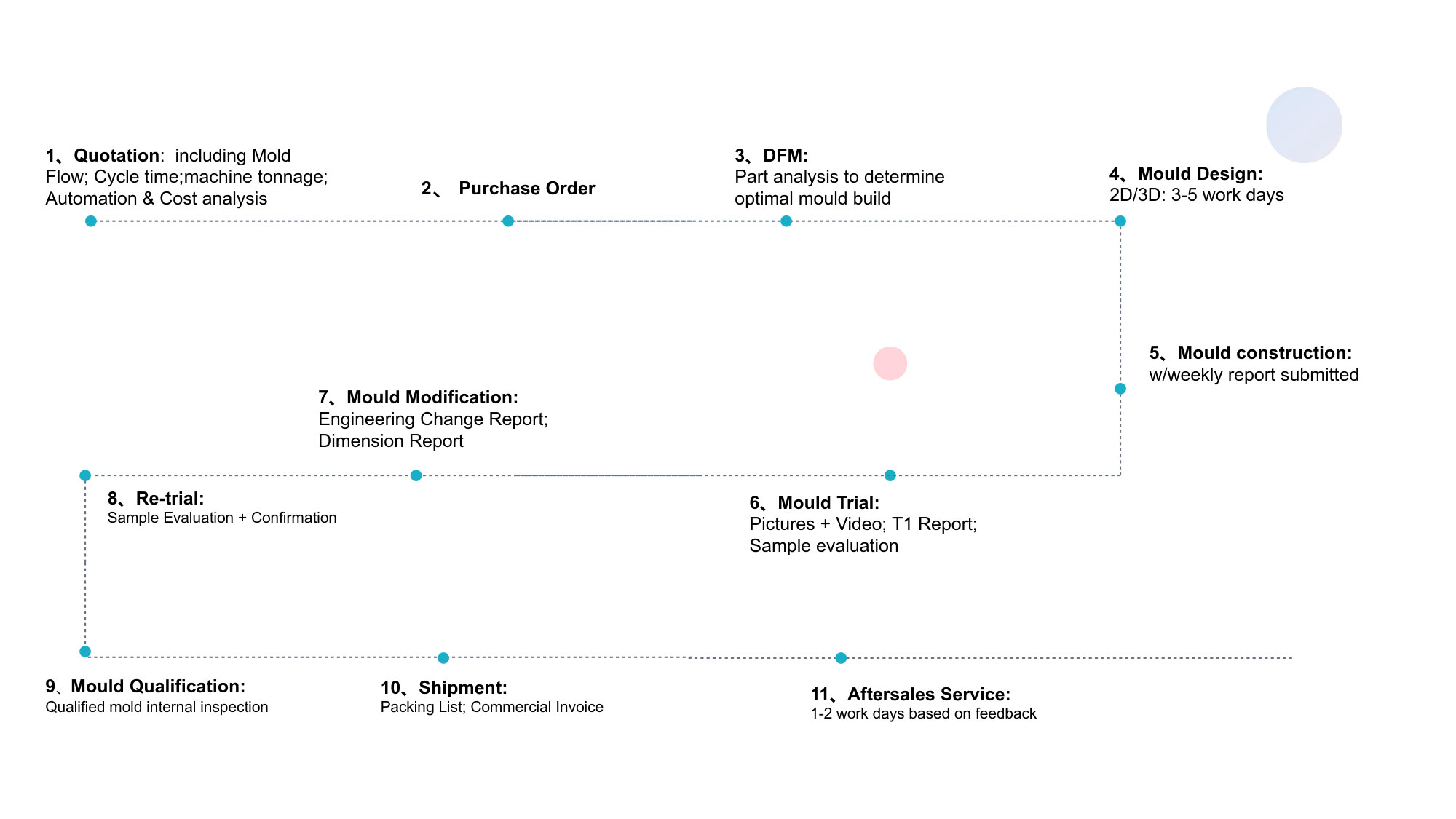
Comprehensive Manufacturing Workflow for Tesla Water Deflector Trim Mold
The complete mold manufacturing process — from raw material to production-ready tool — proceeds through the following stages:
Process Stage Activities
Preliminary analysis Functional requirement review (aerodynamics, environmental stress tolerance, adjacent-part fitment, aesthetic integration); raw material specification (modified PP composite); six‑parameter material benchmarking (density, MFR, shrinkage, flexural modulus, heat deflection temperature)
DFM + Mold flow simulation Digital twin creation with thermal/structural/flow integration; gate/running optimization; weld line and gas trap analysis; cooling circuit design evaluation
Prototyping verification High-speed machined sample mold for functional testing; thermal, impact, structural integrity verification before full tooling commitment
Mold design 3D cavity/core model generation; parting line definition; ejection system and cooling channel layout; interchangeable insert planning for design variants
Material procurement P20 mold base; S136 and H13 core/cavity steels; material certificates and heat-treatment records provided
CNC rough machining Initial bulk material removal on cavity and core sides;including cooling holes and screw holes fabrication
Heat treatment (if required) Vacuum quenching and tempering for S136/H13 components; NAK80 pre-hardened (no secondary heat treatment)
CNC finishing Final surface profiling on complex curvature; 5‑axis machining for aerodynamic geometry; ±0.002 mm tolerance surface preparation
EDM process Electrode fabrication; electrical discharge machining for deep corners, narrow slots (0.03 mm features), and complex cavity details inaccessible to CNC
Wire-cut EDM Precision cutting of narrow slots, ejector pin holes, and featured contours
Polishing / surface finishing Hand or automated polishing to specified finish grade (Ra ≤ 0.2 μm for cosmetic surfaces); NAK80 achieves mirror finish without extra polishing
Assembly Fitting and assembly of all mold components; critical sliding fits tested
Mold trial (T0-T3) Installation on injection press; short-shot arrivals checked for fill pattern; venting and ejection validated; part dimensional inspection against CAD baseline; full dimensional report generated
Production Pilot run verification (100–500 shots); process capability certified (CPK ≥ 1.33); then high‑volume production
Quality SPC in-cycle monitoring; vision inspection for surface defects; batch‑to‑batch color consistency checks; material certificate retention
Delivery & logistics Packaged with custom-designed shipping cases; rust prevention applied for ocean-transport containers (high-humidity protection); spare wear-part kit included
Conclusion: Molding as a Profit Center, Not a Cost Center
For Ansix Tech, a mold is not a sunk expense — it’s a customer‘s profit-generating asset. Every tool is designed with manufacturing sustainability engineered in, including flow-balanced gating, optimized cooling paths, and thermal equilibrium, ensuring that it lands on a customer’s machine requiring zero trial adjustments, producing low-flash components, and delivering multi-million-shot life.
Through early DFM collaboration, material substitution optimization, conformal cooling that cuts cycle times, and a fully integrated production platform, Ansix Tech delivers measurable results:
Cost reduction: Optimized material selection (approximately 15%+ on the Tesla water deflector example)
Production efficiency: Cycle time reduced through conformal cooling and balanced runner design
Risk mitigation: Pre-manufacturing defect simulation and PPAP‑certified Cpk ≥ 1.33 dimensional capability
Management cost: Single‑source accountability from design through mass production
The invitation: Provide Ansix with any existing project, and the team will walk through a full DFM analysis — demonstrating precisely how weld lines, gas traps, and sink marks are predicted and eliminated before tool steel is ever cut.
At Ansix Tech, we don’t just build molds. We engineer the manufacturing reliability that makes our customers successful.
*Ansix Tech has over 28 years of injection molding and tooling manufacturing experience. With IATF 16949, ISO 9001, ISO 14001, and ISO 13485 certifications; 260 injection molding machines from 30–2,800 tons; 30,000+ molds built since establishment; and 70% automated machining ratio with average mold trial count of two — we deliver manufacturing certainty at every stage of the project lifecycle.
Ansix Tech Co Ltd
If you have any plans related to Tesla Water Deflector Trim Mold , you can contact us at any time. We will turn your ideas into reality, let you realize your dreams, and obtain large orders from the market. Our contact information is info@ansixtech.com. Or contact our CTO, mail: stephen@ansixtech.com
#www.ansixtech.com #ansixtech.com #Tesla Water Deflector Trim Mold #Tesla Water Deflector Trim Mold moulds #Tesla Water Deflector Trim Mold injection molding companies #Tesla Water Deflector Trim Mold Canopy Mold injection mold companies #Ansix #Ansix moulds #Ansix china #Ansix tech china #Ansix tech company #Ansix facotry #Tesla Water Deflector Trim Mold injection molding #Tesla Water Deflector Trim Mold injection tools #Tesla Water Deflector Trim Mold injection moulds #Tesla Water Deflector Trim Mold plastic mould #Tesla Water Deflector Trim Mold plastic tools #Ansix Tech #Ansix molds #Ansix injection molding #Ansix mold factory #injection molding Tesla Water Deflector Trim Mold #Ansix mold factory #Tesla Water Deflector Trim Mold china #Tesla Water Deflector Trim Mold molds #injection factory #Tesla Water Deflector Trim Mold injection molding #Tesla Water Deflector Trim Mold injection molding factory #injection molding company #Tesla Water Deflector Trim Mold injection mold companies #Tesla Water Deflector Trim Mold#Tesla Water Deflector Trim Mold mold limited #Ansix mold china #Ansix companies #Ansix company China #Tesla Water Deflector Trim Mold facotry #Ansix Tech #Ansix Tech mould #Tesla Water Deflector Trim Mold injection moulding #injection moulding company #Ansix Tesla Water Deflector Trim Mold parts injection mold companies #medical injection molding companieschina #Tesla Water Deflector Trim Mold china factory #Ansix moulding companies #Ansix molding company #Tesla Water Deflector Trim Mold injection moulding facotry #Ansix Tech mold #Tesla Water Deflector Trim Mold mould #Tesla Water Deflector Trim Mold plastic injection molding #ansix plastic mold #Mold manufacturing #Tesla Water Deflector Trim Mold parts manufacturing #Tesla Water Deflector Trim Mold plastic parts factory #Tesla Water Deflector Trim Mold injection parts mold #Tesla Water Deflector Trim Mold PRECISION MANUFACTURING #Tesla Water Deflector Trim Mold #China mold #Tesla Water Deflector Trim Mold injection moulding china #Tesla Water Deflector Trim Mold mould china #china precision mold #mold in china #Tesla Water Deflector Trim Mold mold china #Precision molds #High-precision molds #Tesla Water Deflector Trim Mold #Injection molds #Tesla Water Deflector Trim Mold Factory #Tesla Water Deflector Trim Mold Company #Super Large Injection Mold Factory #Large Tonnage Injection Molding Factory #Tesla Water Deflector Trim Mold Company #Tesla Water Deflector Trim Mold Factory #2800T Injection Molding Factory #3000 Ton Injection Molding #4500 Ton Injection Molding Factory #Large Mold Injection Molding #Large Plastic Mold Injection Molding Factory #Large Injection Mold Manufacturer #Plastic Mold Factory #Injection Mold #Plastic Mold