



Water purifier tank float ball PP foam molding
FEATURES
PP Foaming Density Specifications
Foaming Method Density Range (g/cm³) Weight Reduction Typical Cell Size
Conventional Chemical Foaming 0.45–0.65 25–40% 80–200 μm
MuCell® Microcellular 0.30–0.50 35–55% 5–30 μm
MPP (Microcellular PP Foam) 0.03–0.12 85–95% 1–10 μm
Material Selection and Raw Material Properties
The selection of base resin grade is crucial for achieving consistent foam structure and optimal buoyancy performance. Ansix utilizes multiple PP resin grades tailored to specific float ball applications:
Homopolymer PP is selected for high rigidity, dimensional stability, and heat resistance (deflection temperature up to 100°C). For applications requiring enhanced durability in aggressive water chemistries, Random Copolymer PP provides superior impact strength and improved surface finish. Long Chain Branching (LCB) PP with nucleating agents yields the most uniform microcellular structure, reducing average cell diameter and improving cell density for optimal buoyancy characteristics
-
Mold Description
Product Materials:
PP FOAM
Mold Material:
S136ESR
Number of Cavities:
4
Glue Feeding Method:
COLD runner
Cooling Method:
Water cooling
Molding Cycle
12.5s
- The mold manufacturing process and product material selection
To achieve 30 μm cell size in polypropylene foaming—which is inherently challenging due to PP‘s low melt strength—Ansix implements specific additive systems including chemical blowing agents (typically endothermic azodicarbonamide or exothermic types) at 1.5–3.0 wt% concentration, mineral fillers as nucleating agents (talc 10–20 wt%), and compatibility modifiers [9†L40-L41]. The material system is optimized for controlled gas release and bubble nucleation during injection molding.
The density of a float ball directly determines its buoyancy force and operational level within the water purification system. Lower-density foam allows for a smaller physical ball size for the same buoyant force, reducing material consumption and production costs. The controlled closed-cell structure also ensures consistent float position throughout the product lifecycle without gradual liquid absorption causing sinkage.
-
Manufacturing Process – From Raw Material to Finished Float Ball
Molding Process Overview
Conventional Foam Injection Molding injects a polymer melt mixed with chemical blowing agents into the mold cavity, where the foaming agent decomposes at elevated temperatures, releasing gas that expands the melt into a cellular structure.
MuCell® Microcellular Injection Molding represents the premium processing standard for PP foam components. Using supercritical fluid (SCF) — typically nitrogen (N₂) or carbon dioxide (CO₂) — as the physical blowing agent, the SCF is precisely dosed into the polymer melt under high pressure to form a single-phase solution [8†L19-L21]. Upon injection into the mold cavity, the rapid pressure drop triggers simultaneous nucleation of millions of micron-sized bubbles, expanding into uniform closed cells throughout the part. Industry trials with MuCell® on PP materials have demonstrated weight reductions up to 35% accompanied by improved dimensional stability [8†L46-L48].
The most influential molding parameters for microcellular foaming are ΔP (the differential pressure between SCF injection pressure and screw back pressure), SCF throughput rate, and resin temperature — all of which are precisely controlled in Ansix‘s fully automated systems [9†L34-L38].
Mold Manufacturing – The Foundation of Quality
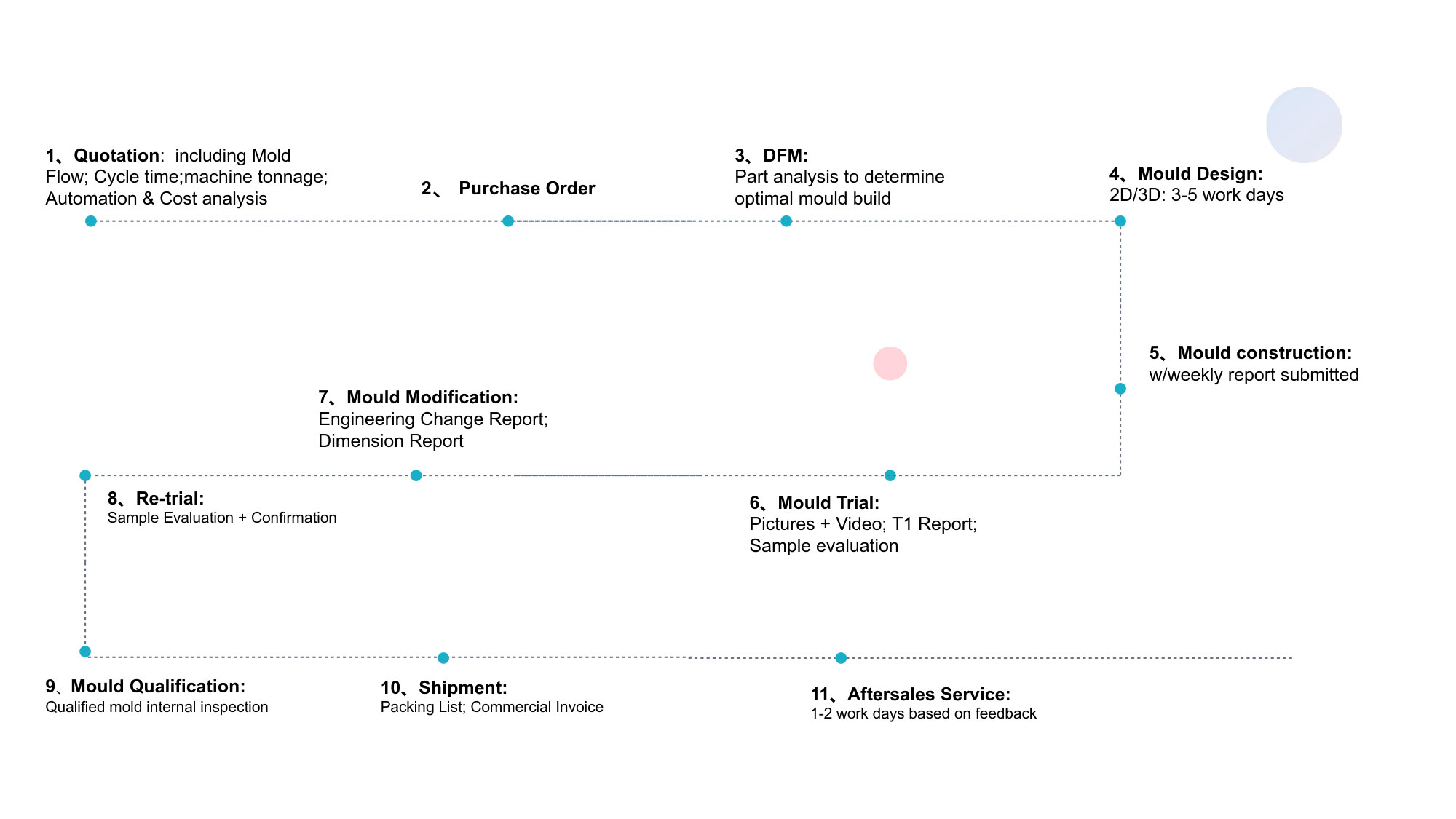
Float ball mold manufacturing follows a multi-stage precision process:
Part design review → 2. DFM analysis with MoldFlow simulation → 3. Mold steel selection → 4. CNC rough/finish machining → 5. EDM for cavity details → 6. Hand polishing and surface finishing → 7. Mold assembly and fitting → 8. Injection trial and optimization → 9. Measurement report and delivery
Mold Steel Selection: Ansix selects mold steels based on production volume. For high-volume production (500,000–1,000,000+ shots), premium grades including S136 (stainless, corrosion-resistant, ideal for humid environments), 2344 / 8407 / H13 (heat-resistant grades for mass production, supports 1M+ shots), and NAK80 (pre-hardened, excellent polishability for cosmetic surface requirements) are utilized [13†L17-L24]. Each steel grade is heat-treated to optimal hardness (typically HRC 48–52) and validated with material certification reports.
Cooling System Engineering: Conformal cooling channels are designed to encircle the cavity as evenly as possible, shortening cooling time and reducing thermal stress that would cause part warpage [4†L14-L16]. Using computer-aided engineering (CAE) simulation, Ansix designs 3D-printed conformal water channels to replace traditional drilled channels, achieving 15% shorter cooling time with 20% higher daily output [19†L15-L18].
Gate and Runner System: Ansix performs MoldFlow analysis to predict melt front advancement, weld line formation, and gas entrapment locations before manufacturing begins. The gate location is optimized to achieve uniform cavity filling and prevent defects [15†L16-L18]. For float ball applications requiring fully spherical geometry, ring or diaphragm gate designs are employed to provide uniform circumferential flow and eliminate asymmetric shrinkage.
3. Delivery Efficiency – Rapid Response Across Project Phases
Stage Standard Lead Time Expedited Option
DFM Analysis & Prototype Mold 3–5 days 2 days
Sample Float Balls (rapid tooling) 7–10 days 5 days
Production Mold (single cavity) 15–20 working days 12 days
Production Mold (multi-cavity) 25–40 working days 20 days
T0 Sample (first tryout) +2–3 days from mold completion 24-hour expedited
Mass Production Ramp-up 5–7 days post mold approval 3 days
To support just-in-time inventory strategies, Ansix maintains 15–30 days‘ safety stock of standard float ball dimensions at all times, guaranteeing continuity and eliminating logistics delays for global customers.
4. Quality Assurance – Dimensional Integrity and Process Validation
Ansix implements a comprehensive quality management system following ISO 9001:2015 and IATF 16949 automotive-grade standards, with every float ball produced in China meeting international quality benchmarks.
Mold Quality Verification: Prior to mold release, full dimensional inspection using Coordinate Measuring Machine (CMM) verifies 100% of critical dimensions. Critical dimensions are validated with Cpk ≥ 1.33 (minimum 1.33, typically achieving 1.67) [16†L23-L24].
Process Control: All injection molding machines are networked and integrated into a Manufacturing Execution System (MES), locking molding parameters (temperature, pressure, injection speed, and cooling time) to authorized engineering access only. Each batch undergoes first-article and last-piece measurement comparison to ensure process stability [16†L15-L19].
Foam Density Control: Real-time monitoring systems track melt temperature, injection pressure, back pressure, and SCF dosing rate to ensure consistent foaming and density within specification limits.
In-process Inspection: Sampling frequencies range from 100% visual inspection for cosmetic defects to hourly dimensional spot checks for production monitoring.
Material Traceability: Full traceability from raw material batch to finished product is maintained, including chemical blowing agent lot tracking, filler certification, and PP resin grade verification.
5. Cost Control – Maximizing Value Through Engineering Excellence
Ansix achieves superior cost competitiveness through systematic optimization across three core dimensions:
Material Cost Reduction: Optimizing wall thickness through intelligent rib design eliminates excess material from non-critical sections while maintaining rigidity. Modulating foam density from 0.55 g/cm³ to 0.35 g/cm³ reduces raw material consumption by over 35% [18†L28-L35]. MuCell® technology itself reduces material consumption by an additional 15–20% compared to conventional foam molding [8†L46-L48].
Manufacturing Efficiency Gains: Optimizing cooling channel design using conformal cooling reduces cycle time by up to 20%, directly translating to higher daily throughput and lower per-unit fixed overhead cost allocation [19†L15-L18]. Hot runner systems eliminate runner scrap, saving an additional 30% in material waste compared to cold runner designs [19†L11-L14].
Long-term Operational Savings: Premium mold steel selection ensures 500,000–1,000,000 shot lifespan before major maintenance, amortizing initial tooling investment across longer production runs and reducing per-unit depreciation cost [19†L42-L45].
6. After-Sales Service Commitment
Ansix provides transparent after-sales support:
Technical Support: Dedicated engineering hotline available 24/7 for troubleshooting, process parameter adjustment, and mold optimization guidance.
Spare Parts: Standard spare parts inventory maintained in local warehouses.
Mold Maintenance: Scheduled mold inspections and maintenance services available at client sites, including polishing, dimension recalibration, and corrosion protection treatment.
Documentation: Comprehensive mold validation reports, PPAP documentation, material certificates, and measurement reports provided with every project.
Ansix‘s Core Customer Value Proposition – Translating Technical Expertise into Measurable Client Benefits
I. Hard Power Foundation – Equipment and Infrastructure That Inspires Confidence
Precision Mold Manufacturing Equipment
Ansix operates a state-of-the-art CNC machining center featuring 5-axis high-speed machining with 0.002 mm precision for complex curved surfaces. Every mold manufactured undergoes full dimensional verification using Coordinate Measuring Machines (CMM) and Optical Image Measuring Instruments, ensuring each mold‘s parting line is smooth and burr-free before delivery.
Injection Molding Machine Fleet
Ansix‘s injection molding capacity ranges from 30 tons to 4000 tons clamping force, covering all product size requirements for water purifier float balls. All machines are equipped with precision weighing systems ensuring part weight repeatability within ±0.1%.
In-house Testing Equipment
Coordinate Measuring Machines for full dimensional inspection
Optical measurement systems for detailed feature verification
Density measurement equipment for foam quality control
Pressure testing for buoyancy validation
II. Mold Manufacturing – Technical Competencies Delivered in Concrete Metrics
Technical Dimension Professional Specification Customer Value
Mold Life Expectancy Glass-fiber reinforced: 500,000 shots / Standard plastic: 1,000,000+ shots Reduced tooling replacement frequency, predictable production cost
Achievable Tolerance ±0.005–0.01 mm on critical features Interchangeable components, consistent assembly fit
Parting Line Precision 0.005 mm mating accuracy Burr-free parts eliminating secondary finishing
Cavity Count Single to 8-cavity configurations Linear reduction in per-unit manufacturing cost
Surface Finish (Cosmetic) Ra < 0.05 μm for Class A surfaces Ready-to-use appearance without secondary operations
Runner and Gate Optimization
MoldFlow simulation identifies weld lines and gas trap locations before steel is cut, optimizing gate location and runner balance to ensure uniform cavity filling [15†L16-L18]. Multi-cavity layouts enable simultaneous production of up to 8 float balls per injection cycle, reducing per-unit manufacturing cost by 40% compared to single-cavity production [19†L20-L24].
Cooling System Engineering
Computer-aided cooling simulation designs water channels that encircle cavities as evenly as possible, reducing cooling time by up to 20% and preventing thermal-stress-induced warpage [19†L15-L18]. This efficiency gain yields faster cycle times and higher machine utilization.
III. Injection Molding Process Control – Eliminating Customer Quality Concerns
Process Standardization and Digital Control
Every injection molding machine is integrated into a Manufacturing Execution System (MES) with all processing parameters (temperature zones, injection pressure and velocity profiles, holding pressure settings, and cooling timing) electronically locked. Only authorized mold engineers can modify parameters after validation. Each production batch requires first-article and last-piece measurement comparisons, ensuring consistent quality across the entire production run [16†L15-L18].
Dimensional Stability Assurance
Ansix‘s injection molding cells are equipped with ultrasonic wall thickness sensors that monitor and feed back real-time melt pressure variations to automatically compensate pack/hold pressure profiles. Alternatively, in-mold temperature sensors can be embedded to enable closed-loop process control. Proper cooling system design paired with mold temperature zone control keeps core-to-cavity temperature differentials within 2°C, eliminating warpage and sink defects.
Surface Finish Classification
Ansix achieves surface finish levels appropriate to each customer‘s requirement: cosmetic surfaces free from flow marks and weld lines (Ra < 0.2 μm) for applications where appearance matters, and general-purpose matte or textured finishes for pure functional components.
Special Materials Processing Capability
Ansix‘s extensive material portfolio includes: PC/ABS, PC, PPS + 40% glass fiber, PEEK, PTFE/PFA, PA6 + 30% glass fiber, PBT, PEI, LCP, and Liquid Silicone Rubber (LSR). For water purifier applications requiring regulatory compliance, UL94 V-0 flame rating and UV resistance certified to 3000 hours without color shift.
IV. Full-Service Process – Reducing Customer Management Burden
Early Engineering Intervention (DFM Report)
Before mold manufacturing begins, Ansix delivers a comprehensive Design for Manufacturability (DFM) report covering:
Draft angle recommendations for smooth part ejection
Wall thickness optimization to eliminate sink marks
Gate location selection minimizing cosmetic defects
Ejector pin mark location allowance for non-critical surfaces
This upfront analysis avoids costly mold modifications after the tool has been cut [15†L12-L13].
Progressive Validation
T0 sampling produces initial parts for customer review
T1–T3 optimization rounds incrementally improve quality
Quick-change inserts verify alternative designs without rebuilding entire molds
Pilot production (100–500 parts) validates quality and Cpk before mass production
Maintenance and Spare Parts
Complete sets of wear parts (ejector pins, core inserts, cavity details) accompany each mold delivery. Scheduled maintenance at 200,000-shot intervals is provided at preferential rates. Lifetime mold repairs are billed at cost.
V. Customer Pain Points and Ansix‘s Concrete Solutions
Customer Concern Ansix‘s Technical Response Quantified Benefit
Frequent mold repairs disrupting orders 2000-shot factory acceptance test with wear report; 3-year mold structure warranty Production stability without hidden tooling surprises
Flash requiring expensive manual trimming 0.005 mm parting line machining precision Eliminates secondary finishing labor
Inconsistent dimensions between batches Ultrasonic thickness sensors + closed-loop control Dimension fluctuation ≤ ±0.02 mm across batches
Long mold repair lead times In-house EDM and electrode machining centers; standard repairs completed within 24 hours Minimized production downtime
High per-unit cost from low cavitation Multi-cavity molds up to 8 cavities Linear reduction in cost per part
VI. DFM Excellence – Translating Technical Risks into Preventive Actions
Technical Risk DFM Detection Method Preventive Action Customer Cost Avoidance
Weld line weakness MoldFlow visualization Gate relocation / multiple gates / flow leader design Eliminates field failure risk
Gas trap causing burn marks Air trap analysis Venting addition at last fill points Zero cosmetic rejects
Sink marks on thick sections Wall thickness analysis Rib optimization / core-out No secondary filling required
Warpage after cooling Thermal stress simulation Cooling channel balancing / mold temperature control Consistent assembly fit
VII. Comprehensive Value Creation – How Ansix Solves Customer Problems
Design and Development – DfX (Design for Excellence): Ansix‘s engineering team analyzes initial part geometry before mold manufacturing begins. Using MoldFlow simulation, they predict melt flow patterns to eliminate weld lines, sink marks, and gas traps before committing to steel cutting. This approach avoids 100% of mold rework costs from preventable design flaws.
Product Validation – Tiered Sampling Approach:
Sample molding evaluation verifies basic geometry
High-speed injection molding trials identify optimal processing windows
Scientific molding methodology validates Cpk ≥ 1.33 for all critical dimensions
Assembly validation confirms final fit and function
Cost Reduction – Systematic Approach:
Material optimization: Density reduction through advanced foaming technology
Manufacturing efficiency: Cycle time reduction via optimized cooling
Scrap reduction: Process capability eliminating defective parts
Tooling cost amortization: High-cavity molds spreading cost over larger production volumes
Capacity and Delivery – Scaling Without Sacrifice: Ansix maintains a dedicated manufacturing line for water purifier float balls, enabling rapid production ramp-up regardless of seasonal demand fluctuations. Real-time MES monitoring tracks production throughput against targets, with automatic alerts if performance deviates.
Experience and Reliability – 29 Years of Manufacturing Excellence: With over 29 years of injection molding experience, Ansix has refined every aspect of PP foam float ball production. This accumulated expertise translates into reduced launch risk and predictable production outcomes for every customer.
Additional Technical Scope – Water Purifier Tank Float Ball PP Foam Molding: In-Depth Production Framework (2000+ words)
Project Initiation – From Customer Concept to Manufacturing Reality
The mold design and injection molding journey begins when a customer shares preliminary product requirements—often a concept sketch or initial part geometry. In these early interactions, Ansix performs structured feasibility analysis covering the float ball‘s intended operating environment, required buoyancy characteristics, anticipated production volume, and any regulatory certifications (e.g., food-contact compliance, WRAS, NSF) that will govern material selection.
Raw Material Selection and Characterization
The choice of PP resin grade for foam float ball applications is not arbitrary—it is a calculated selection considering three key factors: melt flow index (MFI) directly influences foamability, higher MFI facilitates bubble nucleation and uniform cell distribution; nucleating agent content determines final cell size and density; and the base resin‘s molecular architecture (linear vs. branched) affects melt strength during foaming. Ansix tailors the material system precisely to each customer‘s application. Complete material composition data and specific grade references are provided in full technical documentation packages.
DFM Analysis – Predicting Success Before Manufacturing Begins
Using MoldFlow simulation software, Ansix‘s engineering team constructs a digital model of the float ball mold and simulates every aspect of the injection process: the initial melt front advances through the runner system and enters the cavity through the gate, with the simulation predicting fill patterns and indicating weld line positions where converging flows meet; the simulation also predicts air entrapment locations where gas fails to fully evacuate, suggesting vent placement modifications; shrinkage analysis predicts how and where the part will contract upon cooling, directing cooling channel placement.
Critical DFM decisions evaluated before cutting steel include gate style selection (pin gate for float balls to minimize gate vestige visibility), runner balance in multi-cavity configurations ensuring simultaneous cavity filling, and core-out feasibility in areas where structural function permits material removal for weight reduction and cycle time improvement.
Mold Design Priorities for High-Volume Float Ball Production
The mold must accommodate daily injection cycles extending for years, requiring robust mechanical design. Runner and gate systems must be balanced so all cavities fill simultaneously; for spherical float ball geometry, diaphragm gates provide uniform circumferential fill and eliminate asymmetric orientation that would produce non-spherical parts. Cooling channels are positioned to encircle cavities as evenly as possible, reducing cooling time and preventing thermal stress-induced warpage [15†L50-L52]. Ejection systems (ejector pins or sleeve ejection) are positioned away from critical sealing surfaces to avoid feature marks that would affect ball performance.
Runner and Gate Design Trade-offs: Cold runners remain practical when resin is low cost, color changes are frequent, production volumes are moderate, and maintenance simplicity matters more than resin savings. Hot runners are generally better when resin is expensive, the part is high-volume (over 100,000 pieces annually), the gate must be hidden, cycle efficiency matters more than upfront tooling cost, and runner scrap elimination reduces total material consumption by up to 30% [19†L11-L14].
Manufacturing Processes for Complex Float Ball Tooling
Precision mold manufacturing for foam float balls requires specialized machining processes:
CNC High-Speed Machining (HSM) achieves 0.002 mm precision, ensuring parting line smoothness
EDM (Electrical Discharge Machining) creates fine detail features such as ejector pin bores and cooling channel ports with tight tolerances
Surface and Hand Polishing achieves mirror finishes on spherical cavity surfaces for smooth part release
Mold Assembly fits all cooling channel connections, hot runner components, and ejector systems
Prototype to Production – The Validation Pathway
Stage Activities Delivery
DFM Phase Part drawing review, gate layout analysis, cooling simulation, steel type selection DFM Report 3–5 days
Mold Design Phase 3D mold modeling, electrode design, BOM preparation Complete CAD files 7–10 days
Mold Manufacturing CNC machining, EDM, wire cutting, hand fitting, heat treatment Mold ready for testing
T0 Sampling First injection run (50–100 shots), dimension measurement, customer review Samples + Measurement Report
T1–T3 Optimization Parameter tuning, corrective actions Updated parts + Improvement Report
Pilot Production 500–1000 pieces verification run, CPK calculation, first pass yield data PPAP + Production Approval
Injection Molding Process Optimization for PP Float Balls
Process parameters are tuned iteratively to achieve optimal foam density while maintaining dimensional stability:
Melt temperature affects gas solubility and bubble nucleation, typically 190–230°C for PP foam molding
Injection speed influences shear heating and flow front stability, optimized to balance fill while avoiding gas escape
Holding pressure must be applied before foam expansion fully solidifies the skin
Cooling time must be sufficient to stabilize dimensions without extending cycle time unnecessarily
Back pressure during plastication affects SCF mixing uniformity in MuCell® processing; higher melt temperature, faster injection rate, higher mold temperature, and longer cooling time all stimulate crystallization and enhance strength in foamed PP products [17†L31-L33]
Quality Assurance and Process Capability Documentation
Quality Assurance Components:
Incoming material inspection
Process parameter monitoring
First article inspection (FAI)
In-process quality control (IPQC) sampling
Final outgoing quality control
Measurement system analysis (MSA)
Statistical process control (SPC) charting
Documentation Provided for Every Project:
Material certification (resin grade, filler content, regulatory compliance)
Mold flow analysis report (gate and cooling verification)
First article inspection report (all dimensions with deviations noted)
CPK capability study (if applicable for repeat orders)
PPAP (Production Part Approval Process) Level 3 documentation
Packaging and Logistics for Global Delivery
Float balls are typically packed in anti-static bags or bulk cartons depending on surface finish sensitivity. Cartons are labeled with part numbers, batch codes, quantities, date codes, quality inspector stamps, and material certifications. Just-in-time delivery schedules can be arranged for volume contracts, integrating directly with customer inventory systems.
Cost Reduction – Systematic Engineering Across Material, Process, and Efficiency
For a typical 5 million annual-volume float ball program, total product cost breakdown is: raw materials (40–50%), processing (direct labor + machine overhead) (25–35%), tooling amortization (5–10%), quality + shipping (10–15%). Ansix‘s three-pronged approach attacks each category:
Material Reduction: Modulating foam density from 0.55 g/cm³ to 0.35 g/cm³ yields 36% resin savings. For a 40g float ball at $1.80/kg PP resin, the density reduction alone saves $0.026 per part.
Cycle Time Reduction: Optimized cooling reduces cycle time from 45 seconds to 32 seconds. For a 5-million-unit program running on a $120/hour injection molding cell, this 13-second reduction saves approximately $218,000 annually in machine operating costs.
Scrap Reduction: Process capability improvements reduce scrap from 3.0% to 1.2%. This saves 90,000 parts annually—19,800 kg of raw material savings representing direct material avoidance plus associated processing energy savings.
The combination of these optimizations reduces total landed cost by approximately 20–30% compared to conventionally manufactured float balls.
Value-Based Customer Engagement
For Ansix, a mold is not just a block of steel—it is a customer‘s revenue-generating asset. The company designs molds with resin flow stability, gas venting pathways, and temperature balance carefully planned to ensure the customer‘s production line receives ready-to-run tooling that produces low-flash, dimensionally stable parts with extended service life.
The core message is simple: translate every technical competency into customer-facing benefits that address cost reduction, risk mitigation, and production reliability. When customers understand how a DFM report prevents weld-line failures, how optimal gate placement eliminates trimming labor, and how conformal cooling reduces cycle times, they appreciate that Ansix delivers not just tooling, but manufacturing intelligence.
Ansix Tech Co Ltd
If you have any plans related to Water purifier tank float ball PP foam molding , you can contact us at any time. We will turn your ideas into reality, let you realize your dreams, and obtain large orders from the market. Our contact information is info@ansixtech.com. Or contact our CTO, mail: stephen@ansixtech.com
#www.ansixtech.com #ansixtech.com #Water purifier tank float ball PP foam molding #Water purifier tank float ball PP foam molding injection molding companies #Water purifier tank float ball PP foam molding Canopy Mold injection mold companies #Ansix #Ansix moulds #Ansix china #Ansix tech china #Ansix tech company #Ansix facotry #Water purifier tank float ball PP foam molding injection molding #Water purifier tank float ball PP foam molding injection tools #Water purifier tank float ball PP foam molding injection moulds #Water purifier tank float ball PP foam molding plastic mould #Water purifier tank float ball PP foam molding plastic tools #Ansix Tech #Ansix molds #Ansix injection molding #Ansix mold factory #injection molding Water purifier tank float ball PP foam molding#Ansix mold factory #Water purifier tank float ball PP foam molding china #Water purifier tank float ball PP foam molding molds #injection factory #Water purifier tank float ball PP foam molding injection molding #Water purifier tank float ball PP foam molding injection molding factory #injection molding company #Water purifier tank float ball PP foam molding injection mold companies #Water purifier tank float ball PP foam molding Tooling #Water purifier tank float ball PP foam molding mold limited #Ansix mold china #Ansix companies #Ansix company China #Water purifier tank float ball PP foam molding facotry #Ansix Tech #Ansix Tech mould #Water purifier tank float ball PP foam molding injection moulding #injection moulding company #Ansix Water purifier tank float ball PP foam molding parts injection mold companies #medical injection molding companieschina #Water purifier tank float ball PP foam molding china factory #Ansix moulding companies #Ansix molding company #Water purifier tank float ball PP foam molding injection moulding facotry #Ansix Tech mold #Water purifier tank float ball PP foam molding mould #Water purifier tank float ball PP foam molding plastic injection molding #ansix plastic mold #Mold manufacturing #Water purifier tank float ball PP foam molding parts manufacturing #Water purifier tank float ball PP foam molding plastic parts factory #Water purifier tank float ball PP foam molding injection parts mold #Water purifier tank float ball PP foam molding PRECISION MANUFACTURING #Water purifier tank float ball PP foam molding #China mold #Water purifier tank float ball PP foam molding injection moulding china #Water purifier tank float ball PP foam molding mould china #china precision mold #mold in china #Water purifier tank float ball PP foam molding mold china #Precision molds #High-precision molds #Water purifier tank float ball PP foam molding #Injection molds #Water purifier tank float ball PP foam molding Factory #Water purifier tank float ball PP foam molding Company #Super Large Injection Mold Factory #Large Tonnage Injection Molding Factory #Water purifier tank float ball PP foam molding Company #Water purifier tank float ball PP foam molding Factory #2800T Injection Molding Factory #3000 Ton Injection Molding #4500 Ton Injection Molding Factory #Large Mold Injection Molding #Large Plastic Mold Injection Molding Factory #Large Injection Mold Manufacturer #Plastic Mold Factory #Injection Mold #Plastic Mold