



100g and 120g cosmetic face creams/makeup removers/cream jars
FEATURES
FOUNDATIONAL HARDWARE CAPABILITIES — Building Client Trust Through Infrastructure
Before discussing processes or quality systems, clients must understand the tangible infrastructure that enables precision and consistency. At Ansix Tech, our equipment foundation is not simply a list of assets — it is the measurable guarantee of your product quality.
Mold Manufacturing Equipment — Precision That Eliminates Defects at the Source
Our mold shop is equipped with state-of-the-art five-axis high-speed machining centers from leading global manufacturers. A five-axis CNC platform with accuracy up to 0.002mm and surface roughness capabilities of Ra < 0.15µm enables the production of complex, high-precision cavity geometries with exceptional repeatability [3†L12-L15]. For cosmetic jars, this translates directly to client value: part lines between the jar body and closure are machined smooth with no visible mismatch, eliminating the need for post-mold finishing operations that add labor cost and lead time.
-
Mold Description
Product Materials:
PET PETG PS AS PP
Mold Material:
S136ESR
Number of Cavities:
1*12
Glue Feeding Method:
Hot runner
Cooling Method:
Water cooling
Molding Cycle
42.5s
- The mold manufacturing process and product material selection
The integration of wire electrical discharge machining (EDM) capabilities enables the creation of features down to 0.03mm in narrow slots and thin-walled geometries. For molds requiring fine surface detail on jar threading or decorative undercuts, the EDM process can produce directly usable cavity surfaces requiring minimal hand polishing [6†L46-L48]. The client result: thinner walls without deformation risk, saving material cost per unit while maintaining jar integrity.
Injection Molding Machine Fleet — Consistency Across Every Shot
Ansix Tech operates 260 injection molding machines across four production bases in China and Vietnam, with clamping forces ranging from 30 tons to 2,800 tons [16†L4-L6]. Our primary machine brands include Japan‘s Fanuc, Sumitomo, Toshiba, and Nissei, Germany’s Arburg, and China‘s Haitian Machinery — representing the industry’s most reliable and precise equipment platforms [16†L6-L8]. For 100g and 120g cosmetic jars requiring wall thickness precision typically between 1.5mm and 3.0mm, these machines deliver repeatable injection cycles with dimensional stability within ±0.01mm across tens of thousands of shots.
-
The value equation is straightforward: when every mold shot produces identical part geometry, your assembly lines never experience jamming or sealing failures, your product filling operations never encounter dimensional mismatches, and your customers never see irregular jar shapes on retail shelves.
Quality Inspection Equipment — Data-Driven Confidence
Every mold leaving our facility undergoes full dimensional inspection using coordinate measuring machines (CMM) and optical imaging systems. A complete dimensional report is provided for each mold before shipment, with critical dimensions verified to CPK ≥ 1.33 — an industry gold standard indicating that at least 99.97% of production will fall within specification limits. For cosmetic brands, CPK at this level means fewer customer returns, less product waste at filling lines, and consistent premium presentation across every jar.
SECTION TWO: MOLD MANUFACTURING CORE COMPETENCIES — Translating Technical Specifications into Client Value
The mold is the heart of your production line. A poorly designed mold will create endless problems: flash requiring manual trimming, short shots causing product loss, inconsistent dimensions disrupting assembly, and premature wear forcing costly repairs. Ansix Tech designs molds as long-term assets, not temporary tools.
Mold Life Expectancy: Guaranteed Durability with Full Transparency
Our mold construction begins with strategic material selection based on your production volume requirements and plastic formulation. For cosmetic jars typically molded from PET, PETG, PMMA, PP, or AS materials, our standard material configuration pairs a P20 mold base with S136 stainless steel cavity and core inserts. This combination delivers:
For fiber-reinforced materials (e.g., glass-filled PP for enhanced jar rigidity): Minimum 500,000 shots before any cavity wear affects part quality.
For standard cosmetic-grade plastics (PP, PET, AS, PMMA): Minimum 1,000,000 shots with no measurable dimensional drift.
Comprehensive material certifications — including full chemical composition reports and heat treatment curves — accompany every mold shipment. For premium jar applications requiring optical-grade clarity, S136 stainless steel with mirror polishing up to #10,000 grit delivers cavity surface finishes comparable to optical lenses, ensuring transparent jar bodies exhibit no haze or visible tool marks [4†L22-L23]. For applications requiring high-temperature processing — such as PET jars demanding 260–280°C melt temperatures — our tool steel options include H13 and 2344 hot-work steels with enhanced thermal fatigue resistance [4†L24-L25].
The Client Value Statement: You will not pay for unplanned mold repairs during the first million production cycles. Your capital equipment investment is protected, and your production schedule is never disrupted by tooling failures.
Achievable Tolerances: Precision That Eliminates Assembly Problems
For 100g and 120g jar bodies and closures, typical cosmetic packaging tolerances fall into two categories:
Feature Type Achievable Tolerance Client Benefit
General structural features (jar body OD, closure OD) ±0.05mm Consistent fit between jar and cap; no wobbling or misalignment
Critical sealing surfaces (thread engagement, lid-to-rim contact) ±0.02mm Reliable product seal; no leakage during shipping or shelf display
Detailed decorative elements (brand logos, surface textures) ±0.01mm Sharp, premium brand presentation
For jar components requiring precision thread engagement — where both the jar neck and closure threads must maintain consistent fit across millions of units — we routinely hold thread pitch tolerances at ±0.02mm. The client value is profound: your filling line experiences zero jams from jar-cap mismatch, your product never leaks during transit, and your customers never experience difficult opening or poor resealing.
Mold Type Capabilities: Matching the Right Architecture to Your Production Needs
Hot Runner Systems: For high-volume 100g and 120g jar production, hot runner systems eliminate runner waste while reducing cycle times. By keeping the plastic molten within the manifold, hot runners remove the need to eject, collect, and regrind runner material, delivering material savings of 10–20% per part while eliminating the risk of contamination from recycled material regrind. Modern hot runner systems are available with up to 32 or more drops, with nozzle pitch as tight as 65mm, enabling high-cavitation molds that produce maximum parts per machine cycle [7†L4-L7]. Valve-gated hot runner systems further enhance gate mark quality, eliminating vestigial gate protrusions that mar premium jar aesthetics and require secondary trimming operations [7†L43-L47].
Stack Molds: For ultra-high-volume jar production, stack molds — which employ two parallel parting planes to effectively double cavity count without increasing machine clamping force — effectively double your output per machine cycle without requiring larger injection molding machines.
Two-Shot / Multi-Material Molds: For brands requiring soft-touch overmolding on jar bodies or bi-material closures (e.g., rigid PP frame with TPE sealing gasket), two-shot molding integrates both materials in a single automated cycle, eliminating secondary assembly operations and reducing per-unit labor cost.
High-Gloss / Mirror Finish Molds: For transparent jar applications where product visibility drives consumer purchasing decisions, high-gloss mold surfaces polished to Ra < 0.05μm produce jar bodies with optical clarity rivaling glass — no flow marks, no surface haze, no visible tooling artifacts.
Gating and Flow Optimization: Eliminating Defects Before the First Shot
For cosmetic jars, visible weld lines and trapped air pockets are unacceptable — they create inconsistent product appearance and can compromise jar structural integrity during filling line handling. Ansix Tech deploys comprehensive mold flow analysis prior to any steel cutting. This simulation process maps how molten plastic will flow, cool, and shrink inside the mold, identifying potential problem locations such as weld line convergence zones, gas entrapment regions, and unbalanced cavity filling [8†L9-L14].
Mold flow analysis enables us to:
Predict weld line positions and determine whether they fall in visible jar locations; if so, we relocate gates or modify wall sections to push weld lines into hidden areas like jar bottom edges.
Identify gas entrapment locations and design integrated venting channels to prevent burn marks on jar surfaces.
Optimize gate quantity and position to ensure all cavities fill simultaneously, eliminating short shots and maintaining consistent pack pressure across every cavity.
Validate filling balance for multi-cavity molds, ensuring cavity-to-cavity variation remains within ±0.5% of fill volume.
The client value is direct and measurable: instead of discovering weld line defects after building the mold (requiring expensive rework and delaying your product launch), we identify and resolve these issues in simulation, delivering a mold that produces cosmetic-perfect parts from the very first trial shot.
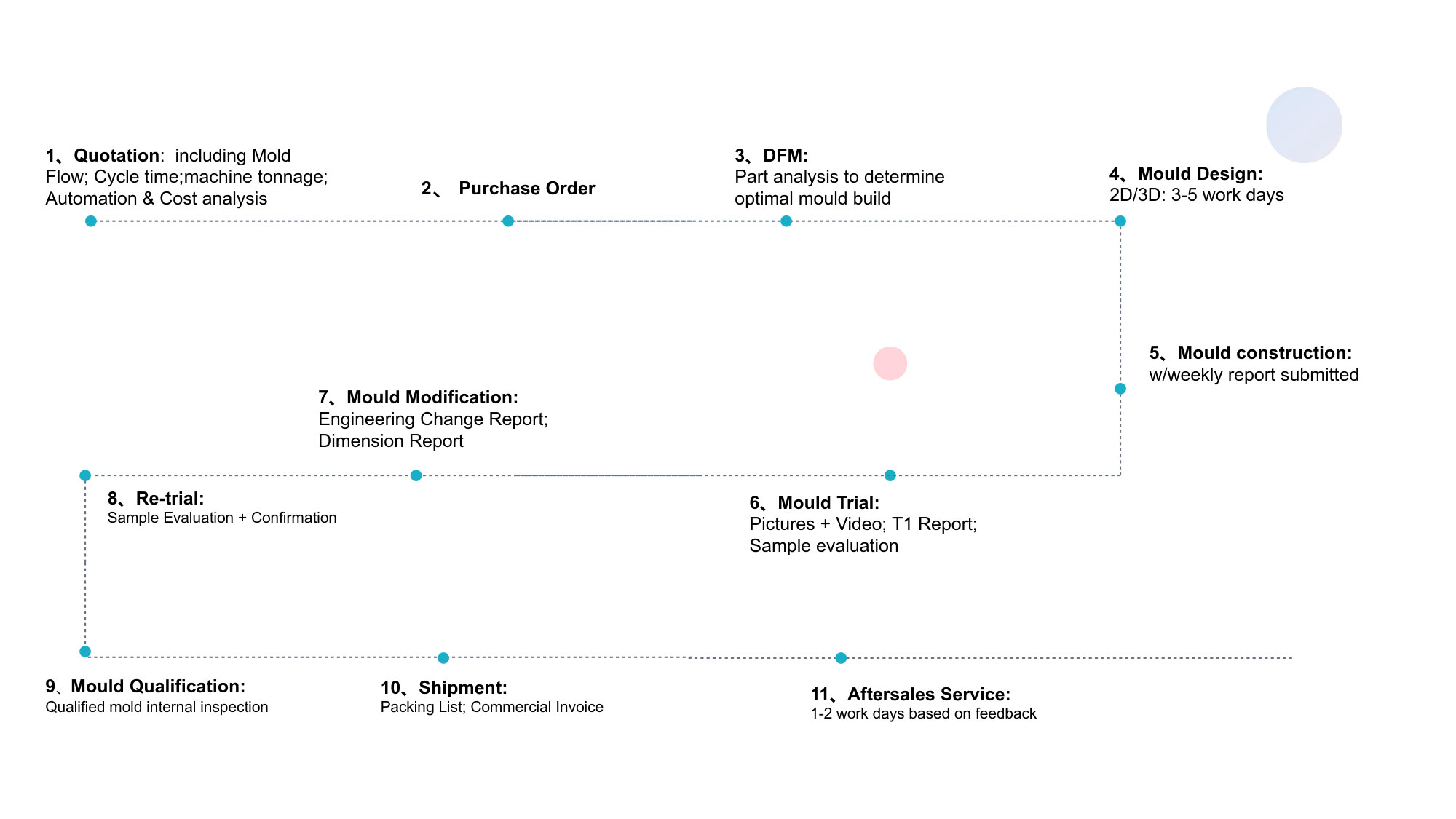
Mold Manufacturing Process Flow: Controlled Precision from Design to Delivery
Stage Activities Quality Controls Client Value
1. DFM Review Mold flow analysis; gate position optimization; draft angle and wall thickness validation; shrinkage compensation calculation Engineering sign-off; client design review No structural redesign after mold completion; reduced development iteration cycles
2. Material Procurement Steel certification (material certificates, hardness testing, ultrasonic inspection for internal defects) Incoming material quarantine; traceability to heat lot Full material pedigree; no hidden defects causing premature wear
3. Rough Machining Cavity and core rough cutting; cooling channel drilling Dimensional checks at each operation Reduced machining time lowers tooling cost
4. Heat Treatment Hardening to specified HRC range (typically 48–52 HRC for S136) Temperature profile logging; hardness certification Uniform material properties across all mold components
5. Precision Machining Five-axis finishing of cavity/core surfaces; electrode manufacturing for EDM operations CMM in-process inspection; surface roughness measurement (Ra measurement) ±0.002mm feature placement; optical-grade surface quality
6. EDM (Electrical Discharge Machining) Cavity detail creation; undercut machining; narrow slot generation Electrode-to-workpiece gap monitoring; spark erosion parameter control Complex geometries (fine jar threads, brand engraving) with no burrs
7. Manual Fitting and Polishing Parting line fitting; slide and lifter assembly; cavity surface polishing Air leak testing; mold closure force measurement; visual surface inspection under magnification Smooth parting lines eliminate flash; mirror surface finish eliminates secondary polishing
8. Mold Assembly Full mold assembly; cooling circuit testing; ejection system functional check Water flow and pressure testing; ejector plate parallelism measurement Ready for immediate installation on your injection machine
9. Mold Trial (T0) First test shots; process parameter optimization; part inspection Full dimensional report; defect documentation; CPK calculation (if sample size sufficient) Validation before mass production; process windows established
10. Mold Shipping Protection against corrosion; custom packaging; full documentation Shipping inspection checklist; final surface protection application Arrives ready to run; no surface rust or damage
Delivery Timelines (Customized to Your Schedule)
Simple mold designs (single-cavity, standard parting lines): 10 working days from design approval to T0 trial.
Medium-complexity molds (4–8 cavities, hot runner system): 25–45 working days, inclusive of mold flow analysis and full documentation.
High-complexity molds (16+ cavities, stack mold, two-shot configurations): Up to 60 working days, with accelerated options available for time-critical launches.
Cooling System Design: The Hidden Driver of Productivity
Mold cooling is frequently overlooked, yet it governs both cycle time and part quality. For 100g and 120g jars with typical wall thicknesses of 1.5mm to 3.0mm, cooling typically consumes 50–70% of the total injection cycle. Optimized cooling channel design — using conformal cooling channels that follow jar contour geometry — can reduce cycle time by 15–25% compared to conventional straight-drilled channels.
Our cooling design methodology:
Separate zone control: Core side cooling and cavity side cooling are independently controlled, allowing differential temperature management to balance shrinkage.
Temperature difference limit: Core vs. cavity temperature difference maintained within 2°C to minimize part warpage.
Baffled and bubbler inserts: For deep jar cores requiring uniform cooling at the bottom features, baffled cooling inserts ensure consistent temperature distribution.
Process integration: Coolant temperature and flow rate are monitored and logged by MES, providing traceability and early warning of cooling circuit blockages.
Ejection System Design: Protection for Cosmetic-Grade Surfaces
For cosmetic jars, ejection marks — small witness marks from ejector pins — cannot be tolerated on visible jar surfaces. Ansix Tech designs ejection systems specifically to leave no visible marks:
Strategic ejector pin placement: Ejection force is concentrated on non-visible locations (jar bottom center, lid interior, under-rim areas).
Sleeve ejectors: For jar bodies where standard ejector pins would leave visible marks, sleeve ejectors contact the jar rim edge only.
Air ejection: For optical-grade transparent jars requiring absolutely mark-free surfaces, compressed air ejection eliminates all mechanical contact with visible surfaces.
The value for your brand: your jar bodies emerge from the mold with pristine, uninterrupted surfaces — no additional finishing, no buffing, no customer complaints about visible tool marks on premium products.
Mold Repair and Maintenance: Minimizing Your Downtime Risk
Anticipating maintenance needs upfront delivers major operational savings:
Spare parts included: Every mold ships with a starter set of wear-prone components — ejector pins, core pins, and cavity inserts — enabling immediate in-house replacement.
Preventive maintenance schedule: Recommended inspection and lubrication intervals provided at 200,000-shot intervals.
Lifetime repair service: Mold repairs conducted at cost after the warranty period, with no hidden charges.
In-house repair center: With dedicated electrode manufacturing and EDM facilities, mold modifications and repairs are completed without subcontractor delays; typical emergency repairs completed within 24 hours.
The Client Value Statement: We do not build molds and disappear. We partner with your production team to keep your tooling running at peak efficiency for the life of your product line.
SECTION THREE: INJECTION MOLDING PROCESS CONTROL — Eliminating Client Quality Concerns
Client concerns around injection molding are remarkably consistent across industries: sink marks that ruin cosmetic appearance, flash that requires manual trimming, dimensional instability that disrupts assembly, and batch-to-batch color variation that creates mismatched components. Ansix Tech addresses each of these concerns with systematic, data-driven process controls.
Process Standardization: Removing Human Error from Production
All Ansix Tech injection molding machines are connected to a Manufacturing Execution System (MES) that locks in every processing parameter — temperature, pressure, injection speed, holding time, cooling duration, and screw position [5†L11-L15]. Critical characteristics for cosmetic jars:
Melt temperature control: ±2°C across all zones from feed throat to nozzle tip.
Injection pressure repeatability: ±0.5% from shot to shot.
Hold pressure profile: Multiple-stage hold pressure tailored to jar geometry; transition points determined by mold flow analysis.
Cooling time: Precisely timed to avoid premature ejection (causing warpage) or excessive cycle time (reducing throughput).
Only authorized process engineers can modify locked parameters, with all changes logged and auditable. Before the start of each production batch, we perform first-article inspection; after the batch completes, last-article inspection ensures quality remained consistent throughout production.
Dimensional Stability Control: Eliminating Assembly Line Jams
For brands operating automated filling lines, even minor dimensional variation between jars can cause catastrophic jams, stopping production and incurring costly downtime. Ansix Tech achieves dimensional stability through:
Mold temperature control: Thermally stable mold bases with integrated heating/cooling circuits maintain uniform temperature distribution; core vs. cavity temperature difference maintained under 2°C.
In-mold pressure sensors: Cavity pressure sensors provide real-time feedback to the injection machine control system, enabling automatic adjustment of holding pressure to compensate for material viscosity variation.
Shot-to-shot monitoring: Critical dimensions are sampled every 60–120 minutes; data is charted in control charts to detect trending deviation before parts fall out of spec.
On a typical 100g jar project, we have demonstrated dimensional consistency across three production runs spaced one week apart, with critical thread pitch dimensions varying by less than 0.02mm — well within cosmetic packaging industry standards.
Cosmetic Surface Quality: Meeting Premium Brand Expectations
Cosmetic jars are judged by appearance first. Our quality standards address every visible surface defect category:
Defect Type Ansix Tech Standard Client Value
Sink marks No visible sink marks on any visible surface under normal retail lighting Consumer sees flawless jar appearance; no product return due to perceived poor quality
Flow marks / Gate blush No visible flow marks; gate mark <0.5mm diameter, recessed below surface Transparent jars show no visible injection artifacts
Weld lines If unavoidable, positioned on non-visible surfaces (jar bottom, lid underside) Aesthetic surface is uninterrupted
Flash <0.03mm at parting lines — effectively invisible and requiring no manual removal No labor cost for trimming; no flash debris in packaging
Parting line witness Ground flush and polished to match adjacent surfaces No visible line on jar body where mold halves meet
Surface roughness (opaque jars) Ra ≤ 0.8μm standard; Ra ≤ 0.2μm for premium lines Soft, uniform texture that feels premium in consumer hands
Surface roughness (transparent jars) Ra ≤ 0.05μm (mirror finish) Crystal clarity with no haze; premium brand presentation
For jars requiring hot stamping, silk screening, or labeling after molding, we can incorporate deformation compensation into the mold design. Printing registration accuracy of ±0.1mm is achievable, ensuring your brand graphics align perfectly across every jar.
Advanced Material Processing Capabilities: Solving the Hard Problems
Ansix Tech maintains extensive processing experience across the full spectrum of engineering thermoplastics. For cosmetic jar applications, key material families include:
PET (Polyethylene Terephthalate): High clarity, good chemical resistance, recyclable; requires melt temperature 260–280°C and thorough drying before processing to prevent hydrolytic degradation.
PETG (PET modified with glycol): Superior clarity to PET, improved impact resistance, easier processing; widely used for premium transparent jars.
PMMA (Acrylic): Glass-like clarity, excellent UV resistance, high surface hardness; high viscosity requires high melt temperature and injection pressure; melt temperature 220–250°C.
PP (Polypropylene): Excellent chemical resistance, good moisture barrier, lightweight; wide processing window (200–250°C melt temperature); suitable for jars where impact resistance is prioritized over clarity.
AS (Acrylonitrile Styrene): Good clarity and chemical resistance; processes similarly to PMMA with slightly better flow characteristics.
PC (Polycarbonate): Exceptional impact strength and heat resistance; requires high melt temperature (280–310°C) and thorough drying.
PE (Polyethylene): Good chemical resistance and low cost; used for jar lids and closures where clarity is not required.
For specialty jar applications, we also process engineering-grade materials including PC/ABS blends, PBT, PA6+GF30 (glass-reinforced nylon for enhanced mechanical strength), and LCP (liquid crystal polymer for extreme thin-wall applications). When flame retardancy is required, UL94 V-0 ratings are achievable with appropriate material formulations. For outdoor-storage or UV-exposed applications, we validate material stability through UV exposure testing up to 3,000 hours with no measurable color change or mechanical property degradation.
SECTION FOUR: FULL-SERVICE INTEGRATION — Reducing Client Management Overhead
Most injection molders offer isolated services — mold design, then molding, then finishing — leaving clients to coordinate across multiple vendors. Ansix Tech integrates the entire manufacturing value chain, reducing your vendor management burden and eliminating interface risks.
Early Engagement (DFM Phase): Preventing Problems Before Investment
Prior to any mold manufacturing commitment, Ansix Tech provides a comprehensive Design for Manufacturability (DFM) report covering:
Wall thickness analysis: Identification of thick sections likely to produce sink marks; recommendations for uniform wall distribution (target range: 1.2mm to 2.5mm for jar bodies).
Draft angle recommendations: Minimum 1–2 degrees on vertical walls; higher draft (3–5 degrees) for deep jar features to prevent ejection damage.
Gate location optimization: Placement recommendations to minimize visible witness marks and ensure balanced filling.
Ejector pin location planning: Identification of permissible witness mark locations and recommended ejection strategies to avoid cosmetic surfaces.
Shrinkage compensation tables: Expected shrinkage values for your specified material (typical range: 0.4–1.0% for semi-crystalline polymers, 0.2–0.8% for amorphous polymers), incorporated directly into mold cavity dimensions.
Assembly and sealing feature validation: Thread design verification to ensure reliable engagement; sealing surface geometry optimization to prevent leakage.
The DFM process typically identifies 5–15 potential manufacturing issues before any tooling investment. For each identified issue, we provide specific design modifications along with the cost and schedule impact of each option, allowing you to make informed tradeoff decisions.
Sample Development and Iteration: Progressive Validation
Our sample development process follows a structured T0–T3 approach:
T0 (First Injection): Functional validation only; samples are inspected for critical dimensions and basic filling. No cosmetic finishing.
T1 (First Revision): Cosmetic surface improvements; dimensional optimization; first production-representative samples.
T2 (Second Revision): All dimensional adjustments complete; cosmetic surfaces finalized; full CPK analysis on all critical dimensions.
T3 (Production Validation): Full-rate cycle time demonstration; multi-cavity balance verification; process window analysis.
Between each iteration, we deliver a comprehensive improvement report documenting every mold modification, the measured effect on part quality, and a cost-impact summary. For complex jar geometries requiring significant iteration, we maintain an inventory of interchangeable mold inserts, allowing design variations to be tested without scrapping entire mold assemblies.
Low-Volume Pilot Production: Confirming Capability Before Scale-Up
Before transitioning to full mass production, Ansix Tech provides a pilot production phase of 100–500 shots under actual production conditions. During pilot runs:
Production-representative processing parameters are established and locked.
Dimensional CPK is calculated on pilot sample sizes (typically 30–50 parts).
Cosmetic surface inspections are performed under production lighting conditions.
Assembly validation is conducted on your equipment (jar-to-lid fit testing; leak testing if required).
Only after pilot production confirms CPK ≥ 1.33 for all critical dimensions and cosmetic standards are met do we proceed to full-rate mass production. This approach eliminates the risk of scaling a process that is not statistically capable.
Spare Parts and Ongoing Support: Protecting Your Production Uptime
Every Ansix Tech mold ships with a comprehensive spare parts package:
Standard spares: Ejector pins (two complete sets; pin sizes from 2mm to 12mm diameter), core pins for undercut features, slide wear plates.
Mold documentation: Full assembly drawings with all component part numbers and material specifications; recommended spare part inventory levels.
Preventive maintenance guide: Detailed lubrication instructions, recommended inspection intervals, and inspection checklists.
Lifetime support: All mold repairs performed at cost after warranty expiration; emergency response within 24 hours for critical production stops.
For clients with in-house maintenance capabilities, we provide training on proper mold handling, cleaning, and lubrication procedures. For clients without in-house mold maintenance, we offer on-site or off-site maintenance contracts tailored to your production volume.
SECTION FIVE: DIFFERENTIATED COMMITMENTS — Addressing Common Client Pain Points Directly
Rather than generic statements of capability, Ansix Tech offers specific, measurable commitments that address the most frequent complaints clients encounter with other suppliers.
Common Client Complaint Ansix Tech Specific Commitment
"Molds require frequent repairs, disrupting our production schedule." Every mold undergoes a 2,000-shot wear test before shipment, with a full wear report documenting cavity condition and dimensional stability. We provide a three-year structural warranty on every mold (excluding normal wear on ejector pins and other consumable components). You will not pay for mold repairs caused by material selection errors or manufacturing defects within the first million production cycles.
"Injection molding produces excessive flash, requiring costly manual trimming." We machine parting lines to 0.005mm fit accuracy and employ self-locking clamp force compensation on our machines. Production parts exit the mold with flash controlled to <0.03mm — effectively invisible, requiring no manual post-processing. Your labor cost for flash removal is eliminated.
"Dimensions drift between production runs; assembly lines jam frequently." All injection machines are equipped with real-time cavity pressure sensors that automatically adjust holding pressure to compensate for material viscosity variation. Each production run begins with CPK validation; ongoing statistical process control detects trending deviation before parts fall out of spec. You will not experience dimension-related line jams caused by drifting process conditions.
"Mold repairs take weeks; each repair stops production." We maintain an in-house electrode manufacturing and EDM facility capable of producing replacement inserts and performing repairs without subcontracting. Standard repair operations — electrode fabrication, EDM machining, polishing, and fitting — are completed within 24 hours. Mold return to production is measured in days, not weeks.
"Color consistency varies between batches; finished products look mismatched." Our MES system locks colorant dosage and melt temperature for each production run. Spectrophotometer measurements are taken at first article, once per shift, and at last article; any deviation triggers automatic process adjustment or production stop. Color difference (ΔE) between batch start and end is maintained <0.5 on the CIE Lab scale — imperceptible under retail lighting conditions.
"We have no visibility into mold manufacturing status." Every Ansix Tech client receives bi-weekly status reports with photographs of mold components at each machining stage. Web-based project portals allow real-time tracking of machining, heat treatment, EDM, polishing, assembly, and mold trial completion.
Specialized Cosmetic Jar Knowledge
For 100g and 120g cream jars specifically, Ansix Tech has accumulated specialized manufacturing knowledge directly applicable to your product line:
Thread sealing optimization: Cosmetic jars rely on cap-to-jar threads for product freshness preservation. Our thread design methodology ensures consistent sealing force across the full circumference, eliminating localized leak paths.
Cavity count optimization: For 100g/120g jars, optimal cavity counts are determined by projected annual volume — 4-cavity for volumes up to 500,000 units/year; 8-cavity for 500,000–1,500,000 units/year; 16-cavity for 1.5M–5M units/year; 32-cavity for 5M+ units/year.
Material-specific gate design: PMMA and PETG — both common materials for transparent jars — require specific gate designs to prevent gate blush and flow marks; our gate designs are optimized for each material.
Dimensional compensation for secondary operations: When jars undergo hot stamping, pad printing, or sleeving after molding, we incorporate deformation compensation into the mold cavity, ensuring printed artwork remains properly positioned after secondary processing.
SECTION SIX: ANSIX TECH‘S 28-YEAR INDUSTRY PROVEN VALUE PROPOSITION
The Ansix Tech Difference
What distinguishes Ansix Tech from other injection molding manufacturers is the systematic integration of material science, predictive digital engineering, and rigorous process control into a unified manufacturing system. With over 28 years of specialized experience in acrylic cosmetic bottle design and production, we have refined every aspect of the manufacturing process — from raw material selection through final assembly — to deliver maximum reliability at minimum unit cost [12†L4-L7].
Material Selection Expertise
Our material engineering team maintains a comprehensive materials database covering hundreds of cosmetic-grade thermoplastics. For every 100g or 120g jar project, we provide:
Recommended material shortlist: 3–5 material options with comparative analysis of clarity, chemical resistance, impact strength, and cost.
Full material certification: Supplier lot traceability, physical property data sheets, processing temperature windows, and shrinkage rates.
Regulatory compliance verification: Material safety data sheets (MSDS) and compliance documentation for relevant regulations.
Alternative material suggestions: Cost-reduction options (e.g., substituting PET for PMMA where clarity requirements permit) or performance-enhanced alternatives.
Cost Reduction Strategy: The Systematic Approach
Ansix Tech‘s cost reduction methodology focuses on three fundamental levers:
Material Cost Optimization
Wall thickness reduction: For typical jar bodies, reducing wall thickness from 2.5mm to 1.8mm reduces material consumption by approximately 28% while maintaining adequate structural integrity for filling line handling. Our mold flow analysis validates minimum feasible wall thickness before prototyping.
Material substitution analysis: For each project, we evaluate whether material substitution can reduce cost without compromising performance. Example: substituting PET for PMMA in transparent jars reduces material cost by 20–35% while maintaining acceptable clarity for many product categories.
Regrind integration: For non-critical internal components (jar inner liners, secondary seals), we can integrate up to 25% post-industrial regrind without affecting performance, reducing material cost per unit.
Process Efficiency Optimization
Cycle time reduction: Optimized cooling channel design and mold temperature management can reduce cycle time for 100g/120g jars from 15–20 seconds to 10–14 seconds — a 30–35% productivity increase that directly reduces per-unit machine cost.
Cavitation optimization: 16-cavity molds reduce per-unit machine time by 75% compared to 4-cavity molds, though at higher initial tooling cost. We perform return-on-investment analysis comparing capital investment against per-unit cost savings to recommend optimum cavity count.
Automation integration: For high-volume projects (5M+ units/year), robotic part removal and automated packaging eliminate manual labor costs.
Supply Chain Optimization
Near-shore production: With four production bases in China and Vietnam, we offer both cost-optimized (China) and trade-risk-mitigated (Vietnam) manufacturing options. Clients can qualify both locations and flex production between them based on trade conditions.
Consolidated vendor management: By integrating mold manufacturing and injection molding into a single supplier relationship, clients eliminate coordination costs and interface risks associated with multi-vendor supply chains.
Quality Validation: From Material to Finished Part
Every Ansix Tech project follows a documented quality validation sequence:
Incoming material validation: Raw material certificates are verified against project requirements; retained samples are archived for future reference.
In-process inspection: At each manufacturing stage — raw steel inspection, machined component inspection, assembled mold inspection — in-process measurements are compared to design specifications.
Mold trial validation: Mold trials include full dimensional measurement of all critical features, cosmetic inspection under controlled lighting, and cycle time documentation.
Production startup validation: First article inspection and CPK analysis before production release; full dimensional report provided to client.
Ongoing process control: In-production sampling frequencies defined by process capability (CPK ≥ 1.33 requires less frequent sampling; CPK < 1.33 requires more frequent sampling and process improvement).
Final inspection and packaging: 100% visual inspection for cosmetic defects on visible surfaces; batch sampling for dimensional confirmation; packaging verified to shipping specifications.
Delivery Assurance
Mold manufacturing: Project timeline established at contract signing; weekly status reporting against timeline; expedited options available for critical-launch projects.
Production ramp-up: Pilot production confirmed before mass production begins; first mass production batch delivered on committed schedule.
Ongoing fulfillment: Production schedules established based on rolling forecasts; safety stock maintained for committed delivery lead times.
SECTION SEVEN: CONCLUSION — YOUR PARTNER IN COSMETIC PACKAGING EXCELLENCE
At Ansix Tech, we view a mold not as a block of steel, but as your business‘s revenue-generating asset. Every decision in mold design — from gate placement to cooling channel routing to steel selection — is made with your production line in mind: minimizing cycle time, eliminating secondary operations, extending tool life, and delivering cosmetic perfection from the first shot to the millionth.
We invite you to experience the Ansix Tech difference. With a single product, we can demonstrate our full-process DFM report, showing precisely how we identify and resolve weld line risks, gas entrapment locations, shrinkage challenges, and surface finish concerns before we ever cut steel. This is not theoretical capability — it is the practical reality of manufacturing cosmetic jars at scale with uncompromising quality.
Your next 100g or 120g cream jar project deserves a partner who understands the stakes. Contact Ansix Tech today to begin the conversation.
Ansix Tech — Precision Injection Molding Solutions Since 1998
Four production bases · 260 injection molding machines · 28+ years of specialized experience
www.ansixtech.com
Ansix Tech Co Ltd
If you have any plans related to 100g and 120g cosmetic face creams/makeup removers/cream jars , you can contact us at any time. We will turn your ideas into reality, let you realize your dreams, and obtain large orders from the market. Our contact information is info@ansixtech.com. Or contact our CTO, mail: stephen@ansixtech.com
#www.ansixtech.com #ansixtech.com #100g and 120g cosmetic face creams/makeup removers/cream jars #100g and 120g cosmetic face creams/makeup removers/cream jars moulds #100g and 120g cosmetic face creams/makeup removers/cream jars injection molding companies #100g and 120g cosmetic face creams/makeup removers/cream jars Canopy Mold injection mold companies #Ansix #Ansix moulds #Ansix china #Ansix tech china #Ansix tech company #Ansix facotry #100g and 120g cosmetic face creams/makeup removers/cream jars injection molding #100g and 120g cosmetic face creams/makeup removers/cream jars injection tools #100g and 120g cosmetic face creams/makeup removers/cream jars injection moulds #100g and 120g cosmetic face creams/makeup removers/cream jars plastic mould #100g and 120g cosmetic face creams/makeup removers/cream jars plastic tools #Ansix Tech #Ansix molds #Ansix injection molding #Ansix mold factory #injection molding 100g and 120g cosmetic face creams/makeup removers/cream jars #Ansix mold factory #100g and 120g cosmetic face creams/makeup removers/cream jars china #100g and 120g cosmetic face creams/makeup removers/cream jars molds #injection factory #100g and 120g cosmetic face creams/makeup removers/cream jars injection molding #100g and 120g cosmetic face creams/makeup removers/cream jars injection molding factory #injection molding company #100g and 120g cosmetic face creams/makeup removers/cream jars injection mold companies #100g and 120g cosmetic face creams/makeup removers/cream jars#100g and 120g cosmetic face creams/makeup removers/cream jars mold limited #Ansix mold china #Ansix companies #Ansix company China #100g and 120g cosmetic face creams/makeup removers/cream jars facotry #Ansix Tech #Ansix Tech mould #100g and 120g cosmetic face creams/makeup removers/cream jars injection moulding #injection moulding company #Ansix 100g and 120g cosmetic face creams/makeup removers/cream jars parts injection mold companies #medical injection molding companieschina #100g and 120g cosmetic face creams/makeup removers/cream jars china factory #Ansix moulding companies #Ansix molding company #100g and 120g cosmetic face creams/makeup removers/cream jars injection moulding facotry #Ansix Tech mold #100g and 120g cosmetic face creams/makeup removers/cream jars mould #100g and 120g cosmetic face creams/makeup removers/cream jars plastic injection molding #ansix plastic mold #Mold manufacturing #100g and 120g cosmetic face creams/makeup removers/cream jars parts manufacturing #100g and 120g cosmetic face creams/makeup removers/cream jars plastic parts factory #100g and 120g cosmetic face creams/makeup removers/cream jars injection parts mold #100g and 120g cosmetic face creams/makeup removers/cream jars PRECISION MANUFACTURING #100g and 120g cosmetic face creams/makeup removers/cream jars #China mold #100g and 120g cosmetic face creams/makeup removers/cream jars injection moulding china #100g and 120g cosmetic face creams/makeup removers/cream jars mould china #china precision mold #mold in china #100g and 120g cosmetic face creams/makeup removers/cream jars mold china #Precision molds #High-precision molds #100g and 120g cosmetic face creams/makeup removers/cream jars #Injection molds #100g and 120g cosmetic face creams/makeup removers/cream jars Factory #100g and 120g cosmetic face creams/makeup removers/cream jars Company #Super Large Injection Mold Factory #Large Tonnage Injection Molding Factory #100g and 120g cosmetic face creams/makeup removers/cream jars Company #100g and 120g cosmetic face creams/makeup removers/cream jars Factory #2800T Injection Molding Factory #3000 Ton Injection Molding #4500 Ton Injection Molding Factory #Large Mold Injection Molding #Large Plastic Mold Injection Molding Factory #Large Injection Mold Manufacturer #Plastic Mold Factory #Injection Mold #Plastic Mold