



32-tooth and 47-tooth sleeping lip balm jar, thick-walled cream, eye cream, wide-mouth bottle
FEATURES
Hardware Infrastructure—Building Trust Through Technical Capability
Before committing to a manufacturing partnership, brands need confidence in the foundational capabilities of their supplier. Ansix Tech‘s investment in advanced manufacturing equipment and technology infrastructure provides that confidence, delivering precision that directly impacts your product’s performance and aesthetics.
1.1 Precision Mold Machining Equipment
Mold quality determines every aspect of the final product—from dimensional accuracy to surface finish and production efficiency. Our mold-making facility is equipped with industry-leading machinery that enables us to achieve tolerances that far exceed industry standards.
Five-Axis High-Speed Machining Centers: Our five-axis CNC machining centers achieve positioning accuracy of 0.002mm, enabling the creation of complex curved surfaces with exceptional precision. For your 32-tooth and 47-tooth lip balm jars, this capability translates directly to seamless parting lines free from flash and burrs. The result? No secondary trimming operations required, eliminating manual labor costs and ensuring consistent product aesthetics across every batch.
-
Mold Description
Product Materials:
PET PETG PS AS PP
Mold Material:
S136ESR
Number of Cavities:
1*8
Glue Feeding Method:
Hot runner
Cooling Method:
Water cooling
Molding Cycle
42.5s

- The mold manufacturing process and product material selection
Wire EDM with Slow-Wire Technology: Precision features such as fine-pitch gear teeth, narrow slots, and micro-holes demand specialized machining capabilities. Our slow-wire EDM systems achieve cutting accuracies down to 0.005mm, with the ability to machine features as fine as 0.03mm in width. For thin-walled eye cream jars, this capability prevents material deformation and ensures wall thickness consistency.
Electrical Discharge Machining Workshop: With on-site EDM capacity, mold modifications and repairs are completed within our facility—never outsourced. The value to you is dramatically reduced lead times for engineering changes and maintenance, typically 24 hours or less for standard repairs.
-
Injection Molding Machine Fleet
Machine capability directly influences production consistency, cycle efficiency, and product quality. Our diversified fleet ensures we can match the optimal machine configuration to your specific product requirements.
Machine Range Application Value Delivered
30–200 tons Small precision components (lip balm jars, eye cream containers) Reduced material waste, faster cycle times for small parts
200–800 tons Medium parts (cream jars, wide-mouth bottles) Optimal shot size utilization, stable process windows
800–2,800 tons Large packaging components, multi-cavity molds Reduced per-unit cost through higher cavitation
All machines are equipped with full-servo electric drive systems, delivering clamping stability with repeatable accuracy of ±0.1%. This means the 1,000th part matches the first part with identical dimensions and quality.
Customer Value: Consistency eliminates the need for costly downstream sorting operations. When every molded part meets specifications, your filling and assembly lines run without interruption.
1.3 Quality Inspection Equipment
Quality assurance begins at the mold level and continues through every production run. Our metrology laboratory is equipped to verify conformance at every stage.
Coordinate Measuring Machines: Every mold leaving our facility undergoes full dimensional inspection, with critical feature Cpk values maintained at ≥1.33. We provide comprehensive dimensional reports with each mold shipment, giving you documented verification of quality.
Optical Measurement Systems: For complex threaded components and thin-walled parts, our 2.5D optical inspection devices provide rapid, non-contact dimensional verification. Each first article is inspected before production runs begin, and random samples are tested throughout production to maintain process control.
Customer Value: No surprises, no hidden non-conformances. You receive documented evidence of quality with every shipment, eliminating the risk of discovering defects after your product has been filled and labeled.
Part Two: Mold Manufacturing—Core Competencies That Deliver Value
The mold is the heart of your production process. Our mold engineering approach focuses on extending productive life, maintaining precision, accelerating lead times, and minimizing downstream modification costs.
2.1 Mold Life and Durability
Mold longevity directly impacts your long-term capital expenditure and production planning. We design and build molds for extended service life through strategic material selection.
Material Selection Hierarchy:
Mold Component Material Options Application Value Delivered
Mold Base P20 Standard applications Cost-effective foundation, minimal dimensional change over service life
Mold Core/Cavity S136, 2344, 2343, 8407, M340, 4Cr13, 9Cr18 High-wear applications, cosmetic surfaces Extended life, corrosion resistance for skincare product formulations
Wear Components SKD11, SKD61, DC53, NAK80, H13 High-contact surfaces, sliding elements Reduced maintenance frequency, longer intervals between servicing
Mirror Finish Components S136, NAK80, 2344 Transparent jars, high-gloss finishes Ra ≤ 0.05μm surface finish suitable for luxury cosmetic packaging
Performance Guarantees:
Glass-fiber reinforced materials: 500,000 cycles minimum
Unfilled engineering plastics: 1,000,000 cycles minimum
Standard resins (PP, PE, PET): 2,000,000+ cycles
Every mold is delivered with complete material certification documentation, including chemical composition analysis and heat treatment curves. You know exactly what you are receiving and can plan maintenance and replacement cycles accordingly.
2.2 Achievable Tolerances
Precision requirements vary significantly across product types. Our mold manufacturing capabilities are calibrated to deliver appropriate tolerances for each application category.
Product Type Achievable Tolerance Customer Impact
Standard structural components ±0.05mm Suitable for most cosmetic packaging applications
Precision threaded components (32-tooth/47-tooth jars) ±0.02mm Consistent torque performance, reliable sealing
Precision medical/dental components ±0.005mm Suitability for regulated applications
For your 32-tooth and 47-tooth sleeping lip balm jars, this precision ensures that every jar closes securely with consistent torque, eliminating consumer complaints about leaking or difficult-to-open containers. For thick-walled cream jars, precise wall thickness control prevents sink marks and warpage that degrade premium aesthetics.
2.3 Mold Type Selection
Different products demand different mold architectures. We recommend and manufacture the optimal configuration for your specific application.
Hot Runner Systems: For high-volume production (500,000+ units annually), hot runner molds eliminate runner waste completely. The value is twofold: material savings of 15–25% per part and reduced cycle time through elimination of runner cooling and ejection steps.
Family Molds: When producing related components (jar body, lid, inner seal), family molds produce all parts in a single cycle, eliminating secondary assembly operations and reducing your total landed cost.
Stack Molds: For extremely high-volume standard components, stack molds double output per machine cycle by utilizing two parting surfaces. This effectively cuts per-unit production cost in half for suitable geometries.
Two-Shot/Multi-Material Molds: For premium products requiring soft-touch overmolding or two-color aesthetics, our bi-injection molds produce finished components in a single operation—no secondary assembly or bonding required.
2.4 Gate and Runner Optimization Through Mold Flow Analysis
Our engineering process begins with comprehensive mold flow analysis before any steel is cut. This predictive capability eliminates common defects before they can occur.
Through CAE mold flow simulation, we analyze:
Material flow behavior and fill patterns
Weld and knit line locations
Air trap positions requiring venting
Pressure distribution throughout the cavity
Cooling efficiency and warpage potential
For double-wall acrylic cream jars, our analysis identifies the optimal gate locations to eliminate visible knit lines on exterior surfaces—a critical requirement for luxury cosmetic packaging that cannot tolerate aesthetic defects [8†L7-L9]. For thin-wall eye cream containers, we optimize gate placement to ensure complete fill without excessive shear that would degrade material properties.
Customer Value: Problems solved in simulation cost nothing. Problems discovered after mold manufacturing cost time and money. Our DFM approach eliminates this waste entirely.
2.5 Cooling System Engineering
Cooling constitutes 60–70% of total injection molding cycle time [12†L17-L18]. Our cooling system designs specifically address this efficiency driver.
We incorporate conformal cooling channels where geometry permits, following the contour of the product shape rather than using traditional straight-drilled channels. For thick-walled cream jars, our cooling systems maintain mold temperature differentials within 2°C across the entire cavity surface, preventing localized hot spots that cause differential shrinkage and warpage.
Multi-zone temperature control is standard practice in our molds. By independently controlling temperature in different regions of the mold, we optimize cooling for varying wall thicknesses within a single part—critical for wide-mouth bottles where the neck region requires different thermal management than the base.
2.6 Delivery Standards
Time-to-market is a critical competitive advantage. Our mold manufacturing lead times are structured to meet aggressive project timelines.
Mold Complexity Standard Lead Time Express Service
Simple single-cavity molds 10 days 7 days
Medium complexity (4–8 cavities) 25–45 days 20 days
Complex multi-cavity hot runner molds 45–60 days 35 days
Even under expedited schedules, we never compromise on validation. Every mold undergoes full testing and inspection before shipment, with trial samples provided for customer approval.
Part Three: Injection Molding Process Control—Eliminating Quality Anxiety
Quality concerns typically center on five recurring issues: shrinkage/sink marks, flash/burrs, dimensional instability, batch-to-batch color variation, and surface defects. Our process control systems address each systematically.
3.1 Process Standardization and MES Integration
All production machines are networked through our Manufacturing Execution System (MES). Every process parameter—temperature, injection pressure, holding pressure, screw speed, cooling time—is locked within the system. Only authorized engineering personnel can modify settings, and all changes are logged with operator identification and timestamps.
First-Article Inspection: Every production run begins with first-article inspection before full-scale production proceeds. Critical dimensions are verified against the approved sample, and process parameters are documented.
End-of-Run Verification: Each production batch concludes with end-of-run inspection, ensuring that the last part meets the same specifications as the first. This closed-loop verification system provides complete traceability.
Customer Value: Your production is protected from undocumented process drift. If quality issues arise, we can trace exactly when and how any parameter changed—or prove that no change occurred, shifting investigation elsewhere.
3.2 Dimensional Stability Control
Dimensional variation across production runs is a persistent challenge in injection molding. Our approach combines hardware and software solutions.
Wall Thickness Monitoring: Machines equipped with ultrasonic sensors continuously monitor wall thickness during production, detecting variations as small as 0.01mm and automatically triggering compensatory adjustments to holding pressure.
In-Mold Pressure/Temperature Sensors: For critical applications, molds incorporate cavity pressure and temperature sensors that provide real-time feedback to the injection unit. This closed-loop control system maintains consistent cavity filling even when material viscosity varies due to batch-to-batch differences.
Proven Performance: In a recent production run of 50,000 cosmetic containers, key dimensional features maintained a total variation of less than 0.02mm across three production batches run over two weeks. This level of consistency eliminates the need for downstream dimensional sorting and ensures compatibility with automated filling and capping equipment.
3.3 Surface Finish and Aesthetic Quality
Cosmetic packaging is judged first by appearance. Our process controls ensure that every part meets your aesthetic requirements.
Surface Grade Specification Application Verification Method
High-gloss transparent Ra ≤ 0.05μm Crystal-clear jars, premium packaging Optical profilometry
Matte/Texture finish SPI standards Standard packaging, opaque components Visual comparison samples
Plating-ready Surface defects ≤ 0.05mm Components for vacuum metallization 100% visual inspection
For transparent thick-walled cream jars, our process controls eliminate bubbles, flow lines, and haziness that would otherwise degrade product perception. For components destined for pad printing or silk screening, we incorporate warp compensation into the mold design, achieving registration accuracy of ±0.1mm for multi-color printing.
3.4 Advanced Material Processing Capabilities
Cosmetic packaging demands a wide range of materials, each with unique processing requirements. Our material processing expertise spans the full spectrum of engineering and commodity resins.
Materials We Process:
Material Family Specific Grades Applications Key Property Delivered
Commodity resins PP, PE, PET, PETG Standard jars, bottles, closures Chemical resistance, cost-effectiveness
Engineering plastics PC, ABS, PC/ABS blends Premium packaging, decorative components Impact resistance, clarity, plating adhesion
Reinforced materials PPS+40%GF, PA6+GF30, PBT+GF High-strength components, threaded closures Dimensional stability, wear resistance
High-performance polymers PEEK, PEI, PPS, LCP Specialty applications Temperature resistance, chemical inertness
Fluoropolymers PTFE, PFA, PVDF Aggressive product compatibility Chemical resistance, non-stick surface
Liquid Silicone Rubber LSR grades Soft-touch seals, gaskets Flexibility, sealing performance
Regulatory Compliance: All materials are sourced with full regulatory documentation, including FDA 21 CFR compliance for food-contact applications and UL94 V-0 certification for flame-retardant components where required [7†L21-L23]. UV stability testing confirms color retention for up to 3,000 hours of accelerated weathering.
Part Four: End-to-End Service Integration—Reducing Customer Management Costs
The true cost of manufacturing extends beyond unit price to include engineering management, vendor coordination, quality verification, and risk mitigation. Our integrated service model reduces or eliminates these hidden costs.
4.1 Early Engagement Through DFM Analysis
The most expensive change is the one discovered after mold manufacturing begins. Our DFM (Design for Manufacturing) process engages before any steel is cut.
What Our DFM Report Includes:
Moldability assessment of your 3D CAD model
Draft angle recommendations (minimum 1° per side, 3° for textured surfaces)
Wall thickness optimization to prevent sink marks and warpage
Gate location recommendations with justification
Ejector pin mark location allowances
Venting requirements
Material-specific considerations
A typical DFM analysis takes 3–5 business days from receipt of your CAD files and is provided at no cost prior to project commitment.
Customer Value: Discover design issues before they become expensive problems. A DFM change costs nothing. A mold modification costs thousands. A production line stoppage costs tens of thousands.
4.2 Trial Molding and Iterative Validation
We do not claim perfection from the first mold trial. Our process acknowledges that refinement is required and budgets time for it.
T0 (First Trial): Mold is tested under production conditions. Any issues—incomplete fill, flash, ejection problems, dimensional deviations—are documented with supporting data.
T1, T2, T3 (Refinement Trials): Successive trials implement corrective actions, each accompanied by a detailed change report documenting modifications made and results achieved.
Quick-change inserts allow us to validate alternative gate locations, cooling configurations, or draft angles without manufacturing an entirely new mold. A typical design iteration can be tested within 48 hours.
Customer Value: You approve changes before the mold enters high-volume production. No surprises, no hidden modifications, no downstream disputes.
4.3 Small-Batch Validation Before Full Production
Moving directly from mold approval to full production without intermediate validation invites risk. Our process includes a formal pilot production stage.
Pilot Run Protocol: 100–500 parts are produced under full production conditions. Dimensional capability is calculated for each critical feature, and CPK values are documented. Process parameters are finalized based on actual production performance, not theoretical calculations.
Only after successful pilot production—typically requiring CPK ≥ 1.33 for all critical dimensions—do we proceed to full-scale manufacturing.
Customer Value: You receive documented evidence of production capability before committing to large order quantities. If adjustments are needed, they occur on 500 parts rather than 500,000.
4.4 Maintenance, Spare Parts, and Long-Term Support
Molds are production assets that require ongoing maintenance. We structure our support services to minimize your operational disruption.
Spare Parts Package: Every mold ships with a complete set of wear-prone components—ejector pins, core pins, wear plates, and other common replacement items. You are not left waiting for critical parts while production stands idle.
Scheduled Maintenance: At 200,000 cycle intervals, we offer comprehensive mold servicing including disassembly, cleaning, wear assessment, and replacement of worn components. This preventive approach extends mold life and prevents unexpected failures.
Lifetime Repair Commitment: For the entire service life of your mold, repairs are performed at our cost for materials plus direct labor. We do not mark up maintenance services as a profit center.
Customer Value: Predictable maintenance costs. Minimal unplanned downtime. A single partner responsible for the entire lifecycle of your production asset.
Part Five: Value Differentiation—Addressing Common Customer Concerns Directly
Rather than generic claims of quality or service, we provide specific, measurable responses to the challenges that have historically frustrated cosmetic packaging buyers.
Comparison: Capability vs. Customer Value
Customer Complaint Traditional Supplier Response Ansix Tech Response
"Molds need repair constantly, disrupting my orders." "We'll look at it when you send it back." "We perform 2,000-cycle wear testing before delivery and provide a comprehensive wear report. Plus, three-year structural warranty on the mold (excluding normal wear components)."
"Flash on parts requires manual trimming—costing me $0.02 per part extra." "That's within industry tolerance." "Our parting lines are machined to 0.005mm fit tolerance. We maintain self-compensating clamp force control. Flash is consistently maintained below 0.03mm—no secondary trimming required. The savings on a 5-million-part order exceed $100,000."
"Dimensions change between production runs. I can't trust my automated filling line." "Maybe the material batch changed." "Ultrasonic wall thickness sensors provide real-time feedback. If dimensions drift, the machine compensates automatically. We can demonstrate three consecutive batches of your product with total dimensional variation ≤ 0.02mm."
"Mold repairs take weeks. My production line is idle." "We'll get to it when we can." "Our on-site EDM and electrode manufacturing means mold repairs never leave our building. Standard repairs: 24-hour turnaround. Complex repairs: 72-hour maximum."
Direct Value Quantification
Material Cost Reduction: Through optimized gate design and runner systems, we reduce material consumption by 15–25% compared to conventionally designed molds. On a 10-million-part annual volume for a standard cream jar, material savings alone typically exceed $30,000–50,000 per year.
Cycle Time Reduction: Our cooling system optimization and DFM-guided wall thickness standardization reduce cycle times by 15% or more compared to industry benchmarks [12†L17-L19]. For high-volume production, each second shaved from cycle time translates directly to increased annual capacity without additional capital investment.
Quality Cost Avoidance: Consistent production with flash below 0.03mm eliminates manual trimming operations. Stable dimensional control eliminates sorting and rework. These quality-related costs—often 5–15% of total production cost in poorly controlled operations—are systematically driven toward zero.
Supply Chain Risk Reduction: With manufacturing facilities in both China and Vietnam, we provide geographic diversification that protects your supply chain against regional disruptions. Lead times for overseas delivery typically range from 15–25 days following sample approval, with additional 7–20 days for sea freight to most international destinations [7†L15-L16].
Design and Manufacturing Workflow for Cosmetic Packaging Components
Understanding the complete process from concept to delivery provides confidence in our ability to execute. Below is our detailed manufacturing workflow for the product categories we specialize in.
Product Portfolio Overview
32-Tooth and 47-Tooth Sleeping Lip Balm Jars: These components demand precision threading that engages smoothly without cross-threading, consistent wall thickness to prevent leaking, and cosmetic-grade surface finish that presents your brand appropriately. The tooth count (32 or 47) defines the rotational travel and closure torque characteristics.
Thick-Walled Cream Jars: Premium cream jars typically feature wall thicknesses of 3–6mm, requiring careful thermal management during molding to prevent sink marks and internal voids [2†L10-L15]. Cooling constitutes the majority of cycle time, making cooling system design critical for economic production.
Eye Cream Containers: Typically smaller in volume (5–15ml) with stringent dimensional requirements for compatibility with dropper assemblies or narrow applicators. Thin-wall sections require high injection pressures and precise process control to prevent incomplete fill [3†L9-L14].
Wide-Mouth Bottles: Openings of 35–80mm diameter require structural reinforcement at the neck to maintain seal integrity under capping torque. Our injection-molded designs achieve thread precision of ±0.05mm, ensuring caps seat properly every time [9†L10-L14].
5.1 Material Selection and Characterization
Material selection determines moldability, performance characteristics, and cost. Our material selection process considers:
Chemical Compatibility: Lip balm formulations contain oils, waxes, and essential oils that can degrade incompatible polymers. Eye cream containers must resist migration of preservatives and active ingredients. We select materials with documented compatibility for your specific product formulation.
Processing Characteristics: Each material has unique melt flow properties, shrinkage rates, and cooling requirements. We characterize each material prior to production to establish optimal processing windows.
Regulatory Compliance: All materials used for cosmetic packaging are selected with consideration of relevant regulations, including FDA 21 CFR for food-contact suitability and EU Cosmetic Products Regulation (EC) No 1223/2009 where applicable.
Common Material Specifications:
Material Grade Examples Typical Applications Key Properties
PP (Polypropylene) PP Homopolymer, PP Copolymer Standard lip balm jars, cream jar bodies Chemical resistance, cost-effective, FDA compliant
PE (Polyethylene) HDPE, LDPE, LLDPE Squeezable tubes, flexible components Impact resistance, flexibility
PET (Polyethylene Terephthalate) PET, PETG Clear jars, wide-mouth bottles Clarity, glass-like appearance
Acrylic (PMMA) PMMA grades Premium transparent jars, luxury packaging Crystal clarity, scratch resistance
ABS ABS general purpose Decorative components, plated parts Plating adhesion, impact strength
5.2 Mold Flow Analysis for Cosmetic Packaging
Mold flow simulation is not an optional extra—it is a requirement for any project where aesthetics and dimensional precision matter.
Specific Considerations for Thick-Walled Components: For thick-walled cream jars, mold flow analysis identifies potential sink marks and internal voids. We evaluate alternative gate locations and injection profiles to minimize these defects while maintaining acceptable cycle times.
Specific Considerations for Multi-Cavity Molds: For high-volume production using 8-, 16-, or 32-cavity molds, flow analysis ensures balanced filling across all cavities. Unbalanced filling creates dimensional variation between cavities, requiring downstream sorting that adds cost and risk.
Transparency Requirements: For clear acrylic or PET jars, weld lines from converging flow fronts create visible lines that degrade luxury aesthetics. Our gate placement strategies—including offset hidden sub-gating—eliminate knit lines on visible surfaces [8†L30-L36].
5.3 Mold Manufacturing Process Flow
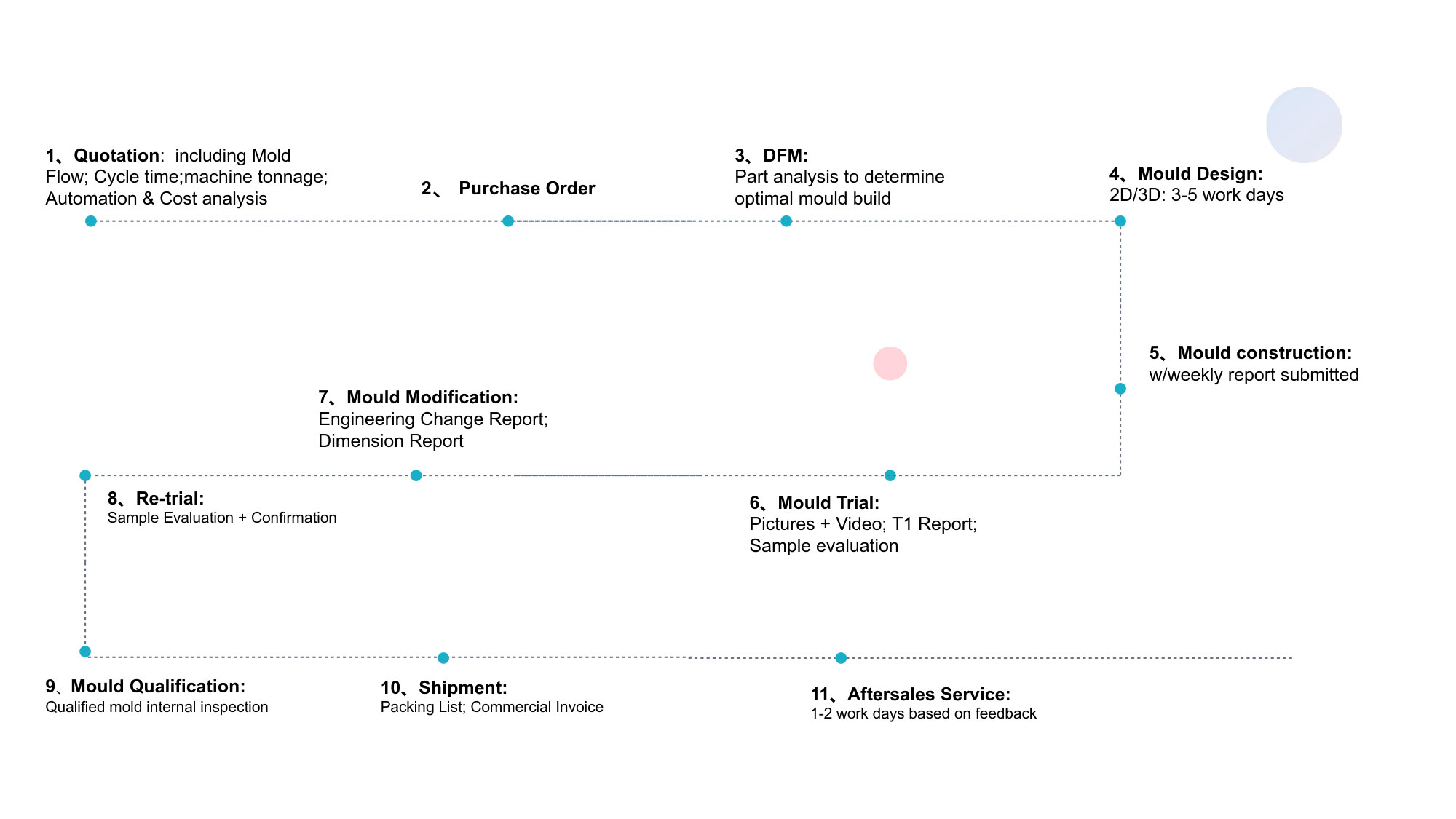
CAD Model Analysis and DFM Review (3–5 days): Full review of customer design with written recommendations.
Mold Design (5–15 days depending on complexity): Detailed 3D mold design including cooling channels, ejection system, and runner/gate configuration.
Material Procurement (Concurrent with design): Ordering of mold base materials, tool steels, and purchased components.
CNC Machining of Mold Base and Components (10–30 days): Roughing and finishing of mold cavities, cores, and structural elements.
EDM for Fine Features (5–10 days): Electrical discharge machining of precision features, fine details, and intricate geometries.
Manual Finishing and Polishing (3–7 days): Surface finishing, polishing to required surface roughness, fitting of components.
Assembly and Fitting (3–5 days): Assembly of mold components, fitting of ejector system, cooling line connection.
Trial Molding (2–5 days per trial): Initial testing, dimensional verification, process optimization.
Customer Sample Approval: Submission of samples with dimensional report for customer approval.
Production Release: After approval, transition to production.
5.4 Injection Molding Process Optimization
Cycle time optimization directly reduces per-unit cost. Our approach targets the largest time components first.
Primary Cycle Component—Cooling (60–70% of cycle): Our conformal cooling designs and multi-zone temperature control reduce cooling time by 15–25% compared to conventionally cooled molds. For a thick-walled cream jar with 6mm wall sections, this can mean the difference between a 30-second cycle and a 25-second cycle—a 20% capacity increase without additional machines.
Secondary Component—Injection and Hold (15–20% of cycle): Our process optimization focuses on profiling injection speeds to minimize shear heating while achieving complete fill. Hold pressure duration and profile are optimized to pack the cavity without creating excessive residual stress.
Tertiary Component—Opening and Ejection (10–15% of cycle): Mold design optimization ensures clean part ejection without sticking or deformation, minimizing the time required for these mechanical operations.
Typical Cycle Times for Reference:
50ml thick-walled cream jar: 25–30 seconds with robotic part removal [2†L14-L15]
Lip balm jar (small, thin-wall): 8–12 seconds
Wide-mouth bottle: 18–25 seconds depending on volume
5.5 Quality Control and Assurance
Our quality system is structured around prevention rather than detection.
Incoming Material Verification: Every batch of incoming resin is tested for melt flow index and moisture content before release to production. Non-conforming materials are rejected before they enter the process.
In-Process Monitoring: MES systems monitor critical process parameters in real time. Out-of-tolerance conditions trigger automatic alerts and, where configured, automatic machine shutdown.
Inspection Frequency: Dimensional inspections occur at documented intervals based on capability studies. For processes with CPK ≥ 1.33, sampling frequency may be reduced. For processes with lower capability, inspection frequency increases.
Final Inspection: Finished components undergo final visual and dimensional inspection before packaging. The specific inspection criteria are documented in the quality plan approved at project initiation.
5.6 Packaging and Logistics
Proper packaging prevents damage during transit and ensures components arrive ready for your filling lines.
Standard Packaging: Bulk components are packaged in clean, sealed polyethylene liners inside corrugated cartons. Layer pads separate product layers to prevent scratching and deformation.
Custom Packaging: Where your automated filling equipment requires specific packaging configurations (stacked orientation, tray loading, etc.), we customize our packaging accordingly.
Traceability: Each carton is labeled with product identification, batch number, quantity, and manufacturing date. Full traceability from raw material receipt to finished product is maintained.
Delivery Lead Times:
Domestic (China/Vietnam): 3–7 days from order confirmation
International (air freight): 7–14 days
International (sea freight): 20–35 days depending on destination
Ansix Tech Industry Experience and Value Proposition
With 28 years of injection molding experience and a demonstrated track record in cosmetic packaging, we bring knowledge that accelerates your project and reduces your risk.
Proven Industry Experience
Our experience spans the full range of cosmetic packaging applications:
Lip care containers including threaded jars and balm tubes
Cream jars from 5ml to 500ml capacities
Wide-mouth containers for thick formulations
Precision eye care packaging requiring dropper compatibility
Lotion and serum bottles with pump fitments
Four Strategic Production Facilities
Operating across China and Vietnam, our facilities provide production redundancy and geographic supply chain diversification. With 260 injection molding machines and supporting equipment, we maintain significant spare capacity to accommodate urgent orders.
Customer Value Summary
The following table summarizes how our technical capabilities translate directly to customer benefit:
Capability Technical Specification Customer Value
Mold precision ±0.005mm for critical features No downstream sorting, compatible with automated filling
Mold life 1–2 million cycles Reduced capital expenditure over product lifecycle
Process control CPK ≥ 1.33 for critical dimensions Predictable quality, no production surprises
Cycle time Industry-leading through optimized cooling Lower per-unit cost, higher annual capacity
Multi-location production China + Vietnam facilities Supply chain risk mitigation
Material selection 28 years of processing experience Right material for application, no costly over-specification
DFM analysis Pre-production at no cost Problems solved before they cost money
Our Philosophy
"A mold is not a block of steel. It is a money-printing machine. When we design your mold, we plan for melt flow, venting paths, thermal balance, and ejection—so that on your production floor, it runs right out of the box with minimal flash, maximum life, and no tuning required."
We invite you to experience our process directly. Provide a CAD model of your current product or a product you are developing. We will prepare a complete DFM report at no cost, demonstrating exactly how we would address weld lines, air traps, sink marks, and other risks specific to your design.
References
Ansix Tech corporate capabilities and manufacturing infrastructure
Alibaba lip balm jar supplier guide—dimensional tolerances and lead time standards
Seawin Industrial gate location optimization for double-wall acrylic jars
Golden Soar wide-mouth bottle engineering and thread precision standards
Seawin Industrial cooling time analysis and cycle time reduction methodology
Plasticstoday thick-walled cosmetic jar manufacturing process
Personal care injection molding DFM and quality systems
Cosmetic packaging material compliance and regulatory requirements
Ansix Tech Co Ltd
If you have any plans related to 32-tooth and 47-tooth sleeping lip balm jar, thick-walled cream, eye cream, wide-mouth bottle , you can contact us at any time. We will turn your ideas into reality, let you realize your dreams, and obtain large orders from the market. Our contact information is info@ansixtech.com. Or contact our CTO, mail: stephen@ansixtech.com
#www.ansixtech.com #ansixtech.com #32-tooth and 47-tooth sleeping lip balm jar, thick-walled cream, eye cream, wide-mouth bottle #32-tooth and 47-tooth sleeping lip balm jar, thick-walled cream, eye cream, wide-mouth bottle moulds #32-tooth and 47-tooth sleeping lip balm jar, thick-walled cream, eye cream, wide-mouth bottle injection molding companies #32-tooth and 47-tooth sleeping lip balm jar, thick-walled cream, eye cream, wide-mouth bottle Canopy Mold injection mold companies #Ansix #Ansix moulds #Ansix china #Ansix tech china #Ansix tech company #Ansix facotry #32-tooth and 47-tooth sleeping lip balm jar, thick-walled cream, eye cream, wide-mouth bottle injection molding #32-tooth and 47-tooth sleeping lip balm jar, thick-walled cream, eye cream, wide-mouth bottle injection tools #32-tooth and 47-tooth sleeping lip balm jar, thick-walled cream, eye cream, wide-mouth bottle injection moulds #32-tooth and 47-tooth sleeping lip balm jar, thick-walled cream, eye cream, wide-mouth bottle plastic mould #32-tooth and 47-tooth sleeping lip balm jar, thick-walled cream, eye cream, wide-mouth bottle plastic tools #Ansix Tech #Ansix molds #Ansix injection molding #Ansix mold factory #injection molding 32-tooth and 47-tooth sleeping lip balm jar, thick-walled cream, eye cream, wide-mouth bottle #Ansix mold factory #32-tooth and 47-tooth sleeping lip balm jar, thick-walled cream, eye cream, wide-mouth bottle china #32-tooth and 47-tooth sleeping lip balm jar, thick-walled cream, eye cream, wide-mouth bottle molds #injection factory #32-tooth and 47-tooth sleeping lip balm jar, thick-walled cream, eye cream, wide-mouth bottle injection molding #32-tooth and 47-tooth sleeping lip balm jar, thick-walled cream, eye cream, wide-mouth bottle injection molding factory #injection molding company #32-tooth and 47-tooth sleeping lip balm jar, thick-walled cream, eye cream, wide-mouth bottle injection mold companies #32-tooth and 47-tooth sleeping lip balm jar, thick-walled cream, eye cream, wide-mouth bottle#32-tooth and 47-tooth sleeping lip balm jar, thick-walled cream, eye cream, wide-mouth bottle mold limited #Ansix mold china #Ansix companies #Ansix company China #32-tooth and 47-tooth sleeping lip balm jar, thick-walled cream, eye cream, wide-mouth bottle facotry #Ansix Tech #Ansix Tech mould #32-tooth and 47-tooth sleeping lip balm jar, thick-walled cream, eye cream, wide-mouth bottle injection moulding #injection moulding company #Ansix 32-tooth and 47-tooth sleeping lip balm jar, thick-walled cream, eye cream, wide-mouth bottle parts injection mold companies #medical injection molding companieschina #32-tooth and 47-tooth sleeping lip balm jar, thick-walled cream, eye cream, wide-mouth bottle china factory #Ansix moulding companies #Ansix molding company #32-tooth and 47-tooth sleeping lip balm jar, thick-walled cream, eye cream, wide-mouth bottle injection moulding facotry #Ansix Tech mold #32-tooth and 47-tooth sleeping lip balm jar, thick-walled cream, eye cream, wide-mouth bottle mould #32-tooth and 47-tooth sleeping lip balm jar, thick-walled cream, eye cream, wide-mouth bottle plastic injection molding #ansix plastic mold #Mold manufacturing #32-tooth and 47-tooth sleeping lip balm jar, thick-walled cream, eye cream, wide-mouth bottle parts manufacturing #32-tooth and 47-tooth sleeping lip balm jar, thick-walled cream, eye cream, wide-mouth bottle plastic parts factory #32-tooth and 47-tooth sleeping lip balm jar, thick-walled cream, eye cream, wide-mouth bottle injection parts mold #32-tooth and 47-tooth sleeping lip balm jar, thick-walled cream, eye cream, wide-mouth bottle PRECISION MANUFACTURING #32-tooth and 47-tooth sleeping lip balm jar, thick-walled cream, eye cream, wide-mouth bottle #China mold #32-tooth and 47-tooth sleeping lip balm jar, thick-walled cream, eye cream, wide-mouth bottle injection moulding china #32-tooth and 47-tooth sleeping lip balm jar, thick-walled cream, eye cream, wide-mouth bottle mould china #china precision mold #mold in china #32-tooth and 47-tooth sleeping lip balm jar, thick-walled cream, eye cream, wide-mouth bottle mold china #Precision molds #High-precision molds #32-tooth and 47-tooth sleeping lip balm jar, thick-walled cream, eye cream, wide-mouth bottle #Injection molds #32-tooth and 47-tooth sleeping lip balm jar, thick-walled cream, eye cream, wide-mouth bottle Factory #32-tooth and 47-tooth sleeping lip balm jar, thick-walled cream, eye cream, wide-mouth bottle Company #Super Large Injection Mold Factory #Large Tonnage Injection Molding Factory #32-tooth and 47-tooth sleeping lip balm jar, thick-walled cream, eye cream, wide-mouth bottle Company #32-tooth and 47-tooth sleeping lip balm jar, thick-walled cream, eye cream, wide-mouth bottle Factory #2800T Injection Molding Factory #3000 Ton Injection Molding #4500 Ton Injection Molding Factory #Large Mold Injection Molding #Large Plastic Mold Injection Molding Factory #Large Injection Mold Manufacturer #Plastic Mold Factory #Injection Mold #Plastic Mold