



10g 15g cream jars, travel-sized decanting bottles, high-transparency PET lotion bottles
FEATURES
Hardware Infrastructure — Building Customer Confidence on a Foundation of Precision Equipment
At Ansix Tech, we understand that product quality is fundamentally constrained by the machines that produce it. Our manufacturing arsenal is purpose-configured for cosmetic-grade precision, and we translate each piece of equipment into direct customer benefit.
1.1 Precision Mold Manufacturing Equipment
Five-Axis High-Speed Machining Centers. We deploy five-axis high-speed machining centers capable of processing complex curved surfaces with 0.002mm accuracy. For cream jars and lotion bottles, which feature ergonomic contours, threaded neck finishes, and seamless parting lines along the closure interface, this precision translates directly into reduced manual finishing labor and elimination of visible flash lines. Customer value: Flawless aesthetic presentation—your brand’s packaging arrives camera-ready for premium retail shelves without costly secondary finishing operations.
-
Mold Description
Product Materials:
PET PETG
Mold Material:
S136ESR
Number of Cavities:
12
Glue Feeding Method:
Hot runner
Cooling Method:
Water cooling
Molding Cycle
32.5s
- The mold manufacturing process and product material selection
Slow-Speed Wire EDM (Electrical Discharge Machining). Our slow-speed wire EDM systems achieve cutting accuracy down to 0.003mm, enabling the production of micro-slots and fine-feature details as small as 0.03mm in diameter. For cosmetic jars requiring snap-fit closures or tamper-evident features, this capability ensures that mechanical interlocks—dovetail channels, undercut lips, and precision threads—are machined with zero deviation. Customer value: Perfect closure fit every time—eliminating sealing failure that would otherwise result in product leakage complaints and brand reputation damage.
CNC EDM (Sinker) with Mirror-Finish Capability. For deep-rib features and textured grip surfaces, sinker EDM delivers unmatched precision. The electrode manufacturing process is managed entirely in-house, allowing us to achieve optical-grade mirror polish (Ra ≤ 0.05 μm) on cavity surfaces. For high-transparency PET lotion bottles, this mirror-finish capability directly prevents surface defects that would otherwise cloud clarity or create light-scattering imperfections. Customer value: Crystal-clear transparency that showcases your formulation—consumers see exactly what they are buying, building immediate product trust.
-
Precision Surface Grinding. All mold plates and core components undergo precision grinding to ensure absolute parallelism in the mold base. For multi-cavity cream jar molds, this means every cavity produces identical parts—eliminating yield losses from cavity-to-cavity variation. Customer value: Batch-to-batch consistency—every product in every shipment looks and performs identically, protecting your brand’s reputation for reliability.
1.2 Injection Molding Press Fleet
Locking Force Range: 30 tons to 2,800 tons. Our comprehensive press fleet covers the full spectrum of cosmetic packaging components, from the smallest 10g cream jars up to large lotion bottles and jar bodies.
All-Electric Servo-Driven Injection Molding Machines. Our press park consists exclusively of all-electric servo-driven injection molding machines. Why does this matter for your cosmetic products? Conventional hydraulic presses suffer from viscosity-based repeatability drift. As the machine heats up during a production run, the oil viscosity changes, causing pressure fluctuations and dimensional variation. Our all-electric machines maintain ±0.1% shot-to-shot repeatability, guaranteeing that the 100,000th part off the line is dimensionally identical to the first part produced. Customer value: Predictable quality at scale—your filling lines never stop for dimensional adjustments, and your warranty claims from mismatched closures become zero.
Two-Shot (2K) Injection Molding Cells. For dual-material applications—soft-touch overmolded grips on travel bottles or dual-color lotion pumps—our integrated two-shot molding cells inject the first material, then rotate the substrate under the second injection unit for overmolding. This integrated workflow eliminates the need for post-mold assembly, reducing assembly labor cost and eliminating adhesive failure modes. Customer value: Reduced assembly steps and part count—lower landed cost per unit and fewer supplier management headaches.
1.3 Metrology and Quality Assurance Equipment
Coordinate Measuring Machines (CMM). Our ZEISS CMMs provide three-dimensional measurement accuracy at the micron level. Every mold undergoes full dimensional inspection before leaving our facility, with key dimensions documented to CPK ≥ 1.33. Customer value: First-part approval on the first try—your production schedule starts on time, not after weeks of dimensional rework.
Optical Imaging Systems. High-resolution vision inspection systems automatically verify critical dimensions—neck thread profiles, sealing bead heights, and jar lip diameters—at rates exceeding production speeds. Customer value: In-line quality without slowing production—defective parts are caught before they reach your packaging line, not after.
Certification Foundation. Ansix Tech has successfully passed ISO9001, IATF16949, ISO13485, ISO14001, and BSCI, maintaining an ISO 8 Cleanroom and GMP compliant with US medical-grade FDA510K standards. Customer value: Regulatory-ready documentation—your quality team receives traceable inspection records for every shipment, simplifying your own compliance audits.
Section Two: Mold Manufacturing Core Competencies — Delivering Measurable Performance Metrics
Customers care about four things in molds: lifespan, precision, lead time, and repair cost. Here is how Ansix Tech delivers on each dimension with concrete technical specifications translated into customer outcomes.
2.1 Mold Lifespan — Guaranteed Durability through Strategic Material Selection
Mold Component Material Selection Performance Guarantee Customer Value
Mold Base P20 Structural integrity Your mold runs for years, not months
Mold Core/Cavity (Standard) S136, 2344, 8407, NAK80, H13 1,000,000+ cycles under normal plastics Lower per-part tooling amortization
Mold Core/Cavity (Abrasive/GF-filled) Powder metallurgy steel, 2343, 8407, M340 500,000+ cycles under GF-reinforced materials Extended tool life even with aggressive formulations
Wear Surfaces DC53, SKD11, 4Cr13, 9Cr18 Enhanced abrasion resistance Reduced downtime for mold maintenance
High-Polish Applications S136ESR, 420SS Corrosion-resistant stainless steel Mirror finish maintained for clear PET/acrylic parts
Ansix Tech selects mold alloys based on three criteria: durability, thermal conductivity, and machinability. For cosmetic applications requiring high clarity and aesthetic perfection, we specify premium stainless steels with ESR (electro-slag remelting) refinement to eliminate micro-inclusions that could otherwise appear as surface defects on transparent parts. Customer value: One mold investment delivers millions of perfect parts—your total cost of ownership is minimized, and your production line never waits for replacement tooling.
2.2 Achievable Tolerances — Precision Measured, Not Promised
Product Category Standard Tolerance Precision Tolerance Customer Value
General structural components ±0.05 mm — Reliable fit and function
Threaded closures (jar lids) ±0.03 mm ±0.01 mm Perfect sealing every fill
Neck finish dimensions ±0.02 mm ±0.008 mm Pump and closure compatibility guaranteed
High-precision sealing surfaces ±0.01 mm ±0.005 mm Zero leakage, zero customer returns
Medical-grade applications ±0.005 mm ±0.002 mm Compliance-ready documentation
We provide full mold steel material certificates and heat treatment curves with every mold delivery. Customer value: Full traceability—when auditors ask for documentation, you have it ready.
2.3 Mold Types and Configurations — Optimized for Your Production Volume
Hot Runner Systems. For high-volume production of 10g/15g cream jars, hot runner systems eliminate sprue waste, reduce cycle times, and improve part quality through precise gate location control. Customer value: Material savings of 15–30% on every production run—your plastic spend goes directly into saleable products, not recycled scrap.
Cold Runner Systems. For smaller batch sizes or material-sensitive applications where hot runner residence time could degrade heat-sensitive formulations (certain PET grades), precision-engineered cold runners provide reliable, economical production. Customer value: Material integrity preserved—no degradation-induced defects in your high-transparency components.
High-Cavitation Molds. Our multi-cavity configurations (up to 32 cavities for 10g jars) multiply your output per machine hour without multiplying your tooling investment proportionally. Customer value: Lower unit cost at scale—every cavity produces identical parts, so your per-part price drops dramatically as volume increases.
Mirror-Finish Molds (Ra < 0.05 μm). For high-transparency PET lotion bottles and acrylic cosmetics jars, our optical-grade mold finish eliminates light-scattering micro-imperfections. Customer value: Glass-like clarity without glass fragility—your product looks premium, ships safely, and costs less than glass alternatives.
2.4 Gating and Runner Optimization — Simulated Before Steel is Cut
Prior to manufacturing any mold, Ansix Tech employs sophisticated Moldflow analysis to simulate the injection molding process digitally. This predictive tool enables engineers to optimize gate location, runner layout, and cooling channel design long before costly trial-and-error begins.
For cream jars (thick-walled, high-clarity requirements): Moldflow analysis predicts weld-line locations and air-trapping zones. We optimize gate placement to position any unavoidable weld lines in non-visible areas (underside of the jar base) rather than on the visible sidewall. Customer value: Flawless visible surfaces—no aesthetic rejects in final inspection.
For travel-sized decanting bottles (thin-walled, high-speed filling): We analyze fill patterns to ensure balanced cavity filling across all impressions. Unbalanced filling leads to short shots in some cavities while overpacking others. Customer value: Every cavity yields a good part—100% yield from the first production day.
For high-transparency PET lotion bottles (material-sensitive to shear and heat): Moldflow reveals where excessive shear heating could cause material degradation (yellowing or haze formation). We adjust gate size and runner geometry to minimize shear stress while maintaining adequate fill speed. Customer value: Crystal clarity maintained through production—your premium formulation deserves premium presentation.
2.5 Cooling System Design — The Silent Productivity Driver
Research shows that 50% to 70% of the injection molding cycle time is spent on cooling. The efficiency of your cooling system directly determines your production capacity and per-part cost.
Conformal Cooling Channels. Ansix Tech utilizes metal additive manufacturing (3D printing) to produce mold inserts with cooling channels that exactly follow the contour of the part. Unlike conventional straight-drilled channels that create hot spots at corners and slow cooling at thick sections, conformal cooling channels enable uniform and rapid heat extraction. Customer value: Cycle time reduction of 15% or more—your injection molding machine produces more parts per hour, directly lowering your unit cost.
Modular Temperature Zone Control. For tall lotion bottles and deep cream jars, we implement multiple independent cooling circuits that can be temperature-controlled separately, maintaining core-to-cavity temperature differential within 2°C. Customer value: Warpage eliminated—your bottles stand straight on shelves and closures seal reliably despite varying wall thickness.
2.6 Ejection System Design — Part Release Without Damage
Ejection system design for cosmetic packaging requires particular care because visible surfaces must remain unmarked. Ansix Tech engineering includes:
Pin Placement Strategy. Ejector pins are positioned on non-visible surfaces (inside jar walls, under bottle base ribs) or in areas that will be covered by labels or decorative elements. Customer value: No ejection marks on your premium visible surfaces—your packaging looks custom, not commodity.
Air Ejection for Thin-Walled Components. For ultra-thin travel bottles where pin ejection could cause distortion, we deploy air-assisted ejection systems that blow the part off the core without mechanical contact. Customer value: Thin, lightweight bottles produced without deformation—lower material cost plus perfect geometry.
Thread Collapsible Cores. For cream jar threaded closures, we use precision collapsible core mechanisms that release the threaded part without unscrewing motions, reducing cycle time by eliminating the unscrewing step. Customer value: Faster cycle times and longer thread life—no thread galling or cross-threading on your filling line.
2.7 Lead Time Standards — Predictable Delivery When You Need It
Mold Complexity Typical Cycle Standard Lead Time Rush Lead Time (with qualification) Customer Value
Simple single-cavity Simple geometry, standard materials 10–15 days 7–10 days Get to market fast for limited launches
Medium complexity (4–8 cavities) Core/cavity with slides or lifters 25–35 days 18–22 days Reliable timeline for product line expansion
High complexity (16+ cavities, hot runner) Full automation-ready 35–45 days 25–30 days Predictable ramp-up for major SKU launches
Rush Production Without Quality Compromise. Our accelerated timeline protocols do not skip validation steps. We maintain dedicated rush-order machining cells and electrode inventory that allow parallel processing of multiple mold components simultaneously. Customer value: Fast delivery that doesn’t sacrifice quality—you get to market on schedule for seasonal launches without accepting second-quality molds.
Section Three: Injection Molding Process Control — Eliminating Customer Quality Anxiety
Cosmetic packaging customers fear four problems: sink marks and dimensional instability that cause closure sealing failures, flash that requires costly manual trimming, part-to-part dimensional variation that shuts down filling lines, and batch-to-batch color inconsistency that damages brand perception. Here is how Ansix Tech’s process control capabilities eliminate each fear.
3.1 Process Standardization — Locked Parameters, Not Guesses
All 260 injection molding machines at Ansix Tech are networked to our Manufacturing Execution System (MES). Key process parameters—melt temperature, injection pressure, holding pressure profile, screw speed, and cooling time—are electronically locked in the system. Only authorized engineers can modify these parameters, and every change is logged with timestamp and operator ID.
Customer value: No operator-induced variation between shifts or between production runs. What passed your qualification on Monday will still pass on Friday, next month, and next year. Your filing line setpoints remain valid for the life of the mold.
3.2 First Article and Last Article Verification
Every production batch undergoes first-article and last-article dimensional comparison using CMM and optical inspection. The documented dimensional spread between first and last parts must fall within your specified tolerance window—typically ≤0.02mm for key sealing dimensions.
Customer value: End-of-batch confidence—you receive documentation that every part in the shipment met specifications, not just the first few off the line. Your receiving inspection becomes a formality, not a bottleneck.
3.3 Size Stability Control — Injection Molding’s Hidden Challenge
The same machine running the same mold with the same material can produce different part dimensions if thermal conditions drift. Ansix Tech’s approach to dimensional stability includes:
Mold Temperature Zone Control. Each mold is equipped with independent temperature controllers for the core side and cavity side, maintaining differential within 2°C. For tall lotion bottles (which tend to warp due to uneven cooling), this zone control ensures the bottle body cools symmetrically, eliminating lean or tilt.
Ultrasonic Wall Thickness Monitoring. Our advanced injection molding cells incorporate ultrasonic through-mold sensors that measure part wall thickness in real time during production【referencing in-process monitoring from medical applications】. The system automatically adjusts holding pressure compensation to correct any detected drift before it produces an out-of-spec part. Customer value: Zero dimensional rejects from thermal drift—your process compensates itself.
Closed-Loop Pressure Control. Servo-driven all-electric machines maintain injection pressure with 0.1% repeatability, eliminating the pressure decay that hydraulic machines experience as oil temperature rises. Customer value: The 100,000th part has the same fill and pack characteristics as the 1st part—no gradual drift toward flash or short shots.
3.4 Appearance Standards — Cosmetic-Grade Surface Quality
Defect Category Acceptance Standard Inspection Method Customer Value
Surface gloss variation ΔE < 0.5 between parts Spectrophotometer batch sampling Consistent brand appearance
Flow marks/striae None visible under 2x magnification in key visible areas Visual with magnification Premium look matches your brand positioning
Sink marks opposite ribs/gates Depth ≤0.03mm, not visible to naked eye under normal retail lighting Optical comparator No distracting surface defects on shelf
Bubbles/voids in transparent parts Zero internal voids >0.2mm in visible wall Backlight inspection station Crystal clarity maintained
Parting line flash ≤0.03mm (typically self-trimming) Feeler gauge and visual No manual deflashing cost
Surface roughness Ra ≤ 0.2 μm for standard finish; Ra ≤ 0.05 μm for mirror/polished finishes Profilometer Soft touch feel where designed; glass-like clarity where specified
Customer value: Your quality team receives clear, documented acceptance criteria. No subjective arguments over “acceptable appearance.” Your packaging presents your product exactly as designed.
3.5 Material Handling and Processing Expertise
Ansix Tech guides customers through strategic material selection, balancing aesthetic, functional, and economic requirements.
Polypropylene (PP). Primary material for opaque cream jars and powder containers. Excellent chemical resistance, autoclavable, low cost. For applications requiring higher clarity, clarified random copolymer PP is recommended, though with acknowledgment that PP inherently has lower gloss than PET.
Polyethylene Terephthalate (PET). The preferred material for high-transparency lotion bottles where product visibility is critical. Excellent clarity, high rigidity, and good barrier properties. PET requires precise drying before processing to prevent hydrolytic degradation (which causes haze and brittleness). Customer value: Crystal-clear packaging that shows off your premium formulation—PET’s glass-like clarity without glass breakage risk.
Acrylic (PMMA). For luxury cosmetic packaging requiring optical-grade clarity and scratch resistance. PMMA achieves the “glass-like” appearance demanded by premium skincare brands without glass fragility. Customer value: Premium shelf presence that commands higher price points—your packaging looks expensive because it is, but without glass shipping costs and breakage risks.
Engineering and High-Performance Materials. Ansix Tech has extensive experience with advanced materials including PC/ABS blends, PPS+40% GF, PEEK, PTFE/PFA, PA6+GF30, PBT, PEI, PPS, LCP, and Liquid Silicone Rubber (LSR), plus specialty fluoropolymers like ETFE. We achieve UL94 V-0 flame ratings where required and UV test validation up to 3,000 hours without discoloration.
Customer value: One partner for all your material needs—from standard cosmetic-grade PP and PET to medical-grade biocompatible materials to flame-retardant industrial components. You avoid the overhead of managing multiple suppliers.
Section Four: End-to-End Service Delivery — Reducing Your Management Costs
Many injection molders focus only on the physical act of molding plastic. Ansix Tech provides comprehensive program management that reduces your internal engineering, procurement, and quality overhead.
4.1 Early Engineering Intervention — DFM (Design for Manufacturability) Before Commitment
Long before any steel is cut, Ansix Tech provides comprehensive DFM analysis—a collaborative process where engineers review every aspect of your part design through the lens of production feasibility.
What your DFM report includes:
Wall thickness analysis. Identification of thickness transitions exceeding 0.3mm—which would cause sink marks or warpage in cosmetic packaging—with specific recommendations for gradual taper geometry rather than abrupt steps.
Draft angle recommendations. Minimum 1–2 degrees for external surfaces, 2–3 degrees for internal surfaces. Parts pulled from the mold without sufficient draft will exhibit drag marks on visible surfaces.
Gate location optimization. We propose specific gate locations and show your design team where any weld lines will form. You approve location before we cut steel—no surprises when the first sample parts arrive.
Ejector pin mark placement. We specify exactly where ejector pins will contact the part. If you require an entirely mark-free visible surface (for luxury jars with transparent sidewalls), we can design air ejection or stripper plate systems instead.
Thread and closure geometry verification. For screw-top jars and bottles, we analyze thread engagement, sealing bead geometry, and cap fit. We identify potential interference issues before tooling begins.
Customer value: You receive a documented, actionable engineering report before committing any tooling spend. Problems are solved on screen, not in steel, where changes cost 10–100x less. Design iterations that would take weeks of physical mold rework instead happen in days of digital simulation. Cost saving: Early DFM typically prevents 3–5 major mold modifications that would otherwise cost 5,000–20,000 each.
4.2 Prototype and Sample Progression (T0 to T3)
We provide a structured sample progression that gives you visibility into mold performance before volume production begins.
Milestone Deliverable Purpose Customer Value
T0 samples (first mold test) 10–20 sample parts, initial mold performance report Verify basic fill, ejection, and part integrity before full validation Early warning of major issues—decide on modifications before full qualification begins
T1 samples (first round of corrections) 50–100 parts, full dimensional report, CPK analysis for critical dimensions Validate all geometry after initial corrections Confidence that the mold produces correct parts before you commit to qualification
T2 samples (optimization round) Optimized cycle time data, appearance validation Fine-tune process parameters for production efficiency Production-ready parameters—your technicians can replicate our settings exactly
T3 validation (production readiness) 200–500 parts, final CPK ≥ 1.33, full inspection documentation Formal qualification for production release Ready-to-run mold delivers to your line—set up and start production day one
Fast-change capability. Our internal electrode manufacturing center and EDM capabilities allow us to modify mold components without sending work to outside shops. Mold repairs and modifications typically complete within 24 hours for standard changes【customer commitment from user context】.
4.3 Small-Batch Pre-Production Validation
Before committing to full-scale production, Ansix Tech offers 100–500 pre-production samples run at full production cycle times and settings. We measure yield rate, dimensional CPK, and process capability—and provide a full report. Only when you approve does mass production begin. Customer value: You validate your packaging line’s ability to handle our parts before you schedule your filling run. No surprises on production day.
4.4 Maintenance and Spare Parts Program
Spare parts kit delivered with every mold. For each mold we ship, we include a documented spare parts kit containing critical consumables: ejector pins, core pins, wear plates, and seal components. Customer value: No emergency orders when a routine replacement is needed—you have the parts on your shelf before you need them.
Scheduled maintenance protocol. Every 200,000 cycles, we provide mold maintenance service at factory cost【user context commitment】. For customers with on-site maintenance teams, we provide documented maintenance procedures, lubrication schedules, and torque specifications. Customer value: Predictable maintenance cost—no surprise repair bills.
Lifetime repair guarantee. Mold repairs are priced at material cost only (labor free), except for wear items that follow normal consumable replacement schedules【user context commitment】. Customer value: Your tooling investment is protected for the life of your product. No unexpected “the mold needs $X,XXX in repairs before it runs again” surprises.
4.5 Logistics and Delivery
Ansix Tech maintains warehouses at each of our four production bases (Shenzhen, Dongguan, Hunan, Vietnam) and partners with major international logistics providers to ensure reliable delivery. Standard delivery options include:
Air express (DHL/FedEx/UPS): 3–7 days for sample parts and small production runs
Air freight: 5–10 days for medium production volumes
Ocean freight: 25–35 days for full container loads
DDP (Delivered Duty Paid): Full door-to-door service including customs clearance for major markets
Customer value: You choose the speed and cost combination that works for your inventory strategy—no forced premium shipping for every order.
Section Five: Differentiated Customer Value — Direct Answers to Common Industry Complaints
Rather than claiming generic superiority, here are direct responses to the most common complaints customers have about injection molding suppliers.
Complaint 1: “Molds need constant repair—every order requires tooling work that delays my production.”
Ansix Tech’s solution: We perform 2,000-cycle aging tests on every mold before delivery and provide a wear report documenting dimensional stability over the test run. We offer a three-year structural warranty on mold bases, cores, and cavities (excluding normal consumable wear like ejector pins and seals). Customer value: Your production schedule is protected—no “emergency mold repair” line stoppages between scheduled maintenance intervals.
Complaint 2: “Every batch has flash that requires expensive manual trimming before filling.”
Ansix Tech’s solution: We machine parting surfaces to 0.005mm fit accuracy and employ self-locking mold clamping force compensation that maintains consistent clamp tonnage throughout the production run despite thermal expansion. Our standard flash specification is ≤0.03mm—thin enough to be self-trimming as the part ejects or entirely invisible on the finished container. Customer value: Zero manual trimming labor cost. Your parts go straight from molding to filling without intermediate handling.
Complaint 3: “Dimensions are never the same between batches—I keep adjusting my filling line setpoints.”
Ansix Tech’s solution: All-electric servo machines maintain ±0.1% shot-to-shot repeatability regardless of machine warm-up state or ambient temperature changes. Ultrasonic in-mold sensors monitor wall thickness in real time and automatically adjust holding pressure to compensate for drift before it produces non-conforming parts. Customer value: Your filling line setpoints are valid for every batch, every time. Changeovers take minutes, not hours of trial-and-error adjustments.
Complaint 4: “Mold repairs take weeks—I’m stuck with a broken mold and a full production schedule.”
Ansix Tech’s solution: We maintain in-house electrode manufacturing and EDM capabilities at each production facility. Mold repairs—including welding, re-machining, and component replacement—are completed without sending work outside the facility. Routine repairs (weld and re-machine, ejector pin replacement) are completed within 24 hours. Customer value: Your mold is back in production tomorrow, not next month.
Cost Reduction — Engineering Savings Across Materials, Process, and Efficiency
Ansix Tech’s approach to cost reduction is systematic and transparent. Recent projects have demonstrated component cost reductions of 20–30% without compromising critical performance.
Material Cost Optimization
High-flow polymer selection. By recommending specific high-flow grades of PP, PET, or PMMA, we reduce required injection pressure and shorten cooling time. A single material upgrade can reduce cycle time by 10–15% while using exactly the same mold.
Scrap reduction through hot runner systems. For large-volume cream jar programs, hot runner systems eliminate cold runner sprue waste entirely—15–30% less material consumed per good part.
Regrind integration protocols. For applications where regrind is acceptable (colored jars, non-critical opaque containers), we implement controlled regrind percentage protocols that maintain mechanical properties while reducing raw material consumption. Customer value: Your material spend goes farther without quality degradation.
Process Efficiency Optimization
Cycle time reduction. Through conformal cooling channel design, optimized thermal management, and automated part handling, our engineering team consistently achieves cycle times 15–25% faster than conventionally designed tools. For a typical 10g cream jar with a 20-second cycle target, a 3-second reduction (15%) across a 16-cavity mold running 24/7 represents over 600 additional jars per hour—directly into your bottom line.
Automated parts handling. Integration of pick-and-place robots and conveyor systems eliminates manual part removal, allowing lights-out production on our all-electric presses. Customer value: Lower labor cost per part and 24-hour production capability without shift premiums.
Multi-cavity productivity. Higher cavity counts multiply output per machine hour without multiplying tooling cost proportionally. Our typical 16-cavity mold for 15g jars produces approximately the same per-part variable cost as an 8-cavity mold but amortizes the higher initial tooling cost over twice the hourly output.
Supply Chain and Management Cost Reduction
Single-source manufacturing. By providing design, DFM, tooling, production, assembly, and logistics from one facility, we eliminate the management overhead of coordinating multiple suppliers. Customer value: One purchase order, one quality contact, one delivery schedule—your procurement team’s time has value too.
On-time delivery guarantee. Our 70% automated machining ratio and proven two-shot average time from mold start to production readiness mean we deliver on schedule. No “waiting for the toolmaker to finish” delays. Customer value: Your product launch calendar is protected—no expensive launch delays because packaging arrived late.
Quality Validation — Ensuring Reliability Before Volume Production
Pre-Production Validation Protocol
Validation Stage Activity Pass Criteria Customer Involvement
Material validation Raw material certification review, moisture analysis Material certificate matches specification; moisture ≤ spec limit Material certificate provided for your records
Mold validation (Mold qualification) Full dimensional inspection, 2,000-cycle aging test All dimensions within tolerance; no wear or performance degradation after 2,000 cycles Optional witness at our facility or remote video review
Process validation (IQ/OQ/PQ) Installation qualification, operational qualification, performance qualification CPK ≥ 1.33 for all critical dimensions over 300+ part run Full documentation provided for your quality system
Production validation First batch of 5,000–20,000 parts (volume based on your annual demand) Yield ≥ 98%, CPK maintained, color consistency validated Your quality team may attend or review sample documentation
Ongoing Quality Control
Activity Frequency Specification Documentation
In-process dimensional check Every 50 shots Key dimensions recorded; action limit at 50% of tolerance Logged in MES; available for your review
Visual appearance audit Every 200 shots No surface defects as defined in your appearance specification Sample retention and digital image capture
Full dimensional layout Every 5,000 parts or end of batch All tolerances verified on 5–10 parts PDF report with CMM data
Material lot traceability Each material lot change Certificate of analysis retained for each production lot Batch records retained for 10+ years
Customer value: Your quality audit team receives complete, traceable documentation for every shipment. When your customer asks for validation evidence, you have it ready.
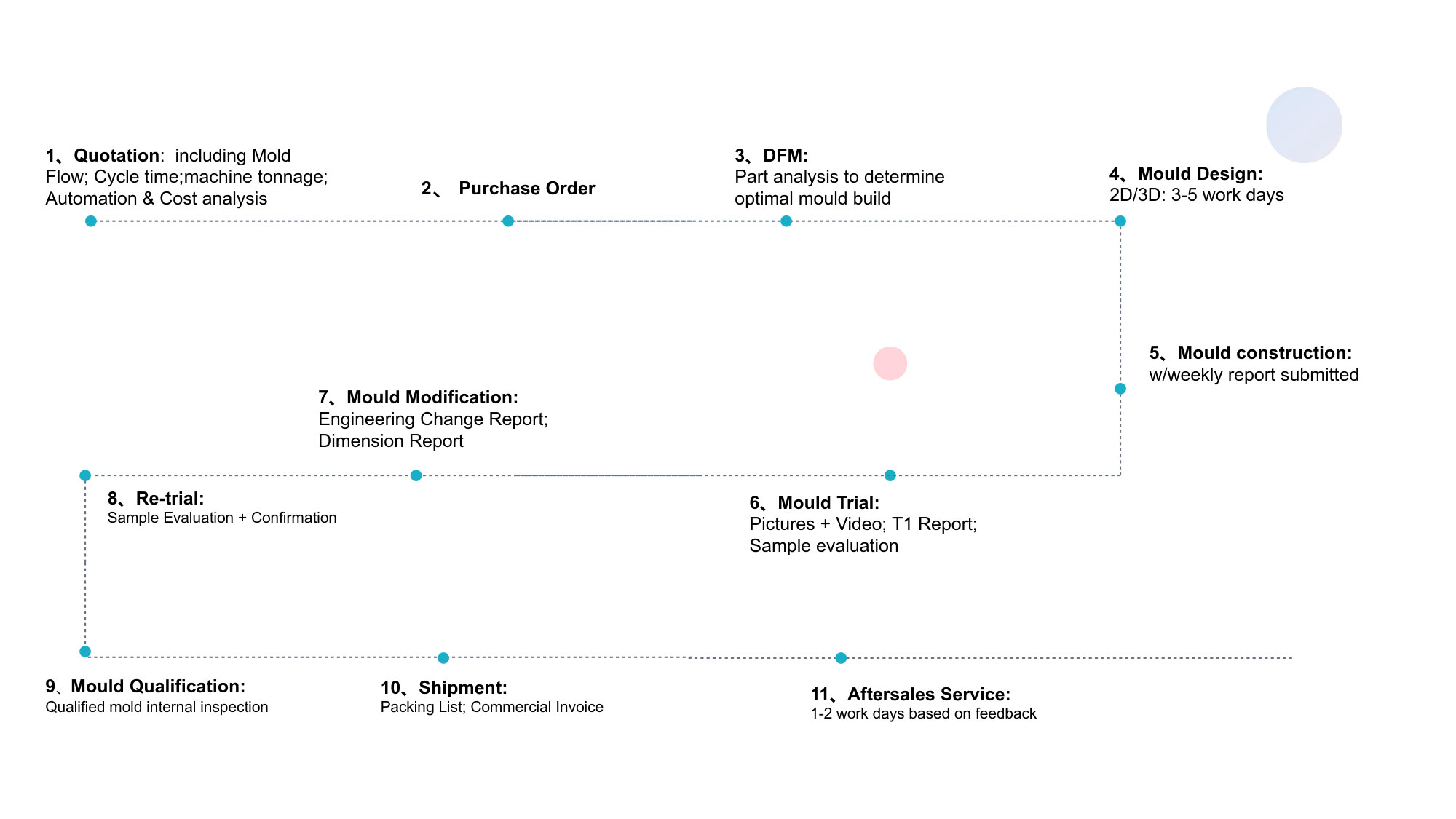
Manufacturing Workflow Summary — From Concept to Delivery
Step 1: Project Kickoff. Initial consultation documenting your product requirements—annual volume, target unit cost, material preference, aesthetic requirements (gloss/matte/color/transparency), closure type (screw, snap, pump), regulatory requirements (food contact, FDA, EU cosmetics regulation).
Step 2: DFM Analysis (2–7 business days). Engineering review of your 3D model or sample part. DFM report detailing wall thickness recommendations, draft angle adjustments, gate location proposals, ejector pin placement plan, cycle time estimate, and material recommendations. No cost for initial DFM review.
Step 3: Material Selection Confirmation. Based on DFM analysis, we provide documented material recommendations including specific grade numbers, supplier information, and processing parameters. Your team confirms material selection before mold design begins.
Step 4: Mold Design (5–10 business days depending on complexity). 3D mold design with cooling analysis, ejection layout, runner/gate design. Design review with your engineering team before manufacturing release.
Step 5: Mold Manufacturing (10–45 days depending on complexity). Our in-house machining centers, EDM, and grinding equipment complete all mold components. Quality control checkpoints at each manufacturing stage.
Step 6: Mold Assembly and Initial Testing. Mold assembly followed by T0 testing on an injection press. Initial samples inspected for basic dimensional and appearance conformance.
Step 7: Sample Delivery and Approval. T1 samples (50–100 parts) shipped to you for qualification. Full dimensional report included. Your sample evaluation determines whether mold proceeds to production or requires additional correction.
Step 8: Production Validation. Following sample approval, 100–500 pre-production parts manufactured at full production cycle times. CPK analysis performed on critical dimensions. Quality documentation prepared.
Step 9: Mass Production. Full-scale production run on dedicated all-electric presses. In-process quality inspections per your specification. Real-time MES monitoring available for your remote review.
Step 10: Packaging and Delivery. Parts packaged per your specification (bulk boxes, layer-packed, anti-static, climate-controlled as required). Logistics coordination via your preferred carrier or our logistics partners. Customs documentation provided for international shipments.
Conclusion: Why Ansix Tech for Your Cosmetic Packaging Components
Ansix Tech’s 28 years of injection molding expertise, 260-machine fleet across four global facilities, ISO 9001/IATF 16949/ISO 13485/ISO 14001 certifications, and 70% automated machining ratio provide a foundation of manufacturing capability that few competitors match.
But our value to you is not measured in machine specifications—it is measured in your reduced per-part costs, your eliminated production surprises, your faster time-to-market, and your reduced supply chain management burden.
Every mold we build is designed for productivity from day one. Every production process is locked in a digital system to eliminate operator variation. Every shipment includes full quality documentation to protect your compliance audit. And every customer relationship begins with a DFM analysis that identifies and solves problems before any steel is cut—saving you the cost of modification cycles and the risk of launch delays.
We invite you to submit a sample product for a comprehensive DFM analysis. You will see how we identify potential issues you did not know existed, quantify the cost savings we can achieve, and provide a fixed timeline and fixed price for your complete tooling and production program—from your design files to your shipping dock.
Ansix Tech Co Ltd
If you have any plans related to 10g15g cream jars, travel-sized decanting bottles, high-transparency PET lotion bottles , you can contact us at any time. We will turn your ideas into reality, let you realize your dreams, and obtain large orders from the market. Our contact information is info@ansixtech.com. Or contact our CTO, mail: stephen@ansixtech.com
#www.ansixtech.com #ansixtech.com #10g15g cream jars, travel-sized decanting bottles, high-transparency PET lotion bottles #10g15g cream jars, travel-sized decanting bottles, high-transparency PET lotion bottles moulds #10g15g cream jars, travel-sized decanting bottles, high-transparency PET lotion bottles injection molding companies #10g15g cream jars, travel-sized decanting bottles, high-transparency PET lotion bottles Canopy Mold injection mold companies #Ansix #Ansix moulds #Ansix china #Ansix tech china #Ansix tech company #Ansix facotry #10g15g cream jars, travel-sized decanting bottles, high-transparency PET lotion bottles injection molding #10g15g cream jars, travel-sized decanting bottles, high-transparency PET lotion bottles injection tools #10g15g cream jars, travel-sized decanting bottles, high-transparency PET lotion bottles injection moulds #10g15g cream jars, travel-sized decanting bottles, high-transparency PET lotion bottles plastic mould #10g15g cream jars, travel-sized decanting bottles, high-transparency PET lotion bottles plastic tools #Ansix Tech #Ansix molds #Ansix injection molding #Ansix mold factory #injection molding 10g15g cream jars, travel-sized decanting bottles, high-transparency PET lotion bottles #Ansix mold factory #10g15g cream jars, travel-sized decanting bottles, high-transparency PET lotion bottles china #10g15g cream jars, travel-sized decanting bottles, high-transparency PET lotion bottles molds #injection factory #10g15g cream jars, travel-sized decanting bottles, high-transparency PET lotion bottles injection molding #10g15g cream jars, travel-sized decanting bottles, high-transparency PET lotion bottles injection molding factory #injection molding company #10g15g cream jars, travel-sized decanting bottles, high-transparency PET lotion bottles injection mold companies #10g15g cream jars, travel-sized decanting bottles, high-transparency PET lotion bottles#10g15g cream jars, travel-sized decanting bottles, high-transparency PET lotion bottles mold limited #Ansix mold china #Ansix companies #Ansix company China #10g15g cream jars, travel-sized decanting bottles, high-transparency PET lotion bottles facotry #Ansix Tech #Ansix Tech mould #10g15g cream jars, travel-sized decanting bottles, high-transparency PET lotion bottles injection moulding #injection moulding company #Ansix 10g15g cream jars, travel-sized decanting bottles, high-transparency PET lotion bottles parts injection mold companies #medical injection molding companieschina #10g15g cream jars, travel-sized decanting bottles, high-transparency PET lotion bottles china factory #Ansix moulding companies #Ansix molding company #10g15g cream jars, travel-sized decanting bottles, high-transparency PET lotion bottles injection moulding facotry #Ansix Tech mold #10g15g cream jars, travel-sized decanting bottles, high-transparency PET lotion bottles mould #10g15g cream jars, travel-sized decanting bottles, high-transparency PET lotion bottles plastic injection molding #ansix plastic mold #Mold manufacturing #10g15g cream jars, travel-sized decanting bottles, high-transparency PET lotion bottles parts manufacturing #10g15g cream jars, travel-sized decanting bottles, high-transparency PET lotion bottles plastic parts factory #10g15g cream jars, travel-sized decanting bottles, high-transparency PET lotion bottles injection parts mold #10g15g cream jars, travel-sized decanting bottles, high-transparency PET lotion bottles PRECISION MANUFACTURING #10g15g cream jars, travel-sized decanting bottles, high-transparency PET lotion bottles #China mold #10g15g cream jars, travel-sized decanting bottles, high-transparency PET lotion bottles injection moulding china #10g15g cream jars, travel-sized decanting bottles, high-transparency PET lotion bottles mould china #china precision mold #mold in china #10g15g cream jars, travel-sized decanting bottles, high-transparency PET lotion bottles mold china #Precision molds #High-precision molds #10g15g cream jars, travel-sized decanting bottles, high-transparency PET lotion bottles #Injection molds #10g15g cream jars, travel-sized decanting bottles, high-transparency PET lotion bottles Factory #10g15g cream jars, travel-sized decanting bottles, high-transparency PET lotion bottles Company #Super Large Injection Mold Factory #Large Tonnage Injection Molding Factory #10g15g cream jars, travel-sized decanting bottles, high-transparency PET lotion bottles Company #10g15g cream jars, travel-sized decanting bottles, high-transparency PET lotion bottles Factory #2800T Injection Molding Factory #3000 Ton Injection Molding #4500 Ton Injection Molding Factory #Large Mold Injection Molding #Large Plastic Mold Injection Molding Factory #Large Injection Mold Manufacturer #Plastic Mold Factory #Injection Mold #Plastic Mold