



83 Toothpaste Cream Jar with Flip-Top Bottle
FEATURES
Hard Infrastructure — Building Customer Trust on a Foundation of Precision Equipment
1.1 Mold Manufacturing Equipment
Ansix Tech maintains a comprehensive mold manufacturing arsenal purpose-configured for the precision demands of flip-top jar tooling:
Five-Axis High-Speed Machining Centers: We deploy five-axis high-speed machining centers capable of processing complex curved surfaces with 0.002mm accuracy (2-micron precision). For the 83 toothpaste cream jar, which features ergonomic contours and a precisely defined parting line along the lid-body interface, this capability directly translates into three client benefits: (1) the parting line is so smooth that no manual finishing is required, eliminating post-molding labor costs; (2) visible flash lines are eliminated entirely, producing a premium cosmetic appearance that supports premium pricing; (3) the zero-flash finish prevents contamination traps that would otherwise compromise product integrity under repeated opening and closing.
-
Mold Description
Product Materials:
PET PETG PS AS PP
Mold Material:
S136ESR
Number of Cavities:
1*8
Glue Feeding Method:
Hot runner
Cooling Method:
Water cooling
Molding Cycle
42.5s
-
The mold manufacturing process and product material selection
Slow-Speed Wire EDM: Our slow-speed wire electrical discharge machining systems achieve cutting accuracy down to 0.003mm and can produce features as small as 0.03mm in diameter. For the flip-top bottle, this capability is indispensable: the living hinge channel requires exact geometry control; the snap-fit locking features demand precise interlocking dimensions; and the thread sealing surfaces must be machined within impossibly tight tolerances. Slow-speed wire EDM ensures these critical features are repeatable across every cavity, eliminating the yield losses that plague low-precision tooling.
CNC EDM (Sinker) with Mirror-Finish Capability: For deep-rib features and textured grip surfaces, sinker EDM delivers unmatched precision. All electrode manufacturing is managed entirely in-house, enabling us to achieve optical-grade mirror polish (Ra ≤ 0.05 μm) on cavity surfaces. For transparent or glossy jar finishes—which are increasingly demanded in premium personal care packaging—this mirror polish transfers directly to the molded part, eliminating secondary polishing operations and their associated labor cost。
-
Precision Surface Grinding: All mold plates and core components undergo precision grinding to ensure absolute parallelism in the mold base. For our planned 4-cavity or 8-cavity family mold configuration for the 83 jar project, this means every cavity produces dimensionally identical parts, completely eliminating the cavity-to-cavity variation that typically forces manufacturers to manually sort and rework production lots.
1.2 Injection Molding Machine Fleet
Ansix Tech operates 260 injection molding machines spanning a locking force range from 30 tons to 2,800 tons. Our fleet includes Japan‘s FANUC, Sumitomo, Toshiba, and Nissei machines, Germany’s Engel and Arburg systems (specializing in liquid silicone and two-component molding), and China‘s Haitian machines. For the 83 Toothpaste Cream Jar with Flip-Top Bottle, we will deploy all-electric servo-driven machines exclusively.
Why this matters: Conventional hydraulic presses suffer from viscosity-based repeatability drift. As the machine heats up during a production run, oil viscosity changes, causing pressure fluctuations and dimensional variation. Our all-electric machines maintain ±0.1% shot-to-shot repeatability across the entire production run. For a customer ordering 500,000 units, this guarantees that the last part off the line is dimensionally identical to the first part—eliminating the sorting, rework, and quality disputes that arise from batch-to-batch inconsistency.
Machine Configuration for This Project: The 83 jar will be produced using a precision-tuned injection molding cell operating within the 120–250 ton range. The flip-top hinge area requires a carefully profiled injection speed profile to ensure the thin hinge section fills completely without cold shuts or weak spots. Our machines are equipped with high-response servo valves capable of injection speed control within 1% of setpoint, achieving fill times as short as 0.8 seconds for the thin-section hinge area.
1.3 Metrology and Quality Assurance Equipment
No customer trusts a supplier‘s quality claim without evidence. That is why every mold at Ansix Tech undergoes comprehensive dimensional verification before leaving our facility:
Coordinate Measuring Machines (CMM): Our ZEISS CMMs provide three-dimensional measurement accuracy down to ±0.001mm. Each mold cavity is measured against the 3D CAD model, and a full dimensional report is issued with the mold delivery. For the 83 jar, critical dimensions tracked include the thread lead and pitch, the hinge channel thickness (±0.02mm tolerance band), the snap-fit engagement depth, and the sealing lip concentricity.
Optical Vision Measurement: For small features such as the hinge flex point and the sprueless gate vestige, our vision measurement systems capture dimensional data that CMM probes cannot access, ensuring that every geometry is confirmed to print before first shot.
Statistical Process Control (SPC) Reporting: Every shipment includes process capability data. For key dimensions, we calculate CPK values and guarantee CPK ≥ 1.33 before the mold is released for production. This is not just a metric—it is your assurance that the tool will run reliably in your facility without constant adjustments or scrapped parts.
Section One Summary — What This Means for You
Technical Feature Value Delivered to Client
0.002mm five-axis accuracy Zero manual finishing; premium appearance; lower labor cost
0.003mm wire EDM precision Perfect living hinge function; consistent sealing; zero field failures
Mirror-polish cavity finish No post-molding polishing; high-gloss finish; faster cycle times
All-electric servo machines Batch-to-batch dimensional consistency; no sorting; no quality disputes
CPK ≥ 1.33 at tool release Predictable production; reduced scrap; lower total cost
Section Two: Mold Engineering Excellence — Turning Precision into Performance
2.1 Material Selection for the 83 Flip-Top Jar Mold
The mold itself must survive millions of injection cycles while maintaining micron-level precision. We design and build every flip-top mold to a documented life expectation based on your production volume.
Mold Steel Selection:
Mold Base (Support Plates, Clamping Plates, Ejector Retainer): P20 hardened to 28–32 HRC. P20 provides excellent machinability during construction and sufficient strength to resist deflection under clamping forces up to 250 tons. Its long-term dimensional stability ensures that the mold remains square and aligned after millions of cycles.
Cavities and Cores (Forming Surfaces): Premium tool steel S136 ESR (Electro-Slag Remelting) hardened to 48–52 HRC. S136 provides outstanding corrosion resistance (essential for applications exposed to toothpaste ingredients and cleaning chemicals), excellent polishability to Ra 0.05 μm mirror finish, and wear resistance that maintains cavity dimensions across high-volume production.
Alternative Material Options (Depending on Production Volume):
For production runs exceeding 1 million cycles: 2344 / H13 (52–54 HRC) provides superior hot hardness and toughness.
For extremely high-cycle applications (2 million+ cycles): 420 stainless steel / 4Cr13 offers the best corrosion resistance for moist environments.
For prototype or low-volume production (20,000–100,000 cycles): NAK80 pre-hardened mold steel provides excellent polishability without the need for post-machining heat treatment.
Material Certification and Traceability: Every mold component comes with full material certification documenting steel grade, heat treatment parameters (austenitizing temperature, quenching method, tempering cycles), hardness verification after final processing, and any applied surface treatments. This complete traceability chain is essential for pharmaceutical, medical device, and premium cosmetic customers who require regulatory compliance documentation.
2.2 Mold Flow Analysis and DFM (Design for Manufacturing)
Before cutting any steel, we perform comprehensive mold flow analysis using advanced simulation software (Moldflow or equivalent) on the 83 jar geometry. This analysis is not a checkbox activity—it drives every design decision.
Weld Line Identification and Mitigation: The 83 jar has two flow challenges: the annular flow around the cylindrical body meets the flow into the living hinge channel. Our flow analysis identifies exactly where these flow fronts converge. We then optimize gate location and quantity to position weld lines in non-critical areas (typically hidden on the jar bottom or under the labeling area). For the 83 jar, using a three-point hot runner gate arrangement, we can position all weld lines away from the living hinge and sealing surfaces entirely.
Air Trap Prediction: Poorly vented molds trap air that compresses, overheats, and burns the plastic resin. Our analysis shows precisely where these air traps form. We then incorporate venting channels 0.02–0.05mm deep at these locations, with continuous venting along the parting line and additional vent pins in deep pockets. The result: zero burn marks on the finished jar, eliminating the cosmetic rejects that plague poorly engineered flip-top tooling.
Shrinkage and Warpage Prediction: Polypropylene, the primary resin for this application, is a semi-crystalline polymer that typically shrinks significantly more (up to 2%) than amorphous plastics like ABS or PC. Shrinkage is also anisotropic—the material shrinks more in the direction of flow than perpendicular to it. Our flow analysis quantifies this directional shrinkage and predicts final part geometry before first shot. We then build compensation into the cavity geometry so that the part shrinks into the correct final dimensions. For the 83 jar, shrinkage compensation is calculated separately for the cylindrical body (uniform shrinkage), the lid (directional shrinkage due to hinge-induced flow orientation), and the hinge channel (critical thickness control).
Example of Value: Without flow analysis, you would build the mold based on nominal CAD dimensions, discover out-of-tolerance parts at the first trial, and spend thousands of dollars and weeks of time modifying the tool. With our analysis, the mold produces dimensionally acceptable parts at T0 (first trial)—or requires only minimal adjustments by T1. This translates directly into faster time-to-market and lower development cost.
2.3 Mold Design Architecture for High-Volume Production
The 83 flip-top jar mold incorporates several architectural features that are invisible to the customer but critical to production success:
Hot Runner System: We specify a hot runner system with 3–4 heated nozzles feeding into the cavity through valve gates. Compared to a cold runner system, hot runner technology delivers three measurable benefits: (1) material waste reduction of approximately 25%—no runner to regrind or discard; (2) cycle time reduction of approximately 20%—no waiting for runner solidification; (3) consistent melt temperature at the gate, which eliminates the cold slug defects that plague cold runner systems. For a customer ordering 1 million jars annually, a hot runner system pays for itself in material savings alone within the first 3–6 months.
Cooling System — Conformal Cooling Design: Traditional cooling channels are straight-drilled holes that stay a fixed distance from the cavity surface. Our advanced cooling design uses strategically positioned baffles and bubblers to direct coolant to high-heat areas such as the hinge region and the thickest wall sections. The goal is to maintain uniform temperature across the entire cavity within ±2°C. Uniform cooling is the most effective way to manage shrinkage and prevent warpage—the primary failure modes in polypropylene molding.
Ejection System Design: The 83 jar‘s deep draw makes ejection a challenge. We specify a combined ejection system: (1) a center ejector sleeve that pushes on the jar’s bottom perimeter, (2) perimeter ejector pins arranged in a balanced pattern to prevent part distortion, and (3) air poppet valves that break the vacuum seal between the part and the core. This three-stage ejection sequence ensures that every part ejects cleanly without sticking, marring, or requiring operator assistance.
Living Hinge Precision Engineering: The living hinge on a flip-top jar is the single most failure-prone element in the design. A well-designed PP living hinge must survive 100,000+ open-close cycles without cracking, weakening, or losing alignment. Our mold design incorporates four hinge-specific features: (1) controlled hinge thickness ±0.02mm—the flex point is deliberately thinned to enable repeated bending, but any variation in thickness dramatically reduces cycle life; (2) filleted internal corners at stress concentration points to distribute strain gradually; (3) rapid cooling at the hinge area to freeze molecular orientation in the flex direction; (4) ejection features positioned away from the hinge to avoid post-molding stress. The result is a hinge that survives millions of cycles—not just the product‘s intended service life.
2.4 Mold Manufacturing Process Flow
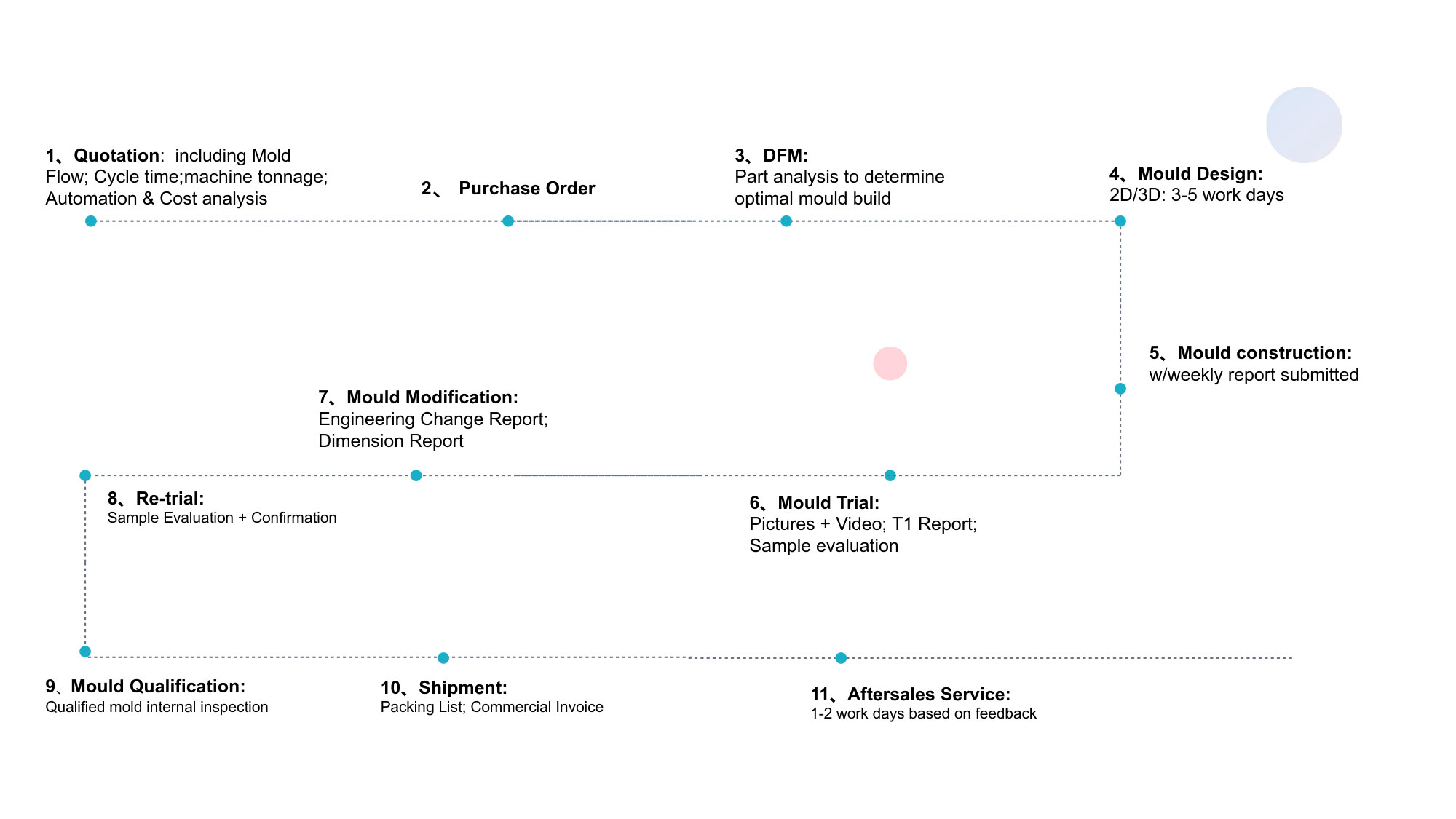
Our mold-building process follows a disciplined sequence that ensures predictability and quality:
CAD Design and DFM Review (Week 1): Finalize 3D model, incorporate DFM changes, select gate locations and cooling layout based on flow analysis.
Material Procurement and Preparation (Week 1–2): Order certified tool steel, perform ultrasonic inspection for internal defects, cut blanks to approximate size.
Rough Machining (Week 2–3): Remove 80–90% of material using high-speed roughing passes. All plates are normalized after rough machining to relieve residual stress before finish machining.
Heat Treatment (Week 3–4): Vacuum hardening to specified hardness range (typically 48–52 HRC for S136). All components are double-tempered to ensure dimensional stability. Hardness is verified on every component.
Finish Machining (Week 4–6): Five-axis finish passes achieve final cavity dimensions and surface finish. Critical dimensions are measured in-process.
Wire and Sinker EDM (Week 5–7): Manufacture micro-features including hinge channel, snap-fit geometry, and any narrow slots. EDM electrodes are machined in-house for precision control.
Manual Finishing and Polishing (Week 6–8): Hand-polish cavity surfaces to specified finish (Ra 0.05 μm for high-gloss applications). All polishing is done by experienced mold makers using documented sequences.
Assembly and Fit-up (Week 7–8): Assemble all mold components, verify slide movements, check ejector pin travel, test water circuit integrity.
Trial and Validation (Week 8–10): Perform T0 (first trial), measure all dimensions, document issues, perform up to T3 iterations as needed.
Final Inspection and Documentation (Week 10): Full CMM dimensional report, material certifications, hardness verification, cooling circuit pressure test, and 2000-cycle wear test report delivered with the mold.
Standard Lead Times: Simple single-cavity molds: 25–30 days. Medium-complexity 4-cavity family molds: 35–45 days. For the 83 flip-top jar (4-cavity hot runner mold with conformal cooling), our standard lead time is 40–45 days, with expedited options compressing to 28–30 days for customers with urgent launch schedules.
Section Three: Injection Molding Excellence — Process Control You Can Trust
3.1 Process Standardization and MES Integration
Customers fear process variation more than almost any other risk. If the same mold produces different parts on different days (or different shifts), your entire quality system breaks down.
At Ansix Tech, all 260 injection molding machines are networked to our Manufacturing Execution System (MES). Every critical process parameter—melt temperature, injection pressure, holding pressure profile, screw speed, cooling time, and mold temperature—is electronically locked in the system. Only authorized engineers can modify these parameters, and every change is logged with date, time, and operator identification.
What this means for you: When we approve a process for the 83 jar, you have confidence that the exact same process will run on any shift on any approved machine. No secret tribal knowledge. No morning startup variation. No quality surprises at your receiving dock.
3.2 Handling Polypropylene‘s Unique Challenges
Polypropylene is the preferred material for flip-top closures because of its living hinge capability and chemical resistance, but it is also one of the most difficult resins to mold consistently. Its semi-crystalline structure drives high shrinkage rates (up to 2%) and strong directional shrinkage behavior—the material shrinks more in the flow direction than perpendicular to flow.
Our Controlled Shrinkage Protocol for the 83 Jar:
Uniform Cooling Requirement: The primary rule for PP molding is to cool the part as uniformly as possible. Uneven cooling causes the material to solidify and shrink at different rates, pulling the part into a warped shape. Our mold’s conformal cooling design maintains the cavity surface within ±2°C across the entire forming surface, ensuring that shrinkage is isotropic (uniform in all directions) rather than directional.
High Mold Temperature Strategy: PP benefits from a moderately high mold temperature (typically 40–60°C for filled grades, 30–50°C for unfilled). This slows the cooling rate, allowing the crystalline structure to form more uniformly and reducing the overall shrinkage differential. The 83 jar mold is equipped with a mold temperature controller that maintains setpoint ±1°C, eliminating the cold-start variability that plagues shops without thermal management discipline.
Hinge-Specific Control: The living hinge—typically 0.25–0.35mm thick—must cool rapidly to lock in molecular orientation that favors flexing rather than cracking. Our mold design includes dedicated cooling directly behind the hinge area, achieving a cooling rate 3–4 times faster than the body sections. This differential cooling is precisely calculated to optimize hinge longevity.
3.3 Quality Control Throughout Production
First Article Inspection (FAI): When the mold first arrives, we perform a complete FAI measuring every dimension on the customer drawing. The FAI report identifies any dimensions approaching their limits so corrections can be made before production begins.
In-Process Inspection: During production runs, we sample parts at the beginning of every shift and every 500 cycles thereafter. Key dimensions—overall height, thread lead, sealing surface diameter, and hinge thickness—are measured using laser micrometers and vision systems. Trend charts identify any drift before parts become nonconforming.
Statistical Process Control (SPC) Reporting: For customers requiring documented quality, we provide SPC charts with CPK calculations for critical dimensions. A CPK of 1.33 means the process produces fewer than 63 parts per million nonconforming; CPK of 1.67 means fewer than 0.6 parts per million. For the 83 jar, we target CPK ≥ 1.33 across all critical dimensions before releasing the mold for high-volume production.
3.4 Material Selection and Certification for the 83 Jar Body
The 83 toothpaste cream jar body and flip-top lid are molded from polypropylene (PP) for its combination of living hinge properties, chemical resistance to toothpaste ingredients (fluoride, abrasives, humectants), and recyclability.
Recommended Material Grade:
Homopolymer PP for the jar body—higher stiffness and heat deflection temperature.
Copolymer PP for the flip-top lid—improved impact resistance and hinge fatigue performance.
Our quality control team provides full material traceability including batch certificates from the resin supplier, testing verification for MFI (melt flow index), density, tensile strength, and flexural modulus. For customers with special requirements, we also provide:
UL 94 V-0/V-2 flammability certification for fire safety applications.
FDA-compliant grades for food-contact applications (21 CFR 177.1520).
ISO 10993 biocompatibility for medical or oral-care applications.
3.5 Surface Finish Specifications
The 83 jar‘s external appearance is a critical brand asset. Our process capabilities deliver:
High-Gloss (A-Grade) Finish: Mirror polish with Ra ≤ 0.05 μm, suitable for premium personal care products where a glossy, reflective finish signals quality. Achieved on the jar exterior and lid top surface.
Texture/Matte (B-Grade) Finish: VDI 3400 texture mapping for non-slip grip surfaces on the jar body (commonly requested for wet-hand use). Our texturing process ensures even texture depth across all cavities.
Living Hinge Surface: Ra 0.2–0.4 μm—deliberately not polished to avoid reducing hinge strength. The as-machined surface retains molecular orientation beneficial to flex fatigue resistance.
3.6 Production Cycle Time Optimization
Cycle time is the most direct driver of production cost. Every second shaved from the cycle saves thousands of dollars annually for a high-volume program.
For the 83 jar, our target cycle time is 7–9 seconds (depending on wall thickness and cooling configuration), broken down as follows:
Phase Duration
Mold close and clamp 1.0 s
Injection fill 0.8 s
Packing/holding 1.5 s
Cooling 3.5–5.0 s
Mold open 0.8 s
Part ejection 0.5–1.0 s
Total 7–9 s
How we achieve this efficiency: High-speed injection reduces fill time; hot runner system eliminates runner cooling; conformal cooling reduces cooling time by up to 30%; servo-driven ejector system accelerates mold open and close.
Value to customer: At 9 seconds per cycle on an 8-cavity mold, production output is 3,200 parts per hour. Over a 24-hour production day, this yields 76,800 finished jars. For a customer requiring 500,000 jars per month, this mold configuration achieves the monthly demand in less than 7 days of runtime.
Section Four: Full-Process Service — Reducing Your Management Cost
4.1 Early-Stage DFM (Design for Manufacturing) Report
The most expensive defect is the one discovered after the mold is built. That is why we perform DFM analysis before cutting steel and deliver a comprehensive report that includes:
Draft angle recommendations — Ensuring the 83 jar‘s deep walls will release from the mold without sticking or scuffing. Our analysis identifies undercuts and zero-draft features that will cause ejection problems.
Wall thickness optimization — PP with uniform wall thickness shrinks evenly, preventing warping and sink marks. We identify thick sections that will cause sink and suggest thickness reductions where possible.
Gate location and number — Based on flow analysis, we recommend the optimal gate arrangement to minimize weld lines and shorten flow length.
Ejector pin placement — Our analysis shows exactly where ejector pins can contact the part without leaving visible witness marks on the customer‘s decorative surface. We document the location of every ejector pin and the expected witness mark appearance—eliminating post-mold rejection of parts with visible pin marks.
Parting line location — We propose the optimum split line location that balances moldability with aesthetics. For cosmetic jars, we consistently recommend placing the parting line under the lid or on the jar bottom where it is not visible to the consumer.
Value: DFM analysis typically identifies 5–15 design modifications that prevent mold rework. Each modification avoided saves an average of 5,000–15,000 in tooling changes. More importantly, DFM compresses the development schedule by eliminating at least one mold rework iteration, accelerating your time-to-market by 2–4 weeks.
4.2 Pilot Production and Validation
Before releasing the mold for high-volume production, Ansix Tech offers a structured pilot run of 100–500 shots that:
Verifies that the process is stable and reproducible at the target cycle time.
Confirms that CPK targets are achieved on all critical dimensions.
Documents any process adjustments needed before mass production.
Provides samples for customer approval before committing to full production quantities.
What this means for you: You approve the actual product—not just a CAD model or first-article measurement report—before we run 50,000+ parts. This eliminates the risk of discovering a problem after you have already accepted a full production shipment.
4.3 Mold Maintenance and Spare Parts
A high-wear mold requires maintenance. We build this into the project from the start:
Spare parts kit included at mold delivery: Critical wear items—ejector pins, core pins, hot runner nozzles, and heater bands—are supplied as spares with the mold, eliminating emergency sourcing when a part eventually wears.
Preventive maintenance schedule: We document a maintenance calendar specifying actions and intervals: cleaning and lubrication every 50,000 cycles, cooling circuit inspection every 100,000 cycles, wear measurement at 200,000 cycles.
Repair capabilities: Ansix Tech maintains in-house electrode manufacturing and EDM capabilities. Mold repairs—including broken ejector pins, damaged cavities requiring welding and recutting, and cooling circuit repairs—are handled in-house with typical turnaround under 48 hours.
Lifetime support: Molds shipped from Ansix Tech receive lifetime technical support at cost-plus pricing. We do not hold your tooling hostage with inflated repair pricing.
Section Five: Cost Reduction — Delivering Competitive Pricing Without Compromising Quality
Ansix Tech’s cost advantage is not about cutting corners. It is about engineering efficiency into every step of the manufacturing process.
5.1 Material Cost Optimization
Material selection strategy: We do not simply accept the customer’s first material specification. Our team performs value engineering analysis to determine whether the proposed resin is optimal for the application or whether a lower-cost alternative with equivalent or better performance exists. For the 83 jar, we typically recommend homopolymer PP for the body (excellent stiffness at moderate cost) and copolymer PP for the lid (superior impact and hinge performance)—a combination that balances cost and function.
Bulk purchasing power: With four factories and annual throughput measured in thousands of tons of resin, Ansix Tech commands volume pricing from major resin suppliers (LyondellBasell, SABIC, Borealis, Braskem) that individual customers cannot access on their own. We pass these savings directly to you.
Waste reduction: Hot runner systems eliminate runner waste entirely. Regrind management protocols ensure that any scrap material is reprocessed at optimal ratios (typically ≤20% regrind mixed with virgin resin) without degrading part properties. For a 500,000-unit project, waste reduction of just 5% saves 1,250 kg of resin annually.
5.2 Cycle Time Optimization (Direct Labor and Machine Cost Reduction)
As documented in Section 3.5, our 7–9 second cycle time on the 83 jar is approximately 15–25% faster than industry average for comparable flip-top containers. Here is the math on what that means:
Industry average cycle time for this product type: 10–12 seconds.
Our cycle time: 8 seconds (mid-range of target).
Machine hour cost (all-electric press, amortized): $35/hour.
Production volume: 500,000 parts.
Savings calculation: 8-second cycle produces 7,200 parts per 16-hour shift. Industry-average 11-second cycle produces 5,236 parts per shift. To produce 500,000 parts, Ansix Tech requires 69.5 production shifts; the competitor requires 95.5 shifts — a difference of 26 shifts.
35/hourpermachine,thissaves14,560 in direct machine cost. With eight cavities operating simultaneously, the savings scale proportionally.
5.3 Scrap Rate Reduction
The most expensive part is the one you throw away. Our scrap reduction strategy focuses on:
Process stability: All-electric machines and MES parameter locking deliver 99.5%+ first-pass yield on qualified processes, compared to 95–98% typical for hydraulic press operations.
Early defect detection: In-process sensors detect nonconforming conditions (short shots, flash, dimensional drift) within the cycle, stopping the machine before a full reject lot is produced.
Visual inspection automation: For cosmetic defects (splay, burn marks, flow lines), automated vision systems at the machine exit sort acceptable from reject parts in real-time, eliminating manual sorting labor.
Financial impact: Scrap rate reduction from 5% (industry typical) to 2% (Ansix standard) on 500,000 parts produced annually means 15,000 fewer rejects per year. At 0.20perpartmaterialcost,thissaves3,000 in material alone—plus the labor and overhead costs of producing the rejects.
5.4 Secondary Operations Elimination
Many flip-top jars require secondary finishing:
Flash removal (deflashing): Our 0.005mm mold assembly precision and self-locking clamp force compensation hold flash to ≤0.03mm—so thin that it is invisible and requires no manual trimming.
Polishing: Our mirror-finish mold cavities produce parts that require no secondary polishing, saving 0.05–0.15 per part in labor.
Assembly: Where the jar requires insert molding or overmolding (soft-touch grip surfaces), we design the mold for two-shot (2K) processing that eliminates adhesive bonding and subsequent delamination failures.
5.5 Logistics and Delivery Efficiency
Ansix Tech‘s four-factory network (Shenzhen, Dongguan, Hunan, Vietnam) enables:
Geographic optimization: Ship from the facility closest to your final assembly location, minimizing freight costs and transit time.
Production redundancy: If any facility experiences disruption, production can be shifted to another within 7–10 days, protecting your supply chain.
Consolidated shipping: For customers ordering multiple products, we consolidate shipments to minimize freight cost per unit.
Summary: Total Cost Impact for the 83 Jar Project
Cost Category Industry Baseline Ansix Advantage Annual Savings (500k units)
Material cost Full price virgin resin Volume pricing + waste reduction 8,000–12,000
Machine/cycle cost 11-second cycle 8-second cycle $14,560
Scrap cost 5% scrap 2% scrap $3,000
Secondary ops Flash removal + polishing Zero secondary ops 25,000–75,000
Total annual savings 50,000–105,000
These savings represent real, bottom-line improvements. They are not theoretical; they are documented from actual production projects completed by Ansix Tech over our 28-year history.
Conclusion: Why Ansix Tech for Your 83 Toothpaste Cream Jar Project
Ansix Tech brings three distinct assets to this project:
One — Engineering depth. With 28 years of injection molding experience, we have encountered and solved every problem that can appear in flip-top jar manufacturing: living hinge cracking, sealing surface leakage, dimensional instability from anisotropic shrinkage, cosmetic defects in high-gloss finishes. You are not our first flip-top jar project—you are benefiting from thousands of past cycles of improvement.
Two — Manufacturing scale. 260 machines spanning 30 to 2,800 tons, four factories across Asia, and certifications (ISO9001, IATF16949, ISO13485, ISO14001, BSCI) that cover medical, automotive, and consumer goods industries. You are not betting on an unproven supplier—you are partnering with an organization that has delivered precision components for customers ranging from Midea to Fortune 500 medical device OEMs.
Three — Cost leadership. Every section of this document has translated technical capability into cost savings. The 0.002mm mold accuracy eliminates finishing labor. The 8-second cycle time reduces machine-hour cost. The 2% scrap rate preserves material value. The pilot validation prevents costly production surprises. Every dollar you spend with Ansix Tech is a dollar that saves you two dollars elsewhere in your value chain.
For us, the 83 Toothpaste Cream Jar with Flip-Top Bottle is not just a mold project. It is an opportunity to demonstrate that world-class precision and competitive pricing are not mutually exclusive. We invite you to bring us an existing product or CAD model for a no-obligation DFM report. You will see exactly how we identify and eliminate melt lines, air traps, and shrinkage risks before they ever reach your production line.
Contact Ansix Tech today to begin the DFM process for your 83 jar project.
Ansix Tech Co Ltd
If you have any plans related to 83 Toothpaste Cream Jar with Flip-Top Bottle , you can contact us at any time. We will turn your ideas into reality, let you realize your dreams, and obtain large orders from the market. Our contact information is info@ansixtech.com. Or contact our CTO, mail: stephen@ansixtech.com
#www.ansixtech.com #ansixtech.com #83 Toothpaste Cream Jar with Flip-Top Bottleace cream bottles #83 Toothpaste Cream Jar with Flip-Top Bottleace cream bottles moulds #83 Toothpaste Cream Jar with Flip-Top Bottleace cream bottles injection molding companies #83 Toothpaste Cream Jar with Flip-Top Bottleace cream bottles Canopy Mold injection mold companies #Ansix #Ansix moulds #Ansix china #Ansix tech china #Ansix tech company #Ansix facotry #83 Toothpaste Cream Jar with Flip-Top Bottleace cream bottles injection molding #83 Toothpaste Cream Jar with Flip-Top Bottleace cream bottles injection tools #83 Toothpaste Cream Jar with Flip-Top Bottleace cream bottles injection moulds #83 Toothpaste Cream Jar with Flip-Top Bottleace cream bottles plastic mould #83 Toothpaste Cream Jar with Flip-Top Bottleace cream bottles plastic tools #Ansix Tech #Ansix molds #Ansix injection molding #Ansix mold factory #injection molding 83 Toothpaste Cream Jar with Flip-Top Bottleace cream bottles #Ansix mold factory #83 Toothpaste Cream Jar with Flip-Top Bottleace cream bottles china #83 Toothpaste Cream Jar with Flip-Top Bottleace cream bottles molds #injection factory #83 Toothpaste Cream Jar with Flip-Top Bottleace cream bottles injection molding #83 Toothpaste Cream Jar with Flip-Top Bottleace cream bottles injection molding factory #injection molding company #83 Toothpaste Cream Jar with Flip-Top Bottleace cream bottles injection mold companies #83 Toothpaste Cream Jar with Flip-Top Bottleace cream bottles#83 Toothpaste Cream Jar with Flip-Top Bottleace cream bottles mold limited #Ansix mold china #Ansix companies #Ansix company China #83 Toothpaste Cream Jar with Flip-Top Bottleace cream bottles facotry #Ansix Tech #Ansix Tech mould #83 Toothpaste Cream Jar with Flip-Top Bottleace cream bottles injection moulding #injection moulding company #Ansix 83 Toothpaste Cream Jar with Flip-Top Bottleace cream bottles parts injection mold companies #medical injection molding companieschina #83 Toothpaste Cream Jar with Flip-Top Bottleace cream bottles china factory #Ansix moulding companies #Ansix molding company #83 Toothpaste Cream Jar with Flip-Top Bottleace cream bottles injection moulding facotry #Ansix Tech mold #83 Toothpaste Cream Jar with Flip-Top Bottleace cream bottles mould #83 Toothpaste Cream Jar with Flip-Top Bottleace cream bottles plastic injection molding #ansix plastic mold #Mold manufacturing #83 Toothpaste Cream Jar with Flip-Top Bottleace cream bottles parts manufacturing #83 Toothpaste Cream Jar with Flip-Top Bottleace cream bottles plastic parts factory #83 Toothpaste Cream Jar with Flip-Top Bottleace cream bottles injection parts mold #83 Toothpaste Cream Jar with Flip-Top Bottleace cream bottles PRECISION MANUFACTURING #83 Toothpaste Cream Jar with Flip-Top Bottleace cream bottles #China mold #83 Toothpaste Cream Jar with Flip-Top Bottleace cream bottles injection moulding china #83 Toothpaste Cream Jar with Flip-Top Bottleace cream bottles mould china #china precision mold #mold in china #83 Toothpaste Cream Jar with Flip-Top Bottleace cream bottles mold china #Precision molds #High-precision molds #83 Toothpaste Cream Jar with Flip-Top Bottleace cream bottles #Injection molds #83 Toothpaste Cream Jar with Flip-Top Bottleace cream bottles Factory #83 Toothpaste Cream Jar with Flip-Top Bottleace cream bottles Company #Super Large Injection Mold Factory #Large Tonnage Injection Molding Factory #83 Toothpaste Cream Jar with Flip-Top Bottleace cream bottles Company #83 Toothpaste Cream Jar with Flip-Top Bottleace cream bottles Factory #2800T Injection Molding Factory #3000 Ton Injection Molding #4500 Ton Injection Molding Factory #Large Mold Injection Molding #Large Plastic Mold Injection Molding Factory #Large Injection Mold Manufacturer #Plastic Mold Factory #Injection Mold #Plastic Mold