



Brown cream bottle, amber yellow thick-walled face cream bottle, transparent yellow cosmetic dispensing container
FEATURES
Amber Yellow Thick-Walled Face Cream Bottles – Featuring robust wall thickness designed for premium tactile feel and enhanced durability, these bottles combine structural integrity with an elegant amber-yellow aesthetic. The thick-wall construction provides superior rigidity, making them ideal for airless pump systems and luxury cream packaging. The manufacturing process utilizes high-flow materials such as acrylic or PET, delivering exceptional transparency with the characteristic amber-yellow tint.
Transparent Yellow Cosmetic Dispensing Containers – These versatile containers blend high optical clarity with a soft yellow tint, offering excellent product visibility while creating a distinctive brand signature. The materials used (typically PET for its crystal-clear transparency and chemical resistance, or high-clarity acrylic for thick-walled applications) undergo rigorous testing for optical defects such as bubbles, flow lines, and haze.
-
Mold Description
Product Materials:
PET PETG PS AS PP
Mold Material:
S136ESR
Number of Cavities:
1*8
Glue Feeding Method:
Hot runner
Cooling Method:
Water cooling
Molding Cycle
42.5s
- The mold manufacturing process and product material selection
Manufacturing Process Overview
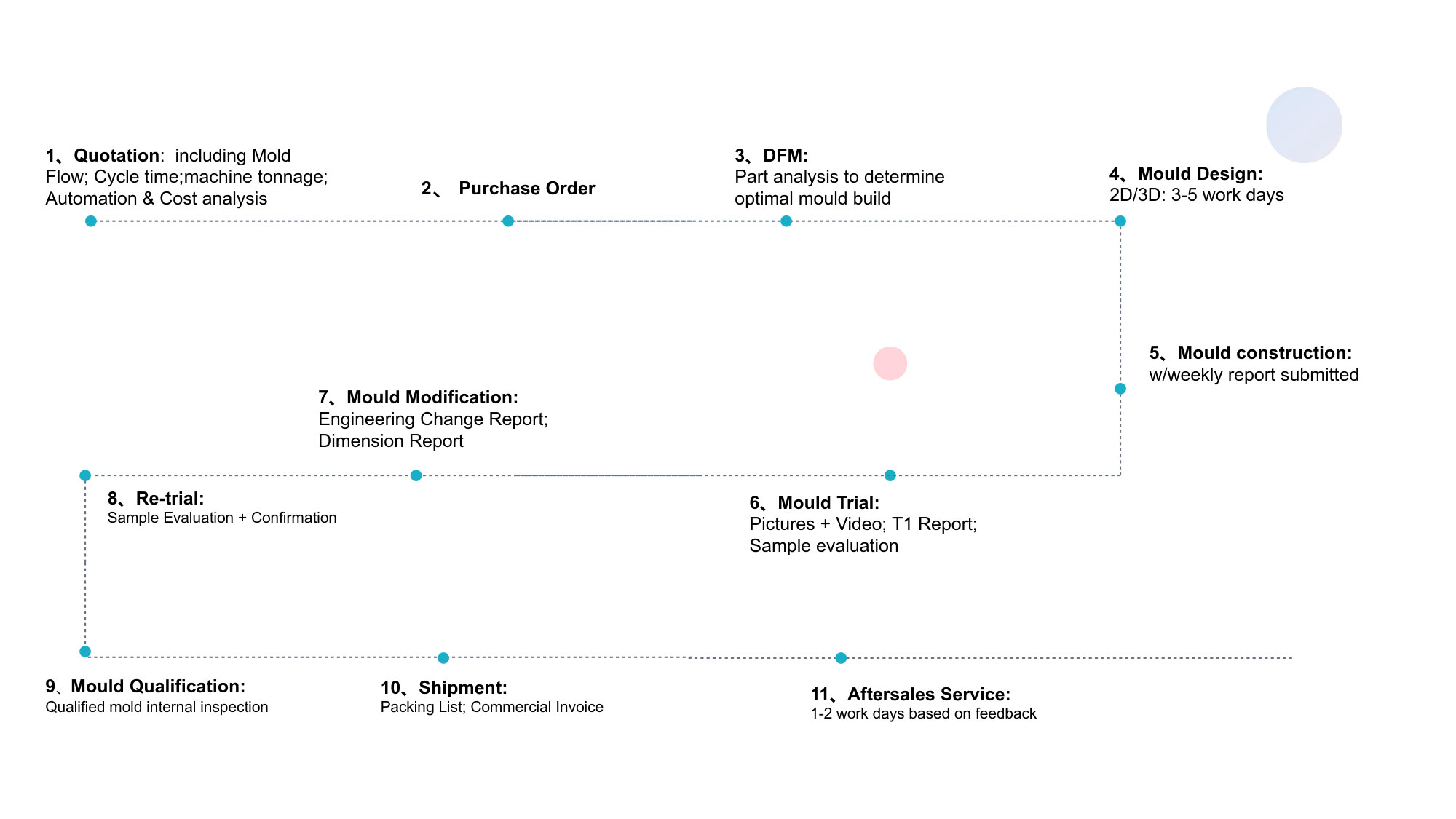
All three product categories are manufactured using advanced injection molding processes, where granular raw materials undergo high-temperature melting in precision-controlled barrels and are injected under constant pressure into custom-designed multi-cavity molds. For thick-walled products requiring exceptional uniformity, injection blow molding (IBM) technology ensures consistent material distribution and highly uniform wall thickness across all cavities.
Key product characteristics we deliver:
Wall thickness uniformity held to ±0.02mm across all cavities
No visible flow lines, bubbles, or weld lines on transparent finishes
Precise neck finish dimensions (standard calibers: 16#, 18#, 22#, 24#, 28/410, 24/410, etc.) ensuring perfect fit with pumps and closures
Consistent color matching validated against Pantone standards
-
Mold Manufacturing: The Foundation of Excellence
2.1 Advanced Mold Manufacturing Equipment (Building Customer Trust Through Infrastructure)
At Ansix Tech, we believe that world-class products begin with world-class tooling infrastructure. Our mold manufacturing capabilities are built on a foundation of precision machining equipment that transforms engineering specifications into tangible, high-performance production assets.
CNC Machining Centers – Our facility is equipped with 5-axis high-speed machining centers capable of achieving ±0.002mm accuracy on complex curved surfaces. This precision ensures that the parting lines on your cream bottles and dispensing containers remain smooth and free from visible mismatch or burrs. The elimination of secondary deburring operations translates directly to 3-5% cost savings on post-processing and assembly.
Wire EDM (Slow Wire Cutting) – We utilize state-of-the-art slow-speed wire EDM systems that can machine micro holes as small as 0.03mm and narrow slots with exceptional precision. This capability is critical for cosmetic packaging applications requiring thin-wall sections (which can lead to flash or dimensional variation if improperly supported) and intricate core/cavity geometries. By avoiding thin-wall deformation issues common in the industry, we reduce scrap rates by up to 8% and eliminate costly mold reworks.
Precision Milling & Grinding – Complementing our high-speed machining centers, we maintain a full suite of precision surface grinders, jig grinders, and CNC milling stations capable of handling mold bases up to 1,500mm in dimension. The integration of these machines within a single facility ensures that mold repairs and modifications can be completed in under 24 hours—a significant advantage over competitors who must outsource these operations.
2.2 Injection Molding Machine Fleet (Scale and Consistency)
Our injection molding machine park spans 30 tons to 4,000 tons of clamping force, covering a complete range of product sizes—from small 10g cream jars to large 500ml dispensing containers. The fleet is configured with:
All-electric servo-driven machines for precision applications requiring ±0.1% shot-to-shot repeatability
Hybrid servo-hydraulic machines for high-volume production where energy efficiency and consistent packing pressure are paramount
Two-shot and multi-material injection units enabling over-molding and dual-color applications for premium packaging designs
The key customer benefit is absolute consistency: every shot produced on our all-electric machines delivers identical fill characteristics, ensuring that the 10,000th bottle matches the first in terms of weight, dimensions, and visual appearance.
2.3 Inspection & Metrology Equipment (Verification You Can Trust)
No claim of precision is credible without third-party-grade measurement verification. Our quality lab is equipped with:
Coordinate Measuring Machines (CMM) – Capable of measuring complex 3D geometries to ±0.001mm accuracy. Every mold cavity undergoes 100% dimensional inspection before production approval.
Optical Comparators and Vision Measurement Systems – Used for rapid inspection of threads, undercuts, and critical sealing surfaces. These systems provide real-time feedback during sample runs and first-article inspections.
2.5D Inspection Devices – Specifically used to verify wall thickness uniformity across all cavities, ensuring variation stays within ±0.02mm.
SPC Data Integration – All measurement data is logged into our Statistical Process Control (SPC) system, generating full dimensional reports for every production batch with CPK values targeted at ≥1.33 for critical dimensions.
2.4 Mold Life & Performance Guarantees (Translating Specifications into Customer Value)
Problem: Customers fear mold failure, unexpected downtime, and the hidden costs of frequent repairs.
Ansix Solution: We don‘t just build molds; we engineer them for predictable, long-term performance.
Dimension Technical Specification Customer Value Delivered
Mold Life Guarantee Up to 500,000 shots for glass fiber-reinforced materials; 1,000,000+ shots for standard plastics Eliminates unplanned replacement costs. A single mold can serve your brand for 5-10 years of continuous production.
Dimensional Tolerance ±0.05mm for standard structural components; ±0.005mm for precision sealing surfaces and threads Guarantees leak-proof fit with closures and pumps. Eliminates costly field failures and customer complaints.
Cavity Consistency Wall thickness variation ≤ ±0.02mm across all cavities Every bottle from every cavity looks and feels identical. No cherry-picking cavities for premium customers.
Material Certification Full material certificates and heat treatment curves provided for all mold components (S136, 2344, 8407, H13, NAK80, DC53, SKD11/61, M340) Full traceability. You‘ll know exactly what's inside your mold, with documented proof of every processing step.
Mold Types Available Hot runner (reduces sprue waste by 70-90%), stack molds (doubles output per machine), two-shot/multi-material, high-gloss mirror finish (Ra<0.05μm) Flexibility to match your production volume and aesthetic requirements with the optimal mold technology.
2.5 Gate & Runner System Optimization
Using advanced mold flow analysis software, we digitally simulate resin flow behavior before cutting any steel. The analysis identifies optimum gate locations, predicts knit line positions where two flow fronts meet, and locates potential air trap zones that could cause burn marks or incomplete fills.
For transparent yellow and amber bottles, this pre-production simulation is critical: improper gate placement can result in visible flow marks that destroy the premium aesthetic. By optimizing gate location, number, and geometry, we eliminate visible flow defects before the first sample is molded. This proactive approach reduces T0-to-production lead time by 30-40% compared to trial-and-error methods.
2.6 Cooling System Design – The Hidden Driver of Efficiency
The problem: Insufficient or poorly designed cooling extends cycle times by 15-30%, increasing per-unit cost and delaying order fulfillment.
The Ansix advantage: We design conformal cooling channels that follow the contour of the product geometry, ensuring uniform heat extraction across the entire cavity surface. Research demonstrates that conformally cooled molds achieve 56% shorter cooling times and 15% faster overall cycle times compared to traditional straight-drilled cooling channels.
Customer value translation: For a typical 50g cream jar with an original 20-second cycle, a 15% cycle reduction saves 3 seconds per shot. Across an 8-cavity mold producing 300,000 units, this translates to approximately 1,250 hours of machine time saved—directly impacting your bottom line.
2.7 Ejection & Venting Systems
Proper ejection system design prevents part deformation and sticking. Our engineers calculate optimal ejector pin placement, diameter, and stroke to ensure clean, damage-free part release after every cycle. Venting channels are strategically placed at last-fill locations to allow trapped air to escape, eliminating burn marks and improving surface finish quality.
Witness mark management – For cosmetic packaging where visual perfection is paramount, we coordinate with customers to position ejection witness marks in non-visible areas (typically the bottom face or interior surfaces), ensuring the exterior remains flawless.
Part 3 – Material Selection and Technical Expertise
3.1 Comprehensive Material Portfolio
Ansix Tech‘s 28 years of material processing experience covers virtually every thermoplastic suitable for cosmetic packaging. Our material selection process is guided by product requirements including chemical resistance (for creams, oils, and alcohol-based formulations), impact resistance (for shipping and daily use), optical clarity (for transparent bottles), and regulatory compliance (FDA, EU REACH, BPA-free standards).
Primary materials for cosmetic packaging containers:
PP (Polypropylene) – Excellent chemical resistance, good clarity, lightweight, FDA-approved, ideal for lotion bottles and caps
PET (Polyethylene Terephthalate) – High barrier properties, exceptional transparency, non-shattering, lightweight, environmentally friendly, available in pearlescent, colored, and crystal-clear finishes
Acrylic (PMMA) – Superior optical clarity, thick-walled feel, premium aesthetic for luxury brands; chemical resistance is moderate, requiring inner liners for certain formulations
AS (Acrylonitrile Styrene) – Better transparency than ABS combined with good toughness, suitable for thick-walled cream bottles
ABS (Acrylonitrile Butadiene Styrene) – High impact strength and dimensional stability, excellent for caps and closures
K-Resin (SBC) – Glass-like clarity with good impact resistance, popular for transparent dispensing containers
Specialty materials for demanding applications:
PC/ABS blends – High heat resistance and impact strength
PC (Polycarbonate) – Exceptional impact resistance and optical clarity
PPS+40%GF – Superior chemical and heat resistance for aggressive formulations
PEEK, PEI, LCP – High-performance engineering plastics for specialized applications
PBT, PA6+GF30 – Excellent mechanical properties for structural components
Liquid Silicone Rubber (LSR) – For soft-touch sealing elements and over-molded components
3.2 Material Compliance & Certification
For customers exporting to regulated markets, our raw material sourcing complies with:
FDA 21 CFR – Materials suitable for food and cosmetic contact (USA)
EU REACH & EC 1935/2004 – European compliance for cosmetic packaging
California Prop 65 – Hazardous substance disclosure requirements
BPA-free certification – Increasingly required for Australian and UK markets
UL94 V-0, V-2 – Flame retardancy ratings for applicable products
Each incoming material shipment is verified with a Certificate of Analysis (COA) and tested for key properties (melt flow index, moisture content, color consistency) before approval for production.
3.3 Material-Related Customer Value
Customer Concern Ansix Capability Value Delivered
“Will my cream degrade the bottle?” Extensive chemical compatibility database + on-site testing Product safety guaranteed. No costly recalls.
“Will the yellow tint fade over time?” UV-stabilized formulations tested to 3,000 hours Brand identity preserved. Shelf-life confidence.
“Will my cap fit the bottle neck exactly?” Single-sourced material for bottle and cap components Perfect fit guaranteed. No leaking.
“Do I need FDA/EU compliance documentation?” Full material traceability + COA with every shipment Regulatory compliance assured. Market access secured.
Part 4 – DFM (Design for Manufacturability) and Mold Flow Analysis
4.1 Early Engagement: The Ansix DFM Process
Customer problem: Many injection molders accept customer CAD files without critical review, only to discover manufacturing issues after tooling is cut—resulting in costly redesigns, delayed timelines, and compromised part quality.
Ansix solution: We perform DFM analysis before quoting your project. Within 3-5 days of receiving your 3D CAD file and specifications, we deliver a comprehensive DFM Report covering:
Material flow simulation – Filling time, pressure distribution, temperature gradients, shear rates
Gate location optimization – Recommendations for optimal placement and gate type (pin, submarine, valve, etc.)
Weld and knit line prediction – Location mapping and mitigation strategies
Air trap identification – Vent placement recommendations to eliminate burn marks
Sink mark and warpage analysis – Wall thickness optimization and rib design improvements
Draft angle recommendations – Minimum angles for clean part ejection
Ejector pin mark placement – Coordination for non-visible surface marking
The value we deliver: By identifying and solving manufacturability issues in the digital phase, we eliminate 80-90% of post-mold-change expenses that plague less-prepared suppliers. Your timeline accelerates by 30-40% because T0 samples arrive closer to production-ready quality.
4.2 How Mold Flow Analysis Prevents Real-World Defects
Defect Cause How Ansix Mold Flow Prevents It
Visible flow lines on transparent bottles Improper gate placement causes chaotic material flow Simulation identifies smooth flow path; gate positioned for laminar filling
Weld lines at cosmetic surfaces Two flow fronts meet at visible location Gate relocation or vent addition moves weld lines to non-visible areas
Burn marks (black spots) Trapped air compresses and overheats Vent placement optimized at last-fill locations
Sink marks on thick walls Insufficient packing or cooling Cooling channel layout optimized; packing pressure adjusted
Warpage/deformation Non-uniform shrinkage Part geometry optimized; cooling balanced across cavity
Short shots (incomplete fill) Insufficient injection pressure or poor flow Material selection validated; gate size optimized
4.3 Comprehensive DFM Deliverables
Each DFM study produces a detailed report including:
Filling analysis – Time-lapse visualization of resin flow progression
Pressure distribution map – Identifies high-pressure zones that may cause mold deflection
Temperature profile – Ensures uniform cooling avoids hot/cold spots
Shear rate analysis – Prevents material degradation from excessive shear
Clamp tonnage requirement – Ensures sufficient machine capacity for full cavity packing
Cycle time estimation – Based on cooling requirements and part geometry
Customer value: You receive this analysis before committing to tooling investment, enabling informed design decisions that optimize manufacturability and cost. This early investment typically pays for itself 5-10 times over through reduced tooling iterations and faster time-to-market.
4.4 Process Validation: From T0 to Production Ready
Our process validation follows a disciplined, documented protocol:
Stage Activities Deliverables
T0 Sample First shots from new mold; visual and dimensional inspection Sample parts + preliminary inspection report
T1 Optimization Process parameter adjustments; minor mold modifications Updated parts + modification log
T2 Validation Repeatability testing across 50-200 cycles per cavity CPK analysis + capability report
T3 Approval Full process window verification; customer sign-off Approved sample + process specification
Trial Run 500-1,000 part pre-production run Yield analysis + CPK confirmation
For critical dimensions, we target CPK ≥ 1.33, representing a process where only 63 parts per million fall outside specification tolerances.
Part 5 – Injection Molding Manufacturing Process
5.1 Scientific Molding Approach
Ansix Tech employs scientific injection molding methodologies, which replace traditional trial-and-error with data-driven process development. Unlike conventional approaches where operators adjust parameters based on intuition, scientific molding leverages mold flow analysis, Design of Experiments (DOE), and real-time cavity pressure monitoring to define a repeatable, validated molding process.
The scientific molding framework includes:
Decoupled molding – Separating fill, pack, and hold phases for independent optimization
Cavity pressure monitoring – Real-time sensors provide immediate feedback on fill dynamics
Process window validation – DOE identifies robust parameter ranges insensitive to normal variation
First-part verification – Each production start requires pre-production verification against master sample
5.2 Process Optimization for Efficiency and Cost Control
Problem: Unoptimized injection molding processes consume excessive energy, extend cycle times, and generate unnecessary scrap.
Ansix capability: Through systematic process optimization, we deliver measurable improvements:
Optimization Area Technical Method Customer Result
Cycle time reduction Optimized cooling channel design + high-speed materials Up to 30% faster cycles; same machine produces more parts per hour
Energy consumption Plackett-Burman DOE to identify key parameters; all-electric servo machines Energy costs reduced by 15-25%; lower carbon footprint
Material yield Hot runner systems + optimized sprue design 70-90% reduction in runner waste; more parts per kg of material
Setup time SMED (Single-Minute Exchange of Die) protocols Changeover time reduced by 65%; faster job transitions
Scrap reduction Closed-loop process control + cavity sensors Scrap rates under 2% for stable production
Real-world impact: A 30% cycle time reduction on a 20-second cycle (to 14 seconds) increases theoretical output from 180 to 257 parts per hour per cavity—a 43% increase in capacity. For a 300,000-unit order, this accelerates completion by several days and reduces per-unit cost by an estimated 15-20%.
5.3 In-Process Quality Control
Quality is not inspected at the end—it is built into the process. Our production floor implements rigorous in-process controls:
Continuous monitoring systems:
Barrel temperature control – All zones regulated to ±1°C stability; temperature directly affects material viscosity, pigment dispersion, and final color
Injection pressure and velocity – Closed-loop control maintains shot-to-shot consistency
Cavity pressure transducers – Optional sensor integration provides real-time fill monitoring
Automated part handling – Robotic extraction systems prevent damage during ejection
Scheduled QC checks:
Hourly – Dimensional verification of key features
Every 2 hours – Visual inspection and color verification against master standard; 10 units pulled randomly from production
Every shift – Weight check, leak test, thread gauge verification
Batch start/end – First-part and last-part inspection for trend detection
5.4 Cosmetic Quality Standards
For cosmetic packaging, visual quality is equally important as dimensional accuracy. Our inspection protocols address:
Surface finish – Transparent bottles must be crystal-clear, free from bubbles, flow lines, and haze
Parting line mismatch – Alignment tolerances held to ≤0.03mm to eliminate visible steps
Scratches and tool marks – 100% visual inspection under standardized D65 daylight lighting before packaging
Color consistency – Pantone-matched colors held to delta E < 1.0 during pre-production; continuous monitoring throughout production runs
Cleanliness – Bottles cleaned and free from mold release, oil, dust, and foreign particles prior to packaging
Odor – No residual plastic smell detectable; material selection ensures odor-free final products
Functional testing requirements:
Leak testing – Vacuum leakage, pressure resistance, and water immersion tests performed on sample batches
Cap torque testing – Ensure cap fits securely without cross-threading or loosening
Dimensional measurement – Neck finish, height, diameter, and wall thickness verified against master sample
Weight check – Confirms consistent material fill across all cavities
Part 6 – Quality Assurance and Control Systems
6.1 ISO and Industry Standards Compliance
Ansix Tech maintains quality management systems aligned with internationally recognized standards:
ISO 9001:2015 – Comprehensive quality management for design, production, and delivery
ISO 22716 (Cosmetics GMP) – Good Manufacturing Practices specifically for cosmetic packaging, covering facility hygiene, personnel training, equipment calibration, material control, production documentation, and distribution controls
SPI AQ-103 – The Society of the Plastics Industry‘s cosmetic specification for molded parts, addressing surface finish, cleanliness, and visual acceptance criteria
For customers requiring additional certifications (ISO 13485 for medical-grade components, food-contact compliance, etc.), we can qualify specific projects against applicable standards.
6.2 Multi-Stage Quality Gates
Our quality system operates through five verification stages:
Gate 1: Raw Material Verification
Incoming material lots are tested for melt flow index, moisture content, color consistency, and compliance against COA documentation. Any material falling outside acceptance criteria is rejected and quarantined.
Gate 2: First Article Inspection (FAI)
Before full production approval, a 50-unit sample from every cavity is produced and subjected to complete dimensional measurement against customer drawing requirements. Dimensional data is compiled into a full inspection report, and 10 production samples are submitted for customer sign-off before mass production begins.
Gate 3: In-Process Quality (IPQ)
Real-time SPC monitoring tracks key dimensions, part weight, cycle time consistency, and visual defects. Control charts flag deviations before they exceed specification limits, enabling immediate corrective action.
Gate 4: Final Quality Control (FQC)
100% visual inspection performed under standardized lighting conditions after assembly but before packaging. Color verification against master Pantone standard ensures batch-to-batch consistency.
Gate 5: Pre-Shipment Verification
Batch sampling according to AQL tables (ANSI/ASQ Z1.4 standards). All samples undergo comprehensive functional testing (leak tests, cap compatibility, drop testing) before shipment release. Each delivery includes a factory inspection report.
6.3 Preventive and Corrective Systems
The problem: Most suppliers react to quality issues after they occur—scrapping defective parts, delaying shipments, and eroding customer confidence.
Ansix‘s approach: We implement preventive systems that stop problems before they start.
Tooling maintenance schedule – Preventive maintenance cycles (cleaning, lubrication, wear inspection) scheduled at 50,000-shot intervals, documented and traceable
Process monitoring alarms – Real-time alerts for deviation outside control limits; automated intervention where possible
Non-conforming material control (NCMR) – Dedicated quarantine area for suspect parts; root cause analysis performed on all non-conformances; corrective action implemented and verified
Supplier quality management – Critical raw material suppliers audited annually; material conformance verified on every shipment
Part 7 – Smart Manufacturing Integration and Efficiency Enhancement
7.1 MES (Manufacturing Execution System) Integration
All injection molding machines are networked into our centralized MES platform. This system provides:
Real-time production monitoring:
Machine status (running/idle/down/setup) tracked live
Cycle time and shot count captured automatically
Efficiency (OEE) calculated in real time
Process parameter lockdown:
All molding parameters (temperature, pressure, velocity, time, cooling duration) are locked within the MES
Only authorized process engineers can modify parameters, with full audit trail documentation
Prevents unauthorized operator adjustments that could compromise quality
Quality data integration:
Dimensional inspection results automatically linked to production batch records
Color delta E readings logged for full traceability
Non-conformance records and corrective actions tracked in centralized database
Customer value: Full production traceability. If a quality issue arises, we can trace defective parts back to specific shot times, material lots, and process conditions—enabling rapid root cause identification and preventing recurrence.
7.2 Automation and Robotics
To enhance consistency and reduce labor costs, we deploy automation at multiple levels:
Robotic part extraction – Removes molded parts with consistent motion profiles, eliminating manual handling damage
Automated degating – Integrated sprue cutters remove runners at the press, eliminating secondary trimming operations
Vision inspection systems – Automated optical inspection for surface defects, flash detection, and dimensional verification
Automated packaging – Counted, sorted, and packaged parts ready for shipment without manual touching
Cost impact: Automation reduces labor costs by 30-50% on high-volume production while improving consistency and eliminating human inspection bias.
7.3 Lean Manufacturing Implementation
Ansix Tech applies lean manufacturing principles to eliminate waste and maximize value-added activities:
Waste Type Ansix Elimination Strategy
Defects Poka-yoke (error-proofing) devices + cavity pressure monitoring
Overproduction Kanban pull systems; production scheduled to actual demand
Waiting SMED changeover protocols; mold pre-heating stations
Transportation Cellular manufacturing layout; material flow optimized
Inventory Just-in-time material ordering; finished goods held to minimum levels
Motion Ergonomic workstations; tools positioned at point of use
Over-processing Value stream mapping; process steps eliminated where unnecessary
Result: Shorter lead times, lower inventory costs, reduced working capital requirements for customers.
7.4 Capacity Planning and Lead Time Management
Production Volume Typical Lead Time (from PO approval) Capability
Prototype / Low Volume (100-5,000 units) 10-15 days Single-cavity or soft tooling; fast iteration cycles
Medium Volume (5,001-50,000 units) 20-25 days Multi-cavity production tooling; optimized cycle times
High Volume (50,001-500,000+ units) 25-40 days High-cavitation molds (4, 6, 8, 12, 16 cavities); automated lines
Emergency / Expedited As low as 10-15 days (requires validation protocol maintenance) Additive manufacturing for mold inserts; parallel processing
Customer value: Predictable, reliable lead times that align with your product launch schedules. No surprises, no delays.
Part 8 – Cost Control and Value Engineering
8.1 Systematic Cost Reduction Framework
For us, cost reduction is not about cutting corners—it is about engineering efficiency. We attack cost through five primary levers:
Lever 1: Part Design Optimization (DFM)
Wall thickness reduction where structurally possible → Less material per part
Draft angle optimization → Cleaner ejection, reduced cycle time
Rib design for stiffness without added thickness → Reduced weight without compromising strength
Typical savings: 8-15% of material cost
Lever 2: Mold Design for Efficiency
Hot runner systems → Eliminates sprue and runner waste; 70-90% material savings on runner systems
Multi-cavitation (4, 6, 8, 12, 16 cavities) → Same machine hour produces more parts; reduces per-unit overhead allocation
Conformal cooling → 15%+ cycle time reduction → More parts per hour → Lower per-unit cost
Stack molds → Doubles output from same machine footprint
Typical savings: 15-30% of production cost
Lever 3: Process Parameter Optimization
DOE-optimized parameters → Fastest possible cycle within quality specifications
Mold flow analysis → Eliminates mold rework (most costly waste in injection molding)
Scientific molding methodology → Process robust to normal variation; higher yields
Typical savings: 10-20% of cycle-time-related costs
Lever 4: Material Selection and Sourcing
Alternative material recommendations (when suitable) → Lower material cost without performance compromise
Bulk purchasing across customer projects → Volume discounts passed through
Regrind utilization for non-cosmetic surfaces → Reduces virgin material consumption
Typical savings: 5-15% of material cost
Lever 5: Secondary Operations Integration
In-mold decoration (IMD) → Eliminates separate printing operation
In-mold labeling → No post-mold labeling labor
Automated assembly integrated with molding → Reduces handling and assembly costs
Typical savings: 20-40% of secondary operation costs
8.2 Customer Value Quantification
For a hypothetical 500,000-unit annual volume of a 50g cream jar with closure:
Cost Element Baseline Industry Ansix Optimized Annual Savings
Raw material cost @ $2.50/kg (15g part) $18,750 $16,500 (12% savings) $2,250
Production cost @ $50/hour $175,000 $140,000 (20% savings) $35,000
Tooling amortization (over 500k units) $15,000 $12,000 (20% reduction) $3,000
Quality / scrap cost $7,500 $3,750 (50% reduction) $3,750
TOTAL ANNUAL SAVINGS $44,000+
Note: Savings vary by product complexity, material selection, and order volume. Request a detailed cost analysis for your specific project.
8.3 Price Stability Commitment
Customer concern: Raw material prices fluctuate, making cost forecasting difficult.
Ansix approach: We maintain strategic inventory of high-volume materials and offer:
Fixed pricing for 6-12 month contracts – Lock in rates for budget certainty
Raw material surcharge protection – Transparent pass-through agreements when applicable
Volume-based tiered pricing – Lower unit costs as volumes increase
8.4 Risk Reduction and Value Assurance
Customer Risk Ansix Mitigation Strategy
“Mold breaks down after 100k shots” Mold life guarantee: 500k-1M shots with documented maintenance schedule
“Dimensional variation causes assembly issues” CPK ≥1.33 on critical features; 100% dimensional verification
“Color mismatch across batches” Single-lot raw material sourcing; delta E <1.0 control
“Late delivery disrupts my launch” MES real-time tracking + buffer inventory agreements
“Hidden costs for mold repairs” 3-year structural warranty on molds (excluding wear parts)
“Quality rejects at my incoming inspection” Pre-shipment AQL inspection; full certification included
Part 9 – Customer Support and Full-Service Capabilities
9.1 End-to-End Service Offering
From concept to completed packaging: Ansix Tech supports every stage of your product development cycle.
Stage Ansix Capability
Concept / Ideation DFM analysis; material selection consultation; cost estimation
Prototyping Rapid tooling or 3D-printed samples for form/fit testing
Design Refinement Mold flow analysis; structural simulation; design-for-assembly review
Production Tooling Multi-cavity molds with conformal cooling; hot runner systems
Trial Runs T0→T3 samples; process optimization; CPK validation
Mass Production 30T-4000T injection molding; automation-integrated lines
Secondary Operations Hot stamping, silk screen printing, UV coating, assembly
Quality Certification Dimensional reports; material certifications; functional test data
Packaging & Logistics Custom packaging; protective handling; global shipping support
9.2 Design for Assembly (DFA) and Full Packaging Solutions
Beyond individual components, Ansix Tech can support complete packaging system integration:
Bottle + cap compatibility – Threads, sealing surfaces, and torque requirements verified together
Pump head integration – Neck finishes matched to standard pump specifications
Tamper-evident features – Design and mold integration for safety seals
Dispensing systems – Compatibility with airless pumps, lotion pumps, mist sprayers
Secondary decoration – Hot stamping, silk screening, labeling, and coating services in-house
9.3 After-Sales Support and Spare Parts
Mold spare parts kit – Every mold ships with a documented spare parts kit including critical wear components (ejector pins, core pins, hot runner nozzles, heater bands). This ensures that routine maintenance or unexpected wear can be addressed without ordering from external sources.
Maintenance schedule – Recommended maintenance intervals (cleaning, lubrication, wear inspection) documented for every mold. For customers preferring full-service support, we offer scheduled mold return for preventive maintenance at 100,000-shot intervals.
Lifetime repair support – Mold repairs beyond warranty period are billed at cost-plus-labor rates, typically 50-70% below new mold replacement cost.
9.4 Training and Technical Support
For customers establishing their own assembly or filling operations, we provide:
Technical documentation – Full mold drawings, process specifications, quality inspection protocols
Online support – Video troubleshooting guides for common molding issues
On-site assistance – Available for critical launches or technical problem-solving
Process handover – For projects transitioning from development to production
Part 10 – Competitive Differentiation and Commitment
10.1 Addressing Industry Pain Points Head-On
Common Customer Complaint Ansix Commitment
“The mold is constantly being repaired and affecting my orders.” We perform 2,000-shot aging tests before mold delivery, with full wear report. Plus 3-year mold structure guarantee (excluding normal wear of consumable parts).
“Flash is everywhere, and secondary deburring is expensive.” We part-line fit to 0.005mm accuracy using self-locking clamp force compensation. Flash is held under 0.03mm, eliminating hand-deburring for most applications.
“Dimensions change every production run.” Ultrasonic wall thickness sensors provide real-time feedback and automatic packing pressure compensation. Optional in-mold pressure/temperature sensors for closed-loop control.
“Mold repairs take weeks to complete.” In-house electrode machining center and EDM workshop enable most mold repairs without leaving the facility. Standard patch-weld/insert replacement completed within 24 hours.
10.2 The Ansix Difference
What separates Ansix Tech from other mold makers and injection molders?
Single-source accountability – We design, build, validate, and produce under one roof. No finger-pointing between mold maker and molder when quality issues arise.
Engineering-first culture – Every mold and process begins with simulation and analysis, not guesswork. Our DFM reports and mold flow analyses are not documents—they are blueprints for problem prevention.
Transparent communication – You receive regular project updates, sample parts at every milestone, and documented quality data. No surprises, no excuses.
Long-term partnership focus – We are not transactional suppliers. We seek customers who value engineering partnership and continuous improvement. Your success drives our growth.
10.3 Our Core Message
To our valued customers:
For us, a mold is not just a block of steel—it is a revenue-generating asset for your business. When we design your mold, we simultaneously engineer its robustness for 24/7 production, its venting paths for complete fills, its thermal balance for consistent cycles, and its ejection system for smooth part release.
The result when the mold reaches your production floor: Plug-and-play ready. Minimal trial shots. No flash issues. Extended tool life.
We invite you to experience the Ansix difference.
Request a DFM study for your current or upcoming product. In one session, we will demonstrate how our mold flow analysis identifies melt line, air trap, and sink mark risks—and how we eliminate them before cutting any steel. You will see, clearly and quantifiably, how we deliver lower risk, predictable costs, and reliable quality for your brown cream bottles, amber yellow thick-walled face cream bottles, and transparent yellow cosmetic dispensing containers.
Ansix Tech – 28 Years of Excellence in Mold Manufacturing and Injection Molding
Project inquiries welcome. Contact us today for a comprehensive cost and capability assessment.
Ansix Tech Co Ltd
If you have any plans related to Brown cream bottle, amber yellow thick-walled face cream bottle, transparent yellow cosmetic dispensing container , you can contact us at any time. We will turn your ideas into reality, let you realize your dreams, and obtain large orders from the market. Our contact information is info@ansixtech.com. Or contact our CTO, mail: stephen@ansixtech.com
#www.ansixtech.com #ansixtech.com #Brown cream bottle, amber yellow thick-walled face cream bottle, transparent yellow cosmetic dispensing container #Brown cream bottle, amber yellow thick-walled face cream bottle, transparent yellow cosmetic dispensing container moulds #Brown cream bottle, amber yellow thick-walled face cream bottle, transparent yellow cosmetic dispensing container injection molding companies #Brown cream bottle, amber yellow thick-walled face cream bottle, transparent yellow cosmetic dispensing container Canopy Mold injection mold companies #Ansix #Ansix moulds #Ansix china #Ansix tech china #Ansix tech company #Ansix facotry #Brown cream bottle, amber yellow thick-walled face cream bottle, transparent yellow cosmetic dispensing container injection molding #Brown cream bottle, amber yellow thick-walled face cream bottle, transparent yellow cosmetic dispensing container injection tools #Brown cream bottle, amber yellow thick-walled face cream bottle, transparent yellow cosmetic dispensing container injection moulds #Brown cream bottle, amber yellow thick-walled face cream bottle, transparent yellow cosmetic dispensing container plastic mould #Brown cream bottle, amber yellow thick-walled face cream bottle, transparent yellow cosmetic dispensing container plastic tools #Ansix Tech #Ansix molds #Ansix injection molding #Ansix mold factory #injection molding Brown cream bottle, amber yellow thick-walled face cream bottle, transparent yellow cosmetic dispensing container #Ansix mold factory #Brown cream bottle, amber yellow thick-walled face cream bottle, transparent yellow cosmetic dispensing container china #Brown cream bottle, amber yellow thick-walled face cream bottle, transparent yellow cosmetic dispensing container molds #injection factory #Brown cream bottle, amber yellow thick-walled face cream bottle, transparent yellow cosmetic dispensing container injection molding #Brown cream bottle, amber yellow thick-walled face cream bottle, transparent yellow cosmetic dispensing container injection molding factory #injection molding company #Brown cream bottle, amber yellow thick-walled face cream bottle, transparent yellow cosmetic dispensing container injection mold companies #Brown cream bottle, amber yellow thick-walled face cream bottle, transparent yellow cosmetic dispensing container#Brown cream bottle, amber yellow thick-walled face cream bottle, transparent yellow cosmetic dispensing container mold limited #Ansix mold china #Ansix companies #Ansix company China #Brown cream bottle, amber yellow thick-walled face cream bottle, transparent yellow cosmetic dispensing container facotry #Ansix Tech #Ansix Tech mould #Brown cream bottle, amber yellow thick-walled face cream bottle, transparent yellow cosmetic dispensing container injection moulding #injection moulding company #Ansix Brown cream bottle, amber yellow thick-walled face cream bottle, transparent yellow cosmetic dispensing container parts injection mold companies #medical injection molding companieschina #Brown cream bottle, amber yellow thick-walled face cream bottle, transparent yellow cosmetic dispensing container china factory #Ansix moulding companies #Ansix molding company #Brown cream bottle, amber yellow thick-walled face cream bottle, transparent yellow cosmetic dispensing container injection moulding facotry #Ansix Tech mold #Brown cream bottle, amber yellow thick-walled face cream bottle, transparent yellow cosmetic dispensing container mould #Brown cream bottle, amber yellow thick-walled face cream bottle, transparent yellow cosmetic dispensing container plastic injection molding #ansix plastic mold #Mold manufacturing #Brown cream bottle, amber yellow thick-walled face cream bottle, transparent yellow cosmetic dispensing container parts manufacturing #Brown cream bottle, amber yellow thick-walled face cream bottle, transparent yellow cosmetic dispensing container plastic parts factory #Brown cream bottle, amber yellow thick-walled face cream bottle, transparent yellow cosmetic dispensing container injection parts mold #Brown cream bottle, amber yellow thick-walled face cream bottle, transparent yellow cosmetic dispensing container PRECISION MANUFACTURING #Brown cream bottle, amber yellow thick-walled face cream bottle, transparent yellow cosmetic dispensing container #China mold #Brown cream bottle, amber yellow thick-walled face cream bottle, transparent yellow cosmetic dispensing container injection moulding china #Brown cream bottle, amber yellow thick-walled face cream bottle, transparent yellow cosmetic dispensing container mould china #china precision mold #mold in china #Brown cream bottle, amber yellow thick-walled face cream bottle, transparent yellow cosmetic dispensing container mold china #Precision molds #High-precision molds #Brown cream bottle, amber yellow thick-walled face cream bottle, transparent yellow cosmetic dispensing container #Injection molds #Brown cream bottle, amber yellow thick-walled face cream bottle, transparent yellow cosmetic dispensing container Factory #Brown cream bottle, amber yellow thick-walled face cream bottle, transparent yellow cosmetic dispensing container Company #Super Large Injection Mold Factory #Large Tonnage Injection Molding Factory #Brown cream bottle, amber yellow thick-walled face cream bottle, transparent yellow cosmetic dispensing container Company #Brown cream bottle, amber yellow thick-walled face cream bottle, transparent yellow cosmetic dispensing container Factory #2800T Injection Molding Factory #3000 Ton Injection Molding #4500 Ton Injection Molding Factory #Large Mold Injection Molding #Large Plastic Mold Injection Molding Factory #Large Injection Mold Manufacturer #Plastic Mold Factory #Injection Mold #Plastic Mold