



32-cavity preform mold for PCO 1810 bottle neck
FEATURES
Hard Power Foundation: The Equipment Backbone That Builds Customer Trust
Mold Manufacturing Equipment — Precision That Protects Your Profits
5-Axis High-Speed Machining Centers
Professional Translation: We are equipped with advanced 5-axis high-speed machining centers capable of achieving machining accuracy down to 0.002mm on complex curved surfaces. For your PCO 1810 preform mold, this means the parting line on your bottle necks will be impeccably smooth — free from burrs that could damage downstream blow molding equipment or compromise bottle sealing performance. No secondary finishing required. Lower labor costs, fewer production interruptions.
-
Mold Description
Product Materials:
PET PETG
Mold Material:
S136ESR
Number of Cavities:
1*32
Glue Feeding Method:
Hot runner
Cooling Method:
Water cooling
Molding Cycle
12.5s
- The mold manufacturing process and product material selection
Slow Wire EDM (Wire-Cut Electrical Discharge Machining)
Professional Translation: Our slow wire EDM systems can machine micro-holes and narrow slots down to 0.03mm with exceptional precision. For 32-cavity preform molds, this ensures delicate features like venting slots and cooling channels are executed with microscopic accuracy. The result: uniform cooling distribution across all 32 cavities, eliminating localized overheating that causes dimensional variation. Your blow molding yield improves. Reject rates fall.
CNC Turning Centers and Precision Grinding
Professional Translation: Dedicated CNC lathes and precision surface grinders ensure that every core pin, cavity insert, and neck ring achieves the geometry exactitude required for balanced filling across all 32 cavities. Neck ring split lines maintain consistent height within ±0.005mm — the difference between preforms that blow into perfectly round bottles versus those that create oval or off-centered finished containers.
-
Injection Molding Machine Fleet — Production Stability That Drives Profitability
Ansix Tech operates 260 injection molding machines across four production bases in China and Vietnam, with clamping forces ranging from 30 tons to 2800 tons. Our primary equipment includes premium brands: Japan‘s Fanuc, Sumitomo, Toshiba, and Nissei; Germany’s Engel and Arburg (specializing in two-component liquid silicone); complemented by domestic Haitian and Victor Taichung machines.
For the 32-cavity PCO 1810 preform mold project, we recommend machines in the 400–500 ton range — the optimal balance for 32-cavity preform production. Our all-servo electric drive machines deliver:
Repeatability precision of ±0.1%: Every shot, every cycle, every day. Your production line operates with predictable consistency. No surprises. No rejected batches due to machine drift.
Energy efficiency up to 50-70% lower than hydraulic machines: Direct reduction in your electricity bill per million preforms produced.
Faster cycle times: Electric servos accelerate and decelerate faster than hydraulic equivalents, shaving seconds off each cycle. With 32 cavities, seconds translate directly to higher daily output.
Quality Assurance Equipment — Testing That Protects Your Brand
Coordinate Measuring Machines (CMM)
Professional Translation: Prior to any mold shipment, each mold cavity undergoes a full dimensional inspection using our CMM equipment. We generate comprehensive full-size reports comparing every critical dimension against your engineering drawings.
Optical Imaging and Vision Inspection Systems
Professional Translation: Our high-resolution optical inspection systems measure surface finish, detect micro-cracks, and verify geometry at magnifications that exceed human visual capability. Every core pin, every cavity insert, every cooling channel passage is verified before assembly.
Key Quality Commitment: Every mold leaving our facility undergoes full dimensional reporting. Critical dimensions on your 32-cavity PCO 1810 preform mold are subject to Process Capability Index (CPK) verification — we guarantee CPK ≥ 1.33 for all key features. This is not just a number. It means your production will stay within specification tolerances reliably, batch after batch, regardless of normal process variation.
II. Core Competitiveness in Mold Manufacturing: Performance You Can Measure
Customer priorities for preform molds are simple: lifetime, precision, lead time, and repair cost. Here is how Ansix Tech delivers on each dimension:
Dimension Technical Specification Customer Value Translation
Mold Life Core & Cavity: S136 ESR (HRC 48–52), Heat-treated corrosion-resistant stainless steel Uninterrupted production. For PET preform molding without glass fiber fillers, we guarantee 3–5 million shots minimum — equivalent to 5–6 years of continuous production. Even with aggressive materials, you are looking at 500,000+ shots before any significant wear. Downtime for mold refurbishment is rare. Your production line keeps running.
Mold Base Chrome-plated P20 (HRC 28–32), anti-rust treatment Corrosion protection. PCO 1810 preforms for beverages operate in humid environments with condensation risk. Anti-rust plating means no degradation of guiding surfaces, no contamination of preforms, extended mold life without expensive refurbishments.
Achievable Tolerance Critical neck finish dimensions: ±0.02mm Reliable blow molding. PCO 1810 is a precision neck finish standard. When your preforms have consistent wall thickness and concentric geometry, the downstream blow molding process achieves higher first-pass yields. Less scrap. Less energy consumption in reheating. Lower total cost per finished bottle.
Cavity Fill Balance Cavity-to-cavity variation ≤ 2% Uniform preform weights. When all 32 cavities fill identically, every preform in a cycle has identical material distribution. No need to sort or grade output by cavity position. Lower inspection costs. Consistent blow mold performance across all preforms from every cycle.
Surface Finish Cavity surface roughness Ra ≤ 0.05μm, Class A mirror finish achievable Optically clear bottles. PET preforms require mirror-polished cavity surfaces to produce preforms with smooth internal surfaces. When the preform blows into a bottle, the mirror finish transfers directly. Your bottles achieve crystal clarity without optical distortion — a requirement for premium beverage branding.
Off-Center Deviation ≤ ±0.05mm between core and cavity centerlines Concentric bottle necks. Off-center preforms blow into bottles with eccentric neck finishes that compromise capping and sealing. Our tight concentricity control ensures every bottle seals perfectly. No leakers. No customer complaints.
Gate System Design — Excellence in Flow Balance
For 32-cavity PCO 1810 preform molds, gate balance is the single most critical design factor. We employ hot runner systems with pin valve gate technology for every cavity.
Professional Translation: A 32-cavity preform mold must distribute molten PET simultaneously to 32 cavities through a complex manifold system. Without perfect balance, some cavities overfill while others underfill — leading to weight variation, dimensional inconsistency, and increased scrap rates.
Our Solution:
Feature Technical Detail Customer Value
Pin Valve Gates Pneumatically or servo-actuated valve pins in each cavity Independent control of each cavity‘s fill. No stringing or drool between cycles. Cleaner operation, reduced material waste.
Thermally Balanced Manifold Multi-zone temperature control with independent PID controllers per cavity group Melt temperature is uniform across all 32 flow paths. Consistent viscosity at every gate equals consistent cavity fill.
Fill Simulation Optimization We perform full Moldflow analysis prior to any machining Simulate melt flow, identify weld line positions and air trap risks before cutting steel. Re-optimize gate locations in the virtual environment — saving real machining costs and reducing physical trial iterations from 4–6 to just 1–2.
Cooling System Design — The Hidden Driver of Cycle Time
Preform cycle time is dominated by cooling. PET must be cooled below its glass transition temperature before ejection, or the preform will deform.
Our Conformal Cooling Approach:
Broad, deep cooling channels positioned to follow the contour of core pins and cavities
Intensive water flow around the neck finish area — the thickest section requiring longest cooling
Multiple independent cooling circuits allowing zone-specific temperature adjustment
Mold temperature controllers (water or oil) maintaining ±1°C temperature control accuracy
Professional Translation: Faster cooling means shorter cycle times. Shorter cycles mean more preforms per day from the same mold and machine investment. With optimized cooling design on 32-cavity molds, we deliver cycle times of 13–18 seconds for standard PCO 1810 preforms, depending on preform weight and machine capability. For lighter preforms (e.g., 19g), cycles can be as short as 13 seconds. That equates to 3,600–5,500 preforms per hour from a single mold.
Ejection System Design — Damage-Free Preform Handling
Preforms must be ejected cleanly without surface scratches, core pin damage, or deformation.
Our Ejection Approach:
Strategically positioned ejector pins on thick sections only — never on thin walls that could deform
Self-locking individually controlled ejector mechanisms
Air-assist ejection optional for complex geometries
High-quality graphite bronze wear plates for smooth, reliable ejection movement
Professional Translation: No stuck preforms means no production interruptions. No ejection marks on critical sealing surfaces means no bottle leakers. Ejection reliability at 3–5 million cycles means minimal downtime for ejector pin replacement.
III. Injection Molding Process Control: Eliminating Quality Anxiety
Customers fear injection molding defects. Ansix Tech systematically eliminates them.
Common Customer Fears and Our Countermeasures
Customer Fear Technical Solution The Value Delivered
Sink marks and shrinkage Hot runner with sequential valve gate control + optimized packing pressure profiles. Modflow analysis confirms packing phase distribution No visible sink marks on preform surfaces. No internal voids that weaken the preform or create blow molding defects.
Flash (excess plastic escaping between mold halves) Parting line machining precision within 0.005mm + self-locking clamp force compensation Flash-free preforms eliminate manual deflashing operations. Lower labor costs. Higher first-pass quality rates.
Dimensional instability batch-to-batch All injection machines networked to MES system (Manufacturing Execution System). Process parameters — temperature, pressure, speed, time — locked and accessible only to authorized engineers. First-piece and last-piece comparison per batch Dimensional consistency across weeks and months of production. Preforms from batch 1 are indistinguishable from batch 10,000. No customer complaints about fit or function variation.
Warpage Mold temperature controller分区控温 (zone-based temperature control). Core and cavity temperature differential maintained ≤2°C Bottles blow straight and round. No ovality. No eccentric neck finishes that interfere with capping or sealing.
Gas burns / black spots Full Moldflow simulation identifies air trap locations. Venting slots precisely positioned for gas escape Clean, contamination-free preforms — no carbonized particles in your PET bottles. Meets food-contact safety standards.
IV (intrinsic viscosity) degradation in PET Controlled plasticization with minimized shear heating. Optimized screw design for PET-grade resin Maintains polymer molecular weight. Bottles retain strength, clarity, and barrier properties as specified by material supplier.
Process Standardization Through MES Integration
All 260 Ansix Tech injection molding machines are connected to our MES platform.
Professional Translation: Your production runs are not subject to operator error. Process recipes are stored digitally and locked. An operator cannot accidentally change temperature settings or cycle parameters. Every shot that leaves our machines meets the exact process specification defined during validation.
MES Data Collection Includes:
Real-time monitoring: Temperatures (5+ zones per machine), pressures (injection, holding, back), speeds (injection, screw rotation, clamp movement), cycle time, and cavity pressure profiles
Alarm and deviation logging: Any parameter outside control limits triggers immediate notification
Traceability: Every preform batch is linked to machine, operator, material lot, and process settings — complete genealogy for quality investigations
Appearance Quality Standards — Visual Perfection That Sells
For PCO 1810 bottle preforms, aesthetics are functional. Preforms with surface defects transfer those defects to blown bottles.
Ansix Tech‘s Appearance Capabilities:
Requirement Achievable Standard Applications
Transparent, bubble-free Class A optical clarity, no visible bubbles or flow lines under normal lighting Mineral water, CSD (carbonated soft drink), juice bottles where clarity is a brand asset
High-gloss surface Surface roughness Ra ≤ 0.2μm (mirror finish achieved through S136 polishing and EDM/texture treatment) Premium beverage brands requiring glass-like bottle appearance
No weld lines Weld lines eliminated or shifted to non-critical hidden areas through gate location optimization Any preform — visible weld lines blow into visible bottle defects
Food-grade compliance Materials and processing meet FDA and EU food-contact standards Beverages, edible oils, aseptic filling applications
Specialty Material Capabilities — Experience That Matters
Ansix Tech has successfully processed over 30,000 mold sets across industries ranging from medical devices to automotive interiors to consumer packaging. Our material experience includes:
Material Type Application Examples Key Challenge Our Expertise
PET (bottle-grade) PCO 1810 preforms, CSD bottles, water bottles IV degradation, drying sensitivity, crystallinity control Optimized screw designs for PET; controlled plasticization with minimized shear
Recycled PET (rPET) Sustainable packaging Reduced IV, contamination risks Process adjustments to compensate for lower molecular weight; enhanced filtration
Glass-fiber reinforced (30-50% GF) Structural components Extreme abrasion on mold surfaces Premium tool steels (SKD61 HRC 52–56, 2344) for abrasion resistance
PC/ABS, PC Automotive and electronics enclosures High processing temperatures, moisture sensitivity Controlled processing conditions; vacuum venting
PEEK, PEI, LCP High-performance engineering Ultra-high temperatures (300-400°C), flow challenges Specialized hot runner systems; advanced mold materials
Liquid Silicone Rubber (LSR) Medical and sealing components Two-component mixing, flash control Arburg LSR-dedicated machines; precision cavity design
Certifications That Matter:
ISO 9001: Quality management system
ISO 13485: Medical device manufacturing
IATF 16949: Automotive industry quality standard
ISO 8 Cleanroom and GMP compliance for medical/pharmaceutical grades
IV. Full-Stream Services: Lowering Customer Management Overhead
Many mold manufacturers build tools and ship them. Ansix Tech partners through the entire product lifecycle. Here is how we reduce your management burden.
DFM (Design for Manufacturing) Report — Before You Commit
Deliverable: Comprehensive mold feasibility analysis report provided before mold manufacturing begins.
Contents of Our DFM Report:
Draft angle recommendations — Ensuring preforms eject cleanly without damaging surface finish
Wall thickness optimization — Identifying thick sections that could cause sink marks or prolonged cooling
Gate location proposals — With Moldflow justification for optimal fill balance across 32 cavities
Ejector pin placement map — Clear documentation of where ejector witness marks will appear (avoiding critical sealing surfaces)
Cooling channel layout — Validating that cooling is sufficient for target cycle times
Shrinkage compensation calculations — Predictive adjustments to cavity dimensions for PET‘s unique shrinkage characteristics
Mold steel recommendations — Based on your production volume, material type, and environmental conditions
Professional Translation: You are not buying a mold specification blind. You receive a complete technical justification for every design decision before we cut any steel. No surprises. No “we discovered this is impossible after spending your money.” No project delays from late-discovered manufacturability constraints.
Cost and Risk Savings:
Eliminates 60-80% of common mold rework costs — Issues identified at DFM stage are fixed in CAD, not on machining centers or after failed trial runs
Reduces development iterations from 4-6 trials to 1-2 trials — Moldflow-validated DFM means first trial produces usable parts
Compresses project timeline by 3-5 weeks — No back-and-forth between tooling shop and design office to fix preventable problems
Trial Molding and Sample Submission — T0 to Production
Our Trial Protocol:
Trial Phase Purpose Deliverables
T0 — First Trial Validate basic mold function — ejection, cooling, shut-offs, moving components Function verification report; first samples (may have cosmetic defects)
T1 — Optimization Trial Adjust process parameters based on T0 findings; refine fill balance Optimized process sheet; improved samples with documented improvements
T2 — Fine-tuning Trial Final adjustments to achieve specification compliance Full set of sample preforms meeting customer dimensional and appearance criteria
T3 — Validation Trial Confirm repeatability under production-like conditions CPK data; capability study; final approval samples
Professional Translation: You are not left guessing whether your mold is ready for production. After each trial, we provide detailed improvement reports documenting what changed, why it changed, and how it improved product quality. You have full visibility into the progress.
Rapid Insert Swapping Capability: We design molds with interchangeable inserts for core pins, neck rings, and certain cavity features. This allows validation of multiple design variants without rebuilding entire molds.
Low-Volume Pre-Production Validation — Proof Before Commitment
Before transitioning to full mass production, Ansix Tech offers a pre-production validation phase:
Production run of 100 to 500 shots from the finalized mold
Statistical analysis of output — yield rate calculation, dimensional CPK study, appearance inspection of all parts
Process capability report confirming that the mold meets specifications under production-like conditions
Professional Translation: No expensive surprises. You confirm mold performance on a small scale before committing to million-shot production runs. If issues exist, they are fixed before they cost you lost production days or high scrap rates.
Maintenance, Spare Parts, and After-Sales Service
Service Component Commitment
Spare parts package Standard wear parts (ejector pins, core pin inserts, valve pins, thermocouples, heaters) included with mold delivery — no separate order required
Scheduled maintenance Comprehensive maintenance inspection every 200,000 cycles — check for wear, clean cooling passages, verify alignment
Emergency repair service 24-hour response for critical repairs from our in-house electrode machining center and EDM workshop — routine repairs completed without sending mold offsite
Lifetime repair policy Repairs performed at cost price (materials + labor only) for the life of the mold
Technical support Ongoing engineering consultation for process troubleshooting, even for issues not directly related to mold condition
Cost Savings from Our Service Model:
Customer Pain Point Ansix Solution Cost Impact
Mold breaks, nobody local can fix it In-house repair capability — electrode making, EDM, welding, grinding all under one roof Repair turnaround reduced from 3 weeks to 24 hours. Production downtime minimized.
No spare parts inventory Spare parts package included with mold delivery No emergency premium part orders. No expedited shipping costs.
Mold maintenance is reactive, not preventive Scheduled 200,000-cycle maintenance reminders and service Catastrophic wear prevented. Mold life extended by 30-50%.
No one answers when you have a question Dedicated engineering support throughout mold life Problems solved quickly. No extended production interruptions while waiting for answers.
V. Differential Commitments: Addressing Industry Pain Points Head-On
Instead of generic claims about quality, here is how Ansix Tech specifically addresses the most common customer complaints in the injection molding industry.
Complaint #1: “My mold keeps breaking. I‘m constantly stopping production for repairs.”
Ansix Response: We deliver molds with a 2,000-shot accelerated wear test completed before shipment. We run 2,000 production cycles through your mold, measure wear on critical components (cores, cavities, ejector pins, valve pins), and provide a wear pattern report documenting:
Which components showed measurable wear
Expected wear progression over production life
Recommended spare parts based on actual wear data, not theoretical calculations
Warranty Commitment: Three-year structural warranty on all mold components (excluding normal consumable wear on ejector pins, valve pins, and thermocouples).
Professional Translation: We do not ship molds with unknown behavior. You receive real data on how your mold performs under stress. You know exactly when to expect wear and which parts will need replacement. No unexpected failures. No unplanned downtime.
Complaint #2: “Flash is everywhere. My parts need expensive manual deflashing after every shot.”
Ansix Response: We machine parting lines to 0.005mm precision — verified by CMM inspection before mold assembly. Additionally, our injection molding machines feature self-locking clamp force compensation that automatically adjusts clamping force based on melt pressure.
Professional Translation: Flash-free molding is achievable when the parting line is truly flat and the clamp force is correctly matched to injection pressure. Our specifications ensure both conditions are met.
Result: Flash width held ≤0.03mm across the entire mold interface — so small that it flakes off during ejection. No manual deflashing required. Labor cost savings of $2,000–5,000 per 100,000 preforms (depending on local labor rates). No deflashing dust contamination in your production environment.
Complaint #3: “My dimensions change every batch. I cannot achieve production stability.”
Ansix Response: Our MES-connected machines lock every process parameter. But we go further — we install ultrasonic thickness sensors on the mold that provide real-time feedback on preform wall thickness during injection.
Professional Translation: The mold tells the machine when to adjust. Ultrasonic sensors monitor the plastic as it fills and packs the cavity. If thickness begins drifting toward a limit, the control system automatically adjusts packing pressure to compensate — in real time, within the same shot cycle.
Optional Upgrade: In-mold pressure and temperature sensors with closed-loop control integration (Priamus or equivalent system). Cavity pressure is monitored cycle-by-cycle, and injection parameters are adjusted automatically to maintain consistency.
Dimensional Stability Guarantee: For validated preform geometries, we guarantee shot-to-shot dimensional variation ≤0.02mm on critical features (neck finish O.D., core pin I.D., length) over consecutive production batches.
Complaint #4: “Mold repair takes weeks. My entire production schedule is destroyed.”
Ansix Response: Ansix Tech operates an in-house electrode machining center and EDM workshop dedicated to mold repair. For emergency repairs:
24 hours: Routine repairs (welding minor wear, replacing damaged inserts)
72 hours: Complex repairs (re-cutting cavities, manufacturing replacement core pins)
No outsourcing: Everything stays in-house — no waiting for third-party shops to accept jobs
Professional Translation: Your mold never leaves our ecosystem for repairs. We control the entire repair supply chain. If a core pin breaks on Monday, it is replaced by Wednesday. Your production resumes Thursday. Your customers never know there was an issue.
Complaint #5: “I bought a 32-cavity mold expecting high output. But half the cavities don‘t fill properly.”
Ansix Response: This is a gate balance problem caused by poor manifold design or improper temperature control. Our hot runner systems feature independent temperature control per cavity zone, allowing fine adjustment of melt viscosity at each gate location.
Professional Translation: You do not need to scrap a mold because of poor fill balance. Our gate system architecture — combined with thermocouple-based temperature control at each valve gate — allows tuning. If cavity #17 fills too fast, we reduce its gate temperature slightly to increase viscosity and restrict flow. If cavity #28 fills too slow, we increase its temperature.
Result: Cavity-to-cavity fill balance variation ≤2% achievable. Every cavity produces identical preforms — consistent weight, consistent length, consistent blow molding performance.
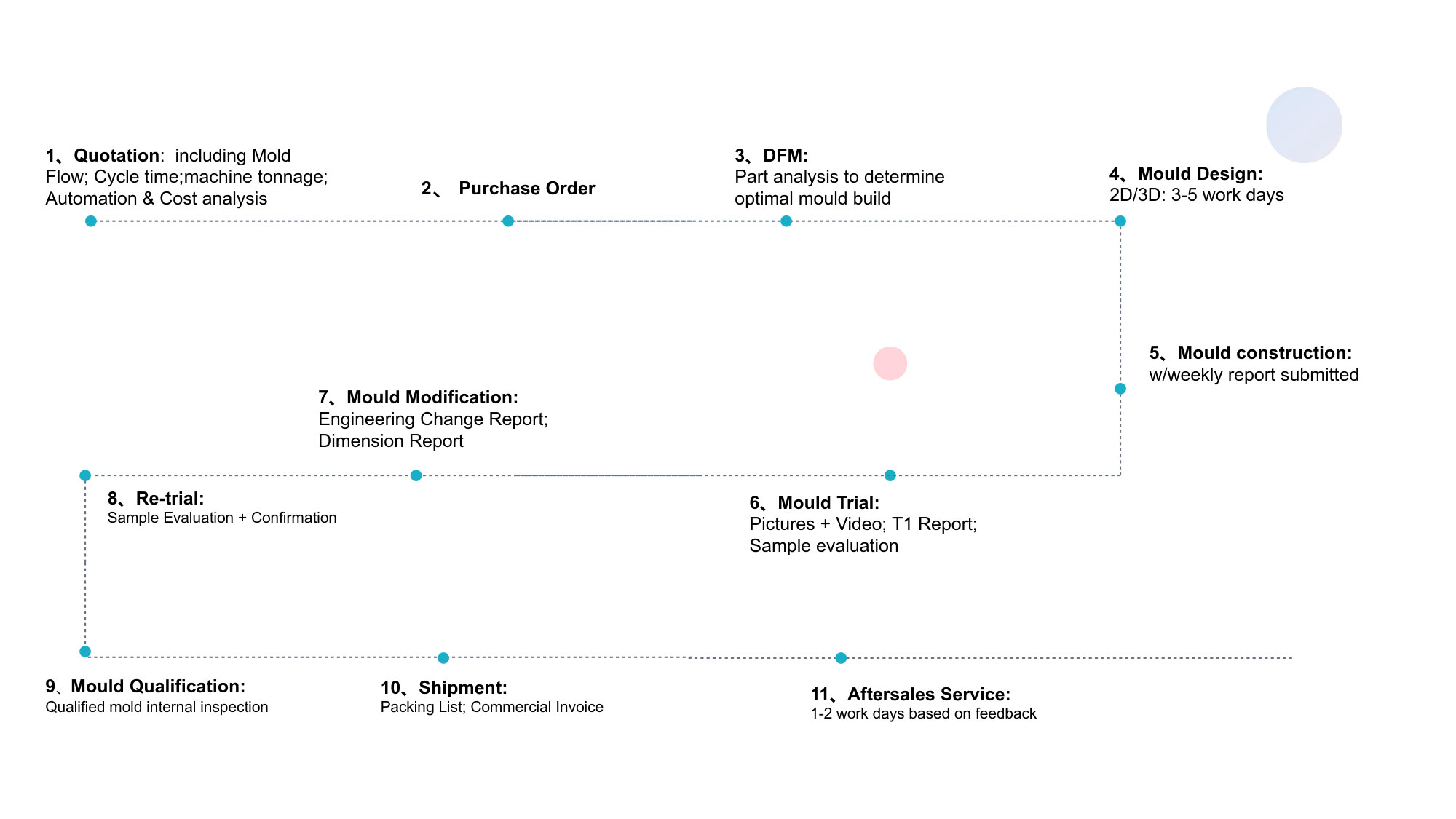
VI. Detailed Manufacturing Process Flow for 32-Cavity PCO 1810 Preform Mold
Phase 1: Project Initiation and Design
Step Activity Timeline Quality Control
1.1 Receive customer product specifications and performance requirements Day 1 Document requirements checklist
1.2 Conduct Moldflow analysis — gate location, fill simulation, weld line prediction, air trap identification Days 2–5 Compare flow patterns to PCO 1810 geometry constraints
1.3 Generate DFM report — include draft angles, shrinkage compensation, ejector placement, cooling channel layout Days 5–8 Internal engineering review against best practices
1.4 Customer review and approval Days 9–12 Signed design release form
1.5 Detailed 3D CAD modeling of all mold components — cores, cavities, manifold, cooling circuits, ejector system Days 13–20 Design rule check; interference detection
Phase 2: Material Procurement and Preparation
Material Component Specification Supplier Qualification
Core and cavity steel S136 ESR stainless steel — electroslag remelted for maximum homogeneity, HRC 48–52 Hardness test certificate; material composition report; ultrasonic inspection for internal defects
Mold base Chrome-plated P20 tool steel, HRC 28–32, anti-rust coated Flatness inspection; surface finish measurement
Hot runner manifold Stainless steel with multi-zone cartridge heaters Pressure test; thermal imaging for even heating verification
Valve pins SKD61 tool steel, HRC 58–60 with TiN coating for wear resistance Microhardness test; coating thickness measurement
Nozzle tips Beryllium copper for rapid thermal response, or SKD61 per customer preference Thermal conductivity test
Phase 3: Mold Manufacturing
Operation Equipment Tolerance Inspection Method
Rough machining of mold base plates 3-axis CNC milling ±0.10mm Visual, dimensional check
Semi-finish machining 5-axis high-speed machining center ±0.01mm CMM sampling
Cavity machining — rough and finish 5-axis high-speed CNC ±0.005mm 100% CMM inspection
Core pin machining — turning and grinding CNC lathe + cylindrical grinder ±0.003mm Optical comparator, air gauge
Neck ring machining Precision EDM ±0.005mm Vision measurement system
Cooling channel drilling Deep-hole drilling machine Position ±0.1mm Flow test, pressure test
EDM for complex cavity features CNC EDM with graphite or copper electrode ±0.002mm Surface finish measurement, CMM
Surface finishing — polishing Manual and automated polishing Ra ≤ 0.05μm Profilometer
Heat treatment (if applicable) Vacuum furnace HRC ±1 Hardness tester; microstructure analysis
Phase 4: Assembly and First Trial
Activity Details Success Criteria
Component cleaning and deburring Ultrasonic cleaning; manual inspection of all edges No sharp burrs; contaminant-free surfaces
Mold assembly Systematic assembly following assembly drawing All moving components operate smoothly; cooling circuits leak-free
Hot runner system integration Install manifold, heaters, thermocouples, valve gates Even temperature distribution across all zones (±1°C)
T0 trial Mount on 400–500T injection machine; run with PET Mold opens/closes properly; ejection functions; no major flash
Measurement and reporting CMM measurement of all preform dimensions Full dimensional report; CPK calculation for critical features
Phase 5: Customer Validation and Approval
Submit sample preforms from T2 trial
Provide CPK data and dimensional inspection reports
Conduct joint trial with customer‘s blow molding equipment (if available)
Obtain written customer approval
Phase 6: Packaging and Shipment
Package Component Specification
External Standard export wooden crate — water-resistant, shock-resistant
Internal Stretch film wrapping; anti-corrosive oil applied to mold surfaces before wrapping
Moisture protection Plastic waterproof film seal
Documentation Mold manual included — assembly drawings, spare parts list, maintenance schedule, cooling circuit diagrams, process settings
Phase 7: Delivery Lead Time
Mold Complexity Standard Lead Time Expedited Lead Time (additional cost)
Simple mold (basic geometry, no slides) 10 days 7 days
Medium complexity (32-cavity preform mold, standard features) 45–60 days 30–35 days
High complexity (special cooling, complex hot runner configuration) 60–75 days 45–50 days
Professional Translation: Our expedited process compresses timelines without skipping validation. Cooling and ejection function tests are still completed. Moldflow analysis is still performed. Your risk is not increased — we simply apply more resources in parallel.
VII. Injection Molding Process Optimization: Efficiency and Cost Control
Process Parameter Optimization for PCO 1810 Preforms
Parameter Recommended Range for PCO 1810 Preform (19g) Impact on Quality and Cost
Drying temperature 160–170°C, 4–6 hours PET must be dried to <50ppm moisture before molding. Inadequate drying = IV degradation, weak bottles
Melt temperature 275–285°C Higher temperature = faster filling but higher IV loss. Optimized point balances quality and cycle time
Mold temperature (cooling water) 10–15°C for water cooling Precise temperature control = consistent shrinkage, minimal warpage
Injection speed Fast profile: 100–200 mm/s Fast fill = thin, uniform wall distribution. Critical for preform concentricity
Packing pressure 60–80% of injection peak Minimizes sink marks without overpacking cavities
Cooling time 6–12 seconds (dominant cycle component) Shortest cooling time that still allows ejection without deformation
Total cycle time 13–18 seconds (depending on preform weight) Directly determines production rate and unit cost
Cycle Time Optimization Strategy
For a 32-cavity PCO 1810 preform mold, cycle time components break down as follows:
Cycle Component Typical Duration Optimization Opportunity
Mold close 1.0–1.5 seconds High-speed servo-driven machines minimize this
Injection (fill) 0.5–1.0 seconds Increased injection speed (with adequate machine power) reduces fill time
Packing 1.0–2.0 seconds Optimize packing profile — shorter = faster, but insufficient = sink marks
Cooling 6–12 seconds Largest opportunity. Conformal cooling design + low mold temperature reduces cooling time by 20–30%
Mold open 0.5–1.0 seconds Servo-driven machines again
Ejection and part removal 1.0–1.5 seconds Reliable ejection + fast robot removal
Total 10–20 seconds Optimized cooling is the key to competitive edge
Efficiency — Cost Translation
Metric Calculation Example (32-cavity, 13s cycle)
Shots per hour 3600 ÷ cycle time (seconds) 3600 ÷ 13 = 277 shots/hour
Preforms per hour Shots × cavities 277 × 32 = 8,864 preforms/hour
Preforms per 8-hour shift Hourly rate × 8 70,912 preforms/shift
Preforms per 24-hour day Hourly rate × 24 212,736 preforms/day
Preforms per year (300 days) Daily output × 300 63.8 million preforms/year
Professional Translation: A reduction of just 1 second in cycle time adds 1,450 preforms per day to your output from the same mold and machine. Over a year, that is 435,000 additional preforms — with no additional capital investment. Our cooling optimization delivers exactly that advantage.
VIII. Quality Control and Assurance System
Incoming Material Quality Control
Material Inspection Activity Standard
Mold steel (S136, P20, etc.) Hardness test (Rockwell); composition analysis via spectrometer Composition certificate; hardness within specified range
Hot runner components Electrical continuity test; thermal imaging No shorts; uniform heating
Cooling system components Pressure test (150% of operating pressure) No leaks; flow rate verified
In-Process Quality Control
Manufacturing Stage Quality Check
Rough machining Dimensional check on critical features
After heat treatment Hardness verification; flatness check
Finish machining 100% CMM inspection of core and cavity dimensions
Surface finishing Surface roughness measurement (profilometer)
Assembly Fitment verification of all moving components; cooling circuit leak test
Final Mold Inspection (Pre-Shipment)
Our final inspection protocol is comprehensive:
Inspection Category Components Acceptance Criteria
Dimensional All cavity, core, and neck finish dimensions Full-dimension report; CPK ≥ 1.33 for customer-specified critical dimensions
Surface finish Cavity and core surfaces Ra ≤ 0.05μm; no visible defects under 10x magnification
Cooling system All cooling circuits Flow test: minimum flow rate per circuit verified; pressure test: no leaks at 150% operating pressure
Hot runner system Manifold, heaters, thermocouples, valve pins Thermal imaging: temperature uniformity ±1°C across all zones
Ejection system All ejector pins, slides, lifters Smooth, uninterrupted movement; no binding
Mold base Guide pins, bushings, alignment features Clearance within specification; no binding
Documentation Mold manual, dimensional report, material certificates Complete, accurate, signed off
Production-Quality Control (During Customer’s Mass Production)
Once the mold is delivered, Ansix Tech supports your quality control efforts through:
First article inspection protocols — Recommended sampling plan for your QC team
In-process monitoring guidelines — Which parameters to track; control limits to use
Periodic maintenance checklist — What to inspect and when
Troubleshooting guide — Common defects and their root causes
Certifications and Compliance
Ansix Tech is certified to:
ISO 9001 — Quality management system
ISO 13485 — Medical device manufacturing (for projects requiring medical compliance)
IATF 16949 — Automotive industry standard
ISO 14001 — Environmental management system
BSCI — Social compliance certification
Professional Translation: Your mold is manufactured in a facility that meets the most demanding international standards — from automotive‘s IATF 16949 to medical‘s ISO 13485. The quality systems that satisfy BMW, Toyota, Medtronic, and Stryker also apply to your preform mold. No second-tier standards. No exceptions.
IX. Cost Control Advantages: Reducing Your Hard Costs
Ansix Tech reduces your total cost of ownership through five strategic cost levers:
1. Raw Material Cost Control
Approach Mechanism Savings
Bulk purchasing power Four production bases in China and Vietnam with combined annual turnover exceeding RMB 1 billion — purchasing volume that commands tier-one supplier pricing 10–15% reduction in material costs compared to smaller mold makers
Material-grade optimization We recommend the minimum steel grade that meets your performance requirements, not the most expensive option. P20 mold base vs. hardened steel? S136 ESR vs. standard S136? We select based on actual needs 20–40% reduction in material costs without compromising performance
Reduced scrap in manufacturing Precision machining from day one means fewer rejected components that need re-machining 5–8% reduction in manufacturing material waste
2. Process Efficiency Improvements
Approach Mechanism Savings
Optimized cooling reduces cycle time Conformal cooling design reduces preform cycle time by 3–5 seconds compared to conventional straight-drilled cooling channels Adds 1.1–1.8 million additional preforms per year per mold (at 300 production days) — equivalent to reducing per-unit cost by 10–20%
Hot runner eliminates cold runner waste No cold runner material to be recycled or discarded. Every gram of PET goes into preforms 15–30% reduction in material consumption per preform — or the same material volume produces more preforms
Fastest machine selection With 260 machines in 30–2,800 ton range, we select the optimal machine for each project — not the only machine available 5–10% reduction in molding machine operating costs (energy consumption, maintenance)
3. Reduced Post-Processing and Quality Costs
Approach Mechanism Savings
Flash elimination Parting line precision ≤0.005mm eliminates manual deflashing Eliminates $2,000–5,000 per 100,000 preforms in manual trimming labor
First-pass yield improvement Process validation and MES control drive first-pass yield >98% Reduces scrap costs by 50–75% compared to typical first-pass yields of 90-95%
No rework loops DFM + Moldflow reduces development iterations from 4-6 trials to 1-2 trials Saves $5,000–15,000 in trial material, machine time, and labor per project
4. Total Cost of Ownership Reduction
Cost Component Typical Industry Standard Ansix Tech Advantage Lifetime Savings (5 years / 10 million preforms)
Mold purchase price Industry benchmark Competitive pricing due to scale and vertical integration Baseline
Maintenance cost 3–5% of mold cost per year 1–2% of mold cost per year due to high-quality materials and preventive maintenance program $8,000–12,000
Downtime cost 3–5 days per year for unplanned repairs <1 day per year (spare parts package + rapid repair capability) $15,000–30,000 (depending on production value)
Scrap cost 5–10% scrap rate on new molds <2% scrap rate after validation $10,000–25,000
Energy cost Industry average machine efficiency 10–20% lower energy consumption per preform through machine optimization $5,000–10,000 annually
Total 5-year savings $40,000–80,000+
5. Geographic Cost Advantages
China-based manufacturing with four production bases providing cost-effective labor, materials, and infrastructure without compromising quality
Vietnam-based production offering alternative supply chain diversification with competitive cost structures
No middlemen — direct from manufacturer to customer eliminates distributor markups
Professional Translation: We are not just building your mold. We are analyzing your entire production system — material selection, processing parameters, quality verification — and optimizing every element to drive your unit cost down. The mold is an investment, not an expense. Our objective is to maximize your return on that investment.
X. Ansix Tech‘s Industry Experience: Reliability You Can Trust
Company Profile
Metric Value
Founded 1998
Years in injection molding 28+ years
Mold sets delivered to date 30,000+ sets
Production bases 4 (China and Vietnam)
Manufacturing floor space 200,000+ square meters
Employees 1,200+, including 200+ design engineers
Injection molding machines 260 units, 30–2,800 tons
Annual turnover >RMB 1 billion
Certifications ISO 9001, ISO 13485, IATF 16949, ISO 14001, BSCI
Key Customer Industries Served
Industry Example Applications Why They Trust Ansix
Medical devices Endoscopic components, surgical instruments, diagnostic equipment ISO 13485 + ISO 8 Cleanroom + FDA-compliant processes
Automotive interiors INS/TOM/DOD decorative components, HVAC parts, lighting IATF 16949 certification; precision multi-cavity molds
Packaging / beverage PCO preform molds, closures, thin-wall containers 32-cavity to 128-cavity preform mold expertise; cycle time optimization
Consumer electronics Housings, structural components, connectors High-precision mold manufacturing; aesthetic finish capability
Household and kitchenware Containers, utensils, small appliances High-volume production capability; cost-effective solutions
Industrial controls Enclosures, switches, protective covers Material expertise in flame-retardant and engineering grades
Track Record in Preform Molds
Ansix Tech has successfully delivered preform molds ranging from 32 cavities to 128 cavities, with neck finishes including PCO 1810, PCO 1881, ROPP, ALASKA, BPF, and 38mm standards. We understand that preform molds are not like other injection molds — they demand:
Extreme concentricity between core and cavity (≤0.03mm off-center maximum)
High-quality S136 or equivalent steel for mirror-finished cavities
Optimized gate balance for uniform cavity filling
Precise control of PET IV retention through processing
Long mold life (3–5 million shots) without performance degradation
Our engineering team has solved the unique challenges of PET preform molding through decades of experience and continuous improvement.
XI. Conclusion: Why Ansix Tech for Your 32-Cavity PCO 1810 Preform Mold
Dear customer, to us, an injection mold is not just a piece of steel. It is a revenue-generating asset — a money-printing machine for your business. When we design your 32-cavity PCO 1810 preform mold, we are simultaneously planning:
Processing robustness — So the mold arrives at your facility ready to run, not requiring days of troubleshooting
Venting paths — To eliminate gas burns and ensure clean, food-safe preforms from cycle one
Thermal balance — To minimize cycle time and maximize your daily output
Wear management — To extend mold life and protect your investment for 5+ years of production
Here is what you can expect when you partner with Ansix Tech:
Your Expectation Our Commitment
On-time delivery 45–60 day lead time for standard 32-cavity PCO 1810 molds, with expedited options available
First-time quality DFM + Moldflow analysis before steel is cut — we identify issues before they become problems
Stable production MES-connected machines + ultrasonic thickness monitoring + optional closed-loop cavity pressure control
Low operating cost Optimized cooling = shorter cycle times = more preforms per hour = lower unit cost
Long mold life S136 cores/cavities (HRC 48–52) + P20 mold base (HRC 28–32, anti-rust) + regular maintenance program
Support when you need it Spare parts package included; 24-hour emergency repair capability; lifetime at-cost repairs
Our Invitation:
We invite you to experience Ansix Tech‘s approach firsthand. Provide us with an existing product — anything from your portfolio that presents injection molding challenges. We will conduct a full DFM report demonstration on your product, showing you exactly how we identify and address potential issues:
Weld line locations and how to move them to hidden surfaces
Air trap positions and optimal venting placement
Shrinkage risks and compensation strategies
Cooling imbalance problems and conformal solutions
You will see our methodology in action before we touch your PCO 1810 preform project. No obligation. Just evidence of what we can deliver.
Contact Ansix Tech:
Email: info@ansixtech.com
Response time: Within 12 hours
Let us build your 32-cavity PCO 1810 preform mold together — a precision tool that pays for itself through efficiency, reliability, and the lowest total cost of ownership in the industry.
Ansix Tech — Turning molds into revenue since 1998.
Ansix Tech Co Ltd
If you have any plans related to 32-cavity preform mold for PCO 1810 bottle neck , you can contact us at any time. We will turn your ideas into reality, let you realize your dreams, and obtain large orders from the market. Our contact information is info@ansixtech.com. Or contact our CTO, mail: stephen@ansixtech.com
#www.ansixtech.com #ansixtech.com #32-cavity preform mold for PCO 1810 bottle neck #32-cavity preform mold for PCO 1810 bottle neck moulds #32-cavity preform mold for PCO 1810 bottle neck injection molding companies #32-cavity preform mold for PCO 1810 bottle neck Canopy Mold injection mold companies #Ansix #Ansix moulds #Ansix china #Ansix tech china #Ansix tech company #Ansix facotry #32-cavity preform mold for PCO 1810 bottle neck injection molding #32-cavity preform mold for PCO 1810 bottle neck injection tools #32-cavity preform mold for PCO 1810 bottle neck injection moulds #32-cavity preform mold for PCO 1810 bottle neck plastic mould #32-cavity preform mold for PCO 1810 bottle neck plastic tools #Ansix Tech #Ansix molds #Ansix injection molding #Ansix mold factory #injection molding 32-cavity preform mold for PCO 1810 bottle neck #Ansix mold factory #32-cavity preform mold for PCO 1810 bottle neck china #32-cavity preform mold for PCO 1810 bottle neck molds #injection factory #32-cavity preform mold for PCO 1810 bottle neck injection molding #32-cavity preform mold for PCO 1810 bottle neck injection molding factory #injection molding company #32-cavity preform mold for PCO 1810 bottle neck injection mold companies #32-cavity preform mold for PCO 1810 bottle neck#32-cavity preform mold for PCO 1810 bottle neck mold limited #Ansix mold china #Ansix companies #Ansix company China #32-cavity preform mold for PCO 1810 bottle neck facotry #Ansix Tech #Ansix Tech mould #32-cavity preform mold for PCO 1810 bottle neck injection moulding #injection moulding company #Ansix 32-cavity preform mold for PCO 1810 bottle neck parts injection mold companies #medical injection molding companieschina #32-cavity preform mold for PCO 1810 bottle neck china factory #Ansix moulding companies #Ansix molding company #32-cavity preform mold for PCO 1810 bottle neck injection moulding facotry #Ansix Tech mold #32-cavity preform mold for PCO 1810 bottle neck mould #32-cavity preform mold for PCO 1810 bottle neck plastic injection molding #ansix plastic mold #Mold manufacturing #32-cavity preform mold for PCO 1810 bottle neck parts manufacturing #32-cavity preform mold for PCO 1810 bottle neck plastic parts factory #32-cavity preform mold for PCO 1810 bottle neck injection parts mold #32-cavity preform mold for PCO 1810 bottle neck PRECISION MANUFACTURING #32-cavity preform mold for PCO 1810 bottle neck #China mold #32-cavity preform mold for PCO 1810 bottle neck injection moulding china #32-cavity preform mold for PCO 1810 bottle neck mould china #china precision mold #mold in china #32-cavity preform mold for PCO 1810 bottle neck mold china #Precision molds #High-precision molds #32-cavity preform mold for PCO 1810 bottle neck #Injection molds #32-cavity preform mold for PCO 1810 bottle neck Factory #32-cavity preform mold for PCO 1810 bottle neck Company #Super Large Injection Mold Factory #Large Tonnage Injection Molding Factory #32-cavity preform mold for PCO 1810 bottle neck Company #32-cavity preform mold for PCO 1810 bottle neck Factory #2800T Injection Molding Factory #3000 Ton Injection Molding #4500 Ton Injection Molding Factory #Large Mold Injection Molding #Large Plastic Mold Injection Molding Factory #Large Injection Mold Manufacturer #Plastic Mold Factory #Injection Mold #Plastic Mold