



4-cavity wide-mouth bottle preform mold
FEATURES
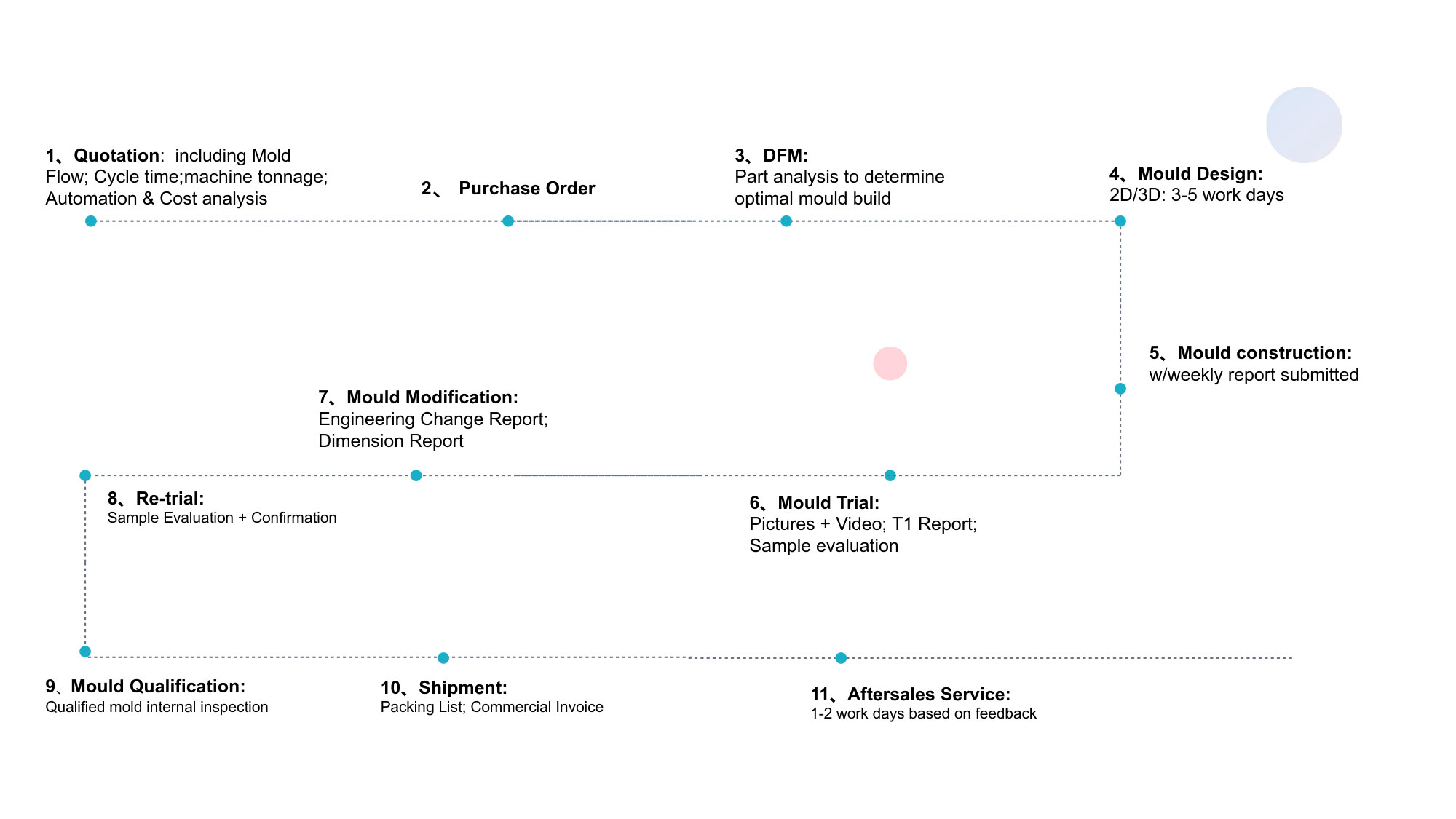
Manufacturing Process
1. Pre-Production Design Engineering
At Ansix, every 4-cavity wide-mouth bottle preform mold begins with a comprehensive Design for Manufacturing (DFM) report. This collaborative engineering phase involves:
Product Feasibility Analysis: Engineers evaluate each angle, wall thickness, and draft angle of the proposed bottle design. Uniform wall thickness (typically between 0.8mm and 3.8mm, depending on the plastic material) is strictly enforced to prevent sink marks and warpage. Draft angles (minimum 1–2 degrees) are carefully designed to ensure smooth part ejection without surface drag marks.
Mold Flow Simulation: Advanced CAE software, including MoldFlow analysis, is employed to predict melt front advancement, identify weld line and air trap locations, and optimize the balance of the hot runner system. For wide-mouth preforms, the simulation specifically addresses the unique challenge of filling thick sections uniformly without inducing premature gate freeze or internal stresses.
-
Mold Description
Product Materials:
pet petg
Mold Material:
S136ESR
Number of Cavities:
1*4
Glue Feeding Method:
Hot runner
Cooling Method:
Water cooling
Molding Cycle
22.5s
- The mold manufacturing process and product material selection
Raw Material Selection
The selection of mold steel is a critical determinant of mold life, part quality, and overall production economics.
Cavity and Core Materials:
S136 (Stavax ESR / 1.2083): Premium stainless mold steel with excellent corrosion resistance (Cr content 13.5%), superior mirror-finish capability (achieving Ra < 0.05μm), and high wear resistance. S136 is the preferred material for transparent PET preforms where optical clarity and surface finish are non-negotiable. The high chromium content provides exceptional corrosion resistance against acidic byproducts generated during PET degradation.
H13 / 1.2344 (SKD61 equivalent): High-performance hot-work tool steel offering outstanding hardness (48–52 HRC), superior thermal fatigue resistance, and excellent high-temperature strength. H13 contains molybdenum and vanadium in significantly higher quantities than S136, providing enhanced wear resistance and making it the optimal choice for glass-filled or abrasive engineering plastics.
2344 Super / 8407: Premium-grade hot-work steel with enhanced polishability and toughness, ideal for applications requiring high cycle counts (over 2 million shots) and minimal maintenance.
-
NAK80: Pre-hardened steel (37–43 HRC) with exceptional mirror-finish capability, used for applications requiring surface precision without post-machining heat treatment.
Mold Plate Materials:
P20 (1.2311 / 1.2738): Pre-hardened chromium-molybdenum steel delivered at HRC 28–33, offering machinability without the need for post-machining heat treatment. This material is used for mold bases and support plates, balancing cost, machinability, and dimensional stability.
4Cr13 / 2316: Martensitic stainless steel with good corrosion resistance (HRC 45–48), specified for threaded port components and other high-wear insert areas.
Hot Runner Components:
Valve pins fabricated from precision-ground Japanese tool steel.
Heating elements sourced from German manufacturers (band heaters on sprue bushings and runner system components).
Insulation pads utilizing DuPont materials to prevent heat transfer to the mold base.
3. Injection Molding Equipment Considerations
The 4-cavity wide-mouth preform mold is designed for compatibility with PET-specific injection molding machines. Typical specifications include:
Clamping force requirements: 170 to 650 tons, with reinforced clamping structures specifically designed for wide-mouth applications.
Screw design: PET-optimized screws with L/D ratios of 24:1 or 25:1, featuring chrome-plated surfaces, low-speed high-torque hydraulic motors, and differential injection cylinder designs.
Dedicated holding pressure systems for wide-mouth geometry compensation.
4. Mold Processing and Fabrication
The manufacturing workflow for a 4-cavity wide-mouth bottle preform mold follows a systematic, quality-controlled sequence:
Step 1: Rough Machining
The mold base (typically P20) is rough-machined using high-speed CNC milling to establish reference datums, cavity pockets, cooling water channels, and ejector plate assemblies.
Step 2: Precision Machining of Core and Cavity Inserts
High-Speed 5-Axis Machining: Makino five-axis vertical machining centers capable of achieving volumetric accuracy of less than 2 microns (0.002mm) total are employed for complex 3D contouring of cavity surfaces. The 5-axis continuous machining technology delivers cycle time reductions of up to 70% compared to traditional 3-axis workflows, while providing flawless blends and matches on contoured surfaces.
Slow Wire EDM: For fine features such as micro-holes (0.03mm diameter), narrow slots, and sharp internal corners, slow-speed wire electrical discharge machining (EDM) ensures precise geometry without inducing burrs or mechanical stress.
Mirror EDM for High-Gloss Finishes: For applications requiring optical clarity in the final PET preform, mirror-finish EDM is employed on cavity surfaces requiring fine-grained texture or superior surface finish.
Step 3: Heat Treatment and Hardening
Following rough and semi-finish machining, cavity and core inserts undergo controlled vacuum heat treatment:
S136 and H13 inserts: Hardened to 48–52 HRC through a multi-stage process including preheating, austenitizing, quenching, and double tempering.
Threaded port inserts (nitrided steel): Surface hardness exceeding HRC 60 through gas nitriding for superior wear resistance.
Step 4: Finish Machining and Polishing
Post-heat treatment, the hardened inserts undergo finish machining to achieve final geometry, followed by systematic polishing:
Surface Finish Specification: Ra ≤ 0.05μm for optical-grade preforms; Ra ≤ 0.1μm for general-purpose transparent preforms.
Progressive Polishing Process: Starting with EDM finish, progressing through 400–1,200–3,000–6,000 grit diamond compound, final micro-finish using colloidal silica suspension.
Step 5: Hot Runner Integration
The hot runner system is precisely aligned and integrated into the mold assembly. Key features include:
Valve-gate hot runner system for tailless preform production with precisely controlled gate vestige (typically ≤ 0.5mm remaining).
Independent temperature control zones for each nozzle, ensuring uniform melt temperature across all four cavities.
Shut-off valve gate system for wide-mouth applications, pneumatically controlled to ensure identical pressure and PET flow ratio for each cavity.
Step 6: Cooling System Implementation
The cooling system is critical for cycle time optimization and dimensional stability:
Conformal Cooling Channels: Coolant channels designed to follow the contour of the cavity surface, providing faster and more uniform heat transfer compared to conventional straight-drilled channels.
Multi-Zone Temperature Control: The mold is equipped with multiple coolant circuits allowing independent temperature regulation of core and cavity, with zone temperature differentials maintained within 2°C to minimize part warpage.
High-Flow Design: Generous coolant port sizing (typically 12mm or larger) and optimized channel routing ensure turbulent flow conditions (Reynolds number > 4,000) for maximum heat extraction efficiency.
Step 7: Assembly and Fitting
Final assembly involves precision fitting of all moving components:
Multi-stage double taper positioning technology ensures mold concentricity with eccentricity maintained within 0.05–0.06mm.
Slide-type independent self-locking mechanisms prevent cavity separation under injection pressure.
All inter-changeable inserts (cores, neck rings, valve pins) are ground to interchangeable tolerances, allowing quick maintenance without requiring individual fitting.
5. Mold Validation and Pre-Delivery Testing
Before shipment, every 4-cavity wide-mouth bottle preform mold undergoes a rigorous validation protocol:
T0 (First Trial): Initial molding trials to verify basic function, cavity filling balance, and ejection performance.
T1–T3 (Iterative Trials): Subsequent trials with progressive optimization of process parameters, including:
Injection pressure profile adjustment
Holding pressure and time optimization
Cooling system performance verification
Gate vestige measurement and refinement
2000-Stroke Production Test: The mold is run continuously for 2,000 injection cycles under production conditions to simulate real-world wear patterns, identify any progressive alignment or wear issues, and validate shot-to-shot consistency.
Full Dimensional Inspection: Every critical feature of the preforms produced is measured using coordinate measuring machines (CMM) and optical comparators, with results documented in a full dimensional report.
6. Packaging and Rapid Delivery
Packaging Protocol: Each mold receives anti-rust oil application to all exposed surfaces, followed by stretch waterproof film wrapping, then placement in standard export wooden cases.
Delivery Time Standard: 40 working days from purchase order confirmation, with expediting available for time-critical projects (compressible to 20 working days without compromising validation steps).
Quality Assurance
Ansix maintains a multi-tiered quality management system ensuring consistent, repeatable mold performance:
In-Process Quality Control:
Three-Axis CMM Inspection: Every cavity and core insert is subjected to in-process CMM verification at rough, semi-finish, and finish stages.
Optical Inspection: 100% visual and dimensional inspection using digital microscopes and optical comparators for fine features such as gate surfaces and ejection pin bosses.
Tooling Certification: Upon completion, each mold is accompanied by:
Full dimensional report comparing as-machined dimensions against drawing specifications.
Steel material certification (mill certificates and heat treatment process records).
2,000-stroke mold wear report documenting cavity surface condition, gate vestige degradation, and cooling performance.
Performance Guarantees:
Mold Life Warranty: For PET preform applications, the mold is guaranteed for 2 million shots with proper maintenance, with structural components (mold base and main plates) warranted for 3 years against fatigue failure.
Dimensional Stability: All molded preforms produced during mold validation exhibit CPK ≥ 1.33 for critical dimensions (neck finish diameter, body wall thickness uniformity, and preform length).
Most Competitive Cost Control Advantages
1. Cavity Count Optimization
The 4-cavity configuration represents the optimal balance between capital investment and per-part cost for many wide-mouth preform applications:
While a 4-cavity mold costs significantly less than 8-, 12-, 16-, or 48-cavity configurations, it still multiplies hourly output by 4× compared to single-cavity production.
For moderate annual volumes (2–5 million preforms per year), the 4-cavity mold avoids the diminishing returns of higher cavitation where incremental productivity gains fail to justify proportionally higher mold costs.
2. Strategic Material Selection
P20 is used for mold plates and non-wear components (P20 costs approximately 40–70 RMB/kg for domestic grades), while premium S136 (120–180 RMB/kg for imported grades) is reserved for cavities and cores where its properties provide tangible value.
Material cost typically represents only 15–25% of total mold cost, with labor accounting for 40–50%. Ansix’s high-efficiency machining and assembly processes directly control these labor-intensive cost drivers.
3. Production Efficiency Advantages
Cycle time for wide-mouth PET preforms on a properly designed 4-cavity mold ranges from 25 to 33 seconds, depending on preform weight and wall thickness. Optimized cooling channel design can reduce cycle times by 5–7%, directly increasing daily output.
A reduction of just 1 second in cycle time on a 4-cavity mold running 24/7 yields approximately 145,000 additional parts per year.
4. Reduced Waste and Rework Costs
Properly balanced hot runner design eliminates cavity-to-cavity weight variation, reducing rejection rates due to out-of-spec preforms.
Self-locking mold cavity design and multi-stage taper positioning technology maintain eccentricity within 0.05–0.06mm, significantly reducing post-molding threading or trimming operations.
Valve-gate hot runner produces tailless preforms, eliminating gate trimming operations entirely.
5. Rapid Turnaround and Reduced Total Cost of Ownership
Delivery time of 40 working days from order accelerates customers’ time-to-market.
Interchangeable insert design reduces maintenance turnaround time; typical cavity/core replacement performed in under 4 hours on the production floor.
Extended mold life (2 million+ shots) amortizes initial investment over longer production runs, reducing per-unit tooling cost to minimal levels.
Part 2: Core Customer Value in Mold Manufacturing, Material Selection, Smart Manufacturing Integration, Efficiency Enhancement, and Process Quality Assurance
4-Cavity Wide-Mouth Bottle Preform Mold: Translating Technical Capabilities into Customer Value
At Ansix Tech, we understand that our customers do not purchase mold steel, machining hours, or injection molding machines. They purchase production reliability, cost predictability, and business risk reduction. The following framework translates technical capabilities into concrete customer value across five critical dimensions.
I. Hard Infrastructure: Building Customer Trust Through Equipment Capability
Translating “We have advanced equipment” into: “Your parts will be manufactured consistently and affordably.”
Mold Processing Equipment
Technical Specification Customer Value Translation
5-Axis High-Speed Machining Centers (Makino D200Z) capable of achieving ±0.002mm volumetric accuracy on complex 3D contoured surfaces Your preform’s parting line will be smooth and free of flash or witness marks — eliminating secondary deburring operations and reducing your per-part finishing costs
Slow Wire EDM capable of machining 0.03mm fine holes and narrow slots Intricate geometries such as venting slots and cooling micro-channels are machined without burrs or heat-affected zones, maintaining thin-wall integrity and eliminating risk of stress cracking
Multi-Face Positioning and One-Setup Machining completes entire mold cavity in a single clamping Cycle time reduction of up to 40% in mold manufacturing — passed directly to you as faster delivery and lower mold cost
Thermal Compensation System (±0.003mm correction per hour) on all precision machining equipment Machining accuracy is maintained regardless of ambient temperature fluctuations or continuous run times — your mold components are dimensionally consistent from first operation to final assembly
Injection Molding Machine Park
Technical Specification Customer Value Translation
Full-Servo Electric Drive Injection Molding Machines (FANUC, Sumitomo, Toshiba, Arburg) with repeatability accuracy of ±0.1% Every shot in your mass production run is identical to the first — you receive consistent preform weights, uniform wall thicknesses, and predictable downstream blow-molding performance, run after run
Clamping force range from 30 tons to 4000 tons, with reinforced clamping structures for wide-mouth applications We have the capability to run any preform size or shot weight you require — from 6g cosmetic preforms to 400g industrial jar preforms — without you needing to qualify multiple mold suppliers
PET-Optimized Injection Units with 24:1 or 25:1 L/D screws and chromium-plated surfaces Your PET material is plasticized uniformly, eliminating degradation zones and black spec contamination — your preforms maintain optical clarity and food-grade compliance
Inspection and Quality Equipment
Technical Specification Customer Value Translation
Coordinate Measuring Machines (CMM) with laser scanning capability Each mold cavity is verified against your print before shipment — any deviation is documented, corrected, or communicated — no surprises when you receive your mold
Optical Comparators and Digital Microscopes for fine feature inspection Micro-features such as gate vestiges (≤0.5mm residual), venting land dimensions, and ejection pin surface conditions are verified to specification — no hidden defects that could cause premature mold failure
Full Dimensional Report and CPK Documentation with CPK ≥ 1.33 for all critical dimensions You have auditable proof that your mold meets specifications — supporting your own customer certifications, regulatory compliance, and internal quality audits
II. Injection Molding Process Control: Eliminating Your Quality Anxiety
Translating “We have process controls” into: “Your rejects are minimized and your yields are maximized.”
Parameter Lockdown and MES Integration
All injection molding machines are networked to a Manufacturing Execution System (MES) that locks critical processing parameters — including melt temperature, injection pressure profile, holding pressure, cooling time, and screw speed — with access restricted to authorized engineering personnel.
Customer Value: Your production is protected against unauthorized operator adjustments that could cause dimensional drift, surface defects, or batch-to-batch inconsistency. Every shift produces parts within the validated process window.
Real-Time In-Mold Monitoring
For high-volume applications, Ansix offers cavity pressure sensors embedded within the mold, connected to real-time monitoring systems such as Kistler ComoNeo:
Value Delivered: Pressure curves for every shot are recorded and compared to the validated signature — any deviation triggers an immediate alert, allowing corrective action before a single reject is produced.
Dimensional Stability Control Through Temperature Management
The mold is equipped with multi-zone temperature controllers and dedicated mold temperature regulators, maintaining core-cavity temperature differentials within 2°C:
Eliminates: Warpage, sink marks, and dimensional instability caused by uneven cooling.
Delivers: Preforms with uniform wall thickness (±0.02mm variation) and consistent blow-molding performance across entire production runs. For a typical wide-mouth jar preform, key dimensional fluctuations are maintained within 0.02mm over three successive production batches.
Defect Prevention Through Scientific Molding
Common customer concerns and corresponding engineering solutions:
Customer Concern Engineering Solution Value Delivered
Sink marks on thick sections Optimized holding pressure profile and extended cooling with compensation Eliminated cosmetic defects — no scrap, no rework
Flash at parting lines Self-locking mold design with 0.005mm parting line fit precision Flash limited to ≤0.03mm — manual deflashing eliminated
Weld lines visible on finished bottles Mold flow analysis pre-optimized gate locations and runner balance Transparent preforms with no visible flow marks
Air traps causing burn marks Strategic venting placement guided by mold flow simulation Clear, unblemished preforms suitable for premium packaging
Material Drying and Quality Assurance
PET is hygroscopic and must be dried to ≤ 50 ppm moisture before injection:
Process Control: Dry air drying systems maintaining dew points between -30°C and -40°C ensure PET pellets enter the injection unit at specification moisture levels.
Value Delivered: Eliminates IV degradation (reduction in intrinsic viscosity), prevents hydrolytic chain scission, and ensures your preforms meet mechanical property and optical clarity requirements.
III. Smart Manufacturing Integration and Efficiency Enhancement
Automation and Connectivity
Machine Connectivity: All injection molding machines are networked for real-time cycle time monitoring — preventing unauthorized adjustments that could cause process deviation.
Online SPC Integration: Critical quality characteristics are monitored in real-time, with statistical process control charts automatically updated after each shot.
Efficiency Gains Quantified
Efficiency Driver Customer Benefit
4-cavity configuration yields 4 parts per shot, increasing hourly output while cycle time remains nearly constant compared to single-cavity Your capital equipment (injection molding machines) produces more parts per hour, reducing your per-part fixed cost allocation
Optimized cooling channel design reduces cycle time by 5–7% On a 33-second baseline cycle, this yields approximately 1.5 extra shots per hour — over one year of continuous production, tens of thousands of additional preforms without additional capital investment
Valve-gate hot runner eliminates gate trimming Your downstream process receives tailless preforms — no secondary trimming operation, no trim waste disposal cost, no manual handling labor
IV. Process Quality Assurance: Reducing Your Risk
Translating “We follow quality procedures” into: “Your production will not be interrupted by mold failures.”
Four-Stage Quality Validation Protocol
Stage 1: Pre-Production DFM (Design for Manufacturing)
Activity: Collaborative design review including dimensional feasibility, draft angle verification, gate location optimization, and ejection system planning.
Customer Value: Potential molding problems (sink marks, air traps, warpage, difficult ejection) are identified and resolved before steel is cut — eliminating costly mold modifications after delivery.
Stage 2: In-Process Quality Gates
Activity: CMM inspection at rough, semi-finish, and finish stages of all cavity and core components.
Customer Value: Non-conforming components are identified early, before assembly — your delivery schedule is not disrupted by last-minute rejections.
Stage 3: Pre-Delivery Mold Validation
Activity: T0 through T3 molding trials followed by 2000-stroke production simulation.
Customer Value: You receive a mold that has already been proven under production-like conditions — first parts off your machine are good parts, not debugging samples.
Stage 4: Accompanying Documentation
Activity: Full dimensional report, steel material certificates, heat treatment records, CPK data, and wear assessment report delivered with the mold.
Customer Value: You have complete traceability for your own quality management system — supporting ISO certifications, customer audits, and regulatory submissions.
Part 3: Comprehensive Manufacturing Solution for 4-Cavity Wide-Mouth Bottle Preform Mold
Project Initiation at Ansix Tech: From Technical Specifications to Customer Value Delivery
Ansix Tech brings over 28 years of specialized experience in mold design, precision manufacturing, and injection molding production to every 4-cavity wide-mouth bottle preform mold project. The following comprehensive framework translates every technical capability — from equipment selection to quality validation — into measurable customer value.
Section One: Demonstrated Hard Infrastructure (Building Customer Confidence Through Equipment Foundation)
Mold Processing Equipment
The Capability: Ansix is equipped with Makino five-axis high-speed machining centers capable of achieving ±0.002mm volumetric accuracy on complex 3D contoured geometries. Five-axis continuous machining technology delivers up to 70% reduction in cycle time for complex contoured surfaces, coupled with 33.3% accuracy improvement over conventional 5-axis platforms.
The Customer Value:
Your preform’s parting line will be smooth and free of witness marks — eliminating secondary finishing operations and reducing your per-part production cost.
Complex geometries such as tapered neck finishes and contoured cavity surfaces are machined in a single setup, eliminating misalignment errors that could cause preform eccentricity.
The enhanced surface finish from 5-axis machining reduces polishing time, accelerating your delivery.
The Capability: Slow wire EDM is available for machining of fine holes down to 0.03mm diameter and narrow slots with tapered relief.
The Customer Value:
Venting slots and ejection pin bosses are machined without burrs, heat-affected zones, or mechanical stress — eliminating risk of stress cracking in thin-wall sections of your preform.
The Capability: High-rigidity, thermally symmetrical machining structure with integrated thermal compensation (±0.003mm correction per hour).
The Customer Value:
Machining accuracy is maintained regardless of ambient temperature fluctuations or continuous run durations — your mold components are dimensionally consistent from first operation through final assembly.
Injection Molding Machine Park for Validation
The Capability: Ansix maintains a fleet of high-end injection molding machines spanning 30 to 4000 tons clamping force, including FANUC, Sumitomo, Toshiba, and Arburg all-electric servo-driven machines. For wide-mouth PET preform applications, the clamp force range of 170–650 tons with reinforced clamping structure is specifically optimized. All machines feature PET-optimized screw designs with 24:1 or 25:1 L/D ratios and chromium-plated surfaces for uniform plasticization without material degradation.
The Customer Value:
The 4-cavity wide-mouth preform mold is validated on production-class machines that replicate your actual manufacturing environment — not on laboratory equipment that fails to reveal real-world molding challenges.
Cycle times are validated during T0–T3 trials, not estimated — you receive reliable production rate data for your capacity planning.
Full-servo drive machines achieve shot-to-shot repeatability of ±0.1% — every preform produced during validation is representative of what you will produce in mass production.
Inspection and Metrology Equipment
The Capability: Coordinate measuring machines (CMM) with full-geometry scanning capability; optical comparators and digital microscopes for fine-feature inspection.
The Customer Value:
Full dimensional report with CPK ≥ 1.33 for all critical features (neck finish dimensions, body wall thickness uniformity, preform length) is delivered with your mold — you have auditable proof that the mold meets print specification.
Section Two: Mold Design and Material Selection — Strategic Choices That Reduce Your Total Cost of Ownership
The True Cost of Mold Steel Selection
Mold steel selection is often treated as a commodity decision: customers ask “How much is the mold?” without understanding how steel choice drives long-term production economics. At Ansix, we guide customers through a data-driven selection process based on three criteria: production volume, resin chemistry/abrasiveness, and surface finish requirement — in that order.
The Capability — Strategic Steel Portfolio:
Material Hardness (HRC) Best Application Customer Value
P20 (1.2311/1.2738) — pre-hardened chrome-molybdenum steel — delivered at HRC 28–33 28–33 Unfilled PET preforms, moderate volumes (<500,000 shots per cavity) Lowest initial tooling cost; no post-machining heat treatment required (saves 5–10 days of lead time and eliminates distortion risk)
718H — upgraded P20 variant with higher hardness 32–38 Enhanced wear resistance for slightly abrasive resins; moderate-to-high volumes (500,000–800,000 shots) Extended tool life compared to standard P20 without S136 cost premium
H13 / 1.2344 / SKD61 — hot-work tool steel — hardened to 48–52 HRC after machining 48–52 Glass-filled resins, abrasive polymers, high-temperature engineering plastics, volumes exceeding 1 million shots Exceptional wear resistance and thermal fatigue resistance — your mold survives glass-fiber reinforced materials without premature cavity wear
S136 (Stavax ESR / 1.2083) — premium stainless steel — Cr content 13.5% 48–52 Corrosive resins (PVC, POM, flame-retardant ABS), optical/medical applications requiring mirror-polished surfaces, high-volume PET preforms with <0.1μm Ra surface finish Superior corrosion resistance (pH resistance to acidic PET degradation byproducts); achieves Ra≤0.05μm mirror finish for transparent preforms with optical clarity
NAK80 — pre-hardened mirror-finish steel 37–43 Applications requiring superior surface finish without heat treatment cycle Fastest lead time for mirror-finish applications; eliminates distortion risk from heat treatment
Steel Cost-to-Value Analysis:
Steel Comparison P20 → H13 H13 → S136
Material cost premium H13 adds 25–40% to steel cost S136 adds 60–90% to steel cost over P20 baseline
Total mold cost impact +25–40% +40–60% over P20 (including machining and heat treatment)
Tool life benefit Extended to 1M+ shots (vs. 500K for P20 with abrasive resins) Extended to 2M+ shots; corrosion resistance prevents gate/orifice degradation
When to justify Glass-filled resins; volumes >500K/year Transparent preforms requiring optical clarity; corrosive materials; medical/pharma applications
The Customer’s Bottom Line: Steel selection drives approximately 30–40% of total tooling cost. Over-specifying steel for low-volume, unfilled applications adds unnecessary cost. Under-specifying steel for high-volume or abrasive applications results in premature tool failure, production interruptions, and mold repairs costing 3–5× the original steel premium. Ansix engineers provide unbiased steel recommendations based on your actual application requirements — we do not up-sell premium steel where it provides no tangible benefit.
Hot Runner System Design
The Capability: The 4-cavity wide-mouth preform mold is equipped with a valve-gate hot runner system featuring independent temperature control for each nozzle, multiple heating zones per cavity, and pneumatic shut-off valve actuation.
Technical Feature Customer Value
Balanced flow design ensuring equal pressure and PET flow ratio across all 4 cavities Every preform from cavities 1 through 4 has identical weight (±0.5% variation), uniform wall thickness distribution, and consistent blow-molding performance — no “bad cavity” rejects
Independent nozzle temperature control with individual thermocouples Cavity-to-cavity melt temperature variation is eliminated — each preform is processed under optimized conditions regardless of its position in the mold
Valve gate actuation producing tailless preform finish No gate stub to trim — secondary finishing operation eliminated; no gate-removal scrap generation; reduced manual handling cost
Thermal insulation pads using DuPont materials between hot half and cold half Minimal heat transfer to mold base — shorter cooling time, faster cycle, higher daily output
Cooling System Design for High-Volume Production
The Capability: Ansix employs conformal cooling channel design — cooling passages that follow the contour of the cavity surface — producing faster and more uniform dynamic heat transfer within the mold.
Technical Feature Customer Value
Conformal cooling channels following cavity contour Cooling is uniform across preform surface — eliminates hot spots that cause dimensional distortion and sink marks; reduces cycle time by 5–7% compared to conventional cooling designs
Multi-zone temperature control with core-cavity temperature differential ≤2°C Preforms are cooled symmetrically — warpage minimized; downstream blow-molding produces round bottles without ovality issues
Turbulent-flow coolant routing (Reynolds number > 4,000) Maximum heat extraction efficiency — shortest cooling time achievable without sacrificing dimensional stability
Runner and Feed System Balance
The Capability: Precision-balanced runner system with identical flow lengths and cross-sections from sprue bushing to each cavity gate.
The Customer Value: Shear heating is uniform across all four cavities — eliminating viscosity variation that would otherwise cause cavity-to-cavity filling imbalance. All preforms are produced with consistent molecular orientation, ensuring uniform stretch blow-molding behavior.
Ejection System Design
The Capability: Multi-point ejection system with precision-located ejection pins distributed around each preform’s neck finish and base.
The Customer Value: Preforms are ejected without deformation, surface marking, or eccentricity. The ejection pin location is pre-discussed and approved via DFM — you know exactly where witness marks will appear on your final preforms, allowing you to position them in non-cosmetic areas.
Section Three: Injection Molding Process Control — Eliminating Quality Anxiety
The Three Most Common Customer Quality Concerns and Ansix’s Engineered Responses
Concern 1: “My parts have sink marks in thick sections.”
Ansix Solution: Multi-stage injection pressure profiling and extended holding pressure with compensation, guided by MoldFlow simulation that identified sink-prone areas before mold construction. Optimized cooling channel placement accelerates solidification of thick sections, preventing post-ejection shrinkage.
Value Delivered: Sink marks eliminated at source — zero cosmetic rejects, zero rework cost.
Concern 2: “I have flash at the parting line after every mold change.”
Ansix Solution: Parting line machined to 0.005mm flatness across entire cavity area. Self-locking cavity clamping with multi-stage taper positioning (eccentricity ≤0.06mm) prevents cavity separation under injection pressure.
Value Delivered: Flash limited to ≤0.03mm across entire production run — manual deflashing eliminated; automated downstream processing enabled; material waste from flash minimized.
Concern 3: “Dimensional consistency batch-to-batch is unreliable.”
Ansix Solution: All injection molding parameters locked in MES with engineering-only access. In-mold cavity pressure sensors with real-time process monitoring (e.g., Kistler ComoNeo) and online SPC integration.
Value Delivered: Dimensional CPK ≥1.33 maintained across shifts, across production batches, across months of continuous operation — your downstream assembly operations run without manual sorting or rework.
Defect Prevention by Design
Common Preform Defect Root Cause Ansix Prevention Method
Haze / poor transparency Moisture in PET >50 ppm or degraded material Dew point-controlled drying system (-30°C to -40°C); PET-optimized screw prevents material stagnation
Black spec contamination Material degradation in hot runner dead zones Valve-gate design eliminates material stagnation; thermal analysis ensures no hot spots
Eccentric core Mold misalignment during clamping Multi-stage double taper positioning with independent cavity clamping
Burn marks Air trapped in cavity unable to escape Strategic venting placement at mold flow simulation-identified air trap locations
Wavy body Uneven cooling causing variable shrinkage Conformal cooling channels with multi-zone temperature control
Appearance Grade Specifications
Requirement Ansix Capability
Transparent parts (optical clarity) Cavity surface finish Ra ≤0.05μm — no haze, no flow marks, no visible weld lines
High-gloss surfaces Mold polished to SPI A-1 (mirror) grade achievable (Ra <0.05μm)
Textured surfaces EDM or chemical texturing to specification — uniform grain depth across all cavities
Engineering Plastic Molding Capabilities
Ansix has successfully molded the following materials in 4-cavity wide-mouth preform applications:
Standard resins: PET, PP, PE, HDPE
Engineering-grade: PC, PC/ABS, PA6+GF30, PBT
High-performance: PPS+40%GF, PEEK, PEI, LCP
Specialty: PTFE/PFA, Liquid Silicone Rubber (LSR)
For each material, we provide: Drying specifications, mold temperature recommendations, injection pressure profiles, and post-molding annealing requirements where applicable.
Section Four: End-to-End Service Delivery — Reducing Your Management Cost
Phase 1: Pre-Production DFM (Design for Manufacturing) — Preventing Problems Before Steel Is Cut
The Capability: Ansix provides a comprehensive DFM report before any manufacturing begins. This includes:
Moldability analysis of part geometry (draft angles, wall thickness, radii, undercuts)
Gate location and number recommendations with justification
Ejection pin placement with witness mark location mapping
Material-specific shrinkage compensation calculations
Cooling system efficiency estimation
Hot runner configuration and nozzle layout
The Customer Value:
Problems are solved in engineering software, not on machined steel — eliminating costly design changes after mold completion.
You approve all design decisions before manufacturing starts — no surprises, no disputes.
The DFM report serves as a communication bridge between your product engineers and Ansix mold designers.
Phase 2: Transparent Quoting and Design Concept
The Capability: For each 4-cavity wide-mouth preform mold, Ansix provides:
Cavity count recommendation based on your annual volume and desired ROI
Steel grade recommendation based on resin type, volume, and surface finish requirements
Hot runner specification (valve gate vs. open gate) with justification
Delivery schedule with milestones for DFM review, mold completion, T0 trial, and shipment
The Customer Value: You receive a solution optimized for your specific production requirements — not a standard mold that may be over-specified (costly) or under-specified (risky).
Phase 3: T0–T3 Validation with Sample Delivery
The Capability: Following mold completion, Ansix conducts up to three validation trials:
Trial Purpose Deliverable
T0 (First Shot) Verify basic mold function: filling balance, ejection, cooling First-article preforms; preliminary dimensional data
T1 Optimize process parameters — injection pressure, holding pressure, cooling time Optimized process sheet; full dimensional report
T2–T3 Fine-tune and validate repeatability CPK data for critical dimensions; process capability statement
The Customer Value: You receive preforms and process documentation before the mold leaves Ansix — no “debugging period” on your production floor.
Phase 4: Low-Volume Pre-Production Run (Optional)
The Capability: For customers needing validation under high-volume conditions, Ansix offers pre-production molding of 100 to 500 shots per cavity.
The Customer Value: You confirm mold performance, part quality, and cycle time before committing to high-volume production on your own equipment — risk-free technology transfer.
Phase 5: Maintenance, Spare Parts, and Technical Support
The Capability: Each 4-cavity wide-mouth preform mold is shipped with:
Included Item Purpose
Spare ejection pins Immediate replacement if pin fails or wears
Spare core and cavity inserts (optional) Rapid changeover for different preform designs or emergency replacement
Spare hot runner nozzles and valve pins Critical spare components to minimize downtime
Comprehensive maintenance schedule (every 200,000 shots) Preventive maintenance procedures including cleaning, lubrication, and critical dimension verification
Lifetime repair service at cost-based pricing Mold can be returned to Ansix for rework, re-polishing, or component replacement at non-profit pricing
One-year warranty on structural components (excluding consumables) Mold base, support plates, and main components warranted against fatigue failure for one year or 500,000 shots, whichever comes first
Section Five: Differentiated Commitment — Addressing Common Industry Pain Points
Common Customer Complaint Ansix’s Differentiated Response
“My mold needs frequent repairs, disrupting production schedules.” Ansix delivers each mold with a documented 2,000-stroke production simulation — the mold has already experienced real-world wear conditions before you receive it. Three-year structural warranty on mold base and major plates.
“I have excessive flash and high post-molding finishing costs.” Ansix machines parting lines to 0.005mm flatness and uses multi-stage taper positioning (eccentricity ≤0.06mm). Your flash is limited to ≤0.03mm — eliminate manual deflashing and reduce material waste.
“Dimensional consistency batch-to-batch is unreliable.” All process parameters locked in MES with engineering-only access. In-mold cavity pressure sensors enable closed-loop process control. Key dimensional CPK ≥1.33 maintained across all batches.
“Mold repair turnaround time is weeks, not days.” Ansix maintains in-house electrode manufacturing and EDM departments — most mold repairs (minor welding, insert replacement) completed within 24 hours and shipped from our facility.
The Core Value Proposition: Turning Technical Specifications into Customer Savings
Customer value begins with understanding what the customer actually pays for:
Hard costs (direct, visible, easy to compare):
Mold purchase price (one-time)
Per-part molding cost (recurring)
Material cost (recurring)
Soft costs (indirect, often invisible, frequently underestimated):
Production downtime from mold failures
Scrap and rework from dimensional inconsistency
Secondary finishing costs (deflashing, gate trimming)
Quality inspection and sorting labor
Changeover and setup time between batches
Warranty claims and customer returns from defective parts
Ansix’s competitive cost control strategy targets both hard and soft costs:
Cost Category Reduction Method Quantified Benefit
Mold purchase price (hard cost) Strategic steel selection (P20 for low-volume/unfilled; S136/H13 only where justified); efficient 4-cavity design balances per-part productivity vs. tooling investment Compared to 8- or 16-cavity molds: 50–70% lower initial investment; compared to single-cavity molds: 4× output per machine hour for moderate additional tooling cost
Per-part molding cost (hard cost) Optimized cooling reduces cycle time by 5–7%; valveless gate eliminates trimming; uniform cavity fill reduces reject rates Cycle time reduction of 1 second on a 4-cavity mold: 145,000 additional parts/year; reduced scrap from 5% to <1%: direct material and labor savings
Production downtime (soft cost) 2-million+ shot mold life; interchangeable insert design (4-hour changeover); documented 2,000-stroke pre-delivery validation Mold changeover time reduced by ~50%; unplanned downtime from mold failures eliminated for first 2 million shots
Secondary finishing (soft cost) ≤0.03mm flash eliminates manual deflashing; tailless valve gate eliminates gate trimming Direct elimination of two labor-intensive post-molding operations
Quality risk (soft cost) DFM pre-engineering eliminates 80%+ of potential defects before production; process parameter lockdown and SPC maintains consistency Incoming inspection volume reduced; customer rejects eliminated; warranty claims minimized
Conclusion: Why Ansix Tech for Your 4-Cavity Wide-Mouth Bottle Preform Mold
A mold is not a piece of steel — it is a production asset, a profit generator, and a risk management tool. At Ansix Tech, we design every 4-cavity wide-mouth preform mold with three priorities:
Production robustness — The mold runs on your equipment with minimal setup time and maximum uptime.
Quality consistency — Every preform meets dimensional and cosmetic specifications, shot after shot, across shifts and production batches.
Total cost optimization — Strategic design choices reduce both your initial investment and your ongoing production costs.
With over 28 years of experience, a comprehensive equipment infrastructure (5-axis machining, CMM inspection, FANUC/Sumitomo/Arburg injection molding machines), and a proven four-stage validation process (DFM → T0/T1/T2 → 2000-shot validation → full documentation), Ansix delivers molds that transition directly to profitable production — not troubleshooting lab projects.
We invite you to experience our DFM process on one of your existing products. Allow us to show you how we identify and eliminate weld lines, air traps, sink marks, and ejection issues before steel is cut — so your production line performs from the very first shot.
Contact Ansix Tech to discuss your 4-cavity wide-mouth bottle preform mold requirements. Let us translate your packaging challenges into optimized manufacturing solutions.
Ansix Tech Co Ltd
If you have any plans related to 4-cavity wide-mouth bottle preform mold , you can contact us at any time. We will turn your ideas into reality, let you realize your dreams, and obtain large orders from the market. Our contact information is info@ansixtech.com. Or contact our CTO, mail: stephen@ansixtech.com
#www.ansixtech.com #ansixtech.com #4-cavity wide-mouth bottle preform mold #4-cavity wide-mouth bottle preform mold moulds #4-cavity wide-mouth bottle preform mold injection molding companies #4-cavity wide-mouth bottle preform mold Canopy Mold injection mold companies #Ansix #Ansix moulds #Ansix china #Ansix tech china #Ansix tech company #Ansix facotry #4-cavity wide-mouth bottle preform mold injection molding #4-cavity wide-mouth bottle preform mold injection tools #4-cavity wide-mouth bottle preform mold injection moulds #4-cavity wide-mouth bottle preform mold plastic mould #4-cavity wide-mouth bottle preform mold plastic tools #Ansix Tech #Ansix molds #Ansix injection molding #Ansix mold factory #injection molding 4-cavity wide-mouth bottle preform mold #Ansix mold factory #4-cavity wide-mouth bottle preform mold china #4-cavity wide-mouth bottle preform mold molds #injection factory #4-cavity wide-mouth bottle preform mold injection molding #4-cavity wide-mouth bottle preform mold injection molding factory #injection molding company #4-cavity wide-mouth bottle preform mold injection mold companies #4-cavity wide-mouth bottle preform mold#4-cavity wide-mouth bottle preform mold mold limited #Ansix mold china #Ansix companies #Ansix company China #4-cavity wide-mouth bottle preform mold facotry #Ansix Tech #Ansix Tech mould #4-cavity wide-mouth bottle preform mold injection moulding #injection moulding company #Ansix 4-cavity wide-mouth bottle preform mold parts injection mold companies #medical injection molding companieschina #4-cavity wide-mouth bottle preform mold china factory #Ansix moulding companies #Ansix molding company #4-cavity wide-mouth bottle preform mold injection moulding facotry #Ansix Tech mold #4-cavity wide-mouth bottle preform mold mould #4-cavity wide-mouth bottle preform mold plastic injection molding #ansix plastic mold #Mold manufacturing #4-cavity wide-mouth bottle preform mold parts manufacturing #4-cavity wide-mouth bottle preform mold plastic parts factory #4-cavity wide-mouth bottle preform mold injection parts mold #4-cavity wide-mouth bottle preform mold PRECISION MANUFACTURING #4-cavity wide-mouth bottle preform mold #China mold #4-cavity wide-mouth bottle preform mold injection moulding china #4-cavity wide-mouth bottle preform mold mould china #china precision mold #mold in china #4-cavity wide-mouth bottle preform mold mold china #Precision molds #High-precision molds #4-cavity wide-mouth bottle preform mold #Injection molds #4-cavity wide-mouth bottle preform mold Factory #4-cavity wide-mouth bottle preform mold Company #Super Large Injection Mold Factory #Large Tonnage Injection Molding Factory #4-cavity wide-mouth bottle preform mold Company #4-cavity wide-mouth bottle preform mold Factory #2800T Injection Molding Factory #3000 Ton Injection Molding #4500 Ton Injection Molding Factory #Large Mold Injection Molding #Large Plastic Mold Injection Molding Factory #Large Injection Mold Manufacturer #Plastic Mold Factory #Injection Mold #Plastic Mold