



Custom 48-cavity PET preform mold
FEATURES
Engineering Hard Power — The Technical Foundation That Builds Customer Confidence
Advanced Mold Processing Equipment: Precision That Eliminates Post-Processing Costs
The foundation of any high-performance multi-cavity mold begins with the precision of its manufacturing equipment. Ansix Tech operates state-of-the-art 5-axis high-speed machining centers capable of achieving complex surface geometries with tolerances as tight as ±0.002mm. For customers, this translates directly into:
Value delivered: Exceptionally smooth parting lines with no burrs or witness marks — eliminating the need for costly secondary finishing operations and reducing downstream reject rates.
Customer pain point solved: Traditional molds with visible parting lines require manual polishing or grinding before preforms can be delivered to bottling customers. Ansix’s precision eliminates this entirely.
-
Mold Description
Product Materials:
PET PETG
Mold Material:
S136ESR
Number of Cavities:
1*48
Glue Feeding Method:
Hot runner
Cooling Method:
Water cooling
Molding Cycle
12.5s
- The mold manufacturing process and product material selection
Our wire EDM (Electrical Discharge Machining) capabilities achieve pitch accuracy of ±0.001mm to ±0.005mm in climate-controlled facilities. This enables the machining of micro-slot venting channels as narrow as 0.03mm and complex core geometries that ensure thin-wall sections resist deformation during high-pressure injection. Wire EDM also eliminates the issue of tool wear that plagues conventional CNC milling, ensuring that every cavity insert cut is identical — critical for cavity-to-cavity uniformity in 48-cavity configurations.
Value delivered: Consistent cavity dimensions guarantee that each of the 48 preforms produced in every cycle is identical, preventing downstream blow-molding line stoppages caused by incompatible preforms.
-
Injection Molding Machine Fleet: Clamping Force Range and Shot Size Coverage
Ansix Tech’s injection molding machine fleet spans clamping forces from 30 tons to 4,000+ tons, covering the complete spectrum of PET preform production requirements. For a standard 48-cavity PET preform mold with 28mm neck diameter, industry best practice requires a minimum clamping force of 220–300 tons.
Why this matters to customers: Undersized clamping force results in mold flash — excess plastic escaping between mold halves — which requires manual trimming, increases scrap rates, and damages mold parting lines over time. Our machine sizing ensures that for a 48-cavity mold producing 18g preforms (864g shot weight per cycle), the clamping force is matched to maintain positive mold sealing throughout injection and packing phases.
All injection molding machines utilized for mold validation and sample production are equipped with all-electric servo drive technology. This delivers:
Shot-to-shot repeatability of ±0.1% — meaning preform weight variation from the first shot to the 3-millionth shot stays within specification limits
Real-time process monitoring — injection pressure, melt temperature, screw speed, and back pressure are continuously tracked
Energy efficiency — all-electric drives consume up to 60% less energy than conventional hydraulic systems, aligning with customer sustainability goals
Precision Measurement and Inspection Equipment: Data-Driven Quality Assurance
Every Ansix Tech PET preform mold undergoes a rigorous inspection protocol before shipment. Our quality assurance infrastructure includes:
Coordinate Measuring Machine (CMM): Measures critical mold dimensions with micron-level accuracy, generating a full dimensional inspection report for every mold delivered
Optical vision measurement systems: Compare 2D and 3D mold geometries against CAD reference data
Full dimensional report documentation: Key dimensions are subject to Cpk (Process Capability Index) analysis with a minimum requirement of Cpk ≥ 1.33 — a statistical guarantee that dimensions will remain within tolerance during mass production
Value delivered to customers: Full traceability of every manufactured component. If dimensional drift occurs in production, customers can reference the original inspection report to verify mold condition — eliminating finger-pointing and accelerating root-cause diagnosis.
Section Two: Mold Manufacturing Core Competencies — Specifications That Deliver Measurable Customer Outcomes
Mold Steel Selection and Heat Treatment: Matching Material to Production Volume
The choice of mold steel directly determines mold lifespan, maintenance frequency, and replacement part costs. Ansix Tech selects materials based on customer production volumes and resin types:
For PET preform applications requiring 1–3 million cycles (standard beverage packaging):
Component Material Hardness (HRC) Key Property
Mold base P20 (chrome-plated) 28–32 Structural rigidity, corrosion protection
Core and cavity inserts S136 stainless steel (vacuum quench) 48–52 Wear resistance, high polishability, corrosion resistance
Neck ring and screw neck S136 / Nitrided steel 48–52 (nitride surface layer) Thread precision, galling prevention
These material selections are industry-proven for PET preform applications. S136 stainless steel provides exceptional corrosion resistance — critical because PET hydrolyzes during processing and releases acidic byproducts that can pit conventional steel surfaces. A S136 mold can guarantee a minimum of 1 million shots under normal operating conditions. With proper maintenance, Ansix Tech molds routinely achieve 3 million to 5 million shots before requiring major refurbishment.
Value delivered to customers: Predictable maintenance intervals and mold lifecycle costing. Customers can budget for mold replacement or overhaul based on actual shot counts, not guesswork.
For customers processing glass-filled resins (e.g., PET + GF30) or engineering plastics such as PEEK, PPS, and LCP, Ansix Tech upgrades to higher-hardness materials including H13 (HRC 48–52), 8407, SKD11, DC53, and M340. Glass fibers are highly abrasive and rapidly wear standard stainless steel molds; H13 and tool steels with hardness exceeding HRC 55 maintain dimensional accuracy even after millions of shots.
Customer pain point solved: Premature mold wear due to incorrect material selection causes unexpected production stoppages, emergency mold repairs, and lost production capacity. Ansix’s material selection process eliminates this risk by matching material hardness and wear resistance to the actual resin being processed.
Precision Mold Design and Critical Tolerances
In multi-cavity PET preform molding, cavity-to-cavity uniformity is not optional — it is the single most important factor determining whether the mold will run successfully in high-volume production. Ansix Tech achieves the following capability levels:
Critical dimensions (neck finish, thread geometry, sealing land): ±0.005mm tolerance capability
General structural features: ±0.05mm standard tolerance
Wall thickness variation: <0.05mm from maximum to minimum thickness per cavity
Preform weight variation: <0.3g between any two cavities
These tolerances are not theoretical — they are verified through systematic inspection protocols. Every mold shipped includes a complete material certification report and heat treatment curve documentation, providing customers with full transparency into the processing history of every steel component.
Customer pain point solved: When a 48-cavity mold produces preforms with weight variation exceeding 0.5g between cavities, the heaviest preforms tend to blow-mold successfully while the lightest preforms fail (burst, neck finish leaks, or thickness distribution issues). The result is an effective yield rate far below theoretical cycle count — typically 70–85% instead of 99%+. Ansix’s cavity-to-cavity precision ensures that every preform behaves identically in downstream blow-molding equipment.
Hot Runner System: The Heart of 48-Cavity PET Preform Mold Performance
For a 48-cavity PET preform mold, the hot runner system is the most technically demanding component. It must distribute PET melt at consistent pressure, temperature, and viscosity across 48 flow paths of varying lengths — a significant fluid dynamics challenge.
Ansix Tech hot runner systems incorporate:
Balanced flow distribution design: Each of the 48 individual nozzle tips receives melt at identical pressure and temperature. Advanced rheological balancing translates into minimum energy demand and very low pressure drop across the manifold.
Multi-zone independent temperature control: One temperature control zone governs each nozzle tip, ensuring that even the cavity farthest from the main inlet receives melt in an identical state.
Shut-off valve gate technology: Eliminates stringing (residual plastic that forms small tails at the gate), preventing these tails from contaminating blow-molding lines and eliminating the need for manual trimming labor.
Minimized AA (acetaldehyde) generation: The hot runner design ensures that PET melt does not degrade from excessive shear or extended residence time. For water-grade preforms, AA content is maintained below 10 ppm — the sensory threshold for taste-sensitive applications.
Value delivered to customers: The hot runner system determines whether a mold runs profitably or becomes a maintenance liability. Ansix’s balanced flow design ensures that all 48 cavities fill simultaneously with consistent melt properties, preventing shot-to-shot variation, reducing scrap rates, and eliminating taste/odor defects in bottled water applications.
Cooling System Design: The Hidden Driver of Cycle Time
The cooling phase typically accounts for 50–70% of the total injection molding cycle time. For a 48-cavity mold producing 18g preforms, cooling efficiency determines whether cycle time is 14 seconds or 20 seconds — a 30% difference in daily output (approximately 43,000 preforms per day per machine).
Ansix Tech cooling systems employ multiple advanced strategies:
Independent water-cooling circuits for each mold region: Separate cooling channels for cavities, cores, neck rings, and stationary plates ensure uniform heat extraction
Conformal cooling technology: Cooling channels follow the contour of the preform geometry rather than using straight drilled lines, eliminating hot spots that cause uneven crystallization and differential shrinkage. Conformal cooling also reduces coolant flow requirements by over 50% compared to conventional designs
Post-mold cooling options: For ultra-high-speed applications, Ansix offers robotic take-out systems with three-stage post-mold cooling stations that continue preform cooling outside the mold, reducing mold cycle times to as low as 13 seconds. With optimized cooling, a 48-cavity mold can achieve cycle times of 18 seconds with conventional cooling or 13 seconds with three-stage post-mold cooling
Minimized temperature variation: Core and cavity cooling channels are engineered to maintain temperature variation across all cavities below 2°C
Customer pain point solved: Cooling inefficiency is the most common hidden cost in PET preform production. A mold producing 48 preforms every 20 seconds at 8,640 cycles per day delivers 414,720 preforms daily. Reducing cycle time to 14 seconds increases daily output to 592,704 preforms — a 43% productivity gain from the same injection press, same operator, and same facility footprint.
Ejection System Design: Preventing Preform Damage and Production Stoppages
PET preforms are ejected from the mold while still warm (approximately 60–80°C). If ejection is uneven or if ejector pins leave marks on the preform finish, the preform may not seal properly during blow molding, resulting in bottle neck leaks.
Ansix Tech ejection system design includes:
Centrally actuated ejection plate system: Preforms drop through the injection machine center ejector, ensuring simultaneous release from all cavities
Interchangeable neck ring design: For customers running multiple bottle neck finishes (e.g., 28mm PCO, 30/25 BPF, 38mm), neck rings can be swapped without replacing the entire mold
Self-locking cavity shutdown capability: If one cavity becomes damaged or requires maintenance, it can be individually shut off while the remaining 47 cavities continue production — preventing emergency mold removals
Section Three: Injection Molding Process Control — Eliminating Quality Variability
Process Standardization and MES Integration
Customers’ greatest quality concerns are predictable: shrinkage variations, flash on parting lines, dimensional instability, and batch-to-batch color differences.
Ansix Tech eliminates these risks through systematic process controls:
MES (Manufacturing Execution System) integration: All injection molding machines are networked. All process parameters — barrel temperatures, injection speed profiles, packing pressure, cooling time, and back pressure — are locked in the MES and accessible only by authorized engineering personnel. Unauthorized operator adjustments are prevented.
First-article and last-article verification: Every production run begins and ends with dimensional and functional inspection. Parts from the start of the run are compared against parts from the end — verifying that process stability has been maintained.
Cpk documentation for key dimensions: For critical features such as neck finish outer diameter, support ring height, and overall preform length, Cpk is calculated from trial production data and reported to the customer before mass production begins.
Customer pain point solved: When production batches vary unpredictably, customers cannot schedule downstream blow-molding operations with confidence. MES-locked parameters ensure that preforms produced today are identical to preforms produced six months ago — provided the same resin lot and process settings are used.
Dimensional Stability Control Through Precision Temperature Management
PET is a semi-crystalline polymer, and its final properties — shrinkage, clarity, and mechanical strength — are highly sensitive to cooling rate and temperature uniformity.
Ansix Tech injection process controls include:
Zone-controlled mold temperature regulation: Heating and cooling circuits are independently controlled for the core side (which forms the preform interior) and the cavity side (which forms the exterior surface)
Core-to-cavity differential temperature control: Temperature difference between core and cavity is maintained within 2°C, eliminating differential shrinkage that causes warpage
Ultrasonic wall thickness sensing (optional): Real-time wall thickness measurement during injection enables closed-loop pressure adjustment to compensate for viscosity variations in incoming resin
In-cavity temperature and pressure sensors: Optional instrumentation provides real-time feedback for closed-loop process control, automatically adjusting pack and hold pressures to maintain consistent preform weight
Visual Quality Standards and Appearance Grades
Ansix Tech molds deliver consistent appearance quality levels:
Application Appearance Requirement Ansix Capability
Transparent water bottles Bubble-free, haze-free, stress-free Polarized light inspection verified
Carbonated soft drink (CSD) preforms Pearlescence-free (stress-free) Optimized cooling prevents spherulite formation
High-gloss cosmetic packaging Ra ≤ 0.05μm mirror finish S136 mirror-polished cores/cavities
Hot-fill applications Heat-set crystallized finish Controlled cooling profile
For customers requiring secondary operations — painting, metallization, or screen printing — Ansix provides design compensation features. The mold geometry can incorporate pre-calculated deformation allowances that ensure printed artwork maintains registration to within ±0.1mm after the preform is blow-molded and decorated.
Specialty Material Processing Capabilities
Ansix Tech has validated injection molding processes for a comprehensive range of resins commonly encountered in packaging and industrial applications:
Standard PET/I- PET (viscosity 0.72–0.84 dL/g): Beverage-grade, water-grade, CSD-grade
rPET (recycled PET): Up to 100% rPET content processing capability
Engineering thermoplastics: PC/ABS, PC, PPS+40%GF, PEEK, PTFE/PFA, PA6+GF30, PBT, PEI, PPS, LCP
Liquid Silicone Rubber (LSR): For two-shot preform-gasket applications
Flame-retardant grades: UL94 V-0 rated materials
UV-resistant grades: Validated for 3,000+ hours UV exposure without significant color shift
Customer pain point solved: Attempting to injection-mold a new resin grade using process parameters optimized for a different resin results in high scrap rates — typically 30–50% — until parameters are dialed in. Ansix’s validated resin database provides starting parameters for each material type, reducing initial scrap from weeks of trials to hours of verification.
Section Four: End-to-End Service Delivery — Reducing Customer Management Overhead
Early Design Phase: DFM (Design for Manufacturability) Analysis
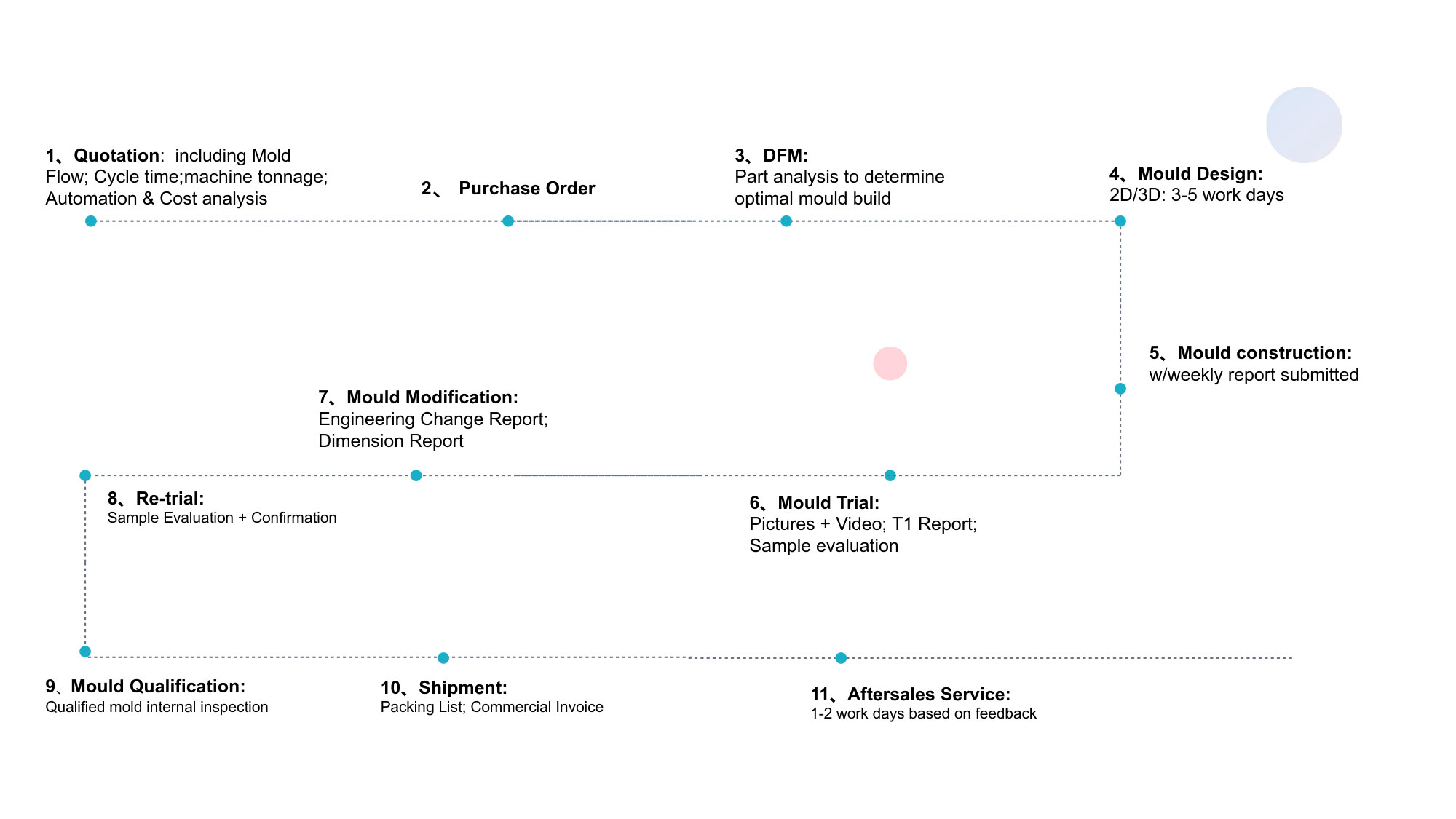
Before any steel is cut or any mold manufacturing begins, Ansix Tech provides a comprehensive DFM report at no cost to the customer. This proactive analysis is the single most valuable step in preventing costly downstream modifications.
The DFM report addresses:
Draft angle recommendations: Ensuring that the preform geometry can be ejected without surface scuffing
Wall thickness optimization: Balancing the need for structural strength in the final bottle against the constraints of injection filling and cooling
Gate location strategy: Predicting weld line locations using CAE flow simulation and proposing gate placement to position weld lines in non-critical zones
Ejector pin mark placement: Mapping where ejector marks will contact the preform and ensuring these contact points do not interfere with sealing lands, threads, or visual surfaces
Shrinkage compensation: Modifying mold cavity dimensions to account for PET’s anisotropic shrinkage behavior
Customer pain point solved: The most expensive mold design error is not discovered until T1 tool tryout — weeks after design sign-off. Finding a non-ejectable geometry at T1 forces either mold modification (adding cost and delaying production) or acceptance of a suboptimal preform design. DFM analysis identifies these issues before manufacturing begins.
Trial Molding Phases: T0 Through T3
Ansix Tech follows a systematic trial molding protocol that progressively validates the mold until it achieves stable, repeatable production:
T0 (engineering fit check): The mold is assembled and run at low speeds to verify basic mechanical function — no bind, no interference, proper ejector stroke
T1 (process window discovery): Short-shot evaluation to verify flow filling sequence, identify any cold slug traps, and establish initial process parameters
T2 (optimization trials): Full-cavity molding with all 48 cavities active. Process parameter adjustments are made to achieve target weight, dimensions, and visual quality
T3 (validation trials): Continuous production run of at least 8 hours with sampling every 30 minutes. Cpk is calculated for key dimensions
For molds requiring fine-tuning after T1, Ansix Tech maintains the capability to rapidly manufacture replacement core pins, cavity inserts, and neck rings in-house — enabling trial iterations that would require weeks of external vendor lead time under conventional mold sourcing models.
Pre-Production Validation: 100 to 500 Shots Before Mass Production Begins
Ansix Tech offers a pre-production validation step that is optional but highly recommended for customers new to PET preform injection molding:
Small lot sample molding: 100 to 500 production shots are run using customer-specified resin and machine
Yield rate and Cpk calculation: For each key dimension, Cpk is calculated from measured sample data
Blow-molding test (customer-performed): Sample preforms are provided to the customer for blow-molding validation
Approval milestone: Only after the customer formally approves sample preforms and blow-molded bottles does mass production begin
Maintenance, Spare Parts, and After-Sales Support
Mold maintenance predictability is a major source of customer anxiety. Ansix Tech mitigates this through:
Spare parts package included with every mold shipment: Critical wear components — ejector pins, core pins, neck inserts, thermocouples, heater bands — are provided as a standard part of mold delivery
Full spare parts manifest: A complete list of every serviceable component with part numbers and specifications
12-month warranty: Full warranty coverage on all mold components. Extended warranty up to 3 years available as an option
Lifetime repair service at cost: Replacement parts and repair services are provided at Ansix’s direct cost throughout the mold’s service life — not marked up for profit
Preventive maintenance schedule: Recommended maintenance intervals (typically every 500,000 shots) with checklists for inspection of hot runner tips, cooling passages, wear plates, and ejector systems
Section Five: Differentiators — Performance Commitments That Target Common Industry Pain Points
Problem: Molds Require Frequent Repair — Damaging Production Schedules
Customer complaint: “Our molds need unexpected repairs every 200,000–300,000 shots. Each repair requires pulling the mold from the press, sending it out, waiting days or weeks, and scrambling to catch up on orders.”
Ansix Tech commitment: Every 48-cavity PET preform mold undergoes a 2,000-shot accelerated wear test before shipment, generating a pre-delivery wear analysis report. Ansix provides a three-year structural warranty on the mold frame, base plates, hot runner manifold, and cooling distribution network (excludes normal wear on consumable components such as ejector pins, heater bands, and seal rings).
The underlying capability: Premium mold steel selection, proper heat treatment, conformal cooling that eliminates thermal stress fatigue, and precision clearances that prevent metal-to-metal wear.
Problem: Flash on Parting Lines — Labor-Intensive Trimming Required
Customer complaint: “Every preform has flash on the parting line. We have to manually trim each one. Labor costs are eating our margins.”
Ansix Tech commitment: Parting line flash thickness is held to 0.03mm or less throughout the full shot life of the mold — verified by gaging flash thickness every 100,000 shots. No manual trimming required.
The underlying capability: Self-locking mold geometry that uses multi-dimensional cone positioning to maintain concentricity under high clamping force. Mold bases are precision-ground with parallelism maintained to 0.005mm across the full platen area. Locking force compensation systems automatically adjust for thermal expansion, ensuring flash does not increase as the mold heats up.
Problem: Dimensions Change Between Production Batches
Customer complaint: “We run 500,000 preforms on the first batch — all dimensions are perfect. Then we shut down for two weeks, run a different product, come back to the mold — and the dimensions are different. We have to spend days dialing it back in.”
Ansix Tech commitment: Statistical process control records maintained for every production batch. Weekly long-term capability studies (Cpk analysis across multiple runs) identify any drift before it produces nonconforming parts. Optional real-time instrumentation — ultrasonic wall thickness monitoring and/or in-cavity pressure sensors — enables automatic process compensation for material variations. Closed-loop control systems automatically adjust pack and hold pressure to maintain consistent preform weight.
The underlying capability: MES-locked process parameters prevent operator variability. Precision temperature control (±1°C per zone) ensures thermal conditions are identical every time the mold runs. Quick-change mold clamping systems with repeatable lock-up positioning ensure consistent clamp tonnage application across mold changes.
Problem: Long Mold Repair Turnaround — Loss of Production Capacity
Customer complaint: “When something goes wrong with the mold — a broken ejector pin, a plugged cooling passage — we have to send it back to the original manufacturer. It’s gone for three to four weeks. We lose production entirely on that press.”
Ansix Tech commitment: Ansix maintains in-house EDM centers, CNC machining, and electrode manufacturing — all mold repairs are performed on-site. The most common repairs (ejector pin replacement, minor welding of damaged sealing surfaces, core or cavity insert replacement) are completed within 24 hours of mold arrival. Full-time emergency service support available.
The underlying capability: All replacement components (ejector pins, core pins, cavity inserts) are manufactured in-house using the same CNC programming and EDM electrodes used to manufacture the original mold. No external vendors required, no waiting for third-party shops to have capacity.
Section Six: Cost Control Across the Entire Value Chain
Material Cost Reduction
PET resin typically accounts for 50–65% of total production cost for preform manufacturers. Ansix Tech helps customers reduce material consumption without compromising bottle performance through:
Lightweighting design: For each bottle type, Ansix optimizes preform wall thickness distribution to minimize grams-per-preform while maintaining burst strength and top load performance. A wall thickness reduction of just 0.10mm across a 48-cavity mold running at 300,000 shots per month can save over 5,000 kg of PET resin annually.
Reduced start-up scrap: MES-locked process parameters ensure that when a mold is reinstalled after maintenance or a mold change, it produces good parts immediately — not after 50–100 scrap shots.
Reduced runner waste: Hot runner systems with shut-off valve gates eliminate sprue waste entirely. The only material consumed per cycle is the preform itself — no cold runner waste requiring regrind or disposal.
rPET processing optimization: Ansix’s validated rPET processing parameters enable customers to incorporate recycled content up to 100% without sacrificing quality, reducing raw material costs compared to virgin PET.
Process Efficiency and Cycle Time Reduction
Cycle time reduction directly reduces per-part cost by increasing output from the same capital equipment, facility, and labor. For a 48-cavity mold producing 18g preforms:
Cycle Time Shots per Day (22hrs runtime) Daily Output (units) Annual Output (300 days)
20 seconds 3,960 190,080 57,024,000
14 seconds 5,657 271,536 81,460,800
The business impact: A 30% reduction in cycle time (20 seconds to 14 seconds) increases annual output by 24 million preforms per machine — equivalent to adding a second injection molding press without additional capital investment, floor space, or operator headcount.
Ansix cooling system design achieves these cycle times through conformal cooling channels and optional three-stage post-mold cooling systems. The cooling phase is the cycle time bottleneck — every second saved in cooling translates directly to additional daily output.
Reduced Defect Rates and Scrap Costs
Defect-driven scrap is a silent profit killer in PET preform production. Common defect types and their causes include:
Defect Primary Cause Ansix Solution
Black specks / contamination Burnt polymer in hot runner Optimized melt residence time, reduced shear heating
Short shots / incomplete fill Hot runner flow imbalance Rheologically balanced manifold design
Haze / opacity Improper cooling rate Conformal cooling with uniform heat extraction
Flash / excess material Insufficient clamp tonnage or mold deflection Self-locking cavity design, rigid mold plates
Pearlescence (stress whitening) Uneven cooling causing spherulite formation Zone-controlled independent cooling circuits
Neck finish distortion Uneven ejection forces Centrally actuated ejection plate
Each defect type has a predictable scrap cost. For a facility running 48-cavity molds on three shifts, reducing overall defect rate from 3% to 0.5% can save hundreds of thousands of dollars annually in avoided resin waste and reprocessing labor.
Energy Cost Reduction
Injection molding presses are significant energy consumers. Ansix Tech supports customer energy reduction goals through:
Mold designs that reduce required clamp tonnage: Balanced cavity filling reduces peak injection pressure, allowing the press to run at lower clamp tonnage — directly reducing hydraulic pump or servo drive energy consumption
Shorter cycle times: Cooling time dominates energy consumption per shot. Shorter cooling times mean fewer kilowatt-hours consumed per preform produced
All-electric machine compatibility: Designed to run on energy-efficient all-electric injection molding machines which consume 30–50% less energy than hydraulic equivalents and achieve shot-to-shot repeatability of ±0.1%
Section Seven: Quality Assurance and Industry Certifications
In-Process Quality Controls Throughout the Manufacturing Workflow
Every custom 48-cavity PET preform mold manufactured by Ansix Tech follows a structured quality control workflow:
Material receipt and certification: Incoming steel is verified against material certifications. Hardness is confirmed by Rockwell testing. Corrosion-resistant grades (S136, 420ESR) are verified for chromium content.
In-process inspection at each manufacturing stage: Machined components are inspected before heat treatment, after heat treatment, and before final assembly.
Assembly and alignment verification: After assembly, each mold is mounted on a test press. The full 48-cavity molding capability is validated with the customer’s specified resin.
2000-shot production validation run: Each mold is run continuously for 2,000 production cycles before shipment. Samples are collected at the following intervals:
Start of run (shots 1–10)
Middle of run (shots 800–1000)
End of run (shots 1900–2000)
All sample preforms are subjected to dimensional measurement, weight measurement, and visual inspection under polarized light for stress assessment.
Final dimensional inspection report: A comprehensive dimensional report is generated for each mold, documenting every critical dimension and its measured value.
Wear analysis report (optional): For customers requiring documented wear characteristics, the mold is disassembled after the 2000-shot run. Critical sealing surfaces are measured and compared to pre-test dimensions. Actual wear rates are documented.
Customer Evidence and Quality Documentation
Ansix Tech provides the following quality documentation with every mold shipment:
Complete steel material certification
Heat treatment temperature profiles and hardness test results
Full dimensional inspection report with Cpk calculations
Process parameter setup sheet for the customer’s resin
Preventative maintenance schedule and checklist
Spare parts manifest with part numbers
Section Eight: Industry Experience and Customer Value Assurance
Over 28 Years of Manufacturing Excellence
Ansix Tech has been designing, engineering, and manufacturing custom injection molds for over 28 years. This accumulated experience translates directly into customer value:
Problem-solving expertise: Most quality issues encountered during T0, T1, T2, and T3 mold trials have been encountered before. Ansix engineers draw on decades of solved problems, avoiding time-consuming trial-and-error approaches.
Established supply chain relationships: Long-term relationships with materials suppliers, heat treatment vendors, and component manufacturers (hot runner tips, heaters, thermocouples, controllers) ensure consistent quality and lead times.
Validated process database: For each resin type (PET, rPET, PC/ABS, PPS+GF, PEEK, LCP, PA6/66, PBT, PEI, PTFE/PFA, LSR, PP, PE, and flame-retardant grades), Ansix maintains validated starting process parameters — eliminating weeks of ramp-up time for new molds.
Reliability — The Ultimate Measure of Mold Value
For beverage packaging customers, mold reliability is measured by one metric: total uptime percentage. A mold that runs 22 hours per day, 300 days per year, with 99% uptime, produces nearly 44,000 preforms more per month than a mold running 95% uptime.
Ansix Tech molds are engineered for high uptime through:
Wear-resistant material selection: S136 and H13 tool steels resist galling, abrasion, and corrosion over millions of cycles
Interchangeable standard components: Wherever possible, hot runner tips, heaters, and thermocouples are industry-standard interchangeable parts that can be sourced from multiple suppliers — not proprietary components locked to a single vendor
In-house repair capability: As described above, repairs are completed within 24 hours at Ansix’s facility — not weeks at an external vendor
Preventative maintenance designed into the mold: Cooling passages are designed to be accessible for cleaning. Wear plates are accessible for replacement without full mold disassembly. Ejector pins are replaceable while the mold remains in the press.
Customer Value Statement
Dear customer, a mold is not a block of steel — it is a revenue-generating asset. Ansix Tech does not simply machine cavities; we engineer injection molding systems. Every design decision — from draft angle selection to cooling channel routing, from gate position to ejector placement — is made with one objective: ensuring that when the mold arrives at your facility, it is ready for production with minimal start-up adjustment, minimal flash, and maximum service life.
The value we deliver is measurable:
15–30% reduction in cycle time through optimized conformal cooling compared to conventional drilled cooling lines
40–50% reduction in scrap during initial process setup through validated starting parameters and DFM analysis
2–3x reduction in mold repair frequency through premium material selection and precision clearances
Elimination of manual flash trimming labor through self-locking cavity design with flash thickness <0.03mm
Predictable maintenance intervals through documented wear analysis and spare parts packages
Conclusion: Transforming Technical Specifications into Tangible Customer Outcomes
The Custom 48-cavity PET preform mold manufacturing solution from Ansix Tech is built on a foundation of technical excellence — 5-axis CNC machining achieving ±0.002mm precision, wire EDM capability for 0.03mm micro-slots, S136 stainless steel cores delivering 3-5 million shot life, conformal cooling reducing cycle times to 13–18 seconds, and rheologically balanced hot runner systems ensuring uniform fill across all 48 cavities.
But technical specifications alone are not the measure of value. The measure of value is the number of good preforms produced per shift. The measure of value is the cost per thousand preforms — including material, labor, energy, maintenance, and scrap. The measure of value is whether the mold runs reliably at 2:00 AM on a Saturday night when the night shift supervisor is not available to troubleshoot problems.
Ansix Tech delivers that value. From DFM analysis that prevents design errors before tooling begins, through T0-to-T3 validation that verifies every mold before shipment, to lifetime repair support at cost — we are committed to being more than a mold supplier. We are a manufacturing partner.
We invite customers to take a real production preform — any weight, any neck finish, any bottle application — and request a complete DFM report. You will see, in documented analysis, how we predict and prevent weld lines, trapped gas defects, sink marks, and ejection marking before a single cavity is machined. The difference is not just visible in the report — it is visible on your production line.
Ansix Tech: Engineering the reliability of your production line into every cavity we machine. With 28 years of experience and a commitment to measurable customer value, we deliver molds that are not just tools — they are production assets that generate revenue from the first shot to the five millionth.
Ansix Tech Co Ltd
If you have any plans related to Custom 48-cavity PET preform mold , you can contact us at any time. We will turn your ideas into reality, let you realize your dreams, and obtain large orders from the market. Our contact information is info@ansixtech.com. Or contact our CTO, mail: stephen@ansixtech.com
#www.ansixtech.com #ansixtech.com #Custom 48-cavity PET preform mold #Custom 48-cavity PET preform mold moulds #Custom 48-cavity PET preform mold injection molding companies #Custom 48-cavity PET preform mold Canopy Mold injection mold companies #Ansix #Ansix moulds #Ansix china #Ansix tech china #Ansix tech company #Ansix facotry #Custom 48-cavity PET preform mold injection molding #Custom 48-cavity PET preform mold injection tools #Custom 48-cavity PET preform mold injection moulds #Custom 48-cavity PET preform mold plastic mould #Custom 48-cavity PET preform mold plastic tools #Ansix Tech #Ansix molds #Ansix injection molding #Ansix mold factory #injection molding Custom 48-cavity PET preform mold #Ansix mold factory #Custom 48-cavity PET preform mold china #Custom 48-cavity PET preform mold molds #injection factory #Custom 48-cavity PET preform mold injection molding #Custom 48-cavity PET preform mold injection molding factory #injection molding company #Custom 48-cavity PET preform mold injection mold companies #Custom 48-cavity PET preform mold#Custom 48-cavity PET preform mold mold limited #Ansix mold china #Ansix companies #Ansix company China #Custom 48-cavity PET preform mold facotry #Ansix Tech #Ansix Tech mould #Custom 48-cavity PET preform mold injection moulding #injection moulding company #Ansix Custom 48-cavity PET preform mold parts injection mold companies #medical injection molding companieschina #Custom 48-cavity PET preform mold china factory #Ansix moulding companies #Ansix molding company #Custom 48-cavity PET preform mold injection moulding facotry #Ansix Tech mold #Custom 48-cavity PET preform mold mould #Custom 48-cavity PET preform mold plastic injection molding #ansix plastic mold #Mold manufacturing #Custom 48-cavity PET preform mold parts manufacturing #Custom 48-cavity PET preform mold plastic parts factory #Custom 48-cavity PET preform mold injection parts mold #Custom 48-cavity PET preform mold PRECISION MANUFACTURING #Custom 48-cavity PET preform mold #China mold #Custom 48-cavity PET preform mold injection moulding china #Custom 48-cavity PET preform mold mould china #china precision mold #mold in china #Custom 48-cavity PET preform mold mold china #Precision molds #High-precision molds #Custom 48-cavity PET preform mold #Injection molds #Custom 48-cavity PET preform mold Factory #Custom 48-cavity PET preform mold Company #Super Large Injection Mold Factory #Large Tonnage Injection Molding Factory #Custom 48-cavity PET preform mold Company #Custom 48-cavity PET preform mold Factory #2800T Injection Molding Factory #3000 Ton Injection Molding #4500 Ton Injection Molding Factory #Large Mold Injection Molding #Large Plastic Mold Injection Molding Factory #Large Injection Mold Manufacturer #Plastic Mold Factory #Injection Mold #Plastic Mold