



72-cavity PET preform mold
FEATURES
Hard-Power Foundation — Infrastructure That Inspires Confidence
At Ansix Tech, we understand that the quality of a mold is fundamentally limited by the quality of the machines that produce it. Before we make any claims about mold performance, we invite customers to examine our manufacturing floor—because seeing is believing.
Precision Mold Manufacturing Equipment
Our 72-cavity PET preform molds are produced using a state-of-the-art equipment lineup designed for uncompromising accuracy:
-
Mold Description
Product Materials:
PET PETG
Mold Material:
S136ESR
Number of Cavities:
72
Glue Feeding Method:
Hot runner
Cooling Method:
Water cooling
Molding Cycle
12.5s
- The mold manufacturing process and product material selection
Equipment Category Technical Capability Customer Value
5‑Axis High‑Speed Machining Centers 0.002 mm precision on complex contours Flawless preform finish, zero post‑mold trimming
CNC Milling & Grinding Tight tolerance control ±0.003 mm Plug‑and‑play mold interchangeability
EDM (Sodick & High‑Precision) 0.03 mm narrow slots, fine electrode work Thin‑wall preforms without deformation
Wire‑Cut EDM Burr‑free precision cuts Clean parting lines, no secondary finishing
High‑Precision Turning Centers Perfect concentricity of core/cavity Uniform wall thickness across 72 cavities
Injection Molding Machine Fleet — Full 30–4,000 Ton Coverage
We maintain a comprehensive range of all‑electric servo‑drive injection molding machines spanning 30 tons to 4,000 tons of clamping force. Our machines achieve ±0.1% shot‑to‑shot repeatability, ensuring that every preform produced in your factory is dimensionally identical to the first one.
-
Quality Inspection & Validation Equipment
Every mold delivered from Ansix Tech undergoes rigorous dimensional validation:
Coordinate Measuring Machines (CMM) — Full 3D geometry verification against CAD baseline
Optical Imaging Systems — High‑magnification inspection of critical features
Full Dimensional Report — Each mold receives a complete dimensional inspection report
CPK ≥ 1.33 — All critical dimensions validated to six‑sigma capability standards
Equipment Summary Table
Equipment Category Capability Impact on Customer
5‑Axis CNC 0.002 mm precision No flash, no hand trimming
EDM / Wire‑Cut 0.03 mm fine features Thin walls, zero deformation
CMM + Optical CPK ≥ 1.33 Lot‑to‑lot consistency
30–4,000 T Servo Press ±0.1% shot repeatability 72 identical preforms every cycle
Section II: Mold Manufacturing Core Competencies — Where Technical Specifications Meet Customer Value
Our 72‑cavity PET preform molds are engineered from the ground up for high‑volume production environments. The table below translates our technical specifications into what they mean for your bottom line.
Parameter Our Technical Standard What It Means for You
Mold Life Mold base: P20; Core/Cavity: S136, 2344, 2316, H13, NAK80. 50–100 million cycles under glass‑filled PET. One mold lasts years—no frequent replacement investment.
Achievable Tolerance Critical dimensions ±0.005 mm, general ±0.05 mm. Full steel certification + heat‑treatment curves provided. Your blow‑molding line runs without adjustments. Fewer rejects.
Mold Types Hot runner (zero material waste), stacked molds (2× output), high‑gloss mirror finish (Ra < 0.05 μm). Flexibility to match your production strategy.
Gate System 72 independent valve‑gated hot runner nozzles. Each cavity has independent heating zone + thermocouple. Balanced filling across all 72 cavities. Weight variation < 0.3 g.
Delivery Standard Standard: 45–60 days. Fast‑track available (expedited shipping). Meet your launch deadlines with confidence.
Section III: Injection Molding Process Control — Engineering Out the Quality Anxiety
Our process control framework eliminates the three most common causes of customer anxiety: dimensional drift, cosmetic defects, and batch‑to‑batch variation.
1. The Smart Factory — MES with Parameter Lockdown
All injection molding machines are connected to a centralized Manufacturing Execution System (MES). Every process parameter—temperature, pressure, injection speed, cooling time—is locked and can only be changed by authorized engineers with full traceability. Each batch undergoes first‑article and last‑article inspection to detect any deviation immediately.
2. Thermal Stability — The Secret to Consistency
We design all 72 cavities with balanced cooling channels to ensure temperature variation between core and cavity is maintained within 2 °C. This thermal uniformity directly translates into consistent preform dimensions across all cavities.
Real‑world proof: For a recent 72‑cavity water bottle preform project, our system delivered key hole‑to‑hole spacing variation of less than 0.02 mm across three production runs spanning one week.
3. Cosmetic Standards by Application
Our molds produce preforms meeting rigorous cosmetic requirements:
Application Requirement Achieved Standard
Transparent clear parts Zero bubbles, zero flow marks, zero haze
Metal‑plated surfaces No gas streaks, perfect adhesion surface
High‑gloss finish Surface roughness Ra ≤ 0.2 μm
Printed/labeled preforms Compensated for shrinkage, registration accuracy ±0.1 mm
4. Material Versatility — Beyond Virgin PET
We have extensive processing experience across a full spectrum of engineered resins for specialized applications:
Standard: PET (virgin & rPET up to 100%)
Engineering grades: PC/ABS, PC, PPS+40% GF, PEEK, PA6+GF30, PBT, PEI, PPS, LCP
High‑performance: PTFE/PFA, PEI (Ultem™), PEKK
Elastomers: Liquid Silicone Rubber (LSR)
Certified compliance: UL94 V‑0 flame rating, UV resistance validated to 3,000+ hours without discoloration
Section IV: End-to-End Service — Reducing Your Total Cost of Ownership
We lower your management burden through a comprehensive service lifecycle that extends far beyond mold delivery.
Stage 1: Early Engineering Intervention — DFM Report (Pre‑contract)
Before any steel is cut, we deliver a comprehensive Design for Manufacturability (DFM) report that includes:
Wall thickness optimization recommendations
Draft angle analysis for smooth ejection
Gate location and injection point layout
Predicted fill, cooling, and warp behavior via Moldflow simulation
Ejector pin mark location and depth allowances
Customer value: You discover and resolve manufacturability issues before they become expensive mold modifications.
Stage 2: Systematic Mold Trials — T0 through T3
We conduct structured mold trials using the IQ/OQ/PQ framework: Installation Qualification (IQ) verifies the mold is built to spec, Operational Qualification (OQ) runs it through parameter ranges, and Process Qualification (PQ) proves it produces conforming parts under production conditions. After each trial, we provide a corrective action report. Our modular insert design allows us to test alternative gating or cooling configurations without building an entirely new mold.
Customer value: No guesswork. You see progress, you sign off confidently, and you avoid costly surprises during your own production ramp‑up.
Stage 3: Pre‑Production Validation — 100–500 Shots
Before approving full‑scale production, we run a 100–500 shot pre‑production validation batch. We statistically analyze yield rate and calculate CPK for all critical dimensions. Only when CPK ≥ 1.33 do we release the mold for mass production.
Stage 4: Maintenance & Spare Parts — Lifetime Support
Spare wear parts (ejector pins, core inserts) shipped with every mold
Preventive maintenance recommended every 200,000 cycles
Lifetime repair service at cost—no hidden markups
Emergency repair: 24‑hour turnaround for standard repairs
Service Lifecycle Table
Stage Activity Customer Value
Pre‑contract DFM + Moldflow analysis No bad‑surprise modifications
T0–T3 trials 3+ trial rounds with corrective reports Predictable timeline, documented progress
Pre‑production 100–500 shots, CPK validation Zero ramp‑up risk
Lifetime Spare parts + repair at cost Lowest total cost of ownership
Section V: Differentiated Commitments — Direct Answers to Industry Pain Points
Rather than generic claims, we provide concrete commitments that directly address the most frequent customer complaints in the PET preform industry.
Common Customer Complaint Ansix Tech's Commitment (Verifiable)
"Molds need constant repairs, disrupting my production schedule." We perform 2,000‑cycle aging validation before shipment, with a detailed wear report. We offer a 3‑year structural warranty on the mold body (excluding normal wear parts).
"Excessive flash means expensive post‑molding trimming." We machine parting lines to 0.005 mm fit precision and use lock‑type clamping force compensation. Flash is controlled to < 0.03 mm—no manual trimming required.
"Dimensions drift between production runs." Our machines feature ultrasonic wall thickness sensors with real‑time feedback to automatically adjust holding pressure. Optional in‑mold temperature/pressure sensors enable closed‑loop adaptive control.
"Mold repairs take weeks and disrupt my line." We maintain an in‑house electrode machining and EDM workshop—repairs never leave our facility. Standard repairs (weld repair/insert replacement) restored to production within 24 hours.
Quality Validation Protocol — What Every Customer Should Demand
A robust validation program saves more money in the first production run than it costs to perform. At Ansix Tech, validation begins during mold design, never after first‑article approval:
Incoming Material Validation:
Material certification with full chemical composition analysis (spectrometer verified)
Hardness testing (Rockwell) documented per cavity insert
Ultrasonic inspection for internal defects in critical mold components
In‑Process Quality Gates:
First‑article inspection after CNC roughing
CMM verification after heat treatment (dimensional stability check)
100% critical dimension inspection after EDM/finishing
Bench assembly inspection with go/no‑go gauges for moving components
Final Mold Qualification:
2,000‑cycle continuous run with automated data logging
Cavity‑to‑cavity weight variation < 0.3 g across all 72 cavities
Gate blush inspection under polarized light
Dimensional CPK report: target ≥ 1.33 on all customer‑designated critical features
Full dimensional inspection report delivered with the mold
Section VI: The Technical Deep Dive — 72-Cavity PET Preform Mold Engineering
For customers who want to understand precisely how our 72‑cavity molds are engineered, the following technical detail demonstrates the depth of our expertise.
Step 1: Raw Material Selection — PET and Beyond
Polyethylene terephthalate (PET) is the industry standard for bottle preforms due to its high transparency, excellent heat resistance, good pressure resistance, and full recyclability. However, we recognize that not all applications use virgin PET. Ansix Tech has extensive experience processing:
rPET (recycled PET) — Up to 100% recycled content with proper drying and process control. The industry is moving toward higher rPET content driven by European Union mandates for 30% recycled content in beverage bottles by 2030. Our 72‑cavity mold design accommodates the unique rheological properties of recycled resins.
PET with barrier additives — For oxygen‑sensitive beverages (beer, juice, nutraceuticals)
PET with UV blockers — For light‑sensitive products
Alternative resins — PP, PE, and other thermoplastics when transparency requirements are relaxed
Material quality control begins before the resin enters the machine. We maintain strict incoming material inspection protocols, including moisture analysis (target < 50 ppm for PET), Intrinsic Viscosity (IV) tracking (±0.02 dL/g drift from baseline), and Acetaldehyde (AA) monitoring (< 10 ppm for water‑grade applications).
Step 2: Moldflow Analysis & DFM — Where Engineering Meets Predictability
Before any steel is cut, we perform comprehensive Moldflow simulation to predict and optimize melt behavior. The software simulates the entire injection process: filling, packing, cooling, and solidification, identifying potential defects such as air traps, weld lines, short shots, sink marks, and warpage.
What Moldflow analysis specifically addresses for 72‑cavity PET preform molds:
Filling balance across 72 cavities — Uneven filling leads to weight variation and downstream blowing defects. The simulation predicts flow front advancement and identifies cavities that would fill faster or slower, allowing us to adjust runner diameters or gate geometries before machining.
Melt temperature uniformity — PET is shear‑sensitive; excessive shear heating can cause material degradation and AA generation. Moldflow predicts temperature rise through the hot runner system and gates.
Cooling efficiency — Cooling accounts for 60–70% of the total cycle time in PET preform molding. Moldflow identifies hot spots and guides conformal cooling channel placement.
Warpage prediction — Differential shrinkage across the preform can cause ovality or neck finish distortion. The analysis predicts final part geometry, allowing us to apply shrinkage compensation factors in the mold design.
The DFM report we deliver to every customer includes:
Wall thickness recommendations (avoiding sink marks while minimizing material usage)
Draft angle analysis for ejection without surface drag
Gate location and type recommendations (valve gate vs. hot tip)
Predicted cycle time ranges based on part geometry and cavity count
Ejector pin placement and mark size allowances
Step 3: 72-Cavity Mold Design — Architecture for High-Volume Production
The design of a 72‑cavity mold is significantly more complex than low‑cavity tooling. Every design decision must account for the multiplied impact of small variations. Here is how we address each critical subsystem:
3.1 Hot Runner System
For multi‑cavity PET preform molds, the hot runner system is critical. We design individual valve gates for each of the 72 cavities, with each gate having its own independently controlled heating zone monitored by a dedicated thermocouple. This configuration provides several advantages:
Balanced melt distribution — Each cavity receives identical melt pressure, temperature, and fill rate
No material waste — Hot runner systems eliminate cold runner scrap, which is especially valuable for PET due to its drying and thermal history costs
Gate quality control — Valve‑gate sequencing allows precise control of gate crystallinity, reducing the white blush or drawbench marks common on preform bottoms
3.2 Cooling System Design
Cooling efficiency directly determines cycle time and preform quality. Uniform cooling minimizes cycle time and yields superior preform quality. Our cooling channel design follows these principles:
Turbulent flow design — Cooling water channels in the gate, cavity, thread splits, and core are designed specifically for turbulent flow at minimum flow rates, ensuring fast and efficient heat exchange between steel and water
Balanced circuit lengths — Each of the 72 cavities has identical cooling circuit geometry, so cooling rate is consistent cavity‑to‑cavity
Thread region cooling — The neck finish area requires aggressive cooling to prevent crystallinity problems that could affect cap sealing
Gate cooling — The gate area is thermally isolated from the hot runner nozzle and aggressively cooled to minimize crystallinity in the preform nub
Performance guarantee: With proper water chiller support, our 72‑cavity mold design can achieve molding cycles as low as 15–18 seconds depending on preform design and injection machine capability.
3.3 Cavity & Core Precision
Each core and cavity insert is machined from high‑grade mold steel with hardness HRC 48–52. We use advanced dipole taper localization technology where each cavity self‑clamps independently, ensuring perfect mold concentricity across all 72 cavities. The turning center machining process ensures every component mates perfectly.
Wall thickness control: Our process limits wall thickness variation between maximum and minimum part sections to ≤ 0.10 mm.
3.4 Ejection System Reliability
A robust ejection mechanism prevents sticking and ensures smooth demolding. Balanced ejection force across all 72 cavities avoids preform deformation during removal. We design ejector pins with:
Precision‑ground diameters for burr‑free ejection
Hardened surfaces (HRC 60+) for wear resistance over millions of cycles
Balanced placement to distribute ejection forces evenly across the preform
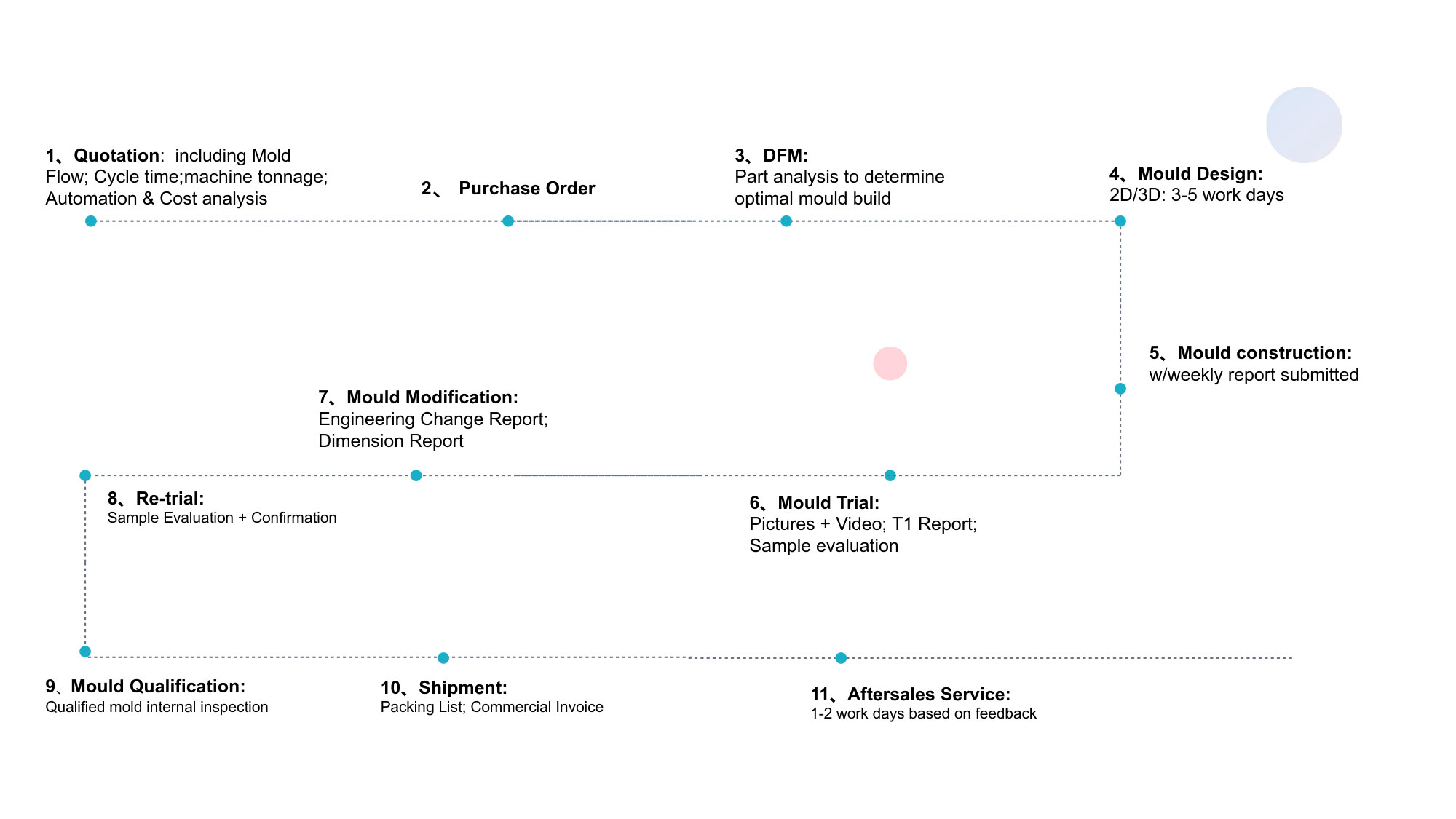
Step 4: Manufacturing Process Flow — From CAD to Completion
Our manufacturing process for a 72‑cavity PET preform mold follows a structured, quality‑gated workflow:
CAD/CAM Design — 3D modeling and simulation using industry‑leading software
Material Procurement & Certification — All mold steels sourced with full material certificates, heat treatment certifications
CNC Rough Machining — Material removal to approximate dimensions
Heat Treatment — Controlled process with documented temperature curves
Precision Finishing — 5‑axis CNC machining to final dimensions
EDM & Wire Cutting — Fine features, narrow slots, and complex geometries
Surface Finishing — Polishing to specified surface roughness (Ra < 0.05 μm for high‑gloss preforms)
Assembly & Fitment — Core/cavity assembly, cooling channel pressure testing
CMM Inspection — Full dimensional verification against CAD model
Mold Trial (T0) — 2,000‑cycle trial with data logging and defect inspection
Customer Sampling (T1–T3) — Customer‑approved samples with corrective action reports
Pre‑production Validation — 100–500 shot batch, CPK ≥ 1.33 confirmation
Final Inspection & Shipping — Full documentation package delivered with mold
Step 5: Injection Molding Process Optimization — Efficiency & Cost Control
The mold is only half the solution; the injection molding process must be optimized to realize the full productivity potential of 72 cavities.
Key process parameters optimized through Taguchi experimental design:
Cooling time (dominant contributor to cycle time)
Melting temperature profile
Injection speed and pressure profile
Holding pressure and time
Mold temperature (zoned control for core vs. cavity)
Studies have shown that optimized process parameters can reduce warpage by 4.75% and weight by 2.05% while improving overall product quality and material efficiency.
For Ansix Tech customers, process optimization delivers:
Higher output per hour — Faster cycles without sacrificing quality
Lower material consumption — Precision weight control reduces PET usage per preform
Reduced energy consumption — Optimized temperature profiles and cooling reduce electricity use
Higher first‑pass yield — Fewer rejects mean lower effective cost per good preform
Step 6: Quality Control & Assurance — The Complete System
Our quality system is not a checklist—it is an integrated manufacturing philosophy.
Incoming Material Control:
Resin moisture verification (< 50 ppm for PET)
IV testing per batch
Color and additive verification
In‑Process Quality Control (During Production):
Shot weight monitoring per cycle
Cavity‑to‑cavity weight balance (target < 0.3 g variation)
Polarized light inspection for stress and crystallinity
Visual inspection under standardized lighting for splay, black specs, bubbles, gate blush
Statistical Process Control (SPC):
X‑R control charts for critical dimensions
CPK tracking: target ≥ 1.33 for customer‑designated features
Continuous improvement loops when CPK approaches 1.33
Final Product Verification:
Dimensional inspection using CMM
AA testing for taste‑sensitive applications
Neck finish gauge inspection (critical for cap sealing)
Blow‑molding validation to confirm stretch‑blow performance
Step 7: Packaging, Logistics & Delivery — The Final Detail
Every mold is cleaned thoroughly, spray‑coated with anticorrosion enamel, and wrapped in protective plastic film. Molds are secured in custom‑fitted wooden export crates with comprehensive shipping documentation.
Standard delivery:
Sea freight for standard timelines (cost‑effective)
Air freight available for urgent projects
Lead times:
Standard delivery: 45–60 days from order confirmation
Expedited available for time‑critical projects
Section VII: The Ansix Tech Value Promise — More Than Just a Mold
28+ Years of Manufacturing Experience
With over 28 years of continuous operation, Ansix Tech has accumulated deep institutional knowledge across hundreds of PET preform projects. This experience translates into faster problem‑solving, fewer design iterations, and more reliable outcomes for our customers.
Proven Industry Experience
Our track record across multiple industries demonstrates our versatility:
Industry Segment Specific Expertise
Beverage (water, CSD, juice) High‑cavitation preforms for high‑speed blow molding
Edible oil & condiments Contamination‑free surface finish, chemical resistance
Pharmaceutical & medical Cleanroom molding, material traceability, validation documentation
Cosmetic & personal care High‑gloss finish, complex geometries, small batch capability
Industrial chemical Corrosion‑resistant mold materials, thick‑wall preform capability
How We Reduce Your Hard Costs — The Systematic Approach
Material cost reduction:
Lightweighting support — Optimizing preform wall thickness to use less resin while maintaining top‑load strength
PET reclaimed material processing — Our molds accommodate up to 100% rPET with proper drying and process control
Reduced scrap rates — Through precision mold building and process validation
Processing cost reduction:
Faster cycle times — Efficient cooling design reduces time per shot
Higher cavitation — 72 cavities means more preforms per machine hour, reducing per‑unit machine cost
Lower energy consumption — Optimized hot runner systems and mold temperature control reduce electricity usage
Maintenance cost reduction:
Longer mold life — Premium materials and precision construction reduce repair frequency
Spare parts included — Minimizes downtime for wear‑related replacements
Lifetime repair at cost — No inflated maintenance pricing
Quality cost reduction:
CPK ≥ 1.33 validation — Fewer customer rejects and field failures
Documented validation protocols — Reduces your internal qualification burden
On‑time delivery — No production line stoppages waiting for tooling
Summary of Ansix Tech's Customer Value Proposition
Customer Concern How Ansix Tech Solves It
Reliability 3‑year structural warranty, 2,000‑cycle pre‑shipment validation
Cost Faster cycles (18 s), lower scrap, lightweighting support, spare parts included
Speed 45–60 day standard delivery, 24‑hour repair turnaround
Quality CMM inspection, CPK ≥ 1.33, full documentation package
Risk DFM before cutting steel, systematic T0–T3 trials, pre‑production validation
Support Lifetime repair at cost, spare parts, technical consultation
Final Message to Our Customers
A mold is not a block of steel. It is a machine that prints revenue for your business. At Ansix Tech, we design every cooling channel, every gate, every ejector pin with one objective: making sure our mold runs on your production line without debugging, without flash, and without early failure.
We invite you to experience the Ansix difference firsthand. Provide us with your preform design, and we will walk you through a full DFM report—showing you, before we cut any steel, exactly how we will eliminate weld lines, air traps, sink marks, and every other risk that keeps production managers awake at night.
Ansix Tech — Engineering trust through every cycle, from T0 through 10 million shots.
For technical consultations, DFM reviews, or specific 72‑cavity inquiries, please contact our engineering team.
Ansix Tech Co Ltd
If you have any plans related to 72-cavity PET preform mold , you can contact us at any time. We will turn your ideas into reality, let you realize your dreams, and obtain large orders from the market. Our contact information is info@ansixtech.com. Or contact our CTO, mail: stephen@ansixtech.com
#www.ansixtech.com #ansixtech.com #72-cavity PET preform mold #72-cavity PET preform mold moulds #72-cavity PET preform mold injection molding companies #72-cavity PET preform mold Canopy Mold injection mold companies #Ansix #Ansix moulds #Ansix china #Ansix tech china #Ansix tech company #Ansix facotry #72-cavity PET preform mold injection molding #72-cavity PET preform mold injection tools #72-cavity PET preform mold injection moulds #72-cavity PET preform mold plastic mould #72-cavity PET preform mold plastic tools #Ansix Tech #Ansix molds #Ansix injection molding #Ansix mold factory #injection molding 72-cavity PET preform mold #Ansix mold factory #72-cavity PET preform mold china #72-cavity PET preform mold molds #injection factory #72-cavity PET preform mold injection molding #72-cavity PET preform mold injection molding factory #injection molding company #72-cavity PET preform mold injection mold companies #72-cavity PET preform mold#72-cavity PET preform mold mold limited #Ansix mold china #Ansix companies #Ansix company China #72-cavity PET preform mold facotry #Ansix Tech #Ansix Tech mould #72-cavity PET preform mold injection moulding #injection moulding company #Ansix 72-cavity PET preform mold parts injection mold companies #medical injection molding companieschina #72-cavity PET preform mold china factory #Ansix moulding companies #Ansix molding company #72-cavity PET preform mold injection moulding facotry #Ansix Tech mold #72-cavity PET preform mold mould #72-cavity PET preform mold plastic injection molding #ansix plastic mold #Mold manufacturing #72-cavity PET preform mold parts manufacturing #72-cavity PET preform mold plastic parts factory #72-cavity PET preform mold injection parts mold #72-cavity PET preform mold PRECISION MANUFACTURING #72-cavity PET preform mold #China mold #72-cavity PET preform mold injection moulding china #72-cavity PET preform mold mould china #china precision mold #mold in china #72-cavity PET preform mold mold china #Precision molds #High-precision molds #72-cavity PET preform mold #Injection molds #72-cavity PET preform mold Factory #72-cavity PET preform mold Company #Super Large Injection Mold Factory #Large Tonnage Injection Molding Factory #72-cavity PET preform mold Company #72-cavity PET preform mold Factory #2800T Injection Molding Factory #3000 Ton Injection Molding #4500 Ton Injection Molding Factory #Large Mold Injection Molding #Large Plastic Mold Injection Molding Factory #Large Injection Mold Manufacturer #Plastic Mold Factory #Injection Mold #Plastic Mold