



8-cavity wide-mouth bottle preform mold
FEATURES
Hard Power Foundation — Building Customer Trust Through Equipment Capabilities
1.1 Precision Mold Machining Equipment
At Ansix Tech, we believe that equipment precision directly translates into part quality and mold longevity.
Five-Axis High-Speed Machining Centers — Our mold manufacturing facility is equipped with state-of-the-art five-axis high-speed CNC machining centers capable of achieving ±0.002 mm geometric accuracy on complex 3D surfaces. For an 8-cavity wide-mouth preform mold, this precision means that critical parting lines are exceptionally smooth — eliminating post-molding flash that would otherwise require manual trimming. Each cavity is machined identically, ensuring cavity-to-cavity consistency that translates into balanced filling during production.
-
Mold Description
Product Materials:
PET PETG PS AS PP
Mold Material:
S136ESR
Number of Cavities:
1*8
Glue Feeding Method:
Hot runner
Cooling Method:
Water cooling
Molding Cycle
13.5s
- The mold manufacturing process and product material selection
Slow Wire EDM (Wire Electrical Discharge Machining) — For fine details such as 0.03 mm micro-holes, narrow slots, and intricate core pins that are inaccessible to conventional cutting tools, we deploy slow wire EDM technology. This process achieves surface finishes of Ra ≤ 0.2 μm without secondary polishing, with tight tolerance control of ±0.002 mm to ±0.005 mm. For thin-walled preforms, this capability prevents stress concentration and deformation during ejection, maintaining product integrity across millions of cycles.
EDM Spark Erosion with In-House Electrode Manufacturing — Ansix maintains an in-house electrode machining center and EDM workshop. For complex cavity features — sharp internal corners, deep ribs, and undercuts — EDM provides the necessary precision. Since electrode fabrication and EDM processing occur under one roof, mold rework and repairs can be completed without outsourcing, typically within 24 hours for standard maintenance operations.
Surface Finishing and Polishing — For wide-mouth bottle preforms requiring optical clarity or cosmetic surfaces, we achieve Class A surface finishes (Ra < 0.05 μm) suitable for transparent applications using advanced polishing techniques and S136 stainless tool steel. This eliminates the need for secondary finishing operations and ensures that preforms emerge with consistent, high-quality appearance.
-
Injection Molding Machine Fleet for Validation and Process Development
To validate molds under conditions that mirror your actual production environment, Ansix operates a comprehensive fleet of all-electric servo-driven injection molding machines covering a clamping force range from 30 tons to 4,000 tons.
All-Electric Servo Drive Technology — Our machines feature fully electric servo drives that deliver ±0.1% shot-to-shot repeatability. For an 8-cavity preform mold producing eight identical parts per cycle, this repeatability means that every preform — across all eight cavities — meets the same weight and dimensional specifications, cycle after cycle, shift after shift.
Process Parameter Lockdown — All injection molding machines are networked and integrated with a Manufacturing Execution System (MES). Critical parameters — melt temperature, mold temperature, injection pressure, injection speed, holding pressure, cooling time, and back pressure — are electronically locked. Parameter adjustments require engineer-level authorization, with all changes logged and auditable. This eliminates the risk of unauthorized operator adjustments that can cause quality drift or scrap generation.
1.3 Metrology and Inspection Equipment
Every mold leaving Ansix Tech’s facility undergoes full dimensional verification using CMM (Coordinate Measuring Machine) and optical inspection equipment.
Full Dimensional Reporting — Each mold is accompanied by a comprehensive dimensional inspection report comparing all measured dimensions against CAD model specifications. Critical-to-quality dimensions are verified with Cpk ≥ 1.33 — demonstrating that the mold is statistically capable of producing conforming parts consistently.
Material Certification and Heat Treatment Traceability — Every mold component is supplied with full material certification, including chemical composition analysis and documented heat treatment curves (hardening, tempering, and any surface treatments such as nitriding or PVD coating). This traceability ensures that material properties — toughness, wear resistance, corrosion resistance — meet the specified requirements for your application and production volume.
The Customer Value Message: *Precision equipment is not a marketing statement — it is a promise of cavity-to-cavity consistency, dimensional accuracy, and long mold life. When we say we can hold ±0.002 mm on critical features, that translates directly into preforms that fit closures perfectly and seal properly, with no post-molding trimming required. And when we certify Cpk ≥ 1.33, that means you will not be sorting good parts from bad — statistical process control ensures virtually all parts are conforming.*
Section II: Mold Manufacturing Core Competencies — Translating Technical Metrics Into Customer Value
Customers care about four things: mold life, dimensional accuracy, delivery speed, and maintenance costs. Below is how Ansix Tech’s technical specifications address each concern:
Dimension Technical Specification Customer Value Translation
Mold Life P20 mold base + premium tool steel mold cores (S136, 2344, 8407, H13, SKD61, DC53, NAK80, M340) 100,000+ cycles for standard plastics; 500,000+ cycles for glass-fiber reinforced materials. Each million cycles of trouble-free production means you avoid downtime for mold repair or replacement — your production line keeps running.
Dimensional Accuracy ±0.05 mm for general structural features; ±0.005 mm for precision-critical areas (neck finish threads, sealing surfaces) Preforms mate perfectly with closures; no leakage, no capping failures. Critical dimensions — especially neck finish profiles and sealing surfaces — maintain specification across the entire mold life.
Mold Types Hot runner systems with valve gate technology; stack molds; multi-material molds; high-gloss molds (Ra < 0.05 μm) Hot runner systems eliminate sprue waste — saving material cost per part. For wide-mouth preforms, valve gate hot runners provide clean gate vestiges with no stringing or drool, ensuring aesthetic quality and reducing downstream deflashing labor.
Gate and Runner Design Flow simulation-optimized (Moldflow/Moldex3D) multi-cavity balanced filling; melt-flipping technology for 8-cavity H-pattern runner balance Balanced filling means all eight cavities fill simultaneously at the same pressure and temperature. Without balancing, some cavities overpack while others underfill, producing dimensional variation and scrap. Our approach reduces cavity-to-cavity variation by 62% or more.
2.1 Eight-Cavity Specific Design Considerations
The 8-cavity configuration presents unique engineering challenges that Ansix Tech has systematically addressed:
Runner Balancing Challenge — For eight-cavity molds with conventional H-pattern runner layouts, research shows that flow imbalance can result in up to 95% of melt flow preferentially entering inner cavities, leaving outer cavities starved. Ansix addresses this through:
Geometrically tapered H-type runner systems — Runner cross-sections are progressively reduced from the sprue toward the end cavities, compensating for pressure drop along the flow path.
Valve gate hot runner sequencing — Individual valve pins in each cavity are electronically timed to open and close, compensating for any residual imbalance and preventing cavity-to-cavity variation.
Moldflow simulation validation — Each runner design is simulated in Moldflow or Moldex3D before steel is cut. The simulation predicts melt front advancement, pressure distribution, temperature gradients, and identifies potential weld lines and air traps. This digital twin approach eliminates guesswork — problems are solved in software, not on the production floor.
Cavity-to-Cavity Consistency — Beyond flow balancing, cavity consistency requires:
Identical machining paths and tooling for each cavity insert (achieved via EDM using a single master electrode)
Uniform cooling channel layout mirroring across all cavities
Interchangeable cavity inserts verified with first-article inspection
The Customer Value Message: *An 8-cavity mold is not simply a 1-cavity mold multiplied by eight. Imbalances in flow, temperature, and packing between cavities are the primary cause of quality variation in multi-cavity molding. Ansix Tech’s engineering processes — from flow simulation through precision machining to valve-gate control — ensure that cavity #1 through cavity #8 produce identical, interchangeable preforms. You do not need to sort preforms by cavity — they are all the same.*
2.2 Lead Time Standards and Delivery
Ansix Tech maintains a structured, parallelized workflow to compress mold delivery lead times while maintaining quality.
Mold Complexity Standard Lead Time Expedited Lead Time Quality Assurance During Expediting
Simple preform molds 25 days 15 days DFM and validation steps preserved; overtime machining
Medium-complexity molds 35-45 days 20-25 days Parallel processing; expedited heat treatment
High-complexity multi-cavity molds 45-60 days 30-35 days All validation steps compressed but not eliminated
The industry average for 8-cavity preform molds typically ranges from 50 to 70 working days. Ansix’s ability to deliver in as few as 20 days for expedited requests comes from in-house capabilities — electrode manufacturing, EDM, CNC machining, and assembly all under one roof — combined with an established supply chain for mold bases and standard components.
The Customer Value Message: *A shorter mold delivery lead time means your product reaches market faster. Every day saved in mold manufacturing is a day of revenue you capture sooner. For customers launching seasonal products or responding to urgent market demand, expedited delivery is not a luxury — it is a competitive necessity. Ansix delivers without compromising the validation steps (DFM, T0/T1 sampling, dimensional verification) that ensure the mold works correctly the first time.*
Section III: Injection Molding Process Control — Eliminating Customer Quality Anxiety
3.1 Process Standardization and Lockdown
Injection molding quality depends on process consistency. Ansix employs a closed-loop process control strategy:
MES-Connected Machine Network — Every injection molding machine used for mold validation and production trials is connected to a central MES. Parameters are locked and require engineer-level authorization for changes. Machine recipes are stored by part number, ensuring that the same process can be recalled and replicated years later.
First Article and Last Article Verification — For every production batch (or validation trial), first-article inspection documents all critical dimensions. End-of-batch verification ensures that dimensional stability has been maintained throughout the run. Any drift exceeding control limits triggers immediate root-cause investigation.
3.2 Dimensional Stability and Warpage Control
For wide-mouth bottle preforms — especially those with thin walls and precise neck finish threads — warpage and dimensional instability are primary quality risks. Ansix addresses these through:
Zone-Controlled Mold Temperature — Each mold is equipped with zone-controlled mold temperature controllers (thermolators) for both core and cavity sides. Temperature difference between the core and cavity is maintained within 2°C, minimizing differential shrinkage that causes warpage and ovality in the neck finish.
Conformal Cooling Design — Where conventional straight-drilled cooling channels cannot follow the complex contours of a preform, Ansix designs conformal cooling channels that trace the part geometry. Conformal cooling studies have demonstrated cycle time reductions of 20-32% with improved temperature uniformity and reduced warpage. For wide-mouth preforms with thick sections at the base and thin sections at the neck, conformal cooling ensures uniform temperature extraction across the entire part geometry.
Ultrasonic Wall Thickness Monitoring — In-line ultrasonic sensors provide real-time feedback on preform wall thickness. When thickness variation is detected, the control system automatically compensates by adjusting packing pressure. This closed-loop control ensures that wall thickness remains within specification even in the presence of material viscosity variations.
In-Mold Pressure and Temperature Sensors — For critical applications, Ansix integrates cavity pressure and temperature sensors directly into the mold. Real-time process data enables:
Early detection of cavity-to-cavity imbalance
Real-time packing pressure adjustment
Part quality prediction before ejection
Closed-loop process control for fully automated quality assurance
The Customer Value Message: *Dimensional variation — preforms that are oval, warped, or out-of-spec on neck finish dimensions — leads to downstream problems: leaking closures, capping machine jams, and customer complaints. Ansix’s thermal management strategy and in-mold sensing ensure that every preform, from cavity #1 to #8, from shift start to shift end, meets the same dimensional specifications. You do not need to sort, measure, or scrap — you just run.*
3.3 Surface Quality and Appearance
For wide-mouth bottle preforms — particularly those used for food, beverage, cosmetic, or pharmaceutical applications — surface quality is directly linked to brand perception.
Transparent and clear applications (unfilled PET, clarified PP) — Achieved through mirror-polished Class A mold surfaces (Ra < 0.05 μm using S136 stainless tool steel), enabling preforms without bubbles, flow marks, or visible defects.
Opaque and colored applications — High-gloss surfaces (Ra ≤ 0.2 μm) provide consistent appearance without gloss variation across cavities.
Glass-fiber reinforced materials (GF-PET, GF-PP, GF-PA) — Wear-resistant mold steels (2344, 8407, H13, SKD61) with appropriate surface treatments prevent premature wear, maintain surface finish across the mold life, and resist abrasive wear from fiber-reinforced compounds.
3.4 Advanced Material Processing Capabilities
Over 28 years of experience, Ansix has developed robust processing knowledge across a wide range of polymers:
Material Category Specific Grades Processing Expertise
Commodity resins PP, HDPE, LDPE, PS High-speed, thin-wall, multi-cavity
Engineering thermoplastics PC/ABS, PC, PA6/66, PBT, POM Warpage control, dimensional stability
High-performance resins PEEK, PEI (Ultem), PPS, LCP High-temperature processing; specialized screw designs
Fiber-reinforced compounds PPS+40%GF, PA6+GF30, PC+GF Wear-resistant mold steels; gate design to minimize fiber breakage
Specialized materials PTFE, PFA, LSR (liquid silicone rubber) Specialized processing; cold runner or injection-compression
Flame-retardant grades UL94 V-0 rated materials Venting design for FR gas management; material-specific processing windows
The Customer Value Message: If your product requires a specific material — whether it is a low-cost commodity resin or a high-performance polymer like PEEK or LCP — Ansix has production-proven process parameters. We do not need to re-engineer the process from scratch; we draw on years of experience with that exact material. This means faster startup, less scrap during process development, and proven mold designs that work with the material you have chosen.
Section IV: End-to-End Service Delivery — Reducing Customer Management Costs
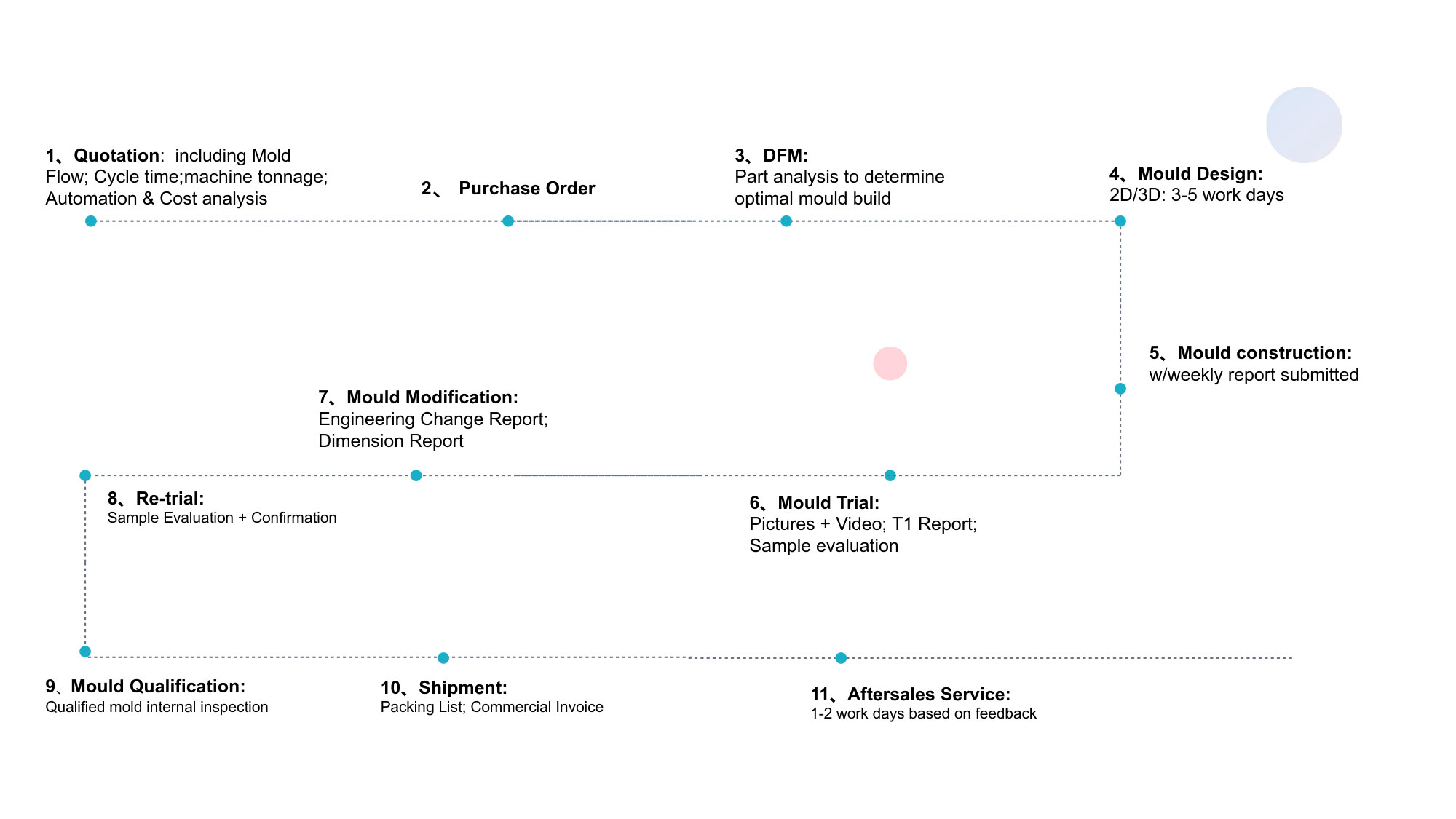
4.1 Early-Stage Design for Manufacturability (DFM) Engagement
Before any steel is cut, Ansix delivers a comprehensive DFM (Design for Manufacturability) report to the customer. This report is a collaborative document that identifies and resolves potential manufacturing issues before they become expensive mold modifications.
What the Ansix DFM Report Includes:
Draft angle analysis — Recommended minimum draft angles for each vertical surface to prevent ejection sticking
Wall thickness optimization — Identification of thick sections that would cause sink marks or extended cooling times; recommendations for uniform wall distribution
Gate location and type recommendation — Optimal gate placement to minimize weld lines, air traps, and flow marks
Parting line selection — Where to locate the parting line to minimize flash risk while allowing clean part ejection
Ejector pin location and mark allowances — Pre-approved locations for ejector pins that will not interfere with sealing surfaces or aesthetics
Material shrinkage assumption verification — Confirmation of shrinkage assumptions for the specified material to ensure final dimensions are correct
Mold flow analysis — Simulation results showing predicted fill patterns, pressure requirements, temperature distribution, and potential defect locations
Customer Value: *DFM is a risk mitigation tool. A thorough DFM review — conducted before mold manufacturing begins — identifies problems that cost 0tofix(changingaCADfile)ratherthan10,000 to fix (re-machining a steel mold). Ansix provides DFM reports before you authorize mold construction. You know what you are getting, and you know it will work.*
4.2 Multi-Stage Mold Validation (T0 to Tx)
Ansix follows a structured mold validation process that de-risks the transition from mold completion to production readiness:
Phase Description Deliverable to Customer
T0 — First Shot Initial mold trial at Ansix facility; verify basic function, ejection, and part formation Molded sample parts; initial visual inspection report
T1 — Dimensional Verification Full dimensional inspection against CAD; cavity-to-cavity variation analysis First-article inspection report; dimensional Cpk analysis
T2 — Process Window Development Design of Experiments (DoE) to identify robust processing window Process parameter matrix; recommended operating conditions
T3 — Capability Confirmation Extended run (e.g., 8 hours continuous) with SPC monitoring Capability report (Cpk); scrap rate; cycle time confirmation
Between T1 and T3, Ansix can implement design changes through interchangeable mold inserts rather than remachining entire mold plates. This flexible insert strategy allows iterative optimization at lower cost and faster turnaround.
Customer Value: You do not pay for a mold and hope it works. Ansix provides validated performance data — dimensional reports, capability indices, scrap rates — before the mold ships. The risk of receiving a mold that does not produce conforming parts is effectively eliminated.
4.3 Low-Volume Pre-Production Trials
Before committing to full-scale production, Ansix offers low-volume pre-production runs of 100 to 500 cycles. This trial run provides:
Confirmation that the mold functions correctly on your specific injection molding machine (as opposed to Ansix’s validation machines)
Real-world scrap rate data under production conditions
Validation of cycle time assumptions
Operator training opportunity on your equipment
Customer Value: *Pre-production trials are insurance. A 500-cycle trial costs a fraction of a production-scale quality failure. Confirm the mold works in your facility, with your operators, on your machine — before you commit to full production volumes.*
4.4 Maintenance, Spare Parts, and Lifecycle Support
Ansix supports the mold throughout its entire operational life:
Complete spare parts kit — Ejector pins, core pins, cavity inserts, and other wear-prone components are delivered with the mold
Documented maintenance schedule — Recommended maintenance intervals (e.g., cleaning, lubrication, component inspection) every 200,000 cycles
Lifelong repair service — Repairs performed at cost; Ansix does not profit from mold maintenance
Emergency support — For production-critical molds, Ansix can ship replacement components within 24-48 hours to minimize downtime
Customer Value: Mold maintenance is a fact of production life. Ansix plans for it, provides the spare parts upfront, and offers support when you need it. No extended negotiations for repair pricing; no weeks of downtime waiting for replacement components. Your production line stays running.
Section V: Differentiating Competencies — Direct Answers to Common Customer Complaints
Rather than claiming superiority in general terms, Ansix provides specific, verifiable responses to the most frequent complaints customers have about mold suppliers:
Common Customer Complaint Ansix’s Specific, Verifiable Response
"The mold is always in repair — every month we have downtime." Ansix delivers molds after a 2,000-cycle aging test with documented wear measurement. We also provide a three-year structural warranty on the mold base and core components (excluding natural wear of ejector pins and other consumables).
"Flash is everywhere — we spend hours manually trimming parts." Ansix machines parting lines to ±0.005 mm fit accuracy and employs self-locking clamp force compensation. The result: flash ≤ 0.03 mm across all eight cavities — low enough that parts go directly from molding machine to downstream assembly with no manual trimming.
"Dimensions drift every batch — we cannot rely on consistent part quality." Ansix machines are equipped with ultrasonic wall thickness sensors providing real-time feedback, combined with in-mold cavity pressure sensors for closed-loop process control. For projects where in-mold sensing is specified, the system automatically compensates for material viscosity variation in real time.
"Mold repair takes weeks — production stops." Ansix maintains in-house EDM and electrode manufacturing. Standard weld repairs or insert replacements are typically completed within 24 hours without waiting for outsourced services.
"The mold needed three rounds of modification before it worked — weeks of lost production." Ansix’s DFM process identifies and resolves issues before steel is cut. The structured T0→T1→T2→T3 validation ensures that production-ready capability is confirmed before the mold leaves our facility. Most molds produce acceptable parts at T1 and are production-ready by T2.
The Customer Value Message: Customers have told us what they hate about previous mold suppliers. Ansix has built specific processes — DFM, in-house repair capability, real-time process control, structured validation — to eliminate each of those pain points. We are not claiming perfection; we are describing systems that prevent these problems from occurring.
Section VI: Cost Reduction Strategy — Driving Down Hard Costs Through Material, Process, and Efficiency Optimization
Cost reduction is not an afterthought at Ansix — it is engineered into every design, process, and material decision.
6.1 Material Cost Reduction
Hot Runner with Valve Gate Technology — For 8-cavity wide-mouth preform molds, Ansix specifies hot runner systems that eliminate sprue waste entirely. For a typical preform molding application, conventional cold runners generate 15-25% material waste (the runner system itself). Hot runner systems reduce this to near-zero waste — saving material cost for every single cycle, for the entire life of the mold.
Thin-Wall and Weight Reduction Design — Through DFM analysis, Ansix identifies opportunities to reduce preform wall thickness without compromising mechanical strength. Thinner walls mean less material per part — direct material cost savings at scale. For example, reducing wall thickness by just 0.2 mm across eight cavities can save hundreds of kilograms of polymer resin per million cycles.
Multi-Cavity Efficiency — An 8-cavity mold produces eight parts per injection cycle. Compared to single-cavity production, an 8-cavity mold reduces machine operating time by a factor of eight, proportionally reducing energy cost, labor cost, and machine amortization per part.
6.2 Process Efficiency and Cycle Time Reduction
Conformal Cooling — Faster cooling equals shorter cycles. Ansix designs conformal cooling channels that achieve uniform part cooling in less time than conventional straight-drilled channels. Published studies show conformal cooling reduces cycle time by 20-32%, directly increasing output from the same molding machine without capital investment.
Balanced Filling — Balanced eight-cavity filling means that all cavities fill at the same time, with the same pressure and temperature profile. An unbalanced mold requires extended packing/holding time to compensate for cavity-to-cavity variation — extending the overall cycle. Ansix’s flow-balanced designs reduce or eliminate this unnecessary cycle extension.
Automated Process Startup — MES-integrated parameter recall means that when a mold is reinstalled after maintenance, the validated process parameters are reloaded automatically. No weeks of re-qualification; no scrap from “re-learning” the process. The mold returns to production at full capability immediately.
6.3 Quality Scrap Reduction
Scrap is pure cost — material, energy, labor, and machine time that produces no saleable output. Ansix’s quality systems directly attack scrap generation:
Scrap Source Ansix Countermeasure Estimated Scrap Reduction
Dimensional variation In-mold sensors + closed-loop control 60-80% reduction
Flash (post-molding trimming waste) ±0.005 mm parting line fit Flash ≤0.03 mm; eliminates manual trimming
Start-up scrap after mold changes MES parameter recall + automated process 70% reduction
Cavity-to-cavity variation Flow simulation + valve gate balancing All cavities produce interchangeable parts
Estimated Total Scrap Reduction — Across the mold lifetime, Ansix’s process control systems typically reduce total scrap from 5-8% (industry average for multi-cavity preform molding) to 1-2%. This 3-6% scrap reduction translates directly to material cost savings and increased saleable output.
6.4 Maintenance and Unplanned Downtime Reduction
Every hour of unplanned downtime is lost production revenue. Ansix’s predictive and preventive maintenance approach minimizes unexpected interruptions:
Wear-resistant materials — Premium tool steels (S136, 2344, 8407, H13, SKD61, DC53) extend component life by 30-50% compared to standard steels.
Spare parts included — Delivered with the mold, eliminating rush-order charges and waiting time for replacement components.
Standardized repair procedures — In-house repair capability returns the mold to service in hours, not days or weeks.
6.5 Total Cost of Ownership Summary
Cost Category Industry Average (Competitor Benchmark) Ansix Tech Delivered Performance Customer Savings
Initial mold cost $XX,XXX Competitive — typically 10-15% below premium European suppliers Lower capital investment
Material waste 15-25% (cold runner) → 1-3% (hot runner) 1-2% with hot runner + thin-wall optimization 15-20% material cost reduction
Scrap rate 5-8% 1-2% 3-6% reduction in wasted material and production time
Cycle time Base reference 20-32% shorter via conformal cooling 20-30% higher output from same machine
Mold life Industry standard 1.5-2× industry standard (via premium materials + heat treatment) Extended mold life reduces replacement frequency
Unplanned downtime Industry average Reduced by >50% (via predictive maintenance + wear-resistant materials) More production hours per year
Total cost of ownership Baseline (1.0×) 0.6-0.7× 30-40% lower total cost over mold life
Section VII: Ansix Tech’s Industry Experience and Track Record
7.1 28+ Years of Manufacturing Excellence
Since our founding, Ansix Tech has specialized in precision injection molds and injection molding production. Over nearly three decades, we have:
Delivered thousands of molds to customers across the packaging, medical, automotive, consumer goods, and industrial equipment sectors
Developed proprietary process knowledge for more than 50 polymer material grades, including commodity resins, engineering thermoplastics, high-performance polymers, and fiber-reinforced compounds
Established quality systems and manufacturing processes that consistently meet or exceed customer expectations
7.2 Customer-Centric Quality Validation System
Ansix’s quality system is not a bureaucratic checklist — it is a practical framework that catches problems early and prevents defects from reaching customers.
Incoming Material Quality — All raw materials (mold steel, mold base components, hot runner systems, standard parts) are inspected upon receipt against specification. Material certifications are retained for full traceability.
In-Process Quality — Every CNC operation, EDM operation, and assembly step is documented with intermediate inspection checkpoints. Critical dimensions are measured before moving to the next process step.
Final Quality Release — Every mold undergoes full dimensional inspection before shipment. The dimensional report is provided to the customer as part of the delivery documentation.
Mold Validation and Customer Acceptance — The mold validation process (T0 to T3) produces documented evidence of mold capability. Customer acceptance is formally documented before shipment.
7.3 Packaging and Rapid Delivery
Once the mold has passed final quality verification and customer acceptance, Ansix coordinates logistics to ensure safe, rapid delivery:
Packaging — Corrosion protection applied to all exposed steel surfaces; mold secured in a heavy-duty wooden crate with shock-absorbing materials; complete documentation (dimensional report, material certifications, spare parts list, maintenance schedule) included in a waterproof pouch
Air freight — For expedited delivery, molds are shipped by air, typically arriving within 2-5 days
Sea freight — For standard delivery, molds are shipped by sea, with customs clearance coordinated by Ansix
Door-to-door tracking — Real-time shipment tracking provided to the customer
Conclusion: Why Ansix Tech for Your 8-Cavity Wide-Mouth Bottle Preform Mold?
Ansix Tech is not the only mold manufacturer in the world, and we do not claim to be the cheapest. But we offer something that many suppliers cannot: predictable performance, documented quality, and a total cost of ownership that is 30-40% lower over the mold’s life.
When you work with Ansix:
You get a DFM report before we cut steel — You know what you are getting, and you know it will work.
You get a mold validated to documented capability (Cpk ≥ 1.33) — You do not guess about quality; you have data.
You get a mold that produces ≤ 0.03 mm flash — You do not spend labor on manual trimming.
You get a hot runner system that eliminates sprue waste — You save material cost for every single cycle.
You get conformal cooling that cuts cycle time by 20-32% — You get more parts per hour from the same molding machine.
You get spare parts included and lifelong support — You minimize unplanned downtime.
For Ansix, a mold is not a block of steel — it is your production asset, your revenue generator. We design every mold with production readiness, thermal balance, exhaust paths, and ease of maintenance as core principles. When our mold reaches your production floor, it operates with minimal setup, low flash, and extended service life — delivering value, not problems.
Next Steps:
Ansix Tech invites qualified customers to participate in a complimentary DFM review of an existing product. During this review, we will demonstrate how our engineering processes — flow simulation, gate optimization, wall thickness analysis, thermal management — identify and resolve manufacturing risks before any steel is cut. You will see firsthand how we translate technical specifications into measurable customer value: lower cost, reduced risk, and higher production uptime.
For a detailed quotation, technical consultation, or DFM review, please contact Ansix Tech’s sales engineering team.
Document Version: 2.0
Last Updated: May 2026
Prepared By: Ansix Tech Engineering Team
Ansix Tech Co Ltd
If you have any plans related to 8-cavity wide-mouth bottle preform mold , you can contact us at any time. We will turn your ideas into reality, let you realize your dreams, and obtain large orders from the market. Our contact information is info@ansixtech.com. Or contact our CTO, mail: stephen@ansixtech.com
#www.ansixtech.com #ansixtech.com #8-cavity wide-mouth bottle preform mold #8-cavity wide-mouth bottle preform mold moulds #8-cavity wide-mouth bottle preform mold injection molding companies #8-cavity wide-mouth bottle preform mold Canopy Mold injection mold companies #Ansix #Ansix moulds #Ansix china #Ansix tech china #Ansix tech company #Ansix facotry #8-cavity wide-mouth bottle preform mold injection molding #8-cavity wide-mouth bottle preform mold injection tools #8-cavity wide-mouth bottle preform mold injection moulds #8-cavity wide-mouth bottle preform mold plastic mould #8-cavity wide-mouth bottle preform mold plastic tools #Ansix Tech #Ansix molds #Ansix injection molding #Ansix mold factory #injection molding 8-cavity wide-mouth bottle preform mold #Ansix mold factory #8-cavity wide-mouth bottle preform mold china #8-cavity wide-mouth bottle preform mold molds #injection factory #8-cavity wide-mouth bottle preform mold injection molding #8-cavity wide-mouth bottle preform mold injection molding factory #injection molding company #8-cavity wide-mouth bottle preform mold injection mold companies #8-cavity wide-mouth bottle preform mold#8-cavity wide-mouth bottle preform mold mold limited #Ansix mold china #Ansix companies #Ansix company China #8-cavity wide-mouth bottle preform mold facotry #Ansix Tech #Ansix Tech mould #8-cavity wide-mouth bottle preform mold injection moulding #injection moulding company #Ansix 8-cavity wide-mouth bottle preform mold parts injection mold companies #medical injection molding companieschina #8-cavity wide-mouth bottle preform mold china factory #Ansix moulding companies #Ansix molding company #8-cavity wide-mouth bottle preform mold injection moulding facotry #Ansix Tech mold #8-cavity wide-mouth bottle preform mold mould #8-cavity wide-mouth bottle preform mold plastic injection molding #ansix plastic mold #Mold manufacturing #8-cavity wide-mouth bottle preform mold parts manufacturing #8-cavity wide-mouth bottle preform mold plastic parts factory #8-cavity wide-mouth bottle preform mold injection parts mold #8-cavity wide-mouth bottle preform mold PRECISION MANUFACTURING #8-cavity wide-mouth bottle preform mold #China mold #8-cavity wide-mouth bottle preform mold injection moulding china #8-cavity wide-mouth bottle preform mold mould china #china precision mold #mold in china #8-cavity wide-mouth bottle preform mold mold china #Precision molds #High-precision molds #8-cavity wide-mouth bottle preform mold #Injection molds #8-cavity wide-mouth bottle preform mold Factory #8-cavity wide-mouth bottle preform mold Company #Super Large Injection Mold Factory #Large Tonnage Injection Molding Factory #8-cavity wide-mouth bottle preform mold Company #8-cavity wide-mouth bottle preform mold Factory #2800T Injection Molding Factory #3000 Ton Injection Molding #4500 Ton Injection Molding Factory #Large Mold Injection Molding #Large Plastic Mold Injection Molding Factory #Large Injection Mold Manufacturer #Plastic Mold Factory #Injection Mold #Plastic Mold