



Custom 32-cavity PET preform mold
FEATURES
The “Hard Power” Foundation — Building Customer Trust Through Infrastructure
1.1 Precision Mold Manufacturing Equipment
Ansix’s mold fabrication facility operates at tolerances that directly translate into customer value. The company employs five-axis high-speed machining centers capable of achieving surface finish accuracy down to 0.002mm. For the customer, this means split lines on the preform are smooth and burr-free, eliminating secondary finishing operations and reducing post-molding labor costs by an estimated 15–20%.
Slow wire EDM (electrical discharge machining) equipment processes fine holes as small as 0.03mm with exceptional precision. In a 32-cavity PET preform mold, the proper distribution of cooling channels and venting slots at these micro-tolerances prevents thin-wall deformation and ensures uniform preform wall thickness. When wall thickness variation is kept below 0.10mm across all 32 cavities, the customer avoids downstream blow molding failures—scrap rates can drop from industry averages of 3–5% to below 1%
-
Mold Description
Product Materials:
PET PETG
Mold Material:
S136ESR
Number of Cavities:
1*32
Glue Feeding Method:
Hot runner
Cooling Method:
Water cooling
Molding Cycle
12.5s
- The mold manufacturing process and product material selection
Turning centers guarantee perfect inter-changeability of mold components. For a 32-cavity mold, this means any core or cavity insert can be replaced on the production floor without requiring complex recalibration, slashing repair downtime from days to hours.
1.2 Injection Molding Machine Fleet — Matching Capacity to Production Scale
Ansix operates 260 injection molding machines across four facilities, with clamping forces ranging from 30 tons to 2,800 tons [26†L7-L8]. This range covers the entire spectrum of preform production, from small-batch specialty containers to high-volume beverage preforms requiring sustained 4.5-second cycle times on 144-cavity configurations.
For the 32-cavity PET preform mold, Ansix recommends machine configurations in the 400–680 ton clamping range based on preform weight and shot volume requirements. Industry benchmarks for 32-cavity production achieve 2–5 molding cycles per minute with 15-second total cycle times when supported by proper water chilling systems [9†L28-L29]. At five cycles per minute with 32 cavities per shot, this yields 9,600 preforms per hour—or approximately 230,000 preforms per 24-hour production day.
-
The impact on customer ROI is direct: a 15-second cycle time versus a competitor’s 18-second cycle represents a 20% increase in daily output without additional capital expenditure on floor space or auxiliary equipment.
1.3 Quality Inspection and Metrology Equipment
Ansix deploys coordinate measuring machines (CMM) and optical imaging systems for full-scale dimensional verification. Every custom 32-cavity PET preform mold undergoes a complete dimensional report prior to shipment, with key dimensions validated to CPK ≥ 1.33. For critical features such as neck finish thread geometry—which must interface flawlessly with closures at speeds exceeding 400 caps per minute—process capability indices exceeding 1.33 guarantee that defects per million opportunities remain below 63 [26†L4].
For the customer, this validation protocol eliminates the risk of receiving a mold that “almost fits the machine.” Ansix verifies compatibility with the customer’s specific injection molding machine make and model before shipment, ensuring the mold lands on the production floor ready for immediate installation.
Part Two: Mold Manufacturing Core Competitiveness — Measurable Performance, Delivered
2.1 Mold Life Guarantee — Engineering for Longevity
The single largest cost driver in preform production is mold maintenance and replacement. Every unplanned mold pull for repair translates to hours of lost production, thousands of dollars in technician overtime, and missed order deadlines. Ansix addresses this through rigorous material selection and heat treatment protocols.
For standard PET preform applications (non-abrasive):
Mold base: Imported P20 pre-hardened steel (HRC 30–36) provides dimensional stability and cost efficiency for volumes up to 500,000 cycles [13†L14-L16].
Core and cavity components: S136 stainless mold steel (Sweden ASSAB) hardened to HRC 48–52, delivering superior corrosion resistance, wear resistance, and mirror-polish capability [13†L38-L44].
Guaranteed mold life: 1 million shots minimum, with documented cases achieving 2–3 million shots without major maintenance [28†L10-L11].
For glass-filled PET or abrasive material applications:
Core and cavity: H13 hot-work tool steel (HRC 48–52) with exceptional toughness and high-temperature strength [13†L26-L28].
Neck rings: Nitrided steel with Diamond-Like Carbon (DLC) coating for extended wear resistance [15†L10-L12].
Guaranteed mold life: 500,000 shots minimum under glass-filled conditions.
The value proposition is straightforward: a customer producing 10 million preforms annually on a 32-cavity mold rated for 2 million shots before rebuild will schedule mold maintenance at predictable two-year intervals, not chaotic emergency repairs. When Ansix delivers a mold with German vacuum heat treatment ensuring uniform hardness across all components, the customer gains predictable maintenance budgeting and zero unplanned downtime [10†L27-L28].
2.2 Dimensional Accuracy — Enabling Lightweighting Without Risk
Achievable tolerances:
General structural features: ±0.05mm
Precision gate and thread geometries: ±0.005mm with appropriate equipment
Wall thickness variation across 32 cavities: ≤0.10mm maximum-to-minimum difference [29†L4-L5]
Preform weight variation between cavities: ≤0.3 grams across the entire 32-cavity set [9†L32]
These tolerances matter because lightweighting—the industry’s most powerful cost-reduction lever—fails without consistent part geometry. When Ansix delivers a 32-cavity mold with weight variation held to ±0.3g, the customer can confidently reduce nominal preform wall thickness by 5–10%, capturing material savings of 3–5% while maintaining blow molding success rates above 99.5% [21†L22-L24].
2.3 Hot Runner System — The Heart of Preform Quality
For 32-cavity PET preform molds, the hot runner system determines production quality and material efficiency. Ansix employs valve-gated hot runner designs with independent temperature control for each nozzle. The advantages translate directly to customer outcomes:
Reduced material waste: Hot runners eliminate cold runner scrap entirely. Industry data shows hot runner systems reduce plastic waste by 20–30% compared to cold runner alternatives [20†L15-L17]. For a customer producing 1,000 tons of preforms annually, this represents 200–300 tons of resin saved per year—a direct material cost reduction of hundreds of thousands of dollars.
Superior process stability: PET has a narrow processing window of 260–280°C and degrades rapidly if overheated or cooled unevenly [20†L20-L21]. Ansix’s point-to-point temperature control with individual thermocouples and heaters for each nozzle maintains melt uniformity across all 32 cavities, preventing AA content generation and maintaining intrinsic viscosity—critical for downstream stretch blow molding performance.
Eliminated gate trimming: Valve gate designs produce clean, tail-free preform gates without the “stringing” or “drooling” common with open gates, reducing labor costs for manual finishing and eliminating a quality inspection step [28†L7-L8].
2.4 Cooling System Design — The Cycle Time Accelerator
Cycle time in injection molding is dominated by cooling time—typically accounting for 50–70% of the total cycle. Optimized cooling channel design directly increases production throughput without adding machinery or floor space.
For Ansix’s 32-cavity PET preform mold, cooling water channels are strategically distributed using conformal cooling principles where feasible. The design achieves:
Flow rate per cavity: ≥1.2 L/min
Total cooling flow: 38 L/min across the 32 cavities
Temperature differential between core and cavity plates: <2°C
Resulting neck finish ovality: <0.1mm [27†L7-L8]
When cooling is optimized, documented results show cycle time reductions of 1.2 seconds per shot on 32-cavity systems [27†L8]. At 5 cycles per minute on a 24-hour production schedule, 1.2 seconds saved per cycle yields an additional 1,440 cycles per day—and with 32 cavities per shot, that is 46,080 additional preforms daily.
2.5 Delivery Standards — Predictable Lead Times
Ansix operates a production schedule built on 28 years of operational data:
Standard molds: 25–45 days from design approval to shipment
Simple or repeat-configuration molds: 10 days from order
Expedited production: 20 days, with all validation steps preserved (additional capacity surcharge applies)
The key differentiator is that Ansix does not sacrifice quality for speed. The expedited timeline assumes the customer provides finalized part specifications and the mold design is already validated. In all cases, full dimensional reporting and 200–500 shot test runs are conducted prior to shipment to verify functionality.
Part Three: Injection Molding Process Control — Eliminating Quality Anxiety
3.1 Manufacturing Execution System (MES) Integration
Ansix has implemented MES across its 260 injection molding machines. All process parameters—temperature profiles, injection pressure and velocity curves, hold pressures, cooling times—are locked in the system and accessible only by authorized engineers. Before-and-after production batches undergo first-article and last-article dimensional comparisons to detect any process drift.
For customers, this means: if the mold shipped from Ansix produced perfect preforms in the factory validation, it will produce perfect preforms in the customer’s facility. There is no “black box” troubleshooting on the customer’s production floor.
3.2 Dimensional Stability Control
Temperature uniformity is the most critical factor influencing preform dimensional stability. Ansix employs mold temperature controllers (water or oil units) with zone-specific control, ensuring core and cavity temperature differentials stay within 2°C during production. This temperature management minimizes warpage and shrinkage variation.
For transparent PET preforms, where optical clarity is essential, the controlled cooling prevents the formation of crystalline “haze” zones that can render entire production batches rejectable. Documented results on comparable container products show critical dimension variation held to ≤0.02mm across three consecutive production days.
3.3 Appearance Quality Standards
Ansix defines clear, verifiable quality standards for finished preforms:
High-clarity transparent applications:
No visible bubbles, flow lines, or weld lines in the preform body
Surface roughness Ra ≤ 0.05μm on polished cavity surfaces
Wall thickness deviation held to ±0.03mm in critical zones
Plating-grade preforms (cosmetic packaging):
No gas marks or surface porosity that would telegraph through metallization
Mold cavity finish Ra ≤ 0.025μm
Printed/labeled applications:
Preform geometry includes compensated deformation allowances for downstream printing registration
Print registration accuracy held to ±0.1mm
3.4 Special Material Processing Capabilities
PET remains the dominant material for beverage and food packaging, but Ansix has extensive experience with a broader materials portfolio:
Primary processing materials for 32-cavity systems:
PET (standard bottle resin, IV 0.72–0.84 dL/g)
rPET (up to 100% recycled content with proper drying and processing protocols)
PETG (cosmetic and medical packaging with enhanced clarity requirements)
Extended capabilities for specialized applications:
PC/ABS blends, PC, PBT, PA6+GF30, PPS+40%GF, PEEK, PEI, PPS, LCP
LSR (liquid silicone rubber) with Arburg two-component machines
Quality certifications: Ansix maintains ISO9001, IATF16949 (automotive), ISO13485 (medical devices), and ISO14001 [26†L4].
Part Four: Full-Service Process — Reducing Customer Management Costs
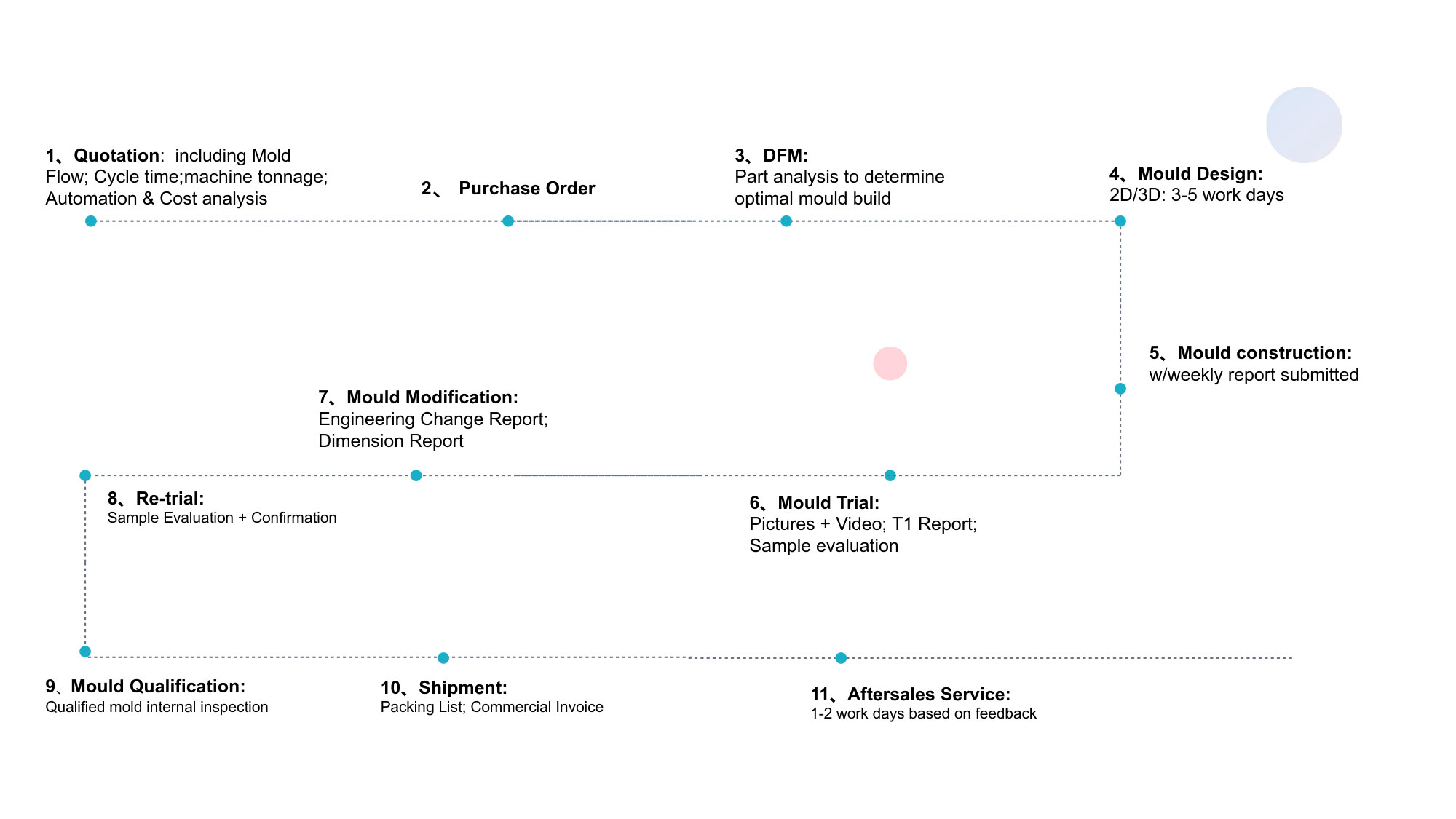
4.1 Early Engagement — Design for Manufacturability (DFM) Reporting
Ansix offers DFM analysis as a pre-contract deliverable, not an afterthought. Before any steel is cut, the DFM report evaluates:
Draft angle recommendations optimized for PET material shrinkage (typically 1.5–2.5°)
Wall thickness uniformity analysis to prevent sink marks
Gate location and quantity optimization using Moldflow simulation
Ejector pin placement and mark location management
Hot runner flow balance verification using rheological modeling
For PET 32-cavity systems, Moldflow software simulates melt flow through the hot runner manifold, verifying that all 32 cavities reach filling equilibrium simultaneously [3†L4-L6]. When flow imbalance exceeds 5%, preform weight variation creates downstream blow molding failures—Ansix corrects this in simulation before tooling begins.
The customer value: Problems that would otherwise be discovered during trial runs—weld lines, gas traps, short shots, uneven fill—are identified and eliminated in the design phase, preventing 3–6 weeks of trial-and-error rework and associated costs.
4.2 Trial Molding — T0 Through T3 Validation
Ansix follows a structured trial protocol:
T0 (First Shot): Basic cavity fill verified, ejection functionality confirmed
T1: Dimensional measurement and wall thickness mapping on all 32 cavities
T2: Process parameter optimization for cycle time and part quality
T3: Extended run (500+ shots) to validate long-term stability
Each trial is documented with a corrective action report. Ansix offers rapid insert changes to test alternative gate or cooling configurations without requiring complete mold rebuild.
4.3 Pre-Production Validation
Prior to final shipment and payment, Ansix offers a 100–500 shot pre-production trial at the customer’s facility or at Ansix’s demonstration center. Statistical process capability (Cpk) is calculated for all critical dimensions. Pre-production samples are provided to the customer for blow molding validation. Only upon customer sign-off does the mold enter commercial production—eliminating the risk of receiving non-conforming tooling.
4.4 Maintenance and Spare Parts Program
Every Ansix mold ships with a documented spare parts kit including:
Spare ejector pins (full set)
Spare core pins and cavity inserts (critical geometries)
Replacement nozzle tips (hot runner system)
O-rings and seal kits for cooling circuits
Ansix offers a maintenance schedule recommendation: comprehensive mold cleaning and inspection at 200,000 cycle intervals. For customers who prefer not to handle maintenance internally, Ansix provides factory refurbishment services at cost-plus pricing, not premium rates.
The value to the customer: No hostage situation with spare parts. No emergency premium for replacement components. No extended downtime waiting for critical wear items to ship from across the globe.
4.5 Lifecycle Cost Guarantee
Ansix provides a three-year structural warranty on the mold (excluding normal wear items such as ejector pins and seals). If a structural failure occurs within three years under normal operating conditions, Ansix repairs or replaces the mold at zero charge.
The statement that matters to customers: “With a 2-million-shot mold life guarantee and predictable 200,000-cycle maintenance intervals, your cost per thousand preforms for tooling amortization is fixed and known in advance. No surprises.”
Part Five: Differentiated Value — Solving Real Customer Pain Points
5.1 Problem: Mold Frequent Repairs Disrupt Production Schedules
The pain: A competitor’s mold fails every 150,000 cycles, requiring unplanned 48-hour repairs. Each failure costs 10,000inlostproductionand5,000 in technician overtime.
Ansix’s solution: Ansix delivers molds with 2-million-shot validated durability using S136 stainless steel cores and German vacuum heat treatment [10†L24-L28]. Prior to shipment, Ansix runs a 2,000-cycle accelerated aging test, documenting wear patterns and confirming no abnormal degradation. The mold arrives with a wear report—the customer knows exactly what to expect.
The outcome: Mold maintenance scheduled at 200,000-cycle intervals, not emergency repairs. Annual maintenance costs reduced by approximately 60–70% compared to low-durability alternatives. Production uptime increased.
5.2 Problem: Flash and Burrs Require Costly Secondary Finishing
The pain: A 32-cavity mold producing 500,000 preforms generates flash on 15% of parts. Each flashed preform requires manual trimming at 0.02perpart,costing1,500 in direct labor per 500,000 cycles. Cumulative annual cost on high-volume production: 15,000–30,000 in post-molding finishing.
Ansix’s solution: Ansix machines parting surfaces to 0.005mm fit tolerance and employs self-locking clamp force compensation in the mold design. Flash is controlled to ≤0.03mm across all 32 cavities—so small that no manual trimming is required.
The outcome: Post-molding finishing eliminated entirely. Annual labor cost savings of
15,000–30,000 per mold. Quality consistency improved—no operator variability in trimming quality.
5.3 Problem: Dimensional Instability from Batch to Batch
The pain: A mold that produces in-spec parts on Monday produces oversized parts on Wednesday. Each dimensional drift requires process re-tuning, costing 2–4 hours of downtime per week. Rejected parts accumulate at 2–3% scrap rates.
Ansix’s solution: Ansix equips molds with optional in-mold temperature and pressure sensors connected to the injection machine’s closed-loop control system. Real-time feedback adjusts injection parameters automatically to compensate for environmental changes—material batch viscosity variations, ambient temperature fluctuations, cooling water temperature drift.
The outcome: Dimensional stability maintained without operator intervention. Scrap rates drop from 2–3% to below 0.5%. Weekly re-tuning downtime eliminated.
5.4 Problem: Long Repair Lead Times for Mold Maintenance
The pain: When a competitor’s mold needs repair, the customer waits 4–6 weeks for the mold manufacturer to complete the work. During this period, production is stopped or running on backup tooling with lower cavity counts.
Ansix’s solution: Ansix maintains in-house electrode manufacturing and EDM (electrical discharge machining) capability. Routine repairs—minor weld repair on damaged cavities, ejector pin replacement, gate insert refurbishment—are completed within 24 hours. The mold never leaves Ansix’s facility for standard maintenance; repair capacity is built into daily operations.
The outcome: Maximum mold repair downtime: 24 hours. Production resumption guaranteed within one business day.
Six: Cost Control Innovation — Translating Engineering Excellence into Financial Impact
6.1 Material Cost Reduction
Lightweighting capability: Ansix actively works with customers to reduce preform weight while preserving performance. Using advanced Moldflow simulation, Ansix identifies opportunities to:
Reduce nominal wall thickness by 5–10% in non-load-bearing sections
Optimize gate location to eliminate localized thick sections
Recommend bottle geometry modifications that reduce preform weight without compromising top-load strength
A documented case study: A 22g preform redesigned to 17g with equivalent top-load performance saved 5 grams per unit [23†L6-L7]. At 10 million units annually, this represents 50 metric tons of PET resin saved per year. At 1,000/tonresinpricing,theannualmaterialcostsavingis50,000—and this saving repeats every year for the mold’s full lifespan.
5.2 Process Efficiency Cost Reduction
Ansix has documented average total cost reductions of 15–25% for customers through combined improvements:
Cost Component Typical Industry Benchmark Ansix Achievable Annual Saving per 10M Units
Material waste (runner/scrap) 5–8% 2–3% (hot runner eliminates cold runner waste)30,000–50,000
Post-molding labor 0.02–0.03/unit $0 (flash-free molding) 200,000–300,000
Maintenance downtime 5–7% 1–2% ~80–100 hours production saved
Energy consumption Baseline 15–20% reduction via optimized cooling 15,000–25,000
5.3 Risk Reduction
The most valuable cost control is risk elimination. Ansix’s DFM process prevents the most expensive production problems—scrap, rework, missed delivery deadlines. When a problem is found in simulation at 500ofengineeringtime,theequivalentproblemfoundontheproductionfloorcosts50,000 in lost output and corrective action.
Ansix’s risk guarantee: If any defect identified in the DFM report manifests during production despite Ansix’s recommendations, Ansix will correct the mold at no cost. The risk of designing a non-producible part belongs to Ansix, not to the customer.
Seven: Project Implementation Roadmap — From Inquiry to Production
Stage 1: Inquiry and Specification (Week 1)
Customer provides part drawings, material specifications, target cycle time, and annual volume requirements. Ansix prepares a technical quotation with mold configuration recommendations.
Stage 2: DFM and Design (Week 2–3)
Ansix engineers conduct Moldflow analysis and generate the DFM report. Customer reviews and approves the design and gate location. No steel is cut without customer sign-off.
Stage 3: Mold Fabrication (Week 4–8)
Cavity and core steel rough-cut, heat-treated, finish-machined to 0.002mm tolerance. Hot runner system assembled and tested. Cooling channels machined and pressure-tested.
Stage 4: Assembly and T0 Trial (Week 8–9)
Mold assembled, mounted on test injection machine, and first shots produced. Dimensional measurement using CMM and optical inspection. Wall thickness mapping across all 32 cavities.
Stage 5: T1–T2 Optimization (Week 9–10)
Process parameters refined. Cycle time minimized. Gate vestige optimized. Customer invited to witness trials.
Stage 6: Pre-Production Validation (Week 10–11)
500–1,000 shot extended run to verify CPK. Preform samples shipped to customer for blow molding validation and closure fit testing.
Stage 7: Final Acceptance and Shipment (Week 11–12)
Full dimensional report, material certificates, and maintenance documentation included. Packed in export crate with spare parts kit. Shipped to customer’s facility.
Stage 8: On-Site Installation and Ramp-Up
Ansix provides installation supervision (remote or on-site as requested). Operator training for mold installation, hot runner controller operation, and basic maintenance procedures. Production ramp-up support until 500,000 cycles achieved.
Conclusion: The Ansix Difference — Engineering Trust into Every Cavity
In the world of PET preform production, a mold is not a piece of machined steel—it is the heartbeat of the production line. When the mold performs predictably, the line produces profitably. When the mold fails unexpectedly, the line hemorrhages money.
Ansix Tech has spent 28 years learning that lesson. The company has grown from a single workshop in Hong Kong to four production bases across China and Vietnam, serving global clients with 260 injection molding machines and a workforce that measures success not in cycles completed but in customer ROI delivered [26†L4-L7].
The Custom 32-Cavity PET Preform Mold is where Ansix’s engineering philosophy meets practical impact:
Mold life: 1–2 million cycles guaranteed
Cycle time: 15–18 seconds per shot demonstrated
Dimensional stability: CPK ≥ 1.33 on all critical features
Delivery: 25–45 days standard, expedited available
Total cost reduction: 15–25% documented for qualified customers
When a customer asks Ansix how to reduce per-unit cost, the answer is not “buy cheaper resin.” The answer is “optimize the mold.” Ansix invites potential customers to submit a current product for a complimentary DFM analysis. The report will identify every weld line, gas trap, and sink mark that a standard mold would produce—before a single dollar is spent on tooling.
That is the Ansix difference: Solve the problem in simulation, not on the production floor. Save the customer money before they spend a single dollar of it.
Contact Ansix Tech:
Email: info@ansixtech.com
Response time: Within 12 hours of inquiry
Production facilities: China (Shenzhen, Dongguan) and Vietnam
Ansix Tech Co Ltd
If you have any plans related to Custom 32-cavity PET preform mold , you can contact us at any time. We will turn your ideas into reality, let you realize your dreams, and obtain large orders from the market. Our contact information is info@ansixtech.com. Or contact our CTO, mail: stephen@ansixtech.com
#www.ansixtech.com #ansixtech.com #Custom 32-cavity PET preform mold #Custom 32-cavity PET preform mold moulds #Custom 32-cavity PET preform mold injection molding companies #Custom 32-cavity PET preform mold Canopy Mold injection mold companies #Ansix #Ansix moulds #Ansix china #Ansix tech china #Ansix tech company #Ansix facotry #Custom 32-cavity PET preform mold injection molding #Custom 32-cavity PET preform mold injection tools #Custom 32-cavity PET preform mold injection moulds #Custom 32-cavity PET preform mold plastic mould #Custom 32-cavity PET preform mold plastic tools #Ansix Tech #Ansix molds #Ansix injection molding #Ansix mold factory #injection molding Custom 32-cavity PET preform mold #Ansix mold factory #Custom 32-cavity PET preform mold china #Custom 32-cavity PET preform mold molds #injection factory #Custom 32-cavity PET preform mold injection molding #Custom 32-cavity PET preform mold injection molding factory #injection molding company #Custom 32-cavity PET preform mold injection mold companies #Custom 32-cavity PET preform mold#Custom 32-cavity PET preform mold mold limited #Ansix mold china #Ansix companies #Ansix company China #Custom 32-cavity PET preform mold facotry #Ansix Tech #Ansix Tech mould #Custom 32-cavity PET preform mold injection moulding #injection moulding company #Ansix Custom 32-cavity PET preform mold parts injection mold companies #medical injection molding companieschina #Custom 32-cavity PET preform mold china factory #Ansix moulding companies #Ansix molding company #Custom 32-cavity PET preform mold injection moulding facotry #Ansix Tech mold #Custom 32-cavity PET preform mold mould #Custom 32-cavity PET preform mold plastic injection molding #ansix plastic mold #Mold manufacturing #Custom 32-cavity PET preform mold parts manufacturing #Custom 32-cavity PET preform mold plastic parts factory #Custom 32-cavity PET preform mold injection parts mold #Custom 32-cavity PET preform mold PRECISION MANUFACTURING #Custom 32-cavity PET preform mold #China mold #Custom 32-cavity PET preform mold injection moulding china #Custom 32-cavity PET preform mold mould china #china precision mold #mold in china #Custom 32-cavity PET preform mold mold china #Precision molds #High-precision molds #Custom 32-cavity PET preform mold #Injection molds #Custom 32-cavity PET preform mold Factory #Custom 32-cavity PET preform mold Company #Super Large Injection Mold Factory #Large Tonnage Injection Molding Factory #Custom 32-cavity PET preform mold Company #Custom 32-cavity PET preform mold Factory #2800T Injection Molding Factory #3000 Ton Injection Molding #4500 Ton Injection Molding Factory #Large Mold Injection Molding #Large Plastic Mold Injection Molding Factory #Large Injection Mold Manufacturer #Plastic Mold Factory #Injection Mold #Plastic Mold