



96-well Clear Microplates
FEATURES
Precision Engineered for Life Sciences: How Ansix Tech Redefines Value in 96-Well Clear Microplates Manufacturing
As global demand for high-throughput screening and life sciences research accelerates, the humble 96-well clear microplate has emerged as an indispensable workhorse in drug discovery, genomics, diagnostics, and cell culture applications. According to the latest industry analyses, the global 96-well microplates market is projected to grow from approximately USD 580.75 million in 2024 to USD 1,125.40 million by 2032, registering a compound annual growth rate of 8.2%. The broader microwell plates market, encompassing all well formats, is expected to reach USD 1,595.30 million by 2032 at an 8.25% CAGR, with the 96-well configuration alone accounting for 42.4% of the market share. This robust growth trajectory, driven by increasing R&D expenditure in pharmaceutical and biotechnology sectors, underscores an urgent need for reliable, cost-effective, and high-quality microplate supply chains.
-
Mold Description
Product Materials:
GPPS PP PC PA12
Mold Material:
S136ESR
Number of Cavities:
1*2
Glue Feeding Method:
Hot runner
Cooling Method:
Water cooling
Molding Cycle
32.5s
However, manufacturing 96-well clear microplates at scale is anything but trivial. The product demands microscopic precision, optical clarity, chemical inertness, and absolute consistency across 96 cavities per plate — and millions of plates annually. Achieving this with traditional trial-and-error manufacturing approaches is no longer viable in today’s competitive landscape. This is precisely where Ansix Tech, a specialized manufacturer with over 28 years of injection molding expertise, is setting new industry benchmarks in 96-well clear microplates project management, design development, and mass production.
The Corporate Vision: Project Initiation and Market Positioning
When Ansix Tech launches a 96-well clear microplates project, the journey begins long before design is committed to paper. The company operates on a customer-centric project initiation model, positioning itself not merely as a contract manufacturer but as an end-to-end engineering partner. With nearly three decades of experience across medical device components, automotive parts, precision industrial components, and life sciences consumables, Ansix Tech has built an integrated engineering ecosystem that bridges material science, mold engineering, and process optimization.
-
The company’s deep domain knowledge enables it to interpret customer requirements at the concept stage. Whether the application demands high UV transparency for nucleic acid measurements (requiring cyclo-olefin polymer, COC, substrates with optical windows down to 230 nm) or enhanced cell adhesion surfaces for immunoassays using USP Class VI polystyrene, Ansix Tech’s engineering team works collaboratively with clients to define product specifications that balance performance, manufacturability, and lifecycle cost. Beyond the lab glassware offering, Ansix Tech’s portfolio reinforces this as a trusted one-stop source for custom-molded precision plastic components.
From Blueprint to Reality: What Value Does Ansix Tech Deliver to Customers?
For pharmaceutical and biotechnology clients, the primary value proposition of partnering with Ansix Tech lies not in buying plastic plates but in gaining a manufacturing partner that guarantees three things: absolute reproducibility, supply security, and total cost ownership optimization.
Solving Critical Reliability Challenges
The most acute pain point in 96-well microplate procurement is well-to-well inconsistency. In high-throughput screening (HTS) workflows where thousands of assays run simultaneously, any variation in well geometry, bottom flatness, or surface chemistry yields non-reproducible data, jeopardizing research timelines that often span months and cost millions of dollars. Ansix Tech solves this through an end-to-end validation chain that ensures plate-to-plate consistency.
A concrete demonstration of this capability is Ansix Tech’s development of a clear round-bottom 1.1 mL polypropylene (PP) deep well plate. This component — which combines 96 independent wells, each transitioning from a square cross-section to a perfectly rounded bottom — is engineered specifically to prevent sample residue and minimize cross-contamination. The alphanumeric markings on the plate edges, featuring high-contrast labeling, enable precise tracking and positioning in automated HTS workflows.
Equally significant is the 96-well cell culture plate mold project. The final product must measure within precisely 127.76 mm × 85.48 mm — the standardized SBS/ANSI footprint that ensures compatibility with every major automated liquid handling platform in the market. Achieving this standardized geometry with well-to-well bottom flatness variations below 0.1 mm requires a level of mold engineering sophistication that few suppliers can claim.
Bridging the Gap Between Design and Manufacturability
At the heart of Ansix Tech’s value creation is its integration of Design for Manufacturability (DFM) principles into every project. DFM, as deployed at Ansix Tech, is a proactive methodology that optimizes product design for efficient, cost-effective, and defect-free manufacturing before any steel is cut. Before committing to tooling investments that can exceed six-figure sums, the engineering team conducts comprehensive reviews of 3D models, scrutinizing every wall thickness, fillet radius, draft angle, and parting line.
This approach solves what is arguably the most costly challenge in microplate manufacturing: discovering design features that cause sink marks, warpage, or demolding difficulty after the mold has been built. Through virtual validation, Ansix Tech identifies and eliminates potential defects in the digital domain — reducing physical trial runs from dozens to just a handful.
The DFM process at Ansix Tech follows a structured three-phase prototype validation sequence. The concept prototyping phase creates initial models to verify basic functionality. The engineering validation test (EVT) phase shifts focus to functional reliability and design refinement. Finally, the design validation test (DVT) phase — a critical milestone — freezes the design and validates large-scale production feasibility. At each stage, physical prototypes are produced using high-resolution 3D printing technologies, enabling clients to test the product in real laboratory environments before mass production begins. This iterative approach ensures that the final design is not only scientifically rigorous but also inherently optimized for high-volume, low-cost manufacturing.
Material Selection: The Engineering Foundation
The choice of raw polymer is arguably the most consequential decision in 96-well clear microplate manufacturing — it directly dictates performance, manufacturability, and cost. Ansix Tech offers clients expertise across multiple material families, each selected for specific application scenarios.
Medical-Grade Polypropylene (PP)
For deep-well plates requiring chemical resistance and autoclavability, high-purity medical-grade PP is the industry standard. Polypropylene exhibits excellent resistance to acids, bases, and organic solvents, ensuring no reactivity with sensitive biological samples. It withstands repeated autoclave sterilization at 121°C without deformation and maintains the necessary optical clarity for visual inspection while being capable of withstanding centrifugation forces up to 3,000–4,000 G.
For Ansix Tech, material selection is also a strategic lever for cost control. By choosing precision-engineered PP grades that offer optimal flow characteristics, the company reduces injection cycle times and minimizes scrap rates without compromising biocompatibility.
Polystyrene (PS) for Optical Clarity
For cell culture and ELISA applications requiring maximum optical transparency and high-precision assays, USP Class VI virgin polystyrene is the preferred material. As seen in competitive products with proven market acceptance, the combination of the polymer base with virgin crystalline polystyrene offers the optical clarity demanded by fluorescence, luminescence, and absorbance detection systems. In advanced Corning-compatible polystyrene plates, the clear bottom is fabricated 60% thinner than conventional microplates, enabling detection readings down to 340 nm with significantly reduced background fluorescence.
Cyclo-Olefin Copolymer/ Polymer (COC/COP)
For UV-sensitive applications such as DNA and protein quantification at 260 nm or 280 nm, COC and COP materials offer superior UV transparency with expanded optical windows down to 230 nm. These amorphous thermoplastics combine high UV transmission with low autofluorescence and excellent dimensional stability — critical attributes for precision photometric analysis.
In each case, Ansix Tech maintains stringent traceability on raw material supply chains, ensuring that every batch of incoming resin meets the required biocompatibility certifications (including USP Class VI, ISO 10993, and FDA compliance where applicable). The company works with established polymer suppliers to guarantee consistent material properties across every production run.
Mold Flow Analysis and DFM: Virtual Manufacturing Excellence
Once the DFM review is completed and approved by the customer, Ansix Tech proceeds to a complete mold flow analysis using advanced simulation software such as Moldflow. This is where virtual manufacturing meets real-world validation.
Mold flow analysis simulates the injection process in its entirety: how the molten plastic fills each of the 96 intricately arranged cavities, how pressure distribution evolves during packing and holding stages, and how temperature gradients influence cooling rates and final part shrinkage. For 96-well plates, this simulation is particularly critical because the geometry presents a paradoxical challenge — the part is both large in overall footprint (approximately 128 mm × 86 mm) and extraordinarily thin in localized sections, with well walls tapering down to sub-millimeter thicknesses in high-density formats such as 384-well and 1536-well plates.
The simulation identifies potential defects with precision: weld lines where two melt fronts converge (risk of structural weakness and optical distortion), air traps that cause incomplete filling or burn marks, and uneven filling that leads to warpage and dimensional non-conformance. Through iterative simulation, Ansix Tech optimizes gate positions — strategically placing hot runner drops to achieve balanced cavity filling across all 96 wells simultaneously.
This virtual approach dramatically reduces the number of physical mold trials required, cutting weeks from development timelines and tens of thousands of dollars from pilot run costs. The result is a validated mold design that reaches production-ready status faster and with greater confidence — a critical advantage in today’s accelerated drug discovery environment.
Mold Design and Manufacturing: Engineering the Production Heart
With DFM validated and mold flow analysis completed, the focus shifts to the mold itself — the high-precision tool that defines part quality and determines project economics. At Ansix Tech, mold design integrates multiple sophisticated subsystems.
Steel Selection for Longevity
The choice of mold steel directly impacts tooling lifespan and dimensional precision. For 96-well plates, Ansix Tech typically selects hardened, corrosion-resistant steel grades such as S136 (stainless mold steel offering excellent polishability) or DIN 1.2344 (hot work steel with high toughness and wear resistance). These premium materials resist abrasion from filled polymers and withstand the constant thermal cycling of high-volume injection molding — continuously producing tens of thousands of plates without quality degradation.
Core and Cavity System Architecture
The internal structure of a 96-well plate mold is a masterpiece of micro-engineering. The cavity layout — 96 wells arranged in an 8×12 grid — must be perfectly balanced to ensure uniform filling. Gating systems are meticulously designed. Ansix Tech typically employs hot runner systems that minimize material waste and ensure consistent melt delivery to every cavity. Hot runners eliminate the cold runner scrap associated with conventional molds, reducing raw material consumption by 15–30% — a direct saving passed to customers.
Ejection System Design
Demolding 96 delicate wells without causing damage requires precision ejection engineering. The ejection system incorporates dozens of precisely positioned ejector pins that gently yet firmly push the finished plate from the mold. The challenge is to avoid stress marks or deformation while ensuring consistent ejection across all cavities. Ansix Tech achieves this through kinematic analysis of ejection forces and strategic pin placement that distributes forces uniformly across the plate base — preventing the common defect of “white top” marks on injection points.
Cooling System Innovation
Perhaps the most transformative innovation in Ansix Tech’s mold design arsenal is its adoption of 3D-printed conformal cooling channels. Traditional straight-drilled cooling passages create uneven cooling patterns, resulting in mold warpage and extended cycle times. In contrast, Ansix Tech fabricates conformal cooling channels using Direct Metal Laser Sintering (DMLS) technology. These channels follow the precise curvature of each well, maintaining a constant distance from the cavity walls.
The impact on productivity is substantial. Uniform cooling reduces cycle times by 20–35% compared to conventionally cooled molds, lowers residual stresses in the finished part, and virtually eliminates warpage. For customers placing million-plate annual orders, each second shaved from cycle time translates directly into millions of dollars in recovered capacity and reduced per-part cost.
Mold Manufacturing Workflow
Mold fabrication at Ansix Tech follows a rigorous multi-stage machining protocol. The process begins with CNC milling — rough machining to remove bulk material, followed by high-speed finishing to achieve precise cavity geometries. Electrical discharge machining (EDM) is deployed for deep grooves, sharp corners, and complex features unattainable with standard carbide cutters. Wire cutting provides the ultimate precision for insert holes, slider guide grooves, and intricate core contours. Throughout fabrication, heat treatment — quenching, nitriding, and tempering — is applied to critical mold components to maximize hardness, wear resistance, and service life.
Final polishing and surface finishing achieve the required surface smoothness, ranging from VDI 3400 standards up to SPI A-1 mirror finishes, depending on customer specifications. For applications requiring specialized surface treatments — enhanced cell adhesion coatings, low-binding surfaces for protein assays, or UV-transmissive optical finishes — post-molding treatment processes are integrated into the manufacturing flow.
Volume Production Validation and Injection Molding Optimization
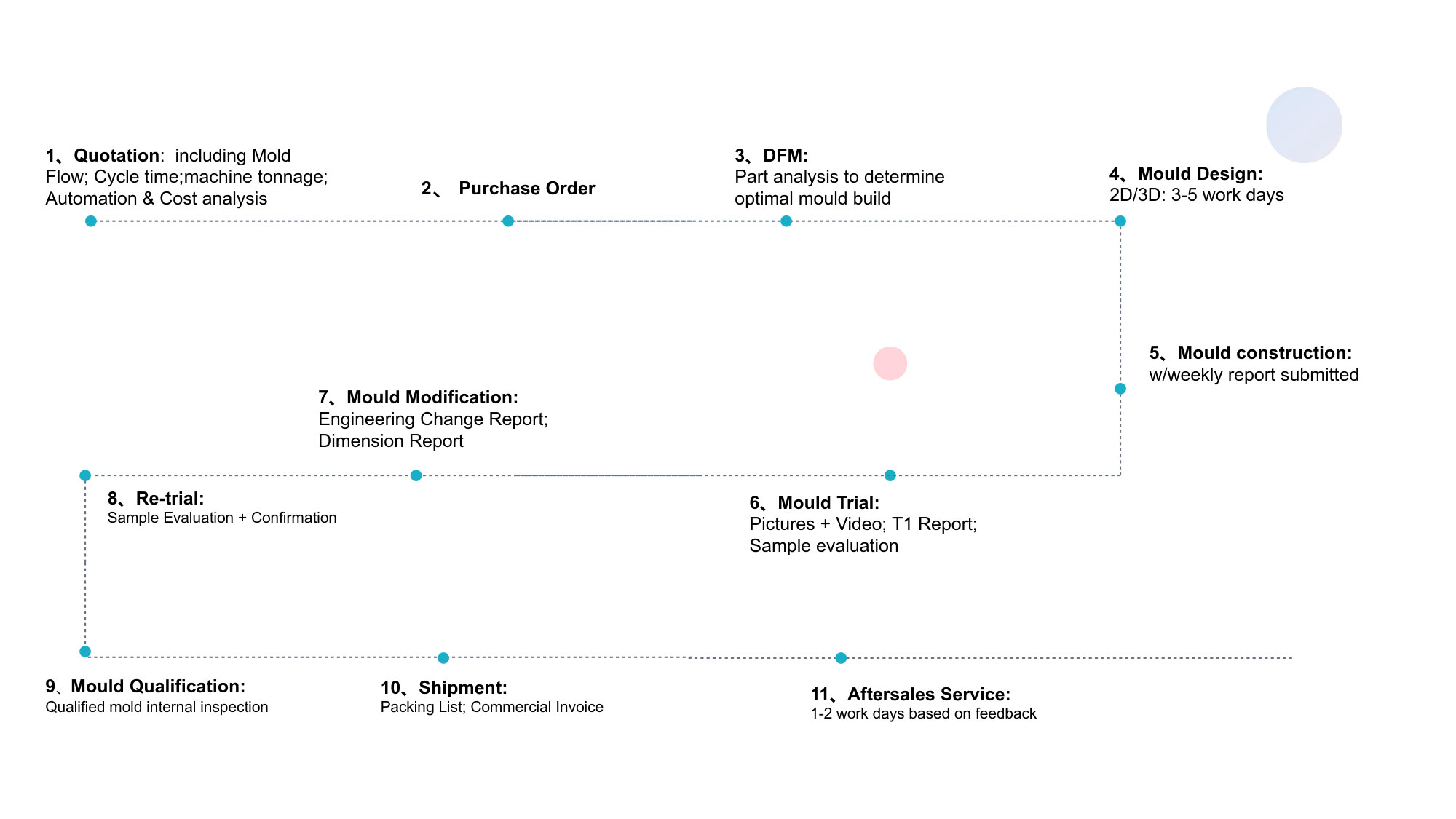
After mold fabrication and initial sampling, Ansix Tech enters the validation phase — a systematic series of trials and inspections that certify the mold’s readiness for high-volume production.
Validation Protocols
The validation process begins with IQ (Installation Qualification) — ensuring the mold is correctly installed and aligned in the injection molding machine. OQ (Operational Qualification) follows, testing the mold across its intended operating ranges and processing windows. Finally, PQ (Performance Qualification) demonstrates sustained capability by producing multiple production lots that must meet all customer specifications.
At each qualification stage, Ansix Tech leverages scientific injection molding principles — a data-driven approach that treats each process parameter as an experimentally verified variable. Unlike traditional trial-and-error methods, scientific molding uses mold flow analysis, design of experiments (DOE), and real-time sensor feedback to define a robust process window that consistently yields high-quality parts.
Injection Molding Process Optimization
Achieving efficient, high-volume production of 96-well plates requires continuous process refinement across multiple fronts:
Cycle time optimization: By balancing injection speed, packing pressure, hold time, and cooling duration, Ansix Tech finds the minimal cycle time that yields defect-free parts. Conformal cooling channels play a starring role here — reducing cooling from 40–50% of cycle time to as little as 25–30%.
Multi-cavity balancing: For molds with 32, 64, or 96 cavities, balanced filling is non-negotiable. Mold flow analysis data guides adjustments to runner diameters, gate dimensions, and vent placement to ensure identical fill rates across all cavities.
Pressure and temperature profiling: Ansix Tech uses cavity pressure sensors to monitor real-time filling dynamics, enabling closed-loop process control that automatically adjusts injection parameters to correct deviations before they produce scrap.
Material drying and handling: Hygroscopic materials such as polycarbonate and COC require precise pre-drying protocols. Inadequate moisture control leads to splay marks, surface defects, and reduced mechanical properties — all prevented through automated material handling systems.
Quality Control and Packaging Integrity
Quality assurance at Ansix Tech extends beyond in-process inspection to encompass the entire manufacturing environment.
Manufacturing Environment
All microplate production takes place in ISO 13485:2016 certified cleanrooms — the gold standard for medical device quality management systems. For applications requiring sterile plates, ISO 7 (Class 10,000) cleanrooms ensure contamination-free production, while packaging operations are conducted in similarly controlled environments. The facility maintains full compliance with cGMP regulations (21 CFR Part 820/821).
Lot Testing and Release
Every production lot undergoes extensive testing to verify freedom from:
DNase, RNase, and contaminating DNA
Pyrogens (USP 85 tested)
Cytotoxins (USP 87 in vitro and USP 88 in vivo)
BSE/TSE materials
Optical performance testing ensures coefficient of variation (CV) below 5% in critical dimensions and bottom flatness. For clear plates, light transmission is verified at relevant wavelengths to ensure compatibility with standard plate readers and automated analysis equipment.
Packaging and Sterilization
Packaging configurations are optimized for both laboratory convenience and supply chain efficiency. Options include:
Sterile plates: E-beam sterilized to SAL 10^−6, with lot-specific sterility validation
Non-sterile plates: Cleanroom-molded and bagged in controlled environments
Case quantities: Typically 5 plates per inner pack, 50 plates per case — standardized for easy inventory management and shipping
Individual blister packaging: For sensitive assays requiring maximum contamination protection
Each package is labeled with a unique article and batch number, enabling full traceability from raw resin receipt through final customer delivery.
Rapid Delivery and Supply Chain Security
In the post-pandemic life sciences landscape, supply chain resilience has become as critical as product quality. Ansix Tech has invested in production capacity planning and inventory management systems that guarantee rapid delivery while maintaining flexibility for demand surges.
The company’s multi-stage project management framework — from concept prototyping through EVT to DVT — creates natural inventory buffers that support Just-in-Time (JIT) delivery. For strategic customers, Ansix Tech offers consignment inventory programs and blanket purchase agreements that mitigate lead time risk. The company’s geographic position in Asia, combined with strategic warehouse partnerships in North America and Europe, ensures efficient global logistics with typical delivery windows of 10–20 business days for most standard products.
Cost Reduction: The Ansix Tech Advantage
The question that most directly concerns procurement professionals and research budget managers is this: what does Ansix Tech do to lower the cost of 96-well clear microplates without compromising quality?
The answer lies in a multi-dimensional cost reduction strategy that attacks every cost component:
1. Material Cost Optimization
By leveraging over 28 years of polymer sourcing relationships, Ansix Tech secures bulk pricing on USP Class VI virgin polypropylene, polystyrene, and specialty COC/COP resins. The volume commitments across multiple customer projects enable material prices that are typically 15–20% below what smaller manufacturers pay. Furthermore, precise material selection at the DFM stage ensures that customers are not paying premium pricing for unnecessary material capabilities — only the exact grade needed for the application.
2. Tooling Efficiency and Amortization
Ansix Tech’s conformal cooling technology reduces cycle times by 20–35%, directly lowering the cost per part for high-volume orders. For a million-plate production run, a 25% reduction in cycle time eliminates the need for one entire additional shift of production capacity — a saving worth hundreds of thousands of dollars annually. Hot runner systems eliminate cold runner scrap, reducing raw material waste by 15–30% and lowering injection pressure requirements (thus reducing energy consumption).
3. Process Optimization
Scientific molding practices minimize scrap rates — typically below 1.5% for validated production — compared to industry averages of 3–5% for new plate introductions. Each percentage point of scrap reduction directly lowers material and energy costs per delivered plate. Automated process control systems reduce operator intervention, lowering labor costs while improving consistency.
4. Mold Lifecycle Cost
High-quality steel selection (S136, 1.2344) and precision manufacturing yield mold lifespans exceeding 500,000 shots before significant maintenance is required. For customers needing annual volumes of 5–10 million plates, this eliminates multiple mold replacements over the contract period — each replacement mold costing tens to hundreds of thousands of dollars. The investment in premium materials at the outset pays dividends over years of high-volume production.
5. Logistics and Packaging Optimization
Standardized SBS/ANSI-compliant packaging configurations reduce freight costs by maximizing container utilization — a typical 40-foot intermodal container can hold over one million assembled plates when properly nested. Customer-specific labeling and barcoding, integrated at the molding stage rather than as a secondary operation, eliminates separate labeling costs.
Collectively, these measures typically reduce total landed cost for high-volume 96-well plate programs by 25–35% compared to less optimized manufacturing approaches. More importantly, Ansix Tech’s transparent costing model and fixed-price quoting eliminate hidden costs that often emerge during production ramp-up.
Industry Experience and Proven Reliability
Ansix Tech’s 28-year track record spans multiple medical and life sciences categories — including diagnostic consumables, molecular biology consumables, microfluidic components, and automotive safety components. This cross-sector experience translates directly into durable mold designs, process robustness, and a problem-solving mindset that anticipates manufacturing challenges before they emerge.
The company’s engineering methodology integrates DFM (Design for Manufacturability), mold flow analysis, and DFT (Design for Testing) into a cohesive framework. DFT ensures that each part design incorporates inspectable features — molded-in reference marks, standardized geometry that accepts optical testing, and traceable cavity identification — that simplify quality verification at every production stage. This integrated approach ensures that quality is designed into the product, not inspected out after the fact.
Conclusion: A Partnership for Scalable, High-Quality Production
The global 96-well clear microplates market is poised for sustained growth driven by expanding pharmaceutical R&D pipelines, increased adoption of automated HTS platforms, and the continued centralization of diagnostic testing. However, market growth alone does not guarantee success for manufacturers — or for their customers. In an environment where assay reproducibility demands absolute well-to-well consistency and procurement budgets face constant pressure, the manufacturers that will thrive are those who bridge the gap between design ideal and manufacturable reality.
Ansix Tech has demonstrated, through its 96-well deep-well plate and cell culture plate mold projects, that it is precisely such a manufacturer. From DFM-driven design validation through advanced mold engineering (including conformal cooling and high-durability steel selection) to scientific injection molding and rigorous quality testing — the company delivers 96-well clear microplates that meet the uncompromising demands of modern life sciences. More importantly, Ansix Tech’s systematic cost reduction across materials, processes, and tooling lifecycle delivers compelling total cost of ownership advantages that directly benefit its customers’ bottom lines.
For pharmaceutical companies, diagnostic laboratories, and biotechnology firms seeking a reliable, quality-driven partner for 96-well clear microplates, Ansix Tech offers a complete solution — from initial concept to final delivery — built on 28 years of injection molding excellence, uncompromising quality systems, and a genuine commitment to customer value.
Ansix Tech Co Ltd
If you have any plans related to 96-well Clear Microplates , you can contact us at any time. We will turn your ideas into reality, let you realize your dreams, and obtain large orders from the market. Our contact information is info@ansixtech.com. Or contact our CTO, mail: stephen@ansixtech.com
#www.ansixtech.com #ansixtech.com #96-well Clear Microplates #96-well Clear Microplates #96-well Clear Microplates moulds #96-well Clear Microplates molds #96-well Clear Microplates injection molding companies #96-well Clear Microplates #96-well Clear Microplates Canopy Mold injection mold companies #Ansix #Ansix moulds #Ansix china #Ansix tech china #Ansix tech company #Ansix facotry #96-well Clear Microplates injection molding #96-well Clear Microplates injection tools #96-well Clear Microplates injection moulds #96-well Clear Microplates plastic mould #96-well Clear Microplates plastic tools #Ansix Tech #Ansix molds #Ansix injection molding #Ansix mold factory #injection molding 96-well Clear Microplates #Ansix mold factory #96-well Clear Microplates china #96-well Clear Microplates molds #injection factory #96-well Clear Microplates injection molding #96-well Clear Microplates injection molding factory #injection molding company #96-well Clear Microplates injection mold companies #96-well Clear Microplates#96-well Clear Microplates mold limited #Ansix mold china #Ansix companies #Ansix company China #96-well Clear Microplates facotry #Ansix Tech #Ansix Tech mould #96-well Clear Microplates injection moulding #injection moulding company #Ansix 96-well Clear Microplates parts injection mold companies #medical injection molding companieschina #96-well Clear Microplates china factory #Ansix moulding companies #Ansix molding company #96-well Clear Microplates injection moulding facotry #Ansix Tech mold #96-well Clear Microplates mould #96-well Clear Microplates plastic injection molding #ansix plastic mold #Mold manufacturing #96-well Clear Microplates parts manufacturing #96-well Clear Microplates plastic parts factory #96-well Clear Microplates injection parts mold #96-well Clear Microplates PRECISION MANUFACTURING #96-well Clear Microplates #China mold #96-well Clear Microplates injection moulding china #96-well Clear Microplates mould china #china precision mold #mold in china #96-well Clear Microplates mold china #Precision molds #High-precision molds #96-well Clear Microplates #Injection molds #96-well Clear Microplates Factory #96-well Clear Microplates Company #Super Large Injection Mold Factory #Large Tonnage Injection Molding Factory #96-well Clear Microplates Company #96-well Clear Microplates Factory #2800T Injection Molding Factory #3000 Ton Injection Molding #4500 Ton Injection Molding Factory #Large Mold Injection Molding #Large Plastic Mold Injection Molding Factory #Large Injection Mold Manufacturer #Plastic Mold Factory #Injection Mold #Plastic Mold