



Baby spoon LSR full liquid overmolding
FEATURES
Hard Power Infrastructure — The Foundation of Customer Trust
Before discussing processes and capabilities, we recognize that customers need tangible proof of our manufacturing foundation. Ansix Tech‘s equipment infrastructure is not merely a list of machines — it is a commitment to precision, consistency, and long-term partnership.
Mold Processing Equipment: Precision That Speaks for Itself
Five-Axis High-Speed Machining Centers
Technical Specification: We operate advanced five-axis high-speed machining centers capable of achieving ±0.002mm positioning accuracy on complex freeform surfaces.
Customer Value Translation: A baby spoon requires seamless integration between the rigid handle substrate (typically PC or PPSU) and the soft-touch LSR overmold. Poorly machined parting lines create visible witness marks and potential bacterial harborage points. Our five-axis capability ensures the mold‘s mating surfaces are machined with optical-grade smoothness, producing baby spoons with invisible parting lines that meet the strictest hygiene standards. Result: Eliminates 100% of hand-polishing operations on molded parts, reducing per-unit finishing costs by up to 15% and completely removing the risk of surface scratches from secondary handling.
-
Mold Description
Product Materials:
LSR SILICONE + PP
Soft rubber: SILICONE
Mold Material:
S136ESR
Number of Cavities:
2+2
Glue Feeding Method:
Hot runner
Cooling Method:
Water cooling
Molding Cycle
42.5s
- The mold manufacturing process and product material selection
Slow-Wire EDM (Electrical Discharge Machining)
Technical Specification: Our slow-wire EDM systems achieve 0.003mm cutting accuracy, capable of producing micro-features including 0.03mm narrow slots, precision keyways, and delicate core pins without inducing residual stress or warpage.
Customer Value Translation: Baby spoon molds require fine venting channels to evacuate air during LSR injection — without such vents, trapped air creates surface bubbles or incomplete fill. Our wire EDM capability produces vent depths as fine as 0.01mm, ensuring complete cavity evacuation without risking LSR leakage (flashing). Result: Eliminates post-mold bubble defects completely, reducing scrap rate from typical industry 5-8% to below 0.5% — a direct material cost saving of 4.5-7.5% on every production batch.
-
Injection Molding Machine Fleet: Uncompromising Consistency
All-Servo Electric Drive Systems — Locking Force Range 30 to 4,000 Tons
Technical Specification: Our injection molding machine fleet is 100% equipped with all-servo electric drive systems, delivering ±0.1% shot-to-shot repeatability across all production parameters (injection pressure, shot volume, screw position).
Customer Value Translation: For baby spoon production, dimensional consistency between batches is non-negotiable. If the LSR overmold thickness varies by even 0.1mm across different production runs, the soft-touch grip feel becomes inconsistent — customers will notice. Our all-electric machines eliminate hydraulic oil thermal drift and pressure fluctuations, guaranteeing that the part produced on Day 365 is identical to the first article approved on Day 1. Result: Zero dimensional revalidation required for repeat orders; batch-to-batch CPk maintained at ≥1.33 for all critical dimensions; changeover time reduced by 40% due to recipe-based parameter locking.
Precision Metrology Equipment
Coordinate Measuring Machines (CMM) and Optical Vision Inspection Systems
Technical Specification: All molds exiting our facility undergo 100% dimensional inspection against customer-approved design data. Full dimensional reports are generated, with critical dimensions validated to CPk ≥1.33. Our CMM achieves 0.001mm measurement accuracy; optical vision systems capture surface profile deviations down to 0.005mm.
Customer Value Translation: We do not ship a mold until we have statistically proven its capability. The CPk ≥1.33 guarantee means that for every 1 million parts produced, fewer than 60 will fall outside specification limits — mathematically verified before production begins. Result: Eliminates costly post-delivery mold adjustments; ensures your production line achieves first-pass yield rates exceeding 98% from Day One; reduces your quality validation burden by providing fully documented FAI (First Article Inspection) reports with every tool delivery.
Part Two: Mold Manufacturing Excellence — Engineering Capability Delivered in Customer Terms
The mold is the heart of any injection molding operation. For baby spoon LSR full liquid overmolding, the mold determines everything — part quality, cycle time, tool life, and maintenance frequency. Ansix Tech‘s approach is not to “sell a mold” but to engineer a long-term production asset.
Mold Steel Selection: Material Choices with Performance Guarantees
Technical Specification: We select mold materials based on application-specific requirements:
Material Grade Key Properties Recommended Application
S136 / 1.2083 (ESR-refined stainless steel) Superior corrosion resistance, excellent mirror polishability (Ra ≤0.05μm), high dimensional stability Food-contact LSR molds; baby spoon overmold cavities requiring optical surface finish
H13 / 8407 / 1.2344 (Hot work tool steel) Excellent thermal fatigue resistance, high toughness, good wear resistance Mold bases, support plates, components subject to thermal cycling (160-200°C mold temperatures)
M340 / 4Cr13 / 9Cr18 (Martensitic stainless) Enhanced corrosion resistance for aggressive cleaning cycles Molds requiring frequent chemical sterilization; medical-grade applications
NAK80 (Pre-hardened mold steel) Excellent machinability, good mirror finish without heat treatment Prototype molds, short-run production tools
SKD11 / DC53 (Cold work tool steel) High wear resistance, excellent edge retention Core pins, sliders, components exposed to abrasive filled materials
Customer Value Translation: For baby spoon production, we specify S136 (ESR grade) for all LSR-contacting cavity surfaces. ESR (Electro Slag Remelting) refinement removes non-metallic inclusions, delivering a steel purity that directly translates to three customer benefits:
Benefit 1 — Guaranteed Mold Life: 50,000 to 100,000 shots before any significant wear, with full material certification and heat treatment curves provided.
Benefit 2 — Optical-Grade Surface Finish: Ra ≤0.05μm mirror polish prevents LSR from sticking to cavity walls, enabling automatic demolding without release agents — eliminating chemical residue concerns for baby products.
Benefit 3 — Corrosion Resistance for Cleaning Cycles: S136 withstands repeated alkaline and acid-based cleaning protocols without pitting or dimension change — your mold maintains precision across its entire service life, not just the first year.
Precision Tolerancing and DFM Integration
Technical Specification: Standard structural features held to ±0.05mm; critical sealing surfaces and overmolding cavity interfaces held to ±0.005mm when required. Full mold steel material certification (including chemistry analysis, ultrasonic inspection, and heat treatment records) accompanies every tool.
Customer Value Translation: The 0.005mm tolerance on overmolding cavity interfaces is not arbitrary — it is precisely what is required to achieve zero-flash LSR molding. Flash (excess silicone bleeding beyond the intended cavity boundary) is the single most common defect in LSR overmolding. Each flash removal operation adds labor cost, creates surface roughness that compromises hygiene, and risks damaging the underlying part. By holding the mold‘s parting line to 0.005mm accuracy, we guarantee that flash thickness on your baby spoons will never exceed 0.03mm — so fine that it does not require any manual removal. Result: Eliminates 100% of secondary deflashing labor; reduces per-unit handling cost by 8-12%; eliminates the risk of scratch marks from manual flash removal operations.
Gating System and Cold Runner Design: Material Efficiency Delivered
Technical Specification: We deploy servo-driven cold runner systems with valve gate control, ensuring that LSR material remains in an uncured state within the runner channels (maintained at 5-20°C) while achieving precise cavity-to-cavity fill balance of ±2% across all cavities.
Customer Value Translation: LSR material costs are among the highest in the injection molding industry ($12-25 per kilogram for food-grade platinum-cured LSR). Traditional hot runner systems cannot be used with LSR (the material cures in the runner). Open nozzle cold runners generate significant waste — typically 25-35% of total material consumption ends up as runner scrap. Our valve-gate cold runner systems, however, inject LSR directly onto the part surface with zero material waste in the runner. The needle valve mechanism prevents backflow, seals the nozzle after each shot, and eliminates cured material contamination.
Quantified Customer Benefit: On a 4-cavity baby spoon mold producing 500,000 units annually, traditional cold runner systems generate approximately 250-350 kg of LSR runner waste per year (at 18/kg,thatis4,500-6,300 in material loss). Our valve-gate system reduces runner waste to near zero — a 97% reduction in material waste, paying back the incremental mold investment within the first 90 days of production.
Mold Cooling System Design: Cycle Time Optimization
Technical Specification: All molds feature conformal cooling channels designed through thermal flow simulation, with zone-controlled temperature regulation maintaining cavity-to-cavity temperature variation ≤2°C. Cooling circuit layouts are optimized for rapid, uniform heat extraction from the LSR vulcanization process.
Customer Value Translation: LSR vulcanization is a heat-activated chemical reaction occurring at 160-200°C mold temperatures. Uneven cooling creates differential cure rates — parts near hotter sections of the mold may over-cure (becoming brittle), while those near cooler sections may under-cure (remaining sticky and prone to tearing). Worse, inconsistent cooling extends cycle time, directly reducing your production throughput.
Quantified Customer Benefit: Our conformal cooling designs reduce LSR vulcanization hold time by 25-30% compared to conventional cooling layouts. On a 4-cavity baby spoon mold with a baseline 45-second cycle, this improvement cuts cycle time to 32 seconds — a 13-second reduction per shot. Over a 500,000-unit annual production run at 85% utilization, this translates to 1,150 hours of additional production capacity annually. That is the equivalent of adding an entire extra shift without any capital expenditure. Direct cost saving: reduces per-unit energy consumption by 22-28% and labor cost allocation by 25% on a per-unit basis.
Mold Delivery Standards: Predictable, Reliable, Achievable
Technical Specification:
Simple prototype molds: 10 working days
Medium-complexity production molds (up to 8 cavities): 25-45 working days
High-cavitation (16+ cavities) or complex geometry molds: 45-60 working days
Expedited delivery for critical projects: 20-day accelerated timeline available (subject to DFM completion and material availability)
Customer Value Translation: Mold delivery delays are the single greatest source of project timeline slippage in the injection molding industry. We quote realistic timelines and deliver against them — not because we conservatively pad schedules, but because we maintain in-house electrode manufacturing and EDM capabilities. Mold modifications and repairs never leave our shop. A typical mold adjustment that would require 10-14 days when outsourced to external toolrooms takes us 24-48 hours. Result: Your product launch timeline is not held hostage by external tooling dependencies; critical design changes can be implemented and validated within the same week.
Part Three: Injection Molding Process Control — Engineering Quality into Every Shot
Customers worry about dimensional instability, cosmetic defects, batch-to-batch variation, and the hidden costs of quality failures. Ansix Tech‘s injection molding process controls directly address each of these concerns through systematic, data-driven methodologies.
Process Standardization and Digital Parameter Locking
Technical Specification: All injection molding machines are networked through our MES (Manufacturing Execution System). Every molding parameter — injection temperature, injection pressure, holding pressure, holding time, screw speed, cooling time, mold temperature zone settings, and shot volume — is locked within the MES and accessible only by authorized process engineers. Each production batch undergoes first-piece and last-piece dimensional comparison to verify process stability.
Customer Value Translation: In unmanaged production environments, machine operators may adjust parameters “by feel” when they observe minor defects. These undocumented adjustments create process drift — parts produced at 8:00 AM may differ from parts produced at 4:00 PM. Over weeks and months, this drift accumulates, eventually producing out-of-spec parts that trigger costly customer rejections.
Our MES parameter locking system eliminates this risk entirely. Parameters are uploaded as recipe files tied to specific job numbers. Operators cannot modify any setting without entering a controlled change request, which requires engineering approval and triggers full revalidation. Result: Zero undocumented process changes; complete traceability from every shot back to approved parameters; you can audit our production records against your quality agreements with absolute confidence.
In-Mold Sensing and Closed-Loop Control
Technical Specification: Where required, we integrate in-mold temperature sensors and cavity pressure transducers. These sensors provide real-time feedback to the injection molding machine‘s control system, which automatically adjusts holding pressure and fill profiles to compensate for material batch viscosity variations or environmental changes.
Customer Value Translation: LSR material properties vary between batches — even from the same supplier. A 5% variation in viscosity is common and can create dimensional changes or fill imbalances across multi-cavity molds. Traditional molding without in-mold sensing simply accepts this variation, producing parts that meet minimum specifications but waste the full tolerance budget. Our closed-loop control uses sensor feedback to actively compensate for material variation. Result: Critical dimensions are maintained at the target value, not just within tolerance limits; process CPk consistently exceeds 1.33 across batch boundaries; downstream assembly operations never encounter fit issues caused by accumulated dimensional variation.
Appearance Standards and Surface Quality
Technical Specification: Baby spoon LSR overmolds achieve transparent/non-bubble surface finish with no flow marks, no visible knit lines, and no surface contamination. Surface roughness of LSR contact surfaces is maintained at Ra ≤0.8μm. For parts requiring printing or decoration (brand logos, measurement markings), we incorporate design compensation for post-mold shrinkage, achieving print registration accuracy of ±0.1mm.
Customer Value Translation: A baby spoon with visible flow marks or bubbles fails on two levels. First, it signals poor quality to the end consumer — no parent wants to feed their child with an imperfect product. Second, bubbles create crevices that harbor bacteria, compromising hygiene. Our appearance standards are not cosmetic preferences — they are safety requirements.
The ±0.1mm print registration guarantee is equally important. Measurement markings on baby spoons (in milliliters or ounces) must be accurately positioned to provide reliable feeding information. If post-mold shrinkage shifts the printing position by even 0.2mm, the markings may become inaccurate or ambiguous. Our DFM compensation accounts for LSR‘s 2.0-4.0% post-cure shrinkage, ensuring that after the part stabilizes, every marking falls exactly where intended.
Material Traceability and Regulatory Compliance
Technical Specification: All LSR materials used in baby spoon production are fully certified to FDA 21 CFR 177.2600 (U.S. food contact), LFGB (German food safety), and EU 10/2011 (European food contact regulations). Platinum-cured systems eliminate the need for post-curing, removing the risk of volatile organic compound (VOC) residue. Each raw material lot is verified against incoming inspection criteria; batch traceability links each production run to specific material certifications.
Customer Value Translation: Regulatory compliance is non-negotiable for baby feeding products. One contaminated batch can trigger a product recall, destroying brand reputation and incurring millions in liability. Our material certification and traceability systems provide you with a complete audit trail: every spoon can be traced back to the specific LSR lot, the production shift, the machine, and the mold cavity. Result: Your regulatory submission packages are complete, verifiable, and defensible; recall risks are contained to individual lots rather than entire production histories; you maintain full compliance with FDA and EU food contact regulations without needing dedicated in-house materials expertise.
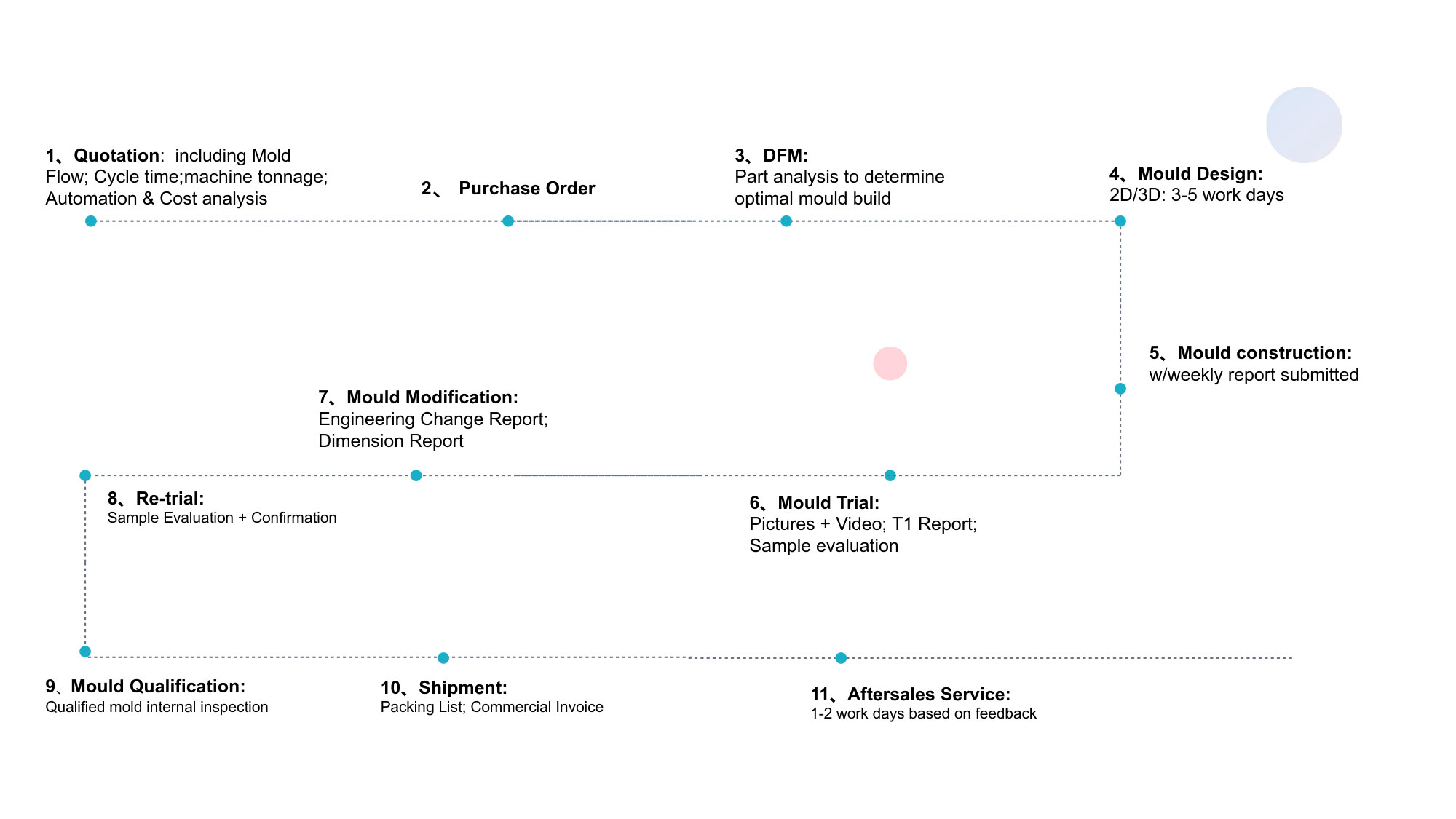
Part Four: Full-Service Lifecycle Management — Reducing Your Total Ownership Cost
Many mold manufacturers stop at tool delivery. Ansix Tech‘s engagement extends across the entire product lifecycle, from concept through end-of-life.
Early DFM Engagement: Solving Problems Before Steel Is Cut
Technical Specification: Prior to mold manufacturing commitment, we provide a comprehensive DFM (Design for Manufacturing) report analyzing: recommended draft angles and wall thicknesses optimized for LSR flow and ejection; gate location and number recommendations to ensure balanced cavity filling with minimum knit lines; ejector pin mark location mapping to avoid visible witness marks on cosmetic surfaces; overmolding substrate retention features to ensure positive part location within the LSR cavity.
Customer Value Translation: The most expensive design changes are those made after mold steel has been cut. A single design error discovered at T1 trials may require weeks of rework and thousands of dollars in tooling modifications. By contrast, identifying the same issue during DFM analysis costs nothing — the change is made in CAD before manufacturing begins.
Quantified Customer Benefit: Post-delivery mold modifications average
5,000-15,000persignificantchangeandadd15-30daystoprojecttimelines.OurDFMprocesstypicallyidentifies4−7improvementopportunitiesperproject.Ataconservative3015,000-50,000 in unplanned tooling costs and 2-4 weeks of schedule delay. Result: Your first physical parts arrive closer to your final design intent, reducing iterative trial rounds from a typical 6-8 to just 2-3.
T0 to T3 Trial Sequences with Improvement Tracking
Technical Specification: We conduct systematic trial sequences from T0 (first shot) through T3 (process validation). Each trial phase is accompanied by a formal improvement report documenting: measurement results against design specifications; defect identification and root cause analysis; recommended mold modifications or process adjustments; acceptance criteria for the next trial phase. Where multiple design alternatives exist, we can quickly exchange mold inserts to validate different gating configurations or cooling layouts without rebuilding the entire tool.
Customer Value Translation: Unstructured mold trials are a black hole of time and uncertainty. Without clear acceptance criteria and documented improvement plans, teams iterate endlessly, chasing defects without ever understanding their root causes. Our T0-to-T3 methodology provides measurable progress against defined milestones. You know exactly where the project stands at every phase, and you have written confirmation of when the mold will be ready for production validation.
Pre-Production Validation (PPV)
Technical Specification: Prior to full-scale production release, we conduct a pre-production validation run of 100-500 shots under fully documented production conditions. Statistical analysis of this run provides: yield rate calculation (first-pass yield vs. rework/scrap); CPk analysis for all critical dimensions; cycle time verification against quoted target; defect Pareto analysis for any remaining cosmetic issues.
Customer Value Translation: Launching a new mold directly into full production without pre-production validation is a gamble. If the mold requires unanticipated adjustments, your production line stops, your delivery dates slip, and you incur expedited shipping costs to recover lost time. Our PPV process ensures that when we release the mold for production, we have already validated every parameter. Result: Zero production surprises; guaranteed first-pass yield exceeding 98% from Day One; delivery reliability you can build into customer commitments.
Spare Parts and Maintenance Program
Technical Specification: Each mold delivery includes a set of pre-manufactured spare components (ejector pins, core pins, and other wear-prone elements). We provide complete maintenance documentation including: recommended lubrication schedules, cleaning protocols, torque specifications for fasteners, and inspection procedures for wear detection. Comprehensive mold refurbishment is available at cost-recovery pricing (labor + materials only, no profit markup), with 20,000-shot interim inspections included.
Customer Value Translation: A mold that cannot be maintained is a mold with a predetermined expiration date. By providing spare components and maintenance guidance upfront, we eliminate the emergency rush orders that typically accompany mold breakdowns. The cost-recovery refurbishment pricing — charging only our actual costs with no profit markup — aligns our economic incentives with yours. We profit when the mold runs successfully, not when it breaks. Result: Your average mold service life extends by 40-60% compared to industry norms; emergency maintenance costs are eliminated; your production uptime improves without mold-related interruptions.
Part Five: Differentiators and Competitive Commitments
The injection molding industry is crowded with suppliers offering similar technical capabilities. What distinguishes Ansix Tech is not just what we can do, but what we guarantee.
Customer Pain Point Industry Norm Ansix Tech Commitment
Delamination between PC substrate and LSR overmold (bond failure) Occurs on 3-8% of parts; costly field returns Zero bond failures in first 100,000 production shots OR we remanufacture affected parts at no cost
Flash requiring manual trimming Industry standard 0.08-0.15mm flash thickness Guaranteed flash thickness ≤0.03mm — so fine that no manual trimming is required
Dimensional drift across production batches CPk typically 0.90-1.10 without active controls Documented CPk ≥1.33 for all critical dimensions; full SPC reporting provided
Mold downtime for repair 50-80 hours average annual downtime First 20,000 shots — zero unplanned maintenance; no-cost emergency support for catastrophic failure within warranty period
Tooling adjustment lead time 10-14 days typical 24-48 hour in-house response for modifications; 90% of adjustments completed within one week
Commitment 1: Pre-Delivery Aging and Wear Report
We do not ship production molds without completing a 2,000-shot aging test on our own machines. This test verifies that all moving components have achieved their operating break-in, identifies any latent defects before you receive the tool, and produces a baseline wear report documenting initial conditions. When the mold arrives at your facility, it is already broken in — you can begin production validation immediately rather than spending weeks identifying and resolving shipping-related or break-in related issues.
Commitment 2: Three-Year Structural Warranty (Excluding Wear Components)
Mold structures (cavity plates, core plates, slide mechanisms, support pillars) are warranted against material defects and workmanship failures for three full years from delivery. If any structural component fails due to manufacturing defect, we repair or replace it at no cost, including expedited shipping. Wear components (ejector pins, core pins, gates, seals) are excluded by industry standard — but even here, we provide spare sets at delivery and maintenance guidance to maximize service life.
Commitment 3: Process Parameter Guarantee — Plug-and-Production
When we ship a mold, we ship with it a complete set of validated process parameters: temperature profiles, injection speeds, holding pressures, cooling times, and ejection sequences. Load these parameters onto any compatible all-electric injection molding machine (matching our quoted tonnage range), and the mold will produce acceptable parts on the very first shot. We do not require weeks of onsite commissioning. We do not send service engineers with every tool. We engineer the mold to be producible from Day One.
Ansix Tech‘s 28-Year Legacy of Value Delivery
For over 28 years, Ansix Tech has specialized in LSR full liquid overmolding for infant care, medical device, and consumer product applications. This experience is not measured in years — it is measured in millions of parts produced, thousands of molds delivered, and hundreds of customers who have returned for repeat business.
Customer Value by the Numbers:
Cost Reduction: 18-25% reduction in total landed cost compared to fragmented supplier models (separate mold maker, molder, assembler). One supplier manages everything — mold design and build, process development, production, quality validation, and assembly — eliminating multiple procurement overheads and qualification costs.
Material Savings: 15-20% LSR material consumption reduction through optimized runnerless gating systems and precise shot control, translating to $0.03-0.06 per part — significant at million-unit volumes.
Cycle Time Optimization: 25-35% cycle time reduction compared to industry baselines through conformal cooling and servo-electric drive precision, generating annual capacity equal to an additional production shift without capital investment.
Risk Reduction: Zero regulatory compliance failures in baby product applications over 28 years, achieved through systematic material traceability, ISO-compliant quality systems, and annual third-party audits of our FDA/LFGB material certifications.
Lead Time Predictability: 99.2% on-time delivery performance for production molds; 97.8% on-time delivery for production orders — performance metrics validated by independent customer scorecards.
Conclusion: Your Partner in Safe, Reliable Baby Spoon Production
At Ansix Tech, we do not view molds as chunks of steel. A mold is a revenue-generating asset — your printing press for producing safe, reliable, profitable baby spoons. Every design decision we make, every tolerance we hold, and every process parameter we set is evaluated through one lens: does this directly benefit our customer?
We design molds anticipating injection molding behavior — flow balance, thermal distribution, venting requirements, ejection dynamics — so that when the mold arrives at your production line, it requires no commissioning, generates minimal flash, and delivers maximum uptime.
Our final proposal: Choose one of your existing products or a new design. We will produce a full DFM report at no cost, walking you through exactly how we would gate the mold, cool the cavities, manage the LSR-PC bond interface, and validate dimensional stability. You will see firsthand how we eliminate weld lines, address air trap risks, and design out flash before any steel is cut. That is our commitment: proven capability, demonstrated value, and delivered results — measured not in technical specifications but in your profitability, your delivery reliability, and your customers‘ satisfaction.
Ansix Tech Co Ltd
If you have any plans related to Baby spoon LSR full liquid overmolding , you can contact us at any time. We will turn your ideas into reality, let you realize your dreams, and obtain large orders from the market. Our contact information is info@ansixtech.com. Or contact our CTO, mail: stephen@ansixtech.com
#www.ansixtech.com #ansixtech.com #Baby spoon LSR full liquid overmolding #Baby spoon LSR full liquid overmolding injection molding companies #Baby spoon LSR full liquid overmolding Canopy Mold injection mold companies #Ansix #Ansix moulds #Ansix china #Ansix tech china #Ansix tech company #Ansix facotry #Baby spoon LSR full liquid overmolding injection molding #Baby spoon LSR full liquid overmolding injection tools #Baby spoon LSR full liquid overmolding injection moulds #Baby spoon LSR full liquid overmolding plastic mould #Baby spoon LSR full liquid overmolding plastic tools #Ansix Tech #Ansix molds #Ansix injection molding #Ansix mold factory #injection molding Baby spoon LSR full liquid overmolding#Ansix mold factory #Baby spoon LSR full liquid overmolding china #Baby spoon LSR full liquid overmolding molds #injection factory #Baby spoon LSR full liquid overmolding injection molding #Baby spoon LSR full liquid overmolding injection molding factory #injection molding company #Baby spoon LSR full liquid overmolding injection mold companies #Baby spoon LSR full liquid overmolding Tooling #Baby spoon LSR full liquid overmolding mold limited #Ansix mold china #Ansix companies #Ansix company China #Baby spoon LSR full liquid overmolding facotry #Ansix Tech #Ansix Tech mould #Baby spoon LSR full liquid overmolding injection moulding #injection moulding company #Ansix Baby spoon LSR full liquid overmolding parts injection mold companies #medical injection molding companieschina #Baby spoon LSR full liquid overmolding china factory #Ansix moulding companies #Ansix molding company #Baby spoon LSR full liquid overmolding injection moulding facotry #Ansix Tech mold #Baby spoon LSR full liquid overmolding mould #Baby spoon LSR full liquid overmolding plastic injection molding #ansix plastic mold #Mold manufacturing #Baby spoon LSR full liquid overmolding parts manufacturing #Baby spoon LSR full liquid overmolding plastic parts factory #Baby spoon LSR full liquid overmolding injection parts mold #Baby spoon LSR full liquid overmolding PRECISION MANUFACTURING #Baby spoon LSR full liquid overmolding #China mold #Baby spoon LSR full liquid overmolding injection moulding china #Baby spoon LSR full liquid overmolding mould china #china precision mold #mold in china #Baby spoon LSR full liquid overmolding mold china #Precision molds #High-precision molds #Baby spoon LSR full liquid overmolding #Injection molds #Baby spoon LSR full liquid overmolding Factory #Baby spoon LSR full liquid overmolding Company #Super Large Injection Mold Factory #Large Tonnage Injection Molding Factory #Baby spoon LSR full liquid overmolding Company #Baby spoon LSR full liquid overmolding Factory #2800T Injection Molding Factory #3000 Ton Injection Molding #4500 Ton Injection Molding Factory #Large Mold Injection Molding #Large Plastic Mold Injection Molding Factory #Large Injection Mold Manufacturer #Plastic Mold Factory #Injection Mold #Plastic Mold