



Toilet seal ring made of LSR liquid silicone
FEATURES
Hygiene and Anti-Microbial Protection. LSR is non-porous and easy to clean, making it the hygienic choice for components that contact water. It resists biofilm formation, mold, and mildew growth — critical advantages for toilet applications where sanitation cannot be compromised.
Temperature and Chemical Resistance. LSR withstands temperatures from -50°C to +250°C and resists degradation from detergents, bleach, disinfectants, and acidic solutions — ensuring long-term performance in commercial and residential settings.
Durability Without Compromise. The material provides superior mechanical strength, tear resistance, and rebound. Unlike thermoplastics that degrade or metals that corrode, LSR maintains its properties through years of service without brittleness or hardening.
-
Mold Description
Product Materials:
LSR SILICONE
Soft rubber: LSR
Mold Material:
S136ESR
Number of Cavities:
4
Glue Feeding Method:
Hot runner
Cooling Method:
Water cooling
Molding Cycle
42.5s
- The mold manufacturing process and product material selection
Flexibility and Design Freedom. LSR’s excellent flow characteristics during injection molding enable complex geometries, thin-wall sections, and precision sealing surfaces that traditional compression-molded rubber cannot achieve.
LSR Injection Molding Process at Ansix Tech
Two-Part Platinum-Cured System. LSR utilizes a two-part liquid system (Part A and Part B) that is pumped from sealed drums at a precise 1:1 ratio through a static mixer before injection. This precision mixing eliminates batch-to-batch variation — a guarantee of consistency that rubber compound mixing cannot provide.
Rapid Injection and Curing. LSR injection molding uses high-pressure injection into heated molds (150-200°C). The material cures rapidly at elevated temperatures, completing crosslinking in seconds rather than minutes. Compared to High-Consistency Rubber (HCR) using compression molding, LSR saves time, labor, and electricity — savings that often overcome the higher upfront tooling costs.
Fully Automated Production. Ansix Tech has introduced a fully automated LSR injection molding system, achieving precise mixing, stable curing, and high-cleanliness production. We have perfected LSR protective component manufacturing for critical applications.
-
Machine Park and Production Capacity
Ansix Tech operates four production bases across China and Vietnam, covering over 200,000 square meters with more than 1,200 employees and annual turnover exceeding one billion RMB. We deploy 260 injection molding machines ranging from 30 tons to 2,800 tons. Our main equipment includes Fanuc, Sumitomo, Toshiba, Nissei, Engel, and Arburg (specializing in LSR injection with two-component capabilities).
We have achieved multi-cavity production up to 128 cavities per mold, with daily capacity reaching 550,000 units. For every LSR injection molding project we support, we provide fully automated production, multi-cavity mold design, cold runner system integration, and automatic demolding solutions.
Quality Assurance System
Certifications. Ansix Tech has successfully passed ISO9001, IATF16949, ISO13485, ISO14001, and BSCI — providing documented quality compliance across medical, automotive, and industrial standards.
Real-Time Quality Control. Ansix Medical has focused on the medical field for many years, equipped with a Class 100,000 constant temperature and humidity cleanroom, and a professional medical project team familiar with medical-grade material properties and process verification procedures. Through automated production and a rigorous testing system, we achieve full control over the product process from mold design to mass production.
Delivery Efficiency
With four production bases across China and Vietnam, we maintain redundant manufacturing capacity to ensure production continuity. Standard lead times: simple molds in 10 days, medium-complexity molds in 25-45 days. For urgent requirements, we can compress timelines with expedited production schedules without compromising quality validation.
Cost Leadership Through Intelligent Cost Control
Material Cost Optimization. By selecting the optimal LSR grade for each application, we avoid over-specification while ensuring performance requirements. Our experience with medical-grade, food-contact-grade, and industrial-grade LSR allows precision matching of material properties to end-use requirements.
Cycle Time Reduction. LSR’s fast injection and fast cure properties inherently reduce cycle times compared to traditional rubber molding. Our optimized process parameters — including precise melt temperature control (34-40°C for LSR), holding pressure (30-50 MPa), and cure temperature (150-200°C) — further minimize per-part production time.
Multi-Cavity Productivity. High-cavity mold designs dramatically lower per-part costs by producing more units per cycle. Our 128-cavity LSR molds deliver industry-leading productivity.
Reduced Post-Processing. Our precision mold manufacturing produces flash-free or minimal-flash LSR parts, eliminating costly manual deflashing operations. This directly reduces labor costs and improves throughput.
Waste Reduction. Through DFM analysis and process optimization, we achieve scrap rates far below industry averages. Reducing scrap means fewer lost materials, lower production costs, and higher overall efficiency.
Energy Efficiency. LSR injection molding consumes less energy than competing processes. The fast cure eliminates extended oven post-curing required by many rubber materials, reducing electricity consumption.
Part Two: Mold Manufacturing, Injection Molding Material Selection, Smart Manufacturing Integration, Efficiency Improvement, and Process Quality Assurance
Customer-Centric Core Value Statement
For OEMs sourcing toilet seal rings, the question is not merely technical capability — it is about risk, cost, and reliability. Ansix Tech transforms technical specifications into measurable customer value: reduced total cost of ownership, minimized production risks, and guaranteed supply chain security.
Section 1: Hard Power Infrastructure — Building Customer Confidence
Precision Machining Capability. We utilize five-axis high-speed machining centers capable of achieving 0.002mm precision on complex curved surfaces. This capability translates directly to customer value: the parting lines on your toilet seal rings are smooth, consistent, and free from burrs — eliminating manual trimming operations that add cost and variability.
Slow Wire EDM Precision. Our slow wire EDM machines can cut fine holes and narrow slots down to 0.03mm. For LSR seal rings with intricate geometries, this prevents thin-wall deformation and ensures sealing surface integrity — directly reducing leak risk in final assembly.
Injection Molding Machine Park. Our 260 injection molding machines span from 30 tons to 2,800 tons, covering every product dimension your design may require. All machines feature full servo-electric drive, delivering repeatability precision of ±0.1% — meaning every molded part in every batch matches the first, eliminating dimensional drift that plagues competitors.
Measurement and Inspection. We deploy CMM coordinate measuring machines and optical inspection systems. Every mold undergoes full dimensional reporting before delivery. Critical dimensions achieve Capability Index (Cpk) of 1.33 or higher — statistical proof that your seal rings will meet specifications consistently, batch after batch.
Section 2: Mold Manufacturing Core Competitiveness
Mold Life Guarantee. The mold steel selection directly determines production economics. For glass-fiber reinforced materials, we guarantee 500,000 mold cycles; for standard plastics without fillers, we deliver 1,000,000 cycles.
Our mold materials include: P20 for general-purpose tooling; S136 stainless steel for corrosion-resistant and high-polish applications; 2344, 8407, and H13 for high-durability mass production (1M+ shots); 8407 (modified H13) with higher purity and improved thermal fatigue resistance for long-term high-temperature applications; SKD11, DC53, and M340 for specialized wear resistance; 4Cr13 and 9Cr18 for corrosion resistance; and NAK80 for high dimensional stability and fine texture etching. We provide complete material certifications and heat treatment curves.
Attainable Tolerances. Standard structural components: ±0.05mm. Precision seals and critical sealing surfaces: ±0.005mm. Every LSR toilet seal ring is produced with flash controlled within 0.03mm, thanks to our 0.005mm parting surface fitting precision.
Mold Types and Capabilities. We design and build: hot runner molds (reducing material waste and cycle time); cold runner systems specifically optimized for LSR (maintaining material viscosity before injection); cold runner integration with valve gate options for precision control; multi-cavity molds up to 128 cavities; high-gloss molds achieving Ra ≤ 0.2μm for smooth sealing surfaces and easy cleaning; overmolding molds combining LSR with rigid substrates; and insert molding capabilities for multi-material integration.
Gate Design Optimization. Using advanced mold flow simulation, we predict weld line positions, air trap locations, and filling behavior before steel is cut. We optimize gate placement to ensure balanced filling across all cavities — eliminating short shots and incomplete filling that cause scrap and rework.
Section 3: Injection Molding Process Control
Process Standardization. All injection molding machines are networked and integrated with MES (Manufacturing Execution System). Every process parameter — temperature, pressure, injection speed, and cure time — is locked into the system. Only authorized engineers can access adjustments. First-article and last-article dimensional verification ensures batch-to-batch consistency.
Thermal Stability Control. LSR cures at elevated temperatures (150-200°C) through platinum-catalyzed crosslinking. We implement zone-controlled mold temperature management, maintaining core and cavity temperature differentials within 2°C. This precision reduces part warpage and ensures uniform curing. Our dimensional stability data: over three consecutive production weeks of a high-volume gasket, critical hole spacing variation stays within ±0.02mm.
Appearance Quality Standards. LSR toilet seal rings achieve: bubble-free surfaces, no flow marks or knit lines visible, consistent surface finish without sinks or voids. We comply with medical-grade cleanliness and meet FDA 510K standards, with ISO 8 Cleanroom and GMP certification.
Materials Expertise. Ansix Tech has extensive experience molding high-performance engineering plastics and medical-grade materials. Our material experience includes: PC/ABS, PC, PPS+40%GF, PEEK, PTFE, PFA, PA6+GF30, PBT, PEI, PPS, LCP, and LSR. For flame-retardant applications, we meet UL94 V-0 standards. For outdoor exposure, we validate UV stability through 3,000-hour accelerated weathering tests.
Section 4: Full-Process Service — Reducing Customer Management Costs
Early Engineering Engagement (DFM Report). Before any tooling investment, we provide comprehensive DFM (Design for Manufacturing) analysis. This includes: draft angle recommendations (minimum 1° per side for LSR), uniform wall thickness guidance (optimally 5-15mm for LSR seals), gate location and venting design, shrinkage allowance calculation (0.1-0.3% for platinum-cure LSR), and ejector pin mark location allowances. This prevents costly mold revisions after production start.
Trial and Sampling. We provide T0 through T3 trial samples, each accompanied by an improvement report. For design validation, we support rapid tool changes using exchangeable inserts — validating multiple design iterations without rebuilding entire molds.
Small-Batch Qualification. Before full production release, we supply 100-500 pilot-run samples. We perform statistical yield analysis and Cpk measurement, confirming process stability before authorizing mass production.
Maintenance and Spare Parts. Every mold ships with a complete set of consumable spare parts: ejector pins, core inserts. We provide scheduled mold maintenance every 200,000 cycles. Long-term repair service is available at material cost.
Section 5: Differentiated Solutions to Common Customer Pain Points
Customer Pain Point Ansix Tech Solution
Frequent mold repairs disrupting production 2,000-cycle wear test before delivery; three-year mold structural warranty; detailed wear report provided.
Excessive flash requiring high post-processing labor costs 0.005mm parting surface fitting precision; self-locking clamp force compensation; flash controlled within 0.03mm — eliminates manual deflashing.
Inconsistent dimensions batch to batch Ultrasonic wall-thickness sensors with real-time feedback; automatic compensation for holding pressure; optional in-cavity pressure/temperature sensors with closed-loop control.
Long mold repair cycles affecting delivery In-house electrode machining and EDM workshop; conventional welding and insert replacement restored within 24 hours.
Part Three: Comprehensive Toilet Seal Ring LSR Mold Manufacturing and Injection Molding Production Solutions
Project Initiation: Ansix Tech’s LSR Toilet Seal Ring Program
Since its founding in 1998 by Mr. Huang in Hong Kong, Ansix Tech has grown into a comprehensive injection molding and mold manufacturing enterprise with four production bases across Shenzhen, Dongguan, Hunan, and Vietnam — covering over 200,000 square meters with more than 1,200 employees. We have served industries including medical devices, automotive systems, electronics, consumer goods, and industrial equipment, delivering over 260 injection molding machines producing everything from precision medical components to large-scale industrial housings.
Our LSR toilet seal ring program represents the convergence of decades of thermoset and elastomer molding expertise. Unlike traditional rubber compression molding or transfer molding processes, LSR liquid injection molding (LIM) uses a two-part platinum-cured liquid silicone system that is precisely metered at 1:1 ratio through static mixers. The low-viscosity LSR reproduces even the most complex micro-features — gaps as small as 0.005mm will produce flash, but we precisely control this using optimized mold design and venting channels.
Raw Material Selection for LSR Toilet Seal Rings
Material selection defines the toilet seal ring’s performance envelope, production economics, and regulatory compliance pathway. Ansix Tech guides every customer through this critical decision with documented recommendations based on application requirements.
LSR Material Grades and Specifications
Platinum-Cured Two-Part System. LSR is a high-purity, platinum-cured silicone material that exhibits exceptional heat resistance, flexibility, chemical stability, and water resistance. The 1:1 mixing ratio precision, maintained through our automated metering systems, eliminates variability — an advantage that rubber compound mixing can never guarantee.
Shore Hardness Selection. For toilet seal rings, we typically specify materials in the 40A to 60A Shore A hardness range. Lower hardness (20A-40A) offers superior conformability for irregular sealing surfaces; higher hardness (50A-70A) provides greater pressure resistance and durability. Each hardness grade maintains its targeted elasticity and rebound properties through the part’s service life.
Key Material Properties.
Tensile Strength: ≥ 8 MPa minimum — resisting tearing during installation and demolding
Tear Strength: ≥ 25 kN/m — preventing edge damage during compression and insertion
Elongation: 400-800% — accommodating complex geometries and over-compression during installation
Viscosity: 5,000-50,000 cps — optimum flow characteristics for injection molding
Application-Specific Grades.
Medical-Grade LSR: ISO 10993 certified for biocompatibility, FDA and USP Class VI compliant
Food-Contact-Grade LSR: FDA and LFGB certified for indirect contact applications in bathroom settings
Industrial-Grade LSR: Optimized for wear resistance and sealing performance without premium certifications
UV-Resistant Grades: For transparent or colored seals with prolonged light exposure
Brand-Approved Suppliers. Ansix Tech has established supply relationships with global LSR manufacturers including Dow, Shin-Etsu, WACKER, and Elkem, ensuring consistent material availability and complete traceability.
DFM Analysis and Mold Flow Simulation
Moldex3D Simulation Protocol
Before any steel is cut, Ansix Tech performs complete mold flow analysis using advanced simulation tools. This early investment prevents iterations and reduces validation costs. The simulation addresses:
Flow Pattern Prediction. We model LSR injection from gate entrance through complete cavity filling. The low-viscosity LSR flows differently from thermoplastic melts — requiring specialized simulation parameters validated on our actual Arburg LSR presses.
Air Trap and Weld Line Identification. We pinpoint gas entrapment locations that would create cosmetic defects or compromise sealing integrity. And we identify weld line formation — the interfaces where flow fronts meet — that could become failure initiation points in a compression seal.
Gate Location Optimization. We evaluate multiple gate location scenarios to minimize flow distance, eliminate incomplete fills, and ensure balanced cavity filling. For multi-cavity molds, we model runner system balance to ensure every cavity fills identically.
Temperature Distribution Modeling. LSR curing is a heat-activated chemical reaction — not a cooling process like thermoplastics. We model the mold temperature profile to ensure uniform crosslinking and prevent premature cure in cold runner systems.
Venting Strategy Development. LSR vents differently from thermoplastic materials. We design micro-channels at 0.02mm width that allow air evacuation while containing the liquid LSR during injection.
Mold Design for High-Volume LSR Production
Cooling System and Conformal Cooling
Advantages. Efficient mold cooling directly reduces cycle time, improves product quality, and lowers per-part cost. Uniform temperature distribution prevents warpage and ensures consistent crosslinking.
Ansix Tech Implementation. For LSR toilet seal rings, we design conformal cooling channels that follow part geometry — not straight drilled holes that leave hot spots. This reduces cycle time by 15-25% compared to conventional cooling designs. And it maintains core and cavity temperature differentials within 2°C.
Cold Runner vs. Hot Runner
LSR molds require specialized runner systems that maintain material viscosity before injection. Unlike thermoplastics, LSR crosslinks when heated — so runner systems that keep material hot will cause premature curing and blockages.
Cold Runner Systems (Standard for LSR). We design cold runner systems where the LSR remains unheated until injection into the cavity. Benefits include: zero material waste (runners are reusable or minimized), prevention of premature crosslinking, and faster cycle times by eliminating runner cure delays. Multi-cavity cold runner designs ensure balanced filling across 128 cavities.
Valve Gate Cold Runner Systems (Precision Option). For demanding applications requiring individual cavity control, we integrate valve gates into cold runner systems. This provides precise timing control for each cavity, improved cosmetic quality by eliminating gate vestige, and shorter cycle times through independent cavity control.
Runner and Gate Design
Runner Balance. For multi-cavity molds, we precisely balance runner lengths and diameters to equalize pressure drop across all cavities. Unbalanced runners produce cavity-to-caval variation — a quality issue that increases scrap and final-test failure rates.
Gate Placement. We locate gates at non-critical areas — not on primary sealing surfaces. This ensures cosmetic quality while maintaining sealing performance.
Runner Sizing. LSR’s low viscosity requires careful runner sizing to prevent uncontrolled flow. We optimize runner cross-sections to provide sufficient flow without pressure spikes that cause mold separation and flash.
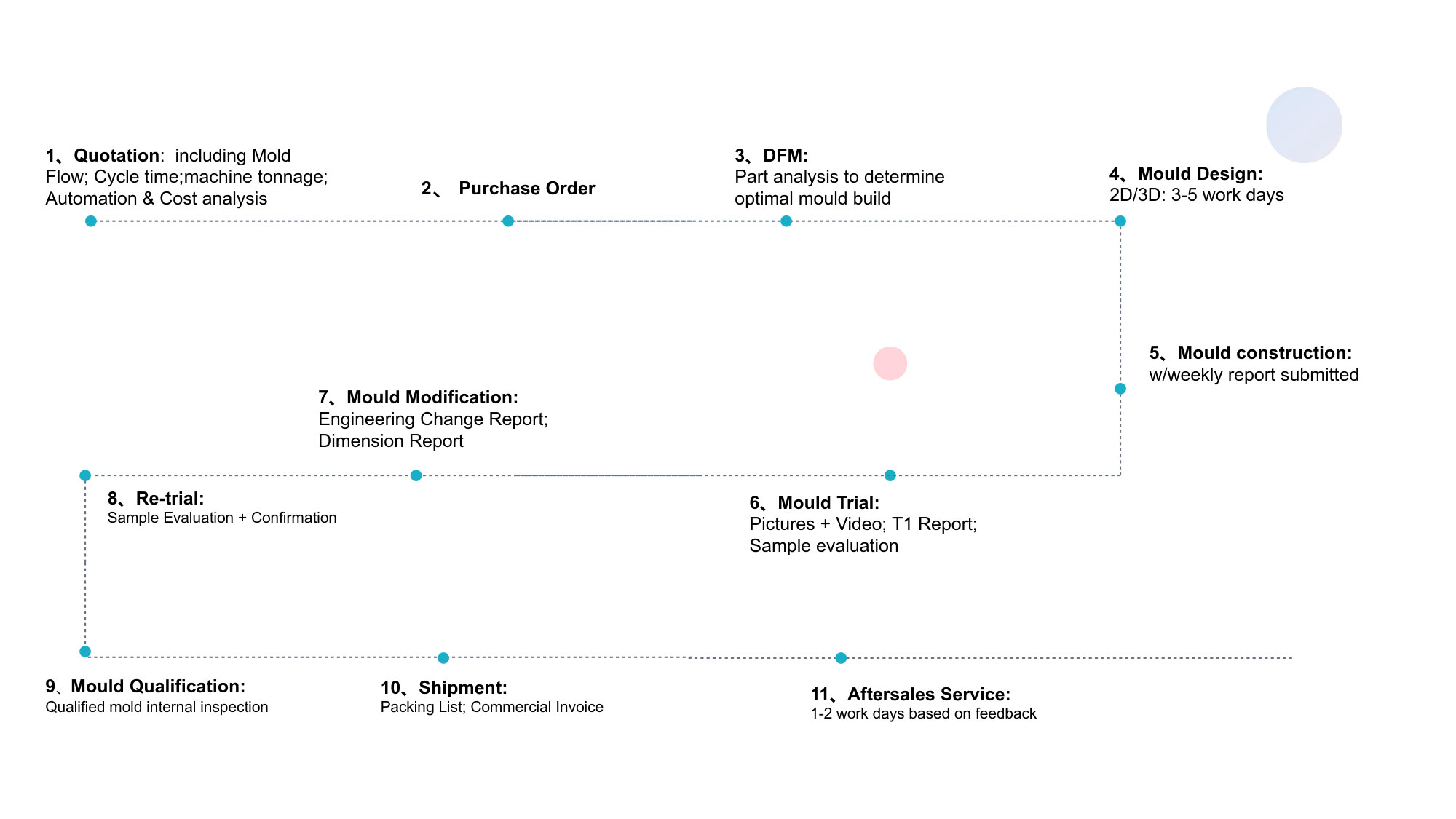
Mold Manufacturing Process Flow
Step 1: Mold Design and DFM
We begin with concurrent engineering — integrating design, manufacturing, and quality requirements before CAD modeling begins. This prevents the downstream discoveries that delay projects and increase costs. We complete full 3D mold design, cooling analysis, ejection system layout, and venting implementation before CAM programming.
Step 2: Rough Machining
CNC Milling. We rough machine mold bases and cavity blanks using high-speed CNC mills that remove material efficiently while leaving stock for finish machining.
Material Selection Impact. P20 performs well for general-purpose tooling with 28-32 HRC pre-hardened condition, eliminating post-machining heat treatment. H13 and 8407 require separate rough machining, heat treatment, and finish machining sequences — which we manage in-house with complete traceability.
Step 3: Heat Treatment
For tooling materials requiring heat treatment (H13, 8407, SKD61, DC53), we contract with certified heat treat vendors who provide documented temperature and soak time records. This traceability provides evidence of proper metallurgical condition — not just supplier claims.
Step 4: Precision Finish Machining
Five-Axis Machining. We perform precision finish machining on our five-axis high-speed machining centers, achieving 0.002mm geometric accuracy on complex surfaces. This is not optional for LSR molds — it determines whether your toilet seal rings have flash problems or clean edges.
EDM and Wire EDM. For internal features inaccessible to milling cutters, we use sinker EDM with precision electrodes machined in-house. For slots and fine features through the mold, we use wire EDM achieving 0.03mm slot width accuracy.
Polish and Surface Finish. We achieve surface finishes down to Ra 0.05μm or better on cavity surfaces. For LSR toilet seal rings, smooth surfaces improve demolding, reduce adhesion, and eliminate cosmetic defects.
Step 5: Mold Assembly and Fitting
We assemble all mold components — cavity inserts, core inserts, slide systems, ejector system, runner components, and cooling fittings — and perform manual fitting to achieve 0.005mm parting surface fit. This precision determines the flash extent that will appear on every produced part.
Step 6: Mold Testing and Validation
Before mold delivery, we perform:
No-load cycle testing: Verify mechanical function of slides, ejectors, and moving systems
Water flow and pressure testing: Verify cooling system performance
No-load temperature mapping: Verify uniform heating across the mold
Dry-cycle testing on actual press: Verify mold-machine interface compatibility
LSR Injection Molding Process Parameters and Optimization
LSR Injection Molding Workflow
The LSR injection molding process follows five key steps: preparation, machine setup, injection, curing, and demolding.
Step 1 — Material Preparation. Part A and Part B LSR components are drawn from sealed drums or pails and metered at precise 1:1 ratio through precision dosing pumps. The two components flow through a static mixer where they combine before entering the injection unit.
Step 2 — Machine Setup. Mold temperature is set to 150-200°C for optimal crosslinking. Injection pressure is set to 50-150 bar to fill fine details. Clamping force is set to prevent mold separation during injection.
Step 3 — Injection. The mixed LSR is injected into the closed mold cavity under controlled pressure and speed. Injection speed is regulated to prevent turbulent flow that traps air and creates cosmetic defects.
Step 4 — Curing. Within the heated mold, the platinum-catalyzed LSR undergoes crosslinking — the chemical reaction that transforms liquid material into solid elastomer. Cure time depends on wall thickness and part geometry.
Step 5 — Demolding. The molded seal ring is ejected from the mold. Efficient demolding design prevents part distortion and adhesion.
Cycle Time Optimization
LSR’s fast injection and fast cure properties naturally reduce cycle times compared to HCR. However, Ansix Tech pushes further through advanced optimization:
Injection Speed Optimization. Higher injection speeds reduce fill time but increase shear heating and turbulence risk. Using simulation and real-world validation, we determine the optimal speed for each part geometry.
Cure Time Reduction. We validate the minimum cure time required for complete crosslinking using physical testing — not over-curing that wastes cycle time without quality benefit.
Cooling Phase Elimination. For LSR, cooling time is minimal — the curing reaction completes the transformation. Unlike thermoplastics requiring cooling to solidification temperature, LSR demolds hot and immediately holds its shape.
Cycle Time Data. For a typical toilet seal ring of 5-10mm wall thickness, optimized cycle times range from 30 to 90 seconds depending on cavity count and part size.
Quality Control and Assurance
Incoming Material Control
Every LSR batch receives documented material certification from our approved suppliers. We perform incoming inspection including viscosity testing (where specified) and hardness verification on test plaques molded from each batch.
In-Process Monitoring
MES Parameter Locking. All machine parameters are locked in MES; only authorized engineers can adjust. This prevents unauthorized operator adjustments that drift process out of specification.
Statistical Process Control (SPC). We perform continuous monitoring of critical dimensions on sampled parts throughout production runs. Cpk values above 1.33 indicate a capable and stable process.
Online Quality Monitoring. For critical programs, we deploy in-cavity pressure and temperature sensors providing real-time feedback to the injection molding machine’s closed-loop control system. When drift occurs, the system automatically compensates — before off-spec parts are produced.
Process Validation (IQ/OQ/PQ)
For regulated applications (medical devices, automotive OEMs), we perform full IQ/OQ/PQ validation as required by ISO 13485 and IATF16949.
Installation Qualification (IQ): Document that the mold and machine are installed according to specifications, including dimensional verification, cooling system function, and electrical/safety checks.
Operational Qualification (OQ): Run the process across its operating window — high and low limits for temperature, pressure, speed — to determine the process capability range.
Process Qualification (PQ): Run continuous production of statistically significant sample size and perform capability analysis. Cpk ≥ 1.33 demonstrates process is capable of meeting specifications consistently.
End-of-Line Inspection
Dimensional Inspection. Using CMM and optical measurement systems, we perform full dimensional reporting on sample parts from each production batch.
Visual Inspection. Trained inspectors evaluate each batch for cosmetic defects including flash, sinks, flow marks, bubbles, and surface defects.
Functional Testing (where specified). For sealing applications, we can perform pressure decay testing, leak testing, or compression set measurement to validate functional performance.
Packaging and Fast Delivery
Packaging
We provide standard polybag packaging for high-volume production, custom tray packaging for automated assembly lines, anti-static packaging where required, cleanroom-compatible packaging for medical-grade parts, and export-grade cartons with complete labeling per customer specification.
Delivery
Our four production bases across China and Vietnam provide geographic redundancy and supply chain security. Lead times are managed through MES production scheduling, bottleneck monitoring and capacity management, and real-time order tracking.
Value Proposition: What Ansix Tech Solves, Saves, and Reduces
What Problems Ansix Tech Solves
Problem Ansix Tech Solution
Seal rings that fail prematurely, causing warranty claims LSR material with documented tensile strength, tear strength, and compression set data.
Inconsistent dimensions batch-to-batch MES parameter locking + SPC monitoring + Cpk verification.
Production delays from mold breakdowns High-durability mold materials (S136, H13, 8407) with documented wear life.
Quality audit failures ISO9001, IATF16949, ISO13485, ISO14001 certifications + full traceability.
Supply chain disruption from single-source dependency Four production bases across two countries.
What Costs Ansix Tech Saves
Cost Category Annual Savings Potential
Material cost 25% reduction through runner optimization and waste reduction
Labor cost 67% reduction through automated production and flash-free molding
Energy cost Reduced through faster LSR cycle times vs. HCR compression molding
Tooling maintenance Reduced through high-durability mold materials (S136, H13, 8407)
Scrap and rework Reduced through process validation + in-process monitoring
What Risks Ansix Tech Reduces
Risk Category Ansix Tech Risk Mitigation
Product liability from seal failure Documented material certification + functional testing.
Production interruption from mold failure High-durability mold materials + on-site repair capability (24-hour recovery).
Regulatory compliance failure ISO9001, IATF16949, ISO13485 + ISO 8 Cleanroom.
Supply chain disruption Four production bases + redundant supplier relationships.
Hidden tooling costs DFM analysis before tooling investment + fixed-price quoting.
Dear customer: At Ansix Tech, we believe a mold is not a block of steel — it is a money-printing machine. We design every LSR mold to ensure flow balance, venting efficiency, and thermal uniformity — so when it reaches your production floor, it runs with minimal setup time, minimal flash, and maximum productivity. Please contact us for a full DFM walkthrough using one of your existing parts. You will see exactly how we eliminate weld lines, air traps, and shrinkage risks before they reach your production schedule.
info@ansixtech.com | www.ansixtech.com
Ansix Tech Co Ltd
If you have any plans related to Toilet seal ring made of LSR liquid silicone , you can contact us at any time. We will turn your ideas into reality, let you realize your dreams, and obtain large orders from the market. Our contact information is info@ansixtech.com. Or contact our CTO, mail: stephen@ansixtech.com
#www.ansixtech.com #ansixtech.com #Toilet seal ring made of LSR liquid silicone #Toilet seal ring made of LSR liquid silicone injection molding companies #Toilet seal ring made of LSR liquid silicone Canopy Mold injection mold companies #Ansix #Ansix moulds #Ansix china #Ansix tech china #Ansix tech company #Ansix facotry #Toilet seal ring made of LSR liquid silicone injection molding #Toilet seal ring made of LSR liquid silicone injection tools #Toilet seal ring made of LSR liquid silicone injection moulds #Toilet seal ring made of LSR liquid silicone plastic mould #Toilet seal ring made of LSR liquid silicone plastic tools #Ansix Tech #Ansix molds #Ansix injection molding #Ansix mold factory #injection molding Toilet seal ring made of LSR liquid silicone#Ansix mold factory #Toilet seal ring made of LSR liquid silicone china #Toilet seal ring made of LSR liquid silicone molds #injection factory #Toilet seal ring made of LSR liquid silicone injection molding #Toilet seal ring made of LSR liquid silicone injection molding factory #injection molding company #Toilet seal ring made of LSR liquid silicone injection mold companies #Toilet seal ring made of LSR liquid silicone Tooling #Toilet seal ring made of LSR liquid silicone mold limited #Ansix mold china #Ansix companies #Ansix company China #Toilet seal ring made of LSR liquid silicone facotry #Ansix Tech #Ansix Tech mould #Toilet seal ring made of LSR liquid silicone injection moulding #injection moulding company #Ansix Toilet seal ring made of LSR liquid silicone parts injection mold companies #medical injection molding companieschina #Toilet seal ring made of LSR liquid silicone china factory #Ansix moulding companies #Ansix molding company #Toilet seal ring made of LSR liquid silicone injection moulding facotry #Ansix Tech mold #Toilet seal ring made of LSR liquid silicone mould #Toilet seal ring made of LSR liquid silicone plastic injection molding #ansix plastic mold #Mold manufacturing #Toilet seal ring made of LSR liquid silicone parts manufacturing #Toilet seal ring made of LSR liquid silicone plastic parts factory #Toilet seal ring made of LSR liquid silicone injection parts mold #Toilet seal ring made of LSR liquid silicone PRECISION MANUFACTURING #Toilet seal ring made of LSR liquid silicone #China mold #Toilet seal ring made of LSR liquid silicone injection moulding china #Toilet seal ring made of LSR liquid silicone mould china #china precision mold #mold in china #Toilet seal ring made of LSR liquid silicone mold china #Precision molds #High-precision molds #Toilet seal ring made of LSR liquid silicone #Injection molds #Toilet seal ring made of LSR liquid silicone Factory #Toilet seal ring made of LSR liquid silicone Company #Super Large Injection Mold Factory #Large Tonnage Injection Molding Factory #Toilet seal ring made of LSR liquid silicone Company #Toilet seal ring made of LSR liquid silicone Factory #2800T Injection Molding Factory #3000 Ton Injection Molding #4500 Ton Injection Molding Factory #Large Mold Injection Molding #Large Plastic Mold Injection Molding Factory #Large Injection Mold Manufacturer #Plastic Mold Factory #Injection Mold #Plastic Mold