



LSR Liquid Silicone Medical Negative Pressure Bulb
FEATURES
Product Overview – What Is an LSR Liquid Silicone Medical Negative Pressure Bulb?
The LSR Liquid Silicone Medical Negative Pressure Bulb, also known as a wound drainage bulb or closed wound suction bulb, is a critical component in post-operative patient care. It is a small, portable device designed to collect excess fluid, blood, and exudate from surgical wounds through negative pressure generated by manual compression. The bulb functions as an external negative pressure source connected to a drainage tube via a one-way anti-reflux valve (typically with sealing pressure ≥0.02MPa) to prevent fluid backflow, with a Luer-lock connector securing the tubing.
Material Choice – Medical-Grade LSR
We manufacture these bulbs from premium medical-grade liquid silicone rubber (LSR) supplied by world-leading manufacturers including Momentive (Silopren™ series), Wacker (SILPURAN® series), and Elkem (SILBIONE® series). Medical-grade LSR is the material of choice for implantable and body-contact medical devices due to:
Biocompatibility: Medical grades are USP Class VI and ISO 10993-certified, non-cytotoxic, hypoallergenic, and latex-free. A representative sample of Silopren LSR 4070 met USP Class VI (maximum contact time with human tissue 29 days) and ISO 10993 requirements.
-
Mold Description
Product Materials:
LSR SILICONE
Soft rubber: SILICONE
Mold Material:
S136ESR
Number of Cavities:
2
Glue Feeding Method:
Hot runner
Cooling Method:
Water cooling
Molding Cycle
22.5s
- The mold manufacturing process and product material selection
Flexibility and Comfort: Material hardness ranges from Shore A 5 to 80, allowing the bulb to be compressible, conform to anatomy, and prevent pressure on tissue — delivering better seals and greater patient comfort.
Durability: LSR products are tear and fatigue resistant, UV stable, and maintain functional integrity across a wide temperature range of approximately -50°C to 200°C.
Sterilizability: The bulb can be sterilized with ethylene oxide, steam, and gamma radiation — essential for medical devices requiring repeated sterilization cycles.
Regulatory Compliance: Our materials comply with FDA 21 CFR 177.2600, BfR Recommendation XV “Silicones”, and Eur. Pharmacopia VI 3.1.9.
Surface Quality: The LSR injection molding process ensures a smooth and uniform surface, reducing the risk of tissue damage during use.
-
Key Product Specifications (Typical)
Parameter Specification
Material Medical-grade LSR (Momentive Silopren 4070/4650/2080, Wacker SILPURAN 6610, or equivalent)
Hardness Shore A 30–70 (customizable per application)
Capacity 100ml, 200ml, 400ml (customizable)
Negative Pressure Range 25–75 mmHg (up to 87.4 cmH₂O)
Anti-reflux Valve Sealing Pressure ≥0.02MPa
Production Environment Class 100,000 constant temperature/humidity cleanroom
Clinical Applications
Post-operative closed wound drainage following orthopedic, thoracic, and abdominal surgeries
Breast surgery (mastectomy, reconstruction) and obstetrics/gynecology
Plastic and reconstructive surgery
Laparoscopic and general surgery procedures
Wound exudate management for chronic or traumatic wounds
Part Two: Hard Infrastructure – Building Customer Confidence on a Foundation of Precision Equipment
At Ansix Tech, we understand that product quality is fundamentally constrained by the machines that produce it. Our manufacturing arsenal is purpose-configured for medical-grade precision.
2.1 Precision Mold Manufacturing Equipment
Five-Axis High-Speed Machining Centers. We deploy five-axis high-speed machining centers capable of processing complex curved surfaces with 0.002mm accuracy. For the LSR Medical Negative Pressure Bulb, which features ergonomic contours and a spherical geometry with intricate parting lines along the bulb body, this capability translates directly into a perfectly smooth bulb surface — eliminating visible flash lines that would compromise patient comfort or introduce contamination traps. The five-axis capability also enables us to machine the bulb’s complex internal geometry and anti-reflux valve seat in a single setup, reducing tolerance stack-up and ensuring leak-proof sealing performance.
Slow-Speed Wire EDM (Electrical Discharge Machining). Our slow-speed wire EDM systems achieve cutting accuracy down to 0.003mm, enabling the production of micro-slots and fine-feature details as small as 0.03mm in diameter. For the negative pressure bulb mold, this capability is critical for machining the ultra-fine venting channels along the parting line (0.001-0.003 inches deep), which are essential for LSR mold venting to prevent air traps — a common cause of surface defects and incomplete filling in silicone bulb molding.
CNC EDM with Mirror-Finish Capability. For deep-rib features and textured grip surfaces, sinker EDM delivers unmatched precision. The electrode manufacturing process is managed entirely in-house, allowing us to achieve optical-grade mirror polish (Ra ≤ 0.05 μm) on cavity surfaces. For the negative pressure bulb, this mirror finish on the mold core directly translates into a smooth, glossy external surface finish on the bulb — enhancing patient comfort and facilitating easy manual compression during use.
Precision Surface Grinding. All mold plates and core components undergo precision grinding to ensure absolute parallelism in the mold base. For multi-cavity bulb molds (typically 4 to 32 cavities depending on bulb size), this means every cavity produces identical parts — eliminating yield losses from cavity-to-cavity variation that typically plague medical device manufacturers.
2.2 Injection Molding Press Fleet
Locking Force Range: 30 tons to 400 tons, optimized for medical device components ranging from small 50mm components up to full instrument housings. For the negative pressure bulb, we typically deploy 80–200 ton presses depending on cavity count and bulb capacity.
All-Electric Servo-Driven Machines. Our press park consists exclusively of all-electric servo-driven injection molding machines. Conventional hydraulic presses suffer from viscosity-based repeatability drift — as the machine heats up during a production run, oil viscosity changes, causing pressure fluctuations and dimensional variation. Our all-electric machines maintain ±0.1% shot-to-shot repeatability, guaranteeing that the 100,000th part off the line is dimensionally identical to the first part produced.
Fully Automated LSR Injection Molding System. We have introduced a fully automated LSR injection molding system that achieves precise 1:1 A/B component mixing, stable curing, and high-cleanliness production. The system features:
High-precision gear pumps for continuous and consistent 1:1 ratio delivery of A and B components
Static mixer for complete and uniform mixing
Actively cooled barrel (20–40°C) to prevent pre-curing before injection
Needle shut-off nozzle to prevent LSR leakage and drooling during injection intervals
Multi-stage injection control with precise VP (velocity-to-pressure) switching based on screw position or cavity pressure
2.3 Metrology and Quality Assurance Equipment
Coordinate Measuring Machines (CMM). Our ZEISS CMMs provide three-dimensional dimensional verification of both mold components and molded parts, with measurement accuracy down to sub-micron levels. Every mold set undergoes a full dimensional inspection before shipment, with a complete dimensional report provided to the customer.
Optical Inspection Equipment. For high-volume production inspection, automated optical inspection systems verify dimensional conformance of every part at specified sampling frequencies, with real-time data logging for SPC analysis.
Class 100,000 Constant Temperature/Humidity Cleanroom. Equipped with a Class 100,000 constant temperature and humidity cleanroom, we ensure high-precision molding of medical devices in a dust-free environment, with strict particle control throughout the production process.
Part Three: Mold Manufacturing – The Core Competitive Advantage
The mold is the foundation of LSR molding, and its quality directly determines the precision and appearance of the final product. At Ansix Tech, we design not just molds — we design manufacturing solutions.
3.1 Mold Material Selection (The “Silent Engine” of Productivity)
For the LSR Negative Pressure Bulb mold, we select materials based on three criteria: durability (service life), dimensional stability (precision retention), and surface quality (part finish). Below is the table of standard mold materials we use across our medical mold portfolio:
Material Grade Typ. Hardness Primary Application for Negative Pressure Bulb Mold Customer Value
S136 / S136 ESR HRC 48–52 Cavity and core for high-cavitation bulb molds requiring mirror finish Corrosion-resistant; biocompatibility; mirror-polish surface (Ra≤0.05μm) for smooth bulb exterior
S136 SUP / M340 HRC 52–54 High-precision cavity for bulbs requiring extreme surface finish Superior wear resistance, extended tool life beyond 1,000,000 cycles
2343 / 2344 / 8407 HRC 48–52 Cavity/core for high-volume production bulbs (50K–500K cycles) Good toughness/hardness balance; thermal fatigue resistance for continuous molding
SKD11 / DC53 HRC 58–62 High-wear core pins, ejector sleeves, runner shut-offs Extreme wear resistance for high-cycle applications
NAK80 HRC 37–43 Pre-hardened core/cavity for prototype or low-volume molds No heat treatment required; good polishability; short lead time
H13 HRC 46–50 Mold base plates, support pillars, hot runner manifold blocks High hot strength; thermal shock resistance
P20 HRC 28–32 Mold base (A/B plates), support plates, spacer blocks Cost-effective structural integrity for mold base components
Each mold we build is accompanied by full material traceability documentation, including mill certificates and heat treatment curves.
3.2 Mold Design Focus for the Negative Pressure Bulb
Parting Surface and Venting System. Given LSR’s excellent flowability (viscosity as low as 1000 Pa·s at γ=10s⁻¹) and low injection viscosity similar to honey or even water-thin for some grades, the parting surface requires extremely high precision. We design venting channels with depths of 0.001-0.003 inches along the parting line to allow air to escape smoothly, preventing material shortages, scorching, or internal air bubbles caused by trapped air.
Cold Runner System. To reduce material waste (LSR scrap cannot be reprocessed — it is a thermoset), we widely employ a cold runner system. The runner design ensures minimal pressure loss, balanced filling across all cavities, and maintains LSR in a cooled state during injection intervals to prevent premature vulcanization. Cold runner systems eliminate runner waste entirely, reducing raw material consumption by up to 52% compared to hot runner configurations.
Temperature Control / Water Circuit Design. The mold must withstand and provide high heat (typically 170–200°C) evenly across cavities, while the injection system keeps the silicone cool until it’s in the mold. We use high-precision hot oil mold temperature controllers and multi-point independently controlled heating rods to maintain mold temperature within ±2°C of set value across all cavities — a prerequisite for consistent vulcanization. Multiple independent water circuits enable zone-specific temperature control, accommodating the bulb’s varying wall thicknesses and preventing localized under-cure or over-cure.
Gate Design. For bulb applications, we use pin-point or submarine gates positioned to ensure balanced filling of the spherical geometry without jetting or turbulence. Small gate diameters (typically 0.8–1.5mm) are essential to avoid turbulence and jetting in LSR processing.
Ejection System. Because cured silicone is flexible and rubbery, ejector pins are normally not used due to LSR’s flash-prone nature. Instead, we design parts to be retained on the moving half of the mold when opened, with air ejection systems and robotic pickers for automated demolding.
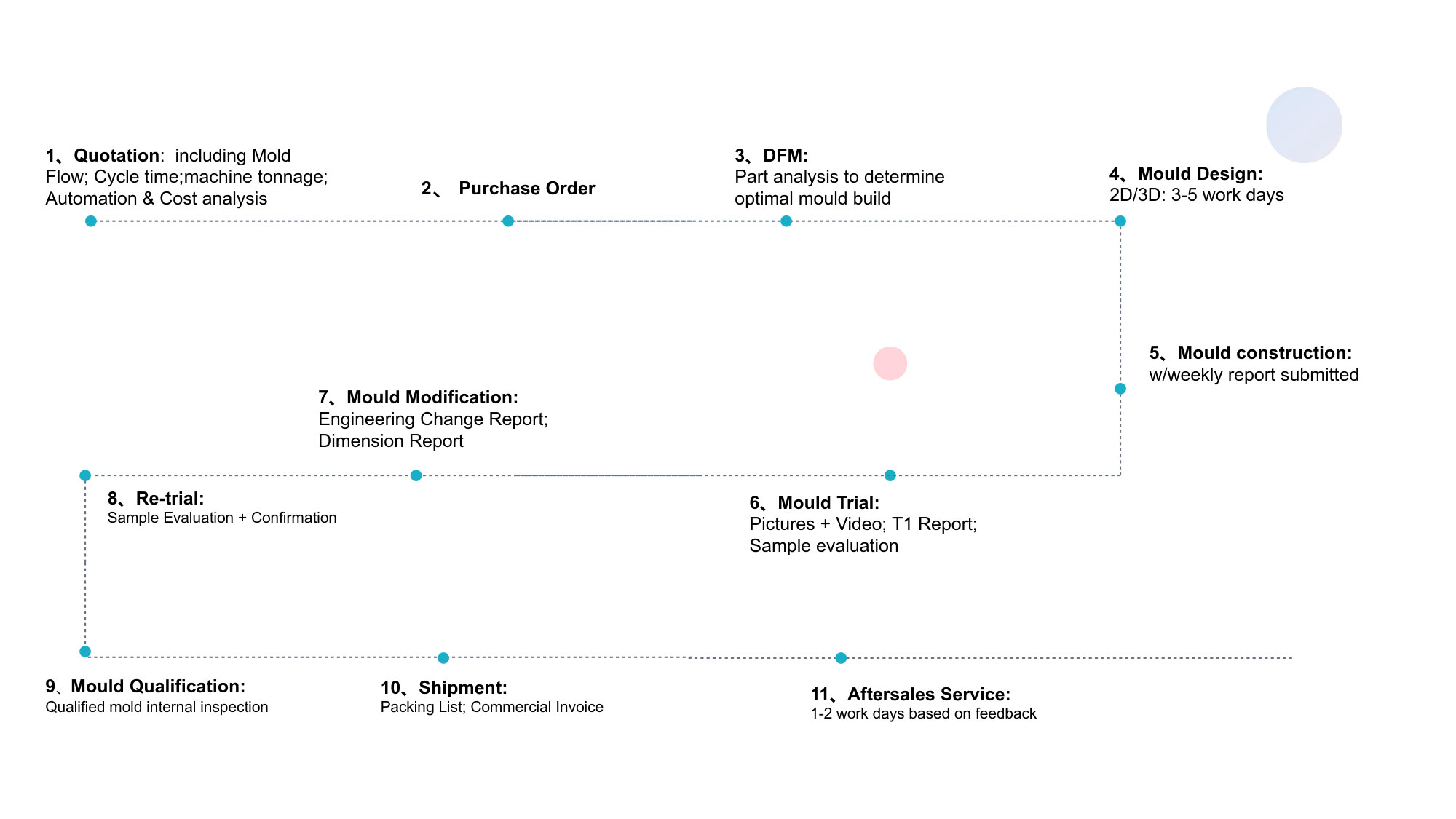
3.3 Mold Manufacturing Process Flow
Step 1 – Design Review & DFM: Mold flow analysis (Moldex3D or SIGMASOFT) is performed to predict and address weld lines, air traps, unbalanced filling, and curing issues before any metal is cut.
Step 2 – Rough Machining: Five-axis high-speed CNC roughing of mold base plates, cavity and core blanks.
Step 3 – Heat Treatment: Vacuum heat treatment for hardened materials, accompanied by full heat treatment documentation.
Step 4 – Finish Machining: Five-axis CNC finishing of cavities and cores to final dimensions (tolerances within ±0.005mm on critical dimensions).
Step 5 – EDM (if required): Sinker or wire EDM for micro-features, deep ribs, and intricate details such as the anti-reflux valve seat and fine venting channels.
Step 6 – Polishing & Surface Treatment: Mirror polishing of cavity surfaces (Ra ≤ 0.05 μm) and optional plating (e.g., nickel-PTFE coating) to enhance demolding performance.
Step 7 – Assembly: Mold assembly with precision-guided components (T-type guide pins vs. cylindrical guide pins) as recommended for LSR molds to handle thermal expansion.
Step 8 – Tryout & Validation: Each mold undergoes in-house tryout on our injection presses before shipment, with 200 cycles of real production to validate filling balance, venting, curing, demolding, and dimensional conformance. A comprehensive mold qualification report is issued.
3.4 Mold Performance Commitments
Dimension Technical Specification Customer Value
Mold Life 500,000–1,000,000 cycles for production-grade bulb molds using S136 or 2343 material with proper maintenance Reduced tooling replacement frequency, lower per-part tooling amortization
Achievable Part Tolerance General features ±0.05mm; critical sealing surfaces for anti-reflux valve ±0.005mm Consistent drainage performance, zero leakage risk, regulatory compliance
Surface Finish (Cavity) Ra ≤ 0.05 μm (mirror polish) Smooth bulb surface for patient comfort and hygiene
Cavity-to-Cavity Variation ≤0.02mm Every bulb in multi-cavity mold performs identically in clinical use
Mold Delivery Lead Time Simple prototype mold: 10–15 days; production mold (multi-cavity): 25–45 days; emergency expedite: 20 days with validation included Faster time-to-market, reduced development cycle risk
Mold Warranty 3-year structural warranty (excluding normal wear of movable components); spare wear parts kit included with mold delivery Predictable maintenance costs, minimized production downtime
Part Four: Injection Molding – Process Control That Eliminates Quality Anxiety
Medical device OEMs fear four things in silicone molding: shrinkage and dimension instability, flash requiring post-processing, batches with inconsistent performance, and surface defects compromising patient safety. Our process control system is designed to eliminate each of these fears.
4.1 Process Standardization and MES Integration
All injection molding machines are networked, with all process parameters (temperature, pressure, injection speed, cure time) locked into the MES system and accessible only to authorized engineers. Each production batch includes first-article inspection and last-article inspection with full dimensional verification. Every 100,000 cycles, a comprehensive mold maintenance service is performed with measurement and documentation.
4.2 LSR Injection Molding Process for Negative Pressure Bulb
Stage 1 – Precision Metering & Mixing: High-precision gear pumps deliver LSR A and B components in a precise 1:1 ratio continuously. Even slight deviations in the metering ratio or uneven mixing will directly lead to poor local curing or decreased physical properties — so this process is fully automated and stably monitored. For colored bulbs, a color pump and metering system are integrated.
Stage 2 – Injection: Multi-stage injection control is employed. Initial high-speed injection quickly fills the main spherical cavity, transitioning to low speed towards the end of filling to ensure adequate venting and avoid air entrapment. Injection pressure for LSR is significantly lower than for thermoplastics — approximately 50–150 bar — protecting the mold from damage while achieving complete filling.
Stage 3 – Curing: At mold temperatures of 170–230°C, the addition-curing LSR vulcanizes without dissociation products within seconds. The negative pressure bulb, with its uniform wall thickness of 2–4mm, typically requires a cure time of 15–45 seconds depending on bulb capacity, with a 4-hour post-cure at 200°C to achieve optimal final properties.
Stage 4 – Demolding: The cured silicone bulb is retained on the moving mold half after opening and is demolded using air ejection combined with robotic pickers — no ejector pins that could damage the bulb or create flash at ejection points.
Stage 5 – Secondary Operations (if required): Post-curing in oven (4 hours at 200°C), trimming, anti-reflux valve assembly, and final packaging.
4.3 Material Shrinkage and Dimensional Compensation
LSR exhibits significant thermal expansion and shrinkage characteristics. At a vulcanization temperature of 150°C, the shrinkage rate is 2% to 4%. Our DFM report accounts for this shrinkage in the mold design phase, ensuring that the final molded bulb dimensions conform to the part drawing. We provide a detailed dimensional report on T0 samples and confirm CPK (Process Capability Index) ≥1.33 on all critical dimensions before production approval.
4.4 Advanced Process Controls for Flash Prevention
Proper mold venting is paramount to avoid air traps in LSR molding. Because LSR’s processing window is narrow and scrap cannot be reprocessed, any quality loss translates directly into profit loss. LSR flashes easily during molding in gaps as small as 0.0002 inches (5 μm) — significantly smaller than thermoplastic molding flash gaps. We address this by:
Machining parting surfaces to 0.005mm accuracy
Using servo-electric injection with precise VP switching
Designing venting channels along the parting line to the bulb’s specific geometry
Implementing cascade injection with needle shut-off valves for multi-cavity molds
Our flash commitment: ≤0.03mm across the entire bulb perimeter, eliminating the need for manual deflashing operations.
4.5 Quality Control and Assurance
Incoming Material QC: Each lot of medical-grade LSR is received with a certificate of analysis (COA) verifying viscosity, hardness, cure characteristics, and regulatory compliance. Material is traceable from supplier to finished part.
In-Process QC: Real-time monitoring of injection pressure, melt temperature, mold temperature, and cure time with SPC charting. Automated optical inspection at specified sample frequencies.
Final QC (Full Inspection): Each production batch undergoes:
Dimensional verification using CMM (first article, and periodic samples)
Hardness testing (Shore A)
Visual inspection for surface defects (bubbles, flow marks, contamination)
Functional testing (negative pressure generation capacity, compression recovery, anti-reflux valve sealing test)
Sterilization compatibility verification (EO, gamma, steam)
Regulatory Compliance: Our production is conducted under ISO 13485 quality management systems, with full documentation and traceability. Final product meets all applicable USP Class VI and ISO 10993 requirements as certified by our material suppliers and verified by in-process controls.
4.6 Special Material and Application Capabilities
Beyond LSR negative pressure bulbs, Ansix Tech has extensive experience molding high-performance engineering plastics and medical-grade materials including: PC (polycarbonate), ABS, PC/ABS blends, PPS with 40% glass fiber reinforcement, PEEK (polyetheretherketone), PTFE/PFA fluoropolymers, PA6 with 30% glass fiber, PBT, PEI, and LCP. This breadth ensures we can accommodate complementary components (connectors, valves, housings) made from rigid materials, and even execute multi-material overmolding applications where LSR is overmolded onto a rigid plastic or metal substrate.
Part Five: Full-Process Service – Reducing Customer Management Costs
5.1 Early-Stage Design for Manufacturing (DFM) – Before Metal Is Cut
Before any tooling commitment, we provide a comprehensive DFM report that includes:
Material selection recommendations based on intended sterilization method, body contact duration, and regulatory requirements
Wall thickness optimization suggestions (balanced for uniform curing and dimensional stability)
Gate location and runner design recommendations based on mold flow analysis (Moldex3D)
Venting design and parting line strategy to prevent flash and air traps
Draft angle recommendations to ensure reliable demolding
Allowable ejector pin mark locations and size constraints
Detailed mold flow simulation report showing predicted fill patterns, weld line locations, air trap locations, and curing distribution
This DFM process reduces prototype iteration cycles, simplifies the overall mold validation process, and saves significant costs.
5.2 Prototype and Sampling – Reducing Design Risk
T0 Sample (First Mold Trial): Delivered within 20–35 days depending on mold complexity. Includes full dimensional inspection report, photos of molded parts, and detailed analysis of mold performance.
T1–T3 Iterations: Each trial includes a comprehensive improvement report. Our ability to rapidly change inserts for design iterations without remaking the entire mold allows for efficient design validation at minimal cost.
5.3 Small-Batch Validation – Confirming Before Mass Production
Before production launch, we provide 100–500 trial shots with:
Statistical process control (SPC) data for all critical dimensions (CPK ≥ 1.33 demonstrated)
Real yield rate analysis
Cycle time optimization data
Full documentation package suitable for regulatory submission (e.g., FDA 510(k) device master record)
5.4 Maintenance and Spare Parts – Lifetime Support
Each mold is delivered with a comprehensive spare parts kit including wear components (ejector pins, core pins, valve pins). We perform scheduled mold maintenance at every 200,000 cycles, including:
Complete disassembly and cleaning
Dimensional verification of critical components
Polishing of cavity surfaces
Replacement of wear components
Detailed maintenance report for your quality records
Lifetime repairs are provided at cost price. Post-warranty, all molds are supported indefinitely with standard service charges.
5.5 Fast Delivery Across the Entire Supply Chain
From mold design to finished product delivery, we maintain transparency at every stage:
Mold Stage: 25–45 days for production-grade multi-cavity molds
Sample Stage: T0 within 35 days of mold completion
Production Stage: Batch delivery typically 15–20 days after PPAP approval
Logistics: DDP and door-to-door shipping options available for all major global markets
Part Six: Cost Reduction Strategy – Delivering Hard Savings
Cost reduction is not an afterthought at Ansix Tech — it is engineered into every decision from raw material selection through logistics. Here is how we drive down total cost of ownership for our customers.
6.1 Material Cost Optimization
Strategy Implementation Customer Savings
Supplier partnerships Long-term agreements with Momentive, Wacker, Elkem, Shin-Etsu for medical-grade LSR at preferred pricing 8–15% material cost reduction vs. spot purchasing
Waste minimization Cold runner mold design eliminates runner waste (up to 52% material savings vs. hot runner) Direct reduction in raw material consumption per part
Material selection guidance Recommending optimal grade for application (hardness, cure speed, cost) without compromising quality Avoids over-specified premium grades where not needed
Bulk purchasing Consolidating orders across multiple components for volume discounts Lower per-unit material cost
6.2 Process Efficiency Optimization
Strategy Implementation Customer Savings
Cycle time reduction Optimized mold temperature control (2°C precision), multi-stage injection profiling, and fast-curing LSR grades 20–35% cycle time reduction compared to baseline
Multi-cavity molds 4 to 32 cavities per mold depending on bulb size Per-part molding time reduced proportionally (4x–32x throughput)
Automated production Fully automated LSR injection molding system with robotic demolding and automated inspection Reduced labor cost (up to 70% labor reduction), 24/7 production capability
Zero-flash molding Precision parting lines (0.005mm accuracy) and optimized venting design Eliminates manual deflashing operations and associated labor
6.3 Tooling Cost Optimization
Strategy Implementation Customer Savings
In-house electrode manufacturing All EDM electrodes manufactured on-site, no subcontracting 15–25% mold fabrication cost reduction
Modular mold design Interchangeable inserts allow bulb capacity changes without new full mold Significant tooling cost reduction for product line variations
Extended mold life Premium S136 or 2343 steel with proper heat treatment (HRC 48–52) Reduced tooling replacement frequency (100% longer life vs. economy steel)
Spare parts kit included Critical wear components included with initial mold delivery No first-procurement expense for spare parts
6.4 Quality-Driven Cost Avoidance
Strategy Implementation Customer Savings
DFM reduces iteration cycles Comprehensive mold flow analysis pre-tooling reduces prototypes needed Fewer design iterations, lower engineering cost, faster time-to-market
In-line quality control Real-time SPC monitoring, automated optical inspection Reduced scrap rate (target ≤ 2% vs. industry average 5–8%)
First-time-right mold design Mold flow analysis and up-front design optimization Eliminates post-delivery mold modifications and associated costs
Low-defect production Process capability demonstrated at CPK ≥1.33 before production release Minimizes quality returns and field failures, reduces regulatory risk
6.5 Total Estimated Cost Reduction
Based on our experience across dozens of LSR medical device programs, our integrated manufacturing approach delivers:
Cost Category Typical Reduction vs. Industry Average
Raw material cost per part 8–15%
Cycle time (seconds per part) 20–35%
Labor cost per part 50–70%
Scrap/rework rate 60–75%
Total landed cost per bulb 25–40%
Part Seven: Differentiators – What Makes Ansix Tech Different from the Competition
Common Customer Complaint Our Specific Commitment
“Molds require constant repair, affecting production schedules.” Every mold undergoes 200-cycle in-house validation before shipment, with wear report and 3-year structural warranty. Spare wear parts kit included.
“Flash requiring manual trimming adds cost and quality risk.” Parting surface machined to 0.005mm accuracy; flash guaranteed ≤0.03mm — no manual deflashing required.
“Dimensions inconsistent from batch to batch.” All-electric servo machines maintain ±0.1% shot-to-shot repeatability. Real-time in-mold pressure and temperature sensors with closed-loop control.
“Mold repairs take weeks, impacting production.” Complete in-house electrode manufacturing and EDM facilities. No subcontracting — mold repairs typically completed within 24–48 hours.
“No visibility into production status.” Full MES system integration. Production status, quality metrics, and shipment tracking available in real-time.
For us, a mold is not a block of steel — it is a revenue-generating asset for your business. We design molds with production durability, ventilation pathways, and thermal balance engineered in, ensuring that when the tool arrives at your production line, it is ready for high-yield, low-flash, long-life operation.
Part Eight: Summary – The Value Ansix Tech Delivers
When you partner with Ansix Tech for your LSR Liquid Silicone Medical Negative Pressure Bulb manufacturing, here is exactly what you get:
✅ Reliable Product: Medical-grade LSR with USP Class VI and ISO 10993 certifications. Smooth, uniform surface finish that reduces tissue damage risk during clinical use.
✅ Regulatory-Ready Quality: ISO 13485 quality systems, full material traceability, complete documentation packages ready for FDA/EU MDR submissions.
✅ Shortest Time-to-Market: DFM and mold flow analysis before metal is cut. 25–45 days for production-grade multi-cavity molds. T0 samples within 35 days.
✅ Lowest Total Cost: 25–40% reduction in total landed cost per bulb through material optimization, cycle time reduction, automation, and zero-flash molding.
✅ Risk-Free Partnership: 3-year mold structural warranty, spare parts kit included, lifetime in-house repair support, and real-time production visibility through MES integration.
✅ Scalable Capacity: 30–400 ton all-electric servo press fleet with multi-cavity mold capabilities (up to 32 cavities per mold), enabling production volumes from 10,000 to 10,000,000 units annually.
✅ Peace of Mind: 28 years of manufacturing experience; dedicated medical project management team; Class 100,000 cleanroom; fully automated LSR injection molding system; and a track record of delivering medical-grade components to global OEMs.
With 28 years of manufacturing experience, Ansix Tech has built a reputation for delivering reliable, cost-effective LSR injection molding solutions to medical device customers worldwide. From DFM and mold design through process validation and full-scale production — we deliver the quality, speed, and value your program requires.
We invite you to partner with us for your next LSR Liquid Silicone Medical Negative Pressure Bulb program. Our team is ready to walk you through our full DFM process and demonstrate how we turn technical expertise into measurable business value for you.
Ansix Tech Co Ltd
If you have any plans related to LSR Liquid Silicone Medical Negative Pressure Bulb , you can contact us at any time. We will turn your ideas into reality, let you realize your dreams, and obtain large orders from the market. Our contact information is info@ansixtech.com. Or contact our CTO, mail: stephen@ansixtech.com
#www.ansixtech.com #ansixtech.com #LSR Liquid Silicone Medical Negative Pressure Bulb #LSR Liquid Silicone Cap injection molding companies #LSR Liquid Silicone Cap Canopy Mold injection mold companies #Ansix #Ansix moulds #Ansix china #Ansix tech china #Ansix tech company #Ansix facotry #LSR Liquid Silicone Cap injection molding #LSR Liquid Silicone Cap injection tools #LSR Liquid Silicone Cap injection moulds #LSR Liquid Silicone Cap plastic mould #LSR Liquid Silicone Cap plastic tools #Ansix Tech #Ansix molds #Ansix injection molding #Ansix mold factory #injection molding LSR Liquid Silicone Cap#Ansix mold factory #LSR Liquid Silicone Cap china #LSR Liquid Silicone Cap molds #injection factory #LSR Liquid Silicone Cap injection molding #LSR Liquid Silicone Cap injection molding factory #injection molding company #LSR Liquid Silicone Cap injection mold companies #LSR Liquid Silicone Cap Tooling #LSR Liquid Silicone Cap mold limited #Ansix mold china #Ansix companies #Ansix company China #LSR Liquid Silicone Cap facotry #Ansix Tech #Ansix Tech mould #LSR Liquid Silicone Cap injection moulding #injection moulding company #Ansix LSR Liquid Silicone Cap parts injection mold companies #medical injection molding companieschina #LSR Liquid Silicone Cap china factory #Ansix moulding companies #Ansix molding company #LSR Liquid Silicone Cap injection moulding facotry #Ansix Tech mold #LSR Liquid Silicone Cap mould #LSR Liquid Silicone Cap plastic injection molding #ansix plastic mold #Mold manufacturing #LSR Liquid Silicone Cap parts manufacturing #LSR Liquid Silicone Cap plastic parts factory #LSR Liquid Silicone Cap injection parts mold #LSR Liquid Silicone Cap PRECISION MANUFACTURING #LSR Liquid Silicone Cap #China mold #LSR Liquid Silicone Cap injection moulding china #LSR Liquid Silicone Cap mould china #china precision mold #mold in china #LSR Liquid Silicone Cap mold china #Precision molds #High-precision molds #LSR Liquid Silicone Cap #Injection molds #LSR Liquid Silicone Cap Factory #LSR Liquid Silicone Cap Company #Super Large Injection Mold Factory #Large Tonnage Injection Molding Factory #LSR Liquid Silicone Cap Company #LSR Liquid Silicone Cap Factory #2800T Injection Molding Factory #3000 Ton Injection Molding #4500 Ton Injection Molding Factory #Large Mold Injection Molding #Large Plastic Mold Injection Molding Factory #Large Injection Mold Manufacturer #Plastic Mold Factory #Injection Mold #Plastic Mold