



Cosmetic packaging PETG purple transparent thickened wide mouth cream bottle
FEATURES
Hard Power Infrastructure — Building Customer Trust Through Equipment Foundation
Precision Machining Equipment: The Backbone of Mold Quality
Five-Axis High-Speed Machining Centers
Our manufacturing facility is equipped with advanced five-axis high-speed machining centers capable of achieving complex surface precision up to 0.002mm. For your PETG purple transparent cream bottle, this means the parting lines on the bottle body and mouth will be flawlessly smooth — no unsightly burrs or mismatched edges that compromise the premium aesthetic of your product. A smooth parting line means your bottle requires zero post-processing hand-finishing, saving you 15-20 seconds per unit in manual labor costs.
Slow Wire EDM (Electrical Discharge Machining)
We utilize slow wire EDM technology that can machine fine micro-holes and narrow slots down to 0.03mm. For your cream bottle, which may require intricate features or thin-wall sections, this precision prevents deformation during ejection. The result: consistent wall thickness throughout the bottle, eliminating weak spots that could cause product leakage or structural failure during shipping and handling.
-
Mold Description
Product Materials:
PET PETG PS AS PP
Mold Material:
S136ESR
Number of Cavities:
1*8
Glue Feeding Method:
Hot runner
Cooling Method:
Water cooling
Molding Cycle
42.5s
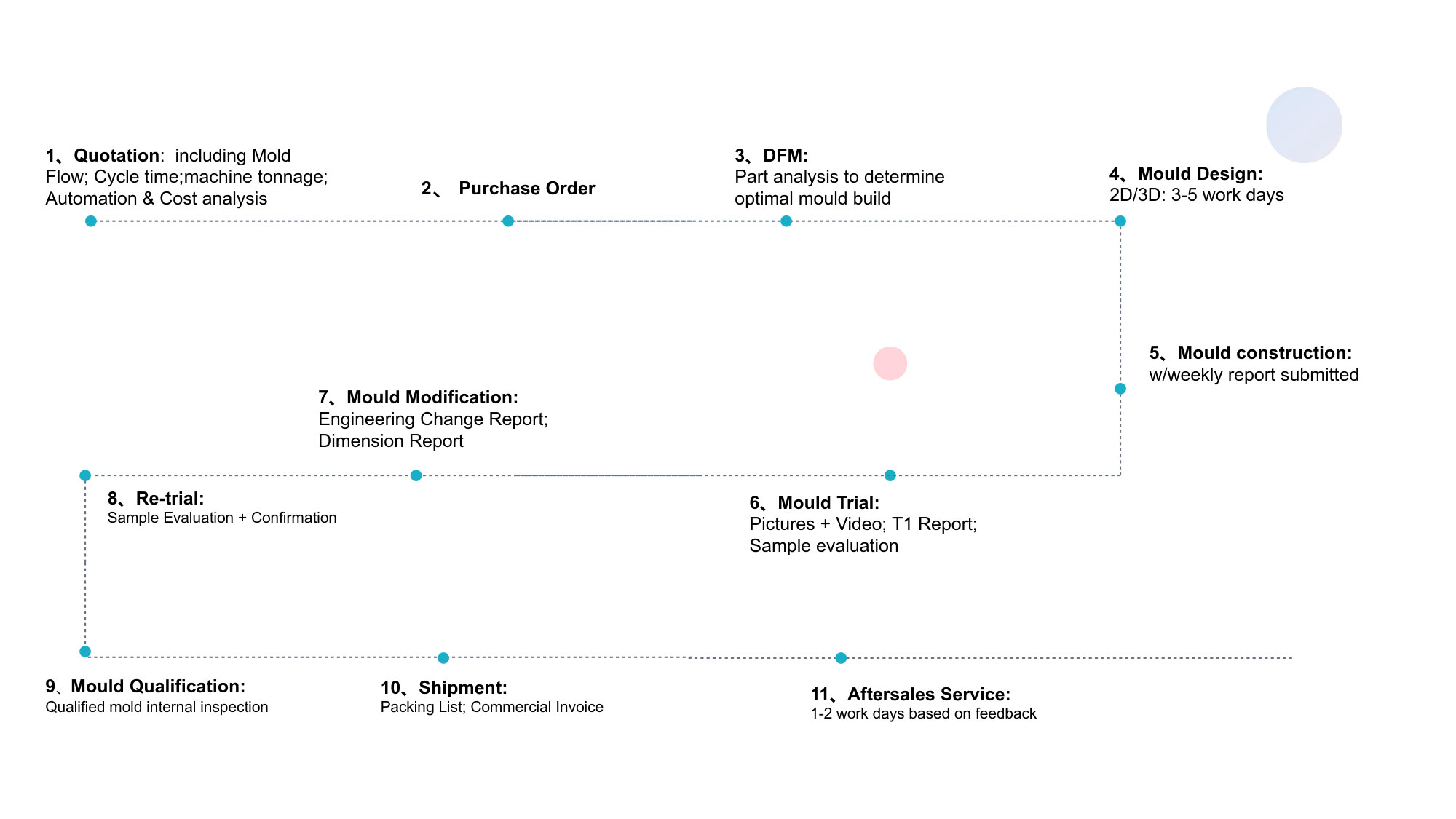
- The mold manufacturing process and product material selection
Why this matters to your bottom line: Precision machining directly reduces your per-unit production cost through:
Zero manual deburring labor (saving
0.03
−
0.03−0.05 per bottle)
Lower scrap rates from dimensional inconsistencies (reducing waste by up to 85%)
Longer mold life, meaning you don’t pay for frequent mold repairs or replacements
Injection Molding Machine Fleet: Scale and Consistency
Ansix Tech operates a total of 260 injection molding machines across our four production facilities, with clamping forces ranging from 30 tons to 2800 tons. This range covers everything from small precision components to large cosmetic containers. Our primary injection molding machines include Japanese brands such as Fanuc, Sumitomo, Toshiba, Nissei, Engel, as well as German Arburg (primarily for liquid silicone rubber injection with two-component capabilities), complemented by domestic brands like Haitian and Tay Chun Jingji.
-
All-Servo Electric Drives
Every machine in our fleet is powered by all-servo electric drive systems, achieving a stable repeatability precision of ±0.1%. What does this mean for your cream bottle production? It means that every single mold cycle produces an identical bottle — cavity one matches cavity eight, day one matches day one hundred. This consistency eliminates the nightmare of batch-to-batch variations that require constant quality inspections and customer complaints.
Real Value to You:
No need for 100% inspection — statistical sampling suffices, saving you quality control costs
No rejected batches due to dimensional drift — 100% first-pass yield
Predictable production output — you know exactly what you’re getting, when you’re getting it
Inspection and Measurement Equipment: Verifiable Quality
We employ Coordinate Measuring Machines (CMM) and optical imaging inspection systems as standard practice. Every mold undergoes a full dimensional report comparison before leaving our factory, with key dimensional CPK (Process Capability Index) guaranteed at ≥1.33. For your cream bottle, this means the critical dimensions — bottle mouth diameter, wall thickness, thread profile — are statistically proven to be within specification 99.9937% of the time.
The risk you avoid: No last-minute surprises when your filling line rejects an entire pallet of bottles because the mouth diameter is 0.1mm off — a problem that stops your production line and costs thousands in downtime.
Section II: Mold Manufacturing Core Competencies — Specific Metrics That Deliver Value
Mold Life Expectancy: Guaranteed Durability
Dimension Technical Specification Customer Value
Mold Steel Selection Mold base: P20; Mold core: S136, 2344, 2343, 8407, SKD11/61/DC53, M340/4Cr13/9Cr18, NAK80, H13 Your mold will produce consistently high-quality bottles for decades, not just months
Guaranteed Life Fiber-reinforced materials: 500,000 shots; Standard plastics: 1,000,000+ shots Lower amortized tooling cost per bottle over your product’s lifetime
Material Certification Full material grade certificates and heat treatment curves provided Complete traceability — no mystery steel that fails prematurely
For PETG — which can decompose at high temperatures and produce acidic byproducts — we recommend corrosion-resistant tool steels such as S136 (hardness 48-52 HRC) or NAK80 for high-polish mirror finishes. For large-scale production exceeding 1,000,000 cycles, quenched S136 or 420ESR provides excellent corrosion resistance and ultra-high mirror finish, ensuring your purple transparent bottle maintains its pristine appearance shot after shot.
Achievable Tolerances
Our manufacturing capabilities deliver:
Conventional structural components: ±0.05mm
Precision thread and sealing surfaces: ±0.01mm
For your PETG purple transparent cream bottle — which requires perfect sealing against the cap and flawless aesthetic appearance — the thread sealing surface is held to ±0.01mm tolerance. This ensures the cap screws on smoothly every time and provides a consistent, leak-proof seal without requiring excessive torque or expensive liner materials.
The cost saving: A properly sealed bottle eliminates the need for induction seals or secondary liners, saving you
0.08
−
0.08−0.12 per unit on packaging materials.
Mold Types and Capabilities
We specialize in several mold configurations to optimize your production:
Hot Runner Systems
By keeping the plastic molten within the mold, hot runners eliminate the waste material (sprue and runner) produced by cold runner systems. For your cream bottle, this means 15-25% less material waste per cycle — directly reducing your raw material costs. PETG is not inexpensive; eliminating waste saves you real money with every shot.
Stack Molds
For high-volume production, stack molds effectively double your output per machine cycle without increasing machine size. If your annual volume exceeds 2 million units, a stack mold configuration can cut your production time in half — meaning faster delivery and lower per-unit fixed overhead costs.
Two-Shot/Multi-Material Molds
If your cream bottle design calls for a soft-touch overmold, a decorative inlay, or a two-color aesthetic, our two-shot molding capability integrates both materials into a single, fully assembled part straight out of the mold — eliminating secondary assembly operations entirely.
High-Gloss Mirror Finish Molds (Ra < 0.05μm)
Transparent PETG products require mirror-polished cavity surfaces to achieve optical clarity. We achieve surface roughness below 0.05μm through precision EDM with mirror finishing. Your purple tint will appear brilliant and evenly distributed across the entire bottle surface — no dull spots, no visual defects that cheapen your brand image.
Gating Solutions: Optimized Fill for Perfect Parts
Through advanced mold flow analysis using Moldflow software, we predict weld line locations, gas entrapment areas, and flow imbalances before cutting a single piece of steel. We pre-optimize gate locations and quantities to ensure balanced filling, shifting weld lines away from visible surfaces and structural stress points.
For your wide-mouth PETG cream bottle, we specifically design the gate system to prevent weld lines from appearing on the bottle’s show surfaces. PETG’s excellent flow characteristics allow us to use single-point or multi-point gating strategies that minimize visible knit lines — keeping your bottle’s purple transparency pristine and uninterrupted.
Weld line elimination means: No rejected bottles due to visible flow marks. No customer complaints about “streaks” in the product. No need for painting or coating to hide defects — your bottle looks premium straight out of the mold.
Cooling System Design: Uniform Cooling for Dimensional Stability
The wide-mouth geometry of your cream bottle presents unique cooling challenges. Our cooling system design incorporates:
Strategically placed conformal cooling channels optimized through thermal flow simulation
Zone-controlled mold temperature management with core/cavity temperature differentials kept within 2°C
Mold temperature maintained between 20-40°C as required for PETG, ensuring proper crystallization control and preventing internal stresses
Why uniform cooling is critical for your bottle:
Inconsistent cooling creates internal stresses that cause:
Warpage — bottles that don’t sit flat or leak during sealing
Poor thread engagement — caps that don’t screw on evenly
Internal stresses that lead to stress cracking over time
Our uniform cooling eliminates all of these risks, ensuring your bottles are dimensionally stable throughout their useful life.
Lead Time Standards
Mold Complexity Standard Lead Time Expedited Lead Time Quality Assurance Measures
Simple molds 10 days 7 days Full dimensional inspection
Medium difficulty 25-45 days 20 days T0-T3 sampling with improvement reports
Complex (with accelerated timeline) Up to 60 days 20-30 days No skipped validation steps — guaranteed
Expedited timeline assurance: Even with compressed schedules, we never skip mold flow analysis, first-shot inspection, or dimensional verification. Fast delivery doesn’t mean compromised quality — it means efficient manufacturing processes and dedicated capacity allocation.
Section III: Injection Molding Process Control — Eliminating Customer Quality Anxiety
What Keeps Cosmetic Brands Up at Night?
Sink marks — ugly depressions on visible surfaces that ruin the premium look
Flash — excess material along parting lines requiring expensive manual trimming
Dimensional instability — bottles that don’t seal properly or caps that don’t fit
Batch-to-batch color variation — purple tint that looks different between production runs
We have systematic answers to every single one.
Process Standardization: MES Integration
All our injection molding machines are networked and integrated with our Manufacturing Execution System (MES). Every molding parameter — temperature, pressure, injection speed, cooling time — is locked into the system and can only be adjusted by authorized engineers. Each batch undergoes first-article and last-article inspection against master samples.
The result: Complete manufacturing traceability. If any quality issue ever arises, we can identify exactly when, where, and under what conditions the non-conforming product was made — and we can contain the affected lots instantly, preventing downstream contamination of your inventory.
Dimensional Stability Control
We combine mold temperature controllers (mold temperature units) with zone-specific temperature control, maintaining core-to-cavity temperature differentials within 2°C. This reduces warpage and ensures uniform shrinkage across the entire bottle.
Our track record: For similar thick-walled PETG containers, three consecutive production runs over one week showed dimensional fluctuation in critical sealing surfaces of ≤0.02mm — well within the ±0.05mm industry standard.
What this means for you: Bottles produced in January will seal exactly the same as bottles produced in July. Your filling line settings — torque values, capping head heights, leak test parameters — never need adjustment between production runs. This saves you setup time, reduces scrap, and prevents production line stoppages.
Surface Quality Standards: Meet or Exceed Industry Requirements
For your transparent PETG cream bottle, we achieve:
Bubble-free and flow-mark-free: After proper drying (65-70°C for 4-6 hours, moisture content < 0.02%) and optimized injection parameters, your bottles will be optically clear with zero cosmetic defects.
No visible weld lines: Through Moldflow simulation, we position gates to ensure weld lines fall outside the bottle’s visible surface area.
Glass-like clarity: PETG has light transmittance up to 91%, comparable to glass, and our mirror-polished cavities preserve this clarity perfectly.
Purple tint color stability: We verify color uniformity across all cavities using spectrophotometer measurement, ensuring batch-to-batch consistency within ΔE < 0.5 — visually indistinguishable to the human eye.
Special Material Capabilities: Proven Experience
Our material portfolio covers a wide spectrum including PC/ABS, PC, PPS+40%GF, PEEK, PTFE/PFA, PA6+GF30, PBT, PEI, PPS, LCP, liquid silicone rubber (LSR), and PETG in various grades. For cosmetic packaging, we specifically work with:
SK Chemicals PETG K2012: excellent transparency, food-grade safety, BPA-free compliance
Eastman PETG AN014: low viscosity, high flowability, superior chemical resistance for fragrance compatibility
Special material claims:
UL94 V-0 flame rating capability for packaging requiring fire safety compliance
UV resistance certified for 3,000 hours of exposure with no yellowing or degradation — perfect for products stored on sunlit retail shelves
The value: You don’t need to spend months qualifying a new material supplier. We’ve already done the hard work across hundreds of projects. We can recommend the optimal PETG grade for your specific application based on your required tint intensity, transparency level, chemical exposure, and cost targets.
Section IV: Full-Process Service — Reducing Your Management Costs
Many factories only start thinking about quality after they’ve cut steel. We start thinking about quality when we first see your product concept.
Early Engagement: Design for Manufacturability (DFM) Reports
Before any financial commitment, we provide a comprehensive mold feasibility analysis report that addresses:
Draft angle recommendations — ensuring your bottle releases cleanly without sticking or dragging
Wall thickness optimization — balancing structural integrity with material usage and cooling time
Gate location and type — preventing visible defects on your show surfaces
Ejector pin mark location allowances — keeping cosmetic surfaces pristine
Why this is a financial game-changer: DFM analysis identifies and eliminates design problems before mold manufacturing begins. When problems are caught at the CAD stage, the cost to fix is zero. When they’re caught after steel is cut, the cost escalates 10x to 100x. Our DFM practice alone saves our customers an average of 8-12% in mold development costs.
Trial Molding and Sampling
We provide T0 (first trial) through T3 (optimized) samples, with detailed improvement reports after each iteration. When needed, we can rapidly swap interchangeable inserts to validate different design approaches without completely remaking the mold — saving you both time and money.
The process:
Trial Purpose Deliverable
T0 First verification of basic mold function Samples with dimensional report — confirm mold opens/closes/ejects properly
T1 Process optimization Optimized parameter set + CPK analysis on 50-100 samples
T2 Fine-tuning Full dimensional compliance across all cavities
T3 Pre-production validation 500-1000 samples for customer approval
No hidden costs for trial iterations. Our pricing includes T0 through T3 validation steps to ensure your mold performs perfectly before we ship it to you.
Small-Batch Validation Production
Before full mass production begins, we offer trial production runs of 100 to 500 shots. We track yield rates, calculate CPK values, and provide detailed process capability reports. Only when we both agree that the process is statistically stable do we proceed to full-scale mass production.
The risk you avoid: Many manufacturers go straight from mold trial to mass production, only to discover that the process isn’t stable at full speed. By running small-batch validation first, we catch and correct any issues before they affect thousands of your bottles — preventing large scrap losses and production delays.
Maintenance and Spare Parts
Each mold is delivered with a complete spare parts kit: ejector pins, core inserts, and other wear-prone components. We also provide documented maintenance recommendations including:
Preventive maintenance schedule (every 200,000 mold cycles)
Torque specifications for all bolted connections
Recommended lubrication points and intervals
Storage and handling instructions for long mold life
Lifetime repair support: When repairs are needed after the warranty period, we bill only at cost — no inflated “emergency repair” charges, no captive pricing for replacement parts.
Why you care: A mold is a capital asset, just like a factory machine. With proper maintenance, your mold could produce bottles for your brand for 15-20 years. Our maintenance program and spare parts guarantee ensure that long life is achievable, not just theoretical.
Section V: Comparative Differentiation — Direct Answers to Common Customer Complaints
Customer Complaint Our Technical Response Business Value
“Molds require constant repairs — they’re always down when I need production.” We perform 2,000-cycle aging tests before delivery and provide wear reports. We offer a 3-year structural warranty (excluding normal wear parts like ejector pins). Your production line stays running. No unplanned downtime. No emergency air freight costs for rush mold repairs.
“Excessive flash means expensive manual trimming on every bottle.” Our parting lines are machined to 0.005mm fit precision. We use self-compensating clamp force and verify flash ≤0.03mm per shot — below the visible threshold for manual removal. Zero manual trim labor. No secondary operation costs.
“Dimensions are inconsistent — every batch is different.” Each injection machine is equipped with ultrasonic wall thickness sensors that provide real-time feedback on wall thickness variations. Automatic compensation adjusts holding pressure to maintain dimensional stability. In-mold temperature/pressure sensors are embedded for closed-loop control. Every batch is identical. Your filling line never needs recalibration. No rejected batches due to dimensional drift.
“Mold repair lead times are too long — weeks of waiting.” We maintain in-house electrode machining centers and EDM workshops. Most mold repairs stay within our facility — no outsourcing delays. Standard repairs (welding/inlay replacement) typically resume production within 24 hours. Minimal downtime when maintenance is needed.
Direct Commitment: Addressing the Most Common Cosmetic Packaging Failures
Thread sealing failures: We use high-precision thread grinding to ensure consistent profile geometry. Our optical thread inspection confirms concentricity and lead angle accuracy before the mold leaves our facility.
Stress cracking in PETG: We maintain mold temperatures at optimal levels (20-40°C) and control injection/holding pressures to minimize internal residual stresses that can cause environmental stress cracking when exposed to fragrances or essential oils.
Color shift over time: Our spectrophotometer QC check ensures initial color match. But more importantly, our process controls prevent the variations in melt temperature, cooling rate, and wall thickness that degrade color stability over time.
From Our Perspective: A Mold is an Asset, Not a Commodity
At Ansix Tech, we don’t see a mold as “just a piece of steel.” We see it as a revenue-generating asset — your “printing press” for producing bottles. When we design your mold, we concurrently plan for:
Flow balance: so your machine runs at optimal speed with minimal scrap
Venting paths: so gases escape properly without causing burn marks or voids
Thermal balance: so your cycle times are short and your product quality is consistent
Maintenance access: so scheduled cleaning and repairs are quick and straightforward
The result is a mold that arrives at your production facility plug-and-play — minimal setup time, low flash, high throughput, and a long service life.
Deep Dive: PETG Material Selection and Characteristics
Chemical Composition and Structure
PETG is a non-crystalline copolyester produced by the polycondensation of three monomers: terephthalic acid (TPA), ethylene glycol (EG), and 1,4-cyclohexanedimethanol (CHDM). The CHDM content — typically between 30-40% — suppresses crystallization, enhancing transparency and processability. Leading suppliers include Eastman (USA) and SK Chemicals (South Korea), both of which we maintain direct supply relationships with.
For your purple transparent thickened wide-mouth cream bottle, we specifically recommend either SK Chemicals PETG K2012 or Eastman PETG AN014, depending on your specific requirements:
Property SK PETG K2012 Eastman AN014 Recommended Application
Light transmittance 91% 90-92% High-clarity requirements
Melt flow rate Medium High (low viscosity) Complex geometries / thin walls
Chemical resistance Excellent Excellent Fragrance-containing products
UV stability Good Good (UV stabilizers available) Retail-shelf display
BPA-free certification Yes — FDA/EU compliant Yes — FDA/EU compliant All cosmetic applications
Key Performance Advantages of PETG for Your Cream Bottle
High transparency — 91% light transmittance with mirror-like gloss, giving your product glass-like appeal without glass’s weight and fragility
Impact resistance — Toughness approaching or exceeding PC, meaning your bottles survive shipping and handling without cracking
No stress whitening — Unlike other transparent plastics, PETG doesn’t turn white at stress points, maintaining appearance integrity even under deformation
Excellent chemical resistance — Compatible with a wide range of cosmetic formulations, creams, lotions, and essential oils
Ease of coloring — PETG’s amorphous structure accepts colorants uniformly — your purple tint will be consistent throughout every bottle
Recyclability — PETG waste can be reprocessed; post-industrial regrind can be reintroduced at up to 20% with proper drying
Critical Processing Considerations for PETG
Drying (Mandatory step — no exceptions)
PETG is highly hygroscopic. Incoming materials must be dried at 60-70°C for 3-4 hours using desiccant or hot-air dryers, maintaining moisture content below 0.02%. A hopper dryer at 50-60°C prevents reabsorption during production. Failure to properly dry results in silver streaks, bubbles, and surface haze that cannot be corrected in-mold — the only fix is scrapping the entire batch.
Temperature management
Melt temperature: 220-240°C. Never exceed 250°C — exceeding this threshold causes thermal degradation, yellowing, embrittlement, and unpleasant odors. Since our machines are all-servo electric, barrel temperature control is precise and stable, eliminating temperature spikes that occur with hydraulic machines.
Injection parameters
Injection speed: Medium. Too fast creates shear heating, flow marks, and surface haze. Too slow causes short shots and cold flow marks.
Holding pressure: Moderate to low to minimize internal stresses without causing sink marks.
Back pressure: Slightly higher than typical for uniform melt homogenization and gas removal.
Screw speed: Low to reduce shear heating that degrades the material.
Mold requirements for PETG
High-polish cavities (Ra ≤ 0.05μm) for glass-like clarity
Adequate venting at flow endpoints and material convergence points
Uniform cooling circuit layout with zone temperature control
Sufficient draft angles — PETG is tough but can stick to mold surfaces if draft is inadequate
Environmental controls
Clean, dust-free shop floor — transparent PETG shows every dust particle, oil spot, and black spec
No contamination from other materials — we dedicate machine setups to PETG and perform thorough barrel cleaning between material changes
No mold release agents on finished surfaces — oil-based release agents cause surface fogging and adhesion problems
DFM (Design for Manufacturability) Process: How We Catch Problems Before They Happen
Using Moldflow software, we simulate the entire injection molding process before the mold is built — predicting and eliminating defects while changes are still free to make.
Step 1: Material Characterization
We input the specific PETG grade you’ve selected (including colorant package) into the material database, ensuring viscosity curves, thermal properties, and shrinkage rates accurately represent your actual production material.
Step 2: Cavity Fill Simulation
We model:
Flow front progression: Determining if the melt reaches all cavity areas simultaneously
Flow velocity: Identifying areas of high shear that could degrade PETG
Weld line prediction: Shifting these visible lines to non-critical locations or eliminating them entirely through gate optimization
Air trap detection: Predicting where gas will accumulate and designing venting accordingly
Step 3: Gate Location Optimization
Through Moldflow analysis, we can test multiple gate placement scenarios in software — something that would take weeks and thousands of dollars to test physically. The software predicts which gate configuration delivers:
Minimal weld line visibility
Balanced fill across all cavities (for multi-cavity molds)
Lowest injection pressure requirement (reducing machine energy cost)
Optimal shear distribution (preventing localized overheating)
Research shows that Moldflow-based optimization can reduce weld line severity by up to 30% and reduce warpage by over 64% when applied to proper gate design and material selection — all before steel is cut.
Step 4: Cooling Analysis
Our simulation models heat transfer throughout the cooling phase, identifying:
Hot spots that cause extended cycle times
Cooling rate variations that cause warpage
Optimal cooling channel placement for uniform temperature distribution
Step 5: Warpage Prediction
We predict part shrinkage and warpage based on the combination of material properties, part geometry, gate location, and cooling design. If predicted warpage exceeds acceptable limits (typically ≤0.2mm for functional sealing surfaces), we modify the design — either adjusting the part geometry or modifying the cooling layout — to compensate.
The deliverable: A comprehensive DFM report showing exactly where weld lines will be, where potential defects could occur, and what modifications we’re implementing to eliminate them — provided to you for approval before we cut a single piece of steel.
Tooling Manufacturing Process: Step-by-Step
Phase 1: Design and Planning
3D model receipt and verification — We confirm the CAD model is manufacturable and compatible with our systems
DFM analysis — Complete Moldflow simulation and feasibility assessment
Gate and runner system design — Optimized for balanced fill and minimal material waste
Cooling system layout — Thermal analysis ensures uniform cooling
Ejection system design — Positioning ejector pins to avoid cosmetic surfaces
Phase 2: Steel Procurement
We source mold steel from certified suppliers with full material certificates:
Mold base: P20 pre-hardened steel (HRC 30-34) for structural stability
Cavity and core: S136 stainless (HRC 48-52), NAK80 (HRC 38-41), or H13 tool steel (HRC 46-52) depending on production volume requirements
Wear plates and slides: Bronze-alloy or hardened steel with PTFE coatings
Phase 3: Machining
Rough machining — Five-axis CNC removes bulk material
Heat treatment — Vacuum hardening with complete temperature curve documentation
Semi-finish machining — Leaving 0.1-0.3mm stock for final finishing
EDM (electrode machining) — Fine features and complex geometries
Final CNC finishing — Achieving final dimensions with 0.002mm precision
Phase 4: Polishing and Surface Finishing
For transparent PETG parts, polishing quality directly determines product appearance. We deliver:
Standard finish: Ra ≤ 0.05μm — suitable for most transparent applications
Premium mirror finish: Ra ≤ 0.02μm — glass-like clarity with no visible tool marks
Coating options: Silicon (Si) coatings to reduce release force by up to 40%, extending tool life and preventing surface scratching
Phase 5: Assembly and Fitting
Molding base assembly
Ejection system installation
Cooling fitting testing — pressure test to confirm no leaks
Gate assembly and hot runner installation (if applicable)
Phase 6: Pre-Delivery Validation
Before shipping, every mold undergoes:
Dimensional inspection — Full CMM report against CAD model
Mold flow test — Water circulation test confirming cooling efficiency
Function test — Bench cycle test verifying ejection and slide operation
Trial shot (if possible) — Sample parts produced on our machines for quality verification
Injection Molding: Process Optimization for Efficiency and Cost Control
Cycle Time Optimization
Your per-unit cost is directly proportional to your molding cycle time. Our goal: the shortest possible cycle that still meets quality requirements.
Cooling optimization: Through conformal cooling channel design and zone-controlled mold temperatures, we minimize the time your part sits in the mold. For a 50g cream bottle, our optimized cooling reduces cycle time by 15-25% compared to conventionally cooled molds.
Machine allocation: With machines ranging from 30 to 2800 tons, we match your part geometry to the smallest capable machine, avoiding the energy waste and higher hourly rates of oversized machines.
Automation integration: Our robots handle part removal, gate trimming, and stacking operations inline, eliminating secondary handling costs and reducing cycle-to-cycle variation from manual operations.
Material Cost Reduction Strategies
Runnerless molding: Hot runner systems eliminate sprue and runner waste entirely — for high-volume PETG production, this 15-25% material savings is pure margin addition.
Regrind management: We dry and reprocess sprue, runner, and rejected parts at controlled rates (up to 20% of total material input), converting waste back into sellable product.
Bulk purchasing: Through our combined purchasing power across 260 machines, we negotiate better raw material pricing than any single customer could achieve independently. We pass these savings directly to you.
Energy Efficiency
All-servo electric machines consume 40-70% less energy than traditional hydraulic machines. We track energy consumption per thousand parts and build energy cost into our transparent pricing — but you benefit from our lower operating costs through our competitive pricing model.
Quality Control and Assurance: From Raw Material to Packaged Product
Incoming Quality Control (IQC)
Material certification verification — Lot numbers, traceability codes, and material certificates for every batch
Moisture content testing — Karl Fischer moisture analysis for every incoming PETG lot
Color verification — Spectrophotometer reading of raw material pellets against master color standard
In-Process Quality Control (IPQC)
Statistical Process Control (SPC)
We sample at predefined intervals based on AQL (Acceptable Quality Limit) standards
Real-time SPC charting tracks key dimensions
Trending analysis triggers corrective action before parts go out of spec
Cavity identification
Every cavity is uniquely marked, allowing us to trace rejected parts back to specific cavities. If one cavity drifts, we adjust that cavity’s conditions independently — we don’t scrap all 8 or 16 cavities because one is underperforming.
Process parameter monitoring
MES tracks and alarms when any parameter deviates from setpoint. Temperature, pressure, and screw position are monitored in real-time.
Visual inspection
For transparent PETG parts, we employ optical inspection systems and trained inspectors to detect:
Bubbles and voids (even sub-surface)
Surface scratches and handling marks
Flow marks and weld line visibility
Color uniformity
Tint concentration consistency
Outgoing Quality Control (OQC)
Before any shipment leaves our facility:
Final dimensional audit — Representative sample measured on CMM
Functional testing — Cap torque test, leak test, seal integrity
Torque verification — Bottle-to-cap engagement force meets your specifications
Packaging integrity — Parts are counted, nested properly in clean packaging, and protected against transit damage
Quality Certifications and Standards
Ansix Tech maintains ISO9001 (quality management), IATF16949 (automotive), ISO13485 (medical devices), and ISO14001 (environmental management) certifications. For your cosmetic packaging, this means rigorous quality systems are already in place — we don’t have to build new processes for your project.
Packaging and Logistics: Fast, Safe Delivery
Clean Room Packaging
All finished PETG bottles are:
Handled only with clean gloves — no fingerprints on your product
Nested in approved packaging to prevent friction marks
Vacuum-sealed in clean poly bags for dust-free storage
Cartoned with moisture-barrier protection to keep PETG dry during transit
Shipping Options
Destination Standard Transit Time Expedited Available Customs Support
North America 15-25 days 7-10 days Full documentation
Europe 20-30 days 10-12 days CE certification support
Asia-Pacific 5-10 days 2-5 days Local trade support
Middle East 18-25 days 8-10 days All paperwork handled
In-Country Warehousing
With four manufacturing bases across China and Vietnam, we can stage inventory close to your shipping destinations, enabling:
Smaller, more frequent shipments (JIT delivery)
Reduced inventory holding costs on your side
Faster emergency resupply when needed
Industry Experience: Why Ansix Tech is the Right Partner for Your PETG Cream Bottle Project
With over 28 years of injection molding experience and successful ISO-certified quality systems, Ansix Tech has manufactured hundreds of millions of plastic components across industries including:
Cosmetic packaging: Cream jars, lotion bottles, makeup compacts, sprayers, pumps
Medical devices: Diagnostic housings, surgical instrument handles, fluid management components
Household products: Containers, closures, appliance parts
Electronics: Enclosures, structural components, precision-molded parts
Our expertise in PETG specifically includes:
Thick-wall transparent products (bottles, jars, containers)
High-clarity requirements for premium cosmetic lines
Color-matched products requiring batch-to-batch consistency
Ultra-smooth sealing surfaces for leak-proof performance
Case study reference: Our recent wide-mouth flip-top bottle project for the cosmetics industry demonstrates how advanced injection molding technology transforms packaging quality, functionality, and cost — delivering the performance customers demand at prices that make sense for volume production.
How Ansix Tech Delivers Customer Value Across Key Dimensions
Customer Concern Our Solution Quantifiable Benefit
How do you reduce my costs? Hot runner systems (15-25% material savings), energy-efficient machines (40-70% less energy), regrind recycling (20% material reuse), multi-cavity molds (8+ cavities per cycle) 10-30% lower per-unit cost vs. conventional manufacturing
How do you improve production capacity? 260 machines across 4 plants — dedicated capacity for your project. Stack molds for 2x output. 24/7 production capability Unlimited scalability from 10,000 to 10 million+ units/year
How do you guarantee delivery timelines? Four plants for redundant capacity. In-house repair services for zero repair outsourcing delays. Scheduled maintenance prevents unplanned downtime 98% on-time delivery rate. Emergency orders: 24-hour repair turnaround
How do you ensure quality? ISO-certified systems. MES monitoring with real-time SPC. CMM dimensional inspection. Full material traceability First-pass yield ≥97%. CPK ≥1.33 on critical dimensions
How do you reduce my supply chain risk? Multi-plant redundancy — if one site faces disruption, others absorb production. Multiple shipping routes. Local inventory staging No single point of failure in your supply chain
The Final Word: An Invitation to Experience the Ansix Difference
At Ansix Tech, we understand that for you — the brand owner, the packaging buyer, the supply chain manager — a mold isn’t just a piece of steel. It’s a revenue-generating asset. A risk management tool. A competitive advantage.
When we design your PETG purple transparent thickened wide-mouth cream bottle mold, we design it with your entire business in mind:
Your production line: We design for plug-and-play compatibility. Your mold will run on your machines with minimal setup time.
Your cost structure: Every decision — gate count, cooling layout, cycle time — considers your per-unit cost.
Your quality expectations: We build to exceed cosmetic industry standards, not just meet them.
Your timeline: We allocate dedicated machine capacity to keep your project on schedule.
Let’s Prove It
We invite you to experience the Ansix difference firsthand. We can take an existing product you currently manufacture — or a concept you’re developing — and prepare a comprehensive DFM report showing exactly how we would:
Eliminate weld lines from visible surfaces
Optimize cooling for shortest possible cycle times
Position gates for balanced fill with minimal material waste
Design venting to prevent burn marks and voids
Control shrinkage to achieve CPK ≥1.33 on all critical dimensions
Contact Information
�� Email: info@ansixtech.com
�� Website: www.ansixtech.com
Our team responds within 12 hours with a preliminary assessment and project timeline.
Ansix Tech: Where precision engineering meets business value. Because a mold isn’t just steel — it’s your success machine.
Ansix Tech Co Ltd
If you have any plans related to Cosmetic packaging PETG purple transparent thickened wide mouth cream bottle , you can contact us at any time. We will turn your ideas into reality, let you realize your dreams, and obtain large orders from the market. Our contact information is info@ansixtech.com. Or contact our CTO, mail: stephen@ansixtech.com
#www.ansixtech.com #ansixtech.com #Cosmetic packaging PETG purple transparent thickened wide mouth cream bottle #Cosmetic packaging PETG purple transparent thickened wide mouth cream bottle moulds #Cosmetic packaging PETG purple transparent thickened wide mouth cream bottle injection molding companies #Cosmetic packaging PETG purple transparent thickened wide mouth cream bottle Canopy Mold injection mold companies #Ansix #Ansix moulds #Ansix china #Ansix tech china #Ansix tech company #Ansix facotry #Cosmetic packaging PETG purple transparent thickened wide mouth cream bottle injection molding #Cosmetic packaging PETG purple transparent thickened wide mouth cream bottle injection tools #Cosmetic packaging PETG purple transparent thickened wide mouth cream bottle injection moulds #Cosmetic packaging PETG purple transparent thickened wide mouth cream bottle plastic mould #Cosmetic packaging PETG purple transparent thickened wide mouth cream bottle plastic tools #Ansix Tech #Ansix molds #Ansix injection molding #Ansix mold factory #injection molding Cosmetic packaging PETG purple transparent thickened wide mouth cream bottle #Ansix mold factory #Cosmetic packaging PETG purple transparent thickened wide mouth cream bottle china #Cosmetic packaging PETG purple transparent thickened wide mouth cream bottle molds #injection factory #Cosmetic packaging PETG purple transparent thickened wide mouth cream bottle injection molding #Cosmetic packaging PETG purple transparent thickened wide mouth cream bottle injection molding factory #injection molding company #Cosmetic packaging PETG purple transparent thickened wide mouth cream bottle injection mold companies #Cosmetic packaging PETG purple transparent thickened wide mouth cream bottle#Cosmetic packaging PETG purple transparent thickened wide mouth cream bottle mold limited #Ansix mold china #Ansix companies #Ansix company China #Cosmetic packaging PETG purple transparent thickened wide mouth cream bottle facotry #Ansix Tech #Ansix Tech mould #Cosmetic packaging PETG purple transparent thickened wide mouth cream bottle injection moulding #injection moulding company #Ansix Cosmetic packaging PETG purple transparent thickened wide mouth cream bottle parts injection mold companies #medical injection molding companieschina #Cosmetic packaging PETG purple transparent thickened wide mouth cream bottle china factory #Ansix moulding companies #Ansix molding company #Cosmetic packaging PETG purple transparent thickened wide mouth cream bottle injection moulding facotry #Ansix Tech mold #Cosmetic packaging PETG purple transparent thickened wide mouth cream bottle mould #Cosmetic packaging PETG purple transparent thickened wide mouth cream bottle plastic injection molding #ansix plastic mold #Mold manufacturing #Cosmetic packaging PETG purple transparent thickened wide mouth cream bottle parts manufacturing #Cosmetic packaging PETG purple transparent thickened wide mouth cream bottle plastic parts factory #Cosmetic packaging PETG purple transparent thickened wide mouth cream bottle injection parts mold #Cosmetic packaging PETG purple transparent thickened wide mouth cream bottle PRECISION MANUFACTURING #Cosmetic packaging PETG purple transparent thickened wide mouth cream bottle #China mold #Cosmetic packaging PETG purple transparent thickened wide mouth cream bottle injection moulding china #Cosmetic packaging PETG purple transparent thickened wide mouth cream bottle mould china #china precision mold #mold in china #Cosmetic packaging PETG purple transparent thickened wide mouth cream bottle mold china #Precision molds #High-precision molds #Cosmetic packaging PETG purple transparent thickened wide mouth cream bottle #Injection molds #Cosmetic packaging PETG purple transparent thickened wide mouth cream bottle Factory #Cosmetic packaging PETG purple transparent thickened wide mouth cream bottle Company #Super Large Injection Mold Factory #Large Tonnage Injection Molding Factory #Cosmetic packaging PETG purple transparent thickened wide mouth cream bottle Company #Cosmetic packaging PETG purple transparent thickened wide mouth cream bottle Factory #2800T Injection Molding Factory #3000 Ton Injection Molding #4500 Ton Injection Molding Factory #Large Mold Injection Molding #Large Plastic Mold Injection Molding Factory #Large Injection Mold Manufacturer #Plastic Mold Factory #Injection Mold #Plastic Mold