



Flip-Top Cap Two-Color Injection Mold
FEATURES
Slow Wire EDM (Wire-Cut Electrical Discharge Machining)
Technical Specification: Precision slow-wire EDM that machines micro-features down to 0.03mm width (approximately one-third the diameter of a human hair), ideal for thin-wall cap hinges, narrow slots, and small core pins.
Customer Value Translation:
What problem does this solve? Enables production of flip-top caps with living hinges that survive 50,000+ open-close cycles without fatigue failure.
Cost saved: Eliminates secondary assembly operations by creating integral hinge geometry directly in the mold—saving 0.02–0.04perpart×10millionannualpieces=∗∗200,000–400,000 annual assembly cost avoidance**.
Risk reduced: Thin-walled areas no longer deform during ejection. No cracked hinge complaints from end consumers.
EDM and Electrode Manufacturing
Technical Specification: Integrated electrode machining center and spark erosion workshop. All mold rework stays in-house, with zero reliance on external subcontractors.
Customer Value Translation:
What problem does this solve? Traditional mold shops ship molds back and forth for rework—weeks of lost production time.
Cost saved: Mold repair turnaround time reduced from 5–10 days to under 24 hours. Every day of mold downtime at full production (say 50,000 caps/day × 2,000 hours/year) costs approximately $15,000–25,000 in lost revenue. Your risk of production stoppage virtually disappears.
-
Mold Description
Product Materials:
PP+PET
Mold Material:
S136ESR
Number of Cavities:
4+4
Glue Feeding Method:
Hot runner
Cooling Method:
Water cooling
Molding Cycle
32.5s
- The mold manufacturing process and product material selection
Risk reduced: No foreign supply chain delays. No miscommunication between multiple vendors. Your production schedule remains predictable.
1.2 Injection Molding Machine Fleet: Cavity-to-Cavity Consistency
Technical Specification: Ansix Tech operates 260 injection molding machines spanning from 30 tons to 2,800 tons clamping force, with a total building footprint of approximately 200,000 m² . Our fleet includes high-end machines from Japan (Fanuc, Sumitomo, Toshiba) and Germany (Arburg two-color liquid silicone injection molding machines).
For flip-top cap applications: Two-color flip-top caps typically require 250–400 ton two-color injection molding machines depending on cavity count and part geometry.
Customer Value Translation:
Coverage: Need 8 cavities? 16 cavities? 32 cavities? We have the press capacity to match your annual demand projections. No need to “work around” machine limitations.
Consistency across multi-cavity: 16-cavity two-color flip-top cap molds require precise balancing of material flow to all cavities simultaneously. Our all-electric servo-driven machines deliver repeatability of ±0.1% shot-to-shot variation.
What this means for your business: Cavity 1 and Cavity 16 produce identical caps—same weight, same dimensions, same aesthetic finish. Your quality control department performs fewer inspections, your customers receive consistent product, and your scrap rate approaches zero.
Cost saved: Poor cavity-to-cavity balance can create 8–15% scrap in multi-cavity two-color molds. On 10 million annual caps, that is 800,000 to 1.5 million scrap caps at roughly 0.10eachmaterialcost=∗∗80,000–150,000 annual waste**. Our precision molding eliminates this waste entirely.
1.3 Metrology and Quality Verification: Data That Proves Performance
Technical Specification:
Coordinate Measuring Machines (CMM): Accuracy to ±0.001mm for complex geometric verification.
Optical Imaging Measuring Instruments: Automated surface inspection at 0.1mm resolution for defect detection.
Full dimensional reporting: Every mold shipped with complete first-article inspection (FAI) and critical dimension CPK ≥ 1.33.
Customer Value Translation:
What problem does this solve? You cannot improve what you cannot measure. Our CMM and optical inspection data provide objective, auditable proof that every critical dimension meets your specification.
Cost saved: Eliminates “measurement disputes” that often cost weeks of delay and engineering overhead. We give you the same data files our own QA uses—no surprises, no renegotiation.
Risk reduced: Before the first cap is molded in your facility, we have already validated the mold’s performance against every requirement. No last-minute dimension rejects after you receive the mold.
Mold Manufacturing Core Competencies — Commitment Through Specific Metrics
For flip-top cap applications, customers care about four things: how long will the mold last, how precise will the parts be, how fast can I get production running, and how expensive will future repairs be. Ansix Tech answers each question with specific, verifiable data.
2.1 Mold Life: From Capital Expense to Long-Term Asset
Technical Specification vs. Customer Value:
Mold base material: P20 for standard applications
Core and cavity materials: Strategic selection from S136, 2344, 8407, H13, SKD61, 718H, NAK80, and M340 based on application requirements.
Material-to-Value Matrix:
Mold Component Material Hardness (HRC) Best For Customer Benefit
Core & Cavity (Standard) S136 (420 stainless) 48–52 Cosmetic-grade surface finish; corrosion resistance for acid-containing plastics Mirror-smooth caps; no surface degradation
Core & Cavity (High-wear) 2344 / H13 48–52 Glass-filled (GF) materials; high-volume production Extended tool life before maintenance
Core & Cavity (High-polish) NAK80 37–43 Mirror finish; aesthetic cosmetic closures Ra <0.05μm surface—out-of-mold polished appearance
Mold Base P20 / 718H Pre-hardened Structural support for core/cavity assembly Dimensional stability—no warping over mold life
Lifetime Warranty Equivalent:
Glass-filled resin (e.g., PP+30%GF): Certified for 500,000 shots before significant wear
Unfilled engineering plastics: Certified for 1,000,000+ shots
Customer Value Translation:
A 32-cavity mold replaced prematurely because of poor steel selection costs:
Mold replacement capital: $45,000–80,000
Lost production during replacement: 5–10 days
Customer delivery penalties: Potentially catastrophic
Our properly selected steel, combined with heat treatment proven by material certification and heat treatment curve documentation, ensures you get the full economic life out of every tool you purchase before you ever need to discuss replacement.
Cost saved: Over five years of production, Ansix-specified steel extends mold life by 40–60% compared to generic material specifications. That means one less tool replacement cycle, $50,000–80,000 direct savings in capital avoidance.
2.2 Dimensional Tolerances: Predictable Geometry, Predictable Brand Quality
Technical Specification:
Standard structural components: ±0.05mm
Precision components (hinges, sealing surfaces, snap-fit features): ±0.005mm (5 microns)
Customer Value Translation:
Flip-top caps demand three critical precision zones:
Sealing lip geometry: Determines leak-proof closure. Deviation beyond ±0.02mm means leaking products—customer complaints, returns, and brand damage.
Snap-fit closure: Must click securely but not be difficult to open. Too tight = customer frustration; too loose = product spillage.
Hinge geometry: Every micron of misalignment multiplies shear stress on the living hinge.
Our ±0.005mm precision in these critical zones ensures:
100% functional sealing across all production
Consistent user experience: every cap opens with the same intended resistance and same satisfying “click”
Zero secondary trimming or post-molding sizing operations
Cost saved: Secondary dimensional sorting operations typically cost 0.005–0.01percap∗∗.On10millioncaps/year,eliminatingthisstepsaves∗∗50,000–100,000 annually.
2.3 Mold Types for Flip-Top Cap Applications
Two-Color (2K / Bi-Injection) Mold:
Core and cavity must be ejected twice—the first color molded, the mold indexes via rotary table, then the second material overmolded.
Two-color flip-top caps with diameter as small as 20mm can be manufactured at 16 or 32 cavities.
Customer Value Translation:
Two-shot injection molding combines two materials in one machine, one cycle, one uninterrupted process. Compared to traditional two-step processes requiring manual part transfer:
Metric Traditional Two-Step Ansix One-Step Two-Color
Cycle time per part 2× cycles + robot transfer 1× combined cycle
Per-unit cost (100k pieces) Higher (additional handling) 5–15% lower
Scrap risk Double exposure to defects Single quality checkpoint
Capital equipment Multiple machines required One machine
Assembly labor Required Eliminated
Cost saved: The 5–15% unit cost reduction for two-color vs. two-step is pure margin improvement. On a 0.30cap,thatis∗∗0.015–0.045 per cap × 5 million = $75,000–225,000 annual savings**.
2.4 Hot Runner Systems and Gate Optimization
Technical Specification:
Valve-gated hot runner nozzles inject material into non-visible areas (cap interiors), eliminating gate vestiges and surface blemishes.
For flip-top caps, back-gated hot runner systems with MeltFlipper™ balancing achieve >99% cavity-to-cavity consistency.
Customer Value Translation:
Surface quality: Eliminates gate marks on visible cosmetic surfaces—your caps look premium, not “manufactured.”
Material savings: Hot runner systems eliminate runner waste entirely. For a 16-cavity flip-top cap mold, cold runner waste can exceed 15–20% of total resin purchased.
Environmental value: Reduced resin consumption = lower carbon footprint for your sustainability reporting.
Cost saved: If resin cost is 1.80/kgandaflip−topcapweighs4g,coldrunnerwasteadds 0.8gpershot.Over10millioncaps:∗∗8,000kgofresinsavedannually∗∗=∗∗14,400 direct material cost avoidance**.
2.5 Cooling System Design for Cycle Time Reduction
Technical Specification:
Conformal cooling channels that follow part geometry enable 30% faster cooling compared to straight-drilled conventional cooling channels. Combined with zone-divided mold temperature control maintaining core-and-cavity temperature differential within 2°C.
Customer Value Translation:
Cooling typically accounts for 60–70% of total injection molding cycle time. Faster cooling = faster production output = higher annual capacity without additional capital investment.
Example: A standard two-color flip-top cap mold cycles at 12 seconds. Optimized conformal cooling reduces cycle time to 9 seconds = 33% faster production.
Daily impact: At 32 cavities × 9 seconds → approximately 307,000 caps per 24-hour day vs. 230,000 caps at 12 seconds. That is 77,000 additional caps per day from the same machine and mold.
Cost saved: Additional 77,000 caps/day × 250 production days × 0.30/cap=approximately∗∗5.8 million additional annual revenue capacity** from the same capital assets.
2.6 Delivery Standards: Reliable Schedules, No Hidden Delays
Technical Specification:
Simple single-cavity molds: 10 days
Standard multi-cavity two-color flip-top cap molds: 25–45 days
Expedited programs (with sign-off on accelerated verification schedule): 20 days compressed delivery
Customer Value Translation:
We do not “rush” by skipping quality steps—we accelerate by overlapping engineering activities:
DFM (Design for Manufacturability) analysis initiated before mold design finalization
Cutter path programming and steel procurement running parallel while 3D design continues
In-house EDM and electrode manufacturing eliminate outsourcing delays
Cost saved: Each week of mold delivery delay postpones revenue generation. For a customer needing 5 million caps ×
0.30percap=∗∗150,000 total monthly production value**. A two-week delivery delay = $75,000 in lost revenue opportunity.
Part III: Injection Molding Process Control — Eliminating Customer Quality Anxiety
Cap customers lose sleep over four defects: sink marks on visible surfaces, flash along parting lines, dimensional variation across batches, and color inconsistency. Ansix Tech addresses each with measurable engineering controls.
3.1 Process Standardization: Taking Variation Out of the Equation
Technical Specification:
All machines networked to MES (Manufacturing Execution System)
All parameters (temperature, pressure, injection speed, holding pressure, cooling time) locked in the system—accessible only to authorized engineers
Every production batch: first-piece inspection AND last-piece inspection with full dimensional and surface comparison
Customer Value Translation:
What problem does this solve? No unauthorized operator changes. No “tweaking” that drifts process out of specification.
Traceability: If a quality issue occurs, we know exactly which shift, which operator (if any), and which parameter drifted—your plant manager gets a root-cause analysis, not an excuse.
Consistency: Batch 1 in January and Batch 10 in October are produced under identical parameters.
Risk reduced: Eliminates the “silent drift” that causes quality escapes—defective products reaching your customer’s production line or, worse, store shelves. Brand protection is priceless.
3.2 Closed-Loop Process Control: Real-Time Correction
Technical Specification:
Cavity pressure sensors (±0.5 bar) and melt temperature sensors (±2°C) monitor every shot.
Ultra-thin processing (e.g., flip-top caps with 0.6mm wall thickness) uses ultrasonic wall-thickness sensors that automatically compensate holding pressure to maintain consistent wall thickness.
SPC (Statistical Process Control) charts monitor shot-to-shot variation, flagging deviations exceeding ±3σ statistical control limits.
Customer Value Translation:
Real-time feedback: If a core pin heats up or cooling performance degrades, the control system compensates within seconds—not after a shift’s worth of defective parts.
Predictive quality: Machine learning models trained on sensor data detect early warning patterns, sometimes identifying issues 15 production cycles before visible defects occur.
3.3 Surface Quality: Customer First Impressions
Technical Specification:
SPI A1 (Mirror) finish for cosmetic closures.
Surface roughness ≤ 0.2μm on high-gloss exterior surfaces.
Transparent components processed with no bubbles, no flow marks, no “silver streaks.”
For printed or labeled products: predetermined warp compensation ensures registration accuracy of ±0.1mm.
Customer Value Translation:
A flip-top cap’s surface is the first physical interaction a consumer has with your brand.
A high-gloss, flawless surface says “premium quality.”
Visible knit lines, sink marks around the hinge boss, or gate vestiges say “low-cost manufacturing.”
Our Class A surface finish means your product speaks “brand quality” from the moment it leaves the production line—no secondary finishing or buffing required.
Cost saved: Eliminates secondary surface treatments (pad printing fixtures, selective masking). Eliminates product returns due to cosmetic complaints.
3.4 Special Material Capabilities: Experience That Prevents Failure
Materials we process for flip-top cap and packaging applications:
PC/ABS (automotive-grade closures)
PC (transparent flip-top caps)
PP (most common flip-top cap material—cost-effective, chemical resistant, excellent hinge property)
PPS+40%GF (high-temperature pharmaceutical cases)
PEEK (medical device closures requiring sterilization and chemical resistance)
PA6+GF30 (structural closures requiring high strength)
PBT (electrical/electronic closure applications)
PEI / PPS / LCP (high-temperature, flame-retardant packaging)
LSR (Liquid Silicone Rubber) for soft-touch overmolding
Flame Retardancy: Capable of UL94 V-0 rated materials for safety-critical packaging
Weatherability Validation: UV resistance tested to 3,000 hours of accelerated weathering without yellowing or mechanical property degradation
Customer Value Translation:
Your material choice is the most important design decision affecting production economics. We guide you to the optimal material—not the most expensive or the cheapest—based on:
Part function (is chemical resistance required? is transparency required? does this hinge require high flexural modulus?)
Production volume (higher volumes justify slower-cycling, higher-performance materials with better total economics)
Regulatory requirements (food contact? medical device? pharmaceutical packaging with USP Class VI requirements?)
Cost saved: Material substitution from a “premium but unnecessary” grade to a “functionally equivalent but less expensive” grade can reduce resin cost by 15–35% × millions of caps = $50,000–150,000 annual savings without compromising performance.
Part IV: Full-Process Service Model — Reducing Your Management Cost and Vendor Count
Most customers are not in the mold business—you are in the product delivery business. Every supplier you manage adds overhead, risk, and communication friction. Ansix Tech’s integrated service model reduces that friction to near zero.
4.1 Early Engineering Engagement (Pre-Contract DFM)
What we deliver BEFORE receiving a purchase order:
Full DFM (Design for Manufacturability) feasibility analysis
Wall thickness optimization recommendations (minimum wall thickness that still produces full-fill without sink)
Draft angle recommendations based on your material, surface texture, and ejection method
Gate location and quantity recommendations based on Moldflow simulation
Ejector pin placement—including approval for visible witness mark locations (we ask where your brand allows marks before we place ejectors)
Material shrinkage verification across all critical dimensions before steel cutting begins
Customer Value Translation:
Engineers who have run production know that 80% of project costs are locked in during the first 20% of the design process.
Cost saved: Every 1investedinDFMavoids8–12 in tooling rework and production delays later.
Timeline saved: First-article approval timelines reduced by 40% when DFM guides design from the beginning.
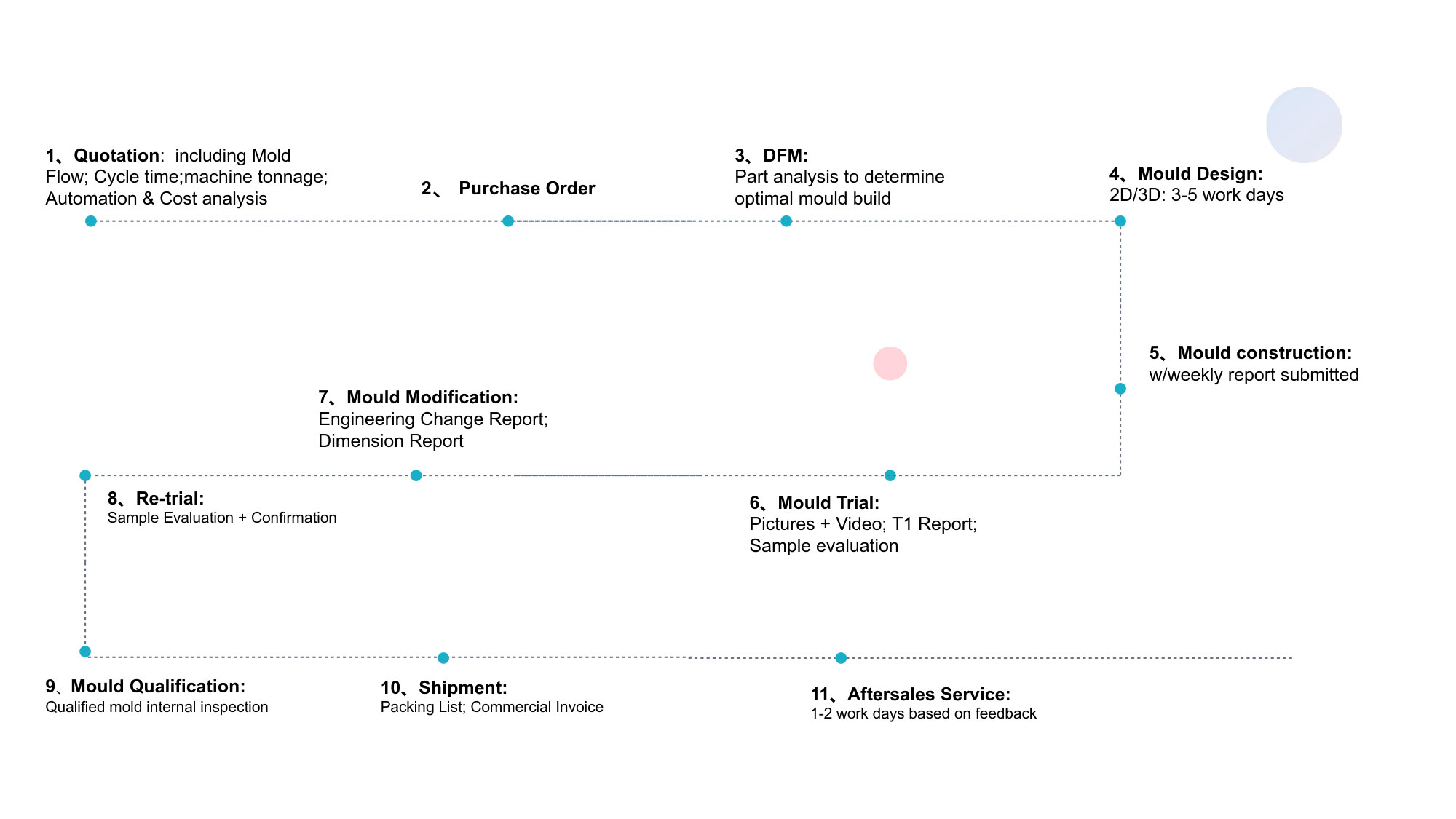
4.2 Mold Sampling and Iteration: T0 to T3
Deliverable sequence:
T0 (first tryout): First injection of material into completed mold. Full dimensional report.
T1–T3 (iterative improvements): Each iteration accompanied by engineering change report—what we changed, why we changed it, and results.
We can test optimization scenarios by replacing individual mold inserts instead of rebuilding an entire mold. Lower testing cost, faster iteration cycles.
Customer Value Translation:
It typically takes 3–5 mold iterations to reach stable production on a complex multi-cavity two-color mold. You pay for one physical mold—we eat the engineering labor for all tuning and optimization cycles required to reach CPK≥1.33.
4.3 Pre-Production Validation (Before Final Acceptance)
Technical Specification:
100–500 shots of production-standard pre-production burn-in on our machines before mold ships to you
Statistical validation of yield and dimensional CPK
Only after CPK≥1.33 do we release mold for final shipment and acceptance
Customer Value Translation:
Many mold makers ship a mold after T0 “works,” leaving you to discover production issues after the mold arrives at your facility. Ansix Tech runs the validation on our machines—on our nickel.
Risk reduced: You do not pay freight on a mold that is not production-ready. You do not tie up your machine time for someone else’s debugging.
Time saved: Mold arrives ready to install and run—not 6 weeks of your own process tuning.
4.4 Maintenance, Spare Parts, and Long-Term Support
What you receive with every mold:
Complete spare part kit (spare ejector pins, spare core inserts, spare valve-gate tips) shipped with the mold, not ordered months later
Recommended maintenance schedule: Seal replacement intervals, cooling channel flushing frequency, lubrication schedule
Every 200,000 cycles: Preventive maintenance we can perform either at your facility or in our shop
Lifetime support: Repairs performed at cost—no “surprise” pricing when a core pin breaks
Customer Value Translation:
Cost saved: Having spare parts on hand eliminates emergency freight costs (often 5–10× ordinary part price) and eliminates production downtime waiting for replacement components.
Peace of mind: You are a production partner, not a one-time sale.
Part V: Differential Positioning — Turning Industry Pain Points Into Your Competitive Advantage
We do not claim to be “better.” We claim to solve problems that other mold manufacturers ignore or cannot address.
5.1 Pain Point: “The mold handles my engineering materials for six months, then I’m chasing dimension changes.”
Ansix Response: For flip-top cap molds processing glass-filled PP or PA6+GF30, we ship only after 2,000 cycles of accelerated wear simulation on our machines. We provide a wear simulation report documenting dimensional drift over the simulation AND compare to our baseline.
Three-year structural warranty on mold base and all stationary components: If the base warps, sliders seize, or core shifts within tolerance spec, we repair at zero cost (excluding only consumable wear components such as valve-gate tips or ejector pins at end of scheduled life).
5.2 Pain Point: “My QC team spends hours every shift trimming flash, and I still get customer complaints about rough edges.”
Ansix Response: Parting line finish precision on our flip-top cap molds is ±0.005mm. With that precise fit, you get flash ≤ 0.03mm at the parting line—so thin it is visually undetectable and functionally harmless.
Cost saved: Eliminates manual trimming labor at 0.01–0.02percap×20millioncaps=∗∗200,000–400,000 annual savings** before you consider the cost of customer returns.
5.3 Pain Point: “Why does Same Part Number weigh differently Week 1 vs. Week 8?”
Ansix Response: All our machines run on closed-loop process control with real-time sensor feedback. If a mold is processing correctly, every part weighs the same ±0.5% shot-to-shot and week-to-week.
If a dimension drifts, the system flags WHY (thermal control failure? material viscosity change? mold wear at High Cycle?), and we fix root cause, not symptom.
5.4 Pain Point: “Mold in repair costs more to maintain than to replace.”
Ansix Response: Because we build molds serviceably—sliders accessible without disassembling base, cooling circuits labeled with color-coded schematics, and 24-hour in-house emergency turnaround for conventional welding/insert replacement.
We do not “sub out” repair work to third-party shops. Our EDM, machining, and electrode manufacturing are all in the same facility where the mold was originally built.
Part VI: Cost Optimization — The Engine of Customer Profitability
Cost reduction is not an afterthought at Ansix Tech—it is engineered into every phase of the project.
6.1 Material Optimization
Strategy Method Customer Saving
Shrinkage data verification Use measured shrinkage curve for YOUR specific material, not generic factory default Eliminates dimensional rework—one less rebuild cycle (saves $10,000–30,000)
Hot runner over cold runner Gate position optimization to avoid runner waste 15–20% resin savings → $0.03–0.04 per cap
Wall thickness optimization DFM thin-wall analysis Faster cycles, less resin consumption
Regrind ratio management Process verified for 15–25% regrind blended into virgin material Lower resin cost—no virgin-only requirement
6.2 Efficiency Optimization
Strategy Method Customer Saving
Cycle time reduction Conformal cooling + optimized gate design 25–35% faster → 33% more annual capacity
Fully automatic ejection Drop-ejection mold design for flip-top caps Zero labor at machine → $0.005–0.01/cap saved
Multi-cavity balancing MeltFlipper™ technology achieving >99% fill uniformity Zero scrap from cavity variation
Predictive maintenance Sensor-based wear monitoring No unplanned downtime → ZERO lost revenue from unscheduled stoppages
6.3 Process Optimization
Strategy Method Customer Saving
DFM-driven design Detects molding defects BEFORE metal is cut Avoids $10,000–50,000 tool rebuilds
FAI on every cavity 100% dimensional inspection before shipment No “surprise” rejects at customer dock
Statistical process control CPK≥1.33 documented for all critical dimensions Product liability risk approaches zero
Traceable parameter lock All MES-stored parameters with authorization Regulatory compliance (FDA, ISO) out-of-the-box
Part VII: Quality and Process Validation Lifecycle — Full Production Readiness
7.1 Quality Control at Every Stage
Phase Inspection Method Customer Assurance
Material receiving Spectrometer analysis (ASTM E1251) Steel delivered matches certification
In-process machining On-machine probing, in-line CMM sampling Freshly machined plates within ±0.005mm
Heat treatment Furnace temperature curve recording, hardness verification of every part Consistent material properties across entire tool
Subassembly Fit-check with mating components No assembly interference at final assembly
Final assembly Full kinematic test: sliders travel, ejectors return, unscrewing function No “stuck mold” in customer press
Mold shipment Full dimension FAI report + CPK values Complete, auditable quality documentation
Customer site Installation support, training, first-shot sign-off First production day successful
7.2 Plastic Part Quality Control
Test Type Method Customer Benefit
First article inspection (FAI) CMM verification of ALL critical dimensions Dimensional accuracy confirmed before production
CPK validation Statistical Process Control runs of 125–500 samples Processes are capable of meeting spec, not just meeting it
Functional testing (caps) Seal lip leak test, hinge-cycle test, thread torque test Part works in real world, not just on CMM
Cosmetic & visual inspection Automated optical inspection system, 100% of production for certain high-visibility brands Brand-damaging defects never reach customer
7.3 Packaging & Shipping
Packaging standard: Individual mold components wrapped, desiccated, corrosion-inhibited, and blocked in snug crating prevents any “rattling” damage in transit.
Customer Value Translation:
Second-most common source of customer disappointment? Mold arrives and does not fit the existing machine or is missing critical documentation. We ship:
Dimensioned installation drawing
Material and heat treatment certificates
Spare parts BOM (orderable part numbers for every wear component)
Daily/weekly/monthly maintenance schedule
Final Statement: Engineering Value Into Every Customer Dollar
At Ansix Tech, we approach every two-color flip-top cap mold project with one principle guiding everything we design, build, and deliver:
A mold is not a block of steel. It is a revenue-generating asset—a printing press for customer profit.
We do not produce “a mold.” We produce reliable, high-output production capacity that integrates into your existing infrastructure, scales with your growth, and delivers predictable per-part cost for millions of production cycles.
When you partner with Ansix Tech, you receive — across every project phase — partners who speak your language: cost, reliability, throughput, quality, and risk reduction.
We invite you to evaluate us not as a supplier, but as a production partner committed to sharing our 28 years of injection molding and precision tooling expertise to make your business more profitable.
Ansix Tech — Engineering the Difference™
*Established 1998. ISO9001, ISO14001, IATF16949, ISO13485 certified. 260 injection molding machines, 30 tons to 2,800 tons. End-to-end capabilities from product design and DFM analysis through mold manufacturing, high-volume production, secondary processing, and final assembly.*
Let us discuss your flip-top cap project and show a DFM report — before you spend a dollar on steel.
Ansix Tech Co Ltd
If you have any plans related to Flip-Top Cap Two-Color Injection Mold , you can contact us at any time. We will turn your ideas into reality, let you realize your dreams, and obtain large orders from the market. Our contact information is info@ansixtech.com. Or contact our CTO, mail: stephen@ansixtech.com
#www.ansixtech.com #ansixtech.com #Flip-Top Cap Two-Color Injection Mold #Flip-Top Cap Two-Color Injection Mold moulds #Flip-Top Cap Two-Color Injection Mold injection molding companies #Flip-Top Cap Two-Color Injection Mold Canopy Mold injection mold companies #Ansix #Ansix moulds #Ansix china #Ansix tech china #Ansix tech company #Ansix facotry #Flip-Top Cap Two-Color Injection Mold injection molding #Flip-Top Cap Two-Color Injection Mold injection tools #Flip-Top Cap Two-Color Injection Mold injection moulds #Flip-Top Cap Two-Color Injection Mold plastic mould #Flip-Top Cap Two-Color Injection Mold plastic tools #Ansix Tech #Ansix molds #Ansix injection molding #Ansix mold factory #injection molding Flip-Top Cap Two-Color Injection Mold #Ansix mold factory #Flip-Top Cap Two-Color Injection Mold china #Flip-Top Cap Two-Color Injection Mold molds #injection factory #Flip-Top Cap Two-Color Injection Mold injection molding #Flip-Top Cap Two-Color Injection Mold injection molding factory #injection molding company #Flip-Top Cap Two-Color Injection Mold injection mold companies #Flip-Top Cap Two-Color Injection Mold#Flip-Top Cap Two-Color Injection Mold mold limited #Ansix mold china #Ansix companies #Ansix company China #Flip-Top Cap Two-Color Injection Mold facotry #Ansix Tech #Ansix Tech mould #Flip-Top Cap Two-Color Injection Mold injection moulding #injection moulding company #Ansix Flip-Top Cap Two-Color Injection Mold parts injection mold companies #medical injection molding companieschina #Flip-Top Cap Two-Color Injection Mold china factory #Ansix moulding companies #Ansix molding company #Flip-Top Cap Two-Color Injection Mold injection moulding facotry #Ansix Tech mold #Flip-Top Cap Two-Color Injection Mold mould #Flip-Top Cap Two-Color Injection Mold plastic injection molding #ansix plastic mold #Mold manufacturing #Flip-Top Cap Two-Color Injection Mold parts manufacturing #Flip-Top Cap Two-Color Injection Mold plastic parts factory #Flip-Top Cap Two-Color Injection Mold injection parts mold #Flip-Top Cap Two-Color Injection Mold PRECISION MANUFACTURING #Flip-Top Cap Two-Color Injection Mold #China mold #Flip-Top Cap Two-Color Injection Mold injection moulding china #Flip-Top Cap Two-Color Injection Mold mould china #china precision mold #mold in china #Flip-Top Cap Two-Color Injection Mold mold china #Precision molds #High-precision molds #Flip-Top Cap Two-Color Injection Mold #Injection molds #Flip-Top Cap Two-Color Injection Mold Factory #Flip-Top Cap Two-Color Injection Mold Company #Super Large Injection Mold Factory #Large Tonnage Injection Molding Factory #Flip-Top Cap Two-Color Injection Mold Company #Flip-Top Cap Two-Color Injection Mold Factory #2800T Injection Molding Factory #3000 Ton Injection Molding #4500 Ton Injection Molding Factory #Large Mold Injection Molding #Large Plastic Mold Injection Molding Factory #Large Injection Mold Manufacturer #Plastic Mold Factory #Injection Mold #Plastic Mold