



Thick-walled frosted cream bottle PET frosted packaging jar
FEATURES
With 260 injection molding machines operating across four production bases in China and Vietnam, our manufacturing capacity exceeds millions of units annually. Standard lead times for mold fabrication range from 25 to 45 days depending on complexity, while production lead times for finished jars typically run 15 to 25 business days following sample approval. Our 24/7 two-shift production schedule ensures consistent output and supports urgent orders with expedited delivery options available upon request.
Quality Assurance
Every product undergoes rigorous quality control throughout all manufacturing stages. Our quality management systems are certified to ISO 9001 standards, with all raw materials subjected to incoming inspection protocols including melt flow index testing, moisture content analysis, and color verification prior to production release. In-process quality checks include dimensional verification using coordinate measuring machines (CMM), visual inspection for surface defects such as flow marks, sink marks, and burn marks, as well as wall thickness uniformity testing. Final inspection covers closure torque testing, leak-proof performance validation (≥30 minutes under vacuum), and drop testing to confirm impact resistance. All products are carefully packaged in anti-static bags with cushioning materials, packed into export-grade cartons, and labeled with traceable lot numbers for full supply chain transparency.
-
Mold Description
Product Materials:
PET PETG PS AS PP
Mold Material:
S136ESR
Number of Cavities:
1*8
Glue Feeding Method:
Hot runner
Cooling Method:
Water cooling
Molding Cycle
42.5s
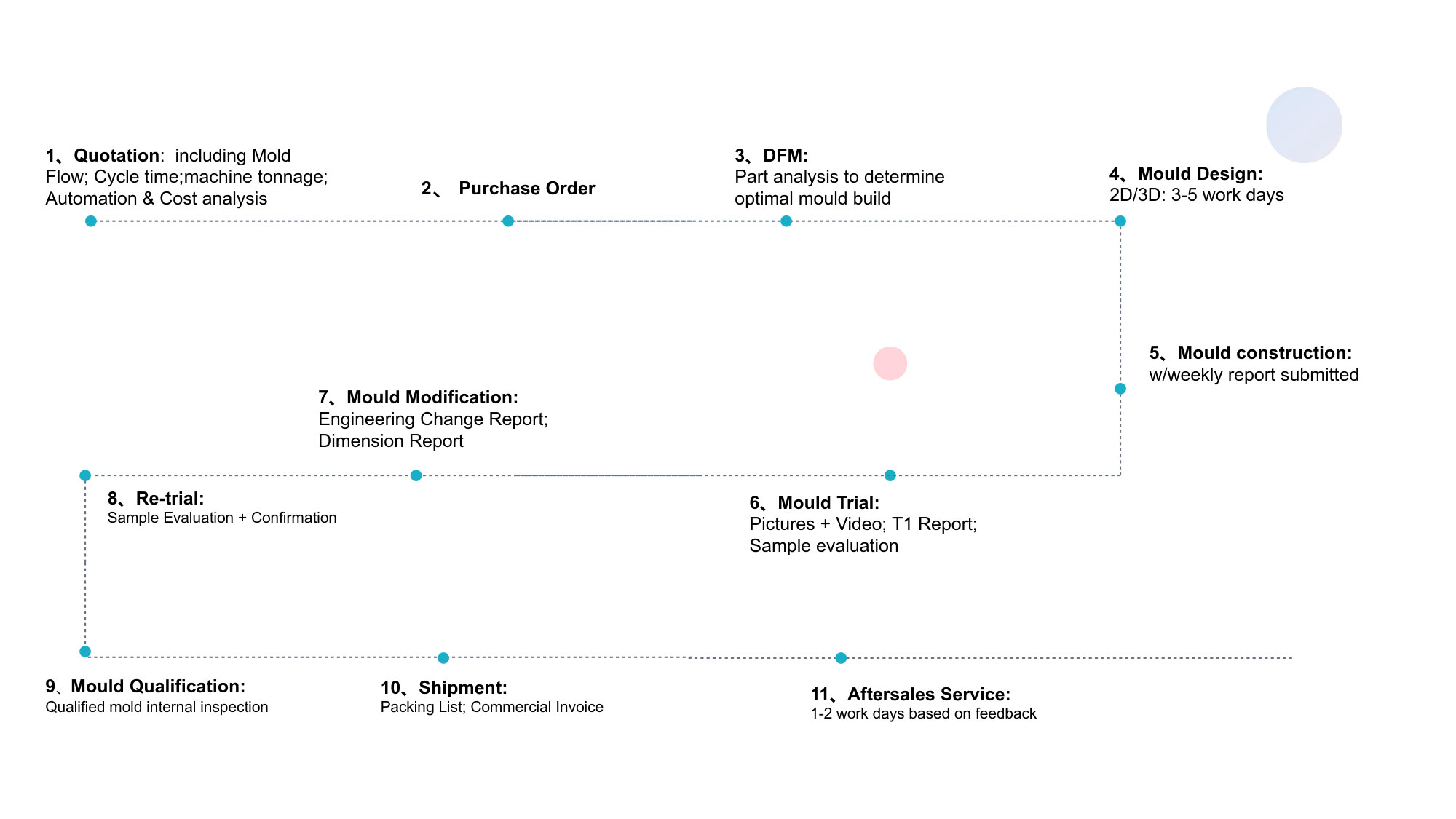
- The mold manufacturing process and product material selection
Our competitive cost structure is achieved through vertical integration across mold manufacturing, injection molding, and decoration processes. Multi-cavity mold designs increase output per injection cycle, reducing per-unit production costs. Optimized runner systems minimize material waste, while in-mold frosting technology eliminates costly secondary finishing operations. Strategic raw material sourcing with volume purchasing agreements ensures stable pricing. Our lean manufacturing practices, including real-time production monitoring and statistical process control, reduce scrap rates and rework costs. Customers benefit from reduced total cost of ownership through extended mold life (guaranteed 500,000 cycles for glass fiber-reinforced materials, 1,000,000 cycles for standard plastics), minimized post-molding finishing requirements, and lower logistics costs due to reduced shipping weight compared to glass alternatives.
-
Mold Manufacturing, Material Selection, Smart Manufacturing, Process Efficiency, and Quality Assurance Core Values (English)
Mold Manufacturing and Injection Molding Material Selection
Our mold manufacturing capability forms the foundation of product quality and production reliability. We utilize five-axis high-speed machining centers capable of achieving ±0.002mm precision on complex curved surfaces, ensuring parting lines are smooth and free of burrs. Wire EDM equipment with slow-wire cutting technology enables fabrication of micro-features as small as 0.03mm, including narrow slots and fine vents, while preventing thin-wall deformation during processing. For multi-cavity applications, we employ modular mold base designs with interchangeable inserts, allowing rapid changeover and reduced maintenance downtime.
Material selection is driven by application-specific requirements. Mold steels are carefully chosen based on production volume, material abrasiveness, and cosmetic requirements. Cavity and core inserts utilize premium tool steels including S136 (420 stainless), which provides high mirror finish capability (Ra ≤ 0.05μm) and superior corrosion resistance for PVC, PP, EP, PC, and PMMA applications. For high-wear applications such as glass fiber-reinforced materials, we specify H13 series steels (2344, 8407) which offer high toughness, excellent heat resistance (HRC 48–52 post heat treatment), and superior wear characteristics. Pre-hardened steels including P20 (718/738) are selected for larger mold plates and support structures requiring dimensional stability. We provide full material certification reports including heat treatment temperature curves and hardness test results with every mold delivery.
Smart Manufacturing Integration and Efficiency Improvement
Our manufacturing facilities are equipped with Industry 4.0-enabled smart manufacturing systems. All injection molding machines are networked through a Manufacturing Execution System (MES) that captures real-time production data including cycle times, shot weights, temperature profiles, and pressure curves. This centralized monitoring platform enables predictive maintenance scheduling, reducing unplanned downtime by anticipating equipment wear patterns.
Efficiency gains are achieved through multiple strategies. Hot runner systems eliminate runner waste, reducing material consumption while improving fill balance across multiple cavities. For high-volume applications, we deploy multi-cavity molds (up to 32 cavities per tool) that multiply output per machine cycle, reducing per-part production costs and energy consumption per unit. Conformal cooling channel designs—optimized through thermal simulation software—reduce cooling time, which typically accounts for 70–80% of the total injection cycle, cutting overall cycle times by 15–30%. Automated material handling systems, including central drying units and closed-loop material conveyance, ensure consistent resin supply while reducing labor requirements.
Process Quality Assurance
Quality assurance begins before the first shot is molded. Every project undergoes a comprehensive Design for Manufacturability (DFM) analysis prior to tool cutting. The DFM report evaluates draft angle requirements, wall thickness distribution, gate location optimization, and ejection pin placement to ensure production feasibility. Complementary mold flow analysis using Autodesk Moldflow or Moldex3D software predicts melt front progression, identifies weld line and air trap locations, and validates fill balance across all cavities. For thick-walled PET applications, specialized analysis verifies shrinkage compensation and prevents sink marks.
During production, all molding machines are locked into validated process windows through MES-controlled parameter restrictions. Only authorized engineering personnel may adjust temperature, pressure, injection speed, or cooling time settings, with all changes logged for traceability. First-article inspection is performed at the start of each production run or shift change, with critical dimensions verified against CAD master data. Ongoing in-process sampling occurs at predetermined intervals, typically every 500–1,000 shots depending on part criticality, with SPC charting of key dimensions to detect trends before defects occur. Our dimensional capability target is CPK ≥ 1.33 for all critical dimensions, with demonstrated repeatability of ±0.02mm variation across multi-day production runs.
Customer Core Value Delivery
What our customers truly value is not the technical specifications themselves, but what these capabilities deliver: reduced project risk, predictable product quality, and lower total cost. Our DFM approach identifies and resolves manufacturability issues before tooling investment, preventing costly downstream modifications. In-mold frosting eliminates secondary finishing, saving customers 15–20% in post-molding processing costs. MES-controlled process parameter locking ensures batch-to-batch consistency, eliminating the risk of receiving non-conforming goods. Customers receive not just a product, but a complete assurance of reliability—backed by documented traceability, material certifications, and process validation reports that simplify their own quality audits and regulatory compliance requirements.
Part 3 — Thick-Walled Frosted Cream Bottle PET Frosted Packaging Jar — Comprehensive Manufacturing and Production Solution (2000+ words)
Executive Summary: Manufacturing Excellence Delivered Through Customer-First Engineering
Dear Valued Customer,
At Ansix Tech, we do not view a mold as merely a block of steel—we view it as a revenue-generating asset, a precision instrument designed to consistently produce high-quality parts that drive your business success. With over 28 years of manufacturing experience across four production bases in China and Vietnam, we have built our reputation on transforming complex technical challenges into reliable, cost-effective production solutions.
This comprehensive manufacturing proposal details our approach to the Thick-Walled Frosted Cream Bottle PET Frosted Packaging Jar project. What follows is not a collection of technical specifications presented for their own sake, but a practical roadmap showing how every engineering decision, process parameter, and quality control measure translates directly into tangible value for your organization: lower risk, lower cost, and predictable, repeatable quality.
Section 1: Hard Asset Foundation — Equipment Capabilities That Build Customer Confidence
Mold Manufacturing Equipment
Our mold shop is equipped with state-of-the-art machinery capable of delivering the precision that thick-walled PET applications demand. The thick-walled geometry of the cream bottle—with wall sections typically exceeding 3.0mm—requires exceptionally precise mold components to achieve uniform wall distribution and defect-free surface finish.
Five-Axis High-Speed Machining Centers: Our five-axis machining centers achieve positioning accuracy of ±0.002mm on complex curved surfaces. For your cream bottle mold, this means parting lines are machined with microscopic precision, eliminating visible witness lines on the finished product and producing a seamless transition between mold halves that requires no secondary deburring or post-finishing.
Slow-Wire EDM (Electrical Discharge Machining): Using wire diameters as small as 0.15mm, our slow-wire EDM systems can produce micro-features including narrow slots, fine vent grooves, and thin-wall sections with positional accuracy of ±0.003mm. For the cream bottle application, this capability ensures uniform venting across the cavity, preventing air entrapment that would otherwise cause surface burn marks or incomplete fill.
CNC Coordinate Measuring Machines (CMM) and Optical Inspection Systems: Every mold component undergoes 100% dimensional verification before assembly. Our CMM equipment measures complex geometries against CAD reference data with measurement uncertainty below 0.001mm. Critical dimensions are documented in a full dimensional inspection report delivered with each mold, with capability analysis (Cpk ≥ 1.33) provided for all customer-identified key characteristics.
Value to Customer: When we claim ±0.002mm precision, we are telling you that your finished bottles will fit your filling line consistently, that your caps will torque uniformly, and that your brand presentation will be flawless across every production batch—no surprises, no rejects, no production line stoppages.
Injection Molding Machine Fleet
Ansix Tech operates 260 injection molding machines with clamping forces ranging from 30 tons to 2,800 tons, allowing us to cover every product size from miniature cosmetic jars to large industrial containers. For your thick-walled frosted cream bottle, we deploy all-electric servo-driven machines that offer repeatability of ±0.1% across consecutive shots.
All-Electric Servo Drive Technology: Our machines utilize position sensors with 2 million counts-per-revolution resolution, enabling shot-to-shot injection stroke repeatability within ±0.01mm. When manufacturing millions of cream bottles, this consistency means every bottle is dimensionally identical—same height, same diameter, same closure fit—eliminating the variation that plagues mechanical-hydraulic systems.
Closed-Loop Parameter Control: Each injection unit is equipped with high-precision closed-loop control technology that continuously monitors and adjusts melt pressure, injection velocity, and holding pressure in real-time. This feedback system compensates for material viscosity variations and environmental changes, maintaining optimal filling conditions throughout extended production runs.
Platen Parallelism and Clamping Stability: Our machines maintain platen parallelism within 0.05mm under full clamping load, ensuring even mold compression across the entire parting surface. For thick-walled parts that generate significant cavity pressure during filling, this prevents flash formation along the parting line—a defect that otherwise requires costly manual trimming.
Value to Customer: An all-electric machine with ±0.1% shot repeatability is not merely a spec sheet claim—it is our guarantee that the 1,000,000th bottle we produce will match the quality of the first one. You receive consistent product quality without the need for frequent machine adjustments or production interruptions.
Section 2: Mold Manufacturing Core Competencies — Specific Metrics That Define Performance
Customers care about four things when it comes to molds: lifespan, precision, delivery speed, and repair costs. Here is how we address each dimension with specific, verifiable commitments.
Mold Lifespan and Material Selection
Mold Component Material Grade Hardness (HRC) Characteristics Application Recommendation
Cavity/Core (Standard) S136 (420 Stainless) 48–52 High mirror finish, excellent corrosion resistance, superior polishing performance High-gloss cosmetic packaging, transparent applications
Cavity/Core (Wear-Resistant) 2344 / H13 48–52 High toughness, excellent heat resistance, superior wear characteristics Glass fiber-reinforced materials, high-volume production
Cavity/Core (High-Polish) NAK80 40–43 Excellent mirror effect, good electrical discharge machining compatibility, superior weldability Electro-etched finishes, complex cosmetic geometries
Sliders / Inserts 8407 (Improved H13) 48–52 High toughness, good thermal fatigue resistance Side-action cores, moving components
Mold Plate / Support P20 (718/738) 28–32 Pre-hardened, excellent dimensional stability, good machinability Mold bases, support plates, ejector plates
Performance Guarantee: We guarantee 500,000 molding cycles for glass fiber-reinforced materials and 1,000,000 cycles for standard plastics under normal operating conditions. Each mold is delivered with full material certification including heat treatment temperature curves and hardness test reports.
Value to Customer: A million-cycle mold means you will not incur tooling replacement costs for the life of your product line. The material certification provides auditable traceability for your quality management system, supporting regulatory compliance and customer audits.
Achievable Tolerances
Feature Type Achievable Tolerance Industry Standard
General structural dimensions ±0.05mm ±0.10mm
Precision fit surfaces (threads, sealing lands) ±0.02mm ±0.05mm
Ejection pin clearance +0.01/-0.005mm ±0.02mm
Parting line mismatch ≤0.02mm ≤0.05mm
Value to Customer: When we hold ±0.02mm on sealing land dimensions, we are ensuring that your caps seal consistently without leakage or excessive torque variation. When we maintain 0.02mm parting line mismatch, we are guaranteeing that your bottles require no manual flash trimming—saving you 5–10 seconds of labor per bottle in post-processing.
Mold Types and Configurations
For the Thick-Walled Frosted Cream Bottle project, we deploy hot runner systems specifically optimized for PET applications. Our PET-Series hot runner technology utilizes a three-platen design that improves geometric thermal balancing and reduces plate bowing, enhancing preform quality while increasing productivity.
Hot Runner Benefits: By eliminating cold runner waste, hot runner systems reduce material consumption by 15–25% per shot. For high-volume cosmetic packaging applications, this material saving directly reduces your per-unit raw material cost. Additionally, shorter flow paths with balanced melt distribution reduce pressure drop, enabling thinner wall sections without increasing injection pressure.
Multi-Cavity Configurations: For your cream bottle, we recommend molds with 8, 16, or 24 cavities depending on annual volume requirements. An eight-cavity mold produces eight bottles per injection cycle, effectively multiplying output by the number of cavities while only incrementally increasing cycle time. The total cost of ownership of a multi-cavity mold is significantly lower than operating multiple single-cavity tools.
Value to Customer: Hot runner technology paired with multi-cavity tooling directly reduces your per-unit production cost. Material savings go directly to your bottom line, while increased cavitation reduces machine time requirements. We analyze your forecasted annual volume to recommend the optimal cavity count—over-tooling drives up initial cost, but under-tooling leaves production capacity on the table.
Gate Design Optimization
Through mold flow analysis using Autodesk Moldflow software, we simulate melt front progression to determine optimal gate location, quantity, and geometry before cutting steel. For your thick-walled cream bottle, we specifically analyze:
Melt Front Progression: Verifying uniform fill across the cavity without flow leaders or hesitation that would create visible flow lines on the frosted surface
Weld Line Locations: Predicting where separate melt fronts converge, then repositioning gates or adjusting venting to move weld lines to non-cosmetic surfaces
Air Trap Prediction: Identifying potential gas entrapment zones, then designing venting channels (typically 0.02–0.05mm depth) to allow air evacuation without flash formation
Fill Pressure Requirements: Calculating required injection pressure to achieve complete fill without exceeding clamp force capacity
Value to Customer: Mold flow analysis is not an abstract engineering exercise—it is our commitment to preventing defects before they happen. By predicting and correcting fill problems virtually, we eliminate the need for costly mold modifications after first shots. This approach typically reduces mold tryout iterations from four to two, saving 10–15 days of project timeline and avoiding 5,000–15,000 in rework costs.
Section 3: Injection Molding Process Control — Eliminating Quality Anxiety
Customers fear the unpredictable: parts that shrink differently batch to batch, visible surface defects that appear randomly, parts that do not assemble consistently, and color variations that compromise brand integrity. Our process control systems address each of these concerns with specific, auditable measures.
Process Standardization Through MES Integration
All 260 of our injection molding machines are integrated into our Manufacturing Execution System (MES), which provides real-time monitoring and control of the entire production process. MES functionality includes:
Parameter Locking: All process parameters—barrel temperatures (zoned individually), mold temperature (core/cavity separately controlled), injection pressure, holding pressure, injection speed profile, cooling time, and screw rotation speed—are locked within the system. Adjustments require supervisor-level authorization with change logs permanently recorded for traceability.
Real-Time Data Acquisition: The system captures machine signals including melt pressure curves, injection velocity profiles, screw position, and cycle time deviations. This data is stored cycle-by-cycle, enabling complete production lot traceability.
Statistical Process Control (SPC): Key process variables are continuously monitored against control limits. When trends approach action limits, the system generates alerts before defects are produced, enabling proactive adjustment rather than reactive sorting.
First-Article and In-Process Inspection Workflow: At production start and at predetermined sampling intervals (typically every 500–1,000 shots), operators perform dimensional verification using calibrated gauges and optical comparators. Results are logged against control limits with automatic non-conformance escalation.
Value to Customer: MES-controlled processing means your parts are not subject to operator variability. The same validated process runs today, tomorrow, and next year. When your quality auditor requests process documentation, we provide complete production records including parameter settings, SPC charts, and inspection results for every batch delivered.
Dimensional Stability Control
For the thick-walled cream bottle, uniform cooling is critical to preventing warpage and achieving consistent dimensions across multiple cavities. We employ:
Zoned Mold Temperature Control: Separate heating/cooling circuits for core and cavity halves, plus additional zones for critical features like bottle necks and bottom corners. Core-to-cavity temperature differential is maintained within 2°C, eliminating the thermal gradient that causes part warpage.
Optimized Cooling Channel Design: Using thermal simulation software (Moldex3D), we design conformal cooling channels that follow part geometry, providing uniform heat extraction across the entire part surface. Cooling typically accounts for 70–80% of injection cycle time—optimized cooling reduces cycle time by 15–30% while improving dimensional stability.
In-Mold Sensors (Optional): For high-precision applications, we integrate cavity pressure and temperature sensors that provide real-time feedback to the machine controller, enabling dynamic adjustment of holding pressure and cooling time based on actual in-cavity conditions.
Value to Customer: When we claim week-to-week dimensional variation below 0.02mm on critical features, we are guaranteeing that your filling line will run without stoppages, that your closures will torque consistently, and that your product presentation will maintain brand integrity across every production lot. No surprises, no rework, no scrap.
Surface Quality Standards
Your thick-walled frosted cream bottle requires a sophisticated aesthetic: the matte finish of the frosted surface must be uniform, the bottle clarity must be maintained beneath the frosting, and the overall surface must be free of visible defects.
Our in-mold frosting technology integrates specialized frost additives directly into the PET resin during injection molding. Unlike secondary frosting processes that require painting, sandblasting, or chemical etching after molding, in-mold frosting:
Eliminates Secondary Operations: No painting, no coating, no etching—reducing post-molding processing time and eliminating associated labor, equipment, and material costs. Customers typically save 15–20% on total part cost.
Provides Uniform Finish: Frost additive distribution is controlled by screw mixing section design and back-pressure settings, ensuring consistent matte effect across the entire bottle surface without batch-to-batch variation.
Maintains Part Integrity: No chemical etching or abrasive blasting means no potential stress concentration or surface degradation that could compromise bottle strength.
Defect prevention measures include:
Flow Lines: Addressed through optimized gate design, injection speed profiling (typically a progressive fill rate to maintain uniform melt front velocity), and mold surface temperature control
Sink Marks: Prevented through adequate packing pressure (typically 50–70% of injection pressure) and packing time extending through gate freeze-off, plus uniform wall thickness design verified through DFM analysis
Burn Marks: Eliminated through vent placement optimization (0.02–0.05mm vent depths at predicted air trap locations)
Brittleness: Avoided through strict moisture control (PET pre-dried to ≤0.02% moisture content before processing) and precise melt temperature management (typically 260–280°C for PET)
Value to Customer: Surface quality defects are not merely cosmetic—they drive scrap costs, customer returns, and brand perception damage. Our process controls prevent these defects from occurring in production, eliminating the hidden costs of sorting, rework, and field failures.
Special Material Capabilities
Material Family Experience Level Key Applications
PET / rPET / PCR PET Extensive Cosmetic jars, thick-walled bottles, food containers
PC / PC-ABS Extensive Impact-resistant housings, medical components
PPS + 40% GF Extensive High-temperature electrical components
PA6 / PA66 + GF30 Extensive Automotive under-hood components
PBT Extensive Electrical connectors, automotive lighting
PEEK Extensive Medical devices, aerospace components
PEI (Ultem) Extensive High-heat electrical housings
LCP Extensive Thin-wall electrical connectors
Liquid Silicone Rubber (LSR) Extensive Medical seals, infant care products
For each material, we maintain validated process parameters including drying requirements, melt temperature windows, mold temperature recommendations, and shrinkage compensation factors. For PET specifically, we have documented experience with multiple resin grades including bottle-grade, injection-grade, and recycled-content variants.
Value to Customer: Material expertise translates directly to reduced project risk. When we recommend a specific PET grade and drying protocol, we are not guessing—we are applying documented experience from similar applications. You avoid the trial-and-error phase that consumes time and drives cost on first-time applications.
Section 4: Full-Process Service — Reducing Your Management Burden
Many injection molding suppliers deliver parts—we deliver complete solutions. Our end-to-end service model eliminates the management overhead of coordinating across separate design, tooling, production, and logistics providers.
Early Engineering Involvement (DFM Report Delivery)
Before we cut any steel or quote any tooling, we deliver a comprehensive Design for Manufacturing (DFM) report analyzing your product design for production feasibility. The DFM report includes:
Draft Angle Verification: We confirm all vertical surfaces provide adequate draft (typically 1–3 degrees for cosmetic surfaces, more for texture surfaces) for clean part ejection. For surfaces with insufficient draft, we document specific modification recommendations with dimensional allowances.
Wall Thickness Analysis: For thick-walled PET applications, we evaluate the transition between nominal wall sections and thick bottom sections, identifying potential sink locations. Uniform wall distribution is essential for preventing warpage and minimizing cycle time.
Gate Location Suggestion: Based on part geometry and material flow characteristics, we propose gate location(s) with justification for each. For your cream bottle, we typically recommend a single valve-gate located at the bottom center or sprue-gate in the neck area, depending on aesthetic requirements and part geometry.
Weld Line Prediction with Mitigation: Using mold flow simulation, we predict weld line locations before tool fabrication. When weld lines occur in cosmetic surfaces, we recommend geometry modifications, gate relocation, or increased melt temperature to minimize visible traces.
Ejection Strategy: We specify ejector pin locations, diameters, and tip designs with clear marking of allowed witness mark positions. Ejector pins are located on non-cosmetic surfaces whenever possible, and we document pin placement for your review before tool construction begins.
DFM Value Quantified: Industry data indicates that design changes made after tool cutting cost 10–15 times more than changes made during design phase. Our DFM process identifies and resolves manufacturability issues before tooling investment, typically preventing
10,000–25,000 in downstream modifications and saving 2–4 weeks of project timeline.
Trial Molding and Sample Delivery
Following tool completion, we conduct systematic mold trials following an approved validation protocol:
T1 Trial: Initial mold function verification under controlled process conditions. We validate fill, pack, cooling, and ejection functionality, documenting any adjustments required.
T2 Trial: Process optimization trials to establish process window and confirm part quality meets specification. We measure critical dimensions, evaluate surface quality, and document optimized process parameters.
T3 Trial (if required): Fine-tuning and process confirmation, including capability demonstration on customer-specified dimensions.
Each trial includes full documentation: dimensional inspection reports, process parameter sheets, photographs of representative samples, and a detailed action plan for any identified issues.
Value to Customer: Our trial process is transparent—you receive complete documentation of every shot. When we deliver T1 samples, you are seeing the result of systematic validation, not an experimental first attempt. This approach typically reduces total trial iterations from five to two, saving 3–4 weeks of project timeline.
Low-Volume Pre-Production Validation
Before committing to full-scale production, we offer low-volume trial runs of 500–2,000 parts to validate production readiness. During this pre-production phase:
We run the validated production process over multiple shifts and multiple days, simulating actual production conditions
We collect dimensional data on 30 consecutive parts from each cavity at production start, mid-run, and end-of-run
We calculate Cpk values for all customer-identified critical dimensions
We provide a pre-production validation report with statistical analysis before you authorize volume production
Value to Customer: Low-volume validation eliminates the risk of approving a process that works for one shift but fails over extended runs. By confirming stability before volume production, you avoid the cost and schedule impact of post-launch quality issues.
Maintenance and Spare Parts
Every mold we deliver includes a complete set of spare wear components: ejector pins, core pins, guide pins/bushings, and any other components subject to wear during normal operation. This spare parts kit is packaged with the mold and delivered at project completion.
Preventive Maintenance Schedule: We provide a maintenance schedule documenting lubrication intervals, cleaning requirements, and component inspection/replacement intervals
Mold Storage Instructions: We document corrosion prevention procedures for extended mold storage
Repair Support: We maintain in-house electrode manufacturing and electrical discharge machining capability for rapid mold repair—conventional repair typically completed within 24 hours of receiving damaged tooling
Lifetime Service Commitment: We repair or replace any mold structural defect (excluding normal wear components) for three years from delivery, with standard repair services available at cost beyond warranty period
Value to Customer: A mold that requires frequent repair disrupts production schedules and drives hidden maintenance costs. Our spare parts kit and rapid repair capability mean you keep producing while we support your tooling—minimizing downtime and eliminating the need to maintain your own repair capability.
Section 5: Differentiated Value — Direct Responses to Industry Pain Points
Rather than making generic claims about our capabilities, we address the specific complaints customers commonly report about competing suppliers—with concrete solutions we deliver every day.
Common Customer Complaint Our Specific Response
"Molds always need repair—production stops while we wait for fixes." Solution: We perform a 2,000-shot production run on every mold before delivery, simulating real production conditions and documenting wear patterns. We provide a comprehensive wear report with the mold, identifying components that will require replacement at specific intervals. Plus, we include spare wear components with every mold and offer three-year mold structure warranty (excluding normal wear consumables).
"We spend hours removing flash from every batch." Solution: We machine parting lines to 0.005mm fit precision on critical areas and utilize self-locking clamp force compensation. This guarantees flash controlled to ≤0.03mm across full production runs—flash so minimal that no manual deburring is required, saving you 3–5 seconds per part in post-processing labor.
"Part dimensions change between batches—we cannot trust consistency." Solution: Our MES-controlled process locks all parameters—temperature, pressure, injection speed, cooling time—so the same validated process runs every shift, every day. Optional in-mold cavity pressure sensors provide closed-loop feedback, automatically adjusting holding pressure to compensate for material viscosity variation. We provide Cpk ≥ 1.33 on all critical dimensions as documented in your PPAP package.
"Mold repair takes weeks—we lose production capacity." Solution: We maintain in-house electrode manufacturing and EDM capability. Standard repairs (weld repair, insert replacement, feature modification) are completed within 24 hours of receiving the tool at our facility. We do not outsource repair work or wait on external suppliers.
"Secondary finishing adds cost and lead time—we need a better way." Solution: Our in-mold frosting technology integrates matte finish directly into the injection molding process. No painting, no sandblasting, no etching, no chemical treatment. You receive finished-surface parts directly from the molding machine, saving 15–20% on total part cost and eliminating 2–5 days of secondary processing lead time.
Section 6: Cost Reduction Strategies — Delivering Hard Savings Through Engineering
Cost reduction is not an afterthought in our manufacturing approach—it is engineered into every process decision from material selection through production optimization.
Material Cost Reduction
Our analysis shows that raw material typically represents 40–60% of total part cost for packaging applications. We reduce material costs through:
Wall Thickness Optimization: Through DFM analysis and mold flow simulation, we identify opportunities to reduce wall thickness in non-critical areas while maintaining structural integrity. A 10% reduction in average wall thickness reduces material consumption by a corresponding 10%—direct savings on every part produced.
Runner System Optimization: Hot runner systems eliminate cold runner waste entirely, saving 15–25% of material that would otherwise be reground or scrapped. For cold runner applications, we optimize runner cross-section and length to minimize waste while maintaining fill balance.
Regrind Integration (Where Applicable): For applications that permit regrind usage, we establish validated regrind ratios (typically 15–25%) that maintain material properties while reducing virgin material consumption. All regrind protocols are validated through mechanical property testing and documented for your quality records.
Multi-Cavity Tooling: While primarily a throughput improvement, multi-cavity tooling also reduces per-part material handling overhead—one material load per cycle produces multiple parts. For a 16-cavity mold, material handling labor per part is 1/16 of single-cavity production.
Process Efficiency Optimization
Cycle Time Reduction: Through optimized cooling channel design, we reduce cooling time (typically 70–80% of cycle time) by 15–30% compared to conventional designs. For a typical 20-second cycle, a 4-second reduction represents 20% increase in machine output without additional equipment investment.
Automated Degating: We design molds with automated degating features—either hot runner valve gates that leave no gate vestige or cold runner systems with automatic degassing mechanisms—eliminating manual gate trimming. This saves 2–4 seconds of post-molding labor per part and eliminates associated labor costs.
Secondary Operation Elimination: In-mold frosting eliminates painting or coating operations; in-mold labeling eliminates separate label application steps; in-mold assembly features eliminate separate assembly steps. Each eliminated secondary operation reduces direct labor and equipment investment requirements.
Value Summary Statement: For a customer producing 1,000,000 cream bottles annually, our cost reduction strategies typically deliver:
Material savings:
0.02–0.05perunit(20,000–50,000 annually)
Labor savings from eliminated secondary operations: 0.03–0.08perunit(30,000–80,000 annually)
Production efficiency gains: 15–25% increase in machine output (avoiding capital expenditure for additional equipment)
Reduced quality costs: Scrap rate reduction from typical 3–5% to below 1% ($20,000–40,000 annually)
Conclusion: Turning Molds into Revenue-Generating Assets
At Ansix Tech, we do not view a mold as a block of steel or a production tool—we view it as your revenue-generating asset. Every design decision we make serves a single purpose: maximizing the value your production tool delivers to your business.
When we design cooling systems, we are not optimizing for our convenience—we are reducing your cycle time and increasing your output.
When we select mold steels, we are not following a standard practice—we are extending your tool life and preventing your production stoppages.
When we perform mold flow analysis, we are not performing an engineering exercise—we are eliminating your defects before they occur.
When we integrate MES process control, we are not adding technology—we are guaranteeing your batch-to-batch consistency.
When we include spare components, we are not increasing our margin—we are protecting your production schedule.
We would welcome the opportunity to demonstrate our approach on one of your active projects. We can provide a comprehensive DFM analysis that will show, with specific predictions and actionable recommendations, how we would address every potential risk in your product design before tooling begins.
A mold is steel. A well-engineered mold is a profit center. Let us build your next profit center.
Ansix Tech — Manufacturing Excellence Delivered Since 1998
Four Production Bases | 260 Injection Molding Machines | 30–2,800 Ton Clamping Capacity | ISO 9001 Certified | Over 28 Years of Manufacturing Experience
Ansix Tech Co Ltd
If you have any plans related to Thick-walled frosted cream bottle PET frosted packaging jar , you can contact us at any time. We will turn your ideas into reality, let you realize your dreams, and obtain large orders from the market. Our contact information is info@ansixtech.com. Or contact our CTO, mail: stephen@ansixtech.com
#www.ansixtech.com #ansixtech.com #Thick-walled frosted cream bottle PET frosted packaging jar #Thick-walled frosted cream bottle PET frosted packaging jar moulds #Thick-walled frosted cream bottle PET frosted packaging jar injection molding companies #Thick-walled frosted cream bottle PET frosted packaging jar Canopy Mold injection mold companies #Ansix #Ansix moulds #Ansix china #Ansix tech china #Ansix tech company #Ansix facotry #Thick-walled frosted cream bottle PET frosted packaging jar injection molding #Thick-walled frosted cream bottle PET frosted packaging jar injection tools #Thick-walled frosted cream bottle PET frosted packaging jar injection moulds #Thick-walled frosted cream bottle PET frosted packaging jar plastic mould #Thick-walled frosted cream bottle PET frosted packaging jar plastic tools #Ansix Tech #Ansix molds #Ansix injection molding #Ansix mold factory #injection molding Thick-walled frosted cream bottle PET frosted packaging jar #Ansix mold factory #Thick-walled frosted cream bottle PET frosted packaging jar china #Thick-walled frosted cream bottle PET frosted packaging jar molds #injection factory #Thick-walled frosted cream bottle PET frosted packaging jar injection molding #Thick-walled frosted cream bottle PET frosted packaging jar injection molding factory #injection molding company #Thick-walled frosted cream bottle PET frosted packaging jar injection mold companies #Thick-walled frosted cream bottle PET frosted packaging jar#Thick-walled frosted cream bottle PET frosted packaging jar mold limited #Ansix mold china #Ansix companies #Ansix company China #Thick-walled frosted cream bottle PET frosted packaging jar facotry #Ansix Tech #Ansix Tech mould #Thick-walled frosted cream bottle PET frosted packaging jar injection moulding #injection moulding company #Ansix Thick-walled frosted cream bottle PET frosted packaging jar parts injection mold companies #medical injection molding companieschina #Thick-walled frosted cream bottle PET frosted packaging jar china factory #Ansix moulding companies #Ansix molding company #Thick-walled frosted cream bottle PET frosted packaging jar injection moulding facotry #Ansix Tech mold #Thick-walled frosted cream bottle PET frosted packaging jar mould #Thick-walled frosted cream bottle PET frosted packaging jar plastic injection molding #ansix plastic mold #Mold manufacturing #Thick-walled frosted cream bottle PET frosted packaging jar parts manufacturing #Thick-walled frosted cream bottle PET frosted packaging jar plastic parts factory #Thick-walled frosted cream bottle PET frosted packaging jar injection parts mold #Thick-walled frosted cream bottle PET frosted packaging jar PRECISION MANUFACTURING #Thick-walled frosted cream bottle PET frosted packaging jar #China mold #Thick-walled frosted cream bottle PET frosted packaging jar injection moulding china #Thick-walled frosted cream bottle PET frosted packaging jar mould china #china precision mold #mold in china #Thick-walled frosted cream bottle PET frosted packaging jar mold china #Precision molds #High-precision molds #Thick-walled frosted cream bottle PET frosted packaging jar #Injection molds #Thick-walled frosted cream bottle PET frosted packaging jar Factory #Thick-walled frosted cream bottle PET frosted packaging jar Company #Super Large Injection Mold Factory #Large Tonnage Injection Molding Factory #Thick-walled frosted cream bottle PET frosted packaging jar Company #Thick-walled frosted cream bottle PET frosted packaging jar Factory #2800T Injection Molding Factory #3000 Ton Injection Molding #4500 Ton Injection Molding Factory #Large Mold Injection Molding #Large Plastic Mold Injection Molding Factory #Large Injection Mold Manufacturer #Plastic Mold Factory #Injection Mold #Plastic Mold