



Gas-Assist Molding Simulation and DFM for Handles for Ansix GAIM
FEATURES
From a production efficiency standpoint, Ansix GAIM dramatically accelerates the manufacturing cycle. The hollow section cools faster than a solid core due to reduced thermal mass, enabling earlier ejection and reducing overall cycle time by 30-50%. Faster cooling also means less time under pressure, which reduces residual stress and virtually eliminates post-molding warpage. This translates into higher throughput—more parts per hour, per machine, per shift. Additionally, the lower cavity pressure required for gas-assisted molding reduces the required clamp tonnage by up to 70%, allowing smaller injection molding machines to produce large-handle geometries that would otherwise require massive equipment investments.
Quality assurance in Ansix GAIM is built upon a foundation of predictive simulation and rigorous validation. Before any steel is cut, Ansix Tech performs comprehensive Moldflow CAE simulations to optimize gas injection timing, gas channel geometry, gas pressure profiles, and melt front behavior. CAE simulations for automotive handle applications have demonstrated deformation reductions of up to 31.3% compared to standard gas-assisted methods, with optimal gas penetration achieved through the precise calibration of gas delay time, injection time, pressure, and holding duration. This simulation-driven approach eliminates the guesswork that plagues traditional tooling development, reducing the number of physical trial shots from dozens down to just two or three.
-
Mold Description
Product Materials:
PA GF30
Mold Material:
S136ESR
Number of Cavities:
2
Glue Feeding Method:
Hot runner
Cooling Method:
Water cooling
Molding Cycle
35.5s
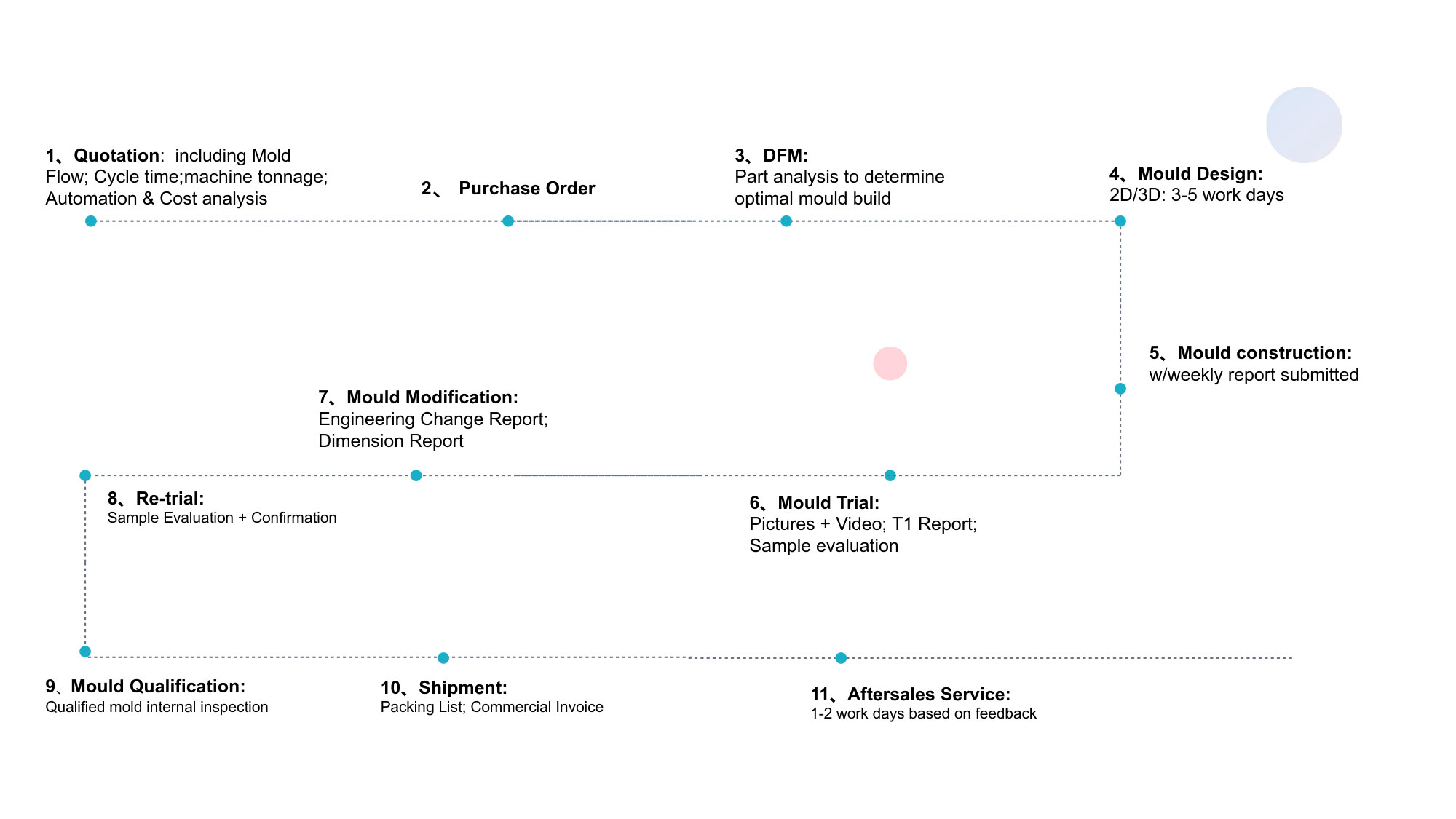
- The mold manufacturing process and product material selection
Pre-production validation includes T0 through T3 sampling rounds, with each iteration accompanied by a detailed improvement report. The CPK (Process Capability Index) for critical dimensions is maintained at 1.33 or higher, ensuring that every handle produced in mass production meets the same exacting specifications as the first sample. Customers receive full dimensional inspection reports at mold delivery, with key features validated against the original CAD model.
The most compelling advantage, however, is cost competitiveness. Ansix Tech delivers GAIM solutions at total landed costs that consistently undercut conventional suppliers through a multi-pronged strategy. First, material savings of 15-30% per part directly reduce variable costs, with annual savings for a high-volume handle program reaching 30-60 metric tons of raw material. Second, shorter cycle times increase effective capacity without additional capital expenditure, lowering the per-part overhead allocation. Third, the elimination of secondary finishing operations removes labor and consumable costs from the bill of materials. Fourth, the ability to consolidate multiple components into a single gas-assisted part reduces assembly labor and eliminates fasteners. Finally, Ansix Tech's strategic sourcing of engineering-grade materials—including PP+GF30, PC/ABS, PPS+40% GF, and PEEK—combined with optimized processing parameters, ensures that raw material spend is minimized without compromising performance. The result is a handle that meets or exceeds all specifications at a price point that strengthens the customer's market position.
-
Core Value Proposition – Mold Manufacturing, Material Selection, Smart Manufacturing, Process Quality, and Customer Benefits
Gas-Assist Molding Simulation and DFM for Handles – Ansix GAIM
When customers evaluate a manufacturing partner for gas-assisted molded handles, the decision ultimately comes down to one question: What value does this supplier deliver that directly impacts my bottom line, my quality targets, and my market responsiveness? Ansix Tech's answer is built on five pillars: precision mold manufacturing, scientifically grounded material selection, smart manufacturing integration, process quality assurance, and customer-centric delivery.
Precision Mold Manufacturing: From Steel to Solution
The quality of any gas-assisted molded handle begins with the mold. Ansix Tech operates a fully integrated mold-making facility equipped with 5-axis high-speed machining centers capable of achieving ±0.002mm precision on complex curved surfaces, ensuring that parting lines are smooth and burr-free. For fine features such as gas pin bores and overflow channels, slow wire EDM machines achieve tolerances down to 0.03mm without inducing thin-wall deformation. Each mold is precision-fitted to a 0.005mm tolerance at the parting surface, employing self-locking clamp force compensation to ensure flash is consistently held below 0.03mm across every batch—eliminating the need for manual deburring. Practical value to the customer means: no secondary trimming labor, no shutdowns for mold repair, and consistent part quality from the first shot of a production run to the millionth.
Scientific Material Selection: Matching Resin to Requirement
Not all plastics behave the same way under gas-assist conditions. Ansix Tech's material science team works alongside customers to select the optimal polymer based on end-use requirements and cost targets. For handles requiring structural rigidity and chemical resistance, PP+GF30 provides excellent flow characteristics for long gas channel lengths while maintaining impact strength. For applications demanding high-temperature stability and wear resistance, PPS+40% GF, PEI, or PEEK deliver flame-retardancy up to UL94 V-0 and UV stability verified through 3,000-hour testing. Ansix Tech also brings demonstrated expertise in PC/ABS, PC, PA6+GF30, PBT, LCP, and liquid silicone rubber (LSR). Each material grade is selected with gas penetration behavior in mind—ensuring that fiber dispersion remains uniform, gas channels remain intact, and warp-age is minimized during cooling.
Smart Manufacturing: Data-Driven Efficiency
Ansix Tech's manufacturing floor operates as an integrated smart factory where every injection molding machine is networked to a central MES (Manufacturing Execution System). Key process parameters—including melt temperature, injection speed, packing pressure, gas delay time, gas pressure, and cooling duration—are locked at the machine level, accessible only by authorized engineers。Batches are tracked in real-time, with first-article and last-article comparisons performed on every production run。Ultrasonic wall thickness sensors mounted on the injection unit provide continuous feedback on cavity fill, automatically adjusting gas pressure compensation to maintain dimensional stability within ±0.01mm across week-long production runs.
Process Quality Assurance: Consistency You Can Count On
Customers fear dimensional drift, sink marks, flash, and color variation. Ansix Tech addresses each concern with verifiable data. Mold temperature is zone-controlled to maintain core-cavity temperature differentials within 2℃, ensuring uniform cooling and eliminating warp-age. For a typical handle geometry, this translates into critical hole-to-hole positional variation of ≤0.02mm across three separate production batches over consecutive weeks. Surface finish meets automotive-grade requirements: transparent handles achieve bubble-free, flow-mark-free optical clarity; plated handles are free of gas splay marks; high-gloss parts achieve surface roughness Ra ≤0.2μm.
Customer-Centric Delivery: Predictability and Peace of Mind
Late deliveries and unpredictable lead times erode customer trust faster than any technical defect. Ansix Tech delivers on committed schedules through dual mechanisms. First, standard mold lead times are quoted at 15-25 days for simple geometries and 30-45 days for complex multi-cavity tools, with expedited options available to compress schedules by up to 40% under defined conditions. Second, capacity forecasting tools project machine availability months in advance, allowing customers to align their demand forecasts with Ansix Tech's production schedule. Mold maintenance packages are embedded into the service offering, with spare wear parts delivered alongside the tool, and every 200,000 cycles triggers a scheduled maintenance inspection without disrupting customer production. The core value is not simply the fastest delivery—it is delivery you can plan your entire assembly line around, with zero surprises.
Document 3: Comprehensive Manufacturing Solution – Gas-Assist Molding Simulation and DFM for Handles
Ansix GAIM Project Initiation: Translating Technical Terminology into Customer Value
Executive Summary
Ansix Tech is an industry-leading manufacturer specializing in Gas-Assist Injection Molding (GAIM) for handle components across automotive, furniture, gardening equipment, and consumer goods sectors. With over 28 years of production experience, Ansix Tech has refined a comprehensive methodology that spans from initial feasibility studies and material selection through precision mold manufacturing, smart factory integration, validation protocols, and high-volume production. This document outlines, in granular detail, how Ansix Tech transforms technical capabilities into measurable customer value—answering the questions that matter most: What problems do you solve? What does it cost me? Where are the risks, and how do you mitigate them?
Unlike conventional molders who view a mold as a capital expense, Ansix Tech treats every mold as a revenue-generating asset. Our design philosophy simultaneously considers flow balance, gas channel geometry, cooling efficiency, ejection strategy, and thermal equilibrium to ensure that when the mold arrives at your production line, it requires zero debugging, produces minimal flash, and delivers years of reliable service. The framework that follows is structured into five integrated sections: (I) hard capability infrastructure, (II) mold manufacturing core competencies with quantifiable metrics, (III) process controls and quality validation, (IV) full-service lifecycle management, and (V) differentiated commitments that directly address common customer grievances.
Section I: Hard Capability Infrastructure – Building Customer Trust Through Verifiable Equipment and Facilities
Customers must believe, not simply hope, that a supplier can deliver on technical promises. Ansix Tech's physical infrastructure provides the tangible foundation for every performance claim.
Mold Manufacturing Equipment: Precision Where It Matters
Equipment Type Technical Specification Customer Value
5-Axis High-Speed Machining Centers ±0.002mm positioning accuracy on complex curved surfaces Parting lines are smooth and burr-free; no secondary trimming required
Slow Wire EDM 0.03mm fine-hole and narrow-slot capability Thin-wall sections remain distortion-free during machining
CNC EDM (Sinker) Integrated electrode manufacturing and spark-erosion in-house Mold repairs completed within 24 hours; tool never leaves the facility
Coordinate Measuring Machine (CMM) Full dimensional inspection at mold delivery Every critical feature verified against CAD; CPK ≥1.33
Optical Imaging Measurement System Non-contact inspection of complex contours Verifies gas channel cross-sections and overflow cavity geometry
Injection Molding Machine Fleet
Ansix Tech maintains a diverse fleet of all-electric servo-driven injection molding machines spanning clamping forces from 30 tons to 4000 tons. This range covers small precision handles up to large structural components exceeding 2 meters in length. All-electric servo drives deliver repeatable positioning accuracy of ±0.1%, ensuring that every shot in a multi-million-part production run is dimensionally identical to the first.
Why this matters to you: A machine of inadequate size cannot produce a large handle without compromise. A machine lacking precision cannot hold tolerances across shifts. Ansix Tech's fleet ensures that your handle geometry is matched to the optimal machine size and that every production machine delivers the same consistent performance day after day, month after month.
Metrology and Validation Equipment
CMM (Coordinate Measuring Machine): Full dimensional inspection reports provided with every mold delivery; critical feature CPK maintained at ≥1.33.
Optical Profilometer: Surface roughness verification to Ra ≤0.2μm for high-gloss applications.
Ultrasonic Wall Thickness Sensors: Real-time feedback during GAIM production; automatically adjusts gas pressure compensation to maintain ±0.01mm wall thickness consistency.
In-Mold Pressure/Temperature Sensors: Closed-loop cavity feedback for process stabilization.
Section II: Mold Manufacturing Core Competencies – Delivering Measurable Performance Metrics
Customers care about four variables: service life, precision, lead time, and repair cost. Ansix Tech addresses each with specific, verifiable commitments.
Service Life: Longevity You Can Budget Around
Mold steel selection directly determines how many cycles a tool will withstand before requiring refurbishment. Ansix Tech builds molds using industry-proven materials matched to the application.
Mold Component Recommended Steel Hardness (HRC) Application
Mold Base P20 / 50# 28-32 Structural support, non-wear surfaces
Mold Core/Cavity (General) S136 / 4Cr13 / 9Cr18 48-52 High polish applications, corrosion resistance
Mold Core/Cavity (High Wear) 2344 / 8407 / H13 48-52 Glass-fiber reinforced resins
Mold Core/Cavity (High Precision) NAK80 37-43 High-gloss surfaces, transparent parts
Wear Inserts / Sliders SKD11 / DC53 / SKD61 58-62 Moving components, high-impact zones
Gas Pin Tips / Thin Features M340 / V4 55-60 Abrasion resistance for gas channel penetration
Performance commitment: For handles molded with glass-fiber reinforced materials (e.g., PP+GF30), Ansix Tech guarantees 500,000 shots before major refurbishment. For non-abrasive thermoplastics (ABS, PC/ABS, PP), the guarantee extends to 1,000,000 shots.
Customer value: You receive a mold with a predictable, budgetable lifespan. No unexpected mid-production tool failures. No surprise capital expenditures.
Dimensional Precision: The Difference Between Interchangeable Parts and Assembly Rework
Ansix Tech achieves the following dimensional capabilities:
Standard structural components: ±0.05mm
Precision gears and medical components: ±0.005mm
Critical hole-to-hole positions across 3 production batches (one week intervals): ≤0.02mm variation
Documentation included with every mold: Complete steel material certification including chemical composition analysis (ASTM/GB standard) and heat treatment temperature curve, ensuring traceability throughout the mold's service life.
Mold Type Capabilities
Ansix Tech designs and builds the following mold configurations based on production volume and part geometry:
Hot Runner Systems: Eliminate runner waste; reduce cycle time; ideal for high-volume handle production.
Stack Molds: Double the output per machine cycle; reduces effective per-part capital cost.
Two-Shot / Multi-Material Molds: For handles requiring soft-touch overmolding or two-color aesthetics.
High-Gloss Molds: Surface finish Ra <0.05μm for transparent and cosmetic-grade handles.
Gas-Assist Specific Tooling: Integrated gas pin locations, overflow cavities, and valve-gate timing systems.
Gate and Gas Channel Optimization
Through comprehensive Moldflow simulation (detailed further in Section IV), Ansix Tech predicts weld line locations, gas trap positions, and melt-front behavior before the first chip of steel is cut. This preemptive analysis determines the optimum number and placement of gates and gas injection points, ensuring balanced filling across the entire cavity.
A concrete example: For an automotive door handle requiring high surface quality where sink marks would be visible, the simulation identifies that a single gate at one end combined with a gas pin at the thickest cross-section yields uniform gas penetration and eliminates surface imperfections. The alternative—adding multiple gates—would introduce weld lines and increase scrap rates.
Customer value: You receive the simplest, most robust gate and gas channel design, not an over-engineered solution that drives up tooling cost and introduces unnecessary failure points.
Standard Lead Times
Mold Complexity Standard Lead Time Expedited Lead Time
Simple two-plate mold (1-2 cavities) 10-12 days 7 days
Medium complexity (hot runner, sliders) 25-35 days 18-20 days
High complexity (multi-cavity, gas-assist specific) 35-45 days 25-28 days
Note on expediting: Ansix Tech will compress lead times without compromising validation steps. Expedited molds receive the same full dimensional inspection, 2000-cycle test shot validation, and CPK reporting as standard-lead-time tools.
Section III: Process Control and Quality Assurance – Eliminating Customer Anxiety
Customers fear four failure modes in injection molding: sink marks, flash, dimensional drift, and color variation. Ansix Tech's process control systems are explicitly designed to prevent each of these from ever reaching the customer.
Networked Process Control (MES Integration)
Every injection molding machine on Ansix Tech's production floor is connected to a centralized MES (Manufacturing Execution System). Process parameters are locked at the machine level:
Melt temperature zones (5-7 zones controlled individually)
Injection speed profile (multi-stage, user-specified)
Packing pressure and duration
Gas delay time, injection pressure, and holding duration
Cooling time (zone-controlled with mold temperature regulation)
Back pressure and screw rotational speed
Authorization control: Only qualified engineers with electronic authorization can modify locked parameters. All changes are logged with operator ID, timestamp, and justification. First-article and last-article samples are compared for every production batch, with any deviation triggering immediate investigation.
Dimensional Stability Control
Mold temperature zone control: Core and cavity temperatures maintained within 2℃ differential, eliminating uneven shrinkage and warp-age.
Real-time wall thickness monitoring: Ultrasonic sensors embedded in the injection unit measure cavity wall thickness during each cycle, automatically adjusting gas pressure compensation to correct any deviation before a non-conforming part is produced.
In-mold pressure and temperature sensors (optional for high-precision applications): Closed-loop feedback to the injection controller enables real-time process adaptation.
Validated performance data: In a recent three-week production run of 50,000 handles for a furniture client, critical hole-to-hole position varied by ≤0.02mm across six consecutive batches spanning seven days each—well within the ±0.05mm specification. The CPK for this feature was calculated at 1.56, indicating a robust, capable process.
Surface Quality Standards
Application Achieved Standard Defect-Free Guarantee
Transparent handles No bubbles, no flow marks 100% visual inspection
Electroplated handles No gas splay marks, no surface imperfections No pinhole defects
High-gloss components Surface roughness Ra ≤0.2μm No orange peel pattern
Painted / printed components Deformation compensation allowance built into tool Print registration accuracy ±0.1mm
Capability with Special Engineering Plastics
Ansix Tech has validated GAIM processes for the following material families:
ABS / PC/ABS – General-purpose handles, interior automotive components
PC (Polycarbonate) – Transparent handles requiring impact resistance
PPS + 40% GF – High-temperature applications (up to 260℃ continuous service)
PEEK – Extreme-performance handles for aerospace and medical applications
PA6 + GF30 – Structural handles requiring stiffness and fatigue resistance
PBT – Electrical handles requiring UL94 V-0 flame retardancy
PEI (Ultem) – High-heat, flame-retardant handles for aviation interiors
LCP – Miniature precision handles requiring dimensional stability at high temperatures
LSR (Liquid Silicone Rubber) – Soft-touch overmolded grips on rigid handles
PTFE / PFA – Chemical-resistant handles for industrial fluid-handling components
Performance certification provided: UL94 V-0 testing reports, UV stability (3,000 hours accelerated testing), thermal cycle testing, and impact resistance data according to relevant industry standards.
Section IV: Full-Service Lifecycle Management – Reducing Your Total Cost of Engagement
Ansix Tech does not simply mold plastic. Ansix Tech partners with customers from the moment a concept is first conceptualized through the entire production lifecycle. This full-service approach dramatically reduces the customer's internal management overhead, decreases the number of vendors that must be coordinated, and eliminates the finger-pointing that occurs when multiple suppliers are involved in a single project.
Early Engagement: Design for Manufacturability (DFM) Report
Before any commercial commitment is finalized, Ansix Tech provides a comprehensive DFM report that answers the critical question: Can this handle design be molded efficiently using gas-assist technology, and what changes are recommended to achieve optimum manufacturability?
DFM report deliverables:
Recommended draft angles for all functional surfaces (minimum 1-2 degrees depending on texture)
Wall thickness optimization to ensure uniform gas channel formation
Recommended gate location(s) and size based on Moldflow simulation
Recommended gas pin location(s) and channel geometry
Ejector pin mark location allowance (where marks are permitted and where they must be avoided)
Gas channel blow-out risk assessment and mitigation recommendations
Material shrinkage compensation factors (pre-built into the 3D CAD model)
Customer value: You avoid the single most expensive mistake in injection molding—opening a mold only to discover that the part geometry cannot be manufactured as designed. The DFM report is your insurance policy against costly tooling rework.
Trial Shots and Sampling (T0 through T3)
Ansix Tech does not deliver a mold and hope it works. Every new GAIM handle tool goes through a graduated validation protocol:
Milestone Deliverables Purpose
T0 (First Shot) Initial sample parts; first-pass dimensional report Verify basic mold function; identify gross defects
T1 (First Optimization) Optimized parts; defect-specific improvement report Address sink marks, flow lines, or filling imbalances
T2 (Second Optimization) Fine-tuned parts; full dimensional inspection Confirm all dimensions within specification
T3 (Production Validation) 2000-cycle test run; CPK report; full inspection Validate process stability prior to mass production
Rapid iteration method: Ansix Tech designs molds with replaceable inserts for gates, gas pins, and overflow cavities. This allows different configurations to be tested on the same mold base without cutting an entirely new tool—reducing iteration time from weeks to days.
Low-Volume Pre-Production Validation
Before committing to full-scale mass production, Ansix Tech offers a low-volume validation run of 100 to 500 shots. This run is performed under actual production conditions, including the same machine, mold, and operating crew that will execute the mass production order. The resulting parts are dimensional inspected and functional tested. Acceptable yield and CPK must be confirmed before a batch release is granted for high-volume processing.
Customer value: You have zero doubt that the process works at scale. Any issues discovered during the low-volume run are solved before the high-volume run begins—when the cost of correction is measured in hours rather than weeks.
Maintenance, Spare Parts, and Long-Term Support
Every mold delivered by Ansix Tech includes a basic set of spare wear parts: ejector pins, core pins, gas pin tips, and springs. These consumables are packaged in a labeled kit and shipped with the mold.
Maintenance schedule:
Every 200,000 cycles – Preventative mold inspection and cleaning (performed at Ansix Tech's facility or at customer site)
Every 500,000 cycles – Full mold disassembly, wear inspection, component replacement per scheduled plan
Lifetime support – Repair services performed at material cost (labor charged at standard rate only)
Customer value: You never face a production shutdown because a $10 ejector pin snapped and the supplier is three weeks away. The spare part kit keeps you running. The scheduled maintenance plan preserves mold function for the full 1,000,000-shot service life.
Section V: Differentiated Customer Commitments – Turning Common Complaints into Competitive Advantages
The injection molding industry is rife with common customer frustrations. Rather than simply claiming superiority, Ansix Tech directly acknowledges each frustration and provides a specific, enforceable commitment to addressing it.
Common Customer Complaint Ansix Tech's Explicit Commitment
"The mold keeps breaking down. Every month another repair. It's killing my delivery schedule." "We perform 2,000-cycle test validation on every new mold. A wear report is included in the delivery package. We provide a three-year structural warranty on the mold base and core/cavity (excludes normal wear on consumable components like ejector pins and gas pin tips). If the mold fails structurally within three years, we repair it at no cost to you."
"The parts have flash everywhere. We're spending a fortune on manual deburring." "We machine every parting surface to 0.005mm fit tolerance. Every mold is equipped with self-locking clamp force compensation that maintains closing pressure even as thermal expansion varies during the cycle. Flash is consistently below 0.03mm, eliminating manual deburring entirely for most geometries."
"The dimensions drift from batch to batch. One month the parts fit perfectly, the next month they don't." "Every injection machine has ultrasonic wall thickness feedback sensors. If the sensor detects a 0.01mm deviation from nominal wall thickness, the gas pressure compensation automatically adjusts to correct it within the same cycle. We also offer in-mold pressure/temperature closed-loop control as an option for high-precision applications. In a recent 50,000-handle production run, critical hole-to-hole position varied by ≤0.02mm across three separate production weeks."
"The repair cycle takes forever. The mold goes out and comes back three weeks later." "We maintain an in-house electrode manufacturing center and EDM department. 90% of mold repairs—including core/cavity crack or gas pin tip replacement—are completed within 24 hours of receiving the mold. The tool never needs to leave our facility for standard repairs."
Section VI: How Ansix Tech Reduces Hard Costs – Material, Process, and Efficiency Optimization
Cost reduction is not a secondary benefit of working with Ansix Tech. It is an engineered outcome achieved through three coordinated strategies across material selection, process design, and production efficiency.
Material Cost Reduction: Buying Resin Smarter, Using Less of It
Strategy 1 – Optimized material grade selection: Not all engineering-grade plastics cost the same. For a given set of mechanical requirements (tensile strength, impact resistance, heat deflection temperature), Ansix Tech's material science team identifies the least expensive grade that meets the requirement. In many cases, a lower-cost material combined with gas-assist hollowing yields better performance than an expensive material molded solid. Example: Switching a solid PC handle to a hollow PP+GF30 handle reduces raw material cost by 30-40% while maintaining structural stiffness.
Strategy 2 – Gas-assisted material reduction: The GAIM process inherently consumes 15-30% less plastic than conventional molding of the same external geometry because the hollow interior contains zero resin. For a handle weighing 200g in solid form, the gas-assist version weighs 140-170g, saving 30-60 metric tons of raw material annually at 1 million parts per year. At current engineering resin prices (3−8/kg),theannualmaterialsavingsalonerangefrom90,000 to $480,000 per program.
Strategy 3 – Scrap reduction through simulation: Traditional tool development methods require multiple physical trial shots to dial in process parameters—each trial shot consumes material and generates scrap. Ansix Tech's Moldflow simulation reduces the required number of physical trial shots from 15-20 down to 3-5, cutting material wasted during validation by 70-80%. Moreover, the validated process achieves first-pass yield exceeding 98%, minimizing scrap during production.
Strategy 4 – Recycled / regrind integration: For non-cosmetic handles and internal structural components, Ansix Tech integrates up to 30% post-industrial recycled material into the melt stream without compromising gas channel integrity. This reduces raw material spend and supports customers' environmental sustainability goals.
Process Efficiency Optimization: Faster Cycles, Higher Throughput
Strategy 5 – Reduced cycle time: The hollow gas channel in a GAIM part cools faster than a solid core due to lower thermal mass. Cycle times for GAIM handles are 30-50% shorter than conventional molding of equivalent solid parts. For a 60-second conventional cycle, the GAIM cycle is 30-42 seconds. The corresponding increase in effective capacity means the same machine produces 42-100% more parts per day without additional capital cost.
Strategy 6 – Lower clamp tonnage: Gas-assist molding operates at significantly lower cavity pressure than conventional molding, reducing required clamp tonnage by up to 70%. Smaller machines are less expensive to purchase, maintain, and operate. For a large handle requiring a 1000-ton conventional machine, the GAIM version may run on a 300-ton machine. Annual savings include lower electricity consumption, reduced machine depreciation, and smaller floor space footprint.
Strategy 7 – Eliminated secondary operations: Solid handles with sink marks require sanding, putty filling, and secondary coating to achieve acceptable surface finish. GAIM handles with zero sink marks go directly from the molding machine to shipping—no sanding, no filling, no secondary coating. Per-part labor savings: 30 seconds to 2 minutes of hand finishing eliminated. For high-volume production, this translates into 1-3 full-time operator positions eliminated from the bill of resources.
Strategy 8 – Part consolidation: Complex assemblies that previously required 3-5 individual components can often be consolidated into a single GAIM handle with integrated features (mounting bosses, snap-fits, living hinges). Eliminating assembly steps reduces labor, eliminates fasteners, and removes failure points. One automotive handle assembly that previously required a two-shot overmold process was consolidated into a single GAIM part, reducing piece price by 42% and eliminating an entire second molding operation.
Efficiency Optimization Across Production Operations
Mold-change efficiency: Ansix Tech's standard mold base design incorporates quick-change features (centralized water manifolds, magnetic platens, standardized ejector layouts) that reduce mold changeover time to 5-15 minutes. Low-volume production runs become economically feasible because changeover time no longer dominates the batch cost calculation.
Automated material handling: Centralized resin drying and conveying systems feed all machines automatically, eliminating operator material loading and reducing the risk of contamination. Desiccant dryers maintain consistent moisture content for hygroscopic materials (nylon, PC, PET) to below manufacturer-recommended levels.
Automated part handling: For single-cavity molds, a robotic arm removes each handle from the machine and places it on a cooling conveyor. For multi-cavity molds, stripper plates and air-blow ejection systems separate parts from the runner system, which is then ground in-line and returned to the raw material hopper. The result: continuous, lights-out production with minimal operator intervention.
Quality-Driven Cost Avoidance
Cost avoidance through reduced rework and scrap: At first-pass yields exceeding 98%, the per-part cost of quality is minimized. The remaining 2% non-conforming parts are identified through in-line automated vision inspection before they reach secondary operations or packaging. This prevents the expensive situation where a defective part is assembled into a higher-level assembly before discovery, resulting in complete disassembly or scrapping of the entire assembly.
Cost avoidance through predictive maintenance: Ansix Tech's MES system tracks shot counts, cycle times, and process trends for each mold. Replacement of ejector pins, gas pin tips, and other consumables is scheduled based on actual wear patterns rather than fixed time intervals—ensuring that parts are replaced before they fail (avoiding unplanned downtime) but not replaced too early (avoiding unnecessary part consumption).
Section VII: A Final Word to Our Customers
A mold is not just a block of steel. It is the engine that generates your revenue, the tool that protects your quality reputation, and the asset that determines your production economics for the next five to ten years. Ansix Tech designs molds with the complete production cycle in mind—the gas channel geometry is placed where it does the most structural good, the cooling lines are routed where they achieve the most uniform temperature distribution, the ejector pins are located where marks will not be visible, and the steel selection is matched to the abrasiveness of your chosen resin.
The result is a mold that arrives at your facility requiring minimal debugging, producing minimal flash, and delivering consistently high-quality parts for the entire service life.
We invite you to take the next step: select a handle you currently manufacture or source from a competitor. Send Ansix Tech the 3D CAD model. We will return a full DFM report that identifies every potential issue—weld lines, gas trap locations, sink mark risk, gas blow-out risk, and wall thickness optimization opportunities—complete with recommended design changes and expected process outcomes. There is no cost or commitment for this DFM evaluation. The only thing you risk is discovering how much better your handle could be.
Molds that perform. Materials that match the application. Processes that are predictable. Delivery that you can depend on. That is the Ansix Tech commitment.
Ansix Tech – Gas-Assist Molding Excellence for Handle Applications
Ansix Tech Co Ltd
If you have any plans related to Gas-Assist Molding Simulation and DFM for Handles for Ansix GAIM , you can contact us at any time. We will turn your ideas into reality, let you realize your dreams, and obtain large orders from the market. Our contact information is info@ansixtech.com. Or contact our CTO, mail: stephen@ansixtech.com
#www.ansixtech.com #ansixtech.com #Gas-Assist Molding Simulation and DFM for Handles for Ansix GAIM #Gas-Assist Molding Simulation and DFM for Handles for Ansix GAIM moulds #Gas-Assist Molding Simulation and DFM for Handles for Ansix GAIM injection molding companies #Gas-Assist Molding Simulation and DFM for Handles for Ansix GAIM Canopy Mold injection mold companies #Ansix #Ansix moulds #Ansix china #Ansix tech china #Ansix tech company #Ansix facotry #Gas-Assist Molding Simulation and DFM for Handles for Ansix GAIM injection molding #Gas-Assist Molding Simulation and DFM for Handles for Ansix GAIM injection tools #Gas-Assist Molding Simulation and DFM for Handles for Ansix GAIM injection moulds #Gas-Assist Molding Simulation and DFM for Handles for Ansix GAIM plastic mould #Gas-Assist Molding Simulation and DFM for Handles for Ansix GAIM plastic tools #Ansix Tech #Ansix molds #Ansix injection molding #Ansix mold factory #injection molding Gas-Assist Molding Simulation and DFM for Handles for Ansix GAIM #Ansix mold factory #Gas-Assist Molding Simulation and DFM for Handles for Ansix GAIM china #Gas-Assist Molding Simulation and DFM for Handles for Ansix GAIM molds #injection factory #Gas-Assist Molding Simulation and DFM for Handles for Ansix GAIM injection molding #Gas-Assist Molding Simulation and DFM for Handles for Ansix GAIM injection molding factory #injection molding company #Gas-Assist Molding Simulation and DFM for Handles for Ansix GAIM injection mold companies #Gas-Assist Molding Simulation and DFM for Handles for Ansix GAIM#Gas-Assist Molding Simulation and DFM for Handles for Ansix GAIM mold limited #Ansix mold china #Ansix companies #Ansix company China #Gas-Assist Molding Simulation and DFM for Handles for Ansix GAIM facotry #Ansix Tech #Ansix Tech mould #Gas-Assist Molding Simulation and DFM for Handles for Ansix GAIM injection moulding #injection moulding company #Ansix Gas-Assist Molding Simulation and DFM for Handles for Ansix GAIM parts injection mold companies #medical injection molding companieschina #Gas-Assist Molding Simulation and DFM for Handles for Ansix GAIM china factory #Ansix moulding companies #Ansix molding company #Gas-Assist Molding Simulation and DFM for Handles for Ansix GAIM injection moulding facotry #Ansix Tech mold #Gas-Assist Molding Simulation and DFM for Handles for Ansix GAIM mould #Gas-Assist Molding Simulation and DFM for Handles for Ansix GAIM plastic injection molding #ansix plastic mold #Mold manufacturing #Gas-Assist Molding Simulation and DFM for Handles for Ansix GAIM parts manufacturing #Gas-Assist Molding Simulation and DFM for Handles for Ansix GAIM plastic parts factory #Gas-Assist Molding Simulation and DFM for Handles for Ansix GAIM injection parts mold #Gas-Assist Molding Simulation and DFM for Handles for Ansix GAIM PRECISION MANUFACTURING #Gas-Assist Molding Simulation and DFM for Handles for Ansix GAIM #China mold #Gas-Assist Molding Simulation and DFM for Handles for Ansix GAIM injection moulding china #Gas-Assist Molding Simulation and DFM for Handles for Ansix GAIM mould china #china precision mold #mold in china #Gas-Assist Molding Simulation and DFM for Handles for Ansix GAIM mold china #Precision molds #High-precision molds #Gas-Assist Molding Simulation and DFM for Handles for Ansix GAIM #Injection molds #Gas-Assist Molding Simulation and DFM for Handles for Ansix GAIM Factory #Gas-Assist Molding Simulation and DFM for Handles for Ansix GAIM Company #Super Large Injection Mold Factory #Large Tonnage Injection Molding Factory #Gas-Assist Molding Simulation and DFM for Handles for Ansix GAIM Company #Gas-Assist Molding Simulation and DFM for Handles for Ansix GAIM Factory #2800T Injection Molding Factory #3000 Ton Injection Molding #4500 Ton Injection Molding Factory #Large Mold Injection Molding #Large Plastic Mold Injection Molding Factory #Large Injection Mold Manufacturer #Plastic Mold Factory #Injection Mold #Plastic Mold