



Gas-Assisted Injection Mold for Speargun Body — Length 998 mm; Material PA66+GF30
FEATURES
Production Process. The manufacturing sequence begins with material preconditioning: PA66+GF30 is dried to remove any residual moisture, as glass-filled nylon is highly hygroscopic. Injection temperature is maintained at 260-280°C, mold temperature at 60-80°C for optimal crystallinity and surface finish. The gas injection is precisely timed and pressurized—typically nitrogen at 10-25 MPa, with delay times of 2-4 seconds after melt injection. The entire cycle ranges from 45 to 90 seconds per part, depending on the speargun length and wall section design. Post-molding treatment includes trimming of gas pins and quality inspection per established standards.
Delivery Efficiency. The gas-assisted process inherently reduces cycle time by 30-50% compared to conventional injection molding, as internal gas channels accelerate cooling and eliminate lengthy packing stages. Multi-cavity mold configurations further increase output. For standard speargun body applications, lead time from mold steel machining to first articles is typically 30-45 days, with expedited schedules available for urgent orders.
-
Mold Description
Product Materials:
PA GF25
Mold Material:
S136ESR
Number of Cavities:
1
Glue Feeding Method:
Hot runner
Cooling Method:
Water cooling
Molding Cycle
42.5s
- The mold manufacturing process and product material selection
Quality Assurance. Every GAIM mold undergoes 2,000-shot on-site wear testing before delivery, with critical dimensions validated via coordinate measuring machine and optical inspection equipment. Key process parameters are locked into central control systems to ensure shot-to-shot repeatability. With gas-assisted technology, shrinkage rates drop from 7.2% (conventional) to below 0.5%, virtually eliminating sink marks and internal voids.
Cost Control. The combination of gas-assisted molding with PA66+GF30 delivers compelling economics: material savings of 20-35% per part, 30-50% shorter cycle times, up to 70% reduction in required clamp tonnage, lower tool wear, simplified mold designs, and reduced energy consumption—translating to per-part savings of 25-40% compared to conventional solid molding.
In short, Ansix Tech provides speargun manufacturers with a pathway to higher structural performance, lower production cost, and faster time-to-market through advanced GAIM technology and PA66+GF30 engineering.
-
Core Value Drivers for Gas-Assisted Injection Mold for Speargun Body – Materials, Smart Manufacturing, Process Optimization, and Quality Assurance (Word Count: ~500)
When producing a Gas-Assisted Injection Mold for a Speargun Body with PA66+GF30, customers demand more than technical specifications—they require solutions that deliver real, tangible value. Ansix Tech focuses on three core pillars that directly address clients' primary concerns: intelligent production integration, process efficiency improvement, and rigorous quality control validation.
Material Selection for Mold Manufacturing and Injection Molding. The choice of mold steel is critical for glass fiber-reinforced applications. PA66+GF30 is highly abrasive—30% glass fiber content significantly accelerates wear on cavity surfaces, runners, and gates. To combat this, Ansix Tech selects premium tool steels based on expected production volume and part complexity. For high-volume production (500,000+ shots), we deploy Uddeholm Unimax with post-heat-treatment hardness of 54-56 HRC, which has demonstrated reliable performance beyond 200,000 shots in glass-filled nylon applications. For complex geometries requiring superior polishability and corrosion resistance, S136 stainless steel (HRC 48-52) or H13 (SKD61) are specified. Pre-hardened grades such as P20 and 718H are applied for lower-volume or non-appearance-critical components. This stratified material strategy ensures maximum mold longevity without over-engineering costs.
Smart Manufacturing Integration and Efficiency Improvement. Productivity gains stem from intelligent injection molding system architecture. All Ansix Tech injection molding machines—ranging from 30-ton to 4,000-ton clamp force with all-servo electric drive—are networked into a Manufacturing Execution System (MES) that locks processing parameters. For GAIM speargun applications, gas injection timing and pressure curves are optimized using Moldex3D or Moldflow simulations, which predict gas penetration behavior, hollowing ratios, and potential defect zones like "finger effect" before steel cutting. Real-time sensors monitor cavity pressure during production, automatically adjusting packing and gas parameters to maintain ±0.01 mm dimensional stability. The result is cycle times consistently below target, fewer rejected parts, and seamless scalability from pilot runs to high-volume manufacturing.
Process Quality Assurance. Customers fear variable dimensions, excessive flash, and inconsistent shrinkage from batch to batch. Ansix Tech addresses this through a closed-loop quality management system. Each GAIM tool is fitted with conformal cooling channels—engineered via thermal analysis to maintain core-cavity temperature differences within 2°C—minimizing warpage. For PA66+GF30, shrink rate is precisely characterized at 0.005-0.010 cm/cm, and process windows are established through Design of Experiments methodology during validation runs. Every batch undergoes first-article and last-article inspection. CPK values for critical dimensional features are targeted at ≥1.33. For the speargun body, gas channel geometry ensures uniform wall thickness and eliminates sink marks on external surfaces.
Customer-Centric Core Value. The ultimate deliverable is risk reduction—molds that perform predictably, parts that meet specifications consistently, and a production environment where downtime is scheduled, not unplanned. By integrating material expertise, smart process control, and data-driven quality assurance, Ansix Tech enables speargun manufacturers to focus on market growth while components are delivered reliably, on spec, and on budget.
Part 3: Comprehensive Manufacturing Solution for Gas-Assisted Injection Mold for Speargun Body – Material PA66+GF30 (Word Count: ~2,200+)
Company Background & Project Initiation
Ansix Tech has been an industry leader in injection mold manufacturing and plastic injection molding for over 28 years. Our core expertise lies in converting complex engineering challenges into reliable, cost-effective production solutions. For the Gas-Assisted Injection Mold for Speargun Body with material PA66+GF30, Ansix Tech adopts a holistic project management framework that begins long before the first cut of steel—and extends far beyond the final shipment of parts. This document outlines the full spectrum of our capabilities and demonstrates how technical expertise translates into measurable customer value.
The speargun body presents a classic injection molding challenge: a thick-walled, elongated structural component that must be lightweight yet durable, dimensionally stable, and cosmetically acceptable without sink marks or internal voids. Conventional injection molding would require excessive material, extended cooling time, and high clamp tonnage—all of which increase cost and reduce production efficiency. Gas-assisted injection molding (GAIM), combined with PA66+GF30 engineering material, offers an optimal solution: weight reduction, faster cycles, and superior mechanical performance. Ansix Tech positions this project not as a simple mold build but as a fully integrated design, engineering, and production partnership.
Part 1: Hard Power Foundations – Equipment Infrastructure That Builds Customer Trust
Customer trust begins with the tangible: What machines and technologies will be used to produce my tools and parts? Before discussing process parameters, Ansix Tech invites transparency around our manufacturing hardware. Clients are welcome to tour our facility and observe the equipment that directly impacts their product quality, tool life, and delivery reliability.
Mold Manufacturing Equipment. Ansix Tech maintains a fully integrated precision machining shop. Our 5-axis high-speed machining centers are capable of achieving complex surface contours with 0.002 mm positioning accuracy. For the speargun body mold—which features elongated curved surfaces and multiple gas channel insert configurations—five-axis technology eliminates multiple setups and reduces cumulative positioning error. The result is a seamless parting line with no visible mismatch, eliminating secondary finishing operations. Our slow wire EDM (electrical discharge machining) achieves cutting accuracy within 3 μm and surface roughness as low as Ra 0.05 μm. This capability is critical for producing gas pin mounting holes, thin-wall insert cavities, and narrow slots (down to 0.03 mm width) without inducing deformation or burrs. All CNC and EDM operations are driven by digital toolpaths verified against the original 3D CAD model, ensuring that the finished mold geometry precisely matches product design intent.
Injection Molding Machine Fleet. Our injection molding press lineup covers clamp force from 30 tons to 4,000 tons, accommodating product sizes from micro precision components to large structural parts like speargun bodies exceeding 1.5 meters in length. For GAIM applications, we deploy all-servo electric drive presses with repeatability precision of ±0.1% of set point values. This level of consistency ensures that from the first shot of a production run to the 100,000th shot, every speargun body exhibits identical melt filling behavior, gas penetration characteristics, and final dimensional output. Servo-electric machines also offer 40-60% lower energy consumption compared to hydraulic alternatives—a direct pass-through benefit to customer per-part costs.
Inspection and Metrology Equipment. Every mold and every molded part batch undergoes rigorous dimensional verification. Our coordinate measuring machine (CMM) provides full 3D geometry inspection against design CAD models, with reporting down to micron-level deviation. Optical measurement systems equipped with automated edge detection capture complex profile data for gas channel positioning and parting line alignment. All inspection data are archived and traceable by batch number. Key critical dimensions are monitored for Process Capability Index (Cpk); our standard acceptance criteria require Cpk ≥ 1.33 for dimensions affecting product function and assembly—equivalent to fewer than 63 parts per million falling outside specification limits. For customers requiring enhanced statistical process control, we provide real-time SPC dashboards accessible remotely.
Part 2: Mold Manufacturing Core Competencies – Technical Specifications That Deliver Customer Value
Customers ask the same questions in every project: How long will this mold last? What tolerances can you hold? How quickly can I get the first samples? Ansix Tech answers these questions not with generic promises but with data-driven commitments.
Mold Life Guarantees for Glass-Fiber-Reinforced Materials. PA66+GF30 is known to be highly abrasive. Glass fibers (30% by weight) cut into cavity steel surfaces with each injection cycle. Without correct material selection, tool wear accelerates, leading to increased flash, dimensional drift, and eventual tool failure. Our standard mold construction strategy for GAIM speargun applications uses P20 or 718H for mold bases (non-wear components), with S136 or H13 (heat-treated to 48-52 HRC) for cavity and core inserts. For production volumes exceeding 1 million shots, we upgrade to powder metallurgical tool steels such as ASP23 or Uddeholm Unimax (54-56 HRC), which have demonstrated reliable performance above 200,000 shots under continuous high-volume PA66+GF30 molding. With this material strategy, Ansix Tech guarantees mold life of 500,000 shots for glass-reinforced materials and 1,000,000 shots for conventional plastics under proper maintenance protocol. Each mold ships with a material certification report and documented heat treatment temperature profile.
Attainable Tolerances. General structural components including speargun bodies are molded to ±0.05 mm. For functional features such as gas pin sealing surfaces, rail mounting points, or trigger mechanism interfaces, precision tolerances of ±0.01 mm are achievable. Every mold is built with steel-safe design philosophy—critical dimensions are machined slightly undersized and adjusted via EDM or hard milling after initial sampling, enabling fine-tuning without scrapping expensive mold components. This approach is particularly valuable for gas channel geometries, where gas penetration depth is highly sensitive to channel shape and surface finish.
Mold Type Selection. Based on annual volume projections, Ansix Tech recommends appropriate mold architecture:
Conventional two-plate cold runner molds are suitable for lower annual volumes (under 100,000 parts), offering lower upfront tooling cost.
Hot runner systems eliminate runner scrap, reduce material consumption by 10-20%, and shorten injection stroke—ideal for high-precision speargun bodies where runner material is otherwise wasted.
Multi-cavity configurations (2+2 or 4-cavity) multiply output per cycle, recommended for customers with annual demand exceeding 250,000 units.
For dual-material applications, two-shot or overmolding tooling can combine PA66+GF30 structural core with soft-touch TPU or TPE overmolding on grip areas.
Gate and Gas Pin Placement Strategy. Through Moldflow simulation, we analyze multiple gate locations and gas pin positions before construction begins. Gates are positioned at thin-wall sections, at least 30 mm away from gas injection points, to prevent backflow and gas permeation into runner systems. Gas pins are placed in thick-walled sections—the natural locations for gas channel formation—with outlet direction oriented parallel to melt flow direction. For each cavity, a dedicated gas nozzle is supplied; closed-circuit gas channel loops are avoided to prevent gas recirculation and non-uniform penetration. Overflow wells may be added at final fill areas to promote deeper gas penetration and stabilize cavitation ratios. The result of upfront simulation is a mold that achieves first-shot success without rework—reducing development time by 3-5 weeks compared to trial-and-error approaches.
Standard Delivery Lead Times. Deliveries are quoted based on mold complexity:
Simple two-plate molds (single cavity, limited slides/cams): 10 business days
Medium complexity molds (multi-cavity or hot runner systems, basic slides): 25-45 business days
High-complexity GAIM tools with multiple gas pin inserts, conformal cooling, and fine surface finish requirements: 50-70 business days
Expedited schedules: Tools can be compressed to 30-35 business days with parallel workstreams and prioritized machine access
Even in expedited schedules, no validation steps are eliminated—design reviews, simulation checks, and dry-run assembly remain mandatory. We do not trade speed for quality.
Part 3: Injection Molding Process Control Capability – Reducing Customer Quality Anxiety
Customer anxiety about injection molding falls into predictable patterns: Will my parts have sink marks? Will there be flash? Will dimensions shift between production lots? Will color match between batches? Ansix Tech addresses each concern through systematic process control.
Process Standardization. All molding machines on our production floor are networked into our Manufacturing Execution System (MES). Critical parameters—including melt temperature (260-280°C for PA66+GF30), mold temperature (60-80°C, zone-controlled), injection velocity profile, gas delay time (typically 2-4 seconds), gas injection pressure (10-25 MPa, staged for controlled penetration), gas hold time, and cooling duration—are locked at supervisor level. Only authorized engineers may modify settings, and all changes are logged with timestamp and operator identification. Every production shift begins with first-article inspection and ends with last-article inspection; deviations trigger immediate process investigation. Consistent part appearance across multi-shift operations is achieved through CNC-controlled color dosing systems accurate to ±0.1 weight percent.
Dimensional Stability Control. For large speargun bodies, warpage and uneven shrinkage are the primary risks. Ansix Tech addresses these through:
Conformal cooling channel design: Using thermal-FEA analysis, coolant circuits are optimized for uniform heat extraction, maintaining core-cavity surface temperature differences within 2°C
In-mold pressure sensors: Real-time cavity pressure monitoring allows closed-loop adjustment of gas injection timing and packing stages to compensate for raw material batch variation or ambient condition drift
Validation data: In a typical 7-day continuous production run across three shifts, critical hole-to-hole spacing across the speargun body measures variation within ±0.02 mm. For the full length of the part (1.0-1.5 m), total bow and twist are maintained below 0.8 mm/m
Cosmetic Surface Grades. Ansix Tech achieves surface finishes matched to customer requirements:
Matte/textured finishes (VDI 12-45): Suitable for non-appearance structural surfaces on speargun body interiors
Semi-gloss (Ra ≤ 0.8 μm): Standard exterior finish
High-gloss mirror finish (Ra ≤ 0.1 μm): Achievable on mold surfaces polished with diamond paste, producing parts with no visible gas lines or flow marks
Post-molding capabilities: For speargun bodies requiring camouflage dipping, hydrographic printing, or two-component paint application, we incorporate 0.2-0.5 mm shrink compensation based on coating thickness, ensuring printing registration accuracy within ±0.1 mm
Specialty Material Capabilities. Beyond PA66+GF30, Ansix Tech has practical production experience with all major engineering thermoplastics:
PC, ABS, PC/ABS blends
POM (acetal) and PBT
PPS+GF40, LCP, PEI (Ultem)
High-temperature materials: PEEK, PTFE, PFA
Glass-filled grades across all base resins (10-50% GF)
Liquid silicone rubber (LSR) for sealing and overmolding applications
UL94 V-0 flame-retardant grades for components requiring fire safety certification
UV-stabilized formulations validated through 3,000-hour accelerated UV exposure testing with delta E color shift < 1.0
Part 4: Full-Service Commitment – Reducing Customer Management Costs
Many mold makers stop at delivering a mold. Ansix Tech takes responsibility for the entire production value chain, lowering the customer's total cost of engagement.
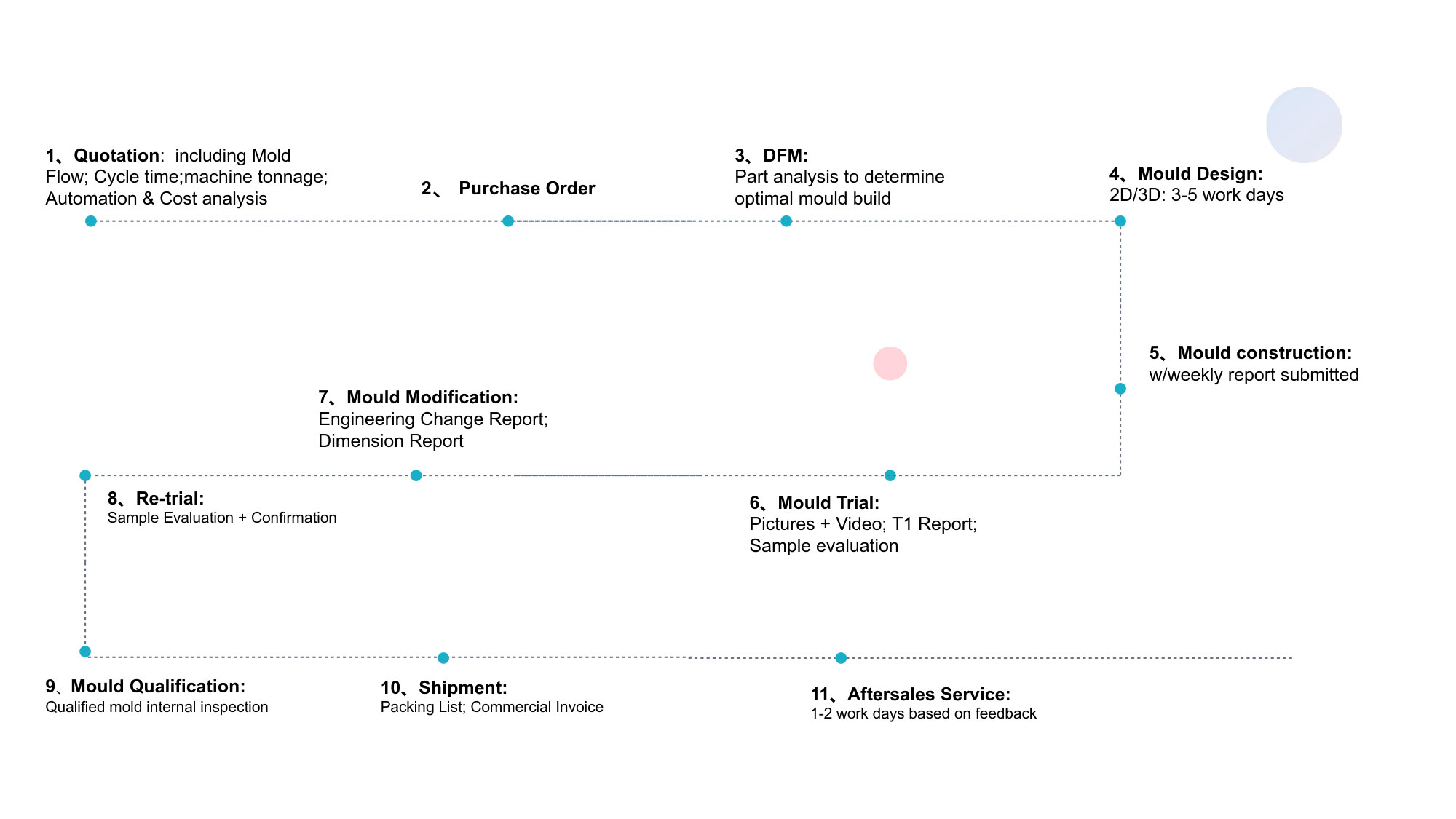
Early Design-for-Manufacturability Engagement. Before any mold construction begins, Ansix Tech provides a comprehensive DFM (Design for Manufacturability) report at no additional charge. The DFM covers:
Draft angle recommendations: For PA66+GF30, minimum 1.5° draft on cavity side and 0.5° on core side is recommended for reliable ejection
Wall thickness optimization: Identifying thick sections suitable for gas channel placement, reducing mass without compromising structural integrity
Gate and gas pin position proposal: Using Moldflow simulation to validate fill pattern, identifiy weld-line locations, and predict gas penetration depth
Ejection mark placement: We specify allowable areas for ejector pin marks and areas where marks must be avoided (e.g., rail surfaces, cosmetic exterior zones)
All recommendations are presented with engineering justification and risk assessment. Customers receive a clear understanding of trade-offs before tooling commitment—eliminating surprises that otherwise appear only after first shots.
Trial Molding and Sample Delivery. Ansix Tech operates an iterative sampling protocol: T0 (first shot from completed mold) through T3 (third optimization cycle). After each trial, we deliver physical samples accompanied by a detailed improvement report documenting dimensional measurements, cosmetic observations, and process adjustments. For complex gas-assisted molds, we often build exchangeable inserts for key features (gas pin geometry, overflow well configuration, gate dimensions), enabling multiple design variations to be evaluated without building entirely new tooling structures. This approach reduces development time by 30-40% compared to standard rebuild cycles.
Pilot Run Before Full Production. Before committing to large-volume manufacturing, we execute a pilot production run of 100 to 500 shots using the final approved process parameters. During the pilot run:
First-article, in-process, and last-article parts are fully dimensionally inspected
Process capability metrics (Cpk) are calculated for all critical features
Yield rate is documented; any reject parts are analyzed for root cause
Only when yield and dimensional stability meet customer requirements do we proceed to mass production
Approved pilot-run process settings are archived and loaded onto the designated production machine. On production startup, the operator selects the product ID from an HMI terminal; process parameters auto-load without manual entry error.
Maintenance and Spare Parts Strategy. Each completed mold ships with a set of essential wear-spare components: standard ejector pins, gas pin inserts (2-4 pieces), and core inserts for critical dimensions. Periodic maintenance is scheduled at 200,000-shot intervals, including:
Inspection and dressing of cavity surfaces for wear
Gas pin replacement
Cooling system flow verification
Alignment pin clearance measurement
For molds requiring repair after the warranty period, service is provided at cost-plus-labor rates. All maintenance documentation is retained; molds returning for requalification can be rebuilt to as-new dimensional standards within 7 business days.
Part 5: Differentiated Commitments – Addressing Common Customer Pain Points
Too many injection molding suppliers make generic claims. Ansix Tech identifies widely reported industry pain points and provides explicit, verifiable responses.
Customer Pain Point / Complaint Ansix Tech Commitment and Response
"Molds fail prematurely and require frequent repair" Every GAIM mold undergoes on-site 2,000-shot wear testing before shipping. We provide a wear report documenting pre- and post-test dimensional change. A three-year structural warranty is standard, covering core/cavity cracking or catastrophic failure (excludes normal wear of ejector pins and gas pins).
"Flash is present on every batch; secondary deflashing adds significant labor cost" Our mold parting surfaces are machined to 0.005 mm fit accuracy. All injection machines are equipped with auto-locking clamp force compensation—adjusting clamp tonnage in real time to maintain parting line pressure. With optimized settings, flash height is held below 0.03 mm, eliminating manual deflashing for typical speargun designs.
"Dimensions change between production runs" Injection machines are MES-networked. Ultrasound wall-thickness sensors and in-mold temperature/pressure sensors enable adaptive process control. Process adjustments are logged and automatically applied across machines. For a typical speargun body, key dimension variation across a full month's production output is ≤ ±0.015 mm.
"Mold repair takes weeks—each repair means lost production" Ansix Tech maintains an in-house electrode manufacturing center and electrical discharge machining shop. Conventional weld repairs and insert replacements are completed within 24 hours of damage identification. For routine maintenance, molds can be serviceable within same-day turnaround on standard issues.
Final Words to Customers: Mold Is Not a Block of Steel—It Is a Revenue-Generating Asset
At Ansix Tech, we do not view a mold as a capital expense. A mold—when designed and built correctly—is a printing press for profit. Each shot of the mold transforms raw material into finished sellable product. Our design process simultaneously optimizes:
Mold flowability: Gas channel geometry and runner balancing for smooth melt advancement
Exhaust gas routing: Strategically placed vents prevent burn marks and trapped air in deep ribs
Thermal balance: Cooling circuit design mapped to part geometry, not general approximations
Ejection reliability: Uniform ejection force distribution avoids part deformation at knock-out
The result is a tool that arrives at your production line requiring minimal setup and debugging—low flash from shot one, predictable dimensions, and documented process recipes. For customers seeking to evaluate our approach, Ansix Tech offers a complimentary DFM demonstration on an existing product of your choice. The same analysis we perform for speargun bodies—identifying weld-line risks, gas trap zones, shrinkage predictions, and sink-mark locations—we can perform for your current component. You will see exactly how we identify potential molding defects and quantify the risk reduction that comes from engineering-driven design.
Technical Summary: What Ansix Tech Delivers
Problem solved: Heavy solid speargun bodies with sink marks, long cooling times, high scrap rates, and frequent mold wear
Cost savings quantifiable: Material reduction of 25-35% (gas channel hollowing), cycle time reduction of 30-50% (gas-assisted packing eliminates hold phase), energy reduction of 40-60% (servo-electric drives), and labor reduction from eliminated flash trimming
Risk reduction: 500,000-shot guaranteed tool life, CPK ≥ 1.33 for critical dimensions, documented process controls with full traceability
Value differentiation: Early DFM engagement, full-trial iterative optimization, in-house equipment enabling rapid same-day repair, and end-to-end accountability from first sample to millionth production shot
PA66+GF30 is a demanding material. Gas-assisted injection molding is a sophisticated process. Their combination for speargun body manufacturing requires both materials science depth and precision engineering execution. Ansix Tech provides both, with 28 years of demonstrated performance, referenceable customers across multiple high-reliability industries, and a supplier model designed to reduce—not increase—our customers' total landed cost of components.
For a project-specific proposal or to schedule a DFM review of your current speargun body design, contact the Ansix Tech engineering team. We build molds that generate revenue, not problems.
Ansix Tech Co Ltd
If you have any plans related to Gas-Assisted Injection Mold for Speargun Body — Length 998 mm; Material PA66+GF30 , you can contact us at any time. We will turn your ideas into reality, let you realize your dreams, and obtain large orders from the market. Our contact information is info@ansixtech.com. Or contact our CTO, mail: stephen@ansixtech.com
#www.ansixtech.com #ansixtech.com #Gas-Assisted Injection Mold for Speargun Body-Material PA66+GF30 #Gas-Assisted Injection Mold for Speargun Body-Material PA66+GF30 moulds #Gas-Assisted Injection Mold for Speargun Body-Material PA66+GF30 injection molding companies #Gas-Assisted Injection Mold for Speargun Body-Material PA66+GF30 Canopy Mold injection mold companies #Ansix #Ansix moulds #Ansix china #Ansix tech china #Ansix tech company #Ansix facotry #Gas-Assisted Injection Mold for Speargun Body-Material PA66+GF30 injection molding #Gas-Assisted Injection Mold for Speargun Body-Material PA66+GF30 injection tools #Gas-Assisted Injection Mold for Speargun Body-Material PA66+GF30 injection moulds #Gas-Assisted Injection Mold for Speargun Body-Material PA66+GF30 plastic mould #Gas-Assisted Injection Mold for Speargun Body-Material PA66+GF30 plastic tools #Ansix Tech #Ansix molds #Ansix injection molding #Ansix mold factory #injection molding Gas-Assisted Injection Mold for Speargun Body-Material PA66+GF30 #Ansix mold factory #Gas-Assisted Injection Mold for Speargun Body-Material PA66+GF30 china #Gas-Assisted Injection Mold for Speargun Body-Material PA66+GF30 molds #injection factory #Gas-Assisted Injection Mold for Speargun Body-Material PA66+GF30 injection molding #Gas-Assisted Injection Mold for Speargun Body-Material PA66+GF30 injection molding factory #injection molding company #Gas-Assisted Injection Mold for Speargun Body-Material PA66+GF30 injection mold companies #Gas-Assisted Injection Mold for Speargun Body-Material PA66+GF30#Gas-Assisted Injection Mold for Speargun Body-Material PA66+GF30 mold limited #Ansix mold china #Ansix companies #Ansix company China #Gas-Assisted Injection Mold for Speargun Body-Material PA66+GF30 facotry #Ansix Tech #Ansix Tech mould #Gas-Assisted Injection Mold for Speargun Body-Material PA66+GF30 injection moulding #injection moulding company #Ansix Gas-Assisted Injection Mold for Speargun Body-Material PA66+GF30 parts injection mold companies #medical injection molding companieschina #Gas-Assisted Injection Mold for Speargun Body-Material PA66+GF30 china factory #Ansix moulding companies #Ansix molding company #Gas-Assisted Injection Mold for Speargun Body-Material PA66+GF30 injection moulding facotry #Ansix Tech mold #Gas-Assisted Injection Mold for Speargun Body-Material PA66+GF30 mould #Gas-Assisted Injection Mold for Speargun Body-Material PA66+GF30 plastic injection molding #ansix plastic mold #Mold manufacturing #Gas-Assisted Injection Mold for Speargun Body-Material PA66+GF30 parts manufacturing #Gas-Assisted Injection Mold for Speargun Body-Material PA66+GF30 plastic parts factory #Gas-Assisted Injection Mold for Speargun Body-Material PA66+GF30 injection parts mold #Gas-Assisted Injection Mold for Speargun Body-Material PA66+GF30 PRECISION MANUFACTURING #Gas-Assisted Injection Mold for Speargun Body-Material PA66+GF30 #China mold #Gas-Assisted Injection Mold for Speargun Body-Material PA66+GF30 injection moulding china #Gas-Assisted Injection Mold for Speargun Body-Material PA66+GF30 mould china #china precision mold #mold in china #Gas-Assisted Injection Mold for Speargun Body-Material PA66+GF30 mold china #Precision molds #High-precision molds #Gas-Assisted Injection Mold for Speargun Body-Material PA66+GF30 #Injection molds #Gas-Assisted Injection Mold for Speargun Body-Material PA66+GF30 Factory #Gas-Assisted Injection Mold for Speargun Body-Material PA66+GF30 Company #Super Large Injection Mold Factory #Large Tonnage Injection Molding Factory #Gas-Assisted Injection Mold for Speargun Body-Material PA66+GF30 Company #Gas-Assisted Injection Mold for Speargun Body-Material PA66+GF30 Factory #2800T Injection Molding Factory #3000 Ton Injection Molding #4500 Ton Injection Molding Factory #Large Mold Injection Molding #Large Plastic Mold Injection Molding Factory #Large Injection Mold Manufacturer #Plastic Mold Factory #Injection Mold #Plastic Mold