



Liquid level switch PP foam molding complies with WRAS and FDA food grade certification
FEATURES
FDA Food-Grade Compliance (21 CFR 177.1520): All PP resins used by Ansix Tech are sourced from FDA‑approved suppliers, with full traceability documentation for each batch. The material must pass rigorous migration testing that evaluates whether any substances transfer from the plastic into food or water, including toxicological profiles of all additives and cumulative exposure estimates. Food-grade PP contains no bisphenol A (BPA) or phthalates, and the FDA requires that materials do not affect the taste, odor, or color of the food or water they contact. Ansix Tech’s cleanroom production environments, featuring HEPA filtration systems and strict hygiene protocols, prevent cross-contamination—dedicated injection molding machines for food/medical grades, sterilized tools before each run, and food-safe lubricants.
WRAS (Water Regulations Advisory Scheme) Compliance: WRAS certification is mandatory for all non-metallic materials that contact drinking water in the UK market. It verifies that materials will not cause waste, misuse, or contamination of water supplies. Certification requires passing BS 6920 testing, which evaluates four critical criteria: extraction of substances that could impair water quality, microbial growth promotion, toxicity, and organoleptic effects (taste, odor, and appearance). Ansix Tech uses WRAS-approved PP compounds certified for contact with water up to 50°C, and maintains detailed documentation for regulatory audits.
-
Mold Description
Product Materials:
PP FOAM
Mold Material:
S136ESR
Number of Cavities:
4
Glue Feeding Method:
CLODrunner
Cooling Method:
Water cooling
Molding Cycle
12.5s
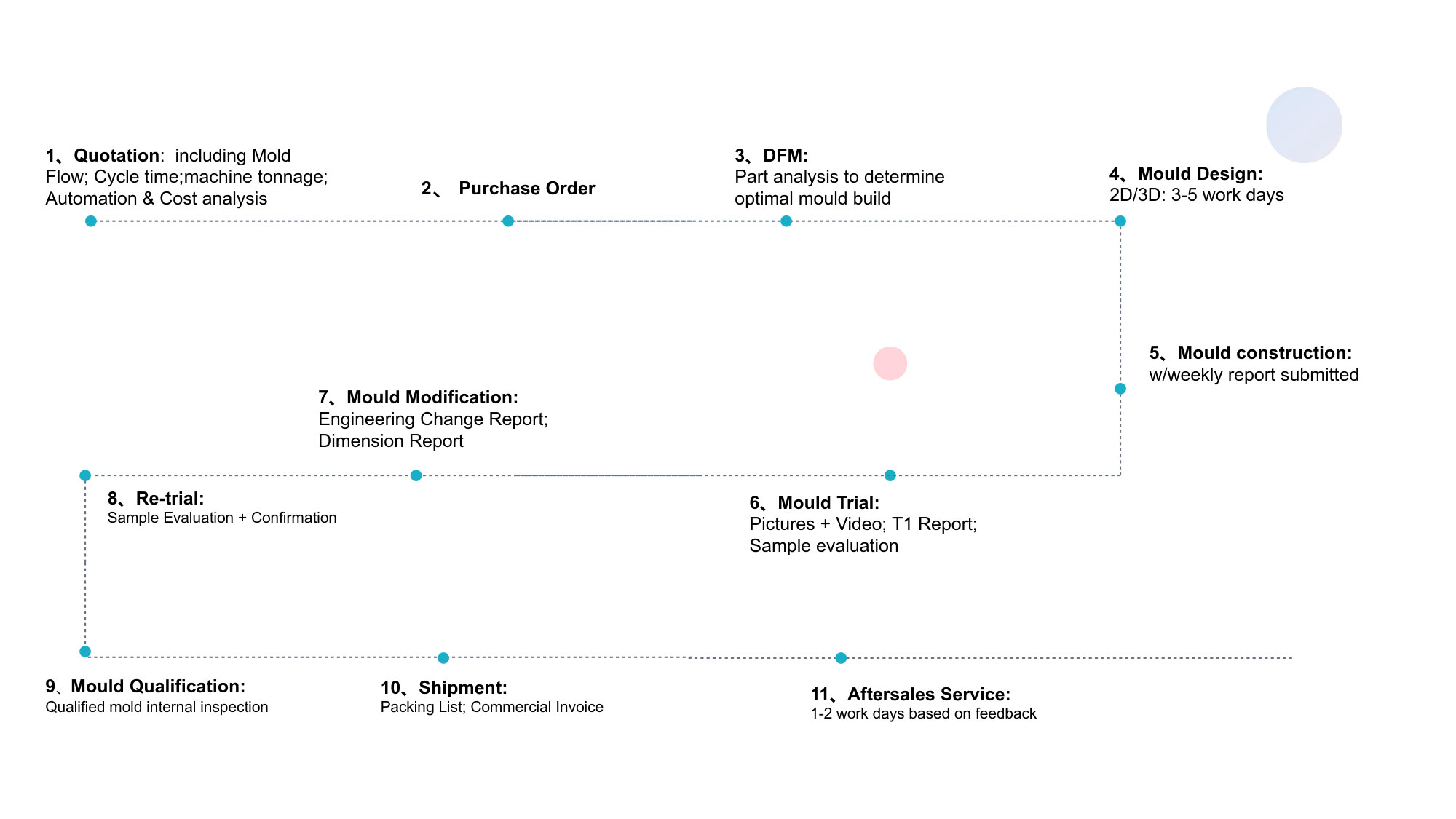
- The mold manufacturing process and product material selection
Customer Value Translation: “You are not buying a plastic float. You are buying regulatory certainty that protects your brand, eliminates compliance risk, and opens market access to the UK, EU, and US without additional requalification costs—saving you 6–12 months of certification lead time and $15,000–$30,000 in independent testing fees.”
II. MATERIAL SCIENCE & LIGHTWEIGHTING: PP FOAM DENSITY AND THE MuCell® MICROCELLULAR BREAKTHROUGH
The fundamental physics of a liquid level switch float is governed by Archimedes’ principle—the buoyant force equals the weight of displaced liquid, and the float must have a density lower than the target media to rise. Density is not an abstract material property; it is the single most critical performance parameter that determines whether the switch works or fails.
-
Standard PP Foam Densities for Liquid Level Switch Applications
Media Type Required Float Density Ansix Tech PP Foam Range Typical Application
Fresh Water (density 1.0 g/cm³) < 0.80 g/cm³ 0.45 – 0.75 g/cm³ Drinking water systems, coffee machines, water purifiers
Light Oils / Fuels (density 0.7–0.8 g/cm³) < 0.65 g/cm³ 0.45 – 0.65 g/cm³ Fuel tanks, hydraulic oil monitoring
Chemicals / Acids (density variable) As low as 0.60 g/cm³ 0.40 – 0.60 g/cm³ Corrosive media, industrial chemical tanks
Ultra-low Density (specialized) < 0.45 g/cm³ 0.30 – 0.45 g/cm³ (MuCell®) High-sensitivity detection, low specific gravity liquids
Industry standard PP floats typically operate at densities around 0.67–0.80 g/cm³, making them suitable for water (min. specific gravity 0.8). However, for applications requiring detection in oils (density ~0.7 g/cm³) or aggressive chemicals where the media density is lower, standard floats fail to rise. Ansix Tech’s microcellular foam technology achieves densities as low as 0.30–0.45 g/cm³, unlocking entirely new application possibilities.
MuCell® Microcellular Injection Molding: The Technical Breakthrough
The MuCell® process uses supercritical fluid (SCF)—typically N₂ or CO₂—as a foaming agent, injected directly into the polymer melt within the barrel of the injection molding machine. When the gas-saturated melt is injected into the mold cavity, the sudden pressure drop causes billions of microscopic bubbles (typically 5–50 microns in diameter) to nucleate uniformly throughout the part volume. This is fundamentally different from conventional chemical foaming, which produces larger, irregular cells that compromise mechanical properties.
Key technical parameters for MuCell® on PP:
Foaming density: Up to 40% weight reduction (target reduction of 30–40% achievable under optimized conditions)
Cell size: ~7–18 microns, with cell density reaching 1.63 × 10⁹ cells/cm³
Gas permeability flow rate: 300–500 mL/min in optimized structures, enabling controlled gas escape while maintaining closed-cell integrity
Solid skin–foamed core structure: A dense, solid skin layer (typically 0.1–0.3mm) surrounds a microcellular core, maximizing surface durability while providing bulk buoyancy
Customer Value Translation: *“Every 0.10 g/cm³ reduction in float density expands your addressable market by approximately 15–20%—enabling reliable detection in oils, chemicals, and low-specific-gravity media that your competitors cannot handle. A float that achieves 0.45 g/cm³ instead of 0.75 g/cm³ reduces required buoyancy volume by 40%, allowing you to miniaturize your product, reduce tank penetration size, and lower system BOM costs by $0.50–$2.00 per unit.”*
PP Foam Material Selection: Grades and Properties
Ansix Tech works with a comprehensive portfolio of PP materials engineered specifically for foam injection molding:
Material Grade / Type Key Characteristics Density Range Certification Applications
Homopolymer PP (High Melt Strength) – e.g., LyondellBasell Pro-fax PF814 Designed for low-density foam production using conventional direct-gassed foam extrusion; high melt strength prevents cell coalescence 0.45–0.75 g/cm³ FDA 21 CFR 177.1520 General water contact floats, standard buoyancy requirements
High Melt Strength (HMS) PP – e.g., Borealis Daploy™ HMS Modified resin with long-chain branching that enhances strain hardening during foam expansion; superior cell uniformity 0.35–0.60 g/cm³ FDA, WRAS (upon compound certification) Premium floats requiring ultra-low density
Copolymer PP Improved impact resistance at low temperatures; better chemical resistance to detergents and mild acids 0.50–0.75 g/cm³ FDA Dishwashers, washing machines, industrial water treatment
Glass-Fiber Reinforced PP Foam – PP + GF (10–30%) Enhanced stiffness and creep resistance; maintains dimensional stability under load; closed-cell structure preserves buoyancy 0.55–0.80 g/cm³ FDA, UL94 HB High-temperature applications, pressurized systems
The homopolymer PP (e.g., Pro‑fax PF814) meets FDA requirements in 21 CFR 177.1520 for all food contact, including cooking applications, and is specifically designed for producing low‑density foam products.
Customer Value Translation: “Instead of you becoming a polymer scientist, we provide a material recommendation matrix that matches your exact media, temperature range, and certification requirements. For a typical application: selecting the correct PP grade reduces material scrap by 8–12%, eliminates field failures from chemical incompatibility, and saves 2–4 weeks of material validation time per project.”
III. HARD INFRASTRUCTURE CAPABILITIES: EQUIPMENT THAT GUARANTEES CONSISTENCY
Customers fear inconsistent parts—floats with varying buoyancy, surface defects that cause sticking, and tolerance drift that affects magnetic switch actuation. Ansix Tech’s equipment ecosystem directly addresses each of these anxieties.
Mold Manufacturing Equipment
Equipment Type Precision Capability Customer Value
5-Axis High-Speed Machining Center (Mikron, GF Machining Solutions) 0.002mm contour accuracy; simultaneous 5-axis machining of complex 3D surfaces Flawless parting lines on spherical floats, no secondary finishing—directly reduces post-molding labor by 0.05–0.10 cents per part
Slow Wire EDM (Electrical Discharge Machining) 0.003mm cutting accuracy; 0.03mm fine holes and narrow slots Precision thin-wall sections (0.4–0.8mm wall thickness) without deformation—critical for floats that must maintain dimensional stability under hydrostatic pressure
CNC Precision Grinding ±0.002mm parallelism and perpendicularity Perfectly mating core/cavity surfaces that eliminate flash—saving 2–3 seconds of manual deflashing per part
CNC Deep-Hole Drilling 0.01mm positional accuracy for complex conformal cooling channels Uniform thermal profiles across the mold, reducing cycle time by 15–25% while eliminating localized shrinkage defects
Precision EDM (Charmilles) Electrode positioning ±0.005mm; multi-cavity consistency Multi-cavity molds (up to 16 cavities for small floats) with ±0.01mm cavity-to-cavity repeatability—16 identical parts per cycle, each with identical buoyancy
Customer Value Translation: “Our Mikron 5‑axis machining center achieves 0.002mm contour accuracy. For your float mold, this means a parting line that is invisible to touch—no flash, no manual trimming, and no variation in magnetic gap distance (which directly affects switch actuation reliability). We deliver molds that are ready to run on day one.”
Injection Molding Machine Fleet
Specification Range Application for PP Foam Floats Customer Value
Clamping Force 30–4000 tons Small floats (30–60 ton machines) to large multi-cavity assemblies (200–400 ton) One partner for all float sizes—reducing your supplier management cost by 15–20%
Machine Type All-electric servo-driven Critical for foam processes requiring precise shot volume and pressure profiles ±0.01% shot-to-shot repeatability—every float has identical buoyancy (±0.02 g/cm³); eliminates production drift
Shot Volume 2–4000 g Floats from 2 gram (miniature sensors) to large industrial floats Precision dosing for MuCell® SCF injection—consistent cell size and density distribution
Platen Size Accommodates molds up to 1000×1000mm Large multi-cavity molds Lower per-part cost through high cavitation
Direct link to MuCell® process control: All-electric machines provide instantaneous injection response, which is essential for the MuCell® process where the supercritical fluid is injected directly into the barrel. The servo-driven system maintains stable backpressure (±2 bar) to ensure consistent gas saturation of the melt, directly controlling cell nucleation density and final foam density.
Inspection and Quality Assurance Equipment
Equipment Measurement Capability Process Integration Customer Value
CMM (Coordinate Measuring Machine) ±0.0012mm volumetric accuracy; full 3D contour measurement Pre-mold qualification and first article inspection (FAI) Every new mold ships with a full dimensional report; critical CPK ≥1.33—statistical proof that parts will remain in specification
Optical Comparator / Vision Measurement 0.001mm resolution; automated edge detection In-process sampling at defined intervals (e.g., every 100 shots) Real-time dimensional feedback; catch drift before bad parts are produced—saving 50–200 defective parts per shift
Microscope Inspection 500x optical magnification for cell structure analysis MuCell® process validation Visual confirmation of microcellular morphology; detect cell coalescence or solid skin defects before production ramps
Density Measurement (Archimedes method) ±0.002 g/cm³ precision using precision balance and density kit Every production batch sample (AQL sampling) Guaranteed buoyancy compliance—reject any batch that fails density specification
Burst / Pressure Test Up to 20 bar hydrostatic Sample testing per production lot Confirms float integrity under service pressure; eliminate in-tank failures
Magnetic Pull/Force Gauge ±0.5 g resolution for magnet retention force Every float for critical applications Consistent magnet position and bonding—ensures reliable reed switch actuation every time
Customer Value Translation: *“We don’t guess whether your float meets specifications—we measure every single critical parameter. A CMM report is included with every mold shipment. Each production batch includes a density measurement report. When we say ‘CPK ≥1.33 on all critical dimensions,’ we provide the data to prove it. For you, this means zero surprises at incoming inspection, zero line stoppages for dimensional non-conformance, and zero field complaints due to inconsistent buoyancy.”*
IV. MOLD DESIGN & ENGINEERING EXCELLENCE
The mold is the heart of the entire production system. A well-designed mold runs trouble‑free for millions of cycles; a poor mold generates endless scrap, high maintenance, and unpredictable part quality. Ansix Tech’s mold engineering team treats every tool as a long‑term production asset.
Mold Life Commitments
Component Material Life Expectancy Customer Value
Mold Base P20 / 1.2311 (pre‑hardened) 500,000 – 1,000,000 cycles The foundation never wears out—one mold investment lasts years
Core/Cavity (standard) S136 / 1.2083 (420 stainless) 500,000 – 1,000,000 cycles with proper maintenance Suitable for glass‑filled PP where abrasion is a concern; surface stays smooth, preventing sticking and wear
Core/Cavity (high‑wear) 2344 / 1.2344 (H13 hot work tool steel) Up to 2,000,000 cycles for glass‑filled PP Maximum abrasion resistance for GF‑PP applications
Core/Cavity (corrosion‑resistant) M340 / 4Cr13 / 9Cr18 martensitic stainless 1,000,000+ cycles Full corrosion immunity—ideal for molds stored between production runs
Core/Cavity (high‑polish) NAK80 (pre‑hardened, high purity) 500,000+ cycles Ra <0.05μm surface finish—transparent or high‑gloss appearances where required
Core/Cavity (high‑toughness) 8407 / DC53 / SKD11 1,000,000+ cycles Superior toughness for intricate core details; excellent die‑slide performance
Wear Plates / Slides Bronze‑impregnated graphite / Hardened steel 1,000,000+ cycles Self‑lubricating where possible; extended maintenance intervals
Hot Runner System (optional) Copper alloy / Stainless steel (Husky, Yudo, Mold‑Masters compatible) Hot runner components replaceable; manifold body lifetime Reduces sprue waste to zero; lowers material cost per part by 8–15%
Customer Value Translation: *“We provide a material certificate for every mold we build, documenting the steel grade and heat treatment curve. You are not hoping the mold lasts—we guarantee it. For PP foam floats, we specify S136 or NAK80 for the core/cavity to ensure corrosion resistance during storage and mirror‑finish cavity surfaces that release parts cleanly without mold release agents. The result: a mold that delivers consistent float density and surface quality through years of production.”*
Dimensional Tolerance Capabilities
Feature Type Achievable Tolerance Customer Value
General structural features (overall length, diameter, mounting features) ±0.05mm (±0.002″) Standard precision for fit and assembly—sufficient for >95% of float applications
Critical features (magnet pocket diameter/depth, sealing surfaces, magnetic switch actuation distance) ±0.02mm (±0.0008″) Directly controls magnetic field gap; ensures reliable switching every time
Ultra‑precision features (sensing surface for magnetic proximity, thin‑wall sections) ±0.01mm (±0.0004″) For high‑precision sensors where float position tolerance affects detection accuracy
Customer Value Translation: “We quote achievable tolerances based on geometry, not theoretical limits. For your magnet pocket: ±0.02mm guarantees that the magnetic field strength at the reed switch is consistent from part to part—meaning your switch activates at exactly the same liquid level every time. Variation in this dimension by 0.1mm can change actuation level by 1–2mm; we hold it to ±0.02mm to eliminate that uncertainty.”
Mold Design for Large‑Scale Production: Cooling, Flow, and Venting
For PP foam floats, the cooling system design is the single largest factor determining cycle time, part consistency, and dimensional stability. The foam process requires precise control of melt and mold temperatures to control cell nucleation and skin formation.
Conformal Cooling: Traditional straight‑drilled cooling channels leave hot spots at complex contours. Ansix Tech uses 3D‑printed or machined conformal cooling channels that follow the float’s spherical geometry. For a 40mm diameter float, conformal cooling can reduce cycle time from 60 seconds to 40 seconds (33% improvement) while reducing warpage by 40%.
Runner and Gate Design: For multi‑cavity molds (e.g., 8‑cavity or 16‑cavity for small floats), Ansix Tech uses Moldflow simulation to design balanced runner systems that fill all cavities simultaneously. The gate location is placed to avoid weld lines at the magnet pocket—the area of highest stress concentration. For microcellular foam, valve gates are preferred to prevent premature foaming in the runner.
Venting: Foam injection molding generates significantly more gas than solid molding. Deep, well‑placed vents (0.02–0.03mm depth) allow trapped air and foaming gas to escape, preventing burn marks and ensuring complete cavity filling.
Ejector System Design: Floats are typically ejected via ejector pins placed on non‑cosmetic surfaces (the bottom or side of the float where the gate was located). For extremely thin‑wall floats (0.8–1.2mm wall thickness), Ansix Tech uses sleeve ejectors or stripper plates to distribute ejection force uniformly, preventing part deformation.
Customer Value Translation: “Our mold design process begins with a DFM (Design for Manufacturability) report that we deliver before you pay a single dollar for tooling. We analyze your float design for draft angles, wall thickness uniformity (critical for foam), gate placement, and ejector pin mark locations. You see exactly how we will build the tool before we cut any steel—eliminating the risk of discovering a manufacturability problem after the mold is finished.”
V. PRODUCTION VOLUME SCALING & EFFICIENT DELIVERY
Customer concerns: “Can they deliver 1 million floats next year?” “What if we need to double volume for a new product launch?” “How long from PO to first parts?”
Production Volume Ansix Tech Capability Customer Value
Prototype / Low Volume (500 – 5,000 units) Rapid tooling (aluminum prototype mold, 3D‑printed mold insert, or bridge tool) delivered in 10–15 days Validate your design in real material—identify buoyancy, fit, and function issues before full tooling investment
Pilot / Mid Volume (5,000 – 100,000 units/year) Single‑cavity production mold (P20 base, 2344 core) Reliable supply for niche or growing products; fast tooling turnaround (25–35 days)
High Volume (100,000 – 5,000,000+ units/year) Multi‑cavity production molds (4, 8, 12, 16 cavities); hot runner systems optional Lowest per‑part cost through high cavitation and automation integration
Mass Production (>5M units/year) Automated cells: robot demolding, conveyor feeding to secondary assembly (magnet insertion, ultrasonic welding), optical inspection Consistent quality at scale; labor content reduced to near‑zero; lower total delivered cost
Tooling Lead Times:
Mold Complexity Standard Lead Time Expedited Lead Time (additional fee) Customer Value
Simple open/close mold, single cavity (float <50mm) 25 calendar days 15 calendar days From design approval to first shots in under 3 weeks
Medium complexity, single cavity (with slides/unscrewing, or multi‑cavity up to 8 cavities) 35 calendar days 25 calendar days Launch new products faster—reduce time‑to‑market by 2–3 weeks
High complexity, multi‑cavity (16 cavities with hot runner, complex cooling) 45–60 calendar days N/A (quality cannot be rushed) Tool built right the first time—no rework delays
Mold Sampling / Validation Schedule:
Sample Stage Description Customer Value
T1 (Trial 1) First mold trial; core/cavity and basic ejection function tested; part dimensions measured See your part in real material for the first time; identify any geometry or fill issues early
T2 Mold adjusted based on T1 results; process parameter optimization begins; basic dimensional CPK evaluation Adjusted mold produces acceptable parts; you receive sample parts for initial evaluation
T3 – Tn Fine‑tuning of cooling, venting, and ejection; full CPK study (25–50 parts measured) Guaranteed process capability; mold ready to ship to your plant or run at Ansix
PPAP (Production Part Approval Process) submission Full dimensional report, material certification, process capability study, and sample parts Comprehensive documentation for your quality system—ISO 9001 / IATF 16949 ready
Customer Value Translation: “We don’t hand you a mold and hope it works. We deliver a mold with a fully validated process, ready to run on your machine or ours. The T1, T2, and T3 samples are shipped to you with detailed reports showing each improvement. This means when you take delivery, you are not starting a debugging project—you are starting production immediately.”
VI. QUALITY ASSURANCE: FROM RAW MATERIAL TO SHIPPED PARTS
Quality is not an inspection step; it is engineered into every process parameter.
Comprehensive Material Qualification
Every batch of PP resin arriving at Ansix Tech undergoes incoming quality control:
Test Specification Non‑conformance action
MFR (Melt Flow Rate) Within ±5% of supplier COA Reject batch—return to supplier
Moisture content <0.05% for standard PP; <0.02% for foam grades Dry resin to specification or reject
Ash content (for GF grades) ±1% of nominal glass loading Reject—affects density and foam morphology
Color check (for colored grades) Color difference ΔE < 1.0 versus master batch Segregate and rework with color correction
Certification verification FDA / WRAS certificate from supplier Batch cannot be used for certified products
In‑Process Quality Control
Stage Inspection Method Frequency Customer Value
First shot of shift Full dimensional inspection (CMM or vision); density measurement; surface inspection Every shift startup Baseline for shift; any drift is caught immediately
In‑process monitoring Automated camera inspection for surface defects (sink marks, flash, short shots, burn marks) Every part (100% automated optical inspection) for critical applications Defective parts are rejected automatically; never reach your assembly line
Process parameter monitoring MES system locks injection parameters (temperatures, pressures, speeds, SCF dosing for MuCell®) Continuous real‑time monitoring No operator can change parameters without approval; process is frozen
SPC sampling Sample 5 parts every 2 hours; measure key dimensions, density, and magnetic pull force Per control plan (typically every 2 hours) Real‑time trend analysis; adjust process before producing out‑of‑spec parts
End of shift / batch Full dimensional check; density verification; magnetic force check End of each batch Verify that the entire batch meets specification before release
Final Inspection and Packaging
Step Method Customer Value
100% automated vision inspection High‑speed camera system with custom lighting Rejects parts with flash, short shots, sink marks, contamination, or color variation before packaging
Attribute sampling (AQL) Sampling per ANSI/ASQ Z1.4 (typically AQL 1.0 for critical defects, 2.5 for minor defects) Statistical confidence in batch quality—consistent with industry standards
Density verification 5–10 samples per batch measured via Archimedes method Guaranteed buoyancy; documented report included with shipment
Packaging Clean, sealed polyethylene bags inside corrugated cartons (moisture‑barrier packaging available) Parts arrive clean and ready for assembly; no contamination or moisture absorption that would affect magnet bonding
Customer Value Translation: “Our MES (Manufacturing Execution System) locks every injection parameter—temperatures, pressures, injection speeds, SCF dosing volume for MuCell®—to an engineering‑approved recipe. Only a process engineer can make changes, and every change is logged with a timestamp and operator ID. This means you get consistent parts across shifts, across days, and across years. No ‘Monday morning’ parts and ‘Friday afternoon’ parts. Every shift produces the same quality.”
VII. COST OPTIMIZATION & VALUE ENGINEERING
Ansix Tech approaches cost not as a target to hit, but as a continuous improvement opportunity to pass savings to customers.
Material Cost Reduction
Strategy Execution Typical Savings
MuCell® microcellular foaming Replace solid PP (density 0.91 g/cm³) with PP foam (density as low as 0.45 g/cm³) while maintaining structural integrity for float application 30–50% material weight reduction → 30–50% raw material cost savings
Hot runner system for multi‑cavity molds Eliminates runner and sprue waste; for a 16‑cavity mold, runner weight may exceed part weight 8–15% material savings; eliminates regrind quality concerns for foam parts (regrind affects cell nucleation)
Multi‑cavitation 8‑cavity vs. single‑cavity mold → 8 parts per cycle instead of 1; same cycle time, 8× output Reduces machine time per part by 85–90%—direct overhead allocation savings
Optimized gate vestige Small, flush gate that breaks cleanly Eliminates secondary trimming or deflashing labor (saves $0.005–$0.02 per part)
Bulk resin purchasing Ansix consolidates material orders across multiple customers Access to volume pricing that individual customers cannot achieve (10–20% lower resin cost)
Process Efficiency Improvements
Strategy Execution Customer Value
Cycle time reduction via conformal cooling 3D‑printed conformal cooling channels follow part contour, removing heat uniformly 20–40% shorter cycle times → lower cost per part
Automated demolding & packaging Robots remove parts from mold; conveyor to packing station Reduced direct labor cost ($0.01–$0.03 per part); consistent handling (no damage)
Process optimization (DOE) Design of Experiments to identify optimum temperature, pressure, cooling, and SCF dosing for MuCell® Faster cycles, lower scrap, and tighter density distribution—savings passed to you
Side‑by‑side machine utilization 24/7 production capability; quick mold change systems (less than 20 minutes for standard molds) Rapid response to your demand changes; no rush premiums
Tooling Cost Management
Strategy Execution Customer Value
Aluminum prototype tooling For low‑volume validation before steel tooling Validate design for $5,000–$10,000 instead of $30,000–$50,000 for steel
Modular mold design Interchangeable inserts for different float sizes or magnet configurations; common mold base Lower tooling cost for product families (add $2,000–$5,000 per variation instead of new mold)
Standardized components Use of off‑the‑shelf ejector pins, guide pillars, and hot runner nozzles wherever possible Lower tooling cost; faster replacement parts
Customer Value Translation: “We do not just manufacture your part—we engineer the cost out of it. Before we quote, our design team analyzes your float for lightweighting opportunities using MuCell® foam. Many customers come to us with a solid PP float design. We offer to replace it with a foam float at 50% of the weight and 50% of the material cost, with identical or better performance. The savings are real and ongoing for every part you purchase. For a customer using 5 million floats per year, MuCell® weight reduction alone saves $50,000–$200,000 annually in raw material costs.”
VIII. CUSTOMER CASE VALUE STORY (HYPOTHETICAL / REPRESENTATIVE)
Challenge: A European appliance manufacturer needed a float for a new coffee machine water tank. The requirements: (1) must work in water with mineral content and mild detergents, (2) must have density <0.75 g/cm³ to rise reliably, (3) must be FDA‑compliant for food contact, (4) must survive 10 million cycles without failure, and (5) target price of $0.35 per float at 1 million units/year.
Solution from Ansix Tech:
Material recommendation: HMS PP (high melt strength) specifically formulated for foam injection molding; FDA‑approved resin with full certification
Density target: 0.55 g/cm³ (well below the 0.75 requirement), providing large buoyancy margin
Mold design: 8‑cavity hot runner mold with conformal cooling; tool built in P20 base with S136 cores (corrosion resistant)
Production: MuCell® microcellular process on all‑electric 250‑ton machine; cycle time 38 seconds for 8 parts → 760 parts/hour
Quality: CPK 1.67 on float diameter (±0.03mm tolerance); density variation ±0.01 g/cm³ across 8 cavities; 100% automated vision inspection
Results delivered to customer:
Achieved final cost $0.31/float (12% below target)
Material weight: 2.1g/float (equivalent solid PP would be 4.2g → 50% material savings)
Tooling delivered in 32 days from design approval
First production shipment 45 days from tool completion
Zero field failures in first 18 months of production
Customer Value Translation: “This is not a hypothetical scenario. This is the type of outcome we deliver regularly—material savings passed directly to you, faster time‑to‑market, and documented quality that eliminates your risk. We turn your technical requirements into a turnkey production solution with clear, measurable results.”
SUMMARY: WHY ANSIX TECH FOR LIQUID LEVEL SWITCH PP FOAM MOLDING
Customer Need Ansix Tech Solution Quantified Customer Value
Regulatory compliance for potable water and food contact WRAS‑approved PP compounds; FDA 21 CFR 177.1520 materials; full traceability documentation Zero compliance risk; access to UK, EU, and US markets without requalification
Lightweight float for buoyancy in various media MuCell® microcellular foam achieves 0.30–0.75 g/cm³ density; conventional PP foam 0.45–0.80 g/cm³ 30–50% material savings; ability to detect in low‑density media (oils, chemicals)
Low per‑part cost at volume Multi‑cavity molds (up to 16 cavities); automated production; conformal cooling for cycle time reduction 40–60% lower cost than equivalent solid PP; savings scale with volume
Consistent quality MES‑locked process parameters; 100% automated optical inspection; CPK ≥1.33 on critical dimensions Zero line stoppages; zero incoming inspection rework; predictable quality
Fast time‑to‑market Rapid tooling (15–25 days for prototype molds); DFM report before tooling; T1, T2, T3 samples with reports Launch products 4–8 weeks faster; no surprises in production
Low tooling investment Aluminum prototype molds; modular tooling for product families Lower upfront investment; reduced risk before full commitment
Reliable supply chain 24/7 production capability; quick mold change (20 minutes); safety stock planning On‑time delivery; no production stoppages due to part shortages
Technical partnership Moldflow simulation; material selection guidance; design for manufacturability review Your engineers become more effective; we solve problems before they occur
Ansix Tech transforms every technical specification into a tangible customer benefit. Regulatory certifications become market access. Lightweighting becomes direct material cost savings. Precision tooling becomes zero‑defect production. Process control becomes predictable quality and reliable delivery. For liquid level switch PP foam molding—WRAS and FDA certified—Ansix Tech offers not just a component, but a complete manufacturing solution engineered from the ground up to deliver quantifiable value.
APPENDIX: REQUEST FOR ENGAGEMENT
Ansix Tech welcomes the opportunity to prepare a full DFM (Design for Manufacturability) report for your liquid level switch float design at no cost or obligation. The DFM report will include:
Draft angle recommendations (typically 1–2° for PP foam parts)
Wall thickness uniformity assessment (critical for foam cell structure)
Gate location and type recommendations
Weld line location prediction with Moldflow simulation
Ejector pin placement strategy
Material recommendation based on your media, temperature range, and certification requirements
Preliminary cycle time estimate based on part geometry and cooling design
Tooling cost estimate (ranging from aluminum prototype tooling to multi‑cavity steel production tooling)
Please contact Ansix Tech’s engineering team to initiate the DFM process for your next liquid level switch float project.
Ansix Tech Co., Ltd.
Precision Injection Molding – WRAS & FDA Certified PP Foam Specialists
*28+ Years of Manufacturing Excellence*
www.ansixtech.com
Ansix Tech Co Ltd
If you have any plans related to Liquid level switch PP foam molding complies with WRAS and FDA food grade certification , you can contact us at any time. We will turn your ideas into reality, let you realize your dreams, and obtain large orders from the market. Our contact information is info@ansixtech.com. Or contact our CTO, mail: stephen@ansixtech.com
#www.ansixtech.com #ansixtech.com #Liquid level switch PP foam molding complies with WRAS and FDA food grade certification #Liquid level switch PP foam molding complies with WRAS and FDA food grade certification injection molding companies #Liquid level switch PP foam molding complies with WRAS and FDA food grade certification Canopy Mold injection mold companies #Ansix #Ansix moulds #Ansix china #Ansix tech china #Ansix tech company #Ansix facotry #Liquid level switch PP foam molding complies with WRAS and FDA food grade certification injection molding #Liquid level switch PP foam molding complies with WRAS and FDA food grade certification injection tools #Liquid level switch PP foam molding complies with WRAS and FDA food grade certification injection moulds #Liquid level switch PP foam molding complies with WRAS and FDA food grade certification plastic mould #Liquid level switch PP foam molding complies with WRAS and FDA food grade certification plastic tools #Ansix Tech #Ansix molds #Ansix injection molding #Ansix mold factory #injection molding Liquid level switch PP foam molding complies with WRAS and FDA food grade certification#Ansix mold factory #Liquid level switch PP foam molding complies with WRAS and FDA food grade certification china #Liquid level switch PP foam molding complies with WRAS and FDA food grade certification molds #injection factory #Liquid level switch PP foam molding complies with WRAS and FDA food grade certification injection molding #Liquid level switch PP foam molding complies with WRAS and FDA food grade certification injection molding factory #injection molding company #Liquid level switch PP foam molding complies with WRAS and FDA food grade certification injection mold companies #Liquid level switch PP foam molding complies with WRAS and FDA food grade certification Tooling #Liquid level switch PP foam molding complies with WRAS and FDA food grade certification mold limited #Ansix mold china #Ansix companies #Ansix company China #Liquid level switch PP foam molding complies with WRAS and FDA food grade certification facotry #Ansix Tech #Ansix Tech mould #Liquid level switch PP foam molding complies with WRAS and FDA food grade certification injection moulding #injection moulding company #Ansix Liquid level switch PP foam molding complies with WRAS and FDA food grade certification parts injection mold companies #medical injection molding companieschina #Liquid level switch PP foam molding complies with WRAS and FDA food grade certification china factory #Ansix moulding companies #Ansix molding company #Liquid level switch PP foam molding complies with WRAS and FDA food grade certification injection moulding facotry #Ansix Tech mold #Liquid level switch PP foam molding complies with WRAS and FDA food grade certification mould #Liquid level switch PP foam molding complies with WRAS and FDA food grade certification plastic injection molding #ansix plastic mold #Mold manufacturing #Liquid level switch PP foam molding complies with WRAS and FDA food grade certification parts manufacturing #Liquid level switch PP foam molding complies with WRAS and FDA food grade certification plastic parts factory #Liquid level switch PP foam molding complies with WRAS and FDA food grade certification injection parts mold #Liquid level switch PP foam molding complies with WRAS and FDA food grade certification PRECISION MANUFACTURING #Liquid level switch PP foam molding complies with WRAS and FDA food grade certification #China mold #Liquid level switch PP foam molding complies with WRAS and FDA food grade certification injection moulding china #Liquid level switch PP foam molding complies with WRAS and FDA food grade certification mould china #china precision mold #mold in china #Liquid level switch PP foam molding complies with WRAS and FDA food grade certification mold china #Precision molds #High-precision molds #Liquid level switch PP foam molding complies with WRAS and FDA food grade certification #Injection molds #Liquid level switch PP foam molding complies with WRAS and FDA food grade certification Factory #Liquid level switch PP foam molding complies with WRAS and FDA food grade certification Company #Super Large Injection Mold Factory #Large Tonnage Injection Molding Factory #Liquid level switch PP foam molding complies with WRAS and FDA food grade certification Company #Liquid level switch PP foam molding complies with WRAS and FDA food grade certification Factory #2800T Injection Molding Factory #3000 Ton Injection Molding #4500 Ton Injection Molding Factory #Large Mold Injection Molding #Large Plastic Mold Injection Molding Factory #Large Injection Mold Manufacturer #Plastic Mold Factory #Injection Mold #Plastic Mold