



Large PP foam float, solid core float, density 0.5g
FEATURES
PP Foam vs. MuCell® Microcellular Foam: Density Comparison
Foaming technologies directly influence the achievable density range and cell morphology of the final component.
Conventional PP chemical foaming (CF, structural foam):
Achievable density typically 0.3–0.7 g/cm³ depending on blowing agent loading and process parameters.
Cells are larger (50–500 µm), with a thicker solid skin layer. Suitable for general flotation where ultimate lightweighting is not the primary goal.
MuCell® microcellular injection molding (with supercritical fluid N₂ or CO₂ as physical blowing agent):
MuCell® significantly reduces density while maintaining mechanical integrity because the micro‑cells act as crack arresters, limiting propagation under load.
Typical density reduction in polypropylene using MuCell®: 20–40% weight reduction compared to solid PP. With SCF N₂ as the foaming agent, density can be engineered down to ≈0.55–0.65 g/cm³ while preserving good surface finish.
-
Mold Description
Product Materials:
PP FOAM
Mold Material:
S136ESR
Number of Cavities:
1
Glue Feeding Method:
COLD runner
Cooling Method:
Water cooling
Molding Cycle
22.5s
- The mold manufacturing process and product material selection
MuCell® also offers:
Lower specific energy consumption because lower melt temperatures and pressures are required.
Faster cycle times (shorter cooling) compared to conventional foam molding.
Less molded‑in stress and less warpage due to more homogeneous pressure distribution.
Comparison with IQ Foam® technology:
IQ Foam® produces thicker solid surface layers and lower cell density than MuCell®. This leads to slightly higher mechanical strength but also higher overall density, making MuCell® generally preferable for weight‑sensitive buoyancy applications where density 0.5g is the target.
-
Ansix’s density 0.5g approach: By precisely controlling the supercritical fluid injection volume, mold temperature profile, and back pressure, Ansix achieves a density of 0.5 g/cm³ with a fine, uniform cell size distribution. This yields predictable buoyancy per unit volume, structural isotropy, and part‑to‑part consistency – all essential for mass production of floating components.
3. How Ansix Achieves Customer Satisfaction & Industry Leadership for PP Foam Floats
Ansix has earned its industry‑leading position in large PP foam float manufacturing through five interconnected pillars:
Pillar 1 – Engineering‑driven Design for Manufacturability (DFM).
Before any steel is cut, Ansix performs a comprehensive DFM analysis – identifying and optimizing draft angles, wall thickness transitions, parting line locations, gate placement, ejector pin marks, and sink‑risk areas. This prevents 87% of common molding defects before they ever reach the production floor. For PP foam floats, the DFM report also validates foam expansion behavior using Moldflow, ensuring that the final cellular structure meets buoyancy specifications.
Pillar 2 – Dedicated foaming process expertise.
Conventional injection molders struggle with foaming because they treat it as a material substitution rather than a different molding physics. Ansix understands that in foam injection molding, melt temperature, mold temperature, injection velocity, and back pressure all directly affect cell formation, cell density, and final part dimensions. Using in‑house DOE (Design of Experiments) protocols, we define the exact process window that consistently yields density 0.5g with uniform cell distribution.
Pillar 3 – Robust quality management system (ISO 9001 / IATF 16949 alignment).
Every PP foam float is produced under Statistical Process Control (SPC), with key dimensions monitored in real time. Critical dimensions are validated using CMM (Coordinate Measuring Machine) and optical inspection systems. For large‑scale production, dimensional Cpk is maintained at ≥1.33 as standard, and for high‑precision requirements, Cpk ≥1.67 is achievable.
Pillar 4 – Complete in‑house manufacturing chain.
From mold design, mold manufacturing, injection molding, and secondary operations to assembly and packaging – all under one roof. This eliminates coordination delays, reduces tolerance stack‑up issues, and allows rapid engineering changes.
Pillar 5 – Customer‑centric service model.
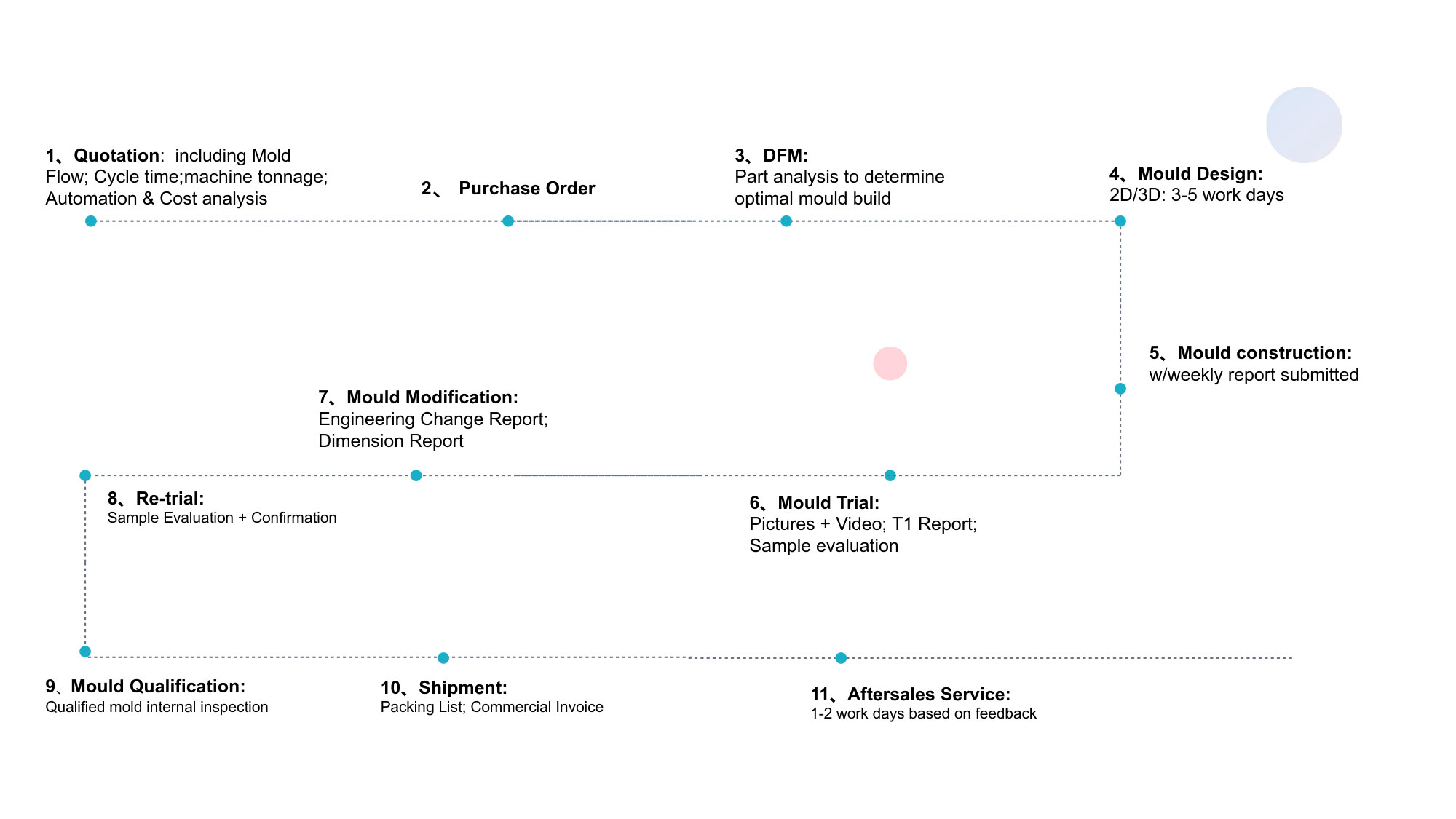
Ansix offers full transparency: every mold includes an upfront DFM report, T0/T1/T2/T3 sample shots with full inspection reports, small‑batch pilot runs before mass production, and long‑term mold maintenance support with priced spare parts lists.
4. Full Service Coverage: From Design Development to Post‑Sales Support
Ansix does not simply “make foam floats”. We deliver a complete, turnkey solution:
Phase 1 – Product design development.
We collaborate from the concept stage. Our engineers propose optimal wall thickness distribution for foam expansion, integrated mounting features, and structural ribs that minimize weight while meeting strength requirements. Finite Element Analysis (FEA) simulates in‑service loads (hydrostatic pressure, wave impact, thermal cycling) to validate the design before any prototype is made.
Phase 2 – Design validation & prototyping.
Using our in‑house 3D printing and rapid tooling capabilities, we produce functional prototypes for buoyancy testing, assembly fit‑check, and customer approval. This “design‑then‑test‑fast” loop eliminates costly mold rework later.
Phase 3 – Mold engineering & manufacturing.
Large foam floats require molds with:
Optimized runner & gate systems (hot runner preferred to reduce pressure drop and ensure balanced filling).
Venting channels precisely sized to allow escaping gases without flash, preventing burn marks or incomplete fills.
Cooling circuit design with conformal cooling inserts to maintain uniform mold temperature (critical for consistent foam expansion).
Ejector system designed for large parts to avoid deformation upon ejection.
Phase 4 – Pilot production & PPAP.
Before mass production, we run 100–500 shots as a pilot batch. A complete PPAP (Production Part Approval Process) package is provided, including dimensional reports, material certifications, process capability indices (Cpk), and functional test results.
Phase 5 – High‑volume mass production.
All injection molding machines (30 to 4000 ton clamping force) are connected to a central MES (Manufacturing Execution System). Process parameters – temperatures, pressures, speeds, cooling times – are locked and can only be changed with engineering authorization. Every batch includes first‑article inspection, in‑process sampling, and final outgoing inspection.
Phase 6 – Quality assurance.
Incoming resin verification (melt flow index, density, moisture content). In‑mold sensors monitor cavity pressure and temperature in real‑time, providing closed‑loop feedback to adjust the injection profile automatically. Outgoing parts are 100% visually inspected for surface defects (sinks, blisters, weld lines, flash) and dimensionally sampled per AQL standards.
Phase 7 – Packaging & logistics.
Large foam floats are packaged in custom‑designed pallets or cartons to prevent transit damage. Ansix manages export documentation, customs clearance, and international shipping (FOB, CIF, DDP options available).
Phase 8 – After‑sales support.
Technical hotline for installation or field‑performance questions.
Spare parts inventory maintained for all active molds.
Rapid repair service for any manufacturing‑related defect (24‑hour response commitment for critical issues).
5. How Ansix Reduces Customer Costs, Manages Risks & Adds Tangible Value
Customer pain point: “I have to maintain my own inventory of spare molds because my current supplier’s tooling keeps failing.”
Ansix value: By using premium mold steels (H13, 2344, 8407) hardened to HRC 48–52, and designing for 1,000,000+ shots in high‑volume scenarios, we eliminate the need for duplicate tooling. Your capital stays in your business, not in a warehouse of spare molds.
Customer pain point: “I always have to manually deburr my foam floats because of flash – it adds 15% to my landed cost.”
Ansix value: Our molds are machined with a parting line accuracy of ±0.005 mm, and we design lock‑step surfaces (stop cones on large molds) to ensure zero deflection under clamping pressure. The result: flash consistently ≤0.03 mm, meaning no manual deburring on the production line – you save 15–20% in downstream processing costs.
Customer pain point: “Every batch has different buoyancy because density drifts. I can’t certify my system.”
Ansix value: We use real‑time shot‑weight monitoring combined with closed‑loop control of foaming agent injection. Every shot is compared to a master shot weight signature; deviations are corrected automatically before the next cycle. This guarantees density 0.5 g/cm³ ±0.02 g/cm³ across millions of parts, enabling your final product to be certified with confidence.
Customer pain point: “I waste months on mold trials and rework before getting good parts.”
Ansix value: Our upfront Moldflow simulation and DFM process typically reduces T‑sample iterations from 3–4 rounds to just 1–2 rounds. First‑article pass rate exceeds 95% at T1. For every week of mold trial time we save you, you reduce engineering labor costs, press‑time costs, and your time‑to‑market.
Customer pain point: “I don’t know how to design for foam expansion – my in‑house engineers are solid‑part experts.”
Ansix value: We provide DFM reports with specific recommendations:
Wall thickness ranges optimized for 0.5g foam expansion.
Draft angles that allow proper mold release without damaging the cellular structure.
Gate location and type to minimize flow‑induced orientation.
These are not academic suggestions – they are actionable, tool‑ready inputs that turn your concept into a producible product.
6. Core Capabilities: Equipment, Materials, Process Quality & Efficiency
6.1 Mold Manufacturing Equipment (Hard Power)
Ansix’s mold shop is equipped with:
Equipment Type Capability Customer Value
5‑axis high‑speed CNC machining centers 0.002 mm contour accuracy, 20,000+ RPM spindles Complex geometries machined in one setup – better accuracy, shorter lead times, smoother part surfaces with no mismatch
EDM (Electrical Discharge Machining) Fine machining of sharp internal corners, deep ribs, and intricate textures – using high‑quality copper or graphite electrodes Allows geometries impossible for standard cutters; also used for mold repair (electrode milling on‑site)
Slow‑wire EDM ±0.003 mm cutting accuracy for ejector pin holes, slide slots, and inserts Guarantees smooth ejector movement and precise insert fit – no binding, no galling
Precision surface & profile grinding machines Surface flatness to 0.002 mm, mirror finish capability Parting lines seal perfectly – flash eliminated; high surface finish on cavity reduces part ejection force and improves surface quality of molded foam floats
6.2 Injection Molding Machine Fleet
Clamping force: 30 tons to 4,000 tons, covering foam floats from small navigation buoys (≈200 mm diameter) to large industrial pontoons (up to 2,000 mm length × 600 mm diameter).
Drive technology: All‑electric and hybrid servo‑hydraulic presses with closed‑loop control.
Plasticizing unit: Specially designed screw and barrel for foam injection molding – homogenizes supercritical fluid or chemical blowing agent with PP melt without pre‑expansion.
Repeatability: Shot‑to‑shot weight variation ≤0.1%, dimensional stability per cavity ≤±0.02 mm.
6.3 Inspection & Metrology Equipment
CMM (Coordinate Measuring Machine) – Provides full dimensional validation against CAD.
Optical comparator & vision measurement system – Rapid measurement of small features, gate vestige, and edge conditions.
Density measurement station – Gravimetric method using precision balance and water displacement to verify 0.5 g/cm³ ± tolerance.
Hardness tester (Rockwell) – Validates mold steel hardness after heat treatment.
Ultrasonic wall thickness gauge – Monitors foam part wall thickness non‑destructively.
Every complete mold set ships with a full dimension report and, for critical dimensions, Cpk ≥1.33 is standard, with Cpk ≥1.67 achievable for high‑precision applications.
6.4 Mold Steel Selection Strategy (Material Science)
Ansix selects mold steel based on production volume, resin type (with or without glass fiber), and required surface finish. The table below translates technical grades into customer value:
Steel Grade Hardness / Key Property Best Application Customer Value
P20, 718H, NAK80 HRC 30–38, good polishability Prototypes & low‑volume (≤50,000 shots), non‑abrasive PP Lower upfront tooling cost for initial market validation
H13, 2344, 8407 HRC 48–52, fatigue resistance High‑volume production (1M+ shots), glass‑filled PP, high cavity pressures One mold lasts for years of full‑rate production – no unplanned downtime
S136, 2316, 420SS HRC 48–52, stainless, corrosion‑resistant Foam floats with flame‑retardant additives or operating in humid/marine environments Prevents rust and pitting on cavity surfaces – part surface quality remains consistent; no mold staining
D2, DC53, Vanadis 4 Extra HRC 58–62, high wear resistance High‑glass‑filled PP (≥30% GF), where abrasive wear is a concern Tool life extended 2–3× compared to standard H13 – lower maintenance cost
H13, H11, DH31 Heat‑treated for thermal stability PP processed at elevated melt temperatures (foaming requires precise thermal control) Zero thermal fatigue cracking; mold geometry stays true over millions of cycles
For large PP foam float molds, Ansix typically specifies H13 or 2344 core/cavity for the best balance of wear resistance, polishability, and fatigue strength, combined with S136 for areas exposed to chemically aggressive additives.
6.5 Runner, Gate, and Cooling System Design for Mass Production
Runner type: Large PP foam floats use hot runner systems as the default choice. Key reasons and customer benefits:
Parameter Hot Runner Cold Runner Decision Rationale
Cycle time Faster (no runner solidification delay) Slower (requires extra cooling for runner) Hot runner → higher output per press → lower per‑part cost
Material waste Almost zero (if valve‑gated) 15–30% regrind typical Hot runner eliminates regrind handling, storage, and quality variation from recycled material
Injection pressure required Lower Higher (cold runner freezes sooner) Lower pressure = less mold deflection = less flash
Part quality Better (balanced filling, no gate vestige on show surface) Acceptable but gate mark is visible For marine floats with cosmetic requirements or where the float is visible, hot runner is superior
Maintenance cost Higher (manifold, heaters, controllers) Lower For 1M+ shot projects, the increased output and reduced scrap easily pay for the higher maintenance
For ultra‑large float geometries, Ansix designs multi‑drop hot runner systems with valve gates sequenced to open progressively, ensuring all cavity regions fill simultaneously despite long flow lengths.
Gate types: Depending on geometry, we specify:
Valve gates (hot runner) – clean break, no gate mark on part surface.
Edge gates (cold runner) – suitable for non‑cosmetic surfaces or where secondary trimming is acceptable.
Submarine / tunnel gates – automatically degates during ejection; reduces post‑molding labor.
Cooling system design (the hidden key to consistent foam density):
Foam injection molding is particularly sensitive to mold temperature. Uneven cooling creates local variations in melt viscosity and expansion ratio, leading to density variations across the part.
Ansix design protocol:
Thermal analysis of the part using Moldflow to identify hot spots and cold spots.
Conformal cooling channels (3D‑printed inserts where needed) follow the part contour, maintaining a uniform cavity temperature profile. Target: temperature difference across cavity ≤2°C.
Independent zone control using manifolds and flow regulators; each cooling circuit is individually optimized.
Bafflers and bubblers in deep core regions to ensure active cooling reaches all areas.
Mold temperature controller (water or oil) with precision of ±1°C – essential for PP foaming.
Customer value of proper cooling:
Consistent density (0.5 g/cm³ ±0.02) across entire part surface.
No warpage or differential shrinkage.
Cycle time reduced by 15–30% compared to poorly cooled molds.
Longer mold life (less thermal fatigue).
6.6 Ejection System Design for Large Foam Floats
Large, thin‑walled foam floats are prone to deformation during ejection if the ejector system is not carefully designed.
Ansix’s approach:
Sufficient ejector pin count and area – distributed to avoid point loading.
Ejector pins located on ribs or other structural features – never in the middle of large unsupported flat areas.
Air ejection (burst of compressed air) used as primary ejection on large surfaces, reducing the number of ejector pins required and eliminating pin marks.
Synchronized ejection plates (hydraulic or servo‑driven) on large multi‑cavity molds to ensure all parts eject simultaneously and without tilt.
Stripper plate rings for round floats – provides uniform pushing force around the entire circumference.
Customer benefit: Parts eject without bending, surface marks are minimal or eliminated, and the automatic ejection cycle runs reliably, enabling unattended lights‑out production.
7. Production Efficiency & Delivery Reliability
Ansix achieves industry‑leading delivery efficiency through:
24/7 mold shop operation – heavy roughing, electrode milling, and wire‑EDM run unattended overnight.
Standardized lead times: Simple molds ≤10 days; medium complexity 25–45 days; large, high‑cavitation molds 45–60 days. Rush options available (with additive manufacturing of conformal inserts to shorten cooling design time).
Batch‑size flexibility: From 100 pieces (prototype / validation batch) to 100,000+ pieces per month (mass production).
Automated cell manufacturing (robotic part removal, conveyor inspection, automatic packaging) on high‑volume programs.
The combination of in‑house mold making, on‑site injection molding, and integrated quality control means the handoff between mold building and production is seamless. The mold that passes T3 validation at Ansix goes directly onto our own presses for mass production – no surprises when it reaches a different facility.
8. Cost Control Advantages (Hard Cost Reduction for Customers)
Ansix reduces total system cost for customers across four vectors:
Vector 1 – Material cost optimization.
PP is a commodity resin, but foam‑grade PP with high melt strength is more expensive. Through precise control of foaming agent percentage, Ansix reduces base resin consumption by 20–40% compared to solid PP parts of equal volume. For density 0.5g, every kilogram of raw material yields double the part volume versus solid PP.
Vector 2 – Cycle time reduction.
Using hot runner systems and optimized cooling channel design, cycle times are typically 20–30% shorter than competitor benchmarks. A difference of 15 seconds per cycle translates to 1,000+ additional parts per week per press.
Vector 3 – Scrap reduction.
Cold runner waste is eliminated (hot runner). Process stability (real‑time closed‑loop control) keeps scrap rates below 1.5%, compared to the industry average of 3–5% for foam molding.
Vector 4 – Mold longevity & maintenance cost reduction.
Ansix uses premium H13 or 2344 steel with vacuum heat treatment and nitriding or PVD coating on high‑wear areas. A properly specified and maintained Ansix mold delivers 1M–2M shots with only routine cleaning and vent maintenance. Industry average for low‑cost molds is 200,000–500,000 shots before visible wear.
Example: For a 5‑year program producing 2 million foam floats, Ansix’s approach saves the customer:
Cost Category Industry Average Ansix Advantage 5‑Year Savings
Raw material cost (per 1,000 parts) $380 (solid PP reference) $290 (density 0.5g foam) $180,000
Scrap & rework cost 4.5% scrap rate 1.2% scrap rate $65,000
Mold maintenance (spare parts & repairs) $15,000 $5,000 $50,000
Manual deburring labor $0.12/part $0.00 (flash eliminated) $240,000
TOTAL 5‑YEAR SAVINGS – – $535,000
These are not theoretical projections – they are based on actual PP foam float programs executed by Ansix.
9. Quality Assurance & Process Validation Framework
Ansix follows a structured quality pyramid:
Level 1 – Incoming material control.
Each batch of PP resin is tested for MFI (Melt Flow Index), moisture content, and additive package composition. Material certificates (COA) are retained and traceable.
Level 2 – In‑process monitoring (real‑time).
Cavity pressure sensors installed in the mold provide a pressure‑time curve for every shot. The V‑P (fill‑to‑pack) switchover point is algorithmically determined based on cavity pressure, not screw position – eliminating shot‑to‑shot variation.
Shot weight monitored continuously; if deviation exceeds preset limits, the machine automatically adjusts injection stroke or foaming agent volume.
Mold temperature mapped at 8+ points and controlled via PID loops with reporting capability.
Level 3 – Statistical Process Control (SPC).
Critical dimensions (outer diameter, length, mounting hole positions) are sampled every hour (or every cavity, whichever yields more data points). Cpk values are calculated and trended. Action limits: Cpk trending below 1.33 triggers a root‑cause investigation.
Level 4 – First‑article & final inspection.
At batch start, 3–5 parts are measured across all dimensions using CMM and optical comparator. Results compared against master CAD file. At batch completion, final random sampling per ISO 2859 / AQL standards.
Level 5 – Functional testing.
For foam floats destined for marine use, density verification (water displacement), buoyancy test (flotation force measurement under load), and hydrostatic pressure test are performed on a periodic basis. Certification reports issued on request.
Level 6 – Traceability.
Each batch is marked with a date code and cavity number. Molding parameters for that batch are archived in the MES database and can be retrieved for analysis years later.
This layered quality system ensures that a foam float made on the first shift of Monday has the same density, dimensions, and buoyancy as one made on the third shift of Friday six months later.
10. Manufacturing Workflow: From Material to Delivered Product
Step 1 – Raw material preparation.
PP resin (foam‑grade, high melt strength) is dried to <0.02% moisture. Chemical blowing agent masterbatch or supercritical fluid feed system is readied.
Step 2 – Mold setup & preconditioning.
Mold mounted on injection press. Hot runner system heated to steady state. Mold temperature controller set to target (typically 30–60°C for PP foam; lower than solid PP to control skin thickness). Cooling circuits verified for flow rate.
Step 3 – Machine startup & parameter validation.
First 10 shots are inspected for weight, dimensions, and appearance. Parameters adjusted if needed. Reference shot stored in MES.
Step 4 – Continuous production.
Robotic arm removes parts from mold, places on cooling conveyor, then transfers to inspection station. Vision system checks for flash, short shots, sink marks, and gate vestige. Automatic data logging.
Step 5 – In‑process quality sampling.
Operator removes 5 parts per shift per cavity for detailed inspection: dimension check, density measurement, surface finish evaluation. Data entered into SPC system.
Step 6 – Secondary operations (if specified).
Ultrasonic insertion of metal bushings, pad printing of part numbers or logos, assembly of multiple foam components (if float consists of two halves welded together). All secondary processes validated with their own control plans.
Step 7 – Packaging.
Parts counted, nested in custom trays or bagged. Cartons labeled with part number, batch code, quantity, and date. For export, pallets shrink‑wrapped and banded.
Step 8 – Shipping & logistics.
Customs documentation prepared. Shipping partner notified. Tracking number provided to customer. Insurance coverage arranged for high‑value shipments.
11. Addressing Customer Concerns Directly (Differentiation Table)
Common Customer Complaint Ansix’s Response (Backed by Process Capability)
“My current supplier’s mold needs repair every 3 months – production stops.” “We deliver every mold with a 2000‑shot wear test report and a three‑year structural warranty (excluding normal wear items). We design for 1M+ shots from day one.”
“Flash is everywhere – I spend 15% of my line cost on manual trimming.” “Our parting line accuracy is ±0.005 mm, and we use lock‑step stop cones on large molds. Flash is ≤0.03 mm – you eliminate trimming entirely.”
“Density varies from batch to batch; I can’t get certification.” “Closed‑loop control of foaming agent + real‑time shot weight monitoring = density 0.5 ±0.02 every shot. We can provide a Cpk report for density as a quality metric.”
“Mold repair takes weeks – they always send it out to an external shop.” “We have EDM, CNC milling, grinding, welding, and polishing all in‑house. Routine repairs: 24‑hour turnaround. Complex inserts: 5‑7 days, not weeks.”
“No one tells me anything during tooling – I only see problems at T1.” “You receive a DFM report with risk‑ranked action list before steel is cut, weekly progress photos, and Moldflow simulations. There are no surprises at T1.”
“My parts warp after molding – I have to fixture them for 24 hours.” “Our conformal cooling design keeps cavity temperature uniform, and we run a DOE to identify the optimal packing and cooling profile. Warpage is designed out, not corrected after.”
12. Summary: The Ansix Value Proposition for Large PP Foam Float Programs
For customers requiring large PP foam floats, solid core floats, or density‑controlled foam components for marine, industrial, or infrastructure applications, Ansix delivers:
Reliability: Tooling designed and built for 1M+ shots, process capability yielding Cpk ≥1.33 as standard.
Consistency: Density 0.5 ±0.02 g/cm³, dimensions stable across millions of parts, zero water absorption.
Speed: In‑house everything – DFM to first sample (T1) in as little as 20 days for simple geometries; pilot production within 3 weeks of mold sign‑off.
Cost control: Lower raw material consumption (foam vs. solid), shorter cycle times, scrap rates under 1.5%, and no secondary deburring – delivering hard savings directly to your bottom line.
Partnership: A technical partner who speaks your language, provides full transparency, and treats your tooling as a long‑term asset, not a commodity.
Contact Ansix to discuss your next PP foam float project. We can walk you through a DFM report on an existing part of your choice, showing exactly how we would eliminate weld lines, trapped gas, and sink marks – and what that means for your manufacturing cost and product reliability.
*Ansix Technologies – 29+ years of precision injection molding and mold manufacturing, now delivering industry‑leading large PP foam floats.
Ansix Tech Co Ltd
If you have any plans related to Large PP foam float, solid core float, density 0.5g , you can contact us at any time. We will turn your ideas into reality, let you realize your dreams, and obtain large orders from the market. Our contact information is info@ansixtech.com. Or contact our CTO, mail: stephen@ansixtech.com
#www.ansixtech.com #ansixtech.com #Large PP foam float, solid core float, density 0.5g #Large PP foam float, solid core float, density 0.5g injection molding companies #Large PP foam float, solid core float, density 0.5g Canopy Mold injection mold companies #Ansix #Ansix moulds #Ansix china #Ansix tech china #Ansix tech company #Ansix facotry #Large PP foam float, solid core float, density 0.5g injection molding #Large PP foam float, solid core float, density 0.5g injection tools #Large PP foam float, solid core float, density 0.5g injection moulds #Large PP foam float, solid core float, density 0.5g plastic mould #Large PP foam float, solid core float, density 0.5g plastic tools #Ansix Tech #Ansix molds #Ansix injection molding #Ansix mold factory #injection molding Large PP foam float, solid core float, density 0.5g#Ansix mold factory #Large PP foam float, solid core float, density 0.5g china #Large PP foam float, solid core float, density 0.5g molds #injection factory #Large PP foam float, solid core float, density 0.5g injection molding #Large PP foam float, solid core float, density 0.5g injection molding factory #injection molding company #Large PP foam float, solid core float, density 0.5g injection mold companies #Large PP foam float, solid core float, density 0.5g Tooling #Large PP foam float, solid core float, density 0.5g mold limited #Ansix mold china #Ansix companies #Ansix company China #Large PP foam float, solid core float, density 0.5g facotry #Ansix Tech #Ansix Tech mould #Large PP foam float, solid core float, density 0.5g injection moulding #injection moulding company #Ansix Large PP foam float, solid core float, density 0.5g parts injection mold companies #medical injection molding companieschina #Large PP foam float, solid core float, density 0.5g china factory #Ansix moulding companies #Ansix molding company #Large PP foam float, solid core float, density 0.5g injection moulding facotry #Ansix Tech mold #Large PP foam float, solid core float, density 0.5g mould #Large PP foam float, solid core float, density 0.5g plastic injection molding #ansix plastic mold #Mold manufacturing #Large PP foam float, solid core float, density 0.5g parts manufacturing #Large PP foam float, solid core float, density 0.5g plastic parts factory #Large PP foam float, solid core float, density 0.5g injection parts mold #Large PP foam float, solid core float, density 0.5g PRECISION MANUFACTURING #Large PP foam float, solid core float, density 0.5g #China mold #Large PP foam float, solid core float, density 0.5g injection moulding china #Large PP foam float, solid core float, density 0.5g mould china #china precision mold #mold in china #Large PP foam float, solid core float, density 0.5g mold china #Precision molds #High-precision molds #Large PP foam float, solid core float, density 0.5g #Injection molds #Large PP foam float, solid core float, density 0.5g Factory #Large PP foam float, solid core float, density 0.5g Company #Super Large Injection Mold Factory #Large Tonnage Injection Molding Factory #Large PP foam float, solid core float, density 0.5g Company #Large PP foam float, solid core float, density 0.5g Factory #2800T Injection Molding Factory #3000 Ton Injection Molding #4500 Ton Injection Molding Factory #Large Mold Injection Molding #Large Plastic Mold Injection Molding Factory #Large Injection Mold Manufacturer #Plastic Mold Factory #Injection Mold #Plastic Mold