



PP foam molding for liquid surface covering balls
FEATURES
Technical Excellence That Drives Satisfaction
Ansix transforms technical expertise into measurable customer outcomes through:
Process Expertise: The company specializes in polypropylene (PP) microfoam injection molding, turning common plastics into high-performance materials that are simultaneously lighter, stronger, and more cost-effective.
Comprehensive Quality Systems: Ansix holds ISO9001, IATF16949, ISO13485, ISO14001, and BSCI certifications, ensuring compliance with international standards across every production batch.
-
Mold Description
Product Materials:
PP FOAM
Mold Material:
S136ESR
Number of Cavities:
4
Glue Feeding Method:
Hot runner
Cooling Method:
Water cooling
Molding Cycle
12.5s
- The mold manufacturing process and product material selection
End-to-End Service Delivery
Product Design & Development
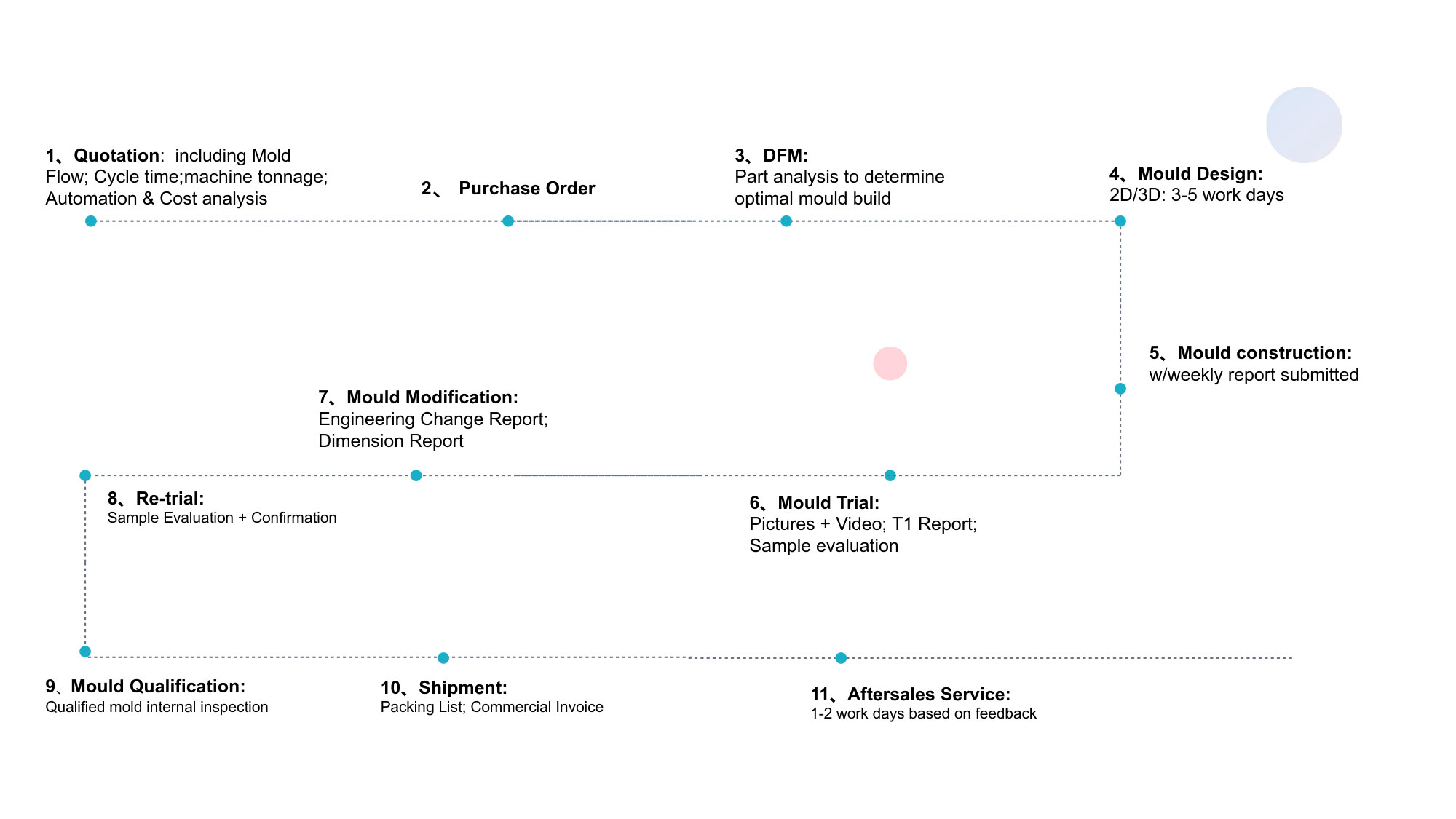
Ansix provides early-stage engineering intervention through Design for Manufacturability (DFM) reports delivered before any tooling commitment. The company analyzes draft angle recommendations, wall thickness optimization, gate location planning, and ejector pin mark placement, preventing structural issues before mold cutting begins. The team of over 200 dedicated engineers and designers works collaboratively with customers from concept through production validation.
Product Validation
Before mass production, Ansix conducts T0 to T3 trial sampling, with each iteration accompanied by comprehensive improvement reports. The company provides 100–500 mold trial production runs, statistically validating yield rates and CpK values to confirm process stability before production scaling.
Mass Production Capability
With 260 injection molding machines spanning 30 to 2800 tons, four production bases across China and Vietnam, and over 200,000 square meters of manufacturing floor space, Ansix delivers high-volume production capacity with exceptional responsiveness.
-
Each mold undergoes full dimensional inspection before shipment, with critical dimensions validated to CpK ≥1.33, statistically proving process capability. In-process monitoring includes real-time parameter logging in MES systems, with fully servo-electric driven machines delivering repeatable precision of ±0.1%.
Delivery & After-Sales Service
Ansix maintains a 24-hour response commitment for customer inquiries and offers mold maintenance at 200,000-cycle intervals, with spare ejector pins and cores delivered with each mold. Emergency repair support ensures 24-hour return to production for critical failures.
The Philosophy That Drives Leadership
Ansix operates on a simple but powerful principle: a mold is not a piece of metal—it is a money-printing machine for customers. Every technical specification translates into lower total costs, reduced production risk, faster time-to-market, and uncompromising quality.
SECTION 2: PP Foam Molding for Liquid Surface Covering Balls – Product Introduction, Manufacturing Process, Delivery Efficiency, Quality Assurance, Cost Control, and After-Sales Service
Product Introduction
PP foam molding liquid surface covering balls are circular plastic packing elements manufactured from polypropylene (PP) using foaming and shrinking technology. The product exists in two configurations: Type I (foam float, hollow-core design) and Type II (solid-core foam ball, energy-saving ball).
Typical specifications include Φ40mm and Φ50mm diameters, with density at 0.5 g/cm³, maximum operating temperature of 120°C, coverage rates of 91–97% depending on edge configuration, compression strength ≤0.4 MPa, and pH range of 1–1.4.
Product Applications
Acid/Alkali Storage Tanks: Prevents acid/alkali gas spillover and volatilization, reducing environmental pollution
Demineralized Water Systems: Isolates water from air, reducing CO₂, O₂, dust, and impurity contamination
Horizontal Acid Storage Tanks & Condensate Storage Tanks: Significantly reduces acid mist and air pollution, protecting water quality
Manufacturing Process
Raw Material Preparation: PP resin is mixed with chemical or physical blowing agents
Melting & Mixing: Material is heated in a controlled barrel to achieve optimal melt viscosity
Foam Injection: Molten PP with integrated blowing agent is injected into the cavity, where gas expansion creates a cellular core structure surrounded by a continuous solid skin
Cooling & Solidification: Temperature-controlled cooling ensures dimensional stability and uniform foam cell structure
Ejection & Finishing: Parts are ejected and undergo secondary operations as required
Delivery Efficiency
With an annual turnover exceeding one billion RMB and rapid response capabilities, Ansix delivers:
Quick-turn prototyping within 1–3 business days
Production molds delivered in 3–4 weeks for straightforward geometries
Mass production scaled immediately following validation
Four production bases ensuring local responsiveness and reduced logistics lead times
Quality Assurance
Raw material certificates and traceability documentation for every batch
In-process SPC monitoring with real-time parameter control
Full dimensional inspection using CMM and optical measurement systems
Process capability validation (CpK ≥1.33) for all critical dimensions
ISO9001, IATF16949, ISO13485, ISO14001 certified systems
Cost Control Advantages
Foam molding delivers inherent cost advantages:
Mold cost reduction: 20–40% lower mold costs due to reduced injection pressures (500–800 psi vs. 3,000–5,000 psi for standard injection molding)
Material savings: 20–40% material consumption reduction through the cellular core structure
Stiffness-to-weight ratio: 3–4 times improvement compared to solid molded equivalents
After-Sales Service Quality
24-hour response to customer inquiries
Mold maintenance at every 200,000-cycle interval
Spare components (ejector pins, cores) delivered with each mold
Lifetime repair support at cost-based pricing
Commitment to continuous technical support throughout product lifecycle
SECTION 3: PP Foam Molding for Liquid Surface Covering Balls – Mold Manufacturing, Material Selection, Smart Manufacturing Integration, Efficiency Enhancement, and Process Quality Assurance
Mold Manufacturing
Ansix builds its molds on a foundation of world-class manufacturing equipment that directly translates into tangible customer benefits:
Five-axis high-speed machining centers: Achieve ±0.002mm precision on complex curved surfaces, ensuring products emerge with smooth, burr-free parting lines requiring no secondary trimming—eliminating manual deburring that adds $0.01–0.02 per unit
Slow-wire EDM systems: Machine 0.03mm small holes and narrow slots with exceptional accuracy, preventing thin-wall deformation
Hardened steel mold bases: Standardized systems provide rapid changeover
Modular cavity design: Enables quick replacement of worn sections without complete mold teardown
Material Selection
For PP foam molding liquid surface covering balls, material selection is optimized for:
Buoyancy requirements: Density of 0.3–0.5 g/cm³ ensures reliable flotation
Chemical resistance: Polypropylene offers excellent resistance to acids, alkalis, and most industrial chemicals
Thermal stability: Operating temperatures up to 120°C
Moisture resistance: PP foam is inherently hydrophobic, ensuring stability in humid conditions and direct water contact
Smart Manufacturing Integration
All injection molding machines are networked with parameters (temperature, pressure, velocity, time) locked in MES systems, accessible only through authorized engineer credentials. Each batch undergoes first-article and last-article comparison for consistent quality.
Efficiency Enhancement
Multi-cavity molds: Designed to maximize output per cycle
Hot runner systems: Reduce material waste from cold runners
Automated parts handling: Robotic extraction and packaging systems minimize cycle time
Centralized material drying and distribution: Ensures consistent material condition
Fully servo-electric driven machines: Deliver repeatable precision of ±0.1%, eliminating batch-to-batch variation
Process Quality Assurance
Every mold undergoes full dimensional inspection before shipment, with critical dimensions validated to CpK ≥1.33—statistically proving process capability to deliver consistent, in-spec parts from the very first production run.
Core Customer Value
Lower total cost of ownership through reduced material consumption and mold wear
Predictable production output with guaranteed dimensional stability
Faster time-to-market through smart process integration
Reduced scrap rates from precision process control
SECTION 4: PP Foam Molding for Liquid Surface Covering Balls – Comprehensive Manufacturing Solution by Ansix Tech (2000+ Words)
Part 1: Hard Infrastructure – Building Customer Trust Through Equipment Capability
Mold Processing Equipment – Precision That Eliminates Secondary Operations
Ansix stands on a foundation of world-class manufacturing equipment that directly translates into tangible customer benefits. The company‘s five-axis high-speed machining centers achieve ±0.002mm precision on complex curved surfaces, ensuring products emerge with smooth, burr-free parting lines requiring no secondary trimming. This eliminates manual deburring labor that typically adds 0.3–0.5 minutes per part and $0.01–0.02 per unit in downstream finishing costs. Poorly machined narrow slots force customers into expensive redesigns; Ansix guarantees first-pass success.
The slow-wire EDM systems machine 0.03mm small holes and narrow slots with exceptional accuracy, preventing thin-wall deformation that often plagues delicate PP foam structures.
Injection Molding Machine Fleet – One Platform, Unlimited Possibilities
The injection molding machine fleet spans 30 tons to 4000 tons clamp force, covering everything from thumb-sized precision balls to large-diameter industrial liquid covering balls in a single platform. Main machines include Japan‘s Fanuc, Sumitomo, Toshiba, Nissei, Engel, and Germany’s Arburg, plus domestic Haitian and Victor Taichung Machinery. All machines are fully servo-electric driven, delivering repeatable precision of ±0.1%, ensuring every shot matches the previous one in weight, dimensions, and properties. Batch-to-batch variation is eliminated.
Quality Assurance Infrastructure – Proof, Not Promises
Quality assurance is anchored in accredited metrology. Every mold undergoes full dimensional inspection before shipment, with critical dimensions validated to CpK ≥1.33—statistically proving the process capability to deliver consistent, in-spec parts right from the start of your production run. Three coordinate measuring machines (CMM) and optical imaging systems verify dimensions with micron-level accuracy.
Part 2: Mold Manufacturing Core Competitiveness – Quantifiable Performance Metrics
Mold Life and Durability
Dimension Technical Specification Customer Value
Mold Life 500,000 cycles for glass-filled materials; 1,000,000 cycles for standard PP Reduced tooling amortization cost per part
Achievable Tolerance ±0.05mm for standard structural components; ±0.005mm for precision features Eliminated assembly rework; consistent product fit
Mold Types Hot runner systems (reduced scrap), stack molds (doubled efficiency), multi-cavity molds (increased output) Lower per-part cost; faster production
Surface Finish Ra <0.05μm for high-gloss finishes; suitable for transparent applications Eliminated post-mold finishing; improved aesthetics
Gate System Optimization Mold flow analysis pre-identifies weld line and gas trap locations, optimizing gate count and positions for balanced filling No internal voids; consistent density; reduced scrap
The Value Behind the Numbers
When Ansix commits to 500,000 cycles minimum for glass-filled materials, this means customers can run their production lines for years without mold replacement. When Ansix achieves ±0.005mm on precision features, this means floating balls assemble correctly every time, with no jamming or inconsistent covering performance. When Ansix delivers molds with Ra <0.05μm surface finish, this means no post-mold polishing operations, faster production, and lower per-unit costs.
Part 3: Injection Molding Process Control – Eliminating Quality Anxiety
Customer Fears Addressed
Customers fear sink marks, flash, dimensional instability, and batch-to-batch color variation. Ansix addresses each systematically:
Process Standardization: All machines are networked with all molding parameters (temperature, pressure, velocity, time) locked in MES systems, accessible only through authorized engineer credentials. Each batch undergoes first-article and last-article comparison.
Dimensional Stability Control: Mold temperature is controlled zone by zone using thermal regulators, with core and cavity temperature differential maintained within 2°C to minimize warpage and deformation.
Real-Time Closed-Loop Control: For maximum assurance, ultrasonic wall-thickness sensors feed real-time data into closed-loop process control, automatically adjusting pack-hold pressure to compensate for any variation. In-mold temperature and pressure sensors with full closed-loop control provide additional monitoring and adjustment capability.
Appearance Grade Standards: Transparent components meet bubble-free, flow-mark-free standards. Plated components show no gas streaks. High-gloss surfaces achieve Ra ≤0.2μm.
Specialty Materials Expertise
Ansix has extensive experience with engineering-grade materials relevant to chemical and industrial applications: PP + glass fiber, PC/ABS, polycarbonate, PPS + 40% glass fiber, PEEK, PA6 + 30% glass fiber, and PBT, all with material certificates and full traceability documentation.
Part 4: End-to-End Service Delivery – Reducing Customer Management Costs
Early-Stage Engineering Intervention (DFM Report)
Before any tooling commitment, Ansix provides a comprehensive Design for Manufacturability analysis covering draft angle recommendations, wall thickness optimization, gate placement strategy, and ejector pin location allowances. This prevents the most expensive discovery of all: finding out a design cannot be manufactured after the mold has been cut.
Trial Sampling and Validation
T0 to T3 sampling iterations are provided, each accompanied by improvement reports. Ansix can quickly change inserts to validate different design approaches without rebuilding entire molds.
Small Batch Validation
100–500 trial production parts are supplied before mass production, with yield rates and CpK statistically validated to confirm process stability and readiness for full-scale production.
Maintenance and Spare Parts
Spare consumables (ejector pins, cores) are delivered with every mold. Mold maintenance is performed every 200,000 cycles, with lifetime repair support at cost-based pricing.
Part 5: Differentiated Value Proposition – Direct Responses to Common Industry Pain Points
Common Customer Complaint Ansix‘s Professional Response and Customer Value
Molds require constant repair, disrupting orders Pre-delivery 2,000-cycle aging test with wear report; three-year mold structure warranty against premature failure
Flash is excessive, requiring costly post-processing 0.005mm parting line fit precision with self-locking clamp force compensation; flash controlled to ≤0.03mm, eliminating manual trimming
Dimensions vary between batches Ultrasonic wall-thickness sensors with automatic compensation; closed-loop process control ensures consistent dimensions
Mold repair cycles are too long In-house electrode machining and EDM workshop; 24-hour repair turnaround for non-catastrophic failures
The Core Philosophy
For Ansix, a mold is not just a block of steel—it is a revenue-generating asset. When the company designs a mold, it simultaneously plans the injection run‘s flow characteristics, venting paths, and thermal balance, ensuring trouble-free, low-flash, high-life performance on the customer’s production line.
Part 6: Design, Development, Manufacturing, and Quality Validation – Comprehensive Technical Execution
Project Initiation
Ansix‘s design and manufacturing expertise spans over 28 years, four production bases across China and Vietnam, more than 1200 employees including over 200 dedicated engineers and designers, and an annual turnover exceeding one billion RMB. The company has built more than 30,000 sets of molds cumulatively, bringing unmatched depth of experience to every project.
From prototype design confirmation through mass production and assembly validation, Ansix‘s end-to-end capability ensures no handoffs, no miscommunications, and no responsibility gaps.
Raw Material Selection and Characteristics
For PP foam molding liquid surface covering balls, material selection focuses on:
Material Type and Grade: Polypropylene (PP) homopolymer or copolymer formulations with optimized melt strength for foaming
Material Properties: Low water absorption, heat resistance up to 120°C, dimensional stability, chemical resistance to acids and alkalis
Foaming Agent Integration: Chemical blowing agents or physical foaming agents (CO₂, N₂) integrated at controlled concentrations to achieve 0.3–0.5 g/cm³ final density
Mold Flow Analysis (DFM)
Before any steel is cut, mold flow analysis predicts filling patterns, identifies potential weld lines and gas trap locations, and validates filling balance. This analysis determines optimal gate locations, runner sizing, vent placement, and cooling channel configuration.
Mold Design Priorities
Cooling System Design: Optimized cooling channel layout ensures rapid, uniform heat extraction, minimizing cycle time while preventing part warpage
Runner System: Balanced runner design ensures all cavities fill simultaneously with identical pressure profiles
Gate System: Gate type and location optimized for foam flow behavior; typically fan or pin gates for uniform melt front advancement
Ejection System: Sufficient ejector pin placement with controlled ejection force prevents part distortion upon demolding
Mold Manufacturing Challenges and Solutions
Foam Core Uniformity: Maintaining consistent cell structure across the entire part volume requires precise control of blowing agent concentration and injection parameters
Surface Integrity: Preventing surface defects from gas breakout requires optimized venting and back pressure control
Dimensional Stability: PP shrinkage behavior after foaming requires compensation at the mold design stage
Injection Molding Process Optimization
Efficiency Improvement: Cycle time reduction through optimized cooling, automated parts handling, and multi-cavity mold configurations
Cost Control: Material savings through foam core structure; energy savings through lower injection pressures; labor savings through automated finishing
Quality Control and Packaging
Final inspection protocols verify dimensional accuracy, surface finish, density uniformity, and coverage performance. Parts are packaged in moisture-resistant, damage-preventive configurations and shipped via the most efficient logistics routing.
Part 7: Cost Reduction – Systematic Savings Across Every Dimension
Material Cost Reduction
Foam molding‘s cellular core structure enables 20–40% material reduction compared to solid injection molding while maintaining or exceeding required stiffness through the 3–4 times better stiffness-to-weight ratio of foam structures.
Tooling Cost Reduction
Molds designed for foam molding operate at lower injection pressures (500–800 psi vs. 3,000–5,000 psi for standard injection molding), significantly reducing mold construction costs and extending tool life.
Energy Cost Reduction
Lower injection pressures and shorter cooling cycles reduce energy consumption per part. Structural foam molding requires less energy and less raw material than compact injection molding.
Labor Cost Reduction
Automated process control, precision flash control eliminating manual trimming, and reduced post-processing operations lower direct labor costs per part.
Risk Cost Reduction
Early DFM analysis prevents design flaws before tooling. Process capability validation (CpK ≥1.33) ensures consistent quality. Spare parts delivered with every mold prevent production stoppages. Certified quality systems (IATF16949, ISO13485 for medical applications) provide regulatory compliance evidence.
Part 8: Industry Experience and Customer Reliability
Ansix serves customers across water treatment, chemical processing, environmental protection, automotive, medical, and consumer electronics industries. Every project is managed through the company‘s complete quality control system, supported by advanced equipment, strong production capacity, a professional technical team, environmental management, supply chain management, and innovation capabilities.
The Ultimate Value Proposition
A mold from Ansix is not an expense—it is an asset that prints revenue for customers. When you invest in an Ansix precision injection mold, you are not simply buying a piece of tooling; you are purchasing the engine of your entire manufacturing operation. Every technical specification Ansix delivers translates directly into measurable customer value: lower total costs, reduced production risk, faster time-to-market, and uncompromising quality.
Closing Statement
For customers seeking a manufacturing partner for PP foam molding liquid surface covering balls, Ansix Tech offers the complete package: world-class equipment, 28+ years of proven expertise, certified quality systems, cost-competitive manufacturing across four production bases, and a philosophy that treats every customer’s mold as a revenue-generating asset. The company invites prospective customers to experience the difference through a comprehensive DFM report walkthrough, demonstrating exactly how Ansix solves weld line, gas trap, shrinkage, and other potential issues before production begins.
Ansix Tech Co Ltd
If you have any plans related to PP foam molding for liquid surface covering balls , you can contact us at any time. We will turn your ideas into reality, let you realize your dreams, and obtain large orders from the market. Our contact information is info@ansixtech.com. Or contact our CTO, mail: stephen@ansixtech.com
#www.ansixtech.com #ansixtech.com #PP foam molding for liquid surface covering balls #PP foam molding for liquid surface covering balls injection molding companies #PP foam molding for liquid surface covering balls Canopy Mold injection mold companies #Ansix #Ansix moulds #Ansix china #Ansix tech china #Ansix tech company #Ansix facotry #PP foam molding for liquid surface covering balls injection molding #PP foam molding for liquid surface covering balls injection tools #PP foam molding for liquid surface covering balls injection moulds #PP foam molding for liquid surface covering balls plastic mould #PP foam molding for liquid surface covering balls plastic tools #Ansix Tech #Ansix molds #Ansix injection molding #Ansix mold factory #injection molding PP foam molding for liquid surface covering balls#Ansix mold factory #PP foam molding for liquid surface covering balls china #PP foam molding for liquid surface covering balls molds #injection factory #PP foam molding for liquid surface covering balls injection molding #PP foam molding for liquid surface covering balls injection molding factory #injection molding company #PP foam molding for liquid surface covering balls injection mold companies #PP foam molding for liquid surface covering balls Tooling #PP foam molding for liquid surface covering balls mold limited #Ansix mold china #Ansix companies #Ansix company China #PP foam molding for liquid surface covering balls facotry #Ansix Tech #Ansix Tech mould #PP foam molding for liquid surface covering balls injection moulding #injection moulding company #Ansix PP foam molding for liquid surface covering balls parts injection mold companies #medical injection molding companieschina #PP foam molding for liquid surface covering balls china factory #Ansix moulding companies #Ansix molding company #PP foam molding for liquid surface covering balls injection moulding facotry #Ansix Tech mold #PP foam molding for liquid surface covering balls mould #PP foam molding for liquid surface covering balls plastic injection molding #ansix plastic mold #Mold manufacturing #PP foam molding for liquid surface covering balls parts manufacturing #PP foam molding for liquid surface covering balls plastic parts factory #PP foam molding for liquid surface covering balls injection parts mold #PP foam molding for liquid surface covering balls PRECISION MANUFACTURING #PP foam molding for liquid surface covering balls #China mold #PP foam molding for liquid surface covering balls injection moulding china #PP foam molding for liquid surface covering balls mould china #china precision mold #mold in china #PP foam molding for liquid surface covering balls mold china #Precision molds #High-precision molds #PP foam molding for liquid surface covering balls #Injection molds #PP foam molding for liquid surface covering balls Factory #PP foam molding for liquid surface covering balls Company #Super Large Injection Mold Factory #Large Tonnage Injection Molding Factory #PP foam molding for liquid surface covering balls Company #PP foam molding for liquid surface covering balls Factory #2800T Injection Molding Factory #3000 Ton Injection Molding #4500 Ton Injection Molding Factory #Large Mold Injection Molding #Large Plastic Mold Injection Molding Factory #Large Injection Mold Manufacturer #Plastic Mold Factory #Injection Mold #Plastic Mold