



Water tank level float switch PP foam molding
FEATURES
How Ansix Achieves Customer Satisfaction and Industry Leadership
Ansix has established its leadership through the following strategic pillars:
1.2.1 Customer-Centric Design and Validation
·
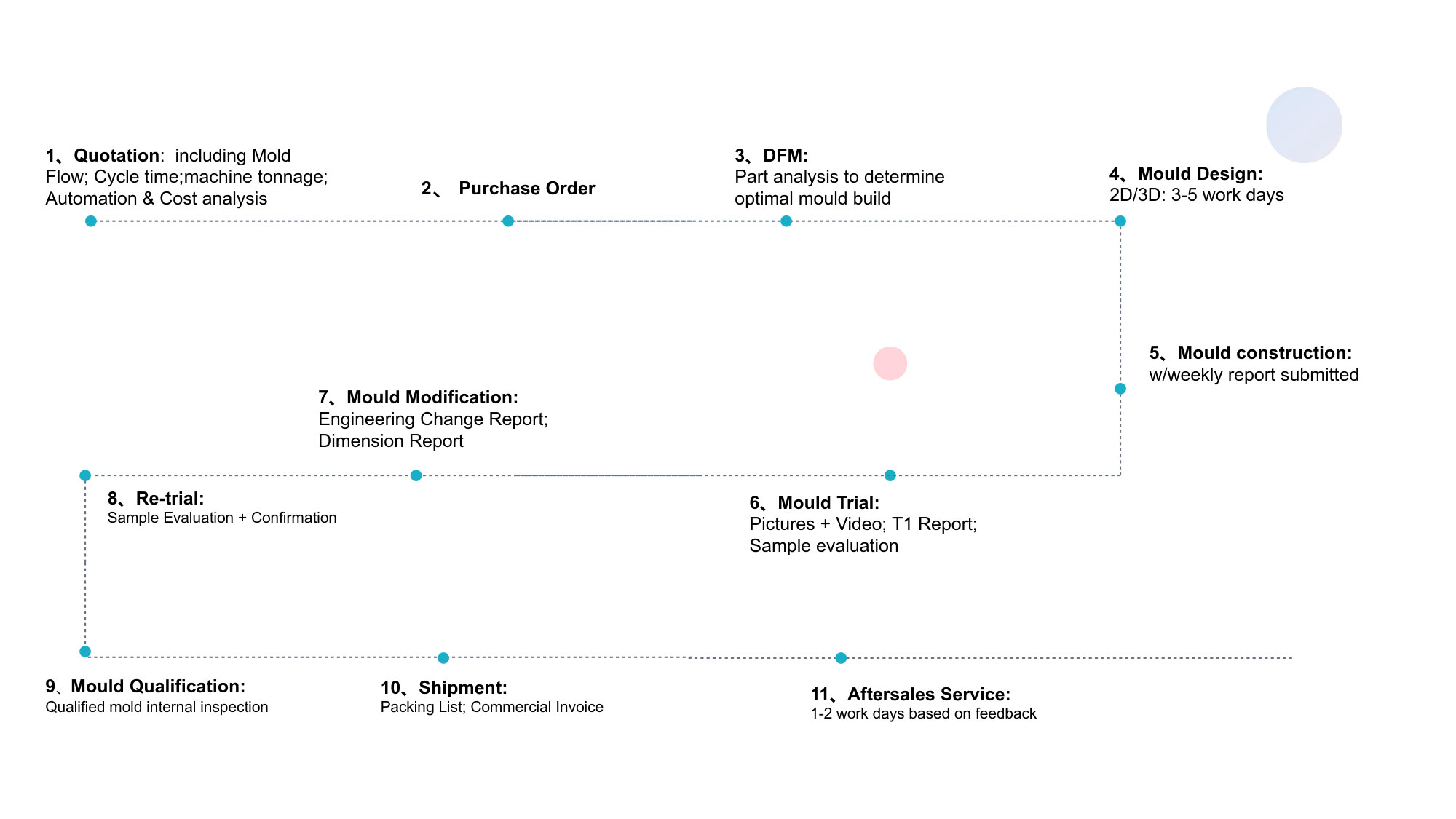
Upfront DFM (Design for Manufacturing): Before mold fabrication, Ansix provides comprehensive DFM analysis including draft angle recommendations, wall thickness optimization, gate location planning, and ejector pin mark position allowances. This prevents “unmanufacturable” designs.
·
·
T0 to T3 Sample Iteration: Provides trial samples with improvement reports after each iteration, allowing rapid insert changes for design validation without remaking entire molds.
·
1.2.2 Precision Manufacturing Infrastructure
·
High-Speed 5-Axis Machining: Capable of 0.002 mm accuracy for complex curved surfaces, ensuring smooth parting lines without burrs.
-
Mold Description
Product Materials:
PP FOAM
Mold Material:
S136ESR
Number of Cavities:
8
Glue Feeding Method:
COLD runner
Cooling Method:
Water cooling
Molding Cycle
22.5s
- The mold manufacturing process and product material selection
Wire EDM (Slow Wire Cutting): Enables precision machining of 0.03 mm fine holes or narrow slots, preventing thin-wall deformation.
·
·
Fully Electric Servo Injection Machines: Stability with ±0.1% repeatability, ensuring every shot in mass production is identical.
·
1.2.3 Comprehensive Quality Assurance
·
Full dimensional inspection with CMM (Coordinate Measuring Machine) and optical imaging systems.
·
·
Critical dimension CPK ≥ 1.33 for each mold before factory release.
·
·
Material traceability with certification reports provided for all mold steels and plastic resins.
·
1.2.4 Full-Process Service Coverage
Ansix delivers end-to-end solutions from prototype confirmation to mass production and assembly validation, reducing the customer’s supplier management burden across the entire product lifecycle.
-
English Technical Description: Product Introduction, Manufacturing Process, Delivery Efficiency, Quality Assurance, Cost Control, and After-Sales Service
Product Introduction
The Water Tank Level Float Switch PP Foam Molding Product is a critical component in liquid level sensing applications. Manufactured from high-quality polypropylene (PP) foam, these float balls are designed to provide precise buoyancy in water, oil, and chemical liquid environments. Typical applications include:
·
Water treatment systems (water towers, tanks, reservoirs)
·
·
Household appliances (water heaters, humidifiers, coffee machines)
·
·
Industrial equipment (fuel tanks, vending machines, chemical processing)
·
·
Solar energy systems and air conditioning units
·
Manufacturing Process
Foaming Technologies Available:
Technology
Description
Advantage for Float Switch
Conventional PP Foam Molding
Chemical blowing agent mixed with PP resin
Cost-effective for standard density requirements
Structural Foam Molding
Gas counter-pressure assisted foaming
Better surface finish with foam core
MuCell® Microcellular Foaming
Supercritical nitrogen or CO₂ as physical foaming agent
10–20% weight reduction, exceptional dimensional stability
The MuCell® process introduces supercritical N₂ or CO₂ into the polymer melt within the plasticizing unit, replacing the traditional pack-and-hold phase with controlled cell growth. This produces a microcellular core (cells/cm³: 10⁹–10¹¹) surrounded by a solid skin, achieving 0.20–0.90 g/cm³ density-. The result is a float that looks and performs like solid plastic but uses 15–20% less polymer-.
Delivery Efficiency
·
Tooling Lead Time: Simple molds available in 10 days; medium-complexity molds in 25–45 days; expedited options (20 days with validation assurance)
·
·
Mass Production Capacity: 30–4,000 ton clamping force injection machines covering all product size ranges
·
·
Just-in-Time Delivery: Real-time production tracking with on-time delivery exceeding 98%
·
Quality Assurance System
·
Process Control: All injection machines networked with MES (Manufacturing Execution System). Molding parameters (temperature, pressure, speed, time) locked and only accessible to authorized engineers. First-article and last-article inspection for every batch.
·
·
Dimensional Stability: Mold temperature zones controlled within ±2°C between core and cavity to minimize warpage. Key hole spacing variation ≤ 0.02 mm across three consecutive production batches.
·
·
Material Certification: Complete material composition reports provided with product delivery (Resin grade, additive content, melt flow index, UL flame rating if applicable).
·
Competitive Cost Control Capability
Cost Element
Ansix Advantage
Customer Benefit
Material Cost
MuCell® reduces polymer consumption by 15–20%
Direct material cost reduction
Processing Efficiency
Reduced cycle time vs. solid molding
Lower per-part processing cost
Tooling Investment
Optimized runner and gate design minimizes scrap
Reduced wasted material expense
Energy Cost
Lower injection pressure and clamping tonnage requirements
Eco-friendly, reduced production overhead
After-Sales Service Guarantee
·
Spare Parts Kit: Ejector pins and core inserts provided with mold delivery
·
·
Preventative Maintenance: Mold maintenance performed every 200,000 cycles
·
·
Lifetime Repair: Cost-plus pricing for repairs; structure warranty of 3 years (excluding normal wear items)
·
·
24-Hour Emergency Support: In-house electrode machining and EDM workshop enabling mold repair without outsourcing; routine rework typically restored within 24 hours
·
3. Core Value Proposition: Mold Manufacturing, Material Selection, Smart Manufacturing Integration, and Quality Assurance
3.1 Mold Manufacturing Competencies
Mold Lifespan Commitment: Depending on material selection (mold base: P20; mold core: S136, 2344, 2343, 8407, SKD11/61/DC53, M340/4Cr13/9Cr18, NAK80, H13):
·
500,000 shots guaranteed for glass-fiber reinforced materials
·
·
1,000,000 shots for standard plastics
·
·
Full mold steel material certification and heat treatment curves provided
·
Achievable Tolerances:
·
General structural parts: ±0.05 mm
·
·
Precision components (critical sealing surfaces): ±0.005 mm
·
Specialized Mold Types:
·
Hot runner systems (reduces scrap waste)
·
·
Stack molds (doubles production efficiency)
·
·
Two-shot / multi-material molds
·
·
High-gloss molds (Ra < 0.05 μm for transparent part applications)
·
Gate and Runner Optimization: Through mold flow analysis, melt flow front, weld line positions, and gas entrapment areas are predicted prior to tooling fabrication to ensure balanced filling.
3.2 Injection Molding Material Selection
Polypropylene (PP) Material Grades for Float Applications:
Material Type
Specific Gravity
Characteristics
Float Switch Application
Homopolymer PP (Solid)
0.90–0.91
Good stiffness, chemical resistance
Stem/body components
Copolymer PP (Solid)
0.89–0.90
High impact strength, better low-temperature performance
Mounting brackets, stems
Foam PP (Conventional)
0.60–0.85
Buoyancy optimized, cost-effective
Float ball – standard
PP + 10% Glass Fiber
0.96
Enhanced dimensional stability
High-temperature float bodies
PP + 20% Glass Fiber
1.03–1.04
Improved creep resistance, higher strength
Pressure-resistant floats
PP + 40% Glass Fiber
1.22
Maximum stiffness and heat deflection
Heavy-duty industrial applications
Special Materials Capability:
Ansix can process PC/ABS, PC, PPS+40%GF, PEEK, PTFE/PFA, PA6+GF30, PBT, PEI, PPS/LCP, and Liquid Silicone Rubber (LSR) for specialized float switch applications including:·
UL94 V-0 flame-rated enclosures
·
·
UV-tested materials (3,000 hours no discoloration)
·
·
FDA-approved grades for drinking water contact
·
3.3 Smart Manufacturing Integration and Efficiency Improvement
MES-Integrated Production:
·
Real-time parameter monitoring and data logging for every shot
·
·
SPC (Statistical Process Control) with automated alerts for parameter drift
·
·
Batch traceability from raw material to finished product
·
Automated Quality Systems:
·
In-mold pressure/temperature sensors enabling closed-loop process control
·
·
Ultrasonic wall thickness sensors providing real-feedback for compensation adjustments
·
Key Efficiency Metrics:
·
CpK ≥ 1.33 on all critical dimensions
·
·
50,000+ shots between scheduled maintenance for properly maintained molds
·
·
24-hour typical turnaround for routine mold repairs (in-house EDM/electrode shop)
·
3.4 Process Quality Assurance (Customer-Centered Value)
Customer Concern
Ansix Technical Solution
Measurable Benefit
Flash (Burrs) – High post-processing cost
0.005 mm fitting accuracy on parting lines; self-locking clamping force compensation
Flash controlled <0.03 mm; eliminates manual deburring
Inconsistent part dimensions – Affects assembly
Machine-mounted ultrasonic wall thickness sensors; real-time compensation of holding pressure
Continuous batch stability; reduced assembly rework
Long repair cycle for mold issues – Production downtime
In-house electrode manufacturing and EDM workshop
Repairs completed within 24 hours
Sink marks / warpage – Cosmetic rejects
Mold temperature zoning (core-cavity ΔT < 2°C); cell growth replaces pack-and-hold phase
Distortion-free parts; improved yield
4. Comprehensive Analysis: Mold Manufacturing and Injection Molding Solutions for Water Tank Float Switch PP Foam Components (2000+ Words)
The following technical exposition follows the “Five-Pillar Value Framework” – transforming technical specifications into tangible customer benefits by answering: What problems does Ansix solve? How much cost is saved? What risks are reduced?
Pillar One: The “Hard Power” Foundation – Equipment Infrastructure That Builds Customer Trust
4.1.1 High-Precision Mold Machining Equipment
Ansix’s mold manufacturing workshop is equipped with:
Equipment Type
Technical Specification
Customer Value Translation
5-Axis High-Speed Machining Center
0.002 mm contour accuracy
Smooth parting lines – no burrs; eliminates secondary finishing
CNC EDM (Sinker EDM)
Multi-axis CNC control
Complex cavity geometries, sharp internal corners
Wire EDM (Slow Wire Cutting)
0.03 mm fine hole / narrow slot capability
Precision inserts without thin-wall deformation
CNC Coordinate Measuring Machine (CMM)
Full dimensional inspection
Validates every dimension before mold ships
4.1.2 Injection Molding Machine Fleet
·
Clamping Force Range: 30 tons to 4,000 tons
·
·
Application Coverage: Micro precision parts (medical devices) to large structural components (water tank covers)
·
·
Drive Technology: Full electric servo motors
·
·
Process Repeatability: ±0.1% shot-to-shot consistency
·
Customer Value: Every part in a production run is identical. No surprise dimensional drift after mold handoff.
4.1.3 Quality Inspection Infrastructure
Device
Function
Commitment
CMM (Coordinate Measuring Machine)
Full dimensional verification per engineering drawing
Pre-delivery full dimension report with CPK calculation
Optical Image Measuring Instrument
Fast 2D contour verification
Surface finish and flash inspection
Hardness Tester
Material hardness validation
Steel grade certification provided
Mold Flow Analyzer
Mold filling simulation software
Optimized gate location to prevent weld lines
Pillar Two: Mold Manufacturing Core Competencies – Concrete Metrics That Prove Value
Customer priorities: lifespan, precision, lead time, repair cost exposure.
4.2.1 Mold Lifespan Assurance
Mold Component
Material Grade
Lifetime Guarantee
Mold Base
P20 / 50C / S50C
1,000,000+ shots
Cavity / Core (Standard)
S136 / 4Cr13 / 9Cr18 / M340
1,000,000+ shots (non-abrasive)
Cavity / Core (Abrasive resins e.g. GF-reinforced)
2344 / 2343 / 8407 / SKD11/61 / DC53 / NAK80 / H13
500,000+ shots
Slides / Lifters / Inserts
Tool steel with DLC or TiN coating
Wear-resistant, extended service life
Customer Value: Predictable tooling lifecycle allows accurate cost-per-part budgeting. No surprise replacement costs.
4.2.2 Achievable Dimensional Tolerances
Application
Achievable Tolerance (mm)
Customer Value
General structural features – ribs, bosses
±0.05 mm
Reliable assembly fit
Critical mating surfaces – seal grooves, O-ring seats
±0.02 mm
No leakage, consistent sealing force
Precision components – gear teeth, valve seats
±0.005 mm
Drop-in interchangeable parts
Customer Value: Eliminates “trial-and-error” assembly. Parts fit first time, every time.
4.2.3 Mold Flow Analysis Prior to Tooling
Before any steel is cut, Ansix performs mold flow simulation for:
Analysis Output
What We Predict
Customer Benefit
Flow front advancement
Unbalanced filling patterns
Uniform properties, no weak spots
Weld line position
Locations where multiple flow fronts meet
Controlled placement where appearance/strength not critical
Air trap / gas entrapment zones
Voids trapped during filling
Venting added to prevent burn marks
Pressure drop profile
Insufficient packing regions
Optimized gate sizing
Cooling analysis
Hot spots and cooling imbalance
Warpage minimized
Customer Value: Defects predicted and eliminated before mold fabrication – no costly design changes after tool completion.
4.2.4 Mold Construction Types and Capabilities
Mold Type
Application
Efficiency Advantage
Hot Runner Mold
Float balls, stems
Zero runner waste; material savings
Cold Runner (Two-Plate)
Simple geometries
Lower initial tooling cost
Three-Plate Mold
Center-gated parts
Automatic degating
Stack Mold
High-volume simple shapes
Double output per machine cycle
Two-Shot / Overmold
Magnetic overmolding for reed switches
Reduces assembly steps
High-Gloss Mold (Ra <0.05μm)
Transparent sight glasses or premium appearance parts
Cosmetic-grade surface finish
Pillar Three: Injection Molding Process Control – Eliminating Customer Quality Anxiety
Customer fears: sink marks, flash, dimensional instability, batch-to-batch color variation.
4.3.1 Process Standardization with MES Integration
The System: Every injection machine is connected to a Manufacturing Execution System (MES) that locks all molding parameters – temperature zones, injection pressure profiles, screw speed, holding pressure switching position, cooling time.
Customer Value: Unauthorized parameter changes are impossible. Process repeatability guaranteed. Each production batch replicates the validated T0 sample.
4.3.2 Dimensional Stability Control
·
Mold temperature zoning: Core and cavity temperatures controlled within ±2°C differential
·
·
Process guard bands: Upper and lower control limits (UCL/LCL) established per CPK study
·
·
In-process inspection: Sample parts measured every hour, or at frequency determined by SPC
·
Measurable Achievement: For a typical support bracket, key mounting hole spacing variation across three batches (one week apart) ≤ 0.02 mm.
4.3.3 Surface Finish and Appearance Control
Requirement
Achievable Standard
Customer Value
Transparent parts
Bubble-free, streak-free
Clear view of internal components
Electroplated parts (chrome, nickel)
No gas streaks or flow marks
Consistent adhesion, no reject plating
High-gloss / piano black parts
Ra surface roughness ≤0.2 μm
Rich appearance, no sink marks
Painted / printed parts
Registration accuracy ±0.1 mm with compensated warpage
No misalignment on final product
4.3.4 Special Material Capabilities
Ansix has successfully processed over 200 engineering resin grades including:
·
Commodity resins: ABS, PP, HIPS, GPPS, PMMA, POM, PA6/PA66
·
·
Engineering resins: PC, PC/ABS, PBT, PET, PPS, LCP
·
·
High-performance resins: PEEK, PEI (Ultem), PSU, PPA
·
·
Specialty materials: LSR (liquid silicone rubber), TPE/TPV for overmolding
·
·
Reinforced grades: GF15/30/40/50%, CF10/20/30%, mineral-filled
·
Compliance certifications available:
·
UL94 V-0 flame rating for electrical enclosures
·
·
FDA / NSF-61 for potable water contact
·
·
RoHS / REACH / SVHC compliance
·
·
UV-stabilized (3,000+ hours QUV testing)
·
Pillar Four: Full-Service Process Coverage – Reducing Customer Management Cost
4.4.1 Early Design Intervention – DFM Report
Before mold fabrication, Ansix provides a Design for Manufacturing (DFM) analysis covering:
DFM Element
Technical Consideration
Customer Risk Eliminated
Wall thickness
Uniform thickness recommended; transitions >2:1 flagged
Warpage, sink, uneven cooling
Draft angles
0.5°–1.5° per side depending on texture
Part ejection without drag marks
Gate location
Positioned to avoid function-critical surfaces
Gate vestige not on sealing face
Ejector pin mark allowances
Customer specifies cosmetic vs. non-cosmetic faces
Marks only on approved surfaces
Shrinkage compensation
PP: 1.2–2.0% depending on GF loading
Dimensionally correct parts post-molding
4.4.2 Trial Sampling and Validation – T0 to T3
Phase
Deliverable
Customer Action
T0
First mold trial – raw samples on press
Dimensional check; identify issues
T1
Corrected samples with modification report
Fit and function validation
T2
Optimized process parameters
CPK study initiation
T3 (Pre-production)
100–500 pre-production parts
Process capability validated before launch
Unique Capability: Ansix can perform rapid insert changes to test multiple design variants without remaking entire molds.
4.4.3 Small-Batch Verification Process
Before mass production release:
·
Sample quantity: 100–500 parts (single cavity or multi-cavity representative)
·
·
Measurement: Full dimension check per drawing
·
·
Capability study: CPK ≥ 1.33 required for approval
·
·
Visual evaluation: Approved limit samples defined for color and texture
·
Customer Value: No risk of large lot rejection due to undiscovered process issues.
4.4.4 Post-Delivery Support
Service
Details
Spare parts kit
2 sets of ejector pins, 2 core inserts, 2 ejector sleeves, springs
Preventative maintenance
Scheduled at 200,000 cycles (owner’s manual provided)
Lifetime repair
Cost-plus pricing; 3-year structural warranty (excludes wear items)
Emergency support
In-house EDM/electrode workshop – returns to production in 24 hours
Pillar Five: Differentiated Commitment – Direct Solutions to Common Customer Pain Points
Customer Pain Point
Industry Typical Response
Ansix Differentiated Commitment
Mold needs frequent repair – missed customer shipments
“Wear is normal”
2,000-cycle wear test before shipping; wear report provided
Flash on molded parts – labor cost to deburr
“Tolerances are within industry standard”
0.005 mm parting line fitting accuracy; flash <0.03 mm
Dimensions change between batches – production stoppages
“Adjust parameters each shift”
MES-locked parameters; in-process dimension monitoring
Slow mold repair – weeks of downtime
“Our repair shop is busy”
In-house electrode and EDM; typical repair 24 hours
5. Ansix Tech’s 29-Year Industry Experience – Delivering Reliability and Value
5.1 End-to-End Solution Provider
With over 29 years of manufacturing experience, Ansix Tech has refined its production system to serve customers from prototype confirmation → mass production → assembly verification – all within one vertically integrated facility.
5.2 Engineering Service Capabilities
Capability
Description
Concurrent Engineering
Ansix engineering team works alongside customer R&D during product design
Material Selection Guidance
Based on operating environment (temperature, chemical exposure, regulatory requirements)
DFM / Mold Flow Analysis
Predict and eliminate molding defects before steel cutting
Prototyping
Rapid tooling (soft tool) or 3D printed prototypes for design validation
Full PPAP (Production Part Approval Process)
Customer-specific documentation standards supported (AIAG, VDA)
5.3 Cost Reduction Expertise – Material, Process, Efficiency Optimization
Ansix’s experience enables systematic cost reduction without compromising quality:
Cost Category
Optimization Method
Typical Savings
Material cost
MuCell® microcellular foaming reduces polymer consumption
15–20% resin reduction
Processing efficiency
Multi-cavity tools (4–32 cavities) reduce per-part cycle time
Up to 50% labor reduction per unit
Energy consumption
Lower injection pressure and clamp tonnage with MuCell®
Reduced electricity per part
Scrap reduction
Optimized runner design; hot runner systems eliminate runner waste
10–20% material waste elimination
Assembly cost
Design for assembly (DFA) – molded-in features (snap fits, living hinges)
Eliminates secondary operations
Logistics cost
Optimized packaging densities; container load planning
Lower freight per unit
Final Summary – The Ansix Value Statement
“For Ansix, a mold is not just a piece of steel – it’s a money-printing machine. We design molds with injection molding robustness, exhaust paths, and thermal balance pre-planned. When the mold arrives on your production floor, it’s ready to run – no debugging, minimal flash, maximum lifespan.”
Ansix Tech solves these fundamental customer problems:
1.
Prevents quality issues before they happen through predictive DFM and mold flow analysis
2.
3.
Reduces total cost of ownership through longer mold life, lower material consumption, and higher process efficiency
4.
5.
Eliminates risk of production delays through in-house repair capabilities and MES-controlled process locking
6.
7.
Saves management overhead through single-source responsibility from design to delivery
8.
Invitation to customers:
“If you have an existing float switch component, let us perform a full DFM report walkthrough on your current design. You’ll see – in detail – how we would have predicted and eliminated weld lines, gas traps, sink marks, and warpage before the first shot was ever molded.”
Ansix Tech Co Ltd
If you have any plans related to Water tank level float switch PP foam molding , you can contact us at any time. We will turn your ideas into reality, let you realize your dreams, and obtain large orders from the market. Our contact information is info@ansixtech.com. Or contact our CTO, mail: stephen@ansixtech.com
#www.ansixtech.com #ansixtech.com #Water tank level float switch PP foam molding #Water tank level float switch PP foam molding injection molding companies #Water tank level float switch PP foam molding Canopy Mold injection mold companies #Ansix #Ansix moulds #Ansix china #Ansix tech china #Ansix tech company #Ansix facotry #Water tank level float switch PP foam molding injection molding #Water tank level float switch PP foam molding injection tools #Water tank level float switch PP foam molding injection moulds #Water tank level float switch PP foam molding plastic mould #Water tank level float switch PP foam molding plastic tools #Ansix Tech #Ansix molds #Ansix injection molding #Ansix mold factory #injection molding Water tank level float switch PP foam molding#Ansix mold factory #Water tank level float switch PP foam molding china #Water tank level float switch PP foam molding molds #injection factory #Water tank level float switch PP foam molding injection molding #Water tank level float switch PP foam molding injection molding factory #injection molding company #Water tank level float switch PP foam molding injection mold companies #Water tank level float switch PP foam molding Tooling #Water tank level float switch PP foam molding mold limited #Ansix mold china #Ansix companies #Ansix company China #Water tank level float switch PP foam molding facotry #Ansix Tech #Ansix Tech mould #Water tank level float switch PP foam molding injection moulding #injection moulding company #Ansix Water tank level float switch PP foam molding parts injection mold companies #medical injection molding companieschina #Water tank level float switch PP foam molding china factory #Ansix moulding companies #Ansix molding company #Water tank level float switch PP foam molding injection moulding facotry #Ansix Tech mold #Water tank level float switch PP foam molding mould #Water tank level float switch PP foam molding plastic injection molding #ansix plastic mold #Mold manufacturing #Water tank level float switch PP foam molding parts manufacturing #Water tank level float switch PP foam molding plastic parts factory #Water tank level float switch PP foam molding injection parts mold #Water tank level float switch PP foam molding PRECISION MANUFACTURING #Water tank level float switch PP foam molding #China mold #Water tank level float switch PP foam molding injection moulding china #Water tank level float switch PP foam molding mould china #china precision mold #mold in china #Water tank level float switch PP foam molding mold china #Precision molds #High-precision molds #Water tank level float switch PP foam molding #Injection molds #Water tank level float switch PP foam molding Factory #Water tank level float switch PP foam molding Company #Super Large Injection Mold Factory #Large Tonnage Injection Molding Factory #Water tank level float switch PP foam molding Company #Water tank level float switch PP foam molding Factory #2800T Injection Molding Factory #3000 Ton Injection Molding #4500 Ton Injection Molding Factory #Large Mold Injection Molding #Large Plastic Mold Injection Molding Factory #Large Injection Mold Manufacturer #Plastic Mold Factory #Injection Mold #Plastic Mold