



Physical micro-foaming molding of plastic panel mesh covers
FEATURES
Hard‑Power Foundation (Instilling Customer Trust Through Equipment)
Before you can be a strategic partner, you must first be a reliable producer. Hard assets speak louder than promises.
1.1 Mold Machining Center – Delivering Burr‑Free, Smooth Surfaces
Ansix Tech operates a fleet of five‑axis high‑speed machining centers (brands include Mikron, FANUC, etc.). In plain terms:
Value statement: “Our five‑axis machines contour complex mesh geometries in a single clamping operation. The parting line is invisible to the naked eye, and no secondary hand‑deburring is required.”
How it reduces risk: Eliminates flash that would otherwise require expensive manual trimming; reduces the risk of sharp edges on mesh covers (safety and aesthetics).
Cost saved: Customers avoid post‑mold tumbling or manual grinding, which typically adds 5–15% to part cost on mesh‑type parts.
The company also uses slow‑wire EDM (electrical discharge machining). On panel mesh covers, this capability is essential for creating clean, stress‑free micro‑cavities for fine mesh holes and narrow slots (down to 0.03 mm).
Value statement: “We cut ultra‑fine vent holes without burrs or heat‑affected zones; your cover’s open area ratio is exactly as designed, no blockages.”
-
Mold Description
Product Materials:
pp foam
Mold Material:
S136ESR
Number of Cavities:
2
Glue Feeding Method:
Hot runner
Cooling Method:
Water cooling
Molding Cycle
42.5s
- The mold manufacturing process and product material selection
Injection Presses – Repeatability That Protects Your Brand
Ansix Tech has 260 injection molding machines ranging from 30 tons to 2,800 tons (covering everything from small precision mesh inserts to large automotive panel covers). All modern presses are fully servo‑electric, delivering:
±0.1 % injection stroke repeatability.
Closed‑loop pressure control that ensures every shot mirrors the golden sample.
Fast cycle times for high‑volume production (key for cost‑sensitive mesh covers).
Value statement: “When we run your mesh cover 24/7, part #100,000 is identical to part #1. No drifting dimensions, no unexpected scrap.”
Risk avoided: No “shrink‑then‑grow” surprises that would cause poor fitment in customer assemblies.
Cost saved: Consistent weight control directly lowers material consumption by 10–20% when micro‑foaming is applied.
-
Inspection & Metrology – Data That Proves Conformance
All tooling and first production samples are measured on CMM (coordinate measuring machines) and optical vision measurement systems:
Each mold before shipment receives a full dimensional report.
Critical dimensions (hole diameters, rib spacing, panel flatness) must achieve Cpk ≥ 1.33 before mass production approval.
Value statement: “We do not guess if your part meets print — we prove it with a certified measurement protocol. You avoid expensive customer rejections and line stoppages.”
Part Two – Mold Manufacturing as the Engine of Profitability
For panel mesh covers, the mold is the product. If the tool is right, production is profitable; if it is wrong, nothing else matters.
2.1 Mold Life & Steel Selection – Predictable Long‑Term Cost
Ansix Tech publishes clear mold life commitments based on material pairs:
Mold component Steel grade used Life guarantee (fibre‑filled materials)
Mold base P20 1,000,000+ cycles
Core/cavity inserts S136, 2344, 8407, SKD61, DC53, NAK80, H13 ≥500,000 cycles with GF/CF materials
Value statement: “Your initial tooling investment is amortized over at least half a million good parts. No unexpected retooling every two months.”
Cost saved: In moulding GF‑reinforced panels, typical competitor tools fail at 100–200k shots, requiring a new tool that costs 40 % of the original. Ansix’s longevity eliminates that emergency spend.
Risk reduced: Predictable tool depreciation means customers can quote multi‑year contracts with confidence.
2.2 Attainable Tolerances – From “Sloppy” to “Assembly‑Ready”
Standard structural features: ±0.05 mm
Precision mesh ribs or critical locating features: ±0.005 mm (achieved via slow‑wire EDM and temperature‑controlled grinding)
Value statement: “Your mesh cover snaps into mating housings the first time, every time. No oversized ribs, no rattles.”
Cost saved: Assembly line rejects drop to near zero, saving $0.50–$2 per part in rework/labour.
2.3 Gating & Runner Design Optimised for Mesh Covers
Using Moldflow simulation, Ansix engineers predict weld lines, air traps, and flow imbalance before the first steel is cut.
Hot runner systems (multi‑tip valve gates) are standard for panel mesh covers, reducing runner scrap by 60–80 %.
For high‑volume mesh covers requiring 1,000,000+ parts/year, stack molds (two parallel parting planes) double output without doubling machine size.
Mirror‑polished cavities (Ra < 0.05 μm) are applied when the mesh cover requires a glossy visible surface.
Value statement: “We eliminate knit lines across your mesh pattern. Your cover looks uniform, and no melt‑flow blemishes hide in the holes.”
Cost saved: Eliminating runner waste alone saves hundreds of kilograms of resin per month; eliminating cosmetic rejects saves thousands of parts.
2.4 Lead Time Commitment – Realistic and Achievable
Mold complexity Standard lead time Priority (extra fee)
Simple two‑plate mold 10 days Not recommended
Medium complexity (mesh panel with slides) 25–45 days 20 days (all tests still performed)
High‑cavitation hot runner 45–65 days 35 days
Value statement: “We give you a date you can trust — and we hit it. Your product launch is not delayed by tooling.”
Risk reduced: No rush surcharge panic, no missed seasonal windows.
Part Three – Injection Molding Process Control (Eliminating the “Quality Lottery”)
Customers fear dimensional drift, sink marks, flash, and color variation. Ansix Tech’s controlled environment removes that fear.
3.1 MES‑Locked Parameters – Repeatability by Rule, Not by Memory
Every injection machine is connected to an MES (Manufacturing Execution System). Key parameters — melt temperature, injection velocity, packing pressure, back pressure for micro‑foaming gas mixing, cooling time — are digitally locked. Only a process engineer can change them, and every change is logged.
First‑article vs. last‑article comparison: Each batch starts with a measured sample and ends with a measured sample.
Value statement: “Your night‑shift production runs exactly like the day‑shift. No operator can accidentally knock a dial and ruin 1,000 covers.”
3.2 Dimensional Stability – Conquering Warpage on Mesh Panels
Physical micro‑foaming inherently reduces internal stress because the expanding cells replace the traditional packing phase. Ansix adds multi‑zone mold temperature control:
Core and cavity temperature difference maintained within 2 °C.
On a typical 300 × 200 mm mesh panel, key hole‑to‑hole spacing stays within ±0.02 mm across three weeks of production.
Value statement: “Your cover remains flat even after thermal cycling in use. No cupping, no twisted corners.”
Cost saved: Customers avoid costly hot‑straightening fixtures or sorting gauges.
3.3 Surface Quality Classification – No Unpleasant Surprises
Requirement Ansix Tech capability
Transparent parts No bubbles, no flow lines
Platable parts No gas marks, uniform matte/gloss
High‑gloss painted Ra ≤ 0.2 μm (mirror‑like)
Printed graphics Registration ±0.1 mm (built‑in distortion compensation)
Value statement: “You get the surface appearance you designed — not a second‑choice ‘functional but ugly’ alternative.”
3.4 Special Materials Experience – We’ve Run Them Before
Ansix Tech has production experience with virtually every engineering thermoplastic that might be specified for panel mesh covers:
PC/ABS, PC, ABS, PP (homo & copolymer)
PPS + 40 % GF (high‑temperature stability)
PEEK, PEI, PPS (for fire‑rated or chemical‑resistant covers)
PA6/PA66 + 30 % GF (high‑strength, automotive)
LCP (low‑warpage for precision electronic covers)
Liquid Silicone Rubber (LSR) for soft mesh components
Specific qualifications: UL94 V‑0 flame rating for electrical enclosures; UV stability tested to 3,000 hours for outdoor‑rated covers.
Value statement: “We already know how to run your exotic material. You avoid months of trial‑and‑error development.”
Part Four – Full‑Lifecycle Service (Reducing Your Management Overhead)
A great mold is valuable; a great mold plus a full service package is invaluable.
4.1 Early DFM Intervention – Fixing Problems Before You Pay
Before a customer signs a tooling contract, Ansix provides a Design for Manufacturing (DFM) report that covers:
Draft angle recommendations (critical for deep‑ribbed mesh covers).
Uniform wall thickness guidance (to avoid thick‑thin transitions that cause sink).
Recommended gate locations and witness mark acceptance zones.
Moldflow simulation of melt front, weld lines, and predicted venting needs.
Value statement: “We tell you what works before you commit to expensive tool steel. Any design change costs 10× more once the mold is built.”
Risk reduced: Zero “surprise” engineering change orders after tool kick‑off.
Cost saved: Typical DFM‑driven simplification reduces tool cost by 15–25 %.
4.2 Prototyping & Molding Trials – Prove It Before Production
T0 to T3 samples with full dimensional and cosmetic inspection reports.
Rapid changeable inserts allow comparing two gate designs without building a whole new mold.
Low‑volume pilot run (100–500 parts) to validate Cpk and yield before releasing to mass production.
Value statement: “You sign off on a pilot run, not a guess. No costly surprises in full‑scale production.”
Risk reduced: Eliminates the classic “we only discovered the problem after 10,000 parts” scenario.
4.3 Maintenance & Spare Parts – Keep the Money Flowing
Each tool leaves the factory with a spare parts kit: replacement ejector pins, core inserts, and wear plates.
Preventive maintenance every 200,000 cycles.
Lifetime repairs charged at cost (no margin on emergency fixes).
Value statement: “We protect your uptime. A broken ejector pin does not become a three‑week production stop.”
Part Five – Differentiated Promises (Turning Industry Pain Points into Guarantees)
Common customer complaint Ansix Tech’s response (backed by measurable capability)
“Molds fail early, interrupting my orders.” “We perform a 2,000‑shot aging test and supply a wear report before shipment. Plus three‑year structural warranty (excluding wear parts).”
“Parts have flash everywhere, adding de‑burring cost.” “Our parting lines are cut to 0.005 mm accuracy, and we use lock‑force compensation. Flash ≤ 0.03 mm — no manual trimming required.”
“Dimensions change batch to batch; they never fit right.” “Ultrasonic wall‑thickness sensors on every press, with closed‑loop packing compensation. Plus optional in‑mold pressure sensors for full closed‑loop control.”
“Mold repair takes weeks, and we lose orders.” “All EDM and electrode machining in‑house. Typical weld repair or insert replacement back online in 24 hours.”
Each of these guarantees translates directly into lower total cost of ownership:
No rework labour.
No lost production days.
No expedited air‑freight of emergency repair parts.
Product, Process & Commercial Advantages of Ansix Tech’s Physical Micro‑Foaming Molding
This section summarises the technology’s inherent benefits, as applied by Ansix Tech to plastic panel mesh covers.
Physical Micro‑foaming Molding – Product Introduction
Product: Lightweight plastic panel mesh covers (automotive grilles, HVAC panels, loudspeaker grills, protective covers with ventilation holes).
Core technology: A physical foaming process in which supercritical nitrogen (or CO₂) is dissolved into the polymer melt inside the injection barrel. Upon injection into the cavity, the sudden pressure drop causes billions of microscopic gas bubbles (1–100 μm) to nucleate and grow, creating a solid skin on the surface and a micro‑cellular core.
Result for the cover: 10–30 % lighter than a solid counterpart, yet with equal or better stiffness‑to‑weight ratio. The honeycomb‑like cell structure also damps vibrations — ideal for acoustic mesh panels.
Key Production Advantages
Advantage How Ansix delivers it
Weight reduction 15–30 % material saved (direct resin cost reduction)
Cycle time reduction Foam‑assisted flow lowers required injection pressure; cooling time shortens by 15–25 %
No sink marks Cell growth replaces traditional packing phase — thick ribs behind thin mesh do not sink
Dimensional stability Low‑stress filling reduces warpage — critical for large, thin mesh panels
Lower clamping force Foaming reduces required tonnage by 30–50 %, allowing smaller presses for the same part (energy saving)
Recyclability Physical foaming leaves no chemical residues; ground runners/regrind can be reused within the original resin classification
Efficiency & Cost Control
Ansix Tech’s cost competitiveness comes from three deliberate strategies:
Material savings via foaming: Replacing solid resin with micro‑cells saves 15–30 % of raw material weight, directly lowering BOM cost.
Cycle time optimisation: Because the foam‑filled melt flows more easily, injection pressures drop and cooling times shorten, boosting hourly output.
Automated production: Ansix’s factories achieve 70 % automated machining and molding, reducing labour cost per part and eliminating human variation.
Documented result: For a high‑volume engine thermostat housing project, Ansix delivered a 30‑second cycle time, first‑pass yield over 99.5 %, and component cost reduced by at least 15 % compared to the customer’s previous supply chain.
Quality Assurance System
Ansix holds ISO9001, IATF16949, ISO13485 (medical), ISO14001, and BSCI certifications, plus an ISO 8 Cleanroom and GMP meeting US FDA 510k standards.
In‑process checks: Automated vision systems inspect every shot for mesh hole blockage, flash, or cosmetic defects.
Statistical control: Key dimensions monitored with control charts; Cpk ≥ 1.33 required for release.
Traceability: Each batch is laser‑marked with date, machine ID, and material lot code.
Delivery & Logistics
Four production bases in China and Vietnam (total area > 200,000 m², > 1,200 employees).
Rapid prototyping: 1–3 business days for 3D printed or CNC prototypes.
Mold delivery: As per table above (as fast as 10 days for simple molds).
Production lead time: Quoted per part; annual volumes from 10,000 to 10 million units are supported with dedicated production cells.
After‑Sales Service
24/7 technical hotline (English and Mandarin).
Field service team available for on‑site mold commissioning and troubleshooting.
Spare part warehouse in Asia and Europe for common ejector pins, hot runner tips, and thermocouples → next‑day air shipping.
Core Value Delivered by Ansix Tech’s Mold & Molding Capabilities
What customers truly buy is not steel and plastic — it is risk reduction, cost reduction, and predictability.
Value Proposition Summary Table
Customer need Ansix Tech capability Quantified value
Avoid late launch DFM report before tool build; realistic lead times Eliminates 3–5 months of tool rework delays
Reduce part price Micro‑foaming reduces resin; multi‑cavity molds 15–30 % material saving; 10–20 % faster cycle
No dimensional rejects MES‑locked parameters; closed‑loop sensors Cpk ≥ 1.33; scrap < 0.5 % after pilot run
Minimise tooling investment Stack molds, hot runners, multi‑cavity designs Lower cost per part; longer amortisation
No supply disruption 4 factories; 260 presses; duplicate tool strategy No single point of failure
Transparency Full measurement reports; mold wear certificates Customer can audit any batch; full traceability
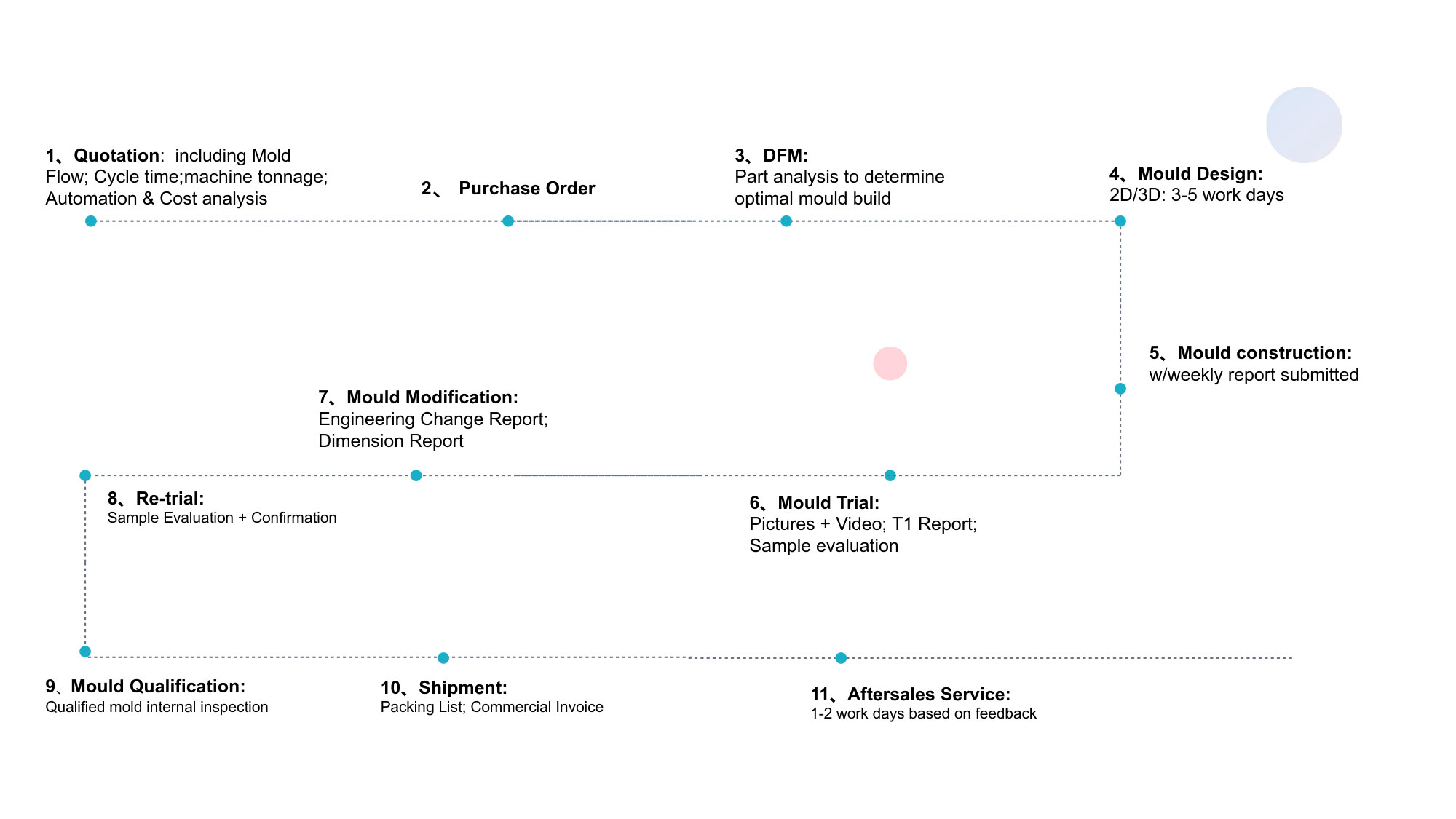
How Ansix Tech Performs Full‑Cycle Development & Production
Step 1 – Material Selection & Raw Material Traceability
For each panel mesh cover project, Ansix specifies the exact resin grade and supplier. Material certificates include:
Melt flow index (MFI) per ASTM D1238.
Density per ASTM D792 (to verify foam density reduction).
Mechanical properties (tensile, flexural modulus, impact) per ASTM/ISO standards.
Thermal properties (HDT, Vicat) and UL flammability rating if required.
Special additives: UV stabilisers, glass fibre content, flame retardants, etc.
All incoming resin lots are quarantined, tested, and released only with a certificate of analysis.
Step 2 – DFM & Moldflow Analysis
Ansix uses Moldflow (Autodesk) or equivalent simulation to:
Predict melt front progression through the mesh pattern.
Identify weld lines and reposition gates to hide them in non‑critical areas.
Simulate the physical foaming process: gas dissolution, bubble nucleation, cell growth, and final cell distribution.
Optimize vent placement to avoid burn marks on thin mesh ribs.
Recommend the optimal number and location of ejector pins, accounting for the delicate mesh geometry.
Customer value: The simulation replaces physical trial‑and‑error. Instead of building, testing, failing, and rebuilding (3–6 months), customers receive a fully validated design in 10–15 days.
Step 3 – Mold Design & Cooling System Engineering
For high‑volume mesh panel covers, rapid and uniform cooling is essential:
Conformal cooling channels (machined directly into the core/cavity) are used wherever the mesh geometry allows.
Baffles and bubblers ensure turbulent flow (Reynolds number > 10,000), maximising heat transfer.
Flow & gating system: Multi‑point hot runner nozzles with sequential valve gating control the melt front to avoid trapping gas.
Ejection system: Mesh parts are sensitive to ejector pin marks. Ansix uses large‑area stripper plates where possible, distributing ejection force over the widest area, avoiding pin marks on visible mesh faces.
Step 4 – Mold Manufacturing & Assembly
Machining: 5‑axis high speed milling of complex mesh contours; electrodes for fine mesh holes cut in‑house on CNC EDM.
Texture & finish: If the cover requires a specific grain or gloss, mold surfaces are processed to exact specification (matt, polished, VDI 3400 textures).
Assembly: Guides, bushings, and hot runner systems are mounted and tested on benchtop molding presses before disassembly for shipment.
Step 5 – Molding Validation & Process Optimisation
Typical physical micro‑foaming process optimisation for a mesh cover:
Gas type: N₂ (most common) or CO₂ (for higher solubility).
Back pressure: Controlled to maintain supercritical gas solution.
Shot volume: Calculated to allow 10–20 % expansion in the cavity (the foam expands to fill the mold).
Optimisation goals: Minimum weight per part, no visible swirl marks on the cover surface, uniform cell size in the core, no trapped gas in fine mesh holes.
T0 → T1 → T2 → T3 trials refine parameters until Cpk > 1.33 and yield > 99.5 % .
Step 6 – Quality Control & Packaging
Inline inspection: Automated camera inspection of each mesh cover for blocked holes, flash, or surface defects.
Sample sampling plan: AQL 0.65 (general inspection level II) for high‑volume production.
Packaging: Dedicated custom trays prevent contact between covers (scratch prevention). Heat‑sealed poly bags and corrugated cartons with moisture barrier for long‑distance shipping.
Step 7 – Fast Delivery & Logistics
Local stock: High‑volume annual contracts can reserve dedicated press time, guaranteeing lead times as short as 7 days from order to door for repeat orders.
Global shipping: Warehouses in China and Vietnam ship directly to Europe, Americas, and Asia. Door‑to‑door air or sea freight managed in‑house.
28+ Years of Industry Experience & Customer Reliability
Founded in Hong Kong in 1998, Ansix Tech has grown to four production bases, 260 injection molding machines, 1,200 employees, and annual turnover in excess of ¥1 billion RMB (≈ $140 million USD).
Core competence: High‑cavitation molds, multi‑material molding (overmolding, insert molding), and complex structural parts.
Application diversity: Automotive, medical (ISO 13485), consumer electronics, home appliances, industrial components.
Global footprint: Customers in North America, Europe, Japan, and Southeast Asia rely on Ansix for long‑term, high‑volume contracts.
Evidence of reliability: For a European thermostat housing project, Ansix reduced component cost by 15 % compared to the incumbent supplier while delivering a cycle time under 30 seconds and first‑pass yield exceeding 99.5 %. For a Milwaukee heavy‑duty tool box, Ansix provided 28 years of accumulated design‑for‑assembly knowledge to reduce part count and eliminate secondary operations.
How Ansix Tech Systematically Lowers Customer Costs
Ansix Tech attacks cost from five angles simultaneously:
Cost driver Ansix’s method Typical saving
Material cost Physical micro‑foaming reduces density → less resin per part 15–30 %
Mold amortisation Long tool life (500k + shots) spreads tooling cost over more parts Tool cost per part drops by 40–60 %
Labour & rework Automated production + high Cpk → almost no post‑mold finishing 5–15 % part cost reduction
Cycle time Foaming reduces cooling time; high‑cavitation molds boost output per hour 10–25 % faster cycle
Supply chain In‑house electrodes, machining, and repair; no outsourcing delays 30–50 % shorter repair lead times; eliminates airfreight premiums
Result: For a typical high‑volume mesh cover (1 million/year), the total landed cost can be 20 % to 35 % lower than what a less‑capable supplier can achieve.
Final Words: From Mold as Steel to Mold as Profit Engine
Ansix Tech approaches every physical micro‑foaming project with a simple philosophy: the mold is not a piece of steel; the mold is the customer’s profit engine. Every design decision — from steel selection to cooling layout to gas injection parameters — is made with the ultimate goal of reducing the customer’s total cost per part, minimising risk, and delivering predictability.
For customers evaluating a new panel mesh cover project, Ansix offers to run a full DFM and Moldflow analysis at no upfront commitment. This single document — showing predicted weld lines, vent locations, shrinkage compensation, and cycle time estimates — provides a level of transparency that eliminates almost all technical risk before the first euro or dollar is spent on tooling.
Contact & Quotation
Ansix Tech – 28 Years of Injection Molding Excellence
ISO 9001 | IATF 16949 | ISO 13485 | ISO 14001 | BSCI | FDA 510k (ISO 8 Cleanroom)
260 injection molding machines – 30 tons to 2,800 tons – 4 global factories
Email: inquiry@ansixtech.com | Web: www.ansixtech.com
For a custom DFM report on your physical micro‑foaming plastic panel mesh cover, contact our engineering team today.
Ansix Tech Co Ltd
If you have any plans related to Physical micro-foaming molding of plastic panel mesh covers , you can contact us at any time. We will turn your ideas into reality, let you realize your dreams, and obtain large orders from the market. Our contact information is info@ansixtech.com. Or contact our CTO, mail: stephen@ansixtech.com
#www.ansixtech.com #ansixtech.com #Physical micro-foaming molding of plastic panel mesh covers #Physical micro-foaming molding of plastic panel mesh covers injection molding companies #Physical micro-foaming molding of plastic panel mesh covers Canopy Mold injection mold companies #Ansix #Ansix moulds #Ansix china #Ansix tech china #Ansix tech company #Ansix facotry #Physical micro-foaming molding of plastic panel mesh covers injection molding #Physical micro-foaming molding of plastic panel mesh covers injection tools #Physical micro-foaming molding of plastic panel mesh covers injection moulds #Physical micro-foaming molding of plastic panel mesh covers plastic mould #Physical micro-foaming molding of plastic panel mesh covers plastic tools #Ansix Tech #Ansix molds #Ansix injection molding #Ansix mold factory #injection molding Physical micro-foaming molding of plastic panel mesh covers#Ansix mold factory #Physical micro-foaming molding of plastic panel mesh covers china #Physical micro-foaming molding of plastic panel mesh covers molds #injection factory #Physical micro-foaming molding of plastic panel mesh covers injection molding #Physical micro-foaming molding of plastic panel mesh covers injection molding factory #injection molding company #Physical micro-foaming molding of plastic panel mesh covers injection mold companies #Physical micro-foaming molding of plastic panel mesh covers Tooling #Physical micro-foaming molding of plastic panel mesh covers mold limited #Ansix mold china #Ansix companies #Ansix company China #Physical micro-foaming molding of plastic panel mesh covers facotry #Ansix Tech #Ansix Tech mould #Physical micro-foaming molding of plastic panel mesh covers injection moulding #injection moulding company #Ansix Physical micro-foaming molding of plastic panel mesh covers parts injection mold companies #medical injection molding companieschina #Physical micro-foaming molding of plastic panel mesh covers china factory #Ansix moulding companies #Ansix molding company #Physical micro-foaming molding of plastic panel mesh covers injection moulding facotry #Ansix Tech mold #Physical micro-foaming molding of plastic panel mesh covers mould #Physical micro-foaming molding of plastic panel mesh covers plastic injection molding #ansix plastic mold #Mold manufacturing #Physical micro-foaming molding of plastic panel mesh covers parts manufacturing #Physical micro-foaming molding of plastic panel mesh covers plastic parts factory #Physical micro-foaming molding of plastic panel mesh covers injection parts mold #Physical micro-foaming molding of plastic panel mesh covers PRECISION MANUFACTURING #Physical micro-foaming molding of plastic panel mesh covers #China mold #Physical micro-foaming molding of plastic panel mesh covers injection moulding china #Physical micro-foaming molding of plastic panel mesh covers mould china #china precision mold #mold in china #Physical micro-foaming molding of plastic panel mesh covers mold china #Precision molds #High-precision molds #Physical micro-foaming molding of plastic panel mesh covers #Injection molds #Physical micro-foaming molding of plastic panel mesh covers Factory #Physical micro-foaming molding of plastic panel mesh covers Company #Super Large Injection Mold Factory #Large Tonnage Injection Molding Factory #Physical micro-foaming molding of plastic panel mesh covers Company #Physical micro-foaming molding of plastic panel mesh covers Factory #2800T Injection Molding Factory #3000 Ton Injection Molding #4500 Ton Injection Molding Factory #Large Mold Injection Molding #Large Plastic Mold Injection Molding Factory #Large Injection Mold Manufacturer #Plastic Mold Factory #Injection Mold #Plastic Mold