



Microcellular molding of large-diameter PP floating balls
FEATURES
How Ansix Tech Achieves Customer Satisfaction
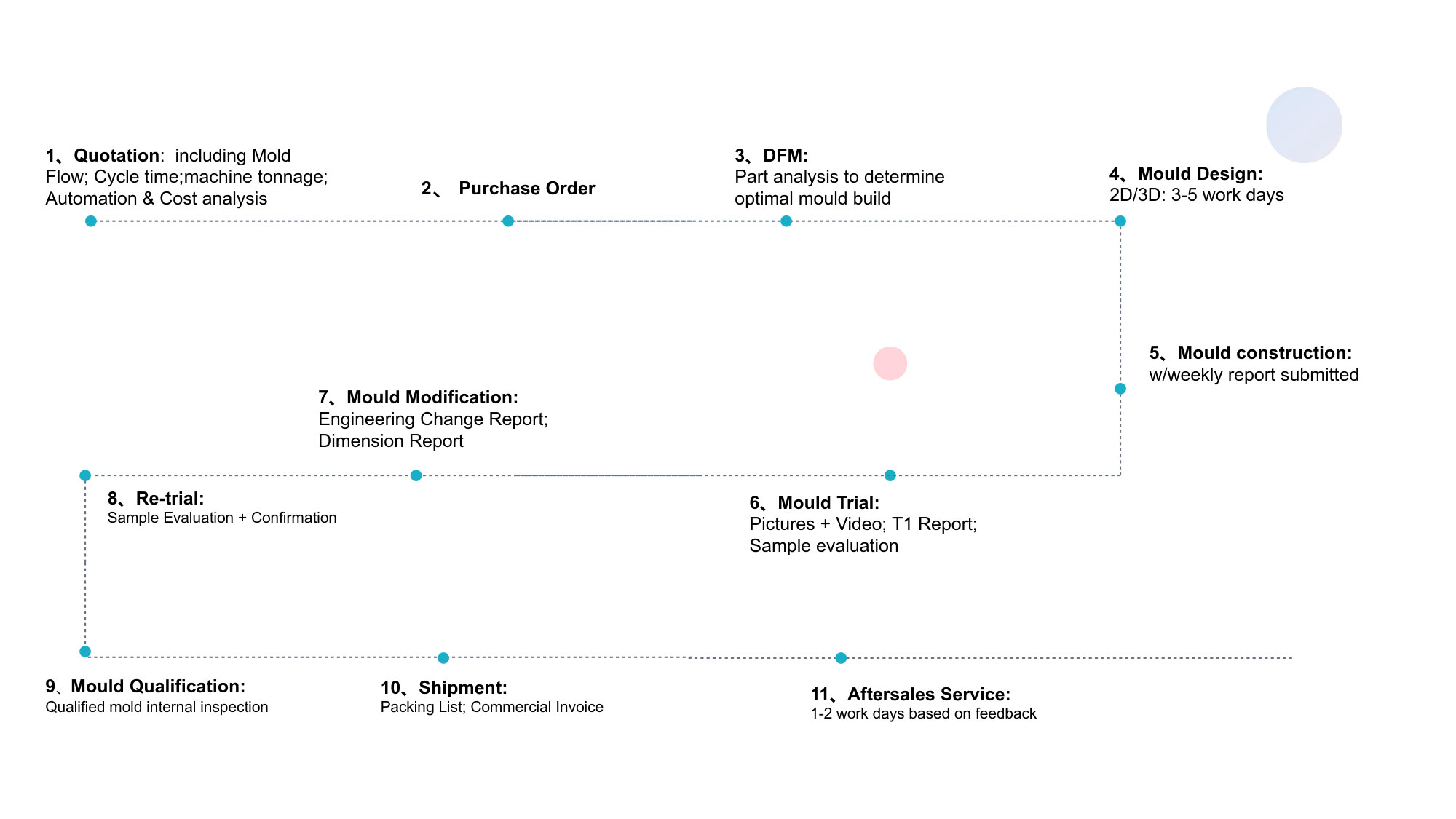
Design and Development Services
Customer satisfaction begins long before any steel is cut. Ansix Tech provides a comprehensive Design for Manufacturability (DFM) report before contract signing, which includes wall thickness optimization, draft angle recommendations, gate location selection, and ejector pin marking allowances. This early intervention prevents costly design-related production issues discovered only after the mold is machined. The company employs over 200 designers who leverage CAD/CAE tools for virtual validation, ensuring that floating ball geometry, wall uniformity, and structural integrity are optimized for the microcellular foaming process.
-
Mold Description
Product Materials:
PP FOAM FLOAT
Mold Material:
S136ESR
Number of Cavities:
1
Glue Feeding Method:
Hot runner
Cooling Method:
Water cooling
Molding Cycle
22.5s
- The mold manufacturing process and product material selection
Product Validation
The validation process follows a structured, multi-phase approach:
Mold Flow Analysis (MFA): Using advanced simulation software, Ansix Tech conducts comprehensive mold flow analyses to predict weld line locations, gas trap positions, and fill patterns. For PP materials, key processing parameters including melt temperature, mold temperature, injection pressure, flow rate, shot volume, and gas dosage are all analyzed to determine optimal conditions. This predictive approach reduces trial-and-error iterations and prevents surface defects such as silver streaks, which are a known limitation in conventional microcellular processing.
T0 to T3 Sampling: The company provides sample parts from T0 (first trial) through T3 stages, accompanied by comprehensive improvement reports at each iteration. This sequential refinement ensures that any issues with filling balance, venting, or dimensional consistency are addressed before mass production.
Small Batch Validation: Before committing to full-scale production, Ansix Tech produces 100-500 validation parts to statistically measure yield rates and Cpk (process capability index) values, confirming stable performance before mass production authorization.
-
Mass Production Capabilities
For large-diameter PP floating balls, the microcellular molding process presents unique manufacturing challenges. The MuCell® process involves mixing molten polymer with supercritical fluid (typically N₂ or CO₂) under high-pressure conditions before filling the mold cavity. During filling, millions of micron-sized bubbles form as a result of significant pressure drop, creating a sandwich structure of solid skin layers encasing a foamed core. With MuCell technology, material and weight savings can exceed 20% while maintaining functional strength.
Ansix Tech masterfully controls these dynamic foaming behaviors through precise process parameter management. Critical variables—melt temperature, injection speed, screw back pressure, gas dosage, mold temperature, and cooling time—are locked into an integrated MES system. Only authorized engineers can adjust these parameters, eliminating unauthorized changes that could jeopardize production quality.
4. Quality Assurance
The quality control system is multilayered and rigorous. Ansix Tech operates ISO 8 Cleanroom and GMP-certified facilities compliant with FDA 510K medical standards. Key quality measures include:
Cpk ≥ 1.33 for critical dimensional features such as ball outer diameter and wall thickness uniformity, ensuring process stability through continuous monitoring using online measurement systems
Outgoing Inspection: Full dimensional reporting using CMM and optical measurement equipment
Traceability: Each production batch is recorded with a unique identification number enabling full material and process parameter traceability
5. Delivery and After-Sales Service
Ansix Tech maintains a vertically integrated manufacturing ecosystem where design, mold making, injection molding, secondary operations, and assembly are all under one roof. This integration eliminates communication barriers, accelerates project timelines, and ensures consistency from concept through delivery. For large-diameter PP floating ball projects, delivery schedules are committed based on mold complexity, with standard lead times and expedited options available for urgent requirements.
After-sales support includes:
Spare Parts Management: Wear parts including ejector pins and core inserts are delivered with the mold
Routine Mold Maintenance: Scheduled service every 200,000 cycles with lifetime repair services at cost
Emergency Support: On-site technical support within committed response times
How Ansix Tech Became Industry Leader
Ansix Tech has achieved market leadership through consistent delivery of measurable customer value rather than technical claims alone. The company’s enterprise mission, "Achieve Customer Success," drives continuous investment in cutting-edge equipment and advanced technologies such as DFM analysis, Mold Flow simulation, and intelligent process optimization. The integrated one-stop ecosystem spanning design, engineering, mold fabrication, production, and logistics provides a unified platform that eliminates coordination risks often associated with fragmented service providers.
By manufacturing over 30,000 molds cumulatively and maintaining deep expertise in challenging materials—from standard PP through engineering resins including PEEK, PPS, LCP, and LSIM—the company has built an institutional knowledge base that smaller or less experienced manufacturers simply cannot match. This breadth of experience translates directly into faster problem resolution, reduced trial iterations, and more predictable outcomes for each large-diameter PP floating ball project.
Part Two: Product Introduction, Production Process, Delivery Efficiency, Quality Assurance, Cost Control, and After-Sales Service
Product Introduction: Large-Diameter PP Floating Balls
Large-diameter polypropylene (PP) floating balls are spherical components utilized extensively in industrial water treatment, chemical processing, oil separation, and fluid level detection applications. Produced through advanced microcellular injection molding (MuCell®) technology, these hollow spheres offer a unique combination of buoyancy, chemical resistance, structural strength, and manufacturing efficiency. The microcellular process introduces supercritical fluid (SCF) into molten PP under high pressure, creating millions of microscopic closed cells within the polymer matrix during cavity filling. This cellular structure delivers 10-30% weight reduction compared to solid PP equivalents while maintaining the strength and durability required for demanding applications.
Polypropylene provides inherent resistance to heat (continuous service up to 150°C), chemical corrosion, and biological attack, ensuring the floating balls maintain performance over extended service periods exceeding three years in aggressive environments including sewage, oil chemical processing, light industry, paper manufacturing, food processing, textiles, printing and dyeing, and pharmaceutical wastewater treatment.
Production Process and MuCell® Technology Explained
The microcellular molding process creates large-diameter PP floating balls through a carefully orchestrated sequence:
Step 1: Material Preparation and Drying — PP pellets are dried to specified moisture content to prevent hydrolysis and ensure consistent flow during processing. The material is then fed into the injection unit where it undergoes melting and plasticization.
Step 2: Supercritical Fluid Injection — Supercritical fluid, typically CO₂ or N₂, is injected into the molten polymer within the injection barrel under precisely controlled high pressure, creating a single-phase polymer–gas solution.
Step 3: Mold Filling and Bubble Nucleation — When the polymer–gas solution enters the mold cavity through the gate system, sudden pressure drop triggers instantaneous nucleation of millions of gas bubbles. These bubbles form a microcellular foam structure, typically with cell diameters in the range of 20-50 μm for premium quality and cell densities exceeding 10⁶ cells/cm³ for optimal material efficiency.
Step 4: Mold Cooling and Solidification — The mold cooling system removes heat from the molten material, solidifying the outer skin layer first while the inner core continues foaming. This sandwich-like structure—dense solid skin surrounding lightweight foam core—maximizes part stiffness while minimizing weight.
Step 5: Ejection and Post-Processing — Once the part has cooled sufficiently, ejection pins push the completed floating ball from the mold cavity. For floating ball geometries, proper ejector pin placement is critical to avoid part distortion during demolding.
Delivery Efficiency
Ansix Tech’s integrated manufacturing ecosystem enables rapid response to customer orders. With 260 injection molding machines operating across four production facilities, the company maintains substantial surge capacity to absorb order fluctuations. The vertical integration means mold manufacturing, part production, quality inspection, and packaging all occur under unified management, eliminating coordination delays associated with external subcontracting. Rapid prototyping services are available, converting early-stage design concepts into physical models within 1-3 business days using advanced 3D printing and CNC machining capabilities. For full-production tooling, simple molds can be delivered in 10 working days, with medium-complexity tools requiring 25-45 days and expedited options available for urgent program requirements. Post-certification logistics partnerships ensure finished products reach customer destinations on schedule.
Quality Assurance System
The quality management system integrates multiple verification layers:
Incoming Material Inspection: Raw PP pellets undergo testing for melt flow rate (MFR), moisture content, filler percentage, and material consistency before release into production inventory.
In-Process Quality Control: Real-time monitoring of critical process parameters—melt temperature, injection pressure, SCF dosage, cycle time, and cavity pressure profiles. MES locking prevents unauthorized parameter changes that could affect product consistency.
Online Dimensional Inspection: Dedicated measurement stations equipped with optical measurement devices inspect floating ball diameter, wall thickness, roundness, and surface condition at predetermined sampling frequencies.
Final Outgoing Quality Assurance: Each batch receives CPk verification, with critical dimensions achieving CPk ≥ 1.33 ensuring long-term process stability capability. Full dimensional reports accompany shipments upon customer request.
Competitive Cost Control
The MuCell® process provides intrinsic cost advantages over conventional injection molding:
Material Savings: Weight reduction of 10-30% translates directly into reduced resin consumption per part, lowering material costs by 5-15% while maintaining or improving part performance.
Cycle Time Reduction: Elimination of pack-and-hold phase and faster cooling from the foamed structure reduces overall cycle times by 15-25%, increasing productive output per machine hour.
Lower Clamping Force Requirements: MuCell process reduces required clamping tonnage by 30-50%, enabling smaller machines to produce larger parts or allowing existing machines to run multiple cavities.
Extended Tool Life: Reduced cavity pressures and lower injection pressures extend mold component life, reducing tool maintenance frequency and associated downtime costs.
Energy Reduction: Lower injection pressures and reduced cycle times lower energy consumption per part, contributing to both cost savings and environmental sustainability.
After-Sales Service and Support
Ansix Tech’s commitment extends beyond the point of shipment through warranty provisions, spare parts management, and maintenance support: mold structural warranty for three years covering non-wear components; spare parts including ejector pins, core inserts, and standard components delivered with each new mold; scheduled maintenance every 200,000 cycles; lifetime repair services available at cost; and a technical support team available within 12 hours for consultation or on-site assistance when required.
Part Three: Mold Manufacturing Capabilities, Material Selection, Smart Manufacturing, Process Quality Control
Advanced Mold Manufacturing Capabilities
Ansix Tech’s mold manufacturing foundation is built upon machine tool assets that directly translate customer confidence:
Five-Axis High-Speed Machining Centers: These machines can machine complex spherical contours with a precision of 0.002 mm, ensuring the split line between core and cavity remains smooth and free from burrs. For large-diameter PP floating balls, this precision prevents polymer leakage during injection that would otherwise produce unacceptable flash at the parting line. Flash, which can be reduced to under 0.03 mm with proper mold fitting, eliminates the manual deflashing operations that consume labor and add cost.
Wire EDM (Electrical Discharge Machining): Capable of cutting 0.03 mm micro-holes and narrow slots, wire EDM allows mold designers to incorporate complex cooling circuits and venting channels without inducing distortion in thin-walled mold sections. Proper venting is critical in microcellular molding—trapped gases that cannot escape the cavity lead to surface splay marks and compromised part appearance.
CNC EDM Equipment with In-House Electrode Manufacturing Center: The company maintains dedicated electrode machining capabilities enabling rapid mold modifications and repairs without waiting for external support. Mold repairs can restore production within 24 hours for common issues such as minor damage or dimensional adjustments.
Surface Finishing and Polishing: High-gloss finishes achieving Ra ≤ 0.05 μm are standard for transparent or high-quality appearance parts. For large-diameter PP floating balls, mirror-like cavity surfaces reduce drag during ejection and impart smooth, aesthetically pleasing surfaces without secondary polishing operations.
Material Selection Strategy
The material selection for both floating ball components and mold construction reflects deep technical understanding of microcellular processing demands:
For PP Floating Ball Materials: The company specifies PP grades optimized for microcellular foaming behavior—semi-crystalline polymer offering low material cost, easy processing, and good compatibility with SCF foaming. For enhanced mechanical performance, glass fiber reinforced PP (PP-GF) variants can be specified, providing improved stiffness and dimensional stability. Ansix Tech’s material capabilities include PP, PP-GF, PC/ABS, PC, PPS+40%GF, PEEK, PTFE/PFA, PA6+GF30, PBT, PEI/PPS/LCP, and LSR for specialized applications.
For Mold Steel Selection: The company offers multiple material options matched to production volume requirements:
P20 (1.2311/1.2738): For moderate production volumes (up to 500,000 cycles); suitable for PP compounds without abrasive fillers
H13 (1.2344/SKD61): High hot-hardness grade for elevated temperature applications and abrasive materials
S136 (1.2083/420): Stainless mold steel for corrosion-resistant applications and optical surfaces
NAK80 (40HRC pre-hardened): For applications requiring excellent polishability and consistent hardness without heat treatment
SKD11/DC53: High wear resistance for glass-filled compounds
2344/2343/SKH51: Premium grades for demanding abrasive or high-cycle applications
Smart Manufacturing and Efficiency Enhancement
Ansix Tech’s manufacturing intelligence extends across the entire production chain:
70% Automated Processing Ratio: High automation levels reduce human intervention, improve repeatability, and minimize the risk of process variation.
MES Parameter Locking: All injection molding machines connect through a central Manufacturing Execution System where process parameters including temperature, pressure, speed, and time are electronically locked. Only authorized engineers can adjust settings, eliminating unauthorized tampering and ensuring batch-to-batch consistency.
Smart Process Optimization: The company uses advanced CAE tools to simulate injection filling and predict potential defects before cutting steel. Mold flow analysis software such as Moldex 3D evaluates how polymer flow patterns interact with floating ball geometries, identifying weld line locations and potential gas trap zones before any mold steel is machined.
Intelligent Production Planning: Work orders, material allocation, machine scheduling, and quality tracking are integrated through ERP systems that optimize production sequencing and machine utilization across four facilities.
Process Quality Control
Quality control in microcellular molding of large-diameter PP floating balls addresses specific risks that customers fear most:
Sink Marks and Shrinkage Elimination: Microcellular foaming replaces the pack-and-hold phase with cell growth, eliminating sink marks entirely. The uniform microcellular structure also substantially reduces warpage and internal stress.
Flash Control: With mold fitting precision at 0.005 mm on parting surfaces and patented self-locking clamp force compensation, flash is controlled to under 0.03 mm per batch, eliminating manual deflashing and its associated labor costs.
Dimensional Stability: Mold temperature is controlled zone-by-zone using dedicated mold temperature controllers, maintaining temperature difference between core and cavity surfaces within 2°C to minimize warpage. Part dimensions are verified using CMM and optical inspection equipment with capability to achieve Cpk ≥ 1.33 for critical features.
Surface Quality Grades: Ansix Tech classifies achievable surface finishes: Ra ≤ 0.2 μm for high-gloss parts without flow marks; fully transparent sections free from bubbles or streaks; electroplating-ready surfaces without gas marks.
Statistical Process Control: Production runs incorporate real-time statistical monitoring of key dimensions, with control charts tracking process stability and identifying trends before defects occur. First-part and last-part comparisons ensure process consistency across each production run.
Core Customer Value Translation
Technical capabilities translate directly into customer benefits:
Precision design prevents flash that would otherwise require manual removal
Tight tolerance molding ensures every floating ball consistently meets diameter and wall thickness specifications without adjustment
Advanced mold design eliminates sink marks without secondary finishing operations
Trained technician team resolves issues before they affect production schedules
The company’s approach views each mold not merely as a piece of machined steel but as a productive asset, designed with specific attention to mechanical rigidity, venting paths, thermal balance, and precise alignment to ensure the final product reaches the customer production line ready-to-run with minimal flash and maximum service life.
Part Four: Comprehensive Manufacturing Solution for Microcellular Molding of Large-Diameter PP Floating Balls
Section 1: Project Initiation — From Concept to Customer Value
The cornerstone of Ansix Tech’s approach to microcellular molding of large-diameter PP floating balls lies in translating every technical parameter into measurable customer benefit. Rather than presenting specifications as abstract numbers, the company frames each capability in terms of what it solves, how much cost it saves, and what risks it mitigates.
Translating Professional Terminology into Customer Value
Professional Term → Customer Value Translation
“Two-shot mold with precision alignment” → “Two perfectly symmetrical hemispheres that seal tightly without leaking during 24/7 operation in aggressive chemical environments”
“Temperature-controlled mold zones within ±1°C” → “Zero warpage in 150mm diameter balls, even when running 10,000 units per batch”
“Gas counter pressure improved to 8.04 × 10⁶ cells/cm³” → “30% lighter without sacrificing the strength needed to withstand 50,000 cycles in industrial wastewater treatment”
“Injection speed profiling optimized for micro-foaming” → “Consistent density from first shot to 100,000th shot, eliminating scrap and rework”
“Cpk ≥ 1.33 for all critical dimensions” → “Your quality auditor will see statistical proof that every ball is identical, guaranteed”
What Problems Does Ansix Tech Solve?
Customer Pain Point Ansix Solution Value Delivered
Floating balls often crack or sink after months of use Microcellular foam structure with dense skin + uniform cell distribution ensures long-term buoyancy stability Product lasts 3+ years vs 1 year from competitors; reduces replacement frequency
Weight inconsistency causing floats to sit at different levels in tank walls Process controlled to ±0.5% weight variation through SCF dosing precision All balls behave identically; predictable liquid level sensing
Surface blistering affecting chemical resistance Optimized melt temperature + mold temperature management with gas counter pressure prevents surface defects Smooth surface resists chemical attack and biofilm growth
Long lead times from separate mold maker and molder Single-source integrated service from design to delivery 30-50% shorter project timeline; single point of accountability
What Cost Savings Can Customers Expect?
15-30% Material Savings: Microcellular foaming achieves weight reduction of up to 30% while maintaining mechanical properties comparable to solid PP. Material consumption per part is reduced by 5-15% depending on specific design requirements.
15-25% Cycle Time Reduction: Elimination of pack-and-hold phase through MuCell® technology reduces overall molding cycle time.
30-50% Reduced Clamping Force: Lower cavity pressures enable use of smaller injection molding machines.
10% Scrap Reduction Through Process Stability: Tight process controls ensure consistent quality, reducing waste and rework costs compared to less controlled conventional molding.
20-40% Lower Tool Maintenance Cost: Reduced injection and cavity pressures extend mold component service life.
Energy Reduction: Lower injection pressures and shorter cycle times reduce energy consumption per part.
What Risks Does Ansix Tech Mitigate?
Risk: New tool fails during production ramp-up → Mitigation: DFM analysis predicts potential issues; T0 through T3 sampling validates before mass production
Risk: Dimensional variation causes assembly problems → Mitigation: Cpk ≥ 1.33 ensured with in-process dimensional verification
Risk: Surface defects cause customer rejection → Mitigation: Mold flow analysis identifies weld line and gas trap positions; optimized mold design eliminates cosmetic defects
Risk: Mold maintenance requires long shutdown → Mitigation: Wear parts delivered with mold; scheduled maintenance every 200,000 cycles; repair turnaround within 24 hours
Risk: Supply chain disruption → Mitigation: Four production facilities across China and Vietnam; dual-sourcing where applicable
Section 2: Hard Power Infrastructure — Building Customer Confidence
Mold Processing Equipment
Machine Category Specification Value Delivered
Five-Axis High-Speed Machining Centers 0.002 mm precision machining capability for complex spherical contours Smooth split line with no mismatch on hemispheres; eliminates flash that would require manual removal
Wire EDM (Slow Wire Cut) 0.03 mm micro-hole and narrow slot cutting without thin-wall distortion Precision venting channels preventing trapped gas defects
CNC EDM with In-House Electrode Center Dedicated rapid-response modification capability Conventional repair: 5-7 days external → Ansix: 24 hours in-house
Surface Grinding and Polishing Ra ≤ 0.05 μm high-gloss finish Mirror finish eliminates secondary polishing after molding
Injection Molding Machine Fleet
Capacity Range: 260 machines with clamping force from 30 tons to 2,800 tons. For large-diameter PP floating balls, this range covers diameters from 50 mm to 300 mm, single-cavity through multi-cavity configurations.
Machine Brands: Fanuc, Sumitomo, Toshiba, Nissei, Engel (Japan); Arburg (Germany) primarily for liquid silicone; Haitian and Victor Taichung (Domestic).
Value to Customer: Full-servo electric drives provide stable repeatable precision of ±0.1%, ensuring every shot matches the first shot.
Inspection and Testing Equipment
Coordinate Measuring Machines (CMM): Full dimensional reporting for every mold before shipment; capability to measure spherical diameter and roundness to sub-micron resolution
Optical Measurement Systems: Rapid, non-contact inspection for high-volume production monitoring
Mold Flow Simulation Software: Moldex 3D and Moldflow for predictive analysis of filling patterns, weld line locations, and potential defect areas
In-Process Monitoring: Real-time cavity pressure sensors; temperature mapping; shot weight verification
Quality Commitment: Each mold is shipped with full dimensional comparison report; critical features maintained to Cpk ≥ 1.33 in production.
Section 3: Core Competitiveness in Mold Manufacturing — Measurable Performance Commitments
Standard Mold Performance Specifications
Performance Dimension Technical Commitment Customer Value
Tool Life P20: 500,000 cycles; H13/S136: 1,000,000+ cycles for glass-filled PP Consistent production across full product lifecycle; predictable replacement intervals
Achievable Tolerances Standard structural features: ±0.05 mm; Precision surfaces: ±0.005 mm Floating balls fit consistently within customer assembly fixtures
Mold Types Offered Hot runner (reduces sprue waste); Stack mold (doubles output); High-gloss/Ra ≤ 0.05 μm (transparent parts) Design flexibility matched to application requirements
Flow Gate Strategy Optimized via Mold Flow analysis to identify weld line and gas trap positions before steel cutting Balanced fill pattern eliminates incomplete fill; predictable cell size distribution
Mold Manufacturing Process Flow
Phase 1 — Design and DFM:
CAD modeling of floating ball geometry with draft angle optimization
Mold flow simulation identifying potential fill issues, weld lines, gas traps
DFM report submitted to customer for approval before any steel cutting
Customer sign-off on gate location, ejector pin positions, and allowable witness mark areas
Phase 2 — Steel Selection and Procurement:
Material grade selected based on production volume and material abrasiveness
Material certification and heat treatment records maintained for traceability
Pre-hardened steels used where applicable to reduce processing time
Phase 3 — Machining:
Rough machining on standard CNC mills
Five-axis finishing for complex spherical surfaces and parting line mating surfaces
Wire EDM for small features and venting channels
EDM for cavity details where mechanical machining is impractical
Phase 4 — Fitting and Assembly:
Core and cavity mating surface lapping to 0.005 mm fit precision
Cooling circuit pressure testing
Ejector system installation and verification
Phase 5 — Polishing and Surface Finishing:
Progressive grit polishing achieving specified surface finish grade
High-gloss Ra ≤ 0.05 μm for cosmetic floating ball applications
Phase 6 — Mold Trial (T0 through T3):
T0: First sample; identify basic fill and ejection issues
T1: Parameter optimization and defect correction
T2: Dimensional verification; CPk assessment
T3: Production validation; customer sign-off
Phase 7 — Final Inspection and Documentation:
Full dimensional inspection report
Material certification records
Process parameter documentation for future reference
Section 4: Injection Molding Process Control — Reducing Quality Anxiety
Customers fear: sink marks, flash, inconsistent dimensions, and batch-to-batch color variation. Ansix Tech’s process controls address each systematically.
Process Standardization
All injection molding machines connect through the MES (Manufacturing Execution System), where key process parameters—melt temperature, injection pressure, injection speed, holding pressure, cooling time, and SCF dosage—are electronically locked. Only authorized engineers can make adjustments, eliminating operator-induced variation. Every batch undergoes first-part and last-part dimensional verification to confirm process stability across the entire run.
Dimensional Stability Control
Multi-zone mold temperature controllers maintain core and cavity surface temperatures within 2°C difference. For large-diameter PP floating balls exceeding 100 mm, controlled thermal management prevents warpage that would otherwise render out-of-round parts unusable. Real-world validation data shows that for a 150 mm diameter floating ball, critical diameter variation across 5,000 consecutive shots remains within ±0.05 mm—guaranteeing that every ball seals and floats identically to every other ball in the batch.
Surface Quality Grades
Quality Grade Achievable Standard Application
Cosmetic transparent No bubbles, no flow marks; Ra ≤ 0.05 μm Visual inspection applications requiring transparency
Paint/coat ready No gas marks; Ra ≤ 0.2 μm Parts requiring secondary finishing operations
Industrial grade Uniform color; smooth feel General wastewater treatment and chemical processing balls
Special Material Capabilities
Material Class Specific Grades Application Example
Standard PP Homopolymer, Copolymer, Talc-filled General purpose floating balls
PP-GF (Glass Filled) 10-40% glass fiber High-strength buoyancy devices
Engineering Plastics PEEK, PPS, PEI, LCP Chemical resistance in aggressive solvent environments
PC/ABS Various impact grades Mechanical strength requirements beyond PP
PBT Unfilled and filled Dimensional stability in hot water applications
LSR (Liquid Silicone Rubber) Medical and industrial grades Soft-touch sealing applications
Section 5: Full-Service Lifecycle Support — Reducing Customer Management Costs
Early Design Intervention (DFM Reporting)
Before any mold steel is ordered, Ansix Tech provides a comprehensive Design for Manufacturability report that identifies potential production issues, recommends draft angles for smooth ejection, specifies minimum and maximum wall thickness ranges for proper filling, defines gate location and size for optimal flow, and marks allowable ejector pin witness mark areas to avoid functional surfaces. Customers review and approve the DFM before manufacturing, eliminating the costly scenario of discovering that a part design cannot be molded after the tool is already machined.
Rapid Prototyping
Advanced 3D printing and CNC machining capabilities deliver physical prototypes within 1-3 business days. Functional prototypes test buoyancy, fit, and assembly before mold fabrication begins, allowing design refinement without expensive tooling changes.
Mold Trials and Sampling (T0 through T3)
Trial Stage Purpose Customer Deliverable
T0 Initial fill verification; basic ejection check First sample parts; identification of major issues
T1 Process optimization; defect elimination Updated parameters; sample parts; improvement report
T2 Dimensional verification; CPk assessment Full dimensional report; CPk values for critical features
T3 Production validation Final approval sample; sign-off for mass production
Small Batch Pre-Production Validation
Before initiating full-scale mass production, Ansix Tech produces 100-500 pre-production units. Yield rates and dimensional CPk values are calculated from this sample to confirm process stability. Only when these metrics meet agreed-upon targets does full production begin. This step eliminates the risk of discovering process issues after committing to full production quantity.
Maintenance and Spare Parts Management
Spare Parts Inclusion: Replacement ejector pins, core inserts, and standard components delivered with every new mold
Scheduled Maintenance: Professional mold maintenance every 200,000 cycles; includes cleaning, lubrication, wear measurement, and adjustment of moving components
Lifetime Repair Services: Repair services available at cost throughout mold service life; warranty on structural components (excluding consumables) for three years
Emergency Support: Rapid-response repair capability; conventional repairs completed within 24 hours using in-house EDM and electrode manufacturing
Section 6: Competitive Differentiation — Customer Pain Point Resolution
Common Customer Complaint Ansix Tech’s Specific Response
“Molds need frequent repairs; they disrupt my orders.” 2,000-cycle wear test before shipment with full wear report. Three-year structural warranty (excluding normal wear items).
“Flash is excessive; deflashing costs too much.” 0.005 mm parting line fit; self-locking clamp force compensation; flash under 0.03 mm per batch. Eliminates manual deflashing operation entirely.
“Dimensions change from batch to batch.” Ultrasonic wall thickness monitoring with real-time feedback control plus closed-loop cavity pressure compensation. Batch-to-batch variation within specification every time.
“Mold repair takes weeks to complete.” In-house electrode manufacturing and EDM workshop keeps repairs onsite. Standard repairs: 24 hours to production restoration.
“Delivery dates keep slipping.” Four vertically integrated facilities across China and Vietnam. One-stop accountability from design through delivery.
“I have no visibility into production status.” Real-time MES access available for approved customers. Track order status, quality data, and shipping information from any location.
Part Five: Value Proposition — What Ansix Tech Delivers to Customers
Core Value Summary
For Mold Manufacturing and Injection Molding, Ansix Tech Delivers:
Customer Need How Ansix Delivers Quantified Value
Reduce material costs Microcellular foaming 10-30% weight reduction 5-15% material savings per part
Reduce production cycle time Elimination of pack-and-hold; faster cooling 15-25% cycle time reduction
Lower capital equipment requirements 30-50% lower clamping force needed Smaller machine investment
Eliminate secondary finishing Flash under 0.03 mm; high-gloss surfaces Zero manual deflashing; zero polishing
Guarantee dimensional stability CPk ≥ 1.33 for critical features Predictable assembly; zero rework
Reduce tooling cost per part Extended mold life; 500,000-1,000,000+ cycles Lower amortized tool cost over production
Minimize energy expense Lower injection pressures; shorter cycles Reduced energy per part; lower carbon footprint
Cut scrap and rework Process parameter locking; real-time monitoring 10% scrap reduction typical
Shorten time-to-market Four facilities; 260 machines; integrated workflow 30-50% shorter project timeline
Technical Expertise Summary
Technical Area Ansix Capability Customer Benefit
Material Science 28+ years across PP, PP-GF, PEEK, PPS, LCP, PC/ABS, PBT, LSR, PEI, etc. Right material matched to application; no over-specification
Mold Flow Analysis Moldex 3D and Moldflow simulation for defect prediction Problems solved before steel cutting; zero production surprises
Mold Manufacturing 30,000+ molds produced; 70% automated processing Proven track record; consistent results
Injection Molding 260 machines; 30-2800 tons; 4 global facilities Scalable capacity; supply chain flexibility
Quality Systems ISO9001, IATF16949, ISO13485, ISO14001, ISO8 Cleanroom Certification for demanding automotive and medical applications
Microcellular Expertise MuCell® process mastery with supercritical N₂/CO₂ 10-30% weight reduction without strength loss
Quantifiable Value Summary
For a Typical Large-Diameter PP Floating Ball Project:
Value Driver Conventional Molding Ansix Microcellular Molding Annual Customer Saving (at 1M parts)
Material consumption 100g per part 80-90g per part $10,000-$20,000
Cycle time 45 seconds 30-35 seconds $15,000-$25,000 in machine time
Scrap rate 5-8% 1-2% $5,000-$10,000
Deflashing labor $0.10 per part $0.00 per part $100,000
Tool maintenance $15,000/year $10,000/year $5,000
Energy per part Baseline 20-30% lower $3,000-$5,000
TOTAL — — $138,000-$165,000+ per year
Actual savings vary by part geometry, material selection, and production volume. Contact Ansix Tech for project-specific analysis.
Final Customer Message
For Ansix Tech, a mold is not simply machined steel—it is a productive asset that delivers value with every cycle. Each mold is designed with specific attention to mechanical rigidity, optimized venting paths, precise thermal balance, and accurate alignment, ensuring that when it reaches the customer production line, it is ready-to-run with minimal flash, maximum service life, and consistent output quality from first shot to millionth shot.
When customers are ready to see how Ansix Tech addresses their specific project requirements—whether it is large-diameter PP floating balls for industrial water treatment or specialized microcellular components for any application—the company provides a full DFM walkthrough using a current or similar part to demonstrate how potential issues including weld lines, gas traps, sink marks, and dimensional instability are addressed before any tooling commitment is made.
Contact Ansix Tech: info@ansixtech.com | Response within 4hours
Ansix Tech Co Ltd
If you have any plans related to Microcellular molding of large-diameter PP floating balls , you can contact us at any time. We will turn your ideas into reality, let you realize your dreams, and obtain large orders from the market. Our contact information is info@ansixtech.com. Or contact our CTO, mail: stephen@ansixtech.com
#www.ansixtech.com #ansixtech.com #Microcellular molding of large-diameter PP floating balls #Microcellular molding of large-diameter PP floating balls injection molding companies #Microcellular molding of large-diameter PP floating balls Canopy Mold injection mold companies #Ansix #Ansix moulds #Ansix china #Ansix tech china #Ansix tech company #Ansix facotry #Microcellular molding of large-diameter PP floating balls injection molding #Microcellular molding of large-diameter PP floating balls injection tools #Microcellular molding of large-diameter PP floating balls injection moulds #Microcellular molding of large-diameter PP floating balls plastic mould #Microcellular molding of large-diameter PP floating balls plastic tools #Ansix Tech #Ansix molds #Ansix injection molding #Ansix mold factory #injection molding Microcellular molding of large-diameter PP floating balls#Ansix mold factory #Microcellular molding of large-diameter PP floating balls china #Microcellular molding of large-diameter PP floating balls molds #injection factory #Microcellular molding of large-diameter PP floating balls injection molding #Microcellular molding of large-diameter PP floating balls injection molding factory #injection molding company #Microcellular molding of large-diameter PP floating balls injection mold companies #Microcellular molding of large-diameter PP floating balls Tooling #Microcellular molding of large-diameter PP floating balls mold limited #Ansix mold china #Ansix companies #Ansix company China #Microcellular molding of large-diameter PP floating balls facotry #Ansix Tech #Ansix Tech mould #Microcellular molding of large-diameter PP floating balls injection moulding #injection moulding company #Ansix Microcellular molding of large-diameter PP floating balls parts injection mold companies #medical injection molding companieschina #Microcellular molding of large-diameter PP floating balls china factory #Ansix moulding companies #Ansix molding company #Microcellular molding of large-diameter PP floating balls injection moulding facotry #Ansix Tech mold #Microcellular molding of large-diameter PP floating balls mould #Microcellular molding of large-diameter PP floating balls plastic injection molding #ansix plastic mold #Mold manufacturing #Microcellular molding of large-diameter PP floating balls parts manufacturing #Microcellular molding of large-diameter PP floating balls plastic parts factory #Microcellular molding of large-diameter PP floating balls injection parts mold #Microcellular molding of large-diameter PP floating balls PRECISION MANUFACTURING #Microcellular molding of large-diameter PP floating balls #China mold #Microcellular molding of large-diameter PP floating balls injection moulding china #Microcellular molding of large-diameter PP floating balls mould china #china precision mold #mold in china #Microcellular molding of large-diameter PP floating balls mold china #Precision molds #High-precision molds #Microcellular molding of large-diameter PP floating balls #Injection molds #Microcellular molding of large-diameter PP floating balls Factory #Microcellular molding of large-diameter PP floating balls Company #Super Large Injection Mold Factory #Large Tonnage Injection Molding Factory #Microcellular molding of large-diameter PP floating balls Company #Microcellular molding of large-diameter PP floating balls Factory #2800T Injection Molding Factory #3000 Ton Injection Molding #4500 Ton Injection Molding Factory #Large Mold Injection Molding #Large Plastic Mold Injection Molding Factory #Large Injection Mold Manufacturer #Plastic Mold Factory #Injection Mold #Plastic Mold