



PCO1810 Bottleneck 48-Cavity Preform Mold
FEATURES
Hard Power Foundation — Building Customer Trust Through Equipment Capability
The foundation of any high-quality mold starts with the precision and capability of the manufacturing equipment. Ansix Tech has invested strategically in world-class machinery that directly translates into superior product quality, faster delivery, and longer mold life for customers.
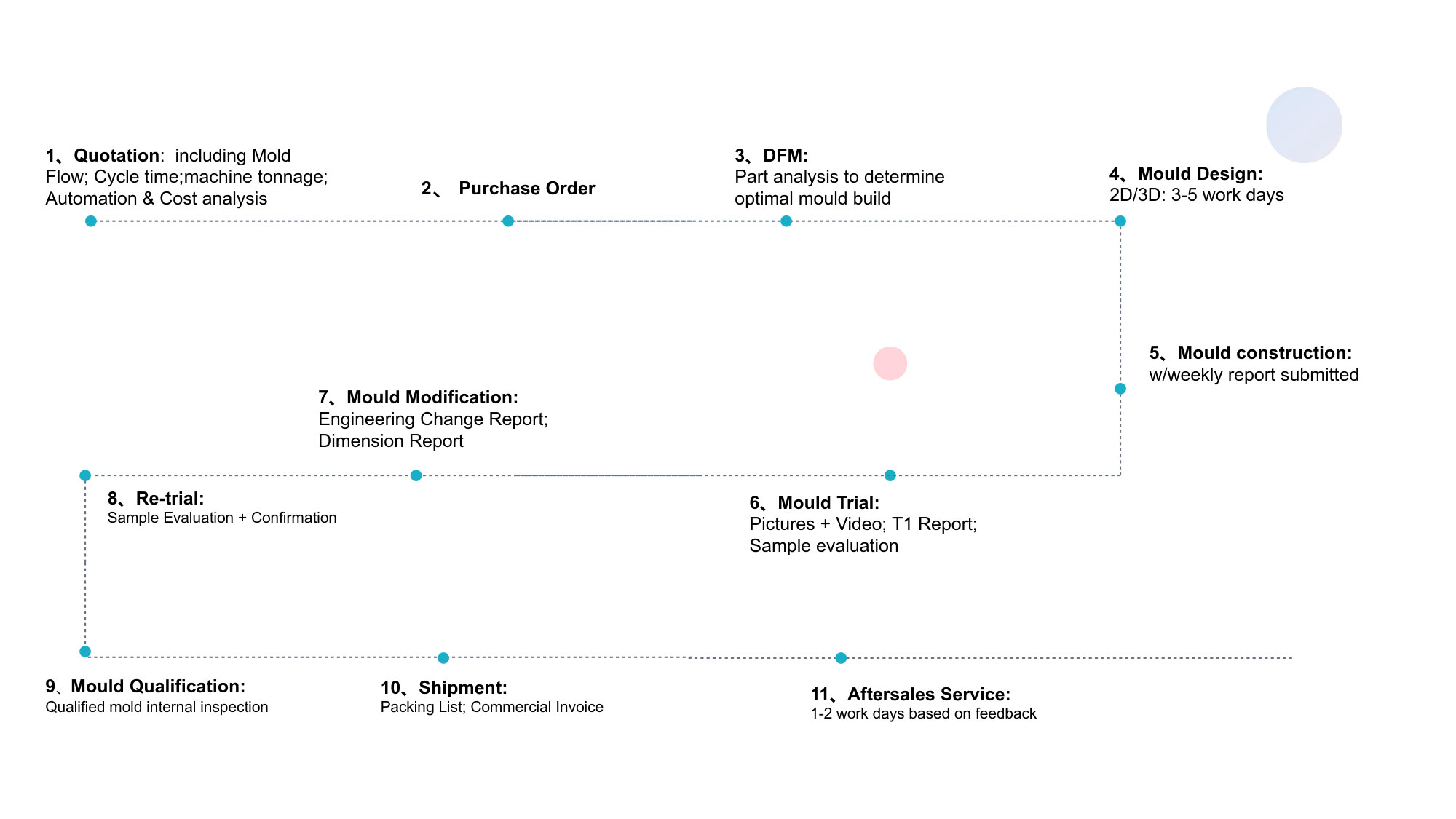
1.1 Precision Machining Equipment
Ansix Tech‘s machining capabilities are designed to achieve micro-level precision that directly impacts preform quality and production stability.
Five-Axis High-Speed Machining Centers: Ansix operates advanced five-axis high-speed CNC machining centers capable of achieving ±0.002mm precision on complex curved surfaces. This level of accuracy ensures that the mold’s parting lines remain smooth and burr-free, eliminating secondary finishing operations that add cost and delay production. For customers, this means preforms with seamless neck finishes and no flash defects that would otherwise require manual trimming.
-
Mold Description
Product Materials:
PET PETG
Mold Material:
S136ESR
Number of Cavities:
1*48
Glue Feeding Method:
Hot runner
Cooling Method:
Water cooling
Molding Cycle
8.5s
- The mold manufacturing process and product material selection
Slow Wire EDM (Electrical Discharge Machining): The company’s slow wire EDM equipment can machine micro-holes and narrow slots as small as 0.03mm with exceptional precision. This capability is critical for cooling channel designs and intricate core geometries, preventing thin-wall deformation that compromises preform wall uniformity. When customers receive preforms with consistent wall thickness, they experience fewer blow-molding failures and higher final bottle quality.
CNC Lathe and Milling Operations: With precision CNC lathes from Mazak and Makino, Ansix ensures that every component—from core pins to cavity inserts—is machined to exact specifications. The turning center processes ensure perfect component fit, eliminating assembly mismatches that cause premature wear or production interruptions.
-
Injection Molding Machine Fleet
The mold is only half the equation; the injection molding machine must work in perfect harmony to realize its full potential.
Clamping Force Range (220–400+ tons): Ansix Tech‘s injection molding machine fleet covers a comprehensive range from 220 tons to 400+ tons, precisely matched to the requirements of 48-cavity preform molds. For a standard PCO1810 48-cavity mold producing 18–28g preforms, the recommended clamping force is 400–550 tons, with the 8–12 tons-per-cavity rule providing a reliable sizing methodology. Ansix’s flexible platen systems distribute clamp force evenly across the platen face, allowing for 10–30% lower clamp tonnage requirements while decreasing mold wear and improving part quality.
All-Servo Electric Drive Systems: Every Ansix injection molding machine features all-servo electric drives that deliver exceptional repeatability with ±0.1% precision. This means that every injection cycle—whether the 1,000th or the 1,000,000th—produces identical preforms with consistent weight, dimensions, and appearance. For customers, this translates to predictable production output, reduced scrap rates, and lower per-unit manufacturing costs.
Shot Weight Compatibility: A 48-cavity mold producing 18g preforms requires approximately 864g of molten PET per injection cycle. Ansix machines are precisely sized so that required shot weight falls between 30% and 80% of maximum shot capacity, ensuring optimal plasticizing efficiency and material quality.
1.3 Inspection and Quality Assurance Equipment
Every mold leaving Ansix Tech undergoes rigorous dimensional verification to ensure it meets or exceeds customer specifications.
Coordinate Measuring Machines (CMM): Ansix utilizes high-precision CMM equipment to verify every critical dimension of each mold component. Before shipment, each mold undergoes a full dimensional inspection, with a comprehensive dimensional report provided to the customer. Critical dimensions are verified to maintain CPK ≥ 1.33, a statistical measure indicating that the manufacturing process is capable of producing parts within specification limits with minimal variation.
Optical Inspection Systems: Optical imaging systems complement CMM measurements, providing non-contact verification of surface finishes, gate locations, and thread profiles. This dual-verification approach ensures that no defect escapes detection before the mold reaches the customer‘s production floor.
Material Certification: Ansix provides complete material certifications for all mold components, including steel grade verification, heat treatment documentation, and hardness testing results. This traceability gives customers confidence in the mold’s long-term durability and performance.
Section Two: Core Competencies in Mold Manufacturing — Translating Technical Specifications into Customer Value
The true measure of a mold manufacturer is not just what equipment they own, but how they apply that equipment to deliver reliable, high-performance tools that exceed customer expectations. Ansix Tech‘s mold manufacturing competencies are organized around the metrics that matter most to customers.
2.1 Mold Life and Durability Commitment
Customers invest in molds expecting years of trouble-free operation. Ansix delivers on this expectation through strategic material selection and proven design practices.
Material Selection Strategy: Ansix Tech employs a tiered material selection approach based on production volume and material type:
Component Material Hardness Customer Value
Mold Base P20 (anti-rust) HRC 28–32 Corrosion resistance, dimensional stability, cost-effectiveness
Core, Cavity, Neck S136 Stainless Steel HRC 48–52 Corrosion resistance, mirror polishability, long wear life
Valve Pins SKD61 (Japan Punch) HRC 50–52 High-temperature durability, precise gate sealing
Wear Plates Graphite Copper — Self-lubricating, reduced maintenance
For high-end applications requiring superior wear resistance, Ansix utilizes German 1.2316 stainless steel, capable of achieving 3 million shots without maintenance. Customers producing abrasive materials benefit from hardened steels like H13, DIN 1.2344 (ESR), or powder-metallurgy steels that deliver superior wear resistance despite glass fiber fillers.
Guaranteed Mold Life Commitment:
Standard thermoplastics (PET, PP, PE): 1,000,000 shots minimum
Glass-fiber reinforced materials (GF30–GF50): 500,000 shots minimum
Premium material specification (1.2316, S136 hardened): 3,000,000 shots with proper maintenance
For customers, this means predictable tooling replacement schedules, reduced unplanned downtime, and lower total cost of ownership over the mold‘s lifetime.
2.2 Achievable Tolerances and Precision
Dimensional accuracy directly impacts blow-molding success and final bottle quality.
Standard Structural Components: ±0.05mm tolerance is maintained for conventional features, ensuring proper fit and function without unnecessary manufacturing cost.
Precision Features (Gates, Threads, Critical Surfaces): ±0.005mm tolerance is achievable for precision gears, medical components, and critical sealing surfaces. For customers, this level of precision means:
Consistent preform neck finish dimensions guarantee reliable capping
Uniform wall thickness (±0.08mm over 100mm length) ensures stable blow-molding
Weight variation between cavities is maintained below ±0.3g, minimizing material waste
Traceable Documentation: Every mold ships with complete material certification, heat treatment curves, and dimensional inspection reports. This documentation provides customers with audit-ready quality records and eliminates uncertainty about material properties.
2.3 Mold Architecture and Configuration Options
Ansix Tech offers multiple mold configurations to match customer production requirements and budget constraints.
Hot Runner Systems with Valve Gate Technology: The PCO1810 48-cavity mold employs a professionally balanced hot runner system with valve gates, which offers multiple advantages: eliminating runner scrap reduces material waste by 20–30%, preventing stringing and gate vestiges eliminates post-molding trimming, and maintaining consistent melt temperatures across all 48 cavities ensures uniform preform quality. Point-to-point PID temperature control provides individual cavity temperature monitoring, with the thermal design incorporating titanium heat shields and air gaps to isolate the 200–300°C hot runner from cooler mold plates maintained at 80–90°C for PET. For PET materials, which exhibit a narrow processing window of 260–280°C, temperature uniformity is non-negotiable to prevent degradation. For customers, this translates to zero material waste from runners, clean gate vestiges requiring no secondary processing, and cycle times reduced to 12–15 seconds per cycle.
Cooling System Optimization: Efficient cooling is the single most important factor determining cycle time and preform quality. Ansix designs cooling systems with:
Core cooling tubes with two-in, two-out configuration (1-inch diameter)
Cavity cooling circuits with optimized flow paths
Neck ring cooling for precise thread formation
Individual cavity temperature control through independent cooling channels
The cooling system employs baffles or spirals to maintain temperature differentials across the mold below 5°C, reducing cycle times to 12–15 seconds for 48-cavity systems. For customers, faster cooling means more preforms per hour and lower energy consumption per part. Reducing cooling time by just two seconds on a 48-cavity mold can increase annual output by over 1.7 million preforms.
2.4 Delivery Standards and Lead Times
Time-to-market is a critical competitive advantage. Ansix Tech offers tiered delivery options that balance speed with quality validation.
Mold Complexity Standard Lead Time Express Option Validation Approach
Simple Mold (single cavity, conventional materials) 10 days 7 days Full dimensional inspection only
Medium Complexity (up to 16 cavities) 25–35 days 20 days T0 sample + dimension report
High Complexity (48-cavity hot runner) 45–60 days 30–35 days T0, T1, T2 samples + CPK validation
Quality Assurance in Express Delivery: Even under expedited schedules, Ansix never compromises on essential validation steps. Every express order includes:
T0 sample run with dimensional verification
Material certification and heat treatment records
Minimum 200-cycle test run to verify ejection and cooling function
Section Three: Injection Molding Process Control — Eliminating Quality Anxiety
Customers‘ greatest concerns in preform production center on visible defects: sink marks, flash, dimensional instability, and batch-to-batch color variation. Ansix Tech has implemented comprehensive process control systems that address each of these concerns systematically.
3.1 Process Standardization and MES Integration
Machine Network Integration: All injection molding machines in Ansix‘s facility are connected to a Manufacturing Execution System (MES) that locks all critical process parameters—temperature, pressure, injection speed, and hold time—against unauthorized changes. Only authorized engineering personnel can modify these parameters, and any change is logged with date, time, and operator identification.
First-Article and Last-Article Verification: Every production batch undergoes first-article inspection before full production begins and last-article verification upon completion. This practice ensures that any process drift is detected immediately, preventing defective production from continuing unnoticed.
For customers, this means documented process stability, traceable quality records, and confidence that every shipment meets the same specifications.
3.2 Dimensional Stability Control
Shrinkage, warpage, and dimensional drift are the enemies of consistent preform quality. Ansix‘s approach to dimensional stability combines mold design optimization with real-time process monitoring.
Zone Temperature Control: Ansix molds incorporate zone-controlled temperature management using mold temperature controllers. The core and cavity temperatures are maintained within 2°C of each other, minimizing differential shrinkage that causes warpage. For PET preforms, which cool from melt temperatures around 275°C to ejection temperatures below 70°C, controlling this gradient is essential.
Performance Data: In validation testing for a customer’s 18g PCO1810 preform, Ansix achieved key dimensional stability metrics: critical hole spacing variation of ≤0.02mm across three consecutive production days, cavity-to-cavity weight variation of ≤0.3g (typically 0.15–0.20g), and wall thickness concentricity within ±0.08mm over 100mm length.
3.3 Surface Quality Standards
Appearance quality directly impacts brand perception for beverage and consumer product customers.
Clarity Grades Achievable:
Grade Ra Value Applications Customer Value
Standard ≤0.4μm Opaque preforms, industrial applications Cost-effective for non-critical surfaces
High Gloss ≤0.2μm Clear water bottles, visible surfaces Transparent preforms with no visible flow marks
Mirror Finish ≤0.05μm Premium cosmetic packaging, optical clarity Defect-free transparent preforms with no bubbles or flow marks
Specific Defect Prevention:
Bubbles/Voids: Eliminated through optimized back-pressure and screw design
Flow Marks/Weld Lines: Predicted and prevented through Moldflow simulation during DFM
Gate Vestiges: Clean break through precise valve gate timing
Splay/Moisture Marks: Controlled through pre-drying protocols and sealed material handling
For customers requiring post-molding decoration (printing, labeling, metallization), Ansix can incorporate deformation compensation into the mold design, achieving print registration accuracy within ±0.1mm.
3.4 Special Material Processing Capabilities
Not all preforms use standard PET. Ansix Tech has extensive experience processing a wide range of engineering and specialty thermoplastics.
Material Experience Portfolio:
Material Category Specific Materials Key Challenges Ansix Solution
Standard Thermoplastics PET, PP, PE Narrow processing window, moisture sensitivity Dedicated PET screws, pre-drying protocols
Engineering Plastics PC, ABS, PC/ABS, PA6+GF30 High melt temperature, abrasive fillers Hardened barrels, wear-resistant screws
High-Performance PEEK, PPS+40%GF, PEI Extreme temperatures, chemical resistance H13 tooling, special cooling strategies
High-Temperature LCP, PPA, PBT Rapid freezing, low viscosity Hot runner optimization, precise gate timing
Elastomers LSR (Liquid Silicone Rubber) Precise mixing, long cure times Specialized injection units, cold runner systems
Additive-Modified FR-rated (UL94 V-0), UV-stabilized Corrosive byproducts, UV degradation Stainless steel tooling, validated additive compatibility
Performance Validations:
Flame Retardant (UL94 V-0) rating: Verified through third-party testing for electrical and electronics applications
UV Stability: Validated to 3,000+ hours of accelerated weathering with no significant color change or property degradation
For customers, this material versatility means single-source responsibility for diverse product lines and reduced supplier management overhead.
Section Four: Full-Service Lifecycle Support — Reducing Customer Management Costs
Too many mold suppliers treat the transaction as complete once the mold ships. Ansix Tech takes a different approach, providing comprehensive support that reduces customers‘ internal management burden and eliminates costly surprises.
4.1 Early Engagement: Design for Manufacturability (DFM) Reports
The most expensive problems are those discovered after the mold is built. Ansix prevents these problems through systematic DFM analysis before any metal is cut.
Pre-Contract DFM Deliverables: Before accepting a purchase order, Ansix provides a complete mold feasibility analysis that includes:
Draft angle recommendations specific to the chosen material and cavity count
Wall thickness optimization to prevent sink marks and ensure uniform cooling
Gate location and runner balancing analysis
Ejector pin placement and mark location tolerance
Cooling channel layout for optimal cycle time
For customers, this upfront investment in analysis eliminates costly design changes after mold completion, reduces time-to-production by 3–6 weeks, and prevents production stoppages due to unmanufacturable features.
4.2 T-Sample Progression: Iterative Validation
Ansix follows a disciplined T-sample progression protocol that provides customers with clear visibility into mold performance at every stage.
T0 Sample (First Shot): The mold runs for the first time with standard parameters. Ansix provides the customer with:
Complete dimensional inspection report
Visual inspection photos of all cavities
Cycle time measurement and cooling performance data
Recommended parameter adjustments for T1
T1 Sample (Parameter Optimization): Following T0 analysis, Ansix implements parameter adjustments and produces a second sample set. Deliverables include:
Updated dimensional inspection with cavity-to-cavity comparison
Material property verification
Weight consistency data across all 48 cavities
Gate quality assessment
T2 Sample (Fine-Tuning): The third sample run represents the mold at near-production readiness. At this stage, Ansix provides:
CPK analysis for all critical dimensions
Full run documentation including cycle time, energy consumption, and material usage
Recommended production parameters for customer‘s facility
Rapid Insert Change Capability: Ansix maintains in-house electrode machining and EDM capabilities that allow for quick design modifications through interchangeable inserts rather than complete mold rework. This approach reduces modification lead time by 70–80% compared to traditional mold rebuilds.
4.3 Low-Volume Production Validation
Before committing to full production quantities, customers require confidence that the mold will perform as expected in their facility. Ansix offers a low-volume validation program.
Pre-Production Run (100–500 Shots): A small batch is produced specifically to validate the mold on the customer’s equipment. This trial run includes:
Yield rate calculation (target: ≥98% on first run, ≥99.5% after optimization)
CPK analysis for critical dimensions on customer‘s machine
Operator training and process transfer documentation
Side-by-side comparison with Ansix’s in-house performance data
For customers, this validation step eliminates the risk of scaling up production only to discover mold issues, reducing ramp-up time by 2–4 weeks and avoiding costly production interruptions.
4.4 Maintenance, Spare Parts, and After-Sales Service
A mold is not a disposable tool; it requires ongoing maintenance to achieve its designed service life. Ansix supports customers throughout the mold‘s operational lifetime.
Spare Parts Package: Every mold shipped from Ansix includes a complete set of consumable spare parts:
Spare ejector pins (all lengths)
Spare core pins (2 per cavity)
Valve pin seals and o-rings
Heater cartridges and thermocouples
Preventive Maintenance Program: Ansix recommends and can perform scheduled maintenance at 200,000-shot intervals. This maintenance includes:
Complete cleaning of cooling channels
Wear measurement and documentation
Resurfacing of critical wear surfaces
Hot runner calibration verification
Lifetime Repair Commitment: Ansix provides lifetime repair services at cost. This means that when wear or damage occurs—as it inevitably does in high-volume production—customers pay only for materials and labor, with no markup on repair services.
Warranty Coverage: Ansix provides a comprehensive warranty covering:
One-Year Structural Warranty: All mold structural components against manufacturing defects under normal use
Three Million Shot Warranty (Premium Materials): Core, cavity, and neck components manufactured from premium German 1.2316 steel
Consumables Exclusion: Ejector pins, seals, and heater components are considered consumables and are not covered under structural warranty
Section Five: Competitive Differentiation — Addressing Common Industry Pain Points
The injection molding industry is filled with suppliers who make grand promises but fail to deliver consistent results. Ansix Tech differentiates itself by directly addressing the most common customer complaints with documented, verifiable solutions.
5.1 Addressing Common Industry Complaints
Customer Complaint Ansix’s Technical Response Verifiable Benefit
“Molds require frequent repairs, disrupting production.” Pre-delivery 2,000-cycle aging test with wear report; three-year structural warranty Eliminates unplanned downtime; predictable maintenance schedule; reduced repair costs
“Excessive flash requires costly secondary finishing.” ±0.005mm parting line fit; self-locking clamp force compensation system; flash maintained ≤0.03mm per batch Eliminates manual deflashing; reduces labor cost; improves product appearance
“Dimensions vary from batch to batch.” Ultrasonic wall thickness sensors with real-time feedback; MES-locked process parameters; ±0.02mm three-day stability validation Consistent blow-molding performance; reduced scrap; reliable bottle quality
“Mold repair takes weeks, causing extended downtime.” In-house electrode manufacturing and EDM capabilities; standard repairs completed within 24 hours Minimizes production interruptions; rapid response to unexpected damage
“Inconsistent gate quality affects appearance.” Valve gate with precise pneumatic timing (10KG air pressure); point-to-point PID temperature control Clean gate vestiges; no stringing; professional appearance without rework
5.2 Tangible Cost Reduction Analysis
Beyond qualitative benefits, Ansix Tech delivers measurable cost reductions across multiple dimensions.
Material Cost Savings: Hot runner systems reduce plastic waste by 20–30% compared to cold runner systems by eliminating runner scrap. For a customer producing 48 preforms per cycle at 18g each, this translates to:
Cold runner waste: approximately 800–1,200g per cycle
Hot runner waste: negligible (only startup purging)
Annual material savings at 5,000 cycles/day, 250 days/year: 5,000 × 1,000g × 250 = 1,250 metric tons of PET saved
Energy Cost Reduction: All-servo electric machines consume 30–60% less energy than conventional hydraulic machines. For a high-volume preform operation running 20+ hours daily:
Hydraulic machine consumption: approximately 0.15–0.20 kWh/kg
All-electric machine consumption: approximately 0.06–0.10 kWh/kg
Annual savings at 5,000 tons annual production: 5,000 × 0.09 kWh × 0.12/kWh=54,000
Labor Cost Reduction: Self-locking cavity design and optimized cooling reduce manual intervention requirements:
Reduced flash eliminates manual deflashing labor
Quick-change core/cavity inserts reduce changeover time from 8 hours to 2 hours
MES automation reduces required operator attention by approximately 30%
5.3 Risk Reduction Through Validation
The true cost of mold problems extends far beyond repair expenses. Ansix’s validation protocols reduce several categories of risk:
Production Risk: Pre-delivery 2,000-cycle testing validates mold performance before it ships, eliminating first-run surprises.
Quality Risk: Full dimensional reporting and CPK ≥1.33 validation ensure that the mold produces parts within specification before it leaves Ansix‘s facility.
Supply Chain Risk: Comprehensive spare parts package shipped with the mold ensures that routine maintenance never requires waiting for ordered components.
Financial Risk: Transparent pricing, documented material certifications, and structured warranty terms eliminate hidden costs and provide predictable total cost of ownership.
Conclusion: Partnering for Long-Term Success
For Ansix Tech, a mold is not merely a block of steel—it is a customer‘s production engine, a tool for generating revenue, and a critical enabler of business growth. Every design decision, every material selection, and every process validation step is made with the customer’s success as the primary objective.
When Ansix designs a PCO1810 48-cavity preform mold, the team simultaneously plans for injection molding flow dynamics, venting pathways, and thermal balance. The objective is a mold that arrives at the customer‘s facility requiring minimal setup, producing minimal flash, and delivering exceptional longevity. This holistic approach—combining hard manufacturing capability, precision validation, comprehensive support, and transparent cost optimization—is what distinguishes Ansix Tech from competitors who view molds as commodities rather than strategic assets.
Next Steps: For customers interested in experiencing the Ansix difference firsthand, the company offers a complimentary DFM report on any existing product. This walk-through demonstrates exactly how Ansix identifies and mitigates risks such as weld lines, gas traps, sink marks, and dimensional instability before any tooling investment is committed.
With 28 years of proven experience, world-class equipment, and an unwavering commitment to customer value, Ansix Tech stands ready to be your trusted partner in PCO1810 48-cavity preform mold manufacturing and injection molding production.
Ansix Tech Co Ltd
If you have any plans related to PCO1810 Bottleneck 48-Cavity Preform Mold , you can contact us at any time. We will turn your ideas into reality, let you realize your dreams, and obtain large orders from the market. Our contact information is info@ansixtech.com. Or contact our CTO, mail: stephen@ansixtech.com
#www.ansixtech.com #ansixtech.com #PCO1810 Bottleneck 48-Cavity Preform Mold #PCO1810 Bottleneck 48-Cavity Preform Mold moulds #PCO1810 Bottleneck 48-Cavity Preform Mold injection molding companies #PCO1810 Bottleneck 48-Cavity Preform Mold Canopy Mold injection mold companies #Ansix #Ansix moulds #Ansix china #Ansix tech china #Ansix tech company #Ansix facotry #PCO1810 Bottleneck 48-Cavity Preform Mold injection molding #PCO1810 Bottleneck 48-Cavity Preform Mold injection tools #PCO1810 Bottleneck 48-Cavity Preform Mold injection moulds #PCO1810 Bottleneck 48-Cavity Preform Mold plastic mould #PCO1810 Bottleneck 48-Cavity Preform Mold plastic tools #Ansix Tech #Ansix molds #Ansix injection molding #Ansix mold factory #injection molding PCO1810 Bottleneck 48-Cavity Preform Mold #Ansix mold factory #PCO1810 Bottleneck 48-Cavity Preform Mold china #PCO1810 Bottleneck 48-Cavity Preform Mold molds #injection factory #PCO1810 Bottleneck 48-Cavity Preform Mold injection molding #PCO1810 Bottleneck 48-Cavity Preform Mold injection molding factory #injection molding company #PCO1810 Bottleneck 48-Cavity Preform Mold injection mold companies #PCO1810 Bottleneck 48-Cavity Preform Mold#PCO1810 Bottleneck 48-Cavity Preform Mold mold limited #Ansix mold china #Ansix companies #Ansix company China #PCO1810 Bottleneck 48-Cavity Preform Mold facotry #Ansix Tech #Ansix Tech mould #PCO1810 Bottleneck 48-Cavity Preform Mold injection moulding #injection moulding company #Ansix PCO1810 Bottleneck 48-Cavity Preform Mold parts injection mold companies #medical injection molding companieschina #PCO1810 Bottleneck 48-Cavity Preform Mold china factory #Ansix moulding companies #Ansix molding company #PCO1810 Bottleneck 48-Cavity Preform Mold injection moulding facotry #Ansix Tech mold #PCO1810 Bottleneck 48-Cavity Preform Mold mould #PCO1810 Bottleneck 48-Cavity Preform Mold plastic injection molding #ansix plastic mold #Mold manufacturing #PCO1810 Bottleneck 48-Cavity Preform Mold parts manufacturing #PCO1810 Bottleneck 48-Cavity Preform Mold plastic parts factory #PCO1810 Bottleneck 48-Cavity Preform Mold injection parts mold #PCO1810 Bottleneck 48-Cavity Preform Mold PRECISION MANUFACTURING #PCO1810 Bottleneck 48-Cavity Preform Mold #China mold #PCO1810 Bottleneck 48-Cavity Preform Mold injection moulding china #PCO1810 Bottleneck 48-Cavity Preform Mold mould china #china precision mold #mold in china #PCO1810 Bottleneck 48-Cavity Preform Mold mold china #Precision molds #High-precision molds #PCO1810 Bottleneck 48-Cavity Preform Mold #Injection molds #PCO1810 Bottleneck 48-Cavity Preform Mold Factory #PCO1810 Bottleneck 48-Cavity Preform Mold Company #Super Large Injection Mold Factory #Large Tonnage Injection Molding Factory #PCO1810 Bottleneck 48-Cavity Preform Mold Company #PCO1810 Bottleneck 48-Cavity Preform Mold Factory #2800T Injection Molding Factory #3000 Ton Injection Molding #4500 Ton Injection Molding Factory #Large Mold Injection Molding #Large Plastic Mold Injection Molding Factory #Large Injection Mold Manufacturer #Plastic Mold Factory #Injection Mold #Plastic Mold