



Self-locking PET preform mold
FEATURES
Foundation of Manufacturing Excellence—The “Hard Power” that Builds Customer Trust
At Ansix Tech, we believe that manufacturing capability transparency is the first step in building customer confidence. Rather than making generic claims about “high precision,” we document and demonstrate our equipment infrastructure, process controls, and quality verification systems.
Advanced Mold Manufacturing Equipment
The precision of any injection mold begins with the machine tools that cut, shape, and finish its components. Ansix Tech maintains a comprehensive suite of CNC machining centers, including five-axis high-speed machining systems capable of achieving 0.002mm accuracy on complex curved surfaces. This capability directly translates into customer value: the parting lines on finished preforms are smooth and free from visible witness marks, eliminating secondary finishing operations and reducing per-part handling costs.
-
Mold Description
Product Materials:
PET PETG PS AS PP
Mold Material:
S136ESR
Number of Cavities:
1*12
Glue Feeding Method:
Hot runner
Cooling Method:
Water cooling
Molding Cycle
15.5s
- The mold manufacturing process and product material selection
Our slow-wire EDM (electrical discharge machining) systems enable the production of fine micro-holes down to 0.03mm diameter and narrow slots with exceptional precision. For PET preform molds, this capability is critical when producing complex cooling channel geometries, thin-walled insert features, and precision gate components. The tight dimensional control prevents thin-wall deformation during injection, ensuring that preforms emerge from each cavity with consistent wall thickness—a parameter that directly affects blow molding performance and final bottle strength.
Electrode machining centers and spark erosion equipment are maintained on-site, enabling mold repair and modification work without transferring tooling to external suppliers. This vertical integration reduces typical repair lead times from weeks to days, and for conventional welding and insert replacement work, production can often resume within 24 hours of repair identification.
Injection Molding Machine Fleet with Precision Servo Control
The mold is only half of the production equation. The injection molding machine that houses and cycles the mold must deliver consistent, repeatable performance shot after shot, day after day, across millions of cycles. Ansix Tech operates a fleet of injection molding machines spanning clamping force ranges from 30 tons to 4,000 tons, covering product weight requirements from micro precision components to large industrial packaging.
-
All machines in our fleet are equipped with all-electric or servo-hydraulic drive systems. Industry data shows that electric drives can reduce position deviations by up to 40% compared to conventional hydraulic systems under equivalent loads. Our servo-driven injection units achieve injection speed accuracy of ±0.1%, enabling smooth filling curves and consistent melt delivery across every production cycle. Full servo motor precision control delivers mold opening position repeatability down to 0.01mm, with screw runout controlled within 0.05mm—and for optical-grade applications, this is further tightened to 0.03mm. Pressure control accuracy reaches ±1 bar, enabling product quality repeatability of 0.1% across production batches.
For customers, this precision eliminates the most common injection molding defect: dimensional drift. When a mold runs on a machine that maintains ±0.01mm clamp positioning accuracy, the critical dimensions of the preform—neck finish diameter, thread profile geometry, overall length, and wall thickness distribution—remain stable without requiring operator intervention between batches. The result is reduced scrap rates, lower per-part inspection costs, and consistent downstream blow molding performance.
Metrology and Quality Verification Equipment
No manufacturing process is complete without comprehensive measurement and verification. Ansix Tech maintains coordinate measuring machines (CMM) and optical inspection systems that provide full dimensional characterization of every mold component and production sample.
Each mold undergoes full dimensional inspection prior to shipment, with every critical feature mapped against the engineering design specification. Key dimension process capability (CPK) targets are maintained at ≥1.33, a standard widely recognized in automotive and medical device quality systems as the threshold for capable, stable production processes. CPK values below 1.0 indicate insufficient process capability requiring intervention; 1.0 to 1.33 requires close monitoring; and CPK ≥1.33 confirms that the process is fully capable of stable mass production.
For customers, this means that when an Ansix Tech mold arrives at their facility, it arrives with validated quality data, not just promises. The mold is ready to run, not waiting for first-article qualification or dimensional correction cycles.
Section II: Mold Manufacturing Core Competencies—Specific Metrics that Define Customer Value
The mold itself is where engineering theory meets manufacturing reality. Ansix Tech structures its mold development process around four pillars: tool life, achievable tolerances, cycle efficiency, and service lead time.
Mold Life and Material Selection
PET preform production is a high-volume business. Typical annual production volumes for beverage packaging can run into tens of millions of preforms per mold, and mold replacement downtime directly impacts customer revenue. Material selection is therefore a strategic decision that balances initial cost against long-term reliability.
For mass production exceeding one million cycles, hardened tool steels are required. Grades such as H13, 8407, and SKD61 offer excellent heat resistance (withstanding temperatures above 300°C) and fatigue resistance, enabling them to withstand high-frequency injection cycles without developing thermal cracks. For applications involving glass-fiber reinforced materials, the wear resistance of H13 series steels becomes essential; standard P20 steels would experience rapid surface galling under abrasive conditions. For PET preforms specifically, which must maintain optical clarity and surface finish, S136 stainless steel is often selected for its combination of corrosion resistance and mirror-polish capability. S136 withstands the acidic environment created by certain PET formulations and can be polished to surface roughness below Ra 0.01μm, preventing rust formation that would otherwise degrade preform transparency.
For the mold base and support structures, pre-hardened P20 steel provides dimensional stability and vibration damping properties that maintain alignment across millions of cycles. The combination of a P20 base with S136 or H13 cavity and core inserts optimizes cost without compromising performance in the wear-critical regions of the mold.
The specific material selection for each mold project is documented in a formal material certification report that includes hardness test results, heat treatment curves, and ultrasonic inspection records. Ansix Tech delivers this documentation with every mold, providing full material traceability for customer quality systems and regulatory compliance.
With appropriate material selection, Ansix Tech guarantees mold life of 1 million shots for standard PET applications, 800,000 shots for glass-filled materials, and 1.5 million shots for optimized material and process combinations. These figures are not theoretical maximums—they are demonstrated performance metrics validated through accelerated wear testing and field data collection.
Achievable Tolerances
Dimensional precision is the currency of injection molding. For standard structural components, Ansix Tech maintains tolerance control within ±0.05mm, which aligns with typical commercial packaging requirements. For precision applications such as medical device components, fine-pitch gear systems, or high-performance connectors, tolerances can be reduced to ±0.005mm.
For PET preform applications specifically, the tolerance on wall thickness distribution is the most critical parameter. The self-locking structure ensures uniform product wall thickness, prevents flash and burrs, and dramatically improves production stability. The off-center adjustment system in Ansix Tech’s multi-cavity molds holds preform thickness variation below 0.05mm across all cavities in the same mold.
This tolerance capability is verified through full dimensional inspection reports delivered with each mold, with CPK calculations performed on all critical dimensions.
Hot Runner Systems and Gate Design
The runner and gate system determines how molten PET flows from the injection unit into each cavity. Ansix Tech primarily employs hot runner systems with self-locking valve pin gate technology. Hot runners maintain the material in a molten state throughout the runner channel, eliminating the solid sprue waste generated by cold runner systems. This material efficiency directly reduces per-part raw material consumption.
The self-locking valve pin gate provides precise material flow control during injection, with a clean gate vestige that requires no post-molding trimming. During injection, the valve needle closes to create a sealed injection environment. After filling, controlled gas pressure supplements and compacts the inner cavity before the melt completely solidifies, virtually eliminating shrinkage marks and porosity on critical sealing surfaces. For carbonated beverage applications where neck seal integrity is essential, this technology ensures the airtight performance required for long-term carbonation retention.
For extremely high-volume applications, Ansix Tech offers mold configurations ranging from 32 cavities to 96 cavities, with the self-locking design enabling stable control at higher cavity counts than conventional non-self-locking systems. The self-locking design for water bottle preform molds supports 48 or more cavities, enabling mass production with consistent quality.
Cooling System Design
In PET injection molding, cooling time typically accounts for 50–70% of the total cycle time. Research confirms that cooling time is the most significant factor affecting both cycle efficiency and part quality, contributing 28.78% of total variance in process performance studies. Optimizing the cooling system is therefore the single most effective lever for cycle time reduction.
Ansix Tech designs cooling circuits with conformal cooling principles wherever geometry permits. Cooling channels are positioned to follow the contour of the preform, maintaining uniform heat extraction from the gate region through the body to the neck finish. Mold temperature is controlled through zoned temperature regulation, with core and cavity temperatures maintained within 2°C of each other to minimize differential shrinkage and warpage.
The result is cooling cycles that are minimized without compromising part solidification quality. For typical beverage preform applications, optimized cooling layouts can reduce cycle times from conventional 12–15 second ranges down to 10–12 seconds, representing a 15–20% production throughput improvement. Process optimization studies have demonstrated warpage reduction of 4.75% (from 0.2 mm to 0.1905 mm) and weight reduction of 2.05% (from 43.25 g to 42.37 g) under optimized process parameters, with cooling time identified as the dominant factor in these improvements.
Lead Time Standards
Time-to-market pressure is a constant in the packaging industry. Ansix Tech structures its manufacturing workflow to deliver predictable lead times:
Simple single-cavity or low-cavity molds: 10–15 days
Medium-complexity multi-cavity molds (32–48 cavities): 25–45 days
Complex high-cavity molds (64–96 cavities): 45–60 days
For customers requiring expedited delivery, accelerated timelines can be offered with the understanding that certain validation steps remain non-negotiable. The mold will still undergo full dimensional inspection and test fitting prior to shipment—no shortcuts are taken on quality validation, even under time pressure.
Section III: Injection Molding Process Control—Eliminating Quality Anxiety
Customers who have experienced inconsistent production from other suppliers understand the specific quality anxieties that plague injection molding operations: sink marks that appear after production has started, flash that drives post-molding labor costs, dimension drift that requires constant machine adjustments, and batch-to-batch color variation that triggers customer rejections.
Ansix Tech addresses each of these concerns through systematic process controls.
Process Standardization via MES Integration
All injection molding machines are networked to a manufacturing execution system (MES) that captures, records, and enforces process parameters. Every critical variable—melt temperature, injection pressure, holding pressure, back pressure, screw rotation speed, injection speed profile, mold temperature, cooling time, and cycle time—is locked into the system and can only be modified by authorized engineering personnel with documented change control. The MES automatically records and timestamps every parameter adjustment, creating an auditable production history for each batch.
Critical dimension CPK calculations are performed in real-time from in-process measurement data, enabling early detection of process drift before non-conforming parts are produced. MES dashboards provide OEE (overall equipment effectiveness), scrap rates, energy consumption per kilogram of production, and lot genealogy tracking, supporting both internal quality management and external customer audits.
Dimensional Stability Control
The single greatest driver of part-to-part variation is temperature inconsistency. Ansix Tech employs mold temperature controllers that provide zoned temperature regulation across the mold. Core and cavity temperatures are independently controlled and held within 2°C differential, minimizing differential shrinkage that leads to warpage. For critical dimensions such as preform neck finish diameter and thread profile, production data from similar projects demonstrates batch-to-batch fluctuation of ≤0.02mm across three consecutive production runs on the same tooling.
For customers requiring extreme consistency, Ansix Tech can integrate in-mold pressure and temperature sensors that provide closed-loop feedback to the injection molding machine controller. Real-time sensor data enables automatic compensation for environmental changes, material batch variation, and process drift, maintaining dimensional output within the specified control limits without operator intervention.
Surface Finish and Appearance Standards
PET preforms intended for transparent bottle applications must meet stringent optical quality requirements. Ansix Tech molds achieve the following appearance classifications:
Transparent parts: bubble-free, flow-mark-free, with surface roughness ≤ Ra 0.2μm
Textured finish parts: consistent texture depth across all cavities
Parts requiring post-molding decoration: deformation-compensated design enabling print registration accuracy of ±0.1mm
For customers with painting, metallization, or printing requirements, mold design includes compensation for expected post-molding shrinkage and warp, ensuring that decorative features remain within registration tolerance after secondary processing.
Special Material Processing Capability
Ansix Tech has accumulated production experience across a wide range of engineering thermoplastics and specialized materials, including but not limited to PC/ABS blends, polycarbonate, PPS with 40% glass fiber reinforcement, PEEK, PTFE/PFA fluoropolymers, PA6 with 30% glass fiber, PBT, PEI/PPS/LCP high-performance polymers, and liquid silicone rubber.
For flame-retardant applications, UL94 V-0 rated components are produced with consistent ignition resistance across the full production run. For outdoor-exposed applications, UV testing protocols verify color stability and mechanical property retention after 3,000 hours of accelerated weathering.
First Article and Process Qualification
Before any production mold enters volume manufacturing, Ansix Tech executes a structured qualification protocol:
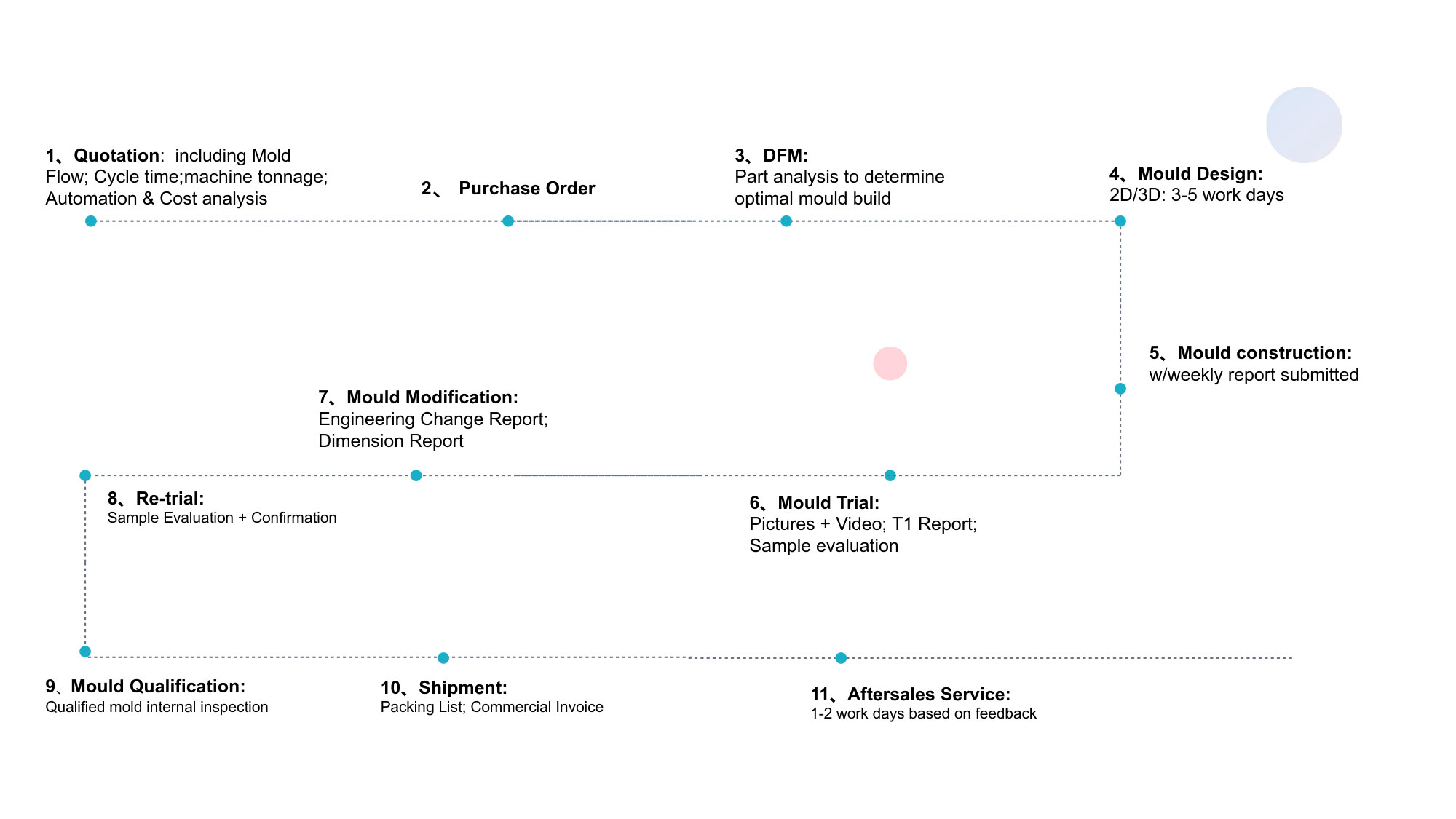
DFM (Design for Manufacturing) analysis: Before mold manufacturing begins, a formal DFM report is delivered to the customer, documenting recommended draft angles, wall thickness optimization, gate location options, and ejector pin marking strategy. This prevents the common industry problem of discovering that a part design is unmoldable only after the mold has been cut.
T0 through T3 samples: The qualification process proceeds through progressive sampling stages, with mold modifications documented and validated at each step. Quick-change insert designs enable alternative process configurations to be evaluated without recutting the entire mold.
Pre-production validation: Before full production release, 100 to 500 pre-production shots are run, with statistical process control data collected. Cpk calculations are performed on all critical dimensions to confirm process capability prior to volume production.
Section IV: Differentiation Through Full-Service Integration—Lowering Customer Management Costs
Many mold suppliers focus exclusively on the mold itself, leaving customers to manage everything else—DFM analysis, process development, quality validation, maintenance, and repair coordination. Ansix Tech takes a fundamentally different approach, providing integrated services that reduce the customer’s management burden and total project cost.
Early Engineering Engagement (DFM)
The most expensive defects are those discovered after the mold has been built. Ansix Tech engages with customers during the product design phase, before mold manufacturing begins, to identify and resolve potential manufacturability issues.
The DFM analysis covers:
Draft angle recommendations: Ensuring sufficient taper for clean part ejection without side-wall scuffing
Wall thickness optimization: Identifying thick sections that would cause sink marks or extended cooling times
Gate location and number: Using mold flow simulation to predict weld line locations, air trap positions, and fill imbalance, optimizing gate placement before steel is cut
Ejector pin marking position: Negotiating acceptable marking locations based on part function and appearance requirements
Parting line placement: Optimizing for flash control and visible witness mark positioning
This analysis is delivered as a formal report before any manufacturing commitment is made. Customers receive the information needed to evaluate whether design modifications are warranted before mold production begins—not after.
Sample Provision and Iterative Refinement
Throughout the development process, Ansix Tech provides samples at each qualification milestone. T0 samples represent the first parts produced from the finished mold, revealing any unanticipated issues in part geometry, material flow, or ejection. Each subsequent sample round is accompanied by a formal improvement report documenting the modifications made and the resulting changes in part quality.
Quick-change insert designs enable alternative gate configurations, cooling layouts, or ejection strategies to be evaluated without manufacturing an entirely new mold, accelerating the qualification cycle and reducing development costs.
Pre-Production Validation
The transition from sample approval to volume production is a common failure point. Ansix Tech offers pre-production validation runs of 100 to 500 shots, during which full quality documentation—including dimensional inspection records, process parameter logs, and CPK calculations—is collected and reviewed.
Only when the validation run demonstrates stable production capability at the target cycle time and quality level does Ansix Tech approve the process for volume production. This eliminates the “sample approved, production fails” scenario that plagues suppliers who rush to ship molds without proper process characterization.
Maintenance, Spare Parts, and After-Sales Support
The self-locking modular construction of Ansix Tech molds enables individual cavity maintenance or replacement without removing the entire mold from the production line. Quick-disassembly self-locking units allow a single cavity to be accessed and serviced while other cavities continue production, minimizing downtime. Standardized accessories such as self-locking screws and cavity components reduce spare parts inventory costs.
Each mold ships with a recommended spare parts kit including common wear items: ejector pins, core inserts, and valve gate components. Ansix Tech provides preventive maintenance services every 200,000 cycles, with lifetime repair services available at cost-recovery pricing. In-house electrode machining and EDM capabilities enable most repairs to be completed without outsourcing, with conventional welding and insert replacement work typically restoring production within 24 hours.
Section V: Quantifiable Customer Value—Cost Reduction, Risk Mitigation, and Production Assurance
Technical capabilities are only meaningful insofar as they translate into customer value. This section documents how Ansix Tech’s approach reduces hard costs, minimizes operational risk, and protects production schedules.
Material Cost Reduction
Material consumption is the largest variable cost in injection molding, often accounting for 50–70% of total part cost. Ansix Tech’s hot runner systems eliminate the solid sprue waste generated by conventional three-plate or cold runner molds. For multi-cavity molds, the material saved per cycle accumulates into significant annual savings:
*Example calculation: For a 48-cavity PET preform mold running a 12-second cycle on three-shift operation (approximately 21,600 cycles per day), a 2% weight reduction through optimized process parameters saves approximately 1.7 metric tons of PET resin annually—direct cost savings that goes to the customer’s bottom line.*
Research-validated process optimization has demonstrated preform weight reduction of 2.05% (from 43.25g to 42.37g) through optimized cooling time, cycle time, and temperature management settings.
Energy Cost Reduction
Energy consumption is the second largest variable operating cost in injection molding. The self-locking structure optimizes clamping force distribution through mechanical wedging action; the clamping force requirement is reduced by approximately 15% compared to non-self-locking designs of equivalent cavity count, with proportional energy savings. Servo-electric drive systems additionally reduce energy consumption by 20–60% compared to conventional hydraulic systems.
Risk Reduction and Quality Assurance
The cost of poor quality extends far beyond the cost of scrapped parts. Customer rejections, warranty claims, and supply chain disruptions carry reputational and contractual penalties that can dwarf direct manufacturing costs. Ansix Tech’s quality management system addresses these risks systematically:
Real-time CPK monitoring detects process drift before non-conforming parts are produced, shifting from reactive defect detection to proactive process control
Full material traceability from raw material certification through final product inspection supports customer quality audits and regulatory compliance
Pre-production validation ensures process capability is established before volume production begins, eliminating the high-risk “qualify-as-you-produce” approach common in the industry
Supply Chain Reliability and Lead Time Assurance
Unplanned downtime is the most expensive failure mode in continuous production. When downtime occurs, every minute lost is production revenue that cannot be recovered. Ansix Tech maintains inventory of commonly required spare parts and operates in-house repair facilities to minimize time-to-recovery when issues occur. For customers requiring emergency support, we maintain dedicated contact channels and priority repair scheduling to return molds to production with minimal interruption.
Total Cost of Ownership Optimization
Many customers evaluate mold suppliers based on initial purchase price alone—a metric that captures only a fraction of the true cost picture. Ansix Tech structures its proposals around total cost of ownership (TCO), which includes:
Initial mold cost: Competitive pricing for the specified cavity count and complexity
Installation and validation cost: Reduced through pre-delivery testing and documentation
Operating cost: Reduced through material efficiency, energy efficiency, and process stability
Maintenance and repair cost: Reduced through modular design and in-house service capability
Downtime cost: Minimized through design reliability and rapid repair response
Quality failure cost: Minimized through process controls and quality systems
When evaluated on TCO rather than initial price, Ansix Tech solutions consistently deliver superior customer value.
Conclusion: Transforming Engineering Capability into Customer Success
At Ansix Tech, we understand that a mold is not merely a block of steel—it is the engine of a customer’s production operation. Every design decision, every material selection, and every process parameter we establish is evaluated through the lens of customer value: Will this reduce the customer’s per-part cost? Will this eliminate a production failure mode? Will this make the customer’s operation more predictable and reliable?
Our self-locking PET preform mold technology represents the convergence of 28 years of manufacturing experience with continuous investment in precision equipment, quality systems, and process engineering. From DFM analysis through pre-production validation to after-sales support, our integrated approach reduces the customer’s management burden while delivering measurable improvements in quality, efficiency, and reliability.
For customers exploring a new PET preform project or evaluating alternative suppliers for an existing application, Ansix Tech offers a full-scope DFM analysis based on the customer’s part design, material specification, and production volume targets. This analysis demonstrates, in concrete terms, how we would approach the project—where the risks are, how we would mitigate them, and what performance the customer can expect to achieve.
We invite you to examine our capabilities against your requirements. Bring us your most challenging preform geometry, your tightest dimensional tolerance, or your most aggressive cycle time target. We will show you how 28 years of experience in self-locking PET preform mold manufacturing translates into measurable value for your production operation.
Ansix Tech Co Ltd
If you have any plans related to Self-locking PET preform mold , you can contact us at any time. We will turn your ideas into reality, let you realize your dreams, and obtain large orders from the market. Our contact information is info@ansixtech.com. Or contact our CTO, mail: stephen@ansixtech.com
#www.ansixtech.com #ansixtech.com #Self-locking PET preform mold #Self-locking PET preform mold moulds #Self-locking PET preform mold injection molding companies #Self-locking PET preform mold Canopy Mold injection mold companies #Ansix #Ansix moulds #Ansix china #Ansix tech china #Ansix tech company #Ansix facotry #Self-locking PET preform mold injection molding #Self-locking PET preform mold injection tools #Self-locking PET preform mold injection moulds #Self-locking PET preform mold plastic mould #Self-locking PET preform mold plastic tools #Ansix Tech #Ansix molds #Ansix injection molding #Ansix mold factory #injection molding Self-locking PET preform mold #Ansix mold factory #Self-locking PET preform mold china #Self-locking PET preform mold molds #injection factory #Self-locking PET preform mold injection molding #Self-locking PET preform mold injection molding factory #injection molding company #Self-locking PET preform mold injection mold companies #Self-locking PET preform mold#Self-locking PET preform mold mold limited #Ansix mold china #Ansix companies #Ansix company China #Self-locking PET preform mold facotry #Ansix Tech #Ansix Tech mould #Self-locking PET preform mold injection moulding #injection moulding company #Ansix Self-locking PET preform mold parts injection mold companies #medical injection molding companieschina #Self-locking PET preform mold china factory #Ansix moulding companies #Ansix molding company #Self-locking PET preform mold injection moulding facotry #Ansix Tech mold #Self-locking PET preform mold mould #Self-locking PET preform mold plastic injection molding #ansix plastic mold #Mold manufacturing #Self-locking PET preform mold parts manufacturing #Self-locking PET preform mold plastic parts factory #Self-locking PET preform mold injection parts mold #Self-locking PET preform mold PRECISION MANUFACTURING #Self-locking PET preform mold #China mold #Self-locking PET preform mold injection moulding china #Self-locking PET preform mold mould china #china precision mold #mold in china #Self-locking PET preform mold mold china #Precision molds #High-precision molds #Self-locking PET preform mold #Injection molds #Self-locking PET preform mold Factory #Self-locking PET preform mold Company #Super Large Injection Mold Factory #Large Tonnage Injection Molding Factory #Self-locking PET preform mold Company #Self-locking PET preform mold Factory #2800T Injection Molding Factory #3000 Ton Injection Molding #4500 Ton Injection Molding Factory #Large Mold Injection Molding #Large Plastic Mold Injection Molding Factory #Large Injection Mold Manufacturer #Plastic Mold Factory #Injection Mold #Plastic Mold