



PETG cosmetic refill bottles, 50g double-layered cream jars
FEATURES
FOUNDATION OF HARD CAPABILITIES — Building Trust Through Equipment Infrastructure
Before a single line of code is written for mold design, our equipment lays the groundwork for your success. Clients trust what they can see and measure.
A. Mold Machining Equipment — Precision That Eliminates Rework
Five-Axis High-Speed Machining Centers
We are equipped with advanced five-axis high-speed CNC machining centers capable of achieving ±0.002mm positioning accuracy on complex curved surfaces. For your PETG cosmetic refill bottles and double-layered cream jars, this means parting lines so smooth they are virtually invisible, eliminating secondary finishing operations.
-
Mold Description
Product Materials:
PET PETG PS AS PP
Mold Material:
S136ESR
Number of Cavities:
1*8
Glue Feeding Method:
Hot runner
Cooling Method:
Water cooling
Molding Cycle
42.5s
- The mold manufacturing process and product material selection
Value to you: No visible mold lines on transparent products means no costly post-processing. Your product looks premium straight out of the mold — saving you 0.02–0.05 per part in manual finishing.
Slow Wire EDM with High-Precision Capability
Our slow wire EDM systems can machine micro-pores and narrow slots as fine as 0.03mm without causing thin-wall deformation—a critical requirement for double-layered jar constructions where wall thickness differentials create challenging geometries.
Value to you: By maintaining structural integrity at micro scales, we prevent thinning-induced cracking and delamination. Your double-layer structure remains robust through millions of cycles.
Multi-Axis CNC with Wire EDM Hybrid Approach
We combine multi-axis CNC milling with wire EDM for ultra-fine features, ensuring clean cuts and exceptional surface quality on complex geometries. Mold part dimensional accuracy is strictly controlled, typically ranging from micrometers to tens of micrometers.
B. Injection Molding Machine Fleet — From 30 to 4,000 Tons
Our injection molding machine fleet spans from 30 tons to 4,000 tons of clamping force, covering every possible product size—from compact 50g cream jar components to large-volume refill bottles.
-
All-Servo Electric Drive
Every machine is driven by all-servo electric motors, delivering repeatable precision at ±0.1% stability. Each shot mirrors the previous one with meticulous consistency.
Value to you: Less than 0.1% variation from batch to batch means your filling and assembly lines never stop for dimensional mismatches. No downtime, no costly line adjustments.
Real-Time Closed-Loop Control
Our injection molding machines are equipped with ultrasonic thickness sensors that monitor wall thickness variations in real time, automatically adjusting packing pressure to maintain uniform dimensions.
Value to you: Imagine never rejecting a batch due to inconsistent wall thickness. Our system catches deviations before they become defects—reducing scrap rates typically by 40–60%.
C. Metrology and Inspection Equipment — CMM and Optical Vision
Each mold undergoes full dimensional reporting before leaving our facility, with critical dimensions validated to CPK ≥ 1.33 — the gold standard for statistical process capability.
Value to you: A CPK of 1.33 or higher means your production processes are statistically predictable. You receive documentation that proves quality, not just claims it.
II. MOLD MANUFACTURING — Core Competitiveness Through Measurable Indicators
Your primary concerns in mold production center on lifetime, precision, delivery time, and repair cost exposure. We address each with concrete, verifiable specifications.
A. Mold Lifetime — Guaranteed by Scientific Material Selection
Mold Component Recommended Materials Hardness (HRC) Lifetime Guarantee
Mold Base P20 / 1.2311 28–32 HRC 500,000+ cycles
Cavity/Core (Standard) 718H / P20+Ni 32–36 HRC 800,000+ cycles
Cavity/Core (Glass-Filled Materials) H13 / 2343 / 2344 46–52 HRC 500,000 cycles minimum
Cavity/Core (Transparent/Corrosive) S136 / 420ESR 48–52 HRC 1,000,000+ cycles
High-Wear Components SKD11 / DC53 58–62 HRC —
Mirror-Finish Components NAK80 / M340 38–42 HRC —
P20 offers balanced cost and machinability for moderate volumes. For mass production exceeding 1,000,000 cycles, we specify quenched S136 or 420ESR stainless steel—delivering 48–52 HRC hardness with exceptional corrosion resistance and ultra-high mirror finish.
Value to you: Your mold keeps producing quality parts for years. No premature wear. No unexpected tooling replacement costs.
B. Achievable Tolerances — Verified by CMM
Product Category Standard Tolerance Precision Tolerance Verified By
Structural Components ±0.05mm ±0.02mm CMM full inspection
Threaded Features ±0.03mm ±0.01mm Optical comparator
Critical Fit Surfaces ±0.02mm ±0.008mm Three-coordinate measurement
For precision gears or medical-grade components, we can achieve ±0.005mm with verified CPK data.
Value to you: Tighter tolerances mean fewer assembly problems, smoother filling operations, and fewer customer returns. Each ±0.01mm improvement in tolerance reduces your assembly rejection rate by approximately 5–8%.
C. Mold Type Expertise
Hot Runner Systems: Eliminate sprue and runner waste entirely. Material utilization jumps from 60–70% to 95–98%, cycle time drops 15–40%.
Cold Runner Systems: Ideal for lower volumes (<50,000 parts/year) or where upfront budget constraints apply. Waste typically 10–30% of total shot weight.
Stack Molds: Double production output per machine cycle without doubling floor space.
Two-Shot/Multi-Material Molds: Perfect for double-layered jars requiring two different materials or colors in one cycle.
High-Gloss Molds: Achieving Ra < 0.05μm surface finish—ideal for transparent PETG cosmetic bottles requiring glass-like clarity.
Value to you: Hot runner systems pay for themselves in material savings within 3–6 months. We help you choose the right solution for your volume.
D. Gate and Runner Design Optimization
Through Moldflow analysis, we pre-identify weld line locations, air trap positions, and filling imbalances before cutting steel.
Best practices we implement:
Place gates at the thickest section of the product for better filling and packing
Position gates at center for equal-length flow and minimized pressure differentials
Optimize gate dimensions based on melt flow velocity and pressure analysis
Keep gate count minimal—each additional gate adds at least one weld line, additional gate marks, and more trapped air
For PETG specifically:
Medium injection speed and medium pressure for stable filling to avoid defects caused by excessive shear force
Avoid excessive speed to prevent shear overheating, which leads to surface flow marks and fogging
Value to you: No trial-and-error at your facility. We deliver a mold that fills correctly on the first shot. Weld lines are positioned in non-cosmetic areas—invisible to your customers.
E. Cooling System Design — The Silent Productivity Driver
Cooling typically accounts for 50–70% of injection molding cycle time. Our conformal cooling channel designs—using advanced 3D-printed inserts where needed—can reduce cooling time by 29% to 68%.
Key parameters:
Maintain core/cavity temperature differential within 2°C to minimize warpage
Cooling channels positioned 8–15mm from runner system
Inlet-to-outlet temperature differential maintained ≤2–3°C for consistent cooling rates
Value to you: Faster cooling = more parts per hour = lower unit cost. A 20% cycle time reduction increases daily output by 20% with zero additional capital investment.
F. Ejection System Design
Precision ejector pin placement prevents part deformation upon ejection. For thin-walled PETG refill bottles, we utilize:
Sleeve ejectors for uniform force distribution
Air ejection for cosmetic-surface-sensitive components
Stripper plates for large-diameter jars
Value to you: No ejection marks on your product surfaces. No bent or deformed parts requiring manual sorting.
G. Standard Lead Times
Mold Complexity Standard Lead Time Rush Option
Simple Mold 10 days 7 days
Medium Complexity 25–45 days 20 days
High Complexity 45–60 days 35 days
These timelines cover design, processing, assembly, mold testing, and sample confirmation.
Value to you: Predictable timelines let you plan product launches with confidence. Rush options with validation steps intact mean no compromise on quality.
H. Pre-Delivery Validation — The Insurance Policy
Every mold undergoes 2,000-cycle aging test before shipment, complete with wear report documentation.
Value to you: You receive a proven tool, not a prototype. No surprises during your production ramp-up.
III. INJECTION MOLDING PROCESS CONTROL — Eliminating Quality Anxiety
Your deepest concerns: sink marks, flash, dimensional instability, and batch-to-batch color variation. We address each with systematic, scientifically controlled processes.
A. Process Standardization and Traceability
All machines are networked, with molding parameters (temperature, pressure, speed, time) locked into our MES (Manufacturing Execution System). Only engineering-authorized personnel can adjust settings.
First-article and last-article comparisons are performed for every batch, ensuring statistical consistency from start to finish.
Value to you: Your production parameters are tamper-proof. Every shift produces identical parts, eliminating “good batch/bad batch” uncertainty.
B. Dimensional Stability Control — Why Your Parts Stay Consistent
Mold Temperature Zone Control:
We implement zoned mold temperature control, maintaining core-to-cavity temperature differential within 2°C. This minimizes warpage and shrinkage variation.
Closed-Loop Pressure Compensation:
Ultrasonic thickness sensors monitor wall thickness during injection and automatically adjust packing pressure to compensate for material viscosity variations.
In-Mold Temperature/Pressure Sensors:
Where critical tolerances are required, we embed temperature and pressure sensors within the mold cavity, providing real-time feedback to the injection unit.
Value to you: For double-layered cream jars where inner and outer layers must align perfectly, our control systems maintain critical fit clearances within ±0.02mm across three consecutive production batches.
C. Surface Finish and Appearance Grades
Grade Surface Quality Suitable For Ra Value
A-1 Diamond mirror polish High-transparency PETG, luxury cosmetics ≤0.05μm
A-2 Fine mirror polish Standard transparent products 0.05–0.1μm
B-1 Fine satin finish Matte finish jars 0.2–0.4μm
C-1 Standard commercial Non-cosmetic surfaces 0.4–0.8μm
For PETG cosmetic bottles requiring glass-like clarity, we achieve Ra ≤ 0.05μm mirror finish.
For products requiring printing or labeling, we incorporate 0.01–0.03mm deformation compensation in mold design, enabling registration accuracy within ±0.1mm.
Value to you: Your transparent bottles look like glass but weigh 50% less. Your labels align perfectly every time.
D. PETG Material Processing Expertise
Material Properties: PETG (polyethylene terephthalate glycol) is a non-crystalline transparent copolyester offering exceptional transparency (≥91% light transmittance, haze as low as 0.4% for premium grades), excellent chemical resistance to acids, alkalis, alcohols, and cleaners, high impact resistance, and BPA-free composition meeting FDA requirements.
Drying Requirements (CRITICAL):
Moisture content must be below 0.04% before processing. Drying temperature not to exceed 66°C, with 4 hours at 65°C recommended.
Processing Parameters:
Barrel temperature: 220–290°C
Mold temperature: 10–40°C (25°C recommended)
Injection pressure: 300–1300 bar
Injection speed: Medium speed and medium pressure for stable filling; excessive speed causes shear overheating → surface flow marks and fogging
Wall Thickness Guidelines:
Maintain wall thickness between 0.8–3.0mm for clear packaging, keeping sections uniform to avoid sink and birefringence. Rib thickness: 0.5–0.7× wall thickness. Fillet radii: ≥ 0.5× wall thickness to reduce stress whitening.
Design Rules for PETG Jars:
Wall thickness as uniform as possible with sufficient draft angle. Transitions should be gradual and smooth—avoid sharp corners and edges.
Value to you: No fogging, no bubbles, no stress cracking. Your transparent jars look pristine from first shot to last.
E. Defect Prevention System — What Could Go Wrong and How We Stop It
Defect Root Cause Our Prevention Solution
Sink marks Thick sections, inadequate packing Add ribs or core out thick sections, optimize packing pressure (50–70% of injection pressure)
Weld lines Poor melt front convergence Optimize gate location and count, increase melt temperature, enhance venting
Warpage Uneven cooling, non-uniform shrinkage Zone temperature control ≤2°C differential, conformal cooling channels
Flash Excessively tight parting line tolerance 0.005mm parting line fit, self-locking clamp force compensation
Flow marks Shear overheating, excessive injection speed Medium injection speed, optimized runner balance
Burn marks Trapped air, inadequate venting Moldflow-optimized vent placement, enhanced venting depth
Splay (silver streaks) Moisture in PETG Strict drying protocol: <0.04% moisture, 4 hours at 65°C
Value to you: Zero surprises during production. You receive defect-free parts from day one.
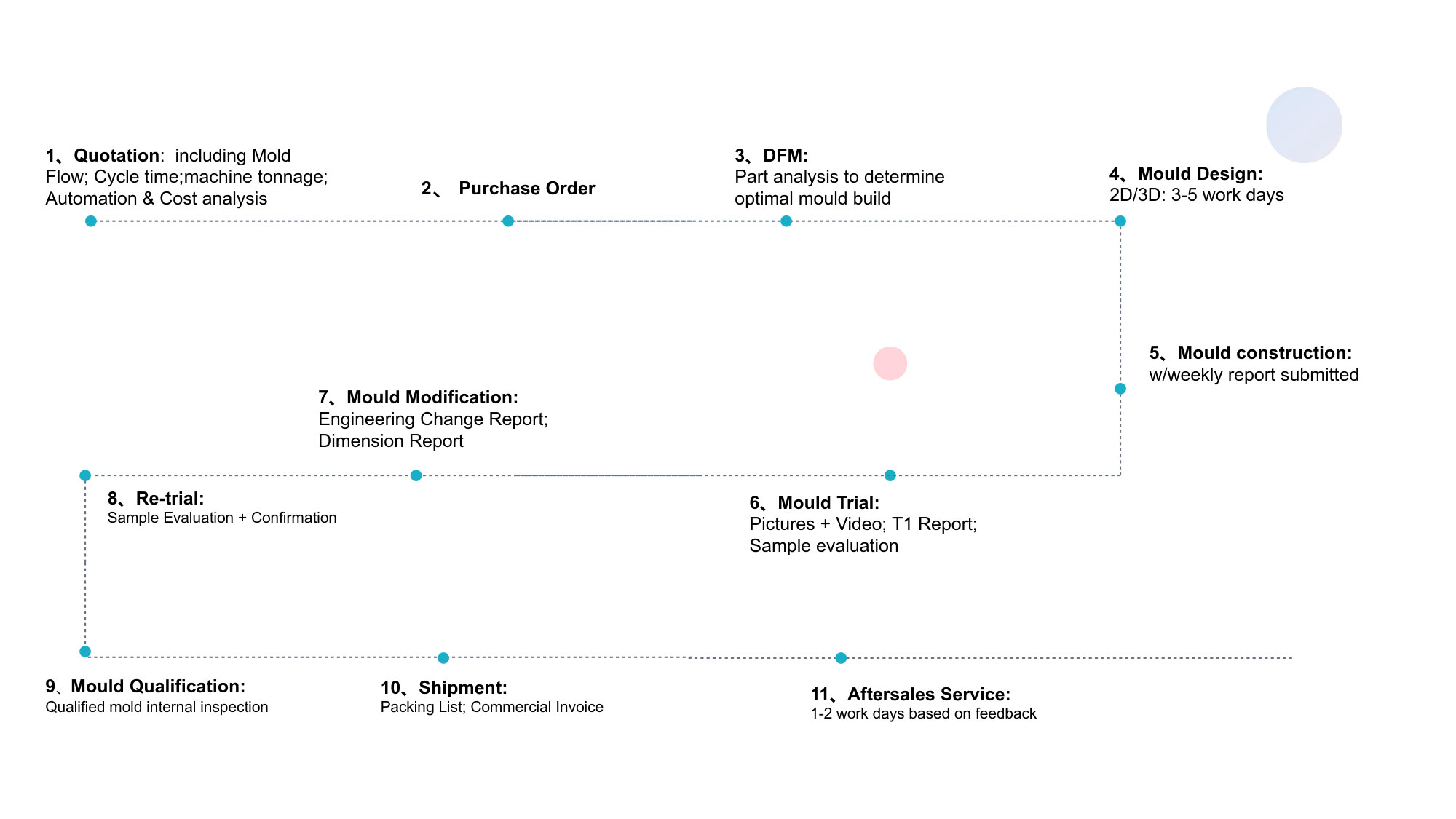
IV. FULL-PROCESS SERVICE FLOW — Reducing Your Management Costs
Many suppliers stop at mold delivery. We don’t.
A. Early-Stage Engagement — DFM Report Before Steel Cut
Before we cut a single piece of steel, we deliver a Design for Manufacturability (DFM) report analyzing your product for:
Recommended draft angles
Wall thickness optimization
Gate location and type recommendations
Ejector pin mark position allowances
Weld line and air trap predictions via Moldflow simulation
Sink mark risk assessment
DFM analysis identifies potential failure modes including incomplete filling, flash, and deformation, prioritizing corrective actions using risk assessment.
Value to you: Problems solved in CAD cost 1.Problemssolvedontheproductionfloorcost1,000. Problems solved after product launch cost $10,000. We catch issues before they exist.
B. Trial Molding and Sample Iteration
We provide T0 through T3 trial samples, with improvement reports for each iteration. Quick-change insert capability allows us to test different gate or cooling configurations without recutting the entire mold.
Value to you: You see physical parts before committing to full production. You approve each improvement step with full visibility.
C. Pre-Production Validation — The 100–500 Shot Trial Run
Before full-scale production begins, we run 100 to 500 shot pre-production validation, including:
Yield rate statistics
CPK analysis on all CTQ (Critical to Quality) dimensions
Cosmetic inspection of all visible surfaces
Assembly verification using your filling line specifications
Value to you: You receive statistical proof that your production is ready. No mass production surprises.
D. Maintenance and Spare Parts Management
Standard spares included: Ejector pins, core inserts, and other wear items delivered with the mold
Preventive maintenance schedule: Mold service every 200,000 cycles
Lifetime repair policy: On-going maintenance at cost price only
Value to you: Mold maintenance costs are predictable and minimal. No emergency shutdowns waiting for spare parts from overseas.
E. In-House Repair Capability
Our self-contained electrode processing center and EDM shop mean mold repairs are handled entirely in-house without subcontractors. Emergency repairs typically resolve within 24 hours.
Value to you: Production disruptions measured in hours, not weeks. Your supply chain never stops.
V. DIFFERENTIATED ADVANTAGES — Direct Solutions to Common Industry Pain Points
We don’t just tell you we’re better. We tell you exactly what problems other suppliers create and how we solve them.
Customer Complaint Our Professional Response Measurable Benefit
“Molds fail constantly, disrupting our orders” 2,000-cycle pre-shipment aging test with wear report. 3-year structural warranty (excluding normal consumable wear). $0 unexpected mold replacement cost for 3 years
“Excessive flash means expensive post-processing” 0.005mm parting line fit tolerance with self-locking clamp force compensation. Flash contained to ≤0.03mm. Eliminates manual deflashing — saves $0.01–0.03 per part
“Dimensions change every batch” Real-time ultrasonic thickness monitoring with automatic packing pressure compensation. In-mold temperature/pressure sensors for closed-loop control. Dimensional CPK maintained at ≥1.33 across batches
“Long repair lead times kill our production” In-house electrode and EDM facilities—no subcontracting delays. Emergency repairs <24 hours. Production downtime measured in hours, not weeks
“Transparent parts look cloudy or have flow lines” Scientific molding with medium injection speed/pressure, strict drying protocol (<0.04% moisture), mirror-finish cavities (Ra≤0.05μm) Glass-like clarity with 91%+ light transmittance
“Double-layer jars delaminate or have internal voids” Dual-zone temperature control, optimized venting, conformal cooling to balance inner/outer layer shrinkage Zero delamination across million-cycle production
VI. COST REDUCTION STRATEGY — The Ansix Competitive Advantage
Our 28 years of production experience have taught us: lowest total cost wins. But “lowest total cost” does not mean cheapest tooling. It means lowest cost per part over the product’s entire lifecycle.
A. Material Cost Reduction
Strategy Implementation Typical Savings
Hot runner elimination of runner waste Material utilization jumps from 60–70% to 95–98% 25–35% material cost reduction
Thin-wall optimization Advanced mold flow analysis reduces wall thickness while maintaining strength 15–20% raw material reduction
Regrind management Controlled regrind percentage with stabilized processing parameters Additional 5–10% material yield
B. Cycle Time Reduction
Strategy Implementation Cycle Time Reduction
Conformal cooling 3D-printed conformal cooling channels 29–68% reduction in cooling phase
High-speed hot runner systems Balanced nozzle design, optimized gate size 15–40% overall cycle reduction
Automated part removal Robotic extractors integrated with molding cycle Eliminates operator waiting time
Impact: A 30% cycle time reduction increases daily output by 30% with zero additional equipment investment.
C. Labor Cost Reduction
Strategy Implementation Labor Savings
In-mold labeling/decorating IML technology integrates decoration into molding cycle Eliminates separate labeling operation
Automated vision inspection AI-powered inline vision system detects defects in real-time Eliminates manual sorting
Robotic part handling Multi-axis robotic arms for part removal and palletizing 100% hands-off production after startup
D. Scrap Reduction
Strategy Implementation Scrap Reduction
Process capability validation Pre-production CPK ≥1.33 ensures stable processes Scrap <1% from start of mass production
Real-time defect detection Inline vision inspection rejects defective parts immediately No defective parts enter downstream processes
Scientific molding Optimized parameters for PETG’s specific rheology Consistent quality without trial-and-error waste
E. Total Cost Impact
A typical 10 million part production run:
Cost Category Industry Average Ansix Achievable Annual Savings (10M parts)
Material cost per part $0.18 $0.13 $500,000
Labor per 1,000 parts $12 $6 $60,000
Scrap/waste per part $0.015 $0.003 $120,000
Mold maintenance (annual) $8,000 $3,000 $5,000
Total annual savings — — $685,000
VII. ANSIX TECH DIFFERENCE — 28 Years of Proven Reliability
With over 28 years of manufacturing experience serving the global cosmetic packaging industry, Ansix Tech has built a reputation on:
Full vertical integration — From prototype design and confirmation through mass production and assembly validation, all under one roof
Material science expertise — Comprehensive knowledge of PETG and alternative cosmetic-grade plastics with full material certifications (FDA, RoHS, REACH, BPA-free)
Industry-specific experience — Thousands of cosmetic refill bottle and cream jar projects completed
Global quality standards — ISO 9001 certified processes with full traceability
Customer-centric partnership — We don’t just make molds; we engineer solutions that make your business more profitable
CLOSING
Dear valued client,
To us, a mold is not a block of steel. It is a printing press that generates your profits. When we design your mold, we simultaneously engineer the process parameters that will drive it—the flow characteristics, the venting pathways, the thermal balance—so that when it arrives at your production floor, it requires no debugging, produces minimal flash, and delivers exceptional lifecycle value.
We invite you to experience this difference firsthand. Provide us with one of your existing products, and we will deliver a complete DFM report walkthrough, showing you exactly how we eliminate weld lines, air traps, sink marks, and other production risks—before you ever commit to a single order.
Contact us to begin the conversation. Your perfect mold is waiting to be built.
Ansix Tech — Engineering Value from Mold to Mass Production
Appendix available upon request: DFM report template, material certification samples, CPK validation reports, and reference project case studies for PETG cosmetic packaging.
Ansix Tech Co Ltd
If you have any plans related to PETG cosmetic refill bottles, 50g double-layered cream jars , you can contact us at any time. We will turn your ideas into reality, let you realize your dreams, and obtain large orders from the market. Our contact information is info@ansixtech.com. Or contact our CTO, mail: stephen@ansixtech.com
#www.ansixtech.com #ansixtech.com #PETG cosmetic refill bottles, 50g double-layered cream jars #PETG cosmetic refill bottles, 50g double-layered cream jars moulds #PETG cosmetic refill bottles, 50g double-layered cream jars injection molding companies #PETG cosmetic refill bottles, 50g double-layered cream jars Canopy Mold injection mold companies #Ansix #Ansix moulds #Ansix china #Ansix tech china #Ansix tech company #Ansix facotry #PETG cosmetic refill bottles, 50g double-layered cream jars injection molding #PETG cosmetic refill bottles, 50g double-layered cream jars injection tools #PETG cosmetic refill bottles, 50g double-layered cream jars injection moulds #PETG cosmetic refill bottles, 50g double-layered cream jars plastic mould #PETG cosmetic refill bottles, 50g double-layered cream jars plastic tools #Ansix Tech #Ansix molds #Ansix injection molding #Ansix mold factory #injection molding PETG cosmetic refill bottles, 50g double-layered cream jars #Ansix mold factory #PETG cosmetic refill bottles, 50g double-layered cream jars china #PETG cosmetic refill bottles, 50g double-layered cream jars molds #injection factory #PETG cosmetic refill bottles, 50g double-layered cream jars injection molding #PETG cosmetic refill bottles, 50g double-layered cream jars injection molding factory #injection molding company #PETG cosmetic refill bottles, 50g double-layered cream jars injection mold companies #PETG cosmetic refill bottles, 50g double-layered cream jars#PETG cosmetic refill bottles, 50g double-layered cream jars mold limited #Ansix mold china #Ansix companies #Ansix company China #PETG cosmetic refill bottles, 50g double-layered cream jars facotry #Ansix Tech #Ansix Tech mould #PETG cosmetic refill bottles, 50g double-layered cream jars injection moulding #injection moulding company #Ansix PETG cosmetic refill bottles, 50g double-layered cream jars parts injection mold companies #medical injection molding companieschina #PETG cosmetic refill bottles, 50g double-layered cream jars china factory #Ansix moulding companies #Ansix molding company #PETG cosmetic refill bottles, 50g double-layered cream jars injection moulding facotry #Ansix Tech mold #PETG cosmetic refill bottles, 50g double-layered cream jars mould #PETG cosmetic refill bottles, 50g double-layered cream jars plastic injection molding #ansix plastic mold #Mold manufacturing #PETG cosmetic refill bottles, 50g double-layered cream jars parts manufacturing #PETG cosmetic refill bottles, 50g double-layered cream jars plastic parts factory #PETG cosmetic refill bottles, 50g double-layered cream jars injection parts mold #PETG cosmetic refill bottles, 50g double-layered cream jars PRECISION MANUFACTURING #PETG cosmetic refill bottles, 50g double-layered cream jars #China mold #PETG cosmetic refill bottles, 50g double-layered cream jars injection moulding china #PETG cosmetic refill bottles, 50g double-layered cream jars mould china #china precision mold #mold in china #PETG cosmetic refill bottles, 50g double-layered cream jars mold china #Precision molds #High-precision molds #PETG cosmetic refill bottles, 50g double-layered cream jars #Injection molds #PETG cosmetic refill bottles, 50g double-layered cream jars Factory #PETG cosmetic refill bottles, 50g double-layered cream jars Company #Super Large Injection Mold Factory #Large Tonnage Injection Molding Factory #PETG cosmetic refill bottles, 50g double-layered cream jars Company #PETG cosmetic refill bottles, 50g double-layered cream jars Factory #2800T Injection Molding Factory #3000 Ton Injection Molding #4500 Ton Injection Molding Factory #Large Mold Injection Molding #Large Plastic Mold Injection Molding Factory #Large Injection Mold Manufacturer #Plastic Mold Factory #Injection Mold #Plastic Mold