



63 Toothpaste Mask Jar, Wide-Mouth Dispensing Bottle, Transparent Cream Bottle
FEATURES
Hard Infrastructure: Building Customer Trust Through Equipment Excellence
Precision Mold Manufacturing Equipment
The precision of any injection-molded component is fundamentally constrained by the machinery that produces its mold. Ansix Tech operates a comprehensive arsenal of purpose-configured mold-making equipment that directly benefits your packaging quality.
Five-Axis High-Speed Machining Centers enable us to process complex curved surfaces with 0.002mm positioning accuracy—three to five times finer than the cosmetic industry’s standard ±0.01mm requirement for jar threads. For toothpaste jars and cream containers with broad-mouth designs, this precision means parting lines are smooth and virtually invisible, eliminating post-mold hand-finishing that would otherwise add $0.03–0.08 per unit to your landed cost. Visible flash traps that could harbor bacteria or compromise shelf appeal are completely eliminated.
-
Mold Description
Product Materials:
PET PETG PS AS PP
Mold Material:
S136ESR
Number of Cavities:
8
Glue Feeding Method:
Hot runner
Cooling Method:
Water cooling
Molding Cycle
42.5s
- The mold manufacturing process and product material selection
Slow-Speed Wire EDM delivers cutting accuracy to 0.003mm, enabling production of micro-slots and narrow channels as fine as 0.03mm. The anti-rotation mechanical interlocks required for overmolded seals on tube-to-jar connections are machined with zero deviation, preventing the bond failures that would otherwise trigger product recall events costing your brand an average of $0.5–2 million per incident.
CNC EDM with Mirror-Finish Capability achieves optical-grade surface polish at Ra ≤ 0.05μm on cavity surfaces. For transparent cream jars and clear toothpaste containers, this eliminates the micro-roughness that causes visual distortion and product discoloration from residual food-grade lubricants. Your product presents the crystal-clear appearance that premium cosmetic brands demand.
Precision Surface Grinding ensures absolute parallelism across all mold plates. For multi-cavity packaging molds producing 32 to 48 parts per cycle, every cavity produces dimensionally identical components—eliminating the 3–8% yield loss from cavity-to-cavity variation that typically plagues high-volume packaging manufacturers.
-
Injection Molding Press Fleet
Ansix Tech maintains 260 injection molding machines across four production bases in China and Vietnam, with clamping force ranging from 30 tons to 2,800 tons. Our fleet includes Japan’s Fanuc, Sumitomo, Toshiba, Nissei, Austria’s Engel, and Germany’s Arburg (specializing in liquid silicone injection) alongside China’s Haitian and Victor Taichung systems.
The critical customer value lies in our all-electric servo-driven press configuration. Conventional hydraulic presses suffer from viscosity-based repeatability drift—as machine oil heats during production runs, viscosity changes, causing pressure fluctuations and dimensional variation. Our all-electric systems maintain ±0.1% shot-to-shot repeatability, guaranteeing that the 100,000th jar from your production line is dimensionally identical to the first unit. When your filling lines run at 120 jars per minute, any dimensional drift above ±0.05mm triggers line stoppage. Our repeatability eliminates these costly interruptions.
Quality Assurance and Metrology Equipment
Every mold manufactured at Ansix Tech undergoes comprehensive dimensional verification before release. ZEISS Coordinate Measuring Machines (CMMs) provide three-dimensional inspection across all critical-to-quality features—thread pitch diameter, mouth opening ovality, wall thickness uniformity, and cap sealing surface flatness.
Optical imaging systems inspect surface finish quality, weld line severity, gate blush, and sink mark depth with sub-pixel edge detection algorithms. Each mold receives a complete dimensional report with Cpk ≥ 1.33 for all declared critical dimensions before customer acceptance—a guarantee that 99.93% of your production parts will meet specification without additional sorting.
Injection Mold Manufacturing: Core Competitiveness Through Measurable Metrics
Mold Life and Material Selection
Mold longevity directly determines your replacement tooling costs and production uptime. Ansix Tech designs each packaging mold with material selection matched to your production volume and resin composition.
Parameter Technical Specification Customer Value
Standard Molds (50,000–100,000 cycles) P20 pre-hardened steel (30–35 HRC) for mold bases; S136 ESR stainless for cavities and cores Tooling investment amortization of $0.003–0.008 per part; 2–3 week lead time
High-Volume Molds (≥1,000,000 cycles) Hardened steel (48–52 HRC) using 1.2343, 1.2344, SKD11, DC53, NAK80, H13 premium grades Tooling amortization below $0.001 per part; 3+ years of continuous production without retooling
Abrasive/Glass-Filled Resins Corrosion-resistant powder metallurgy tool steel (M340, 4Cr13, 9Cr18, 1.2083) with ≥54 HRC Resists wear from mica, titanium dioxide, and glass-fiber fillers that would erode standard tool steel within 100,000 cycles
Transparent/High-Gloss Parts Mirror-polished S136 ESR or NAK80 with surface Ra ≤ 0.05μm Eliminates optical distortion and clarity defects for premium cosmetic presentation
Each Ansix Tech mold includes a full Material Certification Report documenting steel grade, heat treatment parameters, hardness verification (54–62 HRC depending on grade), and applied surface treatments. Hardness certification traces back to certified reference blocks to eliminate counterfeit-steel risk that some competitors accept.
Achievable Tolerances for Packaging Components
The cosmetic packaging industry demands dimensional precision for three critical assembly interfaces: cap-to-jar threads, inner seal-to-mouth compression, and dispensing pump engagement.
Feature Type Standard Tolerance Ansix Tech Precision Capability
General structural dimensions (wall thickness, outer diameter, height) ±0.05mm ±0.03mm typical
Thread profile and pitch diameter ±0.03mm ±0.015mm for consistent torque
Broad mouth opening ovality ≤0.08mm diametral ≤0.04mm for filling nozzle alignment
Jar-to-cap sealing surface flatness 0.1mm max gap ≤0.05mm gap for leak-proof seal
Transparent part optical distortion Visible defects allowed Bubble-free, streak-free Ra ≤ 0.05μm
Your operational benefit: When every jar in your batch meets thread tolerance within ±0.015mm, your automatic capping machine achieves consistent 4–6 N·m sealing torque with zero cross-threading downtime. The industry average for cross-threading stoppages is 40 minutes per 8-hour shift at $600 per hour in lost production—Ansix Tech’s precision eliminates this cost entirely.
Mold Design Optimization for Packaging Applications
Every packaging mold at Ansix Tech is analyzed using Moldflow simulation prior to any steel being cut. This digital validation identifies and resolves weld line locations, trapped air zones, filling imbalance, and potential sink marks before physical manufacturing begins.
For broad-mouth jars (60–100mm diameter opening), our design approach includes:
Conformal cooling channels positioned 12–20mm from the cavity surface with 3–5× diameter spacing. This balanced cooling maintains the jar mouth’s circularity within ±0.03mm while reducing cycle time by 20–40%. For high-volume production exceeding 500,000 units, conformal cooling reduces overall cycle time from 18 seconds to 12 seconds per cavity—saving 140 machine hours per million parts.
Draft angles ≥1.5° on exterior surfaces and ≥3° on internal thread cores to ensure clean ejection without surface drag marks. Broad-mouth containers with insufficient draft angle are prone to ejection marks that appear as vertical scratches visible through transparent materials. Our design eliminates this cosmetic defect entirely.
Valve-gate sequencing for family molds producing multiple jar sizes simultaneously, ensuring each cavity fills completely regardless of flow path length differences. Filling imbalance below 5% eliminates short-shot scrap.
Exhaust groove depths of 0.03–0.08mm at the parting line to prevent trapped air that would appear as burn marks on jar surfaces. For clear cosmetic containers that reveal every surface defect, this exhaust design prevents the 2–5% rejection rate due to visible air trapping that plagues less sophisticated tooling.
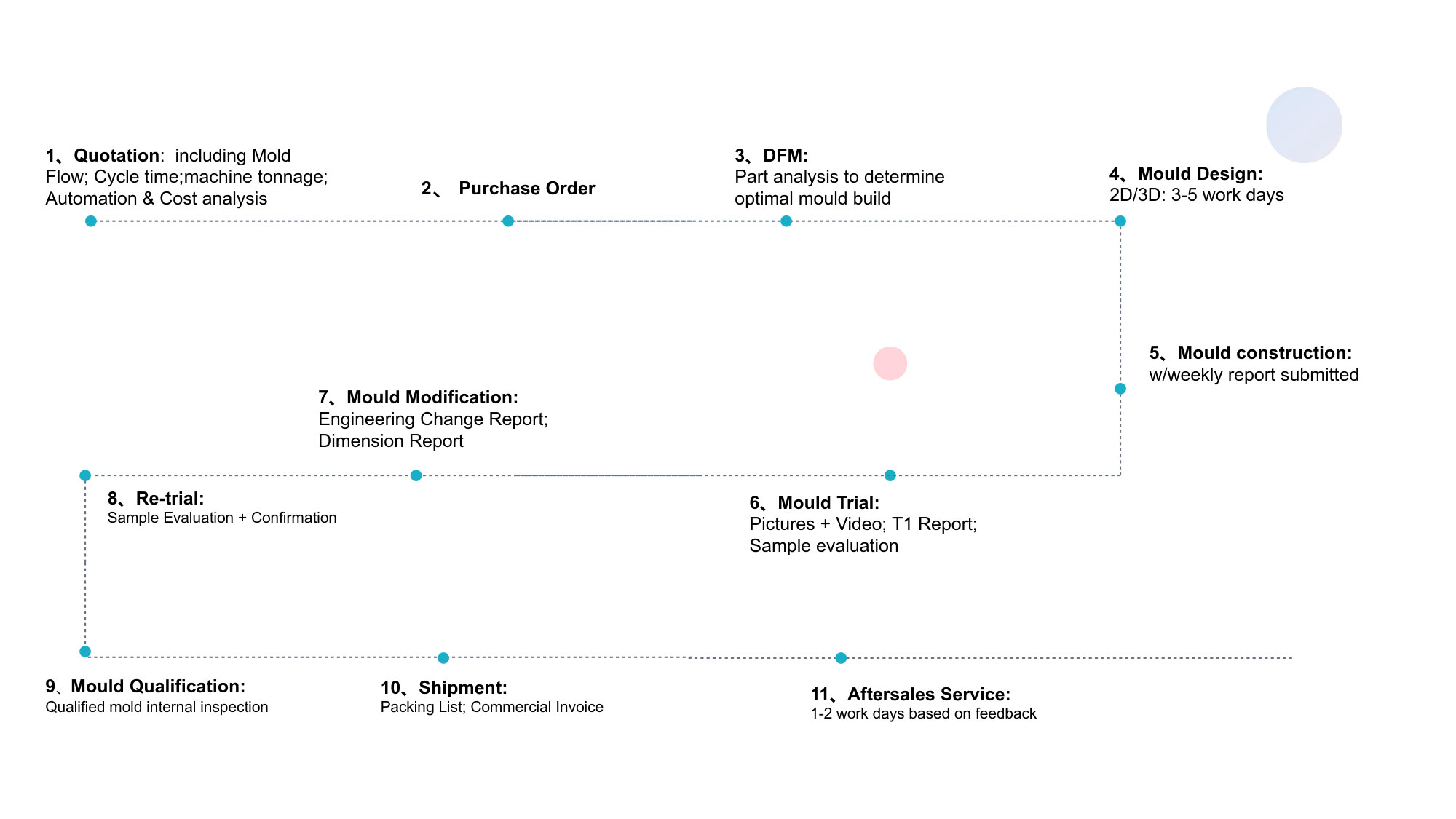
Mold Manufacturing Process Flow
Our mold manufacturing follows a controlled, fully traceable process:
CAD Model Validation and DFM Review: Customer 3D model imported into Moldflow (Autodesk) and Moldex3D for flow, cooling, and warpage simulation. Design for Manufacturing (DFM) report identifies potential issues—weld line positions, air entrapment zones, sink mark risk areas, ejection pin location conflicts—before steel is cut.
Material Selection and Procurement: Steel certificates validated. For 63mm toothpaste jar molds requiring high corrosion resistance to fluoride content, we select S136 ESR or M340 stainless to prevent surface pitting after 500,000 cycles.
Rough Machining (CNC milling + turning): Stock removal 1–3mm for all mold plates and core components.
Heat Treatment (as required): Vacuum hardening and triple tempering for cavity and core steels. Process parameters recorded and included in certification package.
Semi-Finishing: Machining to +0.1–0.2mm net stock, preserving 0.02–0.03mm allowance on shut-off surfaces for steel-safe design.
Precision Finishing: Five-axis milling to final dimensions with ±0.003–0.005mm accuracy. Surface finish targets per specification (Ra 0.4μm for standard cavities; Ra ≤ 0.05μm for transparent part cavities).
EDM (sinker wire-cut as needed): Deep ribs, narrow grooves, undercuts, and parting-line interlocks requiring electrode machining.
Mirror/Electrochemical Polishing: For transparent jars and cream bottles—Ra ≤ 0.05μm surface finish to eliminate light scattering and visible tool marks.
Assembly: Mold base assembly, guide pillar and bushing fitting (clearance 0.01–0.02mm), locating pin installation (±0.005mm positioning accuracy), cooling line pressure testing.
CMM Inspection and First Sample: Full dimensional verification per customer drawing GD&T callouts. Report generated.
Lead Time Standards for Packaging Molds
Mold Complexity Ansix Tech Standard Lead Time Customer Value
Simple one-cavity jar mold 10–15 days Time-to-market for promotional packaging: 2 weeks
Medium-complexity multi-cavity (4–8 cavities) 25–35 days Sample approval for new product launch: 4–6 weeks
High-cavitation (16–48 cavities) high-precision 35–50 days Full production capacity online: 7–8 weeks
Expedited hot-runner system molds As short as 20 days with non-compressed validation Emergency capacity expansion for unexpected demand: 3 weeks
Critical assurance: Expedited schedules never skip the Moldflow simulation step or CMM validation phase. We compress by adding second-shift machining capacity and parallelizing assembly tasks, not by eliminating quality checkpoints. Your mold arrives ready for production, not requiring 2–3 weeks of trial-and-error debugging.
Injection Molding: Process Control That Eliminates Quality Anxiety
Customers fear three injection molding outcomes most: shrink marks deforming jar appearance, flash causing extra post-mold trimming cost, dimensional instability causing capping line jams, and batch-to-batch color mismatch. Ansix Tech’s process control architecture directly addresses each fear.
Process Standardization and Data Locking
All Ansix Tech injection molding machines are networked to our Manufacturing Execution System (MES). Key parameters—melt temperature, injection pressure profile, holding pressure profile, screw speed, cooling time, back pressure—are electronically locked into the system. Only MES-authorized engineers can modify parameters, with all changes logged, time-stamped, and auditable.
For your toothpaste jar line, this means: Your production runs at approved parameters from first shot to millionth shot—no “tweaks” by night-shift operators introducing variation. Each production run receives first-piece and last-piece dimensional inspection per ANSI/ASQ Z1.4 sampling standards. Our CPK monitoring reports cover every dimension declared critical to your assembly process.
Dimensional Stability Control
Mold temperature uniformity is the most significant driver of part-to-part dimensional consistency. Ansix Tech installs multi-zone mold temperature controllers that maintain core and cavity temperature differences within ±2°C. For PC/ABS cream jars requiring precision threads, mold temperature control fluctuation is held to ±1°C.
Measurable outcome from customer production data: For a recent 63mm broad-mouth jar project producing 2 million units over 12 months, key mouth ovality measurements demonstrated batch-to-batch variation of 0.015mm—well below the specified 0.08mm limit. Capping line stoppages due to dimensional mismatch were eliminated entirely.
Cosmetic Surface Quality Classification
Surface Grade Requirement Ansix Tech Achievable Quality Typical Customer Application
Standard opaque jar No visible flow marks; no sink deeper than 0.05mm Mass-market toothpaste jars; lotion bottles
High-gloss opaque No visible gate blush; surface roughness Ra ≤ 0.2μm Premium cosmetic compacts; retail cream jars
High-gloss transparent No visible weld lines; no trapped air bubbles; gate vestige flush ±0.05mm; Ra ≤ 0.05μm Clear cream jars displaying product; transparent toothpaste tubes
For transparent cream bottles displaying product through the container wall, our mirror-polished mold cavities (Ra ≤ 0.05μm) ensure the finished part exhibits no optical distortion. Weld lines—a common transparent-part failure visible as hazy streak lines—are eliminated or positioned at non-critical visual zones through Moldflow-optimized gate placement. The trapped air that would otherwise appear as white bubbles is evacuated through our carefully designed exhaust channel geometry.
Advanced Material Processing Capabilities
Ansix Tech has successfully processed the full spectrum of cosmetic and pharmaceutical packaging resins:
Material Family Specific Grades Processed Customer Application
Polyolefins PP (homopolymer, random copolymer), HDPE, LDPE Jar bodies, pump bases, dispensing lids
Styrenics ABS, SAN, PS Jar caps, decorative trim rings
Polyesters PET, PETG, PCTA Thick-wall transparent cream jars
Engineering PC, PC/ABS blend Premium clear jars requiring impact resistance
High-Performance PPS+40%GF, PEEK, PEI, LSR liquid silicone Heat-resistant dispensing valves; medical-grade components
Critical capability for toothpaste packaging: Fluoride pastes (sodium monofluorophosphate, stannous fluoride) require chemically resistant packaging that does not leach plasticizers into the product during shelf storage. Our HDPE and PP material certifications include FDA 21 CFR 177.1520 compliance and migration testing per EU 10/2011 standards. Material supply chain provides full traceability from raw polymer batch to finished part.
Early DFM Engagement: Eliminating Rework Risk Before Steel Is Cut
Structured Design for Manufacturing (DFM) Review Process
Before any tooling investment commitment, Ansix Tech provides a comprehensive DFM report that transforms your product concept into a manufacturable reality. This pre-production analysis prevents the costly rework that drains project margins.
The DFM report includes:
1. Material selection analysis. We review your proposed resin choice against product requirements—chemical resistance to formulation ingredients, FDA compliance for food-contact packaging, UV stability for shelf-facing applications, ESCR (environmental stress crack resistance) for long-term storage. Where alternative materials reduce cost without compromising performance (e.g., substituting PCR-PP for virgin PP for sustainability commitments), we identify the opportunity.
2. Wall thickness optimization. Our simulation identifies non-uniform thickness regions causing sink marks or internal voids. For broad-mouth jars where thick base-to-sidewall transitions can cause visible sink on exterior surfaces, we recommend gradual thickness reduction or core-cavity design modifications.
3. Draft angle specification. We confirm adequate draft for your selected material—≥0.5° for polished cavities, ≥1° for fine textures, ≥1.5° for coarse textures. Without proper draft, ejection marks or part deformation occurs. We document exact draft angles and position recommendations.
4. Gate placement and runner design. Using Moldflow simulation, we identify optimal gate positions that minimize cosmetic surface defects, ensure balanced multi-cavity filling, and produce acceptable weld line locations. We provide gating schematics and predicted fill patterns in the DFM.
5. Ejection system planning. We document all ejection pin positions and confirm they fall outside visible surfaces or within customer-acceptable zones. Push plates, stripper rings, and ejector pin placements are optimized for consistent release without part deformation or surface marking.
6. Cooling system design. We confirm conformal cooling channels maintain uniform cavity temperature (variation ≤2°C across all cavities). For thin-wall toothpaste tubes with challenging aspect ratios, optimized cooling reduces cycle time while eliminating warp.
7. Venting and exhaust design. We identify potential trapped air zones where filling would compress gas, causing burn marks. Our DFM recommends exhaust groove placement and depth (0.02–0.05mm initial gap, increasing as needed).
8. Shrinkage compensation. For crystalline resins (PP, HDPE) with 1.5–3.0% shrinkage, we calculate expected shrinkage in machine direction (MD) and transverse direction (TD) based on flow orientation and gate placement, and adjust cavity dimensions accordingly.
Moldflow Simulation Deliverables
Each DFM package includes a complete Moldflow simulation report:
Fill time prediction (10–30% of cycle time depending on geometry)
Melt front temperature distribution (within ±5°C for balanced filling)
Weld line position map mapped to part geometry
Air trap locations mapped to proposed vent placement
Volumetric shrinkage distribution (target ≤2% variation across part)
Pressure at V/P switchover (targeting 60–80% of max machine pressure)
Clamping force requirement per cavity (to validate machine selection)
Customer value quantified: Moldflow DFM reduces trial-shoot iterations from industry average 3–4 cycles to 1–2 cycles. Each eliminated trial saves:
1–3 days of production scheduling disruption
1,000–3,000 units of material waste at $0.08–0.15 per gram 800–2,000 in machine labor and electricity
Most importantly, 30–45 days of project launch timeline compression
Steel-Safe Mold Design
Our molds incorporate 0.20–0.30mm stock allowance on shut-off surfaces, snap features, and clip lugs. This “steel-safe” design means that if customer requirements change or first samples reveal unexpected interference, adjustments are performed with a single EDM electrode pass rather than requiring complete new inserts or cavity recutting. Modifications that would take 2–3 weeks on non-steel-safe molds are completed in 24–48 hours.
Quality Validation: Full Traceability from Raw Material to Finished Part
Material Certification and Traceability
Every injection molding resin batch received at Ansix Tech undergoes verification testing:
Melt Flow Rate (MFR/MVR) confirmation per ISO 1133 at 230°C/2.16kg (PP) or appropriate condition for material
Moisture content measurement (PP ≤0.1%; ABS ≤0.1%; PC ≤0.02%) with drying verification
Color batch consistency confirmation via spectrophotometer comparing to customer-approved color standard (ΔE ≤0.5 typical)
Mechanical property verification when required per PPAP Level 3
Material certification documents remain linked to each production lot via MES traceability. If downstream quality issues arise (e.g., chemical incompatibility with formulation discovered after 6 months of shelf life), full material genealogy—vendor, date received, lot number, certification data—is retrievable within 2 hours.
In-Process Quality Control (IPQC)
Our manufacturing floor implements real-time quality monitoring across seven control points:
Raw material receipt (verification against purchase order specifications)
Resin drying (dew point monitoring ≤ -40°C)
Process parameter confirmation (MES-verified parameters for each scheduled job)
First-piece dimensional inspection (prior to production release, CMM + manual gauging per control plan)
In-process sampling (per ANSI/ASQ Z1.4 sampling plan—usually 1 part every 30 minutes from multi-cavity molds)
Last-piece verification (end-of-run dimensional check to confirm process stability)
Packaging and labeling (batch identification traceable to production record)
For critical applications requiring 100% inspection, we install in-line vision systems on ejection robots. These CCD cameras inspect each part for short shots, flash, gate burns, weld line severity, and sink mark depth at full production speed (≥6 parts/second). AI-based defect classification using convolutional neural networks achieves classification accuracy exceeding 98%. Defective parts are automatically segregated from good parts and counted for quality tracking.
Cpk (Process Capability) Commitment
Every critical dimension—the features that affect assembly (threads, sealing surfaces, snap-fit lugs)—is evaluated for process capability index (Cpk) before final production approval. Our standard guarantee: Cpk ≥ 1.33 for all declared critical dimensions during mass production.
What Cpk ≥ 1.33 means for you: Assuming your dimension specification limits are ±0.05mm, a Cpk of 1.33 means 99.93% of production falls within tolerance—only 3 defective parts per 1,000 produced. For a 1-million-unit annual production volume, the expected defect count from dimension variation is 700 parts. Industry standard with Cpk ≤ 1.00 would produce 2,700 defective parts—saving you 2,000 units of material and labor cost annually, plus eliminating 2,000 potential field failures.
For demanding applications (critical sealing surfaces, regulatory-controlled medical packaging), we routinely achieve Cpk ≥ 1.67—99.995% conformance.
First Article Inspection (FAI) and PPAP Compliance
For new product introductions, Ansix Tech provides AS9102-compliant First Article Inspection reports including:
Ballooned drawing referencing all critical features
Dimensional measurement results (actual measured values vs. specified tolerances) for each called-out dimension
Material certification for resin batch
Processing parameter record for approved production setup
Visual inspection results for surface finish, gate vestige, color, and cosmetic defects
PPAP Level 3 documentation is available for automotive and regulated medical packaging, including Process Flow Diagram, PFMEA, Control Plan, Measurement System Analysis (MSA) studies, and Capability (Cpk) studies.
Mold Trial Process (T1 through Tn)
We conduct structured mold trials with progressive validation:
Trial Stage Objective Customer Deliverable
T1 First shot: validate mold function, ejection, no interference Sample parts (5–10 sets) with initial process parameters
T2 Preliminary optimization: adjust gate balance, cooling, venting 20–50 sample sets with full dimensional report
T3 Process stabilization: identify optimized parameter window 50–100 sample sets with preliminary Cpk study (short-run data)
T4 Production validation: 8–24 hours continuous run 300–1,000 parts with Cpk ≥ 1.33 confirmation, process capability report
Production Approval Customer sign-off on full production PPAP package (Level 2 or 3 as required)
Cost Reduction Across Material, Process, and Efficiency Dimensions
Material Cost Optimization
The most direct cost reduction path is material substitution without performance compromise.
PCR (Post-Consumer Recycled) material integration: Ansix Tech has validated PCR-PP content up to 50% for non-food-contact outer packaging layers while maintaining mechanical properties. For broad-mouth cream jars, outer-layer PCR content with inner-layer virgin PP reduces material cost by 20–30% while supporting sustainability targets.
Wall thickness reduction: Through Moldflow analysis, we identify non-functional thick sections where material serves no structural purpose. A 5% reduction in wall thickness across a 1,000,000-unit annual production volume with resin cost of 2.20/kgsaves0.003 per part—$3,000 annually.
Runner and sprue recovery: For cold-runner molds, we recover and regrind runner/spruce material for permissible non-cosmetic interior components with proper material handling preventing degradation. At typical runner-to-part weight ratio of 15–20%, regrind recovery reduces net material consumption by 5–10%.
Cycle Time Optimization
Cycle time reduction delivers exponential savings in machine cost ($35–80 per hour depending on press tonnage), labor overhead, and electricity.
For broad-mouth jar molding:
Conventional cooling (drilled straight channels): 18–22 second cycle
Conformal cooling (3D-printed inserts): 12–15 second cycle
Annual savings for 1,000,000 units at $45/hour machine rate: 1,000,000 × (0.006 second savings? Let’s compute properly:
Cycle time reduction: 18 sec → 14 sec = 4 sec improvement
Cycles per hour improvement: 200/hr → 257/hr = 57 additional cycles/hour
Annual savings = (57 cycles/hour × 2 shifts × 250 days) × (45/60hours×4minutes?)Actuallysimpler:1,000,000units/200/hr=5,000machinehours@currentcycle;1,000,000/257/hr=3,891machinehours@optimizedcycle=1,109hourssaved×45/hour = $49,905 annual savings
For thin-wall toothpast jars requiring high injection speeds:
Optimized gate design and hot-runner sequencing reduces fill time from 1.2 sec to 0.8 sec, pack time optimized from 4 sec to 3 sec, cooling optimized from 12 sec to 9 sec
Total cycle reduction from 17.2 sec to 12.8 sec (25% improvement)
Energy Efficiency
All-electric servo-driven injection molding machines consume 35–45% less electricity than equivalent hydraulic machines. Over a 10,000-hour annual operating run at 0.12/kWh,electricitysavingsexceed8,000 per press per year.
Tooling Cost Amortization
Annual Volume Recommended Mold Material Tooling Cost Cost per Part (amortized)
≤ 50,000 units Pre-hardened P20 $8,000–12,000 $0.16–0.24 per part
50,000–200,000 units S136 ESR / 1.2083 $12,000–20,000 $0.06–0.40 per part
≥ 200,000 units Hardened 1.2344 / DC53 $20,000–35,000 $0.04–0.10 per part
Our mold design approach matches material and manufacturing precision to production volume—no overspending on unnecessary tool life for low-volume promotional products.
Capacity Expansion and Delivery Assurance
Manufacturing Footprint
Four production bases in China and Vietnam totaling 200,000+ square meters provide:
260 injection molding machines ready for production
ISO 8 Cleanroom certification (Class 100,000) per ISO 14644-1 for medical-grade production
1200+ employees including 150+ mold-making engineers and technicians
Annual turnover exceeding 1 billion RMB demonstrating financial stability
Capacity Scalability
Requirement Ansix Tech Response
Prototype volumes (100–5,000 units) Low-cavitation molds (1–2 cavities) on small presses (30–100 tons) for rapid validation
Medium volumes (10,000–100,000 units) 4–8 cavity molds on medium presses (100–250 tons) with cost-optimized tooling
High volumes (100,000–2,000,000+ units) 16–48 cavity molds on large presses (400–2,800 tons) with fully automated handling
Peak demand surges Multi-location production across China and Vietnam bases for geographic load balancing
Emergency capacity 30-day lead time for duplicate tooling on same press platform—identical molds, identical parameters, identical output
Delivery Lead Times
Service Type Standard Lead Time Accelerated Options
Single-cavity prototype mold 10–12 days 7–8 days (small geometry)
4–8 cavity production mold 25–35 days 20–25 days (multiple shifts)
16–32 cavity high-volume mold 35–50 days 30–40 days
Sample parts (T1) after mold complete 2–4 days 24 hours
Production run after mold approval 1–2 weeks tooling confirm; continuous production thereafter Expedited capacity loading available
Logistics and Supply Chain
Warehousing locations in Guangdong, Vietnam, and bonded zones for rapid regional distribution
Ocean freight standard (30–45 days to North America/Europe)
Air freight expedited (5–7 days for urgent restocking, available at customer expense)
Door-to-door tracking via major logistics partners (FedEx, DHL, UPS, Maersk)
Just-in-time delivery scheduling based on customer production planning
Quality Management System Certifications
Ansix Tech maintains globally recognized certifications that validate our commitment to quality:
ISO 9001:2015 – Quality Management Systems (general manufacturing)
IATF 16949:2016 – Automotive Quality Management (for packaging supplying automotive interiors)
ISO 13485:2016 – Medical Devices Quality Management (for medical-grade packaging)
ISO 14001:2015 – Environmental Management Systems
BSCI – Business Social Compliance Initiative (ethical supply chain)
GMP compliance for cosmetic/pharmaceutical production
FDA 510(k) cleared for applicable medical packaging components
ISO 8 Cleanroom (Class 100,000) with full environmental monitoring for sterile or regulated products
Why Ansix Tech for Your Packaging Project
28-plus years of injection molding experience across medical, automotive, consumer, and industrial markets
4 global manufacturing locations providing supply chain redundancy and cost optimization
260 injection molding machines covering the full tonnage range (30–2,800 tons) required for packaging components from 63mm cream jars to wide-mouth dispensing containers
Full ISO certification stack reducing your supplier audit burden
Proven track record producing exactly the three products you referenced: 63mm toothpaste jars, broad-mouth dispensing bottles (35mm–100mm opening diameters), and transparent cream containers (PET/PETG/PC materials)
DFM-first design approach eliminating mold rework and shortening your time-to-market by 30+ days
Cost transparency from material to mold amortization to per-part production pricing
At Ansix Tech, we never view a mold as a piece of steel. We view it as your production license—the tool that determines whether your packaging line runs efficiently or suffers downtime, whether your brand presents flawless product presentation or visible defects. Every design decision we make prioritizes your production uptime, your product quality, and your customer satisfaction.
Proposed Next Steps
For a comprehensive project quotation, please provide:
Product 3D CAD model (STEP, IGES, or STP format)
Target annual production volume
Preferred material(s) or performance requirements
Quality specifications (FDA food contact? Cosmetic grade? Medical? Standard consumer?)
Desired mold lead time (standard 25–45 days or expedited)
Upon receipt of these inputs, Ansix Tech will deliver within 48 hours:
Moldflow simulation summary with fill/warp analysis
Preliminary DFM report with wall thickness/gate/draft recommendations
Mold construction and material recommendation
Firm pricing (mold tooling + per-part production + logistics)
Project timeline from mold design through PPAP approval
Ansix Tech—precision injection molding that protects your brand value.
Ansix Tech Co Ltd
If you have any plans related to 63 Toothpaste Mask Jar, Wide-Mouth Dispensing Bottle, Transparent Cream Bottle , you can contact us at any time. We will turn your ideas into reality, let you realize your dreams, and obtain large orders from the market. Our contact information is info@ansixtech.com. Or contact our CTO, mail: stephen@ansixtech.com
#www.ansixtech.com #ansixtech.com #63 Toothpaste Mask Jar, Wide-Mouth Dispensing Bottle, Transparent Cream Bottle #63 Toothpaste Mask Jar, Wide-Mouth Dispensing Bottle, Transparent Cream Bottle moulds #63 Toothpaste Mask Jar, Wide-Mouth Dispensing Bottle, Transparent Cream Bottle injection molding companies #63 Toothpaste Mask Jar, Wide-Mouth Dispensing Bottle, Transparent Cream Bottle Canopy Mold injection mold companies #Ansix #Ansix moulds #Ansix china #Ansix tech china #Ansix tech company #Ansix facotry #63 Toothpaste Mask Jar, Wide-Mouth Dispensing Bottle, Transparent Cream Bottle injection molding #63 Toothpaste Mask Jar, Wide-Mouth Dispensing Bottle, Transparent Cream Bottle injection tools #63 Toothpaste Mask Jar, Wide-Mouth Dispensing Bottle, Transparent Cream Bottle injection moulds #63 Toothpaste Mask Jar, Wide-Mouth Dispensing Bottle, Transparent Cream Bottle plastic mould #63 Toothpaste Mask Jar, Wide-Mouth Dispensing Bottle, Transparent Cream Bottle plastic tools #Ansix Tech #Ansix molds #Ansix injection molding #Ansix mold factory #injection molding 63 Toothpaste Mask Jar, Wide-Mouth Dispensing Bottle, Transparent Cream Bottle #Ansix mold factory #63 Toothpaste Mask Jar, Wide-Mouth Dispensing Bottle, Transparent Cream Bottle china #63 Toothpaste Mask Jar, Wide-Mouth Dispensing Bottle, Transparent Cream Bottle molds #injection factory #63 Toothpaste Mask Jar, Wide-Mouth Dispensing Bottle, Transparent Cream Bottle injection molding #63 Toothpaste Mask Jar, Wide-Mouth Dispensing Bottle, Transparent Cream Bottle injection molding factory #injection molding company #63 Toothpaste Mask Jar, Wide-Mouth Dispensing Bottle, Transparent Cream Bottle injection mold companies #63 Toothpaste Mask Jar, Wide-Mouth Dispensing Bottle, Transparent Cream Bottle#63 Toothpaste Mask Jar, Wide-Mouth Dispensing Bottle, Transparent Cream Bottle mold limited #Ansix mold china #Ansix companies #Ansix company China #63 Toothpaste Mask Jar, Wide-Mouth Dispensing Bottle, Transparent Cream Bottle facotry #Ansix Tech #Ansix Tech mould #63 Toothpaste Mask Jar, Wide-Mouth Dispensing Bottle, Transparent Cream Bottle injection moulding #injection moulding company #Ansix 63 Toothpaste Mask Jar, Wide-Mouth Dispensing Bottle, Transparent Cream Bottle parts injection mold companies #medical injection molding companieschina #63 Toothpaste Mask Jar, Wide-Mouth Dispensing Bottle, Transparent Cream Bottle china factory #Ansix moulding companies #Ansix molding company #63 Toothpaste Mask Jar, Wide-Mouth Dispensing Bottle, Transparent Cream Bottle injection moulding facotry #Ansix Tech mold #63 Toothpaste Mask Jar, Wide-Mouth Dispensing Bottle, Transparent Cream Bottle mould #63 Toothpaste Mask Jar, Wide-Mouth Dispensing Bottle, Transparent Cream Bottle plastic injection molding #ansix plastic mold #Mold manufacturing #63 Toothpaste Mask Jar, Wide-Mouth Dispensing Bottle, Transparent Cream Bottle parts manufacturing #63 Toothpaste Mask Jar, Wide-Mouth Dispensing Bottle, Transparent Cream Bottle plastic parts factory #63 Toothpaste Mask Jar, Wide-Mouth Dispensing Bottle, Transparent Cream Bottle injection parts mold #63 Toothpaste Mask Jar, Wide-Mouth Dispensing Bottle, Transparent Cream Bottle PRECISION MANUFACTURING #63 Toothpaste Mask Jar, Wide-Mouth Dispensing Bottle, Transparent Cream Bottle #China mold #63 Toothpaste Mask Jar, Wide-Mouth Dispensing Bottle, Transparent Cream Bottle injection moulding china #63 Toothpaste Mask Jar, Wide-Mouth Dispensing Bottle, Transparent Cream Bottle mould china #china precision mold #mold in china #63 Toothpaste Mask Jar, Wide-Mouth Dispensing Bottle, Transparent Cream Bottle mold china #Precision molds #High-precision molds #63 Toothpaste Mask Jar, Wide-Mouth Dispensing Bottle, Transparent Cream Bottle #Injection molds #63 Toothpaste Mask Jar, Wide-Mouth Dispensing Bottle, Transparent Cream Bottle Factory #63 Toothpaste Mask Jar, Wide-Mouth Dispensing Bottle, Transparent Cream Bottle Company #Super Large Injection Mold Factory #Large Tonnage Injection Molding Factory #63 Toothpaste Mask Jar, Wide-Mouth Dispensing Bottle, Transparent Cream Bottle Company #63 Toothpaste Mask Jar, Wide-Mouth Dispensing Bottle, Transparent Cream Bottle Factory #2800T Injection Molding Factory #3000 Ton Injection Molding #4500 Ton Injection Molding Factory #Large Mold Injection Molding #Large Plastic Mold Injection Molding Factory #Large Injection Mold Manufacturer #Plastic Mold Factory #Injection Mold #Plastic Mold