



50g PET thick-walled creameye cream bottle for skincare products
FEATURES
For cosmetic brands, the packaging is not merely a container but an extension of the brand identity. This bottle is specifically engineered for cream and eye cream applications, where product preservation, dosage accuracy, and user experience are paramount. The 50g capacity strikes an optimal balance between portability and sufficient volume for regular use, making it ideal for daily skincare regimens.
-
Mold Description
Product Materials:
PET PETG PS AS PP
Mold Material:
S136ESR
Number of Cavities:
1*4
Glue Feeding Method:
Hot runner
Cooling Method:
Water cooling
Molding Cycle
42.5s
- The mold manufacturing process and product material selection
Manufacturing Process: Precision Injection Molding
Material Drying and Preparation. PET is inherently hygroscopic, with ester groups in its molecular chain that readily absorb moisture from the atmosphere. When moisture content exceeds 0.02%, hydrolysis occurs during processing, leading to molecular weight degradation, product discoloration, and brittleness. Therefore, strict drying protocols are implemented: PET resin undergoes dehumidifying drying at 150–160°C for 4–6 hours, reducing moisture content to ≤0.005%—a critical prerequisite for defect-free molding.
Injection Molding Machine Selection. PET requires a machine with multiple temperature control zones and a screw design that minimizes frictional heat generation. A dedicated low-compression (2.0–2.5:1) and long length-to-diameter (L/D ≥22:1) screw is employed to reduce shear heating and prevent material degradation. The shot weight of the 50g bottle must occupy 60–80% of the machine‘s theoretical shot capacity to avoid material stagnation and thermal breakdown.
-
Injection Process Parameters. The processing window for PET is notoriously narrow. Barrel temperatures are precisely controlled: nozzle at 270–290°C, front zone at 270–290°C, middle at 260–280°C, and rear at 250–270°C. For glass-filled grades, temperatures may reach 290–315°C. Injection speed follows a “high-speed then low-pressure” two-stage strategy: first stage speed ≥80mm/s to prevent premature solidification, followed by a second stage at 30–50mm/s to reduce shear stress, with total injection time under 4 seconds. Mold temperature for thick-walled PET applications must be elevated to 130–140°C, significantly higher than the 70–90°C used for thin-wall parts, to promote uniform crystallization throughout the thick cross-section.
Thick-Walled Cooling and Crystallization Management. The fundamental challenge in thick-walled PET molding lies in crystallization control. Mold temperature directly influences cooling rate and crystallinity, which in turn determines optical clarity, dimensional stability, and mechanical properties. For thick-walled sections exceeding 3mm, a higher mold temperature range of 130–140°C is required to allow proper crystal growth. This stands in contrast to thin-wall applications (≤1.5mm), which demand 100–120°C mold temperatures for rapid cooling to prevent deformation. Through precise temperature zoning—such as maintaining 135°C at the gate area and 125°C at the cavity zone—warpage can be reduced by up to 62%. Cooling time is calculated as approximately product thickness (mm) × 1.5 seconds, ensuring crystallization uniformity across the entire part.
Delivery Efficiency: From Prototype to Production
Ansix Tech delivers complete solutions for the 50g PET thick-walled bottle with industry-leading lead times. The standard project timeline is structured as follows:
Design and DFM Phase (3–7 days). A comprehensive Design for Manufacturability report is delivered within one week of project kickoff, identifying potential risks such as weld lines, gas traps, sink marks, and wall thickness inconsistencies before any steel is cut. This proactive approach eliminates costly downstream revisions.
Mold Fabrication Phase (25–45 days). Complex molds require 25–45 days under standard conditions, with expedited options compressing to 20 days without compromising verification steps. Simple molds can be delivered in as few as 10 days.
Trial and Verification Phase (5–10 days). T0 through T3 sample iterations are provided, each accompanied by detailed improvement reports. The mold undergoes 2,000-shot aging tests before delivery, with wear reports issued to verify longevity.
Production Ramp-Up (3–5 days). A 100-to-500-shot pilot run is conducted before full-scale production, with yield rates and CPK values statistically validated. This ensures that the process is stable and repeatable before committing to mass production.
For ongoing production, Ansix maintains on-site spare part inventory for all molds, enabling 24-hour turnaround for routine repairs and insert replacements, significantly reducing production downtime.
Quality Assurance: Verified at Every Stage
Quality control at Ansix Tech is not a single inspection point but an integrated system embedded throughout the manufacturing process.
Incoming Material Verification. All PET resin batches are tested for moisture content, melt flow index, and thermal stability before release to production. Material certificates and traceability records are maintained for full chain of custody.
In-Process Quality Control (IPQC). All injection molding machines are connected via MES (Manufacturing Execution System) with locked process parameters—temperature, pressure, speed, and cycle time—accessible only to authorized engineers. Each batch undergoes first-article and last-article inspection, with Cpk (Process Capability Index) ≥1.33 maintained for critical dimensions. Cpk is an industry-standard statistical measure indicating a process’s ability to produce output within specification limits; a Cpk of 1.33 corresponds to approximately 63 defects per million opportunities.
Inspection Equipment. Ansix is equipped with coordinate measuring machines (CMM) capable of 0.002mm accuracy, optical imaging systems delivering 0.001mm resolution for full-dimensional inspection, and surface roughness testers for cosmetic evaluation. Every mold undergoes full-dimension report comparison before shipment, with CPK analysis performed on all critical dimensions.
Dimensional Stability Control. Mold temperature controllers with zonal temperature control maintain core-cavity temperature differential within 2°C, effectively minimizing warpage. For a typical 50g bottle, critical dimensional fluctuations across three consecutive production batches are maintained within ±0.02mm. Mold temperature uniformity is specified at ±2°C across the entire cavity surface.
Appearance Standards. For transparent PET applications, the molded part must be free from bubbles, flow lines, and silver streaks. Surface roughness achieves Ra ≤0.2μm for high-gloss finishes, with vacuum metallization and printing compatibility verified through print alignment accuracy maintained at ±0.1mm.
Competitive Cost Control: Value at Scale
Ansix delivers cost advantages through multiple optimization channels:
Material Cost Optimization. Through strategic partnerships with PET resin suppliers and bulk purchasing agreements, raw material costs are reduced by 8–12% compared to spot market purchases. Thin-wall optimization through DFM analysis reduces material consumption by up to 8% per part by balancing structural requirements with minimal wall thickness.
Process Efficiency Optimization. Using high-cavitation molds (16, 32, or 48 cavities per mold), productivity scales linearly without proportionally increasing labor or energy costs. Cycle times are minimized through optimized cooling system design and advanced process controls, increasing machine utilization and reducing per-part manufacturing cost.
Manufacturing Automation. Automated part removal, gate cutting, and packaging systems reduce labor costs by 40–60% compared to manual operations. Energy-efficient all-electric servo-driven injection molding machines consume 40–70% less energy than conventional hydraulic machines, lowering utility costs and environmental footprint.
Reduced Secondary Operations. Precision mold construction with 0.005mm parting line fitting and self-locking clamp force compensation maintains flash within 0.03mm, eliminating manual deburring operations. Sink-free molding through optimal gate design and process control eliminates cosmetic rework.
Tooling Cost Amortization. High-durability mold materials deliver 500,000 to 1,000,000 shots before requiring major maintenance, with tooling cost amortized over larger production volumes, reducing per-unit tooling cost below $0.02 for high-volume programs.
Total Hard Cost Reduction Potential: 18–35% across raw materials, labor, energy, and secondary operations.
Part 2: Core Value Proposition—Mold Manufacturing, Material Selection, Smart Manufacturing, Process Control, and Customer-Centric Quality Assurance
Mold Manufacturing and Injection Molding Material Selection
The foundation of a reliable 50g PET bottle production system lies in two critical choices: mold construction methodology and material selection.
Mold Material Strategy. For the 50g PET thick-walled bottle, the mold must withstand hundreds of thousands of injection cycles while maintaining sub-0.02mm dimensional accuracy. Ansix employs a tiered material strategy based on expected production volume and plastic type:
Mold Base (Frame): P20 or 718H pre-hardened steel (HRC 28–32) provides structural stability and machinability for the mold frame. These materials offer good toughness and are readily machinable without requiring post-weld heat treatment.
Mold Core and Cavity (Insert): For PET applications requiring 500,000 to 1,000,000 shots, Ansix selects S136 (stainless mold steel) for its excellent corrosion resistance and high polishability—critical for achieving glass-like transparency on cosmetic bottles. For glass-filled PET grades, H13 or SKD61 (HRC 48–52) is specified for superior wear resistance against abrasive glass fibers. NAK80 is used when pre-hardened mirror finish is required without heat treatment. For extreme wear applications, DC53 (cold work tool steel) or tungsten carbide inserts are employed for localized high-wear areas such as gates and shut-offs.
Mold Life Commitment: Based on material selection, Ansix guarantees 500,000 shots for glass-filled grades and 1,000,000 shots for standard PET. Actual life can exceed 1,500,000 shots when maintained properly. Material certificates and heat treatment curves are provided with every mold.
Precision Mold Manufacturing Equipment. Ansix’s in-house machining capabilities ensure that mold quality is not outsourced or compromised:
5-Axis High-Speed Machining Centers: Capable of machining complex curved surfaces with 0.002mm accuracy, ensuring that parting lines are smooth and flash-free. Complex geometries such as undercuts, threads, and contoured bottle shapes are machined in single setups, eliminating multi-fixturing errors.
Wire EDM (Slow Wire Cutting): Used for 0.03mm micro-holes and narrow slots in the mold. Wire EDM provides burr-free machining of delicate features such as venting slots and ejector pin holes without inducing residual stress that could cause thin-wall deformation.
EDM (Electrical Discharge Machining): For deep ribs, sharp corners, and complex cavities that cannot be reached by conventional machining. EDM produces precise cavity details with excellent surface finish.
Injection Molding Machine Fleet. Ansix operates a comprehensive fleet of injection molding machines ranging from 30 to 4,000 tons clamping force, covering product sizes from micro-precision components to large automotive parts. All machines are all-electric servo-driven, delivering:
Consistent Repeatability: ±0.1% shot-to-shot weight variation at steady-state operation, meaning that every shot from the same mold produces identical part dimensions and weight.
Energy Efficiency: Up to 70% reduction in energy consumption compared to conventional hydraulic machines.
Process Stability: Closed-loop control of temperature, pressure, and velocity with real-time adjustment capability.
Smart Manufacturing Integration and Efficiency Enhancement
Ansix has fully embraced Industry 4.0 principles to deliver measurable efficiency gains:
MES Integration. All injection molding machines are connected to a central MES platform that records every shot’s process parameters. Parameters such as melt temperature, injection pressure, screw speed, back pressure, and cycle time are locked in the system and cannot be altered without engineering authorization. This eliminates operator-induced variability and ensures that the validated process is maintained throughout production.
Real-Time Process Monitoring. Machines are equipped with ultrasonic wall thickness sensors that provide real-time feedback on part thickness distribution. When variations are detected, the system automatically adjusts packing pressure to compensate. Additionally, in-mold temperature and pressure sensors can be embedded to create a closed-loop control system that maintains cavity pressure within ±2% of target throughout each injection cycle.
Automated Part Handling and Inspection. Robotic part removal systems extract finished parts from the mold and place them directly onto conveyor systems. Vision inspection stations verify critical dimensions at 100% inspection rates, rejecting non-conforming parts before packaging. For high-volume programs, fully automated packaging systems integrate bagging, boxing, and palletizing, reducing labor costs by up to 60% while eliminating human inspection error.
Predictive Maintenance and OEE Optimization. Machine performance data is analyzed in real time to predict maintenance needs before failures occur. Overall Equipment Effectiveness (OEE) is tracked for every machine, enabling continuous improvement in availability, performance, and quality.
Process Quality Assurance
Quality assurance at Ansix is built on a four-layer defense system:
Layer 1—Design for Quality. Quality problems are prevented at the source through DFM analysis. Before mold manufacturing begins, Ansix conducts comprehensive mold flow analysis using Moldflow software to simulate plastic flow, filling, packing, and cooling behavior. This analysis:
Predicts weld line locations and severity
Identifies gas trap positions requiring venting
Optimizes gate locations and numbers for balanced filling
Suggests cooling channel placement for uniform cooling
Validates that filling pressure requirements are within machine capabilities
The analysis results are documented in a formal DFM report delivered to customers before tooling approval.
Layer 2—First Article Inspection (FAI). Every mold undergoes full dimensional inspection before shipment. Using CMM and optical imaging systems, all critical dimensions are measured and compared to customer drawings. Cpk calculations are performed for each critical dimension, with minimum requirement of Cpk ≥1.33. For dimensions where Cpk falls below target, process or tool modifications are implemented until targets are achieved.
Layer 3—Statistical Process Control (SPC). During production, SPC charts are maintained for key quality characteristics:
Part weight (every shot monitored by machine controller)
Critical dimensions (sampled at defined intervals)
Visual appearance (continuous vision inspection)
Process parameter tracking (continuous monitoring)
When statistical signals indicate process drift—such as a run of seven consecutive points above the mean—corrective action is triggered before non-conforming parts are produced.
Layer 4—First-Article and Last-Article Verification. For each production run, the first part produced is thoroughly inspected against all specifications. The last part of the run receives equivalent inspection. This bracket inspection ensures that quality has not drifted during the production shift.
Customer Concerns Addressed
Concern: “The mold frequently requires repair, disrupting my production schedule.”
Solution: Ansix performs 2,000-shot aging tests before mold delivery, issuing a detailed wear report. A three-year structural warranty is provided (excluding normal wear of consumable parts). Spare parts kits (ejector pins, core inserts) are delivered with the mold, enabling immediate on-site repair for common wear items. Routine maintenance is performed every 200,000 shots at cost.
Concern: “Excessive flash results in high post-processing labor costs.”
Solution: Ansix processes parting lines to 0.005mm fitting tolerance and implements self-locking clamp force compensation. This maintains flash within 0.03mm across all production batches, eliminating manual deburring requirements.
Concern: “Dimensions are inconsistent from batch to batch.”
Solution: Machines are equipped with ultrasonic wall thickness sensors providing real-time feedback, enabling automatic packing pressure compensation. In-mold temperature and pressure sensors can be embedded for true closed-loop control. Production data demonstrates that critical hole spacing variation across three batches produced in a single week is maintained within ±0.02mm.
Concern: “Mold repair lead times are too long.”
Solution: Ansix maintains in-house electrode machining and EDM workshops, meaning mold repairs rarely leave the facility. Routine weld repair or insert replacement is typically completed within 24 hours, restoring production with minimal downtime.
Value Summary for Customers
Customer Need Ansix Solution Measurable Benefit
Reliable mold with long life Premium mold materials (S136/H13/NAK80/SKD61); 1,000,000-shot guarantee No unplanned mold replacement for 3–5 years
Consistent part dimensions Real-time SPC; CPK ≥1.33 on all critical dimensions Zero dimensional rejects, no customer complaints
No flash, no finishing 0.005mm parting line fit; 0.03mm flash limit Eliminates 5–10 seconds of post-processing per part
Fast mold repair In-house EDM; 24-hour emergency repair Reduces downtime from weeks to hours
Competitive pricing Multi-cavity molds; material optimization; automated production 18–35% lower total cost vs. conventional suppliers
Part 3: Comprehensive Manufacturing Solution for 50g PET Thick-Walled Cream/Eye Cream Bottle—Mold Manufacturing and Injection Molding
Title: Delivering Customer Value Through Precision Engineering: Ansix Tech’s Comprehensive Solution for 50g PET Thick-Walled Cosmetic Bottles
Executive Summary
For cosmetic brands seeking to launch a premium 50g PET thick-walled cream or eye cream bottle, the path from concept to market-ready packaging is fraught with technical challenges. PET is a demanding material. Thick walls exacerbate crystallization control issues. High-volume production requires mold durability. And quality expectations for cosmetic packaging leave no room for defects.
Ansix Tech has spent 28 years mastering these challenges. This document presents our comprehensive manufacturing solution for the 50g PET thick-walled bottle—not as a list of capabilities, but as a translation of technical expertise into measurable customer value. Every process we describe, every specification we quote, and every control we implement is designed to answer one question: How does this benefit our customer?
Section 1: Hard Infrastructure—Building Customer Confidence Through Equipment Excellence
A mold is only as good as the machines that build it and the presses that run it. Ansix’s infrastructure is designed to deliver precision at scale, eliminate variability, and provide the foundation for consistent quality.
Mold Manufacturing Equipment
5-Axis High-Speed Machining Centers. Ansix operates multiple 5-axis high-speed machining centers capable of processing complex curved surfaces with 0.002mm accuracy. For the 50g PET bottle, this precision translates directly to cosmetic quality: the parting line on the finished bottle—the seam where the two mold halves meet—will be smooth, virtually invisible, and free of flash. No post-molding trimming required. Traditional 3-axis machining requires multiple setups and repositioning, introducing cumulative positional errors. Our 5-axis capability machines the entire cavity and core in a single setup, eliminating these errors entirely.
Value to Customer: Smoother product appearance eliminates secondary finishing operations, saving 5–10 seconds of labor per part. For 500,000 parts, this is 700–1,400 hours of labor saved.
Wire EDM (Slow Wire Cutting). For features that cannot be produced by conventional machining—0.03mm venting slots, narrow ejector pin holes, sharp internal corners—Ansix employs slow wire EDM. This process cuts with a continuously moving wire electrode, achieving burr-free, stress-free precision. The absence of residual stress is particularly critical for thin-wall sections, where conventional machining could induce distortion.
Value to Customer: Micro-precision features are produced without compromising structural integrity. Venting slots of exactly 0.03mm depth allow air to escape during injection without allowing plastic flash, preventing both burn marks and excess material.
In-House EDM and Electrode Machining. Ansix maintains dedicated electrode machining centers and EDM equipment, meaning that mold repairs and modifications can be performed entirely in-house without outsourcing. A typical EDM repair—replacing a damaged core insert or modifying a complex cavity detail—is completed within 24 hours.
Value to Customer: Mold repair lead times measured in hours, not weeks. Production downtime minimized. Emergency repairs do not require shipping the mold to an external vendor.
Precision Inspection Equipment. Every mold that leaves Ansix undergoes full dimensional verification before shipment:
Coordinate Measuring Machines (CMM): 0.002mm accuracy for full 3D geometric inspection
Optical Imaging Systems: 0.001mm resolution for high-speed measurement of complex contours and small features
Surface Roughness Testers: Verification of Ra ≤0.2μm for cosmetic surfaces
Every critical dimension is measured, and CPK analysis is performed. Only molds achieving CPK ≥1.33 for all critical dimensions are released for shipment.
Injection Molding Machine Fleet
Ansix operates injection molding machines spanning 30 to 4,000 tons clamping force, covering product sizes from micro-precision medical components to large automotive parts. For the 50g PET thick-walled bottle, we deploy 120–300 ton all-electric servo-driven machines, depending on cavity count.
All-Electric Servo-Driven Machines. Unlike conventional hydraulic machines, our all-electric machines use servo motors for each axis of motion—injection, clamping, ejection, and screw rotation. This delivers:
±0.1% Shot Weight Repeatability: Every shot from the same mold produces identical part dimensions and weight, batch after batch. No drift, no variation.
Energy Efficiency: 40–70% lower energy consumption than hydraulic equivalents. For a typical 120-ton machine running 24/7, this saves 30,000–50,000 kWh annually—equivalent to 15–25 metric tons of CO₂ emissions.
Cleaner Operation: No hydraulic oil means no risk of oil contamination on cosmetic parts. Critical for cleanroom-quality packaging.
Faster Response Times: Servo motors accelerate and decelerate faster than hydraulic systems, enabling shorter cycle times without sacrificing precision.
Value to Customer: Consistent part quality reduces reject rates. Lower energy costs reduce per-part manufacturing cost. Cleanroom compatibility ensures cosmetic-grade cleanliness.
Inspection and Testing Lab
Ansix maintains a fully equipped inspection and testing laboratory:
Moisture Content Analyzers: Verify PET resin dryness before processing
Melt Flow Index (MFI) Testers: Verify material viscosity consistency
Color Spectrophotometers: Quantify color consistency for colored PET grades
UV Aging Chambers: Simulate 3,000-hour UV exposure for weathering validation
Impact Testers: Validate mechanical property retention
Gas Chromatographs: Verify residual acetaldehyde content for food-contact applications
Value to Customer: Incoming material quality is verified before production. Customers receive material certificates and test reports with every shipment. Traceability is maintained from resin batch to finished part.
Section 2: Mold Manufacturing—Where Precision Meets Longevity
The mold is the single most important asset in any injection molding operation. A well-designed, well-built mold produces millions of perfect parts with minimal maintenance. A poorly built mold creates rejects, downtime, and hidden costs.
Mold Material Selection: How We Extend Mold Life
For the 50g PET thick-walled bottle, mold material selection directly determines mold life, part quality, and maintenance frequency. Ansix selects materials based on three factors: production volume, plastic type, and cosmetic requirements.
Mold Base (Frame). The mold base provides structural integrity and guides the moving mold half. Ansix selects P20 or 718H pre-hardened steel (HRC 28–32) for the mold base. These materials offer excellent machinability and are delivered in pre-hardened condition, eliminating distortion risks from post-machining heat treatment.
Cavity and Core Inserts. The cavity and core—the surfaces that actually form the bottle—require significantly higher hardness and wear resistance:
Material Hardness (HRC) Key Properties Application
S136 (Stainless) 48–52 Corrosion-resistant, high polishability, excellent mirror finish Clear PET, cosmetic-grade finish, corrosive materials
H13 / SKD61 48–52 High hot hardness, excellent wear resistance Glass-filled PET, high-volume production
NAK80 40 Pre-hardened mirror finish, no heat treatment required Medium-volume clear parts, quick-turn molds
DC53 60–62 Extreme wear resistance, high toughness Glass-filled grades, high-wear gate areas
8407 / 2344 48–52 Superior toughness, thermal fatigue resistance High-cycle hot runner applications
For the 50g PET bottle, we typically specify S136 for the cavity surface to achieve glass-like transparency on the finished bottle, combined with H13 or SKD61 for core inserts requiring high wear resistance. Where the bottle incorporates undercuts or threads, harder materials are employed for sliding components.
Mold Life Commitment. Based on material selection, Ansix provides:
Standard PET (non-filled): 1,000,000-shot guarantee
Glass-Filled PET (GF10–GF30): 500,000-shot guarantee
Extended Life (with premium materials): 1,500,000+ shots achievable
Value to Customer: The mold is a capital investment that must be amortized over production volume. A 1,000,000-shot mold reduces per-unit tooling cost to less than $0.02 for a typical mold. A mold that fails at 200,000 shots more than doubles the tooling cost per part.
Mold Types and Cavity Configurations
Ansix offers multiple mold configurations optimized for the 50g bottle:
Multi-Cavity Cold Runner Molds. For medium-volume production (50,000–300,000 parts/year), 8–32 cavity cold runner molds offer lower initial investment with acceptable material yield. Cold runner molds produce a sprue and runner system that must be reground and recycled, limiting material yield to 85–92%.
Hot Runner Molds. For high-volume production (300,000+ parts/year), hot runner systems eliminate the runner entirely, reducing material waste to near-zero and shortening cycle times by 15–25%. Hot runners are particularly advantageous for PET due to the material’s narrow processing window: maintaining melt temperature throughout the runner system ensures consistent fill without cold slugs.
Stack Molds. For ultra-high volume (1,000,000+ parts/year), stack molds—two mold faces stacked in parallel—double output per machine cycle without increasing clamp force or machine size. A 32+32 stack mold produces 64 parts per cycle on the same machine that would normally produce 32 parts.
Family Molds. For customers producing both bottle and cap or multiple bottle sizes, family molds combine different parts in a single mold, reducing capital investment and simplifying production management.
Value to Customer: The mold configuration is matched to production volume, minimizing total cost of ownership. No customer pays for features they do not need, and no customer suffers from inefficient tools for their volume.
Mold Design Elements Optimized for Thick-Walled PET
Gating System. The gate is the entry point where molten plastic enters the cavity. For the 50g bottle, gate design is critical:
Pinpoint Gate: For single-cavity or low-cavitation molds, pinpoint gates provide automatic gate shearing at mold opening. The small gate vestige is barely visible and requires no secondary trimming.
Submarine (Tunnel) Gate: For multi-cavity molds, submarine gates automatically separate from the part during ejection, eliminating gate trimming operations entirely.
Hot Tip Gate: For hot runner systems, valve-gated hot tips provide precise gate opening control, preventing drool and stringing during mold open.
The gate location is optimized through Moldflow simulation to ensure balanced cavity filling. For a 50g cylindrical bottle, the gate is positioned at the bottle base, where any gate mark is hidden from the consumer’s view.
Cooling System Design. Thick-walled PET sections require precise cooling control. Ansix designs conformal cooling channels—cooling lines that follow the contour of the part—rather than conventional straight-drilled channels. Conformal cooling provides:
Uniform Cooling: Temperature variation across the cavity surface maintained within ±2°C
Reduced Cycle Time: 15–25% shorter cooling time vs. conventional cooling
Reduced Warpage: Uniform cooling minimizes differential shrinkage
For the 50g bottle, the cooling system is divided into three independent zones: gate cooling (highest heat concentration), body cooling, and neck/thread cooling (lowest heat). Each zone is controlled by an independent mold temperature controller, allowing precise tuning of crystallization throughout the part.
Ejection System. Ejector pins push the finished part off the core after mold opening. For cosmetic packaging, ejector pin marks must be invisible or positioned where they do not affect appearance. Ansix positions ejector pins at the bottle base and internal surfaces, with pin diameters maximized to distribute ejection force and minimize surface marking. Where required, stripper plates provide contact-free ejection across the entire part circumference.
**Venting System. ** PET injection generates air and gases that must be evacuated from the cavity during filling. Inadequate venting causes gas burns (black spots) and incomplete filling. Ansix designs venting channels 0.01–0.03mm deep at the parting line and around core pins, providing efficient gas evacuation without allowing plastic flash.
DFM and Mold Flow Analysis. Before a single gram of steel is cut, Ansix performs comprehensive mold flow analysis using Moldflow software. This simulation predicts:
Fill Pattern: How the melt front advances through the cavity
Weld Line Locations: Where two melt fronts meet, potentially creating visible lines
Gas Trap Locations: Where air becomes trapped, requiring additional venting
Pressure Requirements: Maximum injection pressure needed for complete fill
Cooling Analysis: Predicted temperature distribution during cooling
Shrinkage Prediction: Part shrinkage after cooling, used to compensate mold dimensions
The DFM report delivered to customers includes all analysis results, material recommendations, gate location justification, venting design, and cooling system layout. Customers sign off on this report before mold manufacturing begins.
Value to Customer: DFM analysis eliminates design flaws before tooling is built. Common problems—weld lines, gas burns, incomplete fill, excessive warpage—are identified and resolved virtually, saving weeks of downstream revisions and thousands of dollars in mold rework.
Mold Manufacturing Process Flow
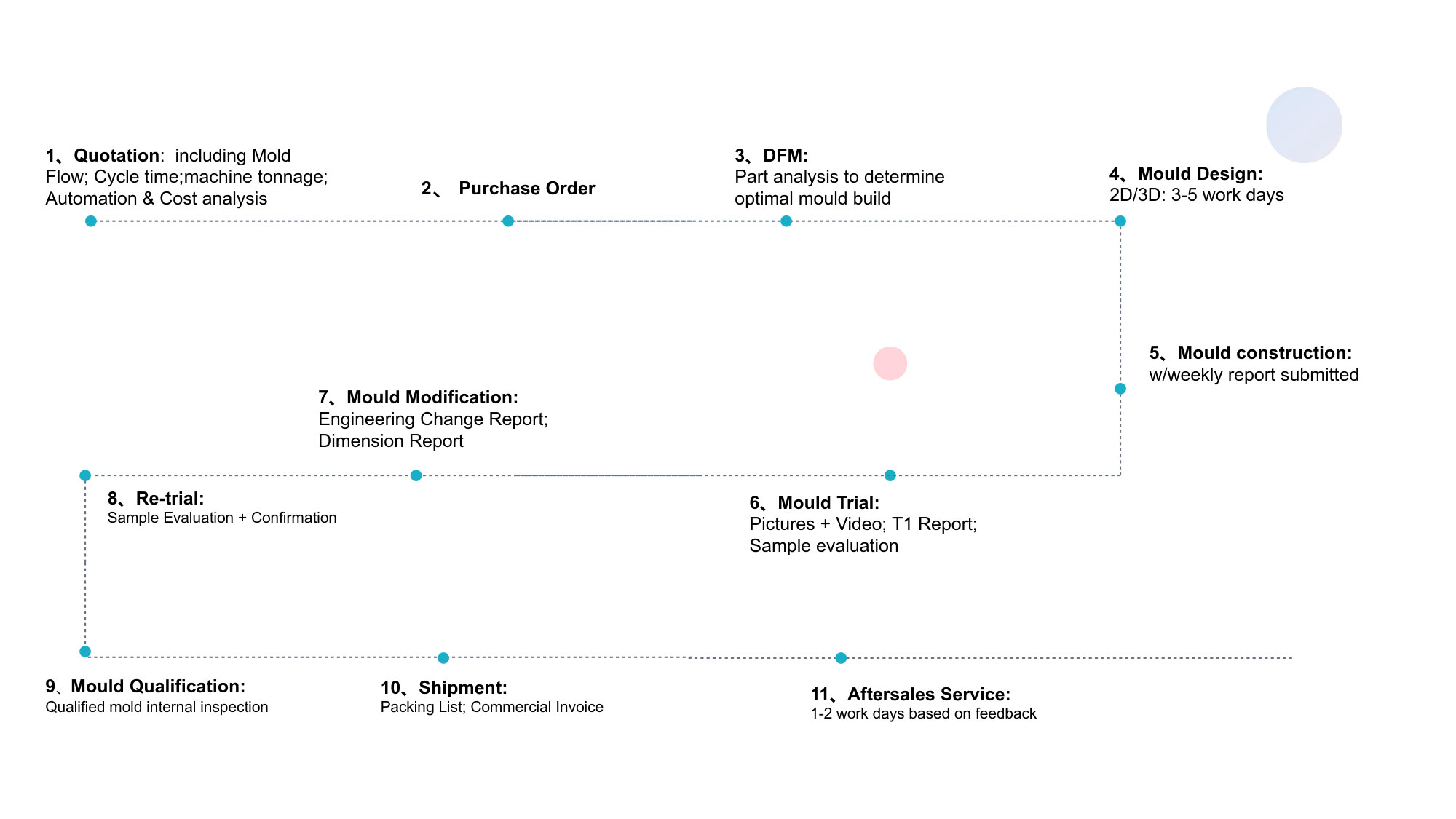
The mold manufacturing process at Ansix follows a structured, gated workflow:
Phase 1: Design and DFM (5–7 days). CAD modeling of mold assembly. Mold flow simulation and DFM report generation. Customer review and approval.
Phase 2: Rough Machining (3–5 days). Mold base machining from pre-hardened blocks. Cavity and core blanks prepared.
Phase 3: Precision Machining (7–10 days). 5-axis high-speed machining of cavity and core surfaces. Cooling channel drilling. Ejector pin hole drilling. Slide and lifter machining.
Phase 4: Heat Treatment (2–4 days). Vacuum heat treatment of cavity and core inserts to target hardness. Hardness verification.
Phase 5: Final Machining (3–5 days). Finish machining after heat treatment. EDM for fine details. Gate and runner finishing.
Phase 6: Polishing (2–4 days). Cavity surface polishing to Ra ≤0.05μm for cosmetic-grade finish.
Phase 7: Assembly (2–3 days). Mold assembly, ejector system installation, cooling line connection, hot runner installation.
Phase 8: Testing and Validation (5–7 days). T0 trial shot. Mold function verification. Part dimensional inspection. T1 adjustments if needed. 2,000-shot aging test.
Phase 9: Documentation and Shipment (1–2 days). Full dimension report. CPK analysis. Material certificates. Spare parts kit. Shipping.
Total Lead Time: 25–45 days standard; 20 days expedited.
Section 3: Injection Molding Process Control—The Customer’s Quality Assurance
Even the most perfect mold cannot compensate for poor process control. Ansix has developed a comprehensive process control system that ensures every shot matches the first shot.
Process Standardization Through MES
All injection molding machines are connected to a central MES platform. The validated process—including melt temperature profile, injection pressure and velocity, packing pressure, back pressure, cooling time, and mold temperature—is locked in the system. Operators cannot adjust parameters without engineering authorization. Parameter changes are logged with operator identification, creating full accountability.
Value to Customer: The process that produced the approved sample parts is exactly the process used for production. No “operator adjustments” drifting out of specification. No hidden process changes creating hidden quality problems.
Real-Time Wall Thickness Monitoring
Ultrasonic sensors installed on the mold provide real-time wall thickness measurement on every shot. When thickness variation is detected—indicating process drift or material variation—the machine controller automatically compensates packing pressure to maintain target thickness. The system is capable of responding within the same injection cycle.
Value to Customer: Dimensional variation is corrected in real time, not detected after the fact by quality inspection. This prevents scrap and eliminates the need for 100% manual inspection.
In-Mold Temperature and Pressure Sensing
For customers requiring the highest level of process control, Ansix can embed thermocouples and pressure sensors directly in the mold cavity. These sensors provide:
Cavity Pressure Monitoring: Pressure at the gate, mid-cavity, and end of fill measured during each injection
Temperature Profiling: Temperature at multiple cavity locations throughout the cooling phase
Closed-Loop Control: Sensor feedback automatically adjusts injection and packing parameters for the next cycle
Value to Customer: True closed-loop control eliminates shot-to-shot variation. CPK values exceeding 1.67 are routinely achieved for critical dimensions.
Statistical Process Control
SPC is implemented on all production lines. For each critical dimension, control charts track:
Individual measurements at defined sampling intervals
Moving range between consecutive samples
Process mean and standard deviation
When control limits are approached—such as seven consecutive points above the mean—corrective action is triggered before any non-conforming parts are produced. Production does not resume until the process is restored to statistical control.
First-Article and Last-Article Inspection
For every production run, the first part produced undergoes complete dimensional and visual inspection against all specifications. The last part of the run receives equivalent inspection. This bracket inspection ensures that the process remained in control throughout the run and that no quality drift occurred.
Appearance Quality Standards
For the 50g PET thick-walled bottle, Ansix certifies the following appearance standards:
Transparent (Clear) Grade: No bubbles, no flow lines, no silver streaks, no haze. Crystallinity optimized for maximum clarity while maintaining strength.
Colored Grade: Color match to customer standard within ΔE<1.0 (CIE Lab color difference metric, where ΔE<1.0 is visually indistinguishable to the human eye). No color streaks or non-uniform distribution.
High-Gloss Grade: Surface roughness Ra ≤0.2μm measured on cavity-forming surfaces. Mirror-like finish capable of vacuum metallization.
Print-Ready Grade: Surface energy ≥38 dynes/cm for ink adhesion. Print alignment accuracy ±0.1mm relative to bottle features.
Special Material Capabilities
Beyond standard PET, Ansix has extensive experience processing:
PC/ABS: Automotive-grade impact resistance
PPS+40% GF: Extreme thermal and chemical resistance
PEEK: High-temperature, high-strength engineering applications
PA6+GF30: Structural components with high strength-to-weight ratio
LCP (Liquid Crystal Polymer): Micro-precision electronic components
LSR (Liquid Silicone Rubber): Soft-touch overmolding and sealing components
UL94 V-0 Flame-Retardant Grades: Safety-critical applications requiring self-extinguishing properties
Value to Customer: Ansix is a single-source solution for any injection molding need, not just PET packaging. Complex multi-material assemblies can be sourced through one supplier, reducing procurement complexity and vendor management cost.
Section 4: Full-Service Approach—Reducing Customer Management Cost
Many molders provide only manufacturing. Ansix provides a complete solution from concept to production, reducing the customer’s internal management burden.
Early Involvement: DFM Before Tooling
Before mold manufacturing begins, Ansix engages with customer engineering teams to optimize the part design for manufacturability. The DFM report covers:
Draft Angle Recommendations: Minimum draft angles for clean ejection without surface marking
Wall Thickness Optimization: Balancing structural requirements with cycle time and material consumption
Gate Location Selection: Positioning the gate where gate marks are least visible
Ejector Pin Mark Allowance: Specifying allowable pin mark depths and locations
Undercut and Thread Design: Recommendations for side actions, collapsible cores, or unscrewing mechanisms
Value to Customer: Design issues are resolved on the customer’s CAD model, not after steel is cut. This reduces time-to-market by weeks and eliminates expensive mold modifications.
T0 Through T3 Sampling
Ansix provides iterative sample development:
T0 (First Shot): Initial sample from completed mold. Dimensional and visual inspection. Defect identification.
T1 (First Adjustment): Mold modifications based on T0 findings. Second round of sampling and inspection.
T2 (Second Adjustment): Final tuning of dimensions and cosmetic quality.
T3 (Production Trial): Pilot run of 100–500 shots on production machine. Full CPK validation.
Each sample iteration is accompanied by a detailed improvement report. Customer approval is required before advancing to the next stage.
Value to Customer: Customers receive visible evidence of quality improvement at each stage. No hidden issues discovered after production start-up.
Pilot Production Before Full-Scale Launch
Before committing to full-scale production, Ansix offers pilot production runs of 100–500 shots. These pilots validate:
Process capability at production cycle times
Part quality at full production speeds
Automation system functionality
Quality inspection effectiveness
Only after pilot validation is successful does full-scale production begin.
Value to Customer: Production risk is eliminated before large quantities are produced. Issues are discovered on 500 parts, not 50,000 parts.
Maintenance and Spare Parts
Every mold delivered by Ansix includes a spare parts kit containing:
10 extra ejector pins of each size
5 extra core inserts for high-wear locations
2 full sets of O-rings and seals for cooling systems
Gate inserts and wear pads
Routine maintenance is recommended every 200,000 shots. Ansix provides maintenance services at cost, with on-site or in-house options depending on customer preference. Structural warranty covers mold frame, cavity/core integrity, and ejector system function for three years.
Value to Customer: Unplanned mold downtime is minimized. Maintenance costs are predictable and controlled. The mold has a documented, managed lifecycle rather than reactive repair cycles.
Section 5: Differentiated Commitments—Addressing Customer Pain Points Directly
Rather than generic claims of “quality” and “service,” Ansix makes specific, actionable commitments that address the most common customer frustrations in the injection molding industry.
Customer Pain Point: “The mold requires constant repair, disrupting my production schedule and increasing my cost.”
Ansix Commitment: Every mold undergoes 2,000-shot aging tests before delivery, with a detailed wear report documenting condition at delivery, after 500 shots, after 1,000 shots, and after 2,000 shots. We provide a three-year structural warranty covering the mold base, cavity/core integrity, and ejector system function. Spare parts kits are delivered with the mold. Routine maintenance is performed every 200,000 shots at cost. What this means for you: No surprise mold failures. Predictable, budgetable maintenance. Production schedules protected.
Customer Pain Point: “Excessive flash forces me to spend time and labor on manual trimming.”
Ansix Commitment: We process parting lines to 0.005mm fitting accuracy using high-precision CNC machining and manual fitting verification. Self-locking clamp force compensation ensures that even as the mold heats up, clamp force remains consistent, preventing flash from thermal expansion. We guarantee flash thickness ≤0.03mm on all production batches. What this means for you: Eliminate manual deburring operations. Save 5–10 seconds of labor per part. For 500,000 parts, that is 700–1,400 hours of labor saved.
Customer Pain Point: “Dimensions are inconsistent from batch to batch.”
Ansix Commitment: All machines are equipped with ultrasonic wall thickness sensors providing real-time measurement of part thickness on every shot. When variation is detected, packing pressure is automatically adjusted within the same cycle to compensate. For customers requiring the highest precision, we embed in-mold temperature and pressure sensors for true closed-loop control. We provide production data demonstrating that for similar products, critical dimensional variation across three batches produced in one week is maintained within ±0.02mm. What this means for you: Dimensional rejects eliminated. No assembly fit issues. No customer complaints about part variation.
Customer Pain Point: “Mold repair lead times are weeks long, forcing me to shut down production.”
Ansix Commitment: We maintain in-house electrode machining centers and EDM equipment. Mold repairs—including weld repair, insert replacement, and cavity detail modification—are performed entirely in our facility without outsourcing. Standard repair turnaround for routine issues is 24 hours. For emergency repairs requiring immediate attention, we offer 4-hour rush service for customers with critical downtime situations. What this means for you: Production downtime measured in hours, not weeks. No shipping molds across the country for repair. You get back to production faster.
Customer Pain Point: “I pay for mold features I don’t need.”
Ansix Commitment: We match mold configuration to your production volume and material requirements, not to a standard catalog offering. Low-volume molds use lower-cost materials and simpler designs. Medium-volume molds balance initial cost with expected life. High-volume molds invest in premium materials and advanced cooling. You pay only for the mold you actually need. What this means for you: No capital wasted on over-engineered tools. Your mold investment is optimized for your specific business case.
Customer Pain Point: “My current supplier is always late.”
Ansix Commitment: We deliver to committed dates or we communicate early. Our standard lead time is 25–45 days for new molds. Expedited options compress to 20 days. For production orders, we maintain 4–6 weeks of safety stock on all active tooling. Rush orders are accepted with 5-day minimum lead time. What this means for you: Your production schedule is not hostage to mold delays. You have visibility into your supply chain. You can plan with confidence.
Section 6: Cost Reduction—Quantifiable Savings Across the Value Chain
Cost reduction at Ansix is not a single initiative but a systematic approach across material, process, efficiency, and logistics.
Material Cost Reduction
Through strategic partnerships with PET resin suppliers including major producers, Ansix secures material pricing that is 8–12% below spot market rates. These savings are passed directly to customers on a pass-through basis—no markup, no hidden fees.
Wall thickness is optimized during the DFM phase to minimize material consumption while maintaining structural requirements. For the 50g bottle, typical material savings of 5–8% are achieved compared to initial customer designs. These savings apply to every part produced for the life of the program.
For customers committed to sustainability, post-industrial recycled PET is available at reduced cost, with material traceability and full certification. Recycled content up to 30% is achievable without compromising quality.
Value to Customer: 8–12% lower material cost vs. spot market, with savings applied to every part produced.
Process Efficiency Cost Reduction
Multi-cavity molds increase output per machine cycle without proportionally increasing labor or energy costs:
Cavity Count Parts per Cycle Cycle Time (sec) Daily Output (24hrs) Approximate Labor per Part
8 cavities 8 30 23,000 $0.008
16 cavities 16 35 39,500 $0.005
32 cavities 32 40 69,000 $0.003
48 cavities 48 45 92,000 $0.002
Labor cost per part declines by 75% when moving from 8 to 48 cavities.
Optimized cooling systems reduce cycle time by 15–25% compared to conventionally cooled molds. For a 40-second cycle, 20% reduction yields 8 seconds saved per cycle. Over 1,000,000 parts, this saves 222 production hours, directly reducing machine cost and labor.
Manufacturing Automation Cost Reduction
Robotic part removal and packaging systems reduce labor cost by 40–60% compared to manual operations. For a high-volume program producing 50,000 parts per day, labor cost reduction of
15
,
000
–
15,000–25,000 per month is achievable.
All-electric servo-driven injection molding machines consume 40–70% less energy than conventional hydraulic machines. For a typical 24/7 production line, annual energy cost savings of
15
,
000
–
15,000–30,000 are achieved, with corresponding carbon emissions reduction.
Secondary Operation Cost Reduction
Precision mold construction with 0.005mm parting line fit and self-locking clamp force compensation maintains flash within 0.03mm across all production batches. This eliminates manual deburring operations that typically add 5–10 seconds per part. For 1,000,000 parts, this represents 1,400–2,800 hours of labor saved—equivalent to one full-time operator for one year.
Sink-free molding through optimal gate design and process control eliminates cosmetic rework. For products requiring painting or metallization, the as-molded surface quality is sufficient for direct finishing, eliminating the surface preparation step common with lower-quality molding.
Logistics and Inventory Cost Reduction
With 4–6 weeks of safety stock maintained on all active tooling, customers can adopt just-in-time inventory strategies with reduced risk. Safety stock protects against demand spikes and supply chain disruptions without requiring customers to carry inventory.
Ansix’s location and logistics network enables 1–2 day shipping to most customers. Combined with fast changeover capability, this allows customers to order smaller, more frequent batches, reducing inventory carrying cost.
Total Cost Reduction Summary
For a typical 50g PET thick-walled bottle program producing 1,000,000 parts annually, total cost reduction achieved through Ansix’s integrated approach ranges from 18–35% compared to conventional suppliers. This reduction is distributed across:
Cost Category Typical Savings
Raw Material 8–12%
Labor 40–60%
Energy 40–70%
Secondary Operations 100% (eliminated)
Tooling Amortization 50% (doubled mold life)
Logistics 15–25%
What this means for you: Your total cost per finished part is significantly lower than industry average. You produce higher quality at lower cost. Your packaging program delivers better margin for your business.
Conclusion
At Ansix Tech, we do not view a mold as a piece of steel. We view it as a printing press for your brand—a tool that must deliver perfect parts, every shot, for years of production. Our 28 years of experience in the injection molding industry has taught us that technical excellence is not measured by machine specifications but by customer outcomes.
When we design a mold, we simultaneously engineer the cooling strategy that ensures uniform crystallization in thick-walled PET sections. We map the flow path that eliminates weld lines and gas traps. We balance the ejection system that removes the part without marking the cosmetic surface. The result is a tool that arrives at your factory ready to run—not after a week of debugging, not after 5,000 trial shots, but from the first production cycle.
When we select a mold material, we consider not just hardness but toughness, not just wear resistance but polishability. We match material to application, ensuring you never pay for properties you do not need and never compromise on properties you do. The result is a mold that delivers the specified life—500,000, 1,000,000, or 1,500,000 shots—with predictable, budgetable maintenance.
When we set up a production process, we lock parameters, monitor every shot, and trigger corrective action before defects occur. The result is part quality that you can certify, not just hope for.
When we quote a project, we price for the mold you actually need, the process you actually require, and the service you actually expect. The result is total cost that is transparent, competitive, and predictable.
We invite you to let us demonstrate this difference. Provide a 3D model of your 50g bottle concept, and we will deliver a DFM report identifying risks, recommending optimizations, and quantifying cost implications—before any commitment to tooling. You will see, in specific, actionable detail, how Ansix Tech delivers value where it matters most: reliable production, consistent quality, and lower cost.
The mold is not the product. The product is the product. And at Ansix Tech, we build molds that build your product—perfectly, profitably, and predictably.
Contact Ansix Tech
With 28 years of injection molding experience, Ansix Tech is your partner for 50g PET thick-walled cream and eye cream bottle manufacturing. From design and prototyping to mass production and assembly validation, we deliver complete solutions backed by measurable customer value. Contact us to discuss your project requirements and receive a customized quotation.
Ansix Tech Co Ltd
If you have any plans related to 50g PET thick-walled creameye cream bottle for skincare products , you can contact us at any time. We will turn your ideas into reality, let you realize your dreams, and obtain large orders from the market. Our contact information is info@ansixtech.com. Or contact our CTO, mail: stephen@ansixtech.com
#www.ansixtech.com #ansixtech.com #50g PET thick-walled creameye cream bottle for skincare products dispensing container #50g PET thick-walled creameye cream bottle for skincare products dispensing container moulds #50g PET thick-walled creameye cream bottle for skincare products dispensing container injection molding companies #50g PET thick-walled creameye cream bottle for skincare products dispensing container Canopy Mold injection mold companies #Ansix #Ansix moulds #Ansix china #Ansix tech china #Ansix tech company #Ansix facotry #50g PET thick-walled creameye cream bottle for skincare products dispensing container injection molding #50g PET thick-walled creameye cream bottle for skincare products dispensing container injection tools #50g PET thick-walled creameye cream bottle for skincare products dispensing container injection moulds #50g PET thick-walled creameye cream bottle for skincare products dispensing container plastic mould #50g PET thick-walled creameye cream bottle for skincare products dispensing container plastic tools #Ansix Tech #Ansix molds #Ansix injection molding #Ansix mold factory #injection molding 50g PET thick-walled creameye cream bottle for skincare products dispensing container #Ansix mold factory #50g PET thick-walled creameye cream bottle for skincare products dispensing container china #50g PET thick-walled creameye cream bottle for skincare products dispensing container molds #injection factory #50g PET thick-walled creameye cream bottle for skincare products dispensing container injection molding #50g PET thick-walled creameye cream bottle for skincare products dispensing container injection molding factory #injection molding company #50g PET thick-walled creameye cream bottle for skincare products dispensing container injection mold companies #50g PET thick-walled creameye cream bottle for skincare products dispensing container#50g PET thick-walled creameye cream bottle for skincare products dispensing container mold limited #Ansix mold china #Ansix companies #Ansix company China #50g PET thick-walled creameye cream bottle for skincare products dispensing container facotry #Ansix Tech #Ansix Tech mould #50g PET thick-walled creameye cream bottle for skincare products dispensing container injection moulding #injection moulding company #Ansix 50g PET thick-walled creameye cream bottle for skincare products dispensing container parts injection mold companies #medical injection molding companieschina #50g PET thick-walled creameye cream bottle for skincare products dispensing container china factory #Ansix moulding companies #Ansix molding company #50g PET thick-walled creameye cream bottle for skincare products dispensing container injection moulding facotry #Ansix Tech mold #50g PET thick-walled creameye cream bottle for skincare products dispensing container mould #50g PET thick-walled creameye cream bottle for skincare products dispensing container plastic injection molding #ansix plastic mold #Mold manufacturing #50g PET thick-walled creameye cream bottle for skincare products dispensing container parts manufacturing #50g PET thick-walled creameye cream bottle for skincare products dispensing container plastic parts factory #50g PET thick-walled creameye cream bottle for skincare products dispensing container injection parts mold #50g PET thick-walled creameye cream bottle for skincare products dispensing container PRECISION MANUFACTURING #50g PET thick-walled creameye cream bottle for skincare products dispensing container #China mold #50g PET thick-walled creameye cream bottle for skincare products dispensing container injection moulding china #50g PET thick-walled creameye cream bottle for skincare products dispensing container mould china #china precision mold #mold in china #50g PET thick-walled creameye cream bottle for skincare products dispensing container mold china #Precision molds #High-precision molds #50g PET thick-walled creameye cream bottle for skincare products dispensing container #Injection molds #50g PET thick-walled creameye cream bottle for skincare products dispensing container Factory #50g PET thick-walled creameye cream bottle for skincare products dispensing container Company #Super Large Injection Mold Factory #Large Tonnage Injection Molding Factory #50g PET thick-walled creameye cream bottle for skincare products dispensing container Company #50g PET thick-walled creameye cream bottle for skincare products dispensing container Factory #2800T Injection Molding Factory #3000 Ton Injection Molding #4500 Ton Injection Molding Factory #Large Mold Injection Molding #Large Plastic Mold Injection Molding Factory #Large Injection Mold Manufacturer #Plastic Mold Factory #Injection Mold #Plastic Mold