



Thin-Walled Stapler Cartridge LCP Injection Molding
FEATURES
This document presents a comprehensive overview of Ansix Tech’s capabilities in thin-walled stapler cartridge LCP injection molding—not as a catalog of technical specifications, but as a translation of engineering excellence into measurable customer value: lower costs, reduced risks, and faster time-to-market.
Section 1: The Foundation of Capability — Equipment That Builds Trust
Before any discussion of design or process, it is essential to establish the technical foundation that makes precision manufacturing possible. Medical device customers are rightly concerned about consistency, repeatability, and quality assurance. Ansix Tech’s equipment infrastructure provides the bedrock upon which all other capabilities rest.
-
Mold Description
Product Materials:
LCP
Mold Material:
S136ESR
Number of Cavities:
1
Glue Feeding Method:
COLD runner
Cooling Method:
Water cooling
Molding Cycle
22.5s

Mold Manufacturing Equipment — Precision Down to the Micron
The mold is the heart of any injection molding operation—and for thin-walled LCP stapler cartridges, mold quality determines success or failure. A poorly machined mold will produce flash, burrs, dimensional variation, and premature wear, all of which translate directly into customer costs: rejected parts, production delays, and patient safety risks.
-
Ansix Tech maintains a state-of-the-art mold workshop equipped with:
Five-Axis High-Speed Machining Centers — These machines achieve machining accuracy of ±0.002 mm on complex freeform surfaces. For a thin-walled stapler cartridge, the parting line must be smooth and free of burrs to ensure proper sealing during injection and clean part ejection. A 0.002 mm tolerance means that your product’s mating surfaces will fit precisely with other components in the stapler assembly—no interference, no gaps, no manual cleanup. Customer value: Eliminates post-molding deburring operations, reducing per-part handling costs and accelerating assembly line throughput.
Slow-Speed Wire EDM Machines — Thin-walled stapler cartridges often require micro-slots as narrow as 0.03 mm for staple ejection ports and precision rails. Conventional machining methods cannot achieve such dimensions without causing material stress or deformation. Ansix’s slow-speed wire EDM machines cut with thermal precision, producing clean, stress-free features in hardened tool steel. Customer value: Enables sophisticated cartridge geometries that improve staple deployment consistency—directly benefiting surgical outcomes—without the risk of thin-wall distortion during machining.
EDM with Advanced Electrode Manufacturing — The company maintains its own electrode machining center and EDM workshop, ensuring that mold repairs and modifications can be completed without outsourcing. For a medical device OEM facing a production deadline, the ability to perform a cavity modification within 24 hours rather than waiting weeks for an external vendor is invaluable. Customer value: Reduces mold repair lead times, minimizing production downtime and inventory buffer requirements.
1.2 Injection Molding Machine Fleet — From 30 Tons to 2,800 Tons
Wall thickness alone does not determine injection molding machine requirements. The flow length-to-thickness (L/T) ratio—often exceeding 200:1 and in extreme cases approaching 500:1 for thin-wall electronics applications—dictates the required injection speed and pressure. LCP’s excellent fluidity reduces these demands somewhat, but thin-wall molding still requires responsive, high-pressure machines capable of filling the cavity before the melt freezes.
Ansix Tech operates 260 injection molding machines across four production bases in China and Vietnam, with clamping forces ranging from 30 tons to 2,800 tons. The primary machine brands include Japan’s Fanuc, Sumitomo, Toshiba, and Nissei; Europe’s Engel and Arburg; and China’s Haitian and Victor Taichung Machinery. For medical-grade production, the arsenal includes all-electric servo-driven machines—particularly Fanuc ROBOSHOT series—which provide repeatable precision of ±0.1%.
Customer value: A machine that delivers the same injection profile, same temperature, and same pressure every cycle means that batch-to-batch consistency is baked into the process, not inspected into the product. For a medical device OEM, this translates into fewer quality excursions, lower scrap rates, and predictable supply chain performance.
1.3 Quality Control and Inspection Equipment — The Truth in Data
Customers cannot accept parts based on trust alone—they require objective evidence of quality. Ansix Tech has invested in comprehensive inspection capabilities.
Coordinate Measuring Machines (CMM) — Every mold undergoes full dimensional reporting before shipment. For thin-walled LCP stapler cartridges, where feature tolerances often fall within ±0.02 mm, CMM inspection provides the granular data required to verify performance. Ansix maintains critical dimension capability indices (Cpk) at or above 1.33 across key features—meaning the process is statistically capable of producing parts that consistently meet specifications.
Optical Measurement Systems — High-magnification imaging enables rapid inspection of surface finish, edge quality, and small feature dimensions that CMM probes cannot access. For a cartridge with staple guide slots spaced 0.5 mm apart, optical inspection catches nonconformities that would otherwise progress to final assembly.
Certification Backing — Ansix Tech operates under ISO 9001, ISO 13485 (medical devices), IATF 16949 (automotive—the gold standard for quality management systems), ISO 14001, BSCI, with an ISO Class 8 Cleanroom and GMP certification, and complies with FDA 510(k) standards. These are not decorative plaques—they are documented evidence that quality systems are embedded in every decision, from raw material receiving to final packaging.
Customer value: When a regulatory auditor asks, “How do you know every cartridge meets specifications?” the customer can answer with confidence: because Ansix Tech provides full dimensional reports, material certifications, and process capability data with every shipment.
Section 2: Mold Manufacturing Excellence — Technical Metrics That Matter
While equipment provides capability, mold design and manufacturing execution determine part quality, tool life, and production economics. Ansix Tech’s mold engineering expertise spans the full spectrum of requirements for thin-walled LCP medical components.
2.1 Mold Life: Guaranteed Durability Under Demanding Conditions
A medical device OEM that builds a production line around a mold expects that mold to run—without drama—for hundreds of thousands or millions of cycles. Mold failure mid-production is not merely inconvenient; it is catastrophic to supply chains and customer relationships.
Ansix Tech structures its mold design and material selection around three tiers of longevity:
Mold Component Material Options Lifespan Commitment
Mold base P20 steel (pre-hardened, excellent machinability) Structural integrity across mold life
Core/Cavity (standard) S136, 2344, 2343, 8407, SKD11/SKD61, DC53, M340, 4Cr13, 9Cr18, NAK80, H13 Glass-fiber reinforced LCP: 500,000+ cycles
Core/Cavity (high-wear) Powder metallurgy tool steels, carbide grades Unfilled/commodity plastics: 1,000,000+ cycles
For LCP containing glass fiber reinforcement (commonly 25% to 40% GF to enhance modulus and heat deflection temperature), the abrasive nature of the fibers accelerates mold wear. Ansix specifies premium tool steels such as SKD11 with nitriding treatment—which has been documented to achieve cavity life exceeding 1 million cycles in LCP connector applications without surface galling—or, for extreme-volume programs, powder metallurgy tool steels that distribute carbide particles uniformly for superior abrasion resistance.
Customer value: A mold that runs 500,000 cycles before requiring significant refurbishment translates directly into lower tooling amortization cost per part, fewer production interruptions, and predictable maintenance scheduling. The alternative—a lower-spec mold that fails at 100,000 cycles—forces the OEM into unplanned tool replacements, production stoppages, and expedited shipping costs for replacement molds.
Every mold is accompanied by material certification reports and heat treatment curves, providing full traceability for regulatory compliance and internal quality assurance.
2.2 Achievable Tolerances: From Mechanical Structure to Surgical Precision
Different features on a stapler cartridge demand different levels of precision, and Ansix Tech’s mold manufacturing capabilities accommodate this stratification:
Application Tier Achievable Tolerance What This Means for the Customer
General structural features (mounting points, ribs, bosses) ±0.05 mm Reliable assembly with mating housing components—no interference fits, no loose connections
Precision features (staple guide slots, alignment rails, critical mating surfaces) ±0.02 mm Consistent staple orientation and deployment—the difference between a smooth closure and a staple misfire
Ultra-precision medical/sensor components ±0.005 mm (5 microns) For applications where micron-level positioning determines device function
For context, a human hair is approximately 70 microns thick. Ansix’s ultra-precision capabilities achieve dimensional control an order of magnitude finer than that.
Customer value: Tighter tolerances do not merely satisfy abstract engineering specifications—they reduce variability in final product assembly. When a stapler cartridge fits precisely every time, the OEM’s assembly line runs faster with fewer rejects. When staple guide slots are positioned accurately, the stapler fires reliably in the operating room—and that reliability protects the OEM from liability and reputational damage.
2.3 Mold Types: Matching Technology to Production Demand
Not all products require the same mold configuration, and Ansix Tech’s versatility across mold types allows customers to optimize for volume, cost, or complexity:
Mold Type Application for Stapler Cartridge Advantage
Hot runner molds High-volume production of thin-wall LCP cartridges requiring zero runner waste Eliminates cold runner scrap (saving 15-30% on material costs); reduces cycle time by eliminating runner cooling; maintains precise temperature control critical for LCP’s narrow processing window
Stack molds (two-layer) Extremely high-volume programs requiring doubled output without doubling machine size Doubles cavitation within the same clamping tonnage; reduces per-part machine time and energy consumption
Two-shot/multi-material molds Cartridges requiring a soft-touch overmold or different material properties in different regions Eliminates secondary assembly operations; improves part integrity versus bonded assemblies
High-gloss / mirror-finish molds Transparent or cosmetic-grade components requiring surface roughness Ra <0.05 μm Produces parts with optical clarity or smooth as-molded finish, eliminating secondary polishing operations
Customer value: The right mold type applied to the right product and volume scenario reduces per-part cost by optimizing material usage, cycle time, and labor requirements. A customer producing two million cartridges annually will achieve dramatically different economics with a hot runner system than with a cold runner—and Ansix Tech helps identify the optimal solution before manufacturing begins.
2.4 Gating Strategy and Flow Optimization
For thin-walled LCP parts, gate design is arguably the single most important variable in the entire molding process. LCP exhibits anisotropic flow characteristics—its molecular orientation differs along flow direction versus transverse to flow—which manifests in differential shrinkage and anisotropic mechanical properties. Improper gate placement can produce weld lines precisely where the part requires maximum strength.
Ansix Tech approaches gate and runner design through:
Mold Flow Simulation (Autodesk Moldflow) — Before cutting steel, Ansix engineers simulate the entire filling and packing process. The software predicts weld line locations, air trap positions, shear heating effects, and residual stress distributions. This digital prototyping process identifiably eliminates issues that would otherwise appear during physical trialing.
Gate Type Selection — For thin-wall applications, fan gates distribute melt across a wide front, reducing orientation effects and minimizing weld lines. Pin-point gates (0.5-1.0 mm diameter) enable automatic degating for multi-cavity layouts. Submarine gates suit aesthetic surfaces but require careful analysis of stress concentration.
Balanced Cavity Filling — In multi-cavity molds, ensuring each cavity fills at the same rate is essential for part-to-part consistency. Ansix employs flow balancing techniques—runner cross-section adjustment, gate geometry optimization, and thermal profiling—to achieve fill balance within 5%. When the melt front reaches each cavity’s end within milliseconds of every other cavity, dimensional variation across cavities approaches zero.
Customer value: Mold flow simulation is not an academic exercise—it is an insurance policy. A single weld line failure in a twenty-cent part can trigger recall costs measured in millions of dollars. By simulating and optimizing before manufacturing, Ansix protects the customer from field failures and the regulatory scrutiny that follows.
2.5 Cooling System Design: The Unsung Hero of Thin-Wall Molding
Cooling consumes 60% to 80% of the injection molding cycle. For thin-wall parts—where the wall cools rapidly—cooling system design must be aggressive yet uniform.
LCP’s optimal mold temperature range spans 30°C to 150°C, with typical settings between 70°C and 110°C for general applications, though higher mold temperatures (approaching 140°C) may be selected when dimensional stability is paramount. Ansix Tech designs cooling systems that:
Maintain core and cavity temperature differential within 2°C to minimize warpage from differential shrinkage
Integrate conformal cooling channels (where geometry permits), following part contours rather than drilling straight lines—reducing cooling time by an estimated 40-50% compared to conventional cooling layouts for complex geometries
Specify beryllium copper inserts for hot spot mitigation—beryllium copper’s thermal conductivity is approximately five times that of tool steel, rapidly extracting heat from localized hot zones that would otherwise cause dimensional instability
Customer value: Faster cooling cycles increase production throughput. Uniform cooling reduces part distortion and scrap. For a large-volume stapler cartridge program, reducing cycle time by 2 seconds per part across 10 million parts—a very modest improvement—saves over 5,500 hours of machine time annually, representing significant cost reduction.
2.6 Ejection System Design: Protecting Thin-Walled Parts During Demolding
Thin walls are fragile. Ejecting a thin-walled LCP cartridge requires careful selection of ejection method and location to avoid deformation, cracking, or cosmetic damage.
Ansix Tech designs ejection systems following these principles:
Ejector pin diameter ≥1.0 mm — Too small, and pins punch through thin walls; too large, and marks become unacceptable on cosmetic surfaces
Stripper plate systems for delicate geometries — A stripper plate distributes ejection force uniformly across the part surface, eliminating point-loading that would deform thin sections
Ejection balance within ±0.02 mm — Uneven ejection force warps parts; Ansix verifies ejection synchronization during mold commissioning
Customer value: A part that ejects cleanly—flat, undistorted, and free of ejector pin marks—goes straight to packaging or assembly. A part that warps during ejection requires secondary fixturing and straightening, adding labor cost and risking downstream assembly failures.
Section 3: Injection Molding Process Control — Eliminating Customer Quality Anxiety
Medical device customers lose sleep over manufacturing issues: What if the parts shrink unpredictably? What if dimensional variation causes assembly failures? What if sink marks or flow lines trigger a quality audit? Ansix Tech’s process control systems are designed to eliminate these anxieties.
3.1 Process Standardization: Every Shot Is the First Shot
Inconsistent process settings are the enemy of quality. A temperature drift of 5°C or a pressure drop of 0.5 MPa can shift part dimensions outside specification—and in a medical device, that means patient risk.
Ansix Tech implements:
MES-Connected Machine Networks — Every injection molding machine is connected to a Manufacturing Execution System (MES) that locks process parameters (temperature, pressure, injection speed, holding pressure profile, cooling time) to authorized settings. No operator can change parameters without engineering approval—and when approval is granted, the MES logs who changed what and when.
First-Article and Last-Article Inspection — Every production batch begins with first-article inspection, verifying that the process is producing conforming parts. When the batch completes, last-article inspection confirms that the process has not drifted. Customers receive comparison reports documenting start-of-batch and end-of-batch dimensional data.
Ultrasonic Wall Thickness Monitoring — Real-time ultrasonic sensors mounted on the injection molding machine measure wall thickness variation shot-to-shot, feeding data back to the control system. When thickness approaches a control limit, the system automatically adjusts packing pressure to compensate—before a single nonconforming part reaches the customer.
Customer value: A process that self-corrects keeps the production line running and the customer’s assembly line uninterrupted. No stopped production lines. No urgent conference calls. No expedited air freight for replacement parts.
3.2 Dimensional Stability: Consistency Across Shifts, Days, and Months
Medical device OEMs need to know that parts produced Monday morning measure identically to parts produced Friday afternoon—and those produced in January match those produced in July.
Ansix Tech achieves this through:
Zone Temperature Control — Individual thermolators control core and cavity temperatures independently. For LCP, maintaining the front mold temperature approximately 10-15°C higher than the rear mold temperature promotes uniform crystallization and reduces residual stress. The temperature differential across the mold is maintained within 2°C, even as ambient shop conditions change.
Process Capability Demonstration — For qualification, Ansix runs multi-batch validation studies. In documented medical device projects, the company has demonstrated critical hole-to-hole spacing variation within ±0.02 mm across three production batches produced over seven days—with 30 parts per batch.
Real-World Performance : In a documented LCP connector project, a SKD11 cavity with nitriding treatment achieved 1 million cycles without surface galling. For a thin-wall stapler cartridge, the design life is determined jointly with the customer, but the underlying systems—mold materials, thermal management, process control—are proven in high-reliality industries.
Customer value: Dimensional stability means that assembly tooling does not require constant re-calibration. It means that an OEM can hold safety stock without worrying about date-code-based dimensional variation. It means that when regulatory auditors review quality records, the data show a stable, capable process.
3.3 Surface Finish and Cosmetic Standards
While stapler cartridges are typically functional rather than cosmetic components, surface quality still matters. Rough surfaces trap contaminants, complicate sterilization validation, and can interfere with mechanical function.
Ansix Tech achieves and documents:
Surface Requirement Achievable Standard Inspection Method
Standard functional surface Ra ≤ 0.8-1.6 μm (consistent with mold finish) Contact profilometry
High-gloss / optical finish Ra <0.05 μm (mirror finish) Optical interference measurement
Medical-grade smooth finish Mold polished to SPI A1/A2 standard Visual inspection under magnification
For parts requiring secondary operations—painting, printing, or coating—Ansix incorporates deformation compensation in the mold design. A mold designed with reverse-compensation will produce parts that, after stress relaxation or thermal cycling, return to nominal dimensions. In practice, this means that pad-printed logos maintain registration within ±0.1 mm on a high-volume production line.
Customer value: A smooth, consistent surface is not cosmetic vanity—it is functional assurance. Smooth surfaces validate sterilization more predictably, clean more easily, and support reliable secondary operations. The customer does not have to “make the part work” despite surface issues; the part works as designed from the mold.
3.4 Special Materials Capability: The Ansix Materials Library
Liquid crystal polymer (LCP) is only one material in Ansix Tech’s extensive processing repertoire. The company’s material experience—and the tooling and process adaptations required to run each material successfully—spans:
Medical-grade LCP : Celanese Vectra MT® series, Sumitomo SUMIKASUPER™, Toray SIVERAS® — Formulated specifically for medical applications requiring biocompatibility and radiation resistance
High-temperature thermoplastics : PEEK (ultra-high temperature stability, melt requirements approach 400°C), PEI (Ultem™), PPS (with up to 40% glass fiber for rigidity)
Standard engineering resins : PC/ABS blends, PA6/PA66 with glass-fiber reinforcement, PBT
High-performance fluoropolymers : PTFE, PFA, FEP — challenging due to high melt viscosity and corrosive degradation products
Liquid silicone rubber (LSR) : For overmolding or multi-component devices requiring soft-touch sealing features
For medical components, where biocompatibility and sterilizability are non-negotiable, Ansix validates material performance to:
Flammability rating : UL94 V-0 for components that may encounter ignition sources or pyrogenicity concerns
Sterilization compatibility : Gamma irradiation (cobalt-60), ethylene oxide (EtO), steam autoclave, and electron beam
Chemical resistance : To surgical cleaning agents, bodily fluids, and sterilization residues
Biocompatibility : ISO 10993 testing where required by the application and notified body expectations
Customer value: When a customer requires a specific medical-grade LCP formulation for its proven biocompatibility and sterilizability profile, Ansix Tech has already processed that material in similar applications—often hundreds of thousands of cycles before the customer’s first tooling order. This experience eliminates trial-and-error risk and accelerates time-to-market.
3.5 Cleanroom Manufacturing and Compliance
Certain medical devices—particularly those contacting sterile surgical fields—require manufacturing in classified cleanroom environments. Ansix Tech operates an ISO Class 8 (100,000-class) cleanroom with GMP compliance, meeting FDA 21 CFR Part 820 requirements for medical device manufacturing.
Customer value: A cartridge manufactured in a cleanroom environment arrives at the customer’s facility ready for sterilization and assembly—no additional cleaning steps, no contamination validation burden. For sterile-loaded stapler systems, this reduces the customer’s in-house processing requirements.
Section 4: Full-Process Service — Reducing Customer Management Costs
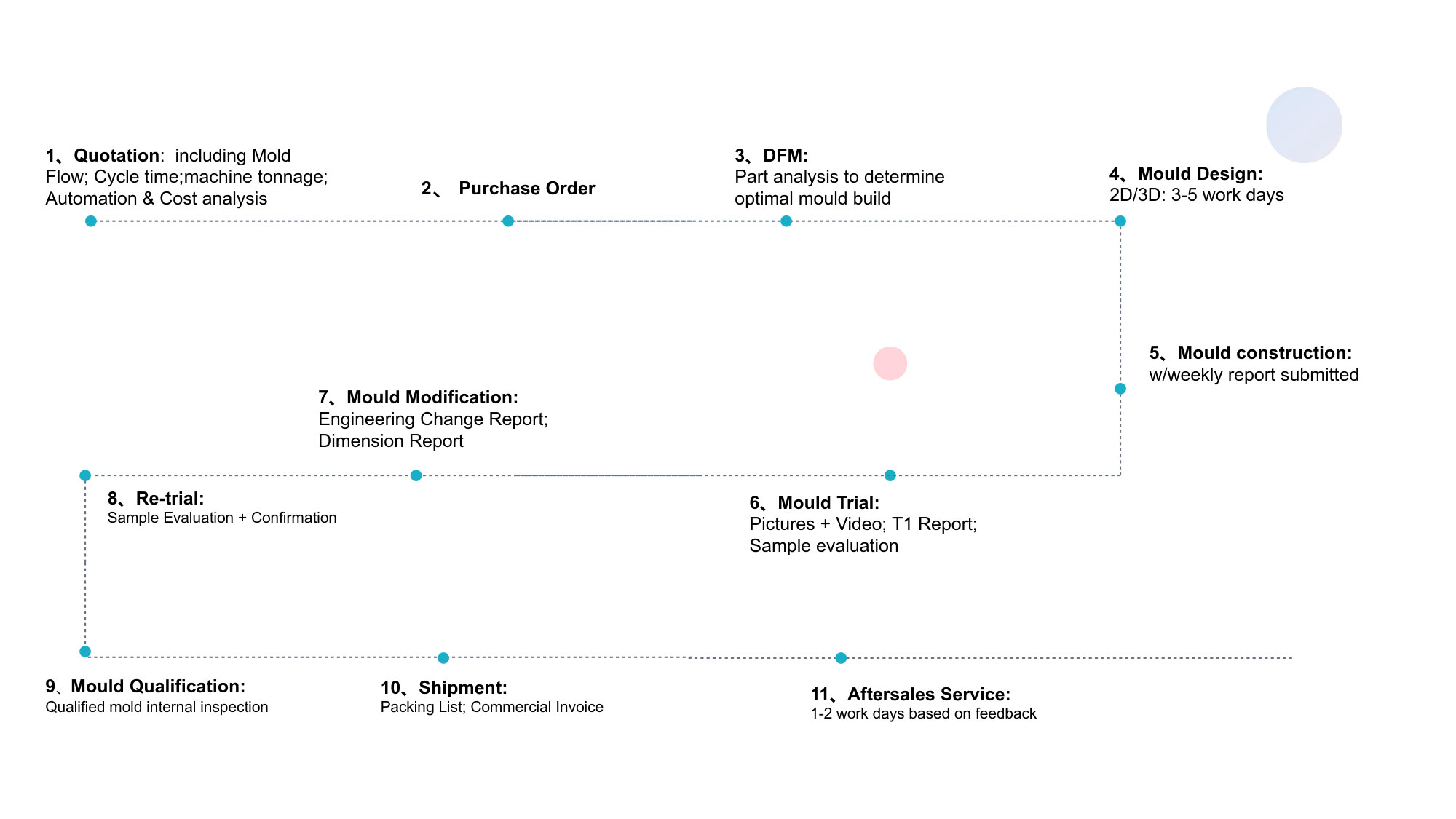
Mold making is not a transactional business—“design, build, deliver, good luck”—and Ansix Tech does not treat it as such. The company’s full-process service model reduces the customer’s management burden and eliminates coordination costs that typically arise when multiple vendors handle design, tooling, processing, and validation.
4.1 Early Engagement and DFM Reports — Solving Problems Before They Exist
The most expensive problem is the one discovered after steel is cut. Ansix Tech’s Design for Manufacturability (DFM) process engages before tooling begins.
Before signing any contract , Ansix provides a comprehensive DFM report covering:
Draft angle recommendations — Ensuring parts release from the mold without sticking or galling; insufficient draft on thin walls causes deformation during ejection
Wall thickness optimization — Identifying thick sections that will cause sink marks or internal voids; recommending transition zones that maintain strength while reducing material usage
Gate location options — Predicting weld line formation and recommending gate positions that place weld lines in non-stress regions
Ejector pin mark allowances — Agreeing on ejector pin location and mark tolerances before the mold is built, eliminating surprise defects during trialing
Customer value: A DFM review that identifies and resolves five manufacturability issues before tooling manufacturing saves weeks of trial cycles, thousands of dollars in engineering rework, and months of project delay. One customer documented a 40% reduction in tooling iterations following implementation of Ansix’s DFM process.
4.2 Trial Molding and Ramp-Up — Validation Without Surprises
Ansix Tech follows a structured trial process:
T0 (Tool Trial) — First physical test of the complete mold. Check for proper ejection, gate vestige, runner puller function, cooling circuit validation, and safe mechanical operation. This typically requires only a few hundred shots.
T1 through T3 — Optimization rounds addressing dimensional nonconformities, cosmetic defects, and cycle time opportunities. Each round produces sample parts and a written improvement report documenting what changed and why.
Quick-Change Insert Capability — By designing interchangeable inserts for core features or gate configurations, Ansix can trial multiple design variations without building separate molds. This compressed iteration allows 2-3 concept evaluations in the time normally required for one steel modification.
Customer value: Structured trial processes deliver predictable project timelines. A customer can plan regulatory submissions, packaging procurement, and distribution logistics around a known launch date—not a moving target.
4.3 Low-Volume Pilot Production — De-Risk Before Ramping
Skipping from trialing directly to full-volume production invites disaster. Ansix Tech offers a low-volume pilot production phase: 100 to 500 shots of production-representative parts, statistically sampled and analyzed.
Pilot production data includes:
Yield calculation — Conforming parts versus total production
Cpk values — Process capability indices for all critical dimensions
Appearance pass/fail rates — Measured against customer-supplied standards
Only when the data confirm a stable, capable process does Ansix transition to full production.
Customer value: A pilot run that reveals a 3% yield shortfall hurts a lot less than a million-piece batch with the same 3% shortfall. Pilot production protects customers from costly surprises.
4.4 Tooling Maintenance and Spare Parts — Keeping Production Running
A mold that runs indefinitely without maintenance does not exist—but a mold with a designed maintenance plan comes close.
Ansix Tech provides:
Spare parts kit — Critical wear components (ejector pins, core pins, gate inserts) included with mold delivery, regionally warehoused when volume justifies
Scheduled preventive maintenance — Cleaning, lubrication, wear inspection, and component replacement at 200,000-cycle intervals
Lifetime repair service — At documented repair cost (no profit markup) for reasonable repairs not caused by customer damage or abuse
24-hour emergency response — Critical repairs supporting customers whose production cannot pause for extended periods
Customer value: A mold maintenance plan is not an upsell—it is a production assurance guarantee. The customer does not worry about “when will the mold fail?” because the answer is documented: “Here is the planned maintenance schedule, here are the spare parts, and here is the response procedure.”
Section 5: Customer Value Framework — Addressing Industry Pain Points Directly
Rather than simply listing capabilities, Ansix Tech structures its value proposition around the specific concerns that medical device OEMs raise most frequently. Below is a direct mapping of industry pain points to Ansix Tech solutions:
Common Complaint Typical Industry Problem Ansix Tech’s Response Measurable Impact
Molds require frequent repairs Unexpected tool failure halts production; replacement tooling takes weeks 2,000-cycle pre-delivery aging test with wear report; three-year structural warranty (excluding normal-wear consumables) Predictable repair intervals; no surprise production stops
Excessive flash drives secondary cleanup costs Deburring and deflashing add labor costs and risk damaging thin walls 0.005 mm parting line fit tolerance; self-locking clamp force compensation keeps flash under 0.03 mm throughout production Eliminates manual deflashing; reduces per-part handling
Dimensions drift between batches First batch assembles perfectly; second batch requires fixture adjustment Ultrasonic in-mold wall thickness sensors + automatic packing pressure compensation + MES-locked parameters Dimensionally consistent across production runs spanning months
Mold repair lead times disrupt schedules External repair shops add shipping, inspection, and scheduling delays In-house electrode manufacturing center and EDM workshop; typical repairs (spot welding, insert replacement) within 24 hours Minimizes downtime impact on customer production schedules
LCP processing is equipment-intensive and failure-prone Standard injection molding equipment cannot handle LCP’s narrow temperature window Dedicated high-temperature LCP molding equipment with precision temperature control; documented and validated processing parameters Reliable first-pass yields; reduced trial-and-error expense
A closing perspective: For Ansix Tech, a mold is not a piece of steel—it is a production machine. Every mold design incorporates resin rheology planning, venting strategy, thermal balance optimization, and use-phase maintainability. When a mold reaches the customer’s production floor, it arrives ready to run—no extended process development, no trial-and-error parameter hunting, just measured, documented, repeatable production.
The company invites prospective customers to experience this approach firsthand by selecting an existing product for a full DFM report walk-through—visualizing how weld lines, gas traps, and sink marks are identified and resolved before tooling proceeds, translating engineering precision directly into time-to-market velocity and total cost control.
Ansix Tech Co Ltd
If you have any plans related to Thin-Walled Stapler Cartridge LCP Injection Molding , you can contact us at any time. We will turn your ideas into reality, let you realize your dreams, and obtain large orders from the market. Our contact information is info@ansixtech.com. Or contact our CTO, mail: stephen@ansixtech.com
#www.ansixtech.com #ansixtech.com #Thin-Walled Stapler Cartridge LCP Injection Molding #Thin-Walled Stapler Cartridge LCP Injection Molding moulds #Thin-Walled Stapler Cartridge LCP Injection Molding molds #Thin-Walled Stapler Cartridge LCP Injection Molding injection molding companies #Thin-Walled Stapler Cartridge LCP Injection Molding Canopy Mold injection mold companies #Ansix #Ansix moulds #Ansix china #Ansix tech china #Ansix tech company #Ansix facotry #Thin-Walled Stapler Cartridge LCP Injection Molding injection molding #Thin-Walled Stapler Cartridge LCP Injection Molding injection tools #Thin-Walled Stapler Cartridge LCP Injection Molding injection moulds #Thin-Walled Stapler Cartridge LCP Injection Molding plastic mould #Thin-Walled Stapler Cartridge LCP Injection Molding plastic tools #Ansix Tech #Ansix molds #Ansix injection molding #Ansix mold factory #injection molding Thin-Walled Stapler Cartridge LCP Injection Molding #Ansix mold factory #Thin-Walled Stapler Cartridge LCP Injection Molding china #Thin-Walled Stapler Cartridge LCP Injection Molding molds #injection factory #Thin-Walled Stapler Cartridge LCP Injection Molding injection molding #Thin-Walled Stapler Cartridge LCP Injection Molding injection molding factory #injection molding company #Thin-Walled Stapler Cartridge LCP Injection Molding injection mold companies #Thin-Walled Stapler Cartridge LCP Injection Molding#Thin-Walled Stapler Cartridge LCP Injection Molding mold limited #Ansix mold china #Ansix companies #Ansix company China #Thin-Walled Stapler Cartridge LCP Injection Molding facotry #Ansix Tech #Ansix Tech mould #Thin-Walled Stapler Cartridge LCP Injection Molding injection moulding #injection moulding company #Ansix Thin-Walled Stapler Cartridge LCP Injection Molding parts injection mold companies #medical injection molding companieschina #Thin-Walled Stapler Cartridge LCP Injection Molding china factory #Ansix moulding companies #Ansix molding company #Thin-Walled Stapler Cartridge LCP Injection Molding injection moulding facotry #Ansix Tech mold #Thin-Walled Stapler Cartridge LCP Injection Molding mould #Thin-Walled Stapler Cartridge LCP Injection Molding plastic injection molding #ansix plastic mold #Mold manufacturing #Thin-Walled Stapler Cartridge LCP Injection Molding parts manufacturing #Thin-Walled Stapler Cartridge LCP Injection Molding plastic parts factory #Thin-Walled Stapler Cartridge LCP Injection Molding injection parts mold #Thin-Walled Stapler Cartridge LCP Injection Molding PRECISION MANUFACTURING #Thin-Walled Stapler Cartridge LCP Injection Molding #China mold #Thin-Walled Stapler Cartridge LCP Injection Molding injection moulding china #Thin-Walled Stapler Cartridge LCP Injection Molding mould china #china precision mold #mold in china #Thin-Walled Stapler Cartridge LCP Injection Molding mold china #Precision molds #High-precision molds #Thin-Walled Stapler Cartridge LCP Injection Molding #Injection molds #Thin-Walled Stapler Cartridge LCP Injection Molding Factory #Thin-Walled Stapler Cartridge LCP Injection Molding Company #Super Large Injection Mold Factory #Large Tonnage Injection Molding Factory #Thin-Walled Stapler Cartridge LCP Injection Molding Company #Thin-Walled Stapler Cartridge LCP Injection Molding Factory #2800T Injection Molding Factory #3000 Ton Injection Molding #4500 Ton Injection Molding Factory #Large Mold Injection Molding #Large Plastic Mold Injection Molding Factory #Large Injection Mold Manufacturer #Plastic Mold Factory #Injection Mold #Plastic Mold